Cleaning
Master sanitation schedule: building one, running it, and proving it happened
A master sanitation schedule (MSS) is a written, facility-wide plan listing every cleaning task in a food plant that falls outside the daily sanitation shift, with how often each is done, the method it follows and who is responsible.
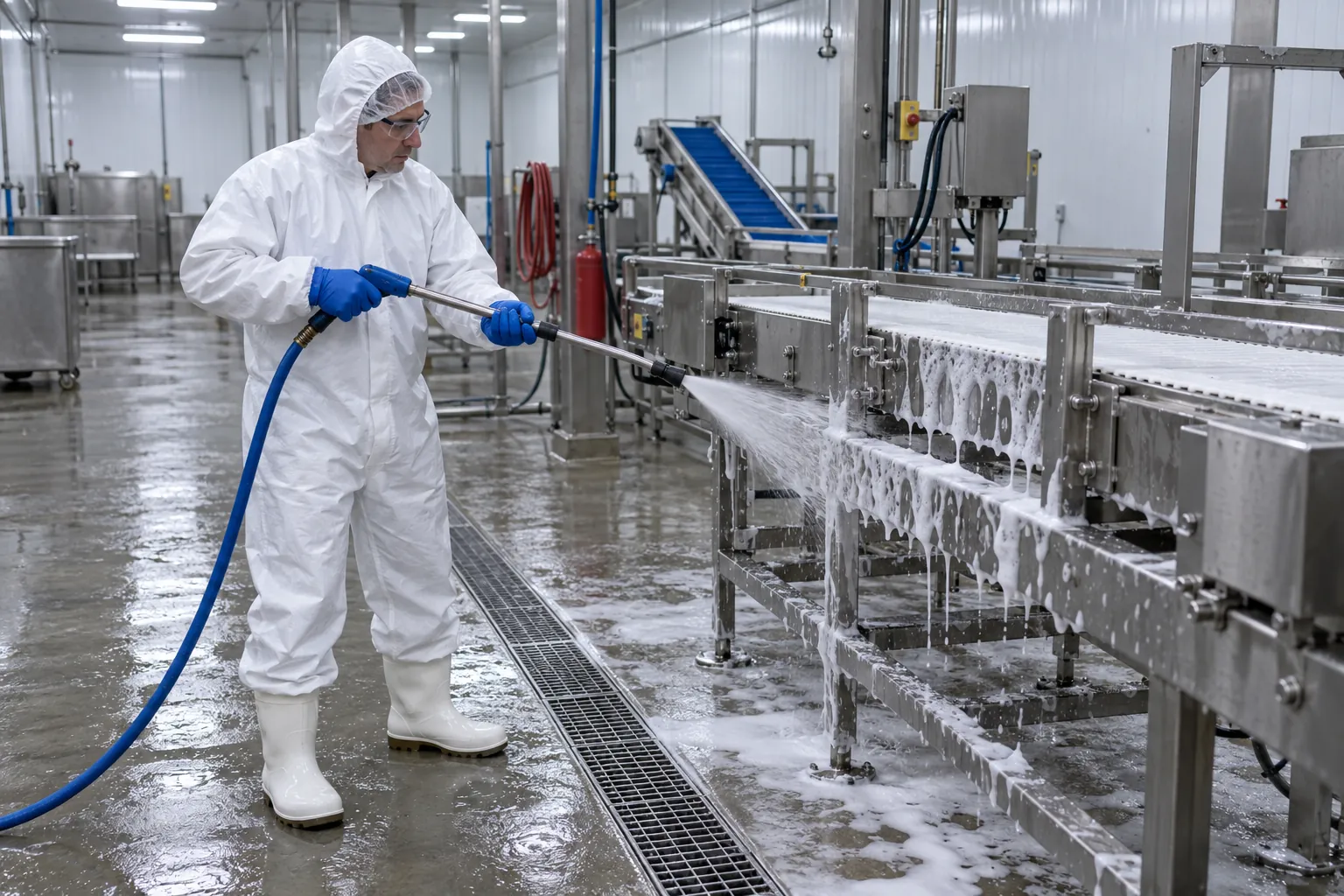
It covers the overheads, the drains, the cooler and freezer coils, the spiral freezer, the dock and the roof, and it is how a plant makes sure the jobs done once a week, once a month or once a year actually get done, by someone named, and signed off. This guide covers where the schedule sits in the federal rules, what goes on it, how to set frequencies, who owns each task, and how to keep a record that shows what really happened.
01
What a master sanitation schedule is, and where the rules come from
A master sanitation schedule (MSS) is a written plan of the cleaning tasks in a food facility that fall outside the routine daily sanitation of production equipment. Each line names the area or piece of equipment, the task, how often it is done, the method or procedure it follows, and who is responsible. Daily cleaning of food-contact surfaces usually lives in the sanitation standard operating procedures (SSOPs) and the pre-op checks; the MSS is where the periodic work lives, so that a job scheduled for every six weeks is not quietly forgotten in week seven.
No federal regulation uses the phrase "master sanitation schedule". It is an industry tool. What the regulations set is the outcome the schedule exists to deliver. For facilities that manufacture, process, pack or hold human food under FDA jurisdiction, 21 CFR 117.35, Sanitary operations requires that "Buildings, fixtures, and other physical facilities of the plant must be maintained in a clean and sanitary condition", that food-contact surfaces "must be cleaned as frequently as necessary to protect against allergen cross-contact and against contamination of food", and that non-food-contact surfaces of equipment be cleaned "in a manner and as frequently as necessary" to protect food. It also covers cleaning chemicals and pest control.
Part 117 is the current good manufacturing practice (CGMP) and preventive controls rule issued under the Food Safety Modernization Act (FSMA). FDA's page on the FSMA Final Rule for Preventive Controls for Human Food explains that, generally, facilities required to register with FDA under section 415 of the Federal Food, Drug, and Cosmetic Act must comply. Where the hazard analysis identifies a hazard such as an environmental pathogen, 21 CFR 117.135 makes sanitation a preventive control: procedures "to ensure that the facility is maintained in a sanitary condition adequate to significantly minimize or prevent hazards such as environmental pathogens, biological hazards due to employee handling, and food allergen hazards". 21 CFR 117.80 adds that "Overall sanitation of the plant must be under the supervision of one or more competent individuals assigned responsibility for this function."
Meat, poultry and egg product plants inspected by USDA's Food Safety and Inspection Service (FSIS) work under 9 CFR Part 416, Sanitation. Section 416.4 requires food-contact and non-food-contact surfaces to be "cleaned and sanitized as frequently as necessary to prevent the creation of insanitary conditions and the adulteration of product". Sections 416.11 to 416.17 set out the Sanitation SOPs: written procedures for what is done "daily, before and during operations", signed and dated by the individual with overall authority on site or a higher-level official, when first implemented and on any change, specifying "the frequency with which each procedure in the Sanitation SOP's is to be conducted" and the employees responsible. A master sanitation schedule sits beside the Sanitation SOPs and covers the periodic work around them.
Restaurants, grocery stores and other retail food establishments are regulated by their state or local health department, most of which base their rules on the FDA Food Code 2022 or an earlier edition. FDA describes it as "a model" offered for adoption by local, state and federal jurisdictions, so the version in force depends on where the kitchen is.
02
What goes on a master sanitation schedule
The best schedules are built by walking the entire plant, room by room, from the roof and overheads down to the floor and drains, and writing down everything that needs cleaning that the daily sanitation crew does not clean every night. A typical food plant MSS covers:
- Overheads and structure: ceilings, overhead pipes and conduit, cable trays, light fixtures, beams and ledges above exposed product, where dust and condensation collect.
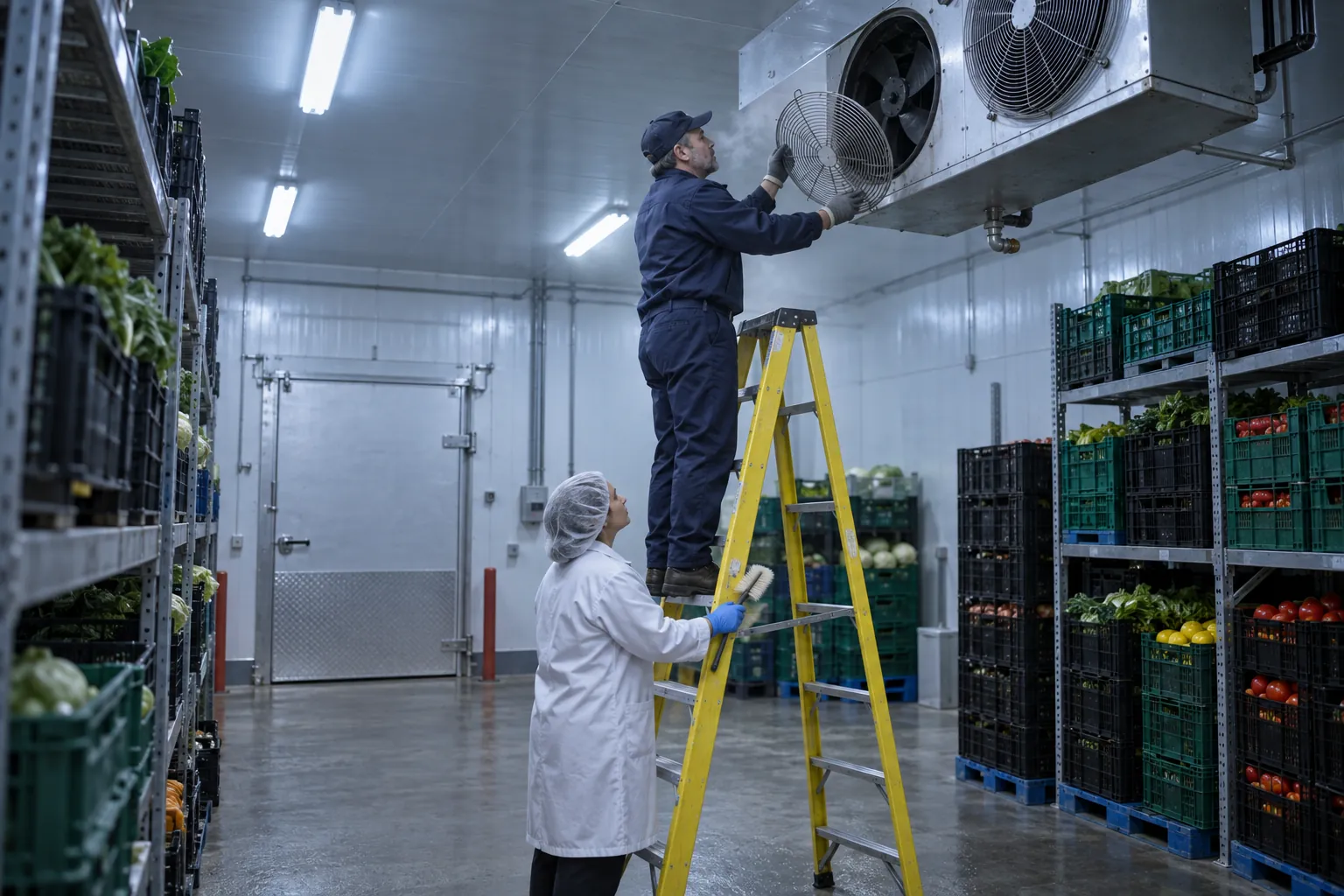
- Refrigeration and air handling: cooler and freezer evaporator coils and drip pans, fan guards, condensate lines, air handling units, filters and ductwork diffusers.
- Drains and floors: floor drains, drain covers and baskets, trench drains, curbs, cove base and floor-wall junctions, plus periodic floor scrubbing or stripping outside production rooms.
- Equipment teardown: parts of production equipment that are not broken down every day, such as spiral freezer belts and frames, oven interiors, conveyor frames, motor housings and the undersides of machines.
- Walls, doors and fittings: walls, doors, strip curtains, handwash sinks, footbaths and hose stations.
- Support areas: loading docks, dumpster pads, pallet storage, maintenance shops, chemical rooms, locker rooms, restrooms and break rooms.
- Outside the building: roof areas around air intakes and exhausts, and grounds where pests find cover.
- Cleaning equipment itself: floor scrubbers, hoses, foamers, brushes and squeegees.
For each line the schedule needs the same six things: the area or equipment, the task (for example, "remove fan guards, foam, rinse, sanitize coil face and drip pan"), the frequency, the procedure it follows (a sanitation standard operating procedure or work instruction, with the chemical, concentration and contact time), any lockout or other safety requirement, and the role responsible, whether the sanitation crew, maintenance, a contract sanitation company or a specialist such as a duct or coil cleaning vendor.
Keep the schedule and the procedures separate. The schedule says what, where, when and who; the procedure says how.
03
Setting the frequency of each task
The regulations deliberately do not set frequencies. Section 117.35 and 9 CFR 416.4 both say "as frequently as necessary", which puts the decision on the plant and makes it the plant's job to justify. Frequencies that hold up usually come from:
- Risk to product. Anything above exposed ready-to-eat product, or close to food-contact surfaces, is cleaned more often than a dry warehouse wall. Many plants group areas by the zones of their environmental monitoring program, from zone 1 food-contact surfaces outward, and set the tightest cleaning frequencies nearest the product.
- Soil load and conditions. Wet, cold and high-humidity rooms, flour and powder handling, and fryers and ovens build up residue faster. Condensation on overheads is a reason to clean more often, and a reason to fix the cause.
- Allergens. Where a line runs more than one allergen profile, the cleaning between runs is usually part of the allergen controls, and the periodic deep clean has to reach the places allergen dust settles.
- Equipment manufacturers' instructions for teardown, parts and chemicals.
- Evidence from the plant itself. Pre-op findings, swab results and pest sightings show whether a frequency is working. If a drain keeps failing pre-op, weekly is not often enough.
- Production windows. A quarterly task needs a scheduled shutdown. Put the downtime on the production calendar when the schedule is written.
Write each frequency as something that can be checked, such as "weekly, by Sunday third shift" or "monthly, in the first planned shutdown", rather than "as needed", which means nobody decides.
Review the frequencies whenever something changes: a new line, product, allergen, room, chemical or contractor, or a trend in the results. Under 9 CFR 416.14 an FSIS establishment must routinely evaluate the effectiveness of its Sanitation SOPs and revise them "as necessary to keep them effective and current with respect to changes in facilities, equipment, utensils, operations, or personnel"; the same discipline suits the master sanitation schedule in any plant.
04
Who does what: sanitation crew, maintenance, supervisors and contractors
A master sanitation schedule only works if every line has an owner and the whole team knows who it is. In most plants the work is split between:
- The sanitation manager or supervisor, who owns the schedule, plans the week's periodic tasks around production, assigns them, and signs off that they were completed and inspected.
- The sanitation crew, usually on third shift, who do most of the tasks and record what they did.
- Maintenance, who remove guards, isolate equipment and put it back together.
- Quality assurance, who inspect after cleaning, run pre-op and swab programs, and review the records.
- Contract sanitation companies and specialist vendors, who may run the night shift or take jobs such as duct or hood cleaning. The plant still owns the outcome.
Safety belongs on the schedule, not only in the safety manual. Federal OSHA's lockout/tagout standard, 29 CFR 1910.147, The control of hazardous energy, defines servicing and maintenance to include "lubrication, cleaning or unjamming of machines or equipment" where an employee may be exposed to unexpected energization or release of stored energy. OSHA's page on the control of hazardous energy sets out what the standard requires. A periodic task that means reaching inside a machine or removing a guard should name the lockout procedure it follows. Check which rules apply in your state: OSHA's State Plans page notes that there are currently 22 State Plans covering both private sector and state and local government workers, and seven covering only state and local government workers, and a state plan can set its own requirements.
The people doing the work need to be trained for it. Section 117.80 requires the competent supervision of overall plant sanitation, and 21 CFR 117.4 requires everyone who manufactures, processes, packs or holds food, including temporary and seasonal personnel, to be qualified for their assigned duties and trained in food hygiene and food safety.
05
What a good completion record looks like, and how it is verified
The schedule is the plan; the completion record shows the plan happened: which task, where, when, by whom, and whether it passed inspection. A task that could not be done should be recorded as not done, with the reason and a new date, not left blank.
Where records are required, the rules are specific about their quality. For records required by part 117, such as monitoring, corrective action and verification records under a food safety plan, 21 CFR 117.305 says records must "Be created concurrently with performance of the activity documented", be "accurate, indelible, and legible", and include the date and, when appropriate, the time of the activity and "The signature or initials of the person performing the activity". Records required by part 117 must be kept for at least two years under 21 CFR 117.315. For FSIS establishments, 9 CFR 416.16 requires "daily records sufficient to document the implementation and monitoring of the Sanitation SOP's and any corrective actions taken", authenticated with the responsible employee's initials and the date, kept for at least six months, and allows them to be kept on computers "provided the establishment implements appropriate controls to ensure the integrity of the electronic data".
Whether your MSS completion records are themselves required records depends on the plant: a task that forms part of a written preventive control or of the Sanitation SOPs carries those duties with it.
Verification closes the loop. Under 21 CFR 117.165 a facility with sanitation preventive controls must verify that they are "consistently implemented and are effectively and significantly minimizing or preventing the hazards", which can include environmental monitoring and review of records. In practice, verification of the master sanitation schedule usually means:
- a supervisor or QA inspection of each periodic task before the area goes back into production;
- ATP or microbial swabs on selected surfaces after the deep clean;
- a weekly review of the schedule against the records to track tasks overdue, skipped or repeatedly deferred;
- a trend of pre-op failures, swab results and pest sightings by area;
- corrective action or correction recorded when a periodic task fails inspection or is found not done: for preventive controls, 21 CFR 117.150 requires both to be documented (for sanitation controls, a timely correction can stand in for the written corrective action procedures), and 9 CFR 416.15 requires corrective action for Sanitation SOPs.
06
Where the record fails, and what SiteClara does about it
Most master sanitation schedules fail in the record rather than in the plan. The schedule is a well-built spreadsheet; the completion record is a clipboard in the sanitation office, initialed at the end of the shift for every task on the week's list, or a column of check marks filled in before the audit. It cannot show when a task was actually done, who did it, or that the coil clean was pushed three times, so when a swab fails nobody can say when the area was last cleaned.
SiteClara records the periodic checks at the location. A printed QR poster, with an optional NFC tag behind it, sits at each area or piece of equipment on the schedule. Crew members scan or tap on their own phone, with no app to install, see the tasks due there, and mark each one done or say what stopped them. The time and the named person are recorded as it happens, with a photo when the task asks for one, and a problem someone finds, such as a damaged drain cover or a coil that needs maintenance, goes onto the team's list of jobs until it is closed.
The supervisor sees what is due, done and missed across the shift, and records the reason a task was missed. Each day they review it, add a note and approve a report that goes to the plant's designated contacts the next morning, 8:00 by default, showing what was completed, what was not, and what is still open. For a contract sanitation company, the same record shows the plant what its crew did on each shift.
07
Questions people ask
What is the main purpose of a master sanitation schedule?
It makes sure the periodic cleaning a plant needs actually gets done, by a named person, on a set date. That serves the outcome federal rules require: 21 CFR 117.35, Sanitary operations says buildings, fixtures and other physical facilities "must be maintained in a clean and sanitary condition", and that non-food-contact surfaces of equipment be cleaned "as frequently as necessary" to protect against allergen cross-contact and contamination.
What should be included in a master sanitation schedule?
No federal rule prescribes its contents, but the Sanitation SOP rules for USDA-inspected plants set a useful minimum: 9 CFR 416.12 says the procedures "shall specify the frequency with which each procedure" is conducted and identify the employees responsible. Most schedules also name the area or equipment, the task, the procedure followed and any lockout requirement.
When should a master sanitation schedule be updated?
Whenever the plant changes and whenever the results show a task is not working. For Sanitation SOPs, 9 CFR 416.14 requires routine evaluation and revision "as necessary to keep them effective and current with respect to changes in facilities, equipment, utensils, operations, or personnel", and the same triggers suit a master sanitation schedule.
08
Further reading, and a list to take away
For FDA-regulated facilities, read 21 CFR 117.35 for the sanitary operations requirement and FDA's page on the FSMA Final Rule for Preventive Controls for Human Food for who the rule covers. For USDA-inspected meat, poultry and egg product plants, read 9 CFR Part 416, which holds both the sanitation performance standards and the Sanitation SOP requirements. For restaurants and retail, start with your state or local health department's adopted version of the FDA Food Code. For worker safety during cleaning, read 29 CFR 1910.147 and check whether your state runs an OSHA-approved State Plan.
Before you sign off a master sanitation schedule, run through this checklist:
- it was built by walking the plant, from overheads to drains and outside;
- every line names the area, task, frequency, procedure, safety requirement and responsible role;
- no line says "as needed";
- frequencies are tighter nearest exposed product and are backed by inspection and swab results;
- long jobs are booked into planned downtime on the production calendar;
- tasks inside machines name the lockout procedure;
- the completion record shows the date, time and person for each task, recorded when it was done;
- a missed or deferred task is recorded with a reason and a new date;
- someone reviews the schedule against the record every week and acts on overdue tasks;
- the schedule is reviewed whenever the plant, products, chemicals or contractors change.
Sources
Every document this guide quotes or links to, in the order it first cites them.
- 21 CFR 117.35, Sanitary operations govinfo.gov
- FSMA Final Rule for Preventive Controls for Human Food fda.gov
- 21 CFR 117.135 govinfo.gov
- 21 CFR 117.80 govinfo.gov
- 9 CFR Part 416, Sanitation govinfo.gov
- FDA Food Code 2022 fda.gov
- 29 CFR 1910.147, The control of hazardous energy govinfo.gov
- Control of hazardous energy osha.gov
- State Plans page osha.gov
- 21 CFR 117.305 govinfo.gov
- 21 CFR 117.165 govinfo.gov
- 21 CFR 117.150 govinfo.gov
Related guides
 CleaningATP testing: what the reading tells you, and how to run a program that means somethingHow ATP testing works, what a reading in RLU does and does not tell you, what the CDC says about using it, and how to run and record an ATP program that holds up.
 CleaningCleaning log sheet: what to record, who initials it, and what it provesWhat a cleaning log sheet should record in offices, break rooms, kitchens and clinics, the OSHA and Food Code rules behind it, and what each set of initials proves.
 CleaningChemical dilution control: getting the mix right, every bottle, every shiftHow a chemical dilution control system works, what OSHA HazCom and EPA labels require, how to check dispensers and bottles, and what the record should show.
 CleaningColor-coded cleaning: keeping the restroom cloth out of the break roomHow a color-coded cleaning system works: choosing zones and colors, writing the chart, keeping cloths and mops apart in practice, and checking the system holds.