Premises and facilities management
Operating room temperature and humidity log: the requirements, and a record that holds up
Operating room humidity requirements in the United States come from CMS guidance and the ventilation standard it points to, ANSI/ASHRAE/ASHE Standard 170: relative humidity in an operating room may go as low as 20 percent and typically no higher than 60 percent, and CMS expects the hospital to keep records showing it stays there.
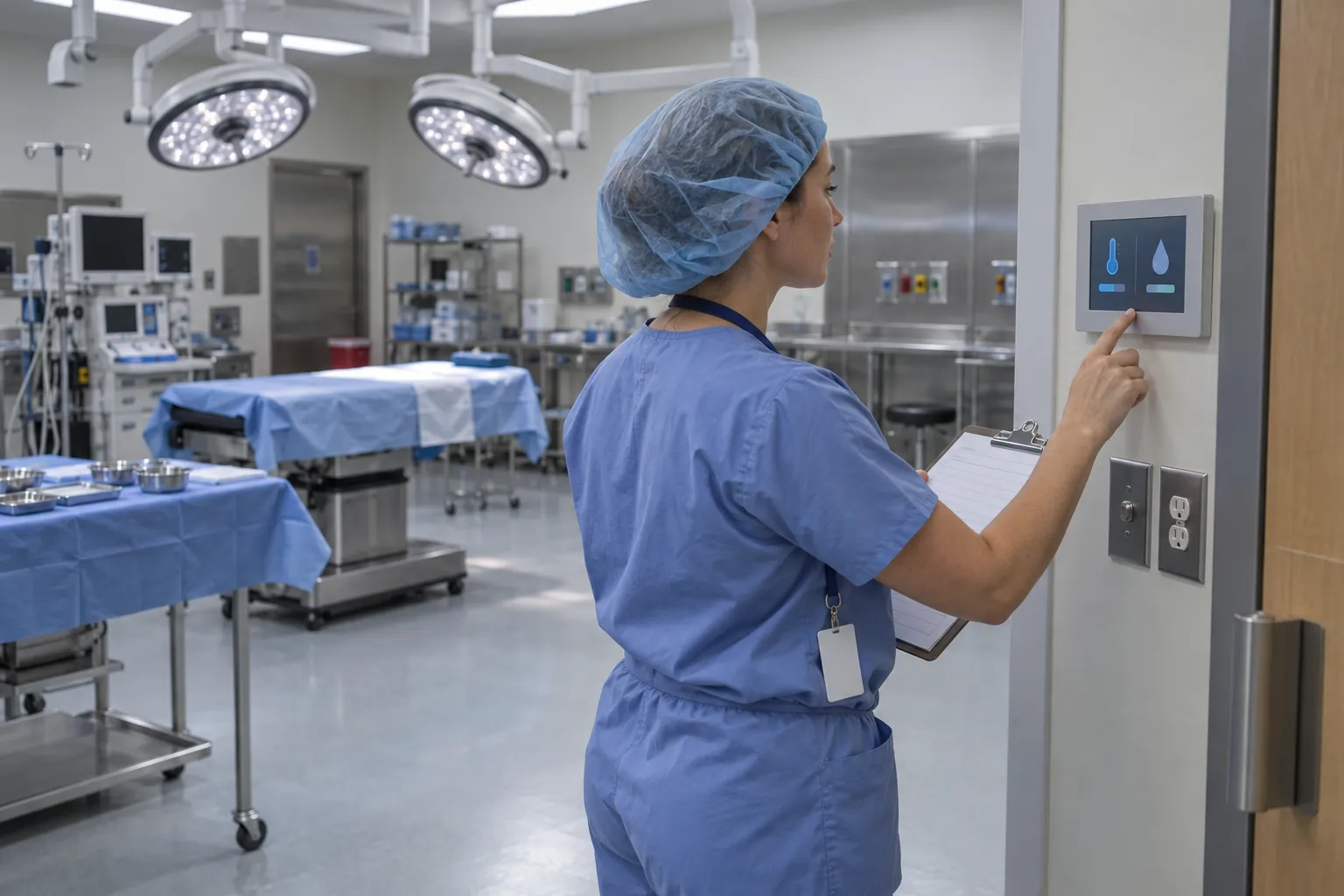
CMS tells its surveyors to review the temperature, humidity and airflow records for operating rooms, and that record is usually a log. Relative humidity and temperature in each OR have to stay within an accepted range, and when they drift out, someone has to notice, act and write down what they did. This guide covers where the ranges come from, which rooms to log, how often, what a good entry looks like, and what to do when a reading is out of range.
01
Operating room humidity requirements: where they come from
There is no single federal rule that says "operating room humidity must be X." The requirement is layered: a Medicare condition of participation, the guidance surveyors work from, the codes CMS has adopted, and the ventilation standard they point to.
The condition of participation. For hospitals that take Medicare and Medicaid, 42 CFR 482.41, Condition of participation: Physical environment, says in paragraph (d)(4): "There must be proper ventilation, light, and temperature controls in pharmaceutical, food preparation, and other appropriate areas." Paragraph (c) of the same section requires hospitals to meet the Health Care Facilities Code, NFPA 99, in the 2012 edition CMS adopted.
The surveyor's guidance. The State Operations Manual, Appendix A: Survey Protocol, Regulations and Interpretive Guidelines for Hospitals (Rev. 248, issued September 18, 2026) spells out what "proper" means under tag A-0726. It lists operating rooms among the areas that must have proper ventilation, and says: "Temperature, humidity and airflow must be maintained within acceptable standards to inhibit microbial growth, reduce risk of infection, control odor, and promote patient comfort." It goes on: "Hospitals must maintain records that demonstrate they are maintaining the required temperature, humidity, and airflow levels." That sentence is why the log exists.
The ranges. The same guidance says that in operating rooms and associated ancillary rooms, "ventilation standards may permit the reduction of relative humidity levels as low as 20%," and that ventilation standards "typically require hospital operating rooms to maintain the upper range of RH at 60 percent or less." The standard behind those numbers is ANSI/ASHRAE/ASHE Standard 170, Ventilation of Health Care Facilities. The 2012 edition of NFPA 99 adopted the 2008 edition of Standard 170, and Addendum D of that edition set relative humidity in anesthetizing locations at 20 to 60 percent. Standard 170 also sets the design temperature range, air change rates and pressure relationship for each room type, and has been revised since; read the edition your state and your authority having jurisdiction (AHJ) have adopted rather than a figure from an old handout.
The CDC design values. The CDC's Guidelines for Environmental Infection Control in Health-Care Facilities (2003), Appendix B: Air, Table B.2, lists operating rooms at positive pressure, at least 15 total air changes an hour, 30 to 60 percent relative humidity and a design temperature of 68 to 73°F. These are 2003 design values, the conditions a room's air handling systems were designed to hold, with a higher humidity floor than CMS now accepts: background, not the range to log against.
Ambulatory surgery centers. ASCs are not under 482.41, but State Operations Manual, Appendix L: Guidance for Surveyors: Ambulatory Surgical Centers says under 42 CFR 416.44(a)(1) that temperature, humidity and airflow in ORs must be maintained within acceptable standards and that "ASCs must maintain records that demonstrate they have maintained acceptable standards." It names Standard 170 as an example of an acceptable standard, with relative humidity "between 20 - 60 percent."
02
Which rooms to log, and what each entry records
CMS does not stop at the operating room. Appendix A refers to "operating rooms and associated ancillary rooms (e.g., pre-op, post-op, storage, sterilization, etc.)." Check your policy and your engineers' room schedule against this list:
- Each operating room, including hybrid ORs and cesarean section rooms;
- Procedure rooms where Standard 170 or your policy calls for controlled humidity;
- Sterile storage and the sterile core, where humidity affects packaging;
- Sterile processing, including decontamination and preparation and packaging;
- Pre-op and PACU, where your policy includes them;
- Satellite ORs operating under the hospital's license.
Each entry in the log should record, at a minimum:
- The room, named the way the building is named, not "OR" alone;
- The date and time of the reading;
- The temperature, in °F, and the relative humidity, as a percentage;
- The acceptable range for that room, printed on the form or shown beside the reading, so nobody has to remember it;
- Whether the reading is in range, a plain yes or no;
- Who took the reading, by name or initials that can be traced to a person;
- If it is out of range, what happened next: who was told, the work order number, what the case team decided, and when the room came back into range.
Some hospitals record room pressure on the same line, because Appendix A treats airflow alongside temperature and humidity. Whether it sits in the same log or in the building automation records is a local choice, provided both can be produced together.
03
How often to record, and who does it
No federal rule sets a frequency. CMS asks for records that show the levels are maintained and leaves the method to the hospital's policy. Most policies use one of three approaches, often combined:
- A daily reading before the first case, taken by the circulating nurse, the charge nurse or an OR assistant from the room's wall display or a handheld meter, entered on the log for that room. This is the most common approach and the one that catches a room that drifted overnight.
- A reading at the start of each case, where the policy wants a closer link between conditions and the procedure, or where a room is known to struggle.
- Continuous monitoring through the building automation system (BAS), which trends temperature and humidity for each room and can alarm to the engineering desk when a value leaves its band. Many hospitals keep a manual daily reading as well, because the BAS trend proves what the sensor saw, while the manual entry proves someone in the room looked and decided the case could go ahead.
The policy also needs to say who owns each part:
- Perioperative services takes and records the reading, and decides with the surgeon and anesthesia provider whether a case proceeds when a room is out of range;
- Facilities or the building engineer owns the air handling units, humidifiers and controls, responds, and records the repair on the work order;
- Infection prevention advises on out-of-range events and reviews the trend;
- Sterile processing checks manufacturers' instructions for use when storage has been out of range;
- The Environment of Care committee reviews the log and corrective actions on a set cycle.
Put the log where the reading is taken, with the range on it, and make the entry at the time and in the room.
04
When a reading is out of range
The log is judged less on the good days than on the bad ones. Appendix A tells surveyors to confirm that, where monitoring found levels outside acceptable parameters, "corrective actions were performed in a timely manner to achieve acceptable levels." A column of in-range readings with one "18%" and nothing written beside it is worse than no log at all, because it shows the problem was seen and not acted on.
A workable out-of-range routine, written into the policy and posted where the log is kept, looks like this:
- Re-check the reading, from a second instrument if one is available, to rule out a faulty display.
- Report it to facilities or the engineering desk straight away, and get a work order number.
- Tell the charge nurse and the case team, so the decision about whether the room is used is made by the people who own it, with infection prevention involved where the policy says so.
- Check sterile supplies. CMS says hospitals "must consider sterile supply and medical equipment manufacturer instructions for use regarding required humidity levels," and warns that failing to maintain them "may void sterile packaging and result in medical equipment malfunction or failure." Where storage has been out of range, sterile processing checks the instructions for what is affected.
- Record every step on the log or an attached event form: the time found, who was told, the work order, the decision, and the time the room was back in range, with a fresh reading to prove it.
- Close the loop. Facilities records the cause and the repair on the work order, and the Environment of Care committee sees it at the next review.
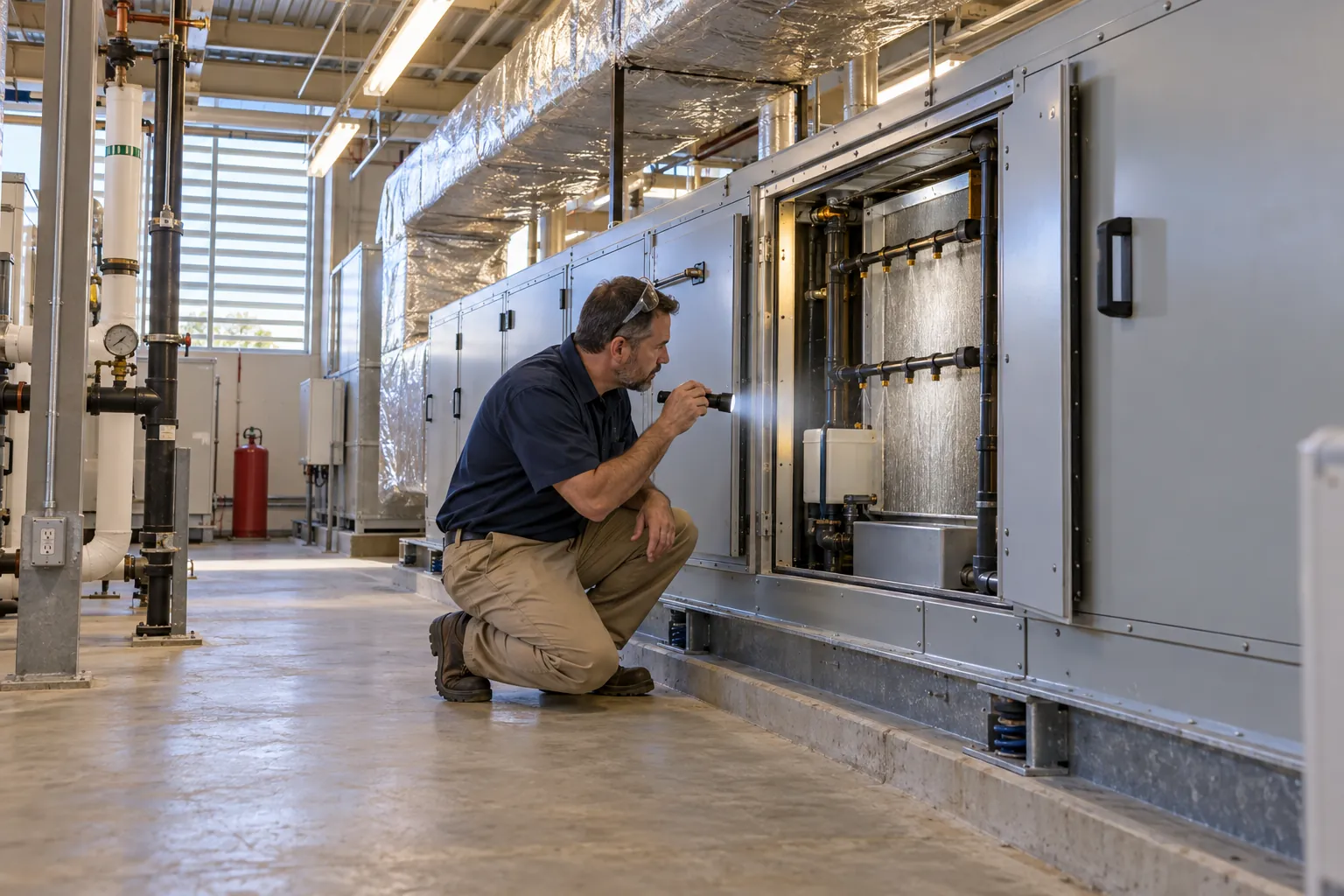
Low humidity is usually a winter problem: cold outdoor air holds little moisture, and a faulty or undersized humidifier cannot make it up. High humidity usually points to a cooling or dehumidification fault. A team asking for a colder room than the system is set to hold can push humidity up as the air cools. Each needs a different fix, which is why the entry needs the numbers, not just "out of range."
A room that reads 22, 21, 20 percent through a cold week is heading for a failure; a log that someone reads, not just fills in, catches it first.
05
What a surveyor looks for, and how the log fails
Surveyors work from the Appendix A survey procedures, which ask them to "review temperature, humidity and airflow maintenance records for operating rooms and associated ancillary rooms to ensure acceptable parameters are being maintained," and to confirm timely corrective action where they were not. For surgical services, the same appendix asks them to verify "that temperature and humidity are monitored and maintained within accepted standards of practice." Accrediting organizations survey the same ground under their own physical environment standards (The Joint Commission's Environment of Care chapter, for example). In practice, a survey-ready log shows:
- a reading for every room, on every day the policy requires one, with no gaps;
- the acceptable range for each room on the log, matching the policy and the room schedule;
- the name or traceable initials of whoever took each reading;
- every out-of-range reading with its corrective action, the work order, the decision and the recovery reading next to it;
- evidence that someone reviews the log, not just fills it in.
The ways OR temperature and humidity logs fail are familiar to anyone who has sat through a mock survey:
- Filled in ahead or after the fact. A week of identical readings in the same pen, or entries for a room that was closed that day.
- Out of range with nothing beside it. The reading was written down honestly, then nobody acted, or somebody acted and nobody wrote it down.
- No range on the form. The person taking the reading has to know that 19 percent is a problem, and at 6:30 a.m. they may not.
- Rooms missing. Sterile storage, a procedure room or a satellite OR that nobody thought was included.
- Two records that disagree. The paper log says 45 percent every morning while the BAS trend shows the room at 17 percent overnight.
06
Where the log fails, and what SiteClara does about it
Most of those failures come down to one thing: a paper log shows what was written, not when, by whom in the room, or what happened after an out-of-range reading. The call to facilities about a dry room is made by phone and never reaches the log.
SiteClara records checks at the place they happen. A printed QR code poster, with an optional NFC tag behind it, goes at each operating room, sterile storage room or other space on the log. The nurse or OR assistant scans the code or taps the tag on their own phone, with no app to install, sees the check set for that room, and marks it done or records what stopped them. The hospital decides what the check asks, such as the temperature and humidity shown on the room's display, and whether it wants a photo of the display. The named person and the time are recorded as it happens. A problem found on the way, such as a humidity reading below range or a display that is not working, can be reported there and then, and goes onto the team's list of open jobs until someone closes it.
The supervisor sees which rooms were checked, which were missed, and gives the reason when a check was missed. Each day they review the results and photos and approve a report that goes the next morning to nominated managers, such as the perioperative director or the facilities manager, showing what was reported, what was completed and what is still open, and how the scheduled checks went.
07
Questions people ask
What are the CMS operating room humidity requirements?
CMS does not print one number in the regulation. Its surveyor guidance for hospitals, the State Operations Manual, Appendix A under tag A-0726, says ventilation standards may permit relative humidity in operating rooms and associated ancillary rooms "as low as 20%" and typically require the upper range to be "60 percent or less." It also says hospitals "must maintain records that demonstrate they are maintaining the required temperature, humidity, and airflow levels," and that the hospital must consider sterile supply and equipment instructions for use before adjusting humidity levels.
What is the acceptable humidity level in surgery rooms at an ambulatory surgery center?
The State Operations Manual, Appendix L, the surveyor guidance for ambulatory surgical centers, gives ASHRAE Standard 170 as an example of an acceptable ventilation standard and says its Addendum D "requires relative humidity in ORs to be maintained between 20 - 60 percent." ASCs must keep records showing they have maintained acceptable standards.
What temperature and humidity should an operating room be kept at?
The CDC Guidelines for Environmental Infection Control in Health-Care Facilities, Appendix B: Air, Table B.2, lists operating rooms at a design temperature of 68 to 73°F and 30 to 60 percent relative humidity, and notes that humidity is expected at the higher end of its range when the temperature is also at the higher end. These are 2003 design values; CMS now accepts humidity down to 20 percent and names AORN or FGI as acceptable standards for OR temperature, so set each room's range from the edition of Standard 170 and the state rules that apply to you.
Is 70% humidity too high for an operating room?
Yes. The State Operations Manual, Appendix A says ventilation standards typically require hospital operating rooms to keep relative humidity at 60 percent or less, "as excessive humidity is conducive to microbial growth and again may compromise the integrity of supplies and medical equipment." A reading of 70 percent is out of range and needs the same re-check, report and record as a low one.
08
Further reading, and a list to take away
Start with the CMS interpretive guidance: the State Operations Manual, Appendix A for hospitals (tag A-0726 under 42 CFR 482.41(d)(4), and the surgical services survey procedures) and State Operations Manual, Appendix L for ambulatory surgery centers, with the regulation itself, 42 CFR 482.41, on the eCFR. ASHRAE lets you view Standard 170 (currently the 2025 and 2021 editions) online without buying it, through its Preview ASHRAE Standards and Guidelines page. The FGI Guidelines for Design and Construction and AORN's guidelines, which CMS names for OR temperature, are available to subscribers and members. Your state's hospital or ASC licensing rules may add their own requirements.
Before your next survey, check that:
- the policy names every room to be logged, including sterile storage, sterile processing and any satellite ORs;
- the ranges in the policy match the edition of Standard 170 and the state rules that apply to you, and each room's range is printed on its log;
- the policy says how often readings are taken, by whom, and from which instrument;
- every sensor and handheld meter is on the preventive maintenance schedule for calibration or verification;
- there is a written out-of-range routine, posted where the log is kept, covering re-check, report, decision, sterile supplies and the recovery reading;
- every out-of-range entry in the last year has its corrective action and work order beside it;
- the manual log and the BAS trend have been compared, and agree;
- someone reviews the log on a set cycle and the review is recorded.
Sources
Every document this guide quotes or links to, in the order it first cites them.
- 42 CFR 482.41, Condition of participation: Physical environment ecfr.gov
- State Operations Manual, Appendix A: Survey Protocol, Regulations and Interpretive Guidelines for Hospitals cms.gov
- S&C 13-25-LSC & ASC, Relative Humidity (RH): Waiver of Life Safety Code (LSC) Anesthetizing Location Requirements cms.gov
- Guidelines for Environmental Infection Control in Health-Care Facilities (2003), Appendix B: Air cdc.gov
- State Operations Manual, Appendix L: Guidance for Surveyors: Ambulatory Surgical Centers cms.gov
- Preview ASHRAE Standards and Guidelines ashrae.org
Related guides
 CleaningOperating room cleaning: turnover, terminal cleaning and the record behind themHow an operating room is cleaned before the first case, between cases and at the end of the day, the rules and guidelines behind it, and how to show it was done.
 Premises and facilities managementEnvironment of care rounds: walking the building, and proving the findings were fixedHow to run environment of care (EOC) rounds in a hospital in 2026: the CMS and Joint Commission basis, what a round covers, who goes and how findings get closed.
 Fire and water checksInterim life safety measures: keeping a healthcare building safe while its fire protection is compromisedWhat The Joint Commission's LS.01.02.01 asks of an ILSM policy, when a fire watch is required, and how to run and record the daily rounds behind the measures.
 Premises and facilities managementIndoor air quality checks in schools and other buildings: what to check, how often, and what to recordIndoor air quality checks for schools and other buildings: what to check, how often, who does it, and what EPA, OSHA and state rules expect of the record.