Premises and facilities management
OSHA bathroom requirements: how many toilets, who may use them, and how they are kept
OSHA's bathroom requirements, in 29 CFR 1910.141(c), require a general industry employer to provide toilets for each sex in the numbers set by Table J-1 (one water closet for 1 to 15 employees, rising to six for 111 to 150 and one more for each additional 40), to keep them sanitary, and to let employees use them when they need to.
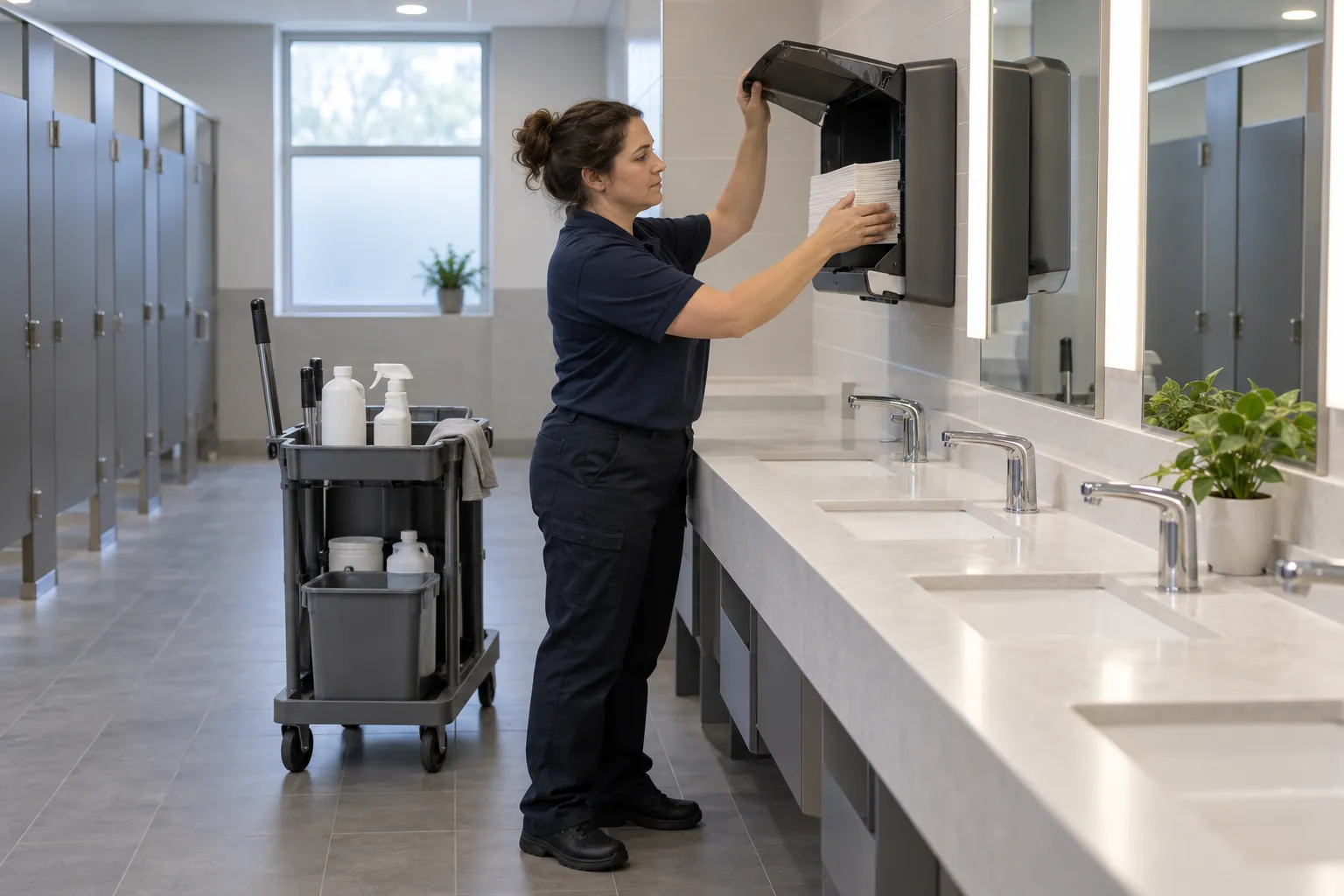
The standard is short, and most of what employers get wrong is not in its table at all: a restroom kept locked, a supervisor who must approve every break, soap that ran out on Monday, a building whose fixture count was set by the plumbing code for a different use. This guide sets out what the federal standard and OSHA's interpretations say, how the building code count sits beside it, where some states go further, and how a facility keeps restrooms provided, open and supplied in practice.
01
What OSHA requires: the sanitation standard
OSHA's restroom rules for most workplaces are in 29 CFR 1910.141, the general industry sanitation standard. Paragraph (c)(1)(i) is the core of it: "toilet facilities, in toilet rooms separate for each sex, shall be provided in all places of employment in accordance with table J-1 of this section. The number of facilities to be provided for each sex shall be based on the number of employees of that sex for whom the facilities are furnished."
The standard defines a toilet room as "a room maintained within or on the premises of any place of employment, containing toilet facilities for use by employees." The rest of the section adds:
- Single-occupancy rooms. "Where toilet rooms will be occupied by no more than one person at a time, can be locked from the inside, and contain at least one water closet, separate toilet rooms for each sex need not be provided."
- Privacy. "Each water closet shall occupy a separate compartment with a door and walls or partitions between fixtures sufficiently high to assure privacy" (1910.141(c)(2)).
- Washing. "Lavatories shall be made available in all places of employment", with "hot and cold running water, or tepid running water", hand soap and individual towels or air blowers (1910.141(d)(2)), and "Washing facilities shall be maintained in a sanitary condition" (1910.141(d)(1)).
- Housekeeping. "All places of employment shall be kept clean to the extent that the nature of the work allows" (1910.141(a)(3)(i)).
- No eating there. "No employee shall be allowed to consume food or beverages in a toilet room" (1910.141(g)(2)).
Construction sites have their own rule, 29 CFR 1926.51, Sanitation, and agriculture has 29 CFR 1928.110. Both are covered in OSHA's Restrooms and Sanitation Requirements page, which sums up the federal position: "Employers must maintain restrooms in a sanitary condition."
Check the state first. OSHA's State Plans page says "There are currently 22 State Plans covering both private sector and state and local government workers, and seven State Plans covering only state and local government workers." A state plan must be at least as effective as federal OSHA and may set its own restroom rule, as California does.
02
How many toilets: OSHA's ratio, the construction table and the building code
OSHA's Table J-1 sets the minimum number of water closets for each sex by the number of employees of that sex:
- 1 to 15 employees: 1
- 16 to 35: 2
- 36 to 55: 3
- 56 to 80: 4
- 81 to 110: 5
- 111 to 150: 6
- over 150: "1 additional fixture for each additional 40 employees"
Its first footnote allows urinals: "Where toilet facilities will not be used by women, urinals may be provided instead of water closets, except that the number of water closets in such cases shall not be reduced to less than 2/3 of the minimum specified." So a site with 45 men and 30 women needs 3 water closets for the men, of which urinals may replace one, and 2 for the women.
Construction. Table D-1 in 29 CFR 1926.51 is simpler: 1 toilet for 20 or fewer workers, 1 toilet seat and 1 urinal per 40 workers for 20 or more, and 1 toilet seat and 1 urinal per 50 workers for 200 or more. Where there is no sanitary sewer, the employer provides privies, chemical toilets, recirculating toilets or combustion toilets, unless local codes prohibit them. On most jobsites that means portable units. The standard sets no servicing interval for them, so agree one with the service company that matches the size of the crew sharing each unit. Like 1910.141, the construction rule does not apply to "mobile crews having transportation readily available to nearby toilet facilities" (1926.51(c)(4)).
The building code count. OSHA's table is a duty on the employer; the fixtures in the building were set when it was permitted, by the codes the state or city adopted. The model International Building Code's fixture table is Table 2902.1, and adopted versions differ. The 2021 Seattle Building Code, Chapter 29 requires, in a business occupancy, 1 water closet per 25 for the first 50 and 1 per 50 for the remainder. Its Section 2902.1.1 divides the occupant load in half for each sex and rounds fractions up, so an office floor with an occupant load of 120 needs 3 water closets for each sex. Chapter 4 of the 2022 New York City Plumbing Code uses a different table: 1 water closet for 1 to 20 persons of each sex, 2 for 21 to 45, 3 for 46 to 70, and so on.
The two counts measure different things. OSHA counts employees of each sex; the building code counts the occupant load of the space, customers and visitors included where the public uses the restrooms. Meet both. A building that met its code can still fall short of Table J-1 if more staff are packed onto a floor than it was designed for, or if half the restrooms are out of order or locked.
03
Restroom access: what OSHA counts as an unreasonable restriction
Having enough toilets is not the same as letting people use them. OSHA's interpretation memorandum 29 CFR 1910.141(c)(1)(i): Toilet Facilities (April 6, 1998) says the standard requires employers to "make toilet facilities available so that employees can use them when they need to do so", and that "The employer may not impose unreasonable restrictions on employee use of the facilities." On numbers, "a clear intent" of Table J-1 "is to assure that employees will not have to wait in long lines to use those facilities."
The memorandum gives the reason: people need to urinate at different rates, more often in pregnancy and with conditions such as incontinence and prostate problems, and holding it in carries a risk of urinary tract infections and other complications. That is why OSHA has never set a number of bathroom breaks. Its April 23, 2003 letter on reasonable access to toilet facilities declined to, because needs vary with "diet, stress, pregnancy, prostate health, other medical conditions, medication use, weather temperature" and what people drink, and confirmed that "an employer is not prohibited from having reasonable restrictions on access to toilet facilities."
What counts as reasonable comes from three sources:
- Locked doors and keys. OSHA's February 2, 2006 letter on restroom regulations for general industry: "If an employer puts any restrictions on employee access to toilet facilities, such as locking the doors and requiring the employees to ask and sign out a key, the restriction must be reasonable, and may not cause extended delays." OSHA says it looks at each complaint case by case, including how long employees had to wait and the employer's reason.
- Line work and relief workers. Where someone must cover a post before a worker leaves it, the 1998 memorandum accepts a signal and relief system "As long as there are sufficient relief workers to assure that employees need not wait an unreasonably long time to use the bathroom." A relief schedule that exists on paper but has nobody free on the night shift does not meet that test.
- Mobile crews. 1910.141(c)(1)(ii) exempts "mobile crews or to normally unattended work locations so long as employees working at these locations have transportation immediately available to nearby toilet facilities." OSHA's June 7, 2002 memorandum on sanitation and mobile crews says that "in general, toilets would be considered 'nearby' if it would take less than 10 minutes to get to them."
For janitorial and security contractors, post orders should say which restrooms contractor staff use, who holds the keys, and how an officer on a single-officer post gets a break. Whether break time is paid is not an OSHA question; the 2003 letter points to the Department of Labor's Wage and Hour Division.
04
Sanitary and supplied: the upkeep OSHA expects
A restroom that exists and is open still fails the standard if it is filthy, out of soap or broken. OSHA's Restrooms and Sanitation Requirements page puts the supply rule plainly: "Restrooms must provide hot and cold running water or lukewarm water, hand soap or similar cleansing agent and warm air blowers or individual hand towels (e.g., paper or cloth). Waterless hand cleaner and towels/rags are not adequate substitutes for soap and water."
In practice, the standard becomes a short list a custodian or day porter checks on every visit:
- every water closet and urinal flushes, and every stall door closes and latches;
- lavatories run water and drain;
- soap, paper towels or a working hand dryer, and toilet paper are stocked;
- floors are clean and dry, and waste receptacles emptied and not leaking;
- nothing is stored in the room, and nobody uses it as a break room;
- the room is open, or the key is where staff were told it would be.
Some states write the upkeep into the rule. California's Title 8, Section 3364, Sanitary Facilities requires that "Toilet facilities shall be kept clean, maintained in good working order and be accessible to the employees at all times" and that "An adequate supply of toilet paper shall be provided for every water closet." It adds that, where practicable, facilities should be within 200 feet of where people regularly work and not more than one floor-to-floor flight of stairs from working areas.
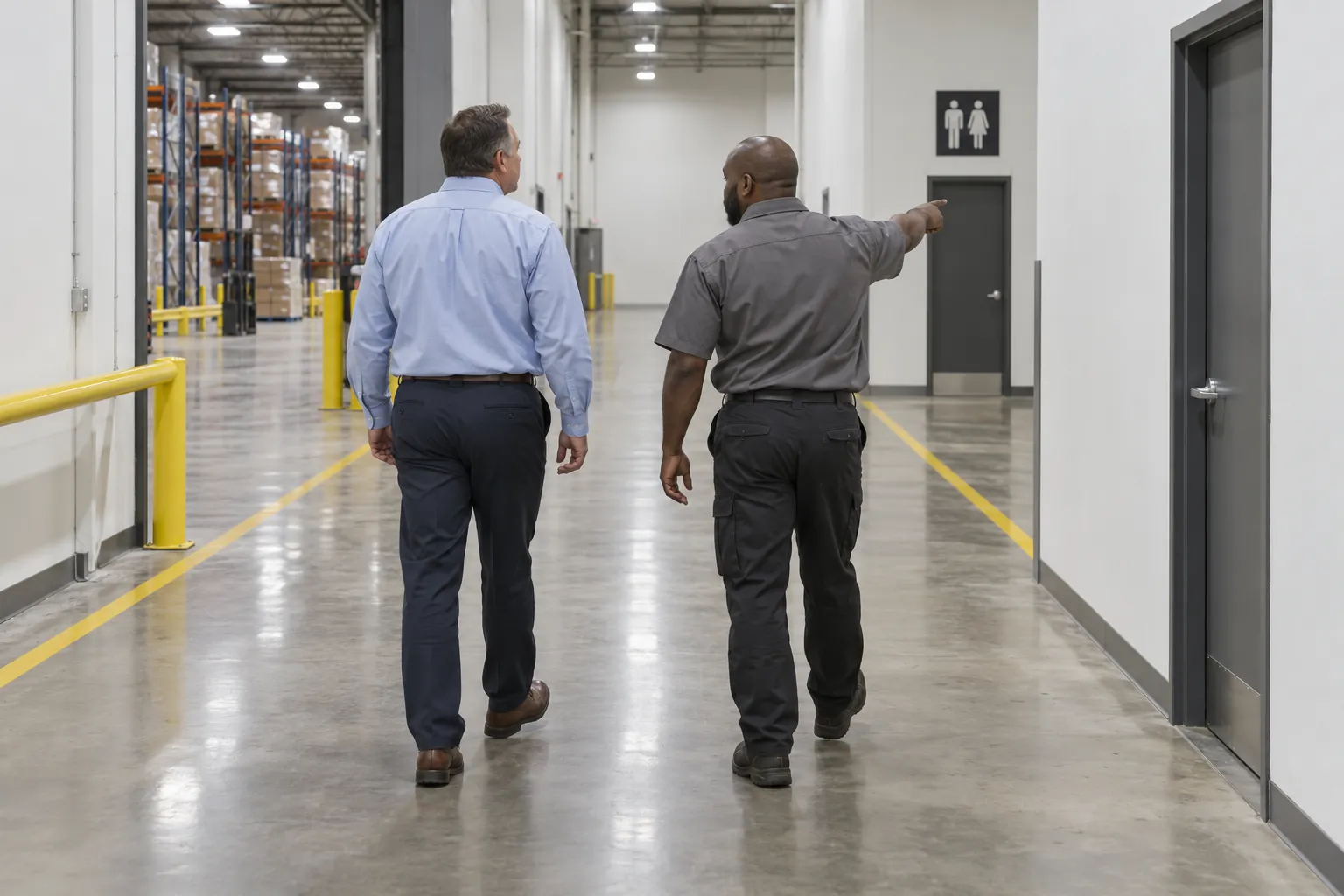
The building codes add distance and access. Seattle's Sections 2902.3.3 and 2902.3.4 and New York City's Sections 403.3.3 and 403.3.4 place required public and employee toilet facilities not more than one story above or below the space they serve, within a 500-foot path of travel (300 feet in a mall), and Sections 2902.3.5 and 403.3.5 both say "Required facilities shall be free of charge." In a new or altered building, restroom accessibility comes from the 2010 ADA Standards for Accessible Design, section 213 and Chapter 6, which apply wherever toilet facilities are provided, including those used only by staff; the guide on public restroom cleaning covers keeping the accessible stall usable.
05
Checking restrooms: who does it, how often, and what the record shows
None of these rules sets a checking frequency or requires a restroom log. The routine is the facility's own, and it should match how hard the restrooms are used. A pattern that works in most commercial buildings:
- Every visit, by the custodian or day porter: the upkeep list above, with anything broken reported at once; several times a shift in a busy office or plant, at least once a shift in a quiet one.
- Daily, by the janitorial supervisor or lead: which restrooms were checked and which were missed, what was reported, and whether any room is closed for repair. A closed restroom reduces the count; if two of four men's water closets are out of order on a floor of 60 men, the floor has two working where Table J-1 asks for four until they are fixed.
- Monthly, by the facility manager: the headcount on each floor or shift against Table J-1 and the fixtures actually working, the key arrangements for any locked restroom, and repeat faults that need a work order rather than another report.
- When things change: a new tenant, a second shift, a reconfigured floor or a construction phase that takes restrooms out of use.
Good evidence answers the questions an OSHA inspector or a client would ask: which restroom, who checked it, when, what was found and what was done. Record the access arrangements too: who holds the keys, how relief works, and how mobile crews reach a toilet within 10 minutes. The guide on the restroom cleaning log covers what each visit's entry should show.
06
Where the restroom record fails, and what SiteClara does about it
Most restroom records are a sheet on the back of the door, initialed on each visit or, too often, at the end of the shift. It cannot show when the room was really checked, says nothing about the restroom locked all afternoon, and the clogged toilet noticed at 10 a.m. is mentioned to whoever was passing.
SiteClara puts a tag at each restroom: a printed QR code poster, with an NFC tag behind it if staff would rather tap. A custodian or day porter scans or taps on their own phone, with no app to install, sees the checks due there, and marks each one done or says what stopped them. The time and the named person are recorded as it happens, with a photo when one is asked for. A fault found there, an out-of-order toilet or a dispenser that will not feed, goes onto the team's list of jobs until someone closes it.
The janitorial supervisor sees which restrooms were checked and which were missed, and records the reason a check was missed. Each day they review it, add a note and approve a report that goes to the facility manager or the client at 8 a.m. the next morning, showing what was checked, what was reported and what is still open.
07
Questions people ask
How many toilets does OSHA require?
In general industry, Table J-1 of 29 CFR 1910.141, Sanitation sets the minimum number of water closets for each sex: 1 for 1 to 15 employees, 2 for 16 to 35, 3 for 36 to 55, 4 for 56 to 80, 5 for 81 to 110, 6 for 111 to 150, and 1 more for each additional 40 employees over 150. On a construction jobsite, Table D-1 of 29 CFR 1926.51, Sanitation applies instead.
Is it an OSHA violation to not have enough bathrooms?
Yes. 29 CFR 1910.141(c)(1)(i) requires toilet facilities for each sex in the numbers in Table J-1, and OSHA's April 6, 1998 interpretation on toilet facilities says "a clear intent" of the table is "to assure that employees will not have to wait in long lines to use those facilities." An employee can raise it through OSHA's File a Complaint page, which takes safety and health complaints online, by phone at 800-321-6742 or through the local OSHA office.
How many times can an employee go to the bathroom?
OSHA sets no number. Its April 23, 2003 letter on reasonable access to toilet facilities says "It would be difficult to set a specific interval for breaks, because the need to use toilet facilities varies from person to person", and that an employer may have reasonable restrictions on access, which OSHA judges case by case, including by how long workers are required to delay bathroom use.
How close does a bathroom have to be at work?
Federal OSHA sets no distance for a fixed workplace. For mobile crews, its June 7, 2002 memorandum on mobile crews and nearby toilet facilities says "in general, toilets would be considered 'nearby' if it would take less than 10 minutes to get to them." Some states set a distance: California's Title 8, Section 3364, Sanitary Facilities says that, where practicable, they "should be within 200 feet of locations at which workers are regularly employed."
Can an employer lock the bathroom or make you ask for a key?
Yes, if it is reasonable. OSHA's February 2, 2006 letter on restroom regulations for general industry says a restriction such as locking the doors and requiring employees to ask and sign out a key "must be reasonable, and may not cause extended delays."
08
Where to read the rules, and a list to take away
Start with OSHA's Restrooms and Sanitation Requirements page, which links the standards and the interpretations cited here, and read 29 CFR 1910.141 in full, or 29 CFR 1926.51 on a construction site. In a state plan state, read the state's own rule. For the fixture count, ask the local building department which code and edition applies.
Before you sign off on a building's restrooms for compliance, check that:
- the water closets working on each floor and shift meet Table J-1 for each sex, and the building code count;
- separate rooms are provided for each sex, or the rooms are single-occupancy and lock from the inside;
- every restroom staff are told to use is open when they work, or the key arrangement causes no extended delay;
- relief is staffed for line work and single-officer posts, and mobile crews can reach a toilet in under 10 minutes;
- every lavatory has running water, soap and towels or a dryer, and every water closet has toilet paper;
- someone checks each restroom on a set routine, and the record shows who, when and what was found;
- out-of-order fixtures go to the building engineer as work orders.
Sources
Every document this guide quotes or links to, in the order it first cites them.
- 29 CFR 1910.141, the general industry sanitation standard osha.gov
- 29 CFR 1926.51, Sanitation osha.gov
- Restrooms and Sanitation Requirements osha.gov
- State Plans page osha.gov
- 2021 Seattle Building Code, Chapter 29 seattle.gov
- Chapter 4 of the 2022 New York City Plumbing Code nyc.gov
- 29 CFR 1910.141(c)(1)(i): Toilet Facilities osha.gov
- April 23, 2003 letter on reasonable access to toilet facilities osha.gov
- February 2, 2006 letter on restroom regulations for general industry osha.gov
- June 7, 2002 memorandum on sanitation and mobile crews osha.gov
- Title 8, Section 3364, Sanitary Facilities dir.ca.gov
- 2010 ADA Standards for Accessible Design ada.gov
- File a Complaint osha.gov
Related guides
 CleaningRestroom cleaning log: what to record, and how to make it believableWhat a restroom cleaning log should record, how often to check, the OSHA and Food Code rules behind it, and how to keep a log a client or inspector will believe.
 CleaningPublic restroom cleaning: frequency, safety and ADA upkeepCleaning public restrooms in parks, transit, venues and public buildings: how often at peak, sharps and bodily fluids under OSHA, and keeping ADA features usable.
 Premises and facilities managementOSHA inspection checklist: what to check before OSHA doesAn OSHA self-inspection checklist for a building: the duty behind it, what to check under each standard, how often, and how to record hazards through to correction.
 Premises and facilities managementBuilding compliance checklist: OSHA, the fire code and the ADA in one US buildingBuilding compliance checklist for US commercial buildings: OSHA, the fire code, elevators, water, asbestos and the ADA, who holds each duty and how often it is due.