Cleaning
Public restroom cleaning: frequency, safety and ADA upkeep
Public restroom cleaning is the routine of cleaning and disinfecting the toilets, urinals, sinks, floors and high-touch surfaces of a restroom open to anyone, restocking its supplies and emptying its trash, as often as its traffic demands.
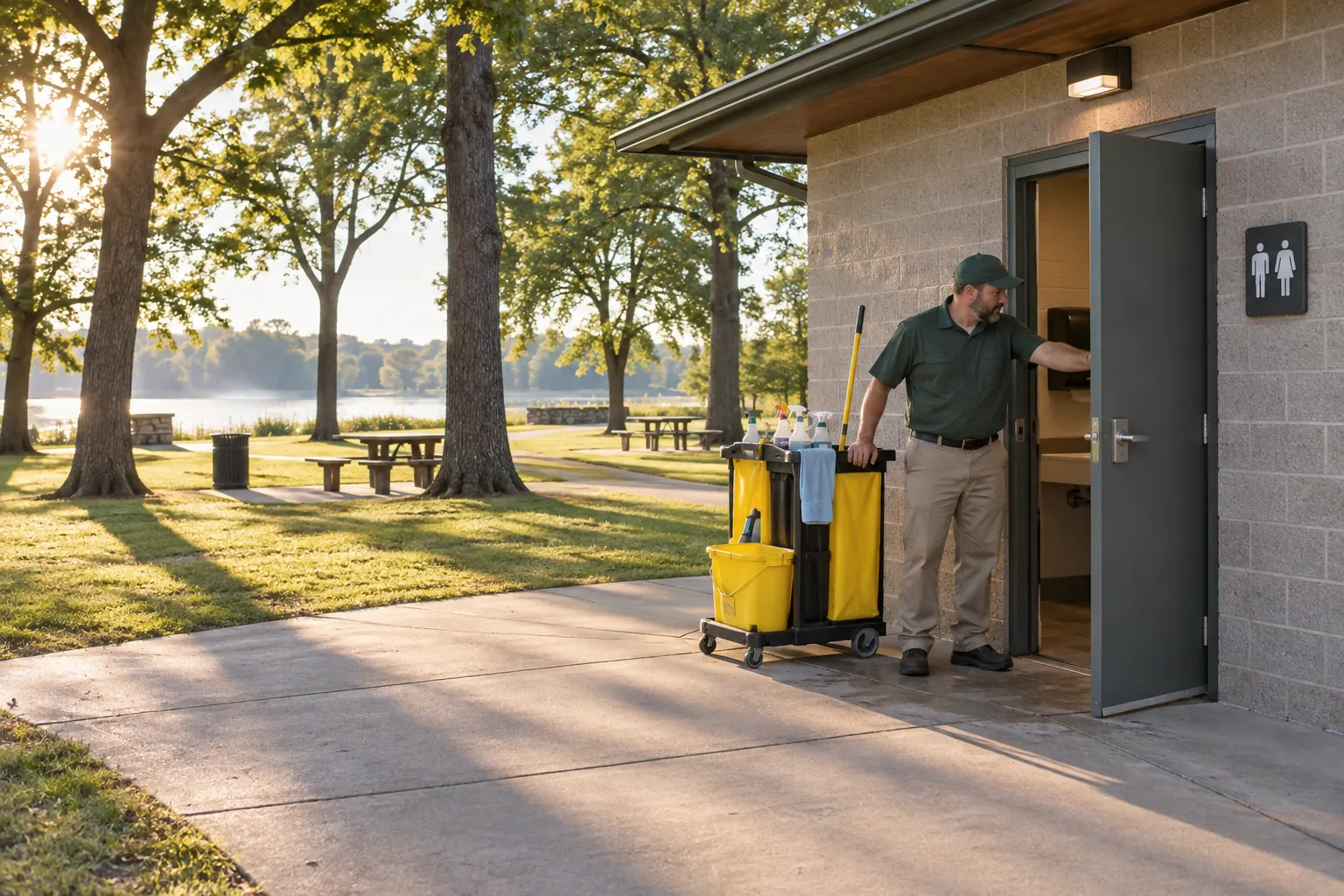
Public restrooms are cleaned for people the crew will never meet, at all hours, often with no attendant. This guide covers running them well in the United States: the federal rules that apply, what a clean covers, how often to visit at peak, handling needles and bodily fluids under OSHA, keeping the accessible stall usable under the ADA, and letting the public report a problem.
01
Who runs public restrooms, and the rules that apply
Public restrooms are run by city and county parks departments, transit agencies, state agencies at rest areas, libraries and city halls, malls, stadiums, arenas, convention centers and event venues. Some have an attendant; most are serviced by a custodial crew or a janitorial contractor moving between buildings.
No federal regulation says how often a public restroom must be cleaned. What the rules set is the outcome and the safety of the people doing the work. The main ones are:
- The ADA, for state and local government. A city park, a public library or a transit station is covered by Title II of the Americans with Disabilities Act. The Department of Justice rule, 28 CFR 35.133, Maintenance of accessible features, says a public entity "shall maintain in operable working condition those features of facilities and equipment that are required to be readily accessible to and usable by persons with disabilities."
- The ADA, for businesses open to the public. Malls, stores, restaurants, theaters, stadiums and other places of public accommodation are covered by Title III. The Title III regulations describe these as "businesses that are generally open to the public and that fall into one of 12 categories listed in the ADA", and 28 CFR 36.211 places the same duty on them to keep accessible features in operable working condition.
- OSHA sanitation, for the crew. 29 CFR 1910.141, Sanitation applies to "permanent places of employment". It requires that "All places of employment shall be kept clean to the extent that the nature of the work allows" and that washing facilities "shall be maintained in a sanitary condition." It protects the employees who work in the building, including the custodians, rather than setting a standard for the public.
- Bloodborne pathogens, for the crew. Where an employee's duties mean contact with blood or other potentially infectious materials can reasonably be anticipated, OSHA's Bloodborne Pathogens standard, 29 CFR 1910.1030 applies. Public restroom work, with discarded needles and bodily fluids, is where that question has to be answered honestly.
Fixture counts, and whether customers must be given access, come from the building and plumbing codes your state or city has adopted. Once the restroom is open, cleaning frequency is the operator's decision, and it belongs in the janitorial scope of work or the contract, with a schedule for each restroom and a clear line on who handles repairs and how fast.
02
What a public restroom clean covers
A public restroom takes harder use than an office restroom, from people who have no reason to look after it. A full clean, which most operators plan at least once a day in any restroom that is open, covers the list below; written up as a restroom cleaning checklist, it gives staff the same order on every visit, working from the cleanest surfaces to the dirtiest so a cloth that has touched a toilet never reaches a faucet:
- Toilets and urinals: bowls, rims, seats, flush valves and handles, and the floor and wall around them, cleaned and disinfected.
- Sinks, faucets and counters: cleaned, water running, sensor faucets working, no standing water on the counter.
- Stalls: doors, latches, partitions, coat hooks, seat cover dispensers and sanitary napkin receptacles.
- Floors: swept, then mopped with a disinfectant cleaner, with attention to the base of toilets and urinals and the floor drain, where odors start. Keep restroom mops for restrooms only to prevent carrying germs to other areas, and put out a wet floor sign while the floor is wet.
- High-touch surfaces: door handles and push plates, flush valves, stall latches, faucet handles, dispenser levers and baby changing stations. The CDC's guidance on when and how to clean and disinfect a facility names "restroom fixtures" among the high-touch surfaces to clean regularly.
- Supplies: toilet paper, hand soap and paper towels restocked, dispensers checked and jams cleared. An empty soap dispenser is the first thing users notice.
- Trash: cans emptied and relined before they overflow, sanitary receptacles serviced by the contractor on schedule.
- Walls, mirrors and graffiti: spot-cleaned, graffiti removed promptly.
- Faults: leaks, clogs, running flush valves, broken latches, dead lights and hand dryers reported.
Deep cleaning belongs on a periodic schedule of its own: descaling toilets and urinals to remove mineral buildup and urine stains, cleaning grout and floor drains, dusting vents, machine-scrubbing floors and pressure washing where the fixtures allow it. Self-cleaning units still need visits to restock and check that they work.
Disinfectants are regulated as pesticides. EPA's page on selected EPA-registered disinfectants says "Disinfectants are pesticides and can be harmful" and "It is important to read and understand the product label before you use it", and explains contact time: "The contact time is the time the product must remain on the surface for it to be effective. The surface should be visibly wet for the entire contact time." A spray-and-wipe in a busy restroom often misses that, so train the crew on the label of the product they actually carry.
03
How often, and what changes at peak
No rule sets the number; the right frequency follows traffic. A common practice, not a requirement, is a full clean at least once a day in any restroom that is open, with shorter checks between cleans to restock, wipe up spills and pick up trash, as often as its busiest hours need.
Visits should follow the pattern of use, not the clock alone. A beach restroom needs its checks concentrated on summer afternoons; a transit station peaks at rush hour; an arena needs checks at intermission or halftime and right after the event lets out. An hourly round through a quiet morning, with nobody there during the lunchtime rush, produces a full log and a restroom the public complains about.
For an event, plan a full clean and restock before the doors open, frequent checks throughout with a named person for each restroom, and a full clean afterward. Portable toilets are serviced by the rental company, and the event team still checks them between services.
04
Needles, bodily fluids and vandalism, handled safely
Public restroom work carries risks that ordinary office cleaning does not. Start with the exposure determination the Bloodborne Pathogens standard requires: if custodians can reasonably be expected to meet blood or other potentially infectious materials, they are covered, and the employer needs a written exposure control plan, training, protective equipment and the vaccination and follow-up the standard sets out. Every custodian should be trained before working a public restroom alone.
Discarded needles and sharps
- Never pick up a needle by hand, gloved or not. The standard says broken glassware that may be contaminated "shall not be picked up directly with the hands" and is to be cleaned up "using mechanical means, such as a brush and dust pan, tongs, or forceps". That rule does not name syringes, but the same approach is the safe one for a needle. Take the sharps container to the needle, not the other way around.
- Under 1910.1030, containers for contaminated sharps are closable, puncture resistant, leakproof on the sides and bottom, and labeled or color-coded.
- Look before reaching: into trash cans, behind toilets, under sanitary receptacles and inside paper towel dispensers. Never compact trash with a hand or a foot.
- Dispose of full sharps containers through the operator's regulated medical waste arrangements, as your state requires.
- Where custodians have occupational exposure, the employer must make the hepatitis B vaccine available at no cost, within 10 working days of initial assignment.
If someone is stuck by a needle or splashed, OSHA's bloodborne pathogens page says to "immediately flood the exposed area with water and clean any wound with soap and water or a skin disinfectant if available", then report it at once. Under the standard, the employer must provide a confidential medical evaluation and follow-up after an exposure incident, so the report has to reach a supervisor the same shift, not the end of the week.
Blood, vomit and other bodily fluids: close the stall or the restroom, use a spill kit with disposable gloves and absorbent, and disinfect with a product whose label covers the germs you are dealing with, for its full contact time. The blood spill cleanup guide covers the steps in detail.
Vandalism and misuse: record damage when it is found, with a photo, the time and the location, make it safe, for example by closing a stall with a broken door, and report it to whoever repairs it. Offensive graffiti should come off the same day. Custodians should not confront anyone behaving aggressively; they should leave and report it. A record of repeated damage by restroom and time of day is what supports a case for better lighting, an attendant or different hours.
05
Keeping the accessible stall usable, and letting the public report problems
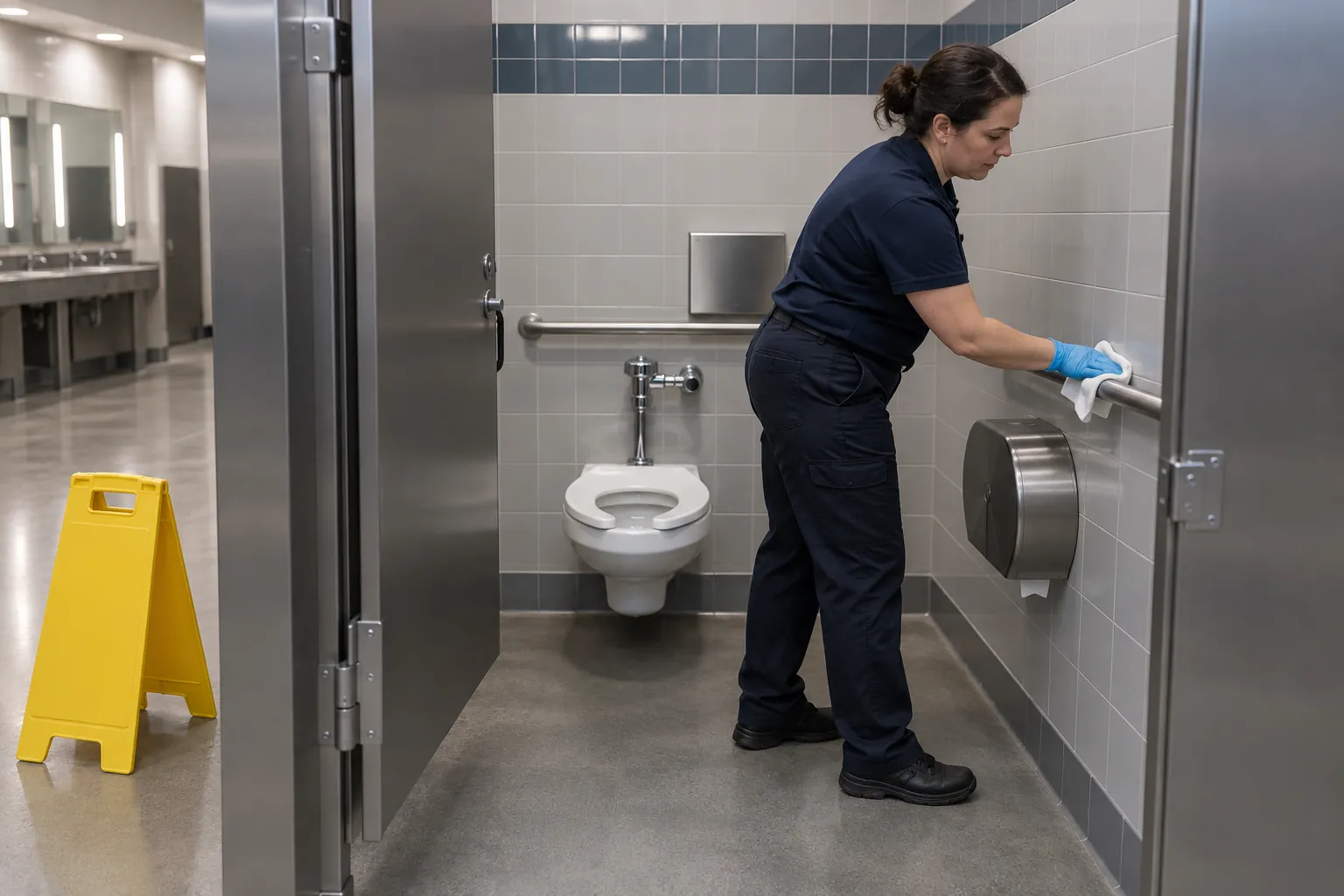
The ADA's maintenance rules are short, and they bite in public restrooms. A grab bar that is loose, a door that sticks, or an accessible stall used to store a mop bucket is an accessible feature that is not in operable working condition. Both 28 CFR 35.133 and 36.211 allow "isolated or temporary interruptions in service or access due to maintenance or repairs", which covers the stall closed while it is cleaned or repaired, not the stall that has been out of order for a month.
The design rules are in the 2010 ADA Standards for Accessible Design, explained in the U.S. Access Board's Guide to the ADA Accessibility Standards, Chapter 6: Toilet Rooms. They apply to new construction and alterations, but a custodial crew can undo a compliant design in a day. Add these to every check:
- Nothing stored in the accessible stall or the turning space. The Access Board's guide says the only elements that can overlap the clear floor space at an accessible toilet are "associated grab bars, toilet paper dispensers, seat cover and other dispensers, coat hooks, shelves, and sanitary napkin disposal units." A trash can, a spare-roll box or a cart parked there does not belong.
- Grab bars secure and clear. The guide says any projecting object "must be located at least 12″ above grab bars". A caddy hung over the bar, or a bag hooked on it, blocks it.
- Dispensers where they were installed. The guide places toilet paper dispensers 7 to 9 inches in front of the toilet with the outlet 15 to 48 inches above the floor. A replacement dispenser or a spare-roll holder bolted up by maintenance should keep to that.
- Pipes under the sink covered. The standards require water supply and drain pipes under lavatories to be insulated or otherwise configured to protect against contact. Report missing wraps rather than leaving them for the next visit.
- The door, latch, any power opener and the baby changing station all work.
Section 213.3.1 of the 2010 Standards calls for at least one wheelchair accessible compartment where toilet compartments are provided, and an ambulatory accessible compartment as well where there are six or more compartments, or where toilets and urinals together total six or more. Check both.
Public reporting. The people who find a problem first are the public. A clear sign in each restroom saying how to report a clogged toilet, a broken latch or an empty dispenser, with a reference for that restroom, turns them into an early warning. The report only helps if it reaches the crew on duty quickly and someone closes it; a phone number that goes to voicemail on a Saturday teaches people not to bother. A restroom cleaning log that records what was fixed, not only what was wiped, is where that loop shows.
06
Where the public restroom record fails, and what SiteClara does about it
Public restrooms are spread across a parks system, a transit line or a venue campus, and the crew moves between them. A paper log on each door tells the supervisor nothing until someone reads it, a missed visit is found by the public first, and a broken latch reported through a 311 line can take days to reach the custodian who could have closed the stall that morning.
SiteClara puts a printed QR code poster in each restroom, with an optional NFC tag behind it. The custodian scans the code or taps the tag on their own phone, with no app to install, sees the scheduled checks due there and marks them done or explains what stopped them, with a photo when it helps. Damage, a clog or a sharps container that needs collecting is reported on the spot and goes onto the team's list of jobs until someone closes it. Where a parks department, a transit agency or a venue runs its own restrooms, public reporting can be allowed at the same tags, so a visitor can report a problem where they find it.
The janitorial supervisor sees what is due, done and missed across every restroom, can record the reason a check was missed, and can escalate a job to the building manager. Each morning at 8 a.m. the approved report for the previous day goes to the nominated facility manager or client contacts, showing what was reported, completed and still open, and how the scheduled checks went.
07
Questions people ask
How do they clean public restrooms?
Staff put on the gloves or goggles the product calls for, close off the restroom or the stall, clean every surface, then disinfect the fixtures, restock and finish with the floor. The CDC's guidance on when and how to clean and disinfect a facility says to "Clean surfaces before sanitizing or disinfecting them, because impurities like dirt may make it harder for sanitizing or disinfecting chemicals to kill germs", and to wear protective equipment "as recommended by Section 8 of the product's Safety Data Sheet." The disinfectant then stays wet on the surface for the contact time on its label.
How often should a public restroom be cleaned?
No federal rule sets a number of cleans a day. Where employees work, OSHA's 29 CFR 1910.141, Sanitation requires that "All places of employment shall be kept clean to the extent that the nature of the work allows" and that washing facilities "shall be maintained in a sanitary condition." The CDC's guidance on when and how to clean and disinfect a facility says to clean high-touch surfaces, including restroom fixtures, "regularly". A common practice is a full clean at least daily, with more checks at each restroom's peak hours.
08
Further reading, and a list to take away
OSHA publishes the sanitation and Bloodborne Pathogens standards, its bloodborne pathogens topic page and the list of State Plans. The Department of Justice publishes the ADA regulations and the 2010 Standards at ada.gov, and the U.S. Access Board explains the toilet room requirements. The CDC and EPA cover cleaning, disinfecting and reading a disinfectant label. Your state or city health and building departments enforce the local codes.
Before the next busy season, check that:
- each public restroom has a written cleaning frequency, with more visits at its own peak times;
- the exposure determination has been made, and every custodian is trained in sharps and bodily fluids before working alone, with sharps containers and spill kits on the cart;
- the crew knows the contact time of the disinfectant they carry;
- damage is recorded with a photo and made safe the day it is found;
- the accessible stall is checked on every visit for clear space, secure grab bars, working latches and nothing stored inside;
- the public can see how to report a problem, and someone acts on it the same day;
- posted hours match the hours the restroom is actually open, and the closing check is recorded.
Sources
Every document this guide quotes or links to, in the order it first cites them.
- 28 CFR 35.133, Maintenance of accessible features ecfr.gov
- Title III regulations ada.gov
- 28 CFR 36.211 ecfr.gov
- 29 CFR 1910.141, Sanitation osha.gov
- Bloodborne Pathogens standard, 29 CFR 1910.1030 osha.gov
- State Plans page osha.gov
- When and how to clean and disinfect a facility cdc.gov
- Selected EPA-registered disinfectants epa.gov
- Bloodborne pathogens page osha.gov
- 2010 ADA Standards for Accessible Design ada.gov
- Guide to the ADA Accessibility Standards, Chapter 6: Toilet Rooms access-board.gov
Related guides
 CleaningRestroom cleaning log: what to record, and how to make it believableWhat a restroom cleaning log should record, how often to check, the OSHA and Food Code rules behind it, and how to keep a log a client or inspector will believe.
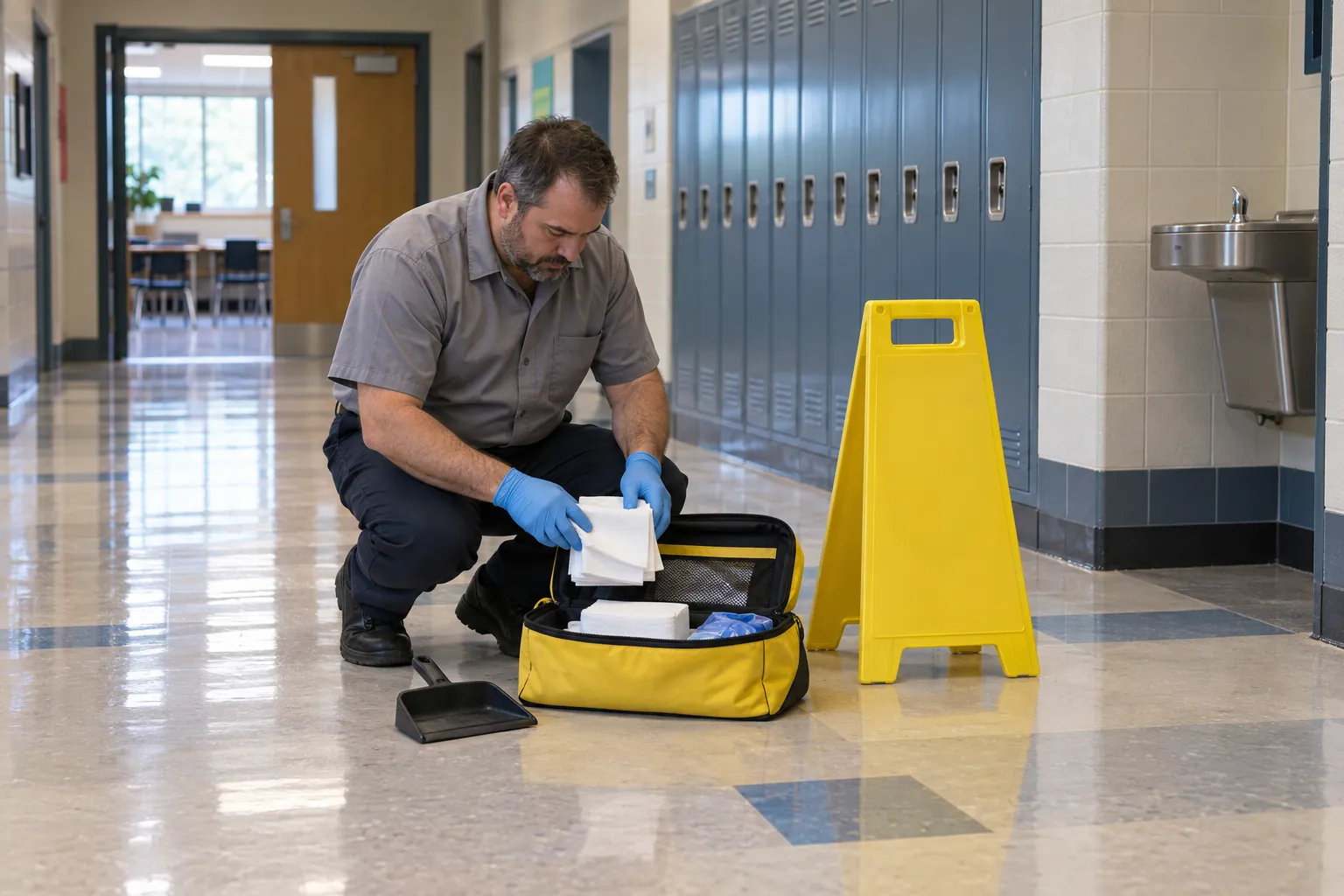 CleaningBlood spill cleanup: doing it safely, and showing it was doneHow to clean up a blood spill at work under OSHA's bloodborne pathogens standard: PPE, sharps, disinfectants, waste, training and the record to keep.
 CleaningHigh-touch surfaces: a cleaning routine you can show was doneHigh-touch surfaces as the CDC describes them: which ones to list area by area, how often to clean and disinfect them, the right method, and a record that holds up.
 CleaningWet floor sign requirements: what OSHA asks for, and how to use the sign wellWhat OSHA and ANSI Z535 require of a wet floor sign, when one is needed, where to place it, when to take it in, and how to show the wet floor was managed.