Security patrols
Patrol vehicle inspection checklist: what to check before every shift, and how to prove it
A patrol vehicle inspection checklist lists what an officer checks on a patrol car before each shift: tires and tread depth, lights, brakes and steering, windshield, wipers and mirrors, horn, the warning light bar and markings, emergency equipment and the patrol equipment such as the radio, with any defect written up when the vehicle is handed back.
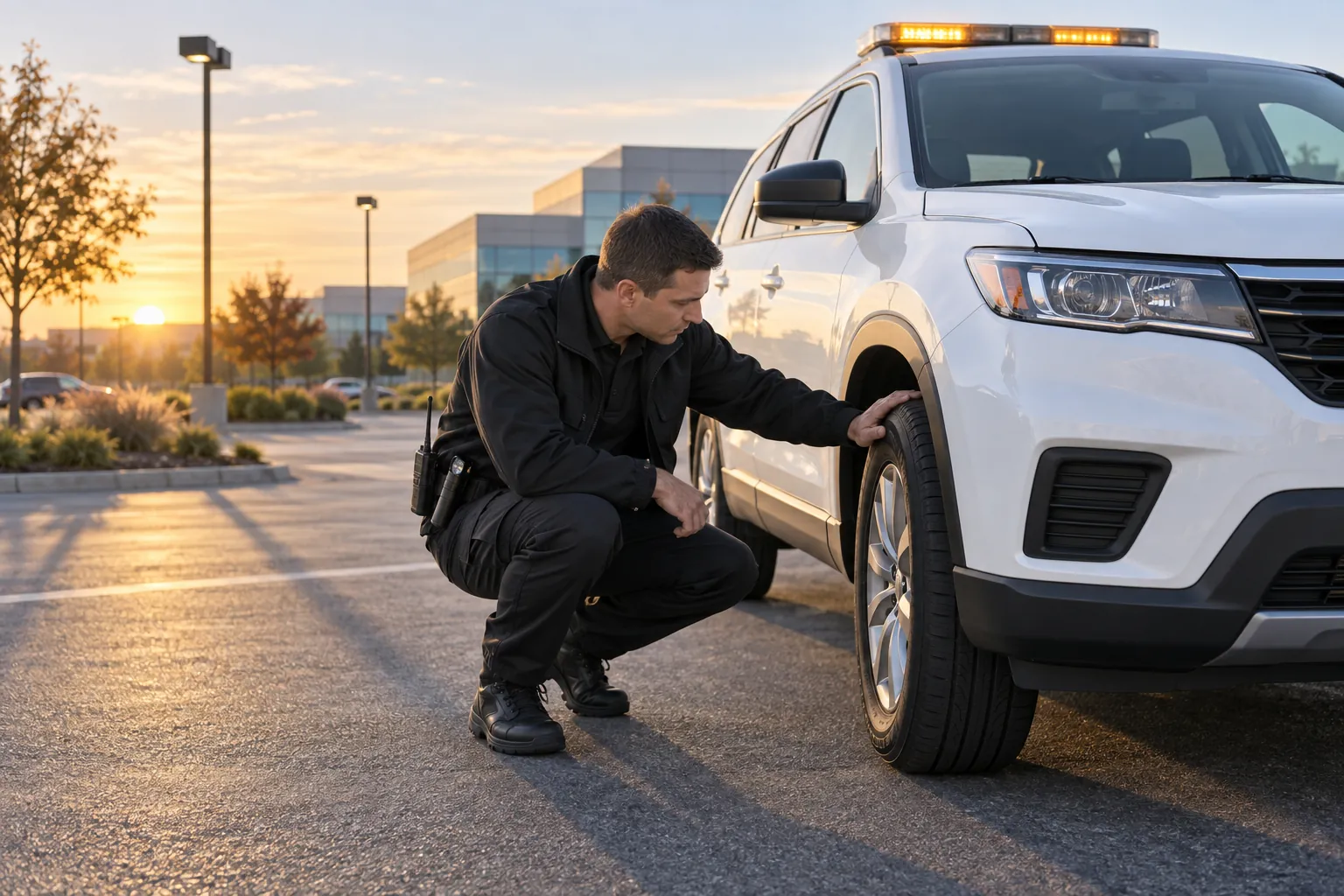
A mobile patrol is only as good as the vehicle it runs in. A car with a dead light bar, a soft tire or an empty fire extinguisher puts the officer at risk and leaves the client's sites unvisited. Most security patrol cars are not commercial motor vehicles, so no federal rule tells a security company exactly how to inspect them, but the federal driver inspection rules for trucks and buses are a sound model, and some states regulate how a patrol vehicle may be marked and lit. This guide covers what a patrol vehicle inspection checklist should include, who does what, how defects are handled, and what a record that holds up looks like.
01
What a patrol vehicle inspection is, and the rules behind it
A patrol vehicle inspection is the check an officer makes on a marked car, pickup, SUV, golf cart or utility vehicle before taking it out on patrol, and the note they make of anything wrong when they hand it back. It is the vehicle's part of the shift change, alongside the radio, the keys and the pass-down log.
Most security companies take their model from the Federal Motor Carrier Safety Administration's rules for commercial vehicles, even though those rules rarely apply to a patrol car. Under 49 CFR 396.13, Driver inspection, before driving a motor vehicle the driver must "be satisfied that the motor vehicle is in safe operating condition," review the last driver vehicle inspection report where one is required, and sign it to acknowledge that they have reviewed it and that the required repairs have been certified. The report itself is set out in 49 CFR 396.11, Driver vehicle inspection report(s), usually called the DVIR, and the general duty to keep vehicles in repair is in 49 CFR 396.3, Inspection, repair, and maintenance.
Those rules bind motor carriers operating commercial motor vehicles in interstate commerce. The definition in 49 CFR 390.5 covers, among other things, a vehicle with a gross vehicle weight rating of 10,001 pounds or more, or one designed or used to carry more than eight passengers (including the driver) for compensation, or more than 15 passengers, including the driver, when not for compensation. An ordinary sedan, SUV or half-ton pickup on a patrol route is none of these. The rules are still worth copying, because they are short, tested, and describe exactly what a careful fleet would do anyway: check before driving, report defects in writing, fix what affects safety before the vehicle goes out again, and certify the repair.
OSHA has no general standard for employees driving on public roads; its motor vehicle requirements are in industry-specific standards such as those for agriculture and maritime. OSHA's Motor Vehicle Safety page notes that, on average, 39% of occupational fatalities are due to transportation incidents, and the joint OSHA, NHTSA and NETS publication Guidelines for Employers to Reduce Motor Vehicle Crashes reminds employers of the General Duty Clause: they must provide a workplace free from recognized hazards likely to cause death or serious physical harm. Its sixth step, vehicle selection, maintenance and inspection, recommends a routine preventive maintenance schedule at the manufacturer's intervals and "a thorough inspection of each vehicle at least annually with documented results placed in the vehicle's file."
Some states also regulate the patrol vehicle itself. In California, Vehicle Code Section 25279 lets a vehicle owned by a private security agency and operated by registered personnel carry a flashing amber warning light system on a highway only if it complies with Vehicle Code Section 27605, which forbids owning or operating a vehicle painted to resemble one used by a peace officer or traffic officer on duty, and is marked "PRIVATE SECURITY" or "SECURITY PATROL" on the rear and both sides, legible from at least 50 feet. The amber lights may not be switched on while on the highway unless a peace officer directs it. The markings and the light bar are therefore part of the inspection in California, not decoration.
02
The patrol vehicle inspection checklist
The FMCSA list in 49 CFR 396.11 is the right starting point. It names service brakes, parking brake, steering mechanism, lighting devices and reflectors, tires, horn, windshield wipers, rear vision mirrors, coupling devices, wheels and rims, and emergency equipment. A patrol vehicle needs most of that plus the equipment that makes it a patrol vehicle. A practical pre-shift checklist covers:
- Walk-around: new body damage since the last shift, noted with a photo before the vehicle moves, so damage is tied to the right shift and nobody inherits someone else's dent.
- Tires, wheels and rims: visible damage or bulges, tread depth above the fleet's replacement mark, obvious under-inflation, lug nuts present. Pressure checked against the door placard at the interval the fleet sets.
- Lights: headlights high and low, tail and brake lights, turn signals, hazard flashers, reverse lights, the license plate light, and the spotlight or alley lights where fitted.
- Warning lights and markings: the light bar works in each mode, and the markings the state or client requires are present, clean and legible.
- Brakes and steering: the parking brake holds, the pedal feels firm, the steering has no unusual play, and nothing pulls on a short low-speed test.
- Visibility: windshield free of cracks in the driver's view, wipers and washer fluid working, mirrors intact and adjusted, horn working.
- Dashboard: no warning lamps that indicate a fault after start-up, fuel or charge level, odometer reading written down.
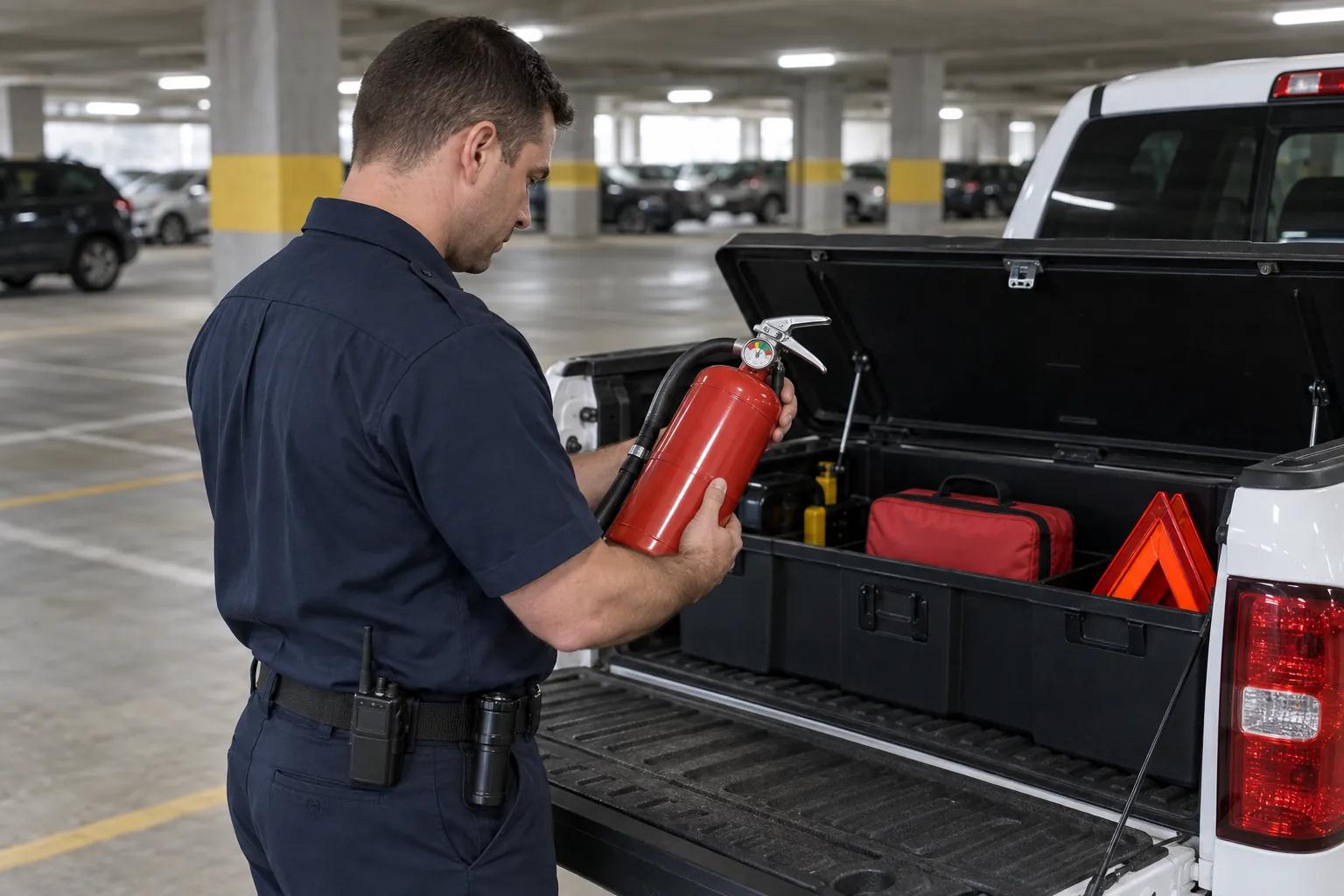
- Emergency equipment: fire extinguisher present, charged and in date; first aid kit stocked; reflective triangles or flares; flashlight; spare tire and jack.
- Patrol equipment: radio and charger, mobile phone mount, any mounted camera, keys and key cards for the route, the site binder or post orders, and the tablet or device used for reports.
Keep the list short enough that an officer can finish it in five to ten minutes without skipping lines.
03
Who does what: officer, supervisor and fleet
The FMCSA structure divides the work in a way that suits a security company well:
- The outgoing officer reports what they found wrong at the end of the shift. Under 49 CFR 396.11 the report must identify the vehicle and list any defect or deficiency "which would affect the safety of operation of the vehicle or result in its mechanical breakdown," and it must be signed. A driver is not required to prepare one if nothing was found, but many security companies ask for a report every shift anyway, because "nothing found" is useful evidence too.
- The company decides what gets fixed. The rule is that, before a vehicle is operated again, any listed defect likely to affect safety is repaired, and someone certifies on the report either that the defect was repaired or that repair is unnecessary.
- The incoming officer checks the vehicle, reads the last report, and verifies the repairs were certified before driving. The same logic sits in 49 CFR 396.13.
- The supervisor or fleet coordinator keeps the maintenance schedule: oil changes, tire rotation and replacement, brake service and the annual inspection the OSHA guidelines recommend, plus any state safety inspection the vehicle is due.
Two principles from the federal rules are worth writing into the post orders. First, 49 CFR 396.7 says a motor vehicle "shall not be operated in such a condition as to likely cause an accident or a breakdown of the vehicle." An officer should know they are allowed, and expected, to refuse a vehicle with no brakes or no lights, and who to call when they do. Second, the certification closes the loop: a defect written on a sheet is not a defect dealt with until someone with authority says it was fixed or did not need fixing.
04
How often to check, and what good evidence looks like
The pattern that works for most patrol fleets is:
- Every shift: the pre-shift walk-around and checklist, and a defect report at hand-back.
- Weekly: tire pressures, fluid levels, a proper interior clean, and a check that the emergency and first aid kits are complete.
- Monthly: a visual inspection of the fire extinguisher. Where an extinguisher is provided for employee use, OSHA's portable fire extinguisher standard, 29 CFR 1910.157, requires a monthly visual inspection and an annual maintenance check with the date recorded. See the monthly fire extinguisher inspection guide for the details.
- On schedule: servicing at the manufacturer's intervals, and registration and insurance cards current.
- At least annually: a mechanic's inspection with the results placed in the vehicle's file, as the OSHA guidelines recommend.
Good evidence answers four questions for each check: which vehicle, who checked it, when, and what they found. The vehicle is identified by its fleet number and plate, not "the Ford." The officer is named, not initialed in a way nobody can read later. The time is the time the check was made, not the start of the shift written in advance. What was found is specific: "right rear tire low, 24 psi, placard 35" is useful; "tires OK" is not.
For vehicles inside the FMCSA rules, the retention periods show what is sensible for everyone. Under 49 CFR 396.11 a motor carrier keeps the driver vehicle inspection report, the certification of repairs and the certification of the driver's review for three months from the date the report was prepared. Under 49 CFR 396.3 the inspection, repair and maintenance records are kept where the vehicle is housed or maintained for one year, and for six months after the vehicle leaves the carrier's control. Both kinds of record may be kept electronically under 49 CFR 390.32, which covers documents a carrier is required to retain. A security company outside the rules can adopt the same periods, or longer if its insurer or contract asks.
05
Dealing with defects, and how the checks are reviewed
Sort defects into two groups before anyone needs to decide under pressure:
- Out of service: anything that makes the vehicle unsafe to drive, such as brakes, steering, a tire that will not hold air, headlights at night, a cracked windshield in the driver's view, seat belts, or a warning light the manual says means stop. The vehicle does not go out until it is fixed and the repair is certified.
- Fix soon: a missing hubcap, a broken interior light, a scratch. The vehicle can run, the defect is written down, and it has a date by which it will be fixed.
When a vehicle goes out of service, the supervisor needs to know at once, because the patrol route depends on it. The post orders should say what happens next: a spare vehicle, a reduced route with the client told, or a foot patrol of the most important sites. The daily activity report should show that the route changed and why, so a missed site visit is explained rather than hidden.
Supervisors review the vehicle checks on a regular cycle, weekly at minimum. The things to look for are patterns: the same defect written up three shifts running and never certified; a vehicle nobody ever reports anything on, which usually means nobody is looking; checks completed at exactly the same minute every day; and a gap where a shift was worked but no check exists.
When there is a crash, the inspection record is one of the first things an insurer, an attorney or a client asks for. The OSHA guidelines recommend that all crashes, regardless of severity, be reported to the employee's supervisor as soon as feasible and reviewed for cause. A defect report written before the crash, and a clear record of whether it was fixed, will settle questions that otherwise turn into arguments. Treat the crash itself through the security incident report process.
Honest reports matter in law as well as in practice. In California, Business and Professions Code Section 7582.26 forbids a private security licensee or its employees from knowingly making a false report to an employer or client, and requires whoever submits a written report to a client to exercise diligence in checking that it is true and correct. A vehicle checklist signed without looking is exactly the kind of record that falls apart when tested.
06
Where the record fails, and where SiteClara fits
The paper vehicle checklist fails in familiar ways. The clipboard in the glove box has a week of ticks in the same pen. The defect on Tuesday's sheet is still there on Friday's, with no one's name against the repair. The incoming officer never saw the outgoing officer's note because it was on a different sheet in a different vehicle. When the client asks why a site was missed on a Saturday night, nobody can say whether the car was off the road or just late.
SiteClara is a way to record routine checks like these as they happen. A printed QR poster, with an optional NFC tag behind it, goes where the check is made: inside the vehicle, on the key cabinet or at the parking bay where the patrol cars are kept. The officer scans the code or taps the tag on their own phone, with no app to install, sees the checks due for that vehicle, such as "lights and light bar working" or "fire extinguisher present and charged," and marks each one done or says what stopped them. The time and the named officer are recorded as it happens, with a photo when one is asked for, for example of new damage or the odometer.
A defect found on the check is reported there and goes onto the team's list of jobs until someone closes it, so the soft tire does not live only on a sheet in the glove box. The security supervisor sees what was due, done and missed, with the reason where one was given. Each day the supervisor reviews the totals and photos, adds a note and approves a report that goes to nominated client contacts at 8 a.m. the next morning, showing what was reported, what is still open and how the scheduled checks went.
07
Questions people ask
What should be included in a vehicle inspection?
A vehicle inspection should include at least the parts the federal driver inspection report covers. Under 49 CFR 396.11, Driver vehicle inspection report(s), those are the service brakes, parking brake, steering mechanism, lighting devices and reflectors, tires, horn, windshield wipers, rear vision mirrors, coupling devices, wheels and rims, and emergency equipment. A patrol vehicle adds its own equipment to that list: the warning light bar, the markings, the radio and the patrol kit, as in the checklist above.
What will fail a car inspection in Virginia?
In Virginia, a car is rejected at its safety inspection when a part covered by the state's Motor Vehicle Safety Inspection Regulations (19VAC30-70) does not meet the standard set there. For passenger vehicles the regulations cover, among other items, service brakes, parking brakes, steering and suspension, tires, wheels and rims, headlamps, rear lamps and license plate lamps, glass, mirrors, windshield wipers and defroster, horn, doors, seats and seat belts, the exhaust system and the fuel system. Under Code of Virginia § 46.2-1158, a vehicle is reinspected at least once every 12 months, and a rejection sticker is valid for 15 calendar days beyond the day it is issued. A patrol car registered in Virginia goes through these inspections like any other vehicle, so its due date belongs on the fleet schedule.
Can a cop pull me over for no inspection sticker?
In Virginia, a police officer may not stop a vehicle for an expired inspection sticker alone until the first day of the fourth month after it expired. Code of Virginia § 46.2-1157 says that "no law-enforcement officer shall stop a motor vehicle due to an expired vehicle inspection sticker" before then, and evidence obtained from a stop that breaks the rule cannot be used. The same section makes each day an uninspected vehicle is operated or parked on a highway a separate offense, and other states set their own rules, so a patrol fleet should keep every vehicle's inspection current rather than rely on the grace period.
08
Where to read the official guidance, and a short list to take away
The primary sources for a patrol vehicle program are:
- 49 CFR 396.11 and 49 CFR 396.13, the FMCSA inspection report and driver inspection rules.
- 49 CFR 390.5, for whether a vehicle is a commercial motor vehicle.
- OSHA's Guidelines for Employers to Reduce Motor Vehicle Crashes.
- Your state's vehicle code and security licensing law, such as California's Vehicle Code Section 25279.
A short list to take away:
- Give every patrol vehicle a fleet number and a checklist of its own, short enough to be done properly.
- Check before every shift and report defects at every hand-back, in writing, with the officer's name and the time.
- Decide in advance which defects take a vehicle out of service, and tell officers they may refuse an unsafe vehicle.
- Certify every repair, or record that repair was unnecessary, before the vehicle goes out again.
- Keep the reports and maintenance records for at least the FMCSA periods, and longer if the insurer or contract asks.
- Review the checks weekly for patterns, and explain every route change caused by a vehicle in the daily activity report.
Sources
Every document this guide quotes or links to, in the order it first cites them.
- 49 CFR 396.13, Driver inspection ecfr.gov
- 49 CFR 396.11, Driver vehicle inspection report(s) ecfr.gov
- 49 CFR 396.3, Inspection, repair, and maintenance ecfr.gov
- 49 CFR 390.5 ecfr.gov
- Industry-specific standards osha.gov
- Motor Vehicle Safety osha.gov
- Guidelines for Employers to Reduce Motor Vehicle Crashes osha.gov
- Vehicle Code Section 25279 leginfo.legislature.ca.gov
- Vehicle Code Section 27605 leginfo.legislature.ca.gov
- 49 CFR 396.7 ecfr.gov
- 29 CFR 1910.157 osha.gov
- 49 CFR 390.32 ecfr.gov
- Business and Professions Code Section 7582.26 leginfo.legislature.ca.gov
- Motor Vehicle Safety Inspection Regulations (19VAC30-70) law.lis.virginia.gov
- Code of Virginia § 46.2-1158 law.lis.virginia.gov
- Code of Virginia § 46.2-1157 law.lis.virginia.gov
Related guides
 Security patrolsSecurity daily activity report: what to include, and how to write one that holds upThe security daily activity report (DAR): what to record, how to write entries that hold up, how it differs from an incident report, and how to review and keep it.
 Security patrolsSecurity pass-down log: what to hand over, and how to make the shift change stickThe security pass-down log: what the outgoing officer hands over, how to run the shift change, how to write entries that stay useful, and how to review and keep it.
 Security patrolsSecurity guard shift checklist: what to check from post-up to pass-downA security guard shift checklist for US sites: what to check at post-up, on each round and at shift change, the state rules behind it, and how to prove it.
 Security patrolsParking patrol: enforcing a private lot, and keeping a record that holds upHow a security parking patrol works on a private lot or garage: the state towing laws, what officers check, who authorizes a tow, and the record that holds up.