Cleaning
Residence hall cleaning: dorms, community bathrooms and the summer turnover
Dorm cleaning is the work of keeping a college residence hall's shared spaces, such as community bathrooms, floor kitchens, lounges and corridors, clean every day while residents keep their own dorm room clean, and of deep cleaning every room between occupants and over the summer.
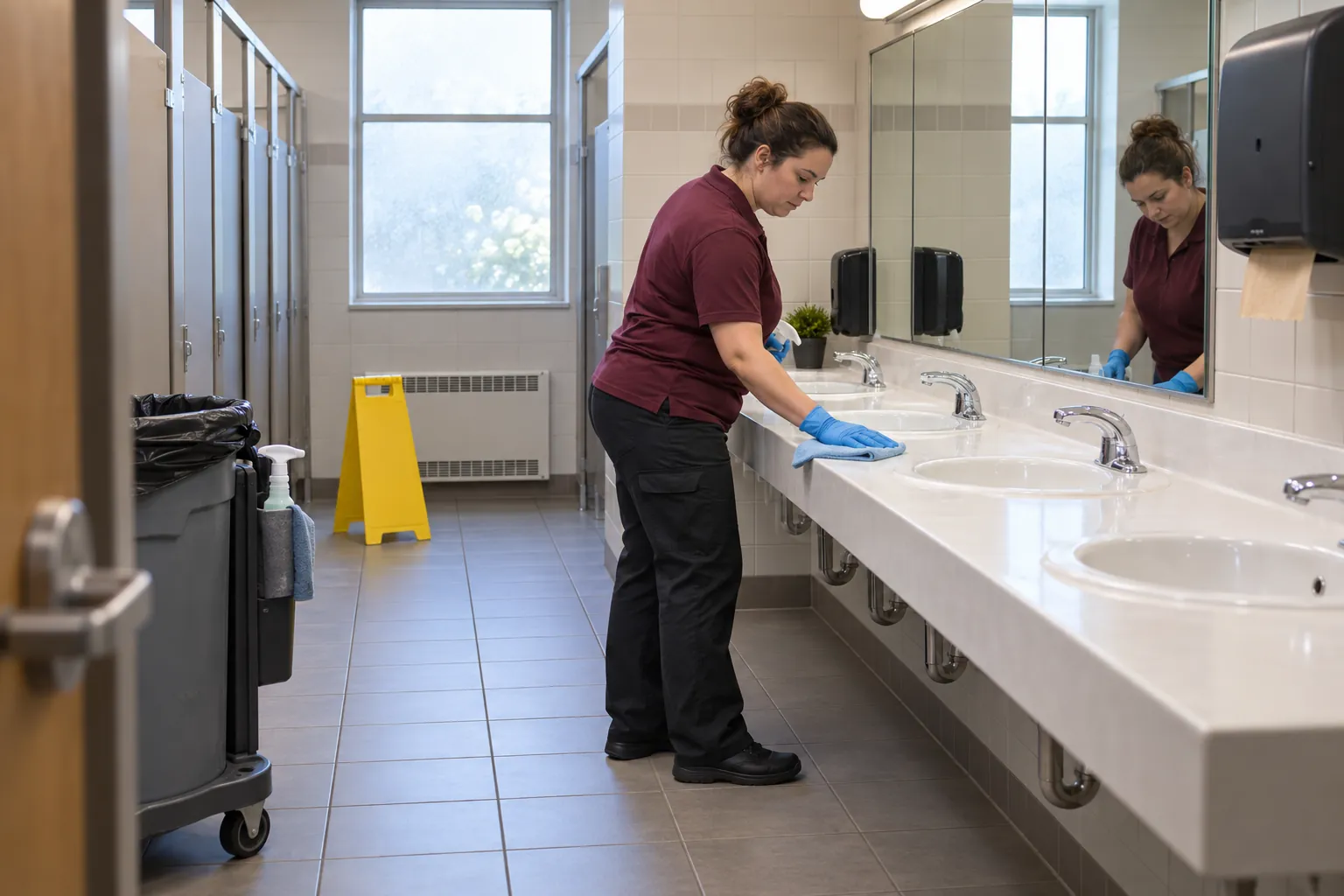
It is done around hundreds of students living at close quarters, many of them away from home for the first time, in buildings that have to be emptied, cleaned and made ready again in a few weeks each summer. This guide is for the housing and residence life offices, campus custodial services and contract janitorial companies that keep dorms clean, and for anyone setting up or checking that work.
01
The rules and standards that touch residence hall cleaning
Campus housing in the United States comes in a few shapes: traditional residence halls with double rooms off a corridor and a community bathroom on each floor, suite-style halls where a handful of rooms share a bathroom, and apartment-style buildings with their own kitchens. No single federal rule sets a cleaning standard for a dorm. Several rules touch the work, and the college's own housing contract decides the rest.
- Workplace housekeeping. For the people who clean, the OSHA walking-working surfaces standard, 29 CFR 1910.22, requires that "all places of employment, passageways, storerooms, service rooms, and walking-working surfaces are kept in a clean, orderly, and sanitary condition". The OSHA sanitation standard, 29 CFR 1910.141, adds that waste receptacles must not leak and must be able to be "thoroughly cleaned and maintained in a sanitary condition".
- Cleaning chemicals. The OSHA Hazard Communication Standard, 29 CFR 1910.1200, requires a written hazard communication program, labels, safety data sheets and training for custodial staff "at the time of their initial assignment" and whenever a new chemical hazard is introduced.
- Blood and sharps. Where custodians are reasonably expected to clean up blood or other potentially infectious materials, the OSHA Bloodborne Pathogens Standard, 29 CFR 1910.1030, applies, including the rule that surfaces "shall be cleaned and decontaminated after contact with blood or other potentially infectious materials" and that broken glass that may be contaminated is never picked up by hand.
- Fire and life safety. Dormitories are covered by the fire code a city or state adopts, usually the International Fire Code or NFPA 101, Life Safety Code, with local amendments. An NFPA standard applies only once a jurisdiction adopts it, and the authority having jurisdiction (AHJ), usually the fire marshal, decides how.
- Campus fire reporting. Under the Higher Education Act, 20 U.S.C. 1092(i) requires every institution that maintains on-campus student housing to "make, keep, and maintain a log, recording all fires in on-campus student housing facilities, including the nature, date, time, and general location of each fire", and to publish an annual fire safety report that describes its policies on portable electrical appliances, smoking and open flames.
Above those rules sits the housing contract each student signs. It says what the college cleans, what residents keep clean themselves and what they will be charged for at move-out. The custodial scope of work should match it line for line.
02
What dorm cleaning covers
The split between what custodial staff clean and what residents clean varies by building type, but a typical residence hall has these areas:
- Community bathrooms in traditional halls: toilets, urinals, sinks, showers and shower curtains, partitions, mirrors, floors and floor drains, and dispensers for soap, toilet paper and paper towels.
- Suite and apartment bathrooms, which residents often clean themselves, with custodians cleaning them between occupants.
- Floor kitchens and kitchenettes: countertops, stovetops, microwaves, sinks, the outside of refrigerators, trash and recycling, and floors.
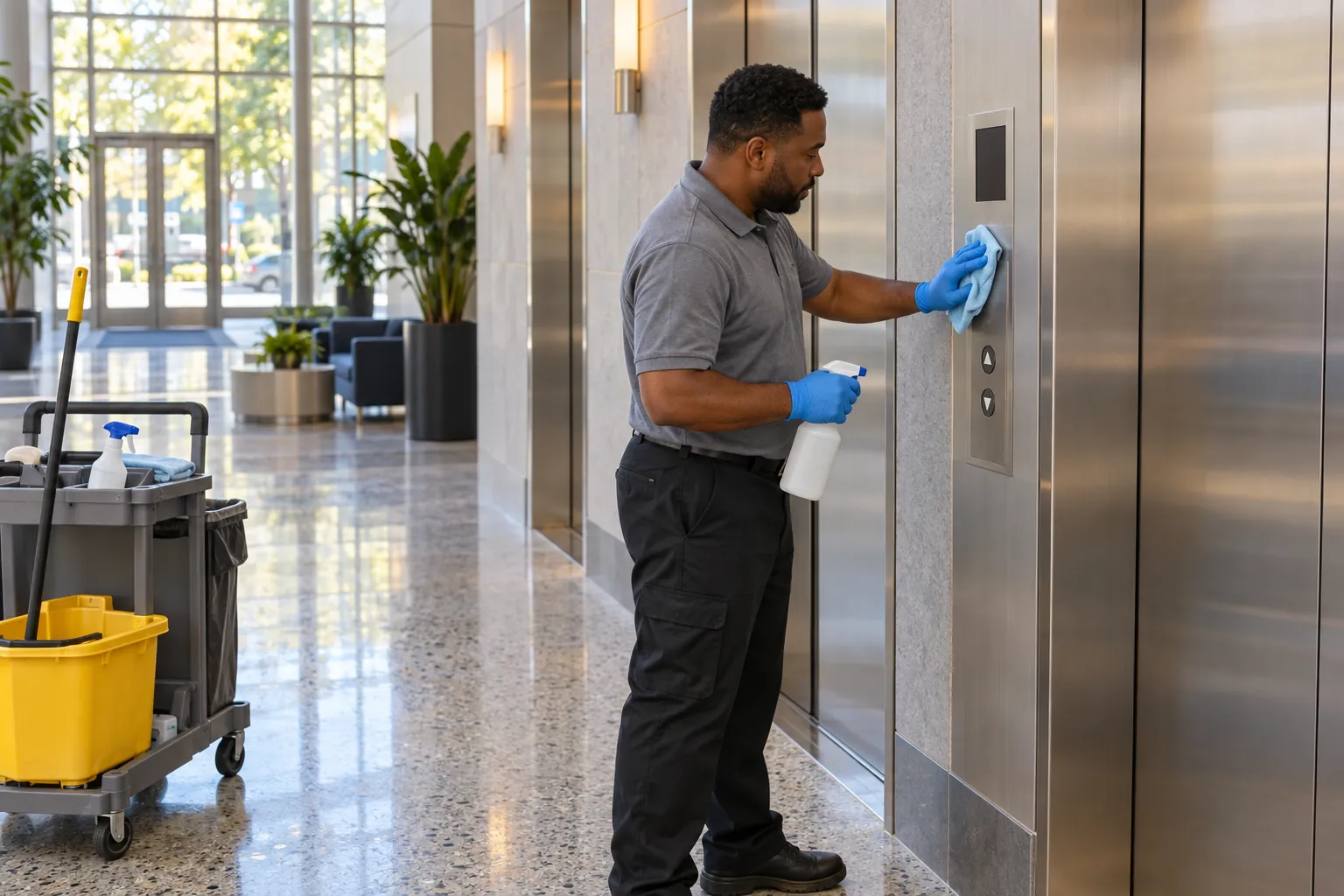
- Corridors, stairwells and elevators: floors, handrails, door handles, elevator buttons, drinking fountains and bottle fillers, and exit routes kept clear.
- Lobbies and front desks: entrance matting, glass, the mail room and package lockers.
- Lounges, study rooms and multipurpose rooms: furniture, whiteboards and floors.
- Laundry rooms: machines, floors and folding tables.
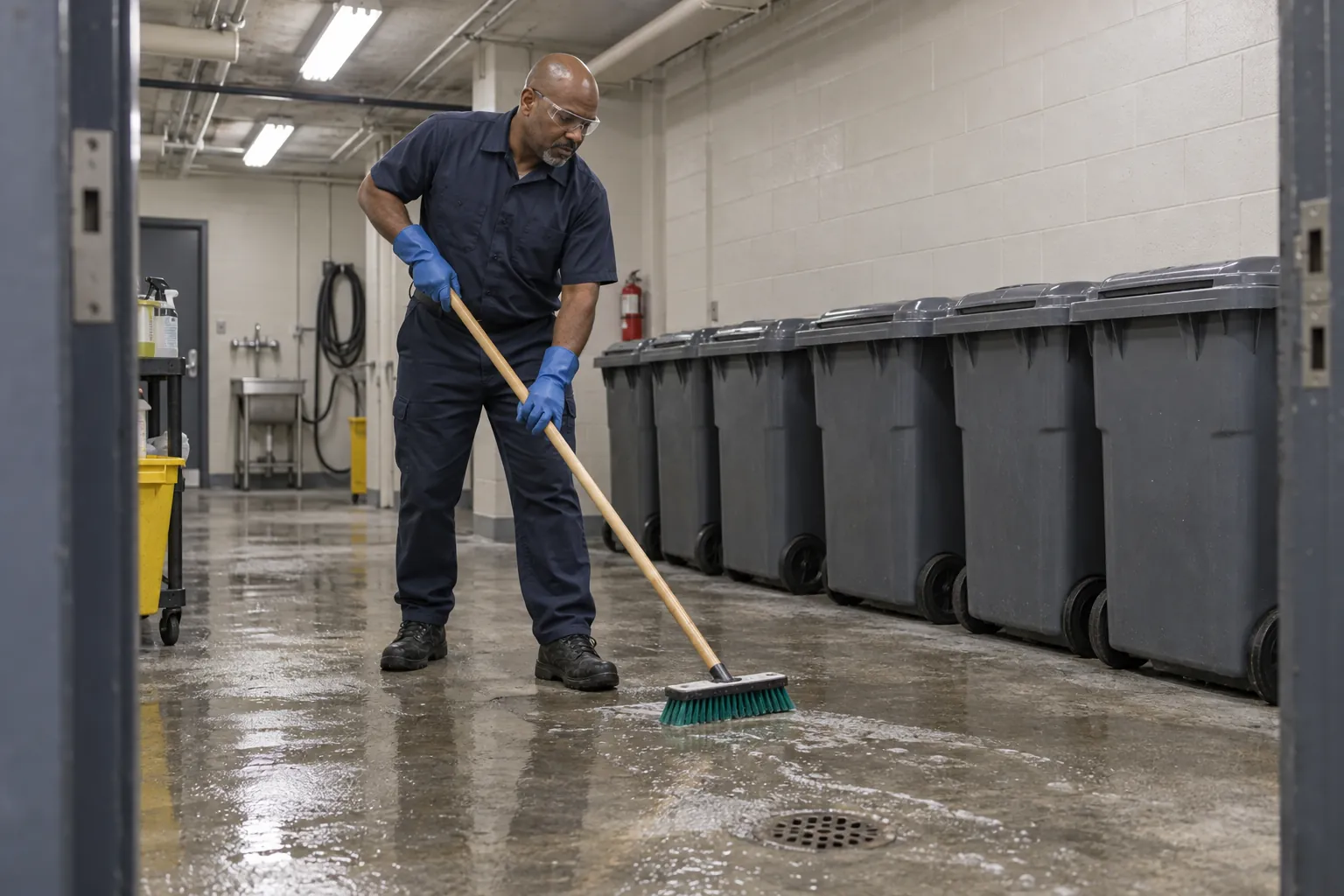
- Trash rooms, chutes and recycling, a frequent source of odors, pests and complaints; see the trash room cleaning guide.
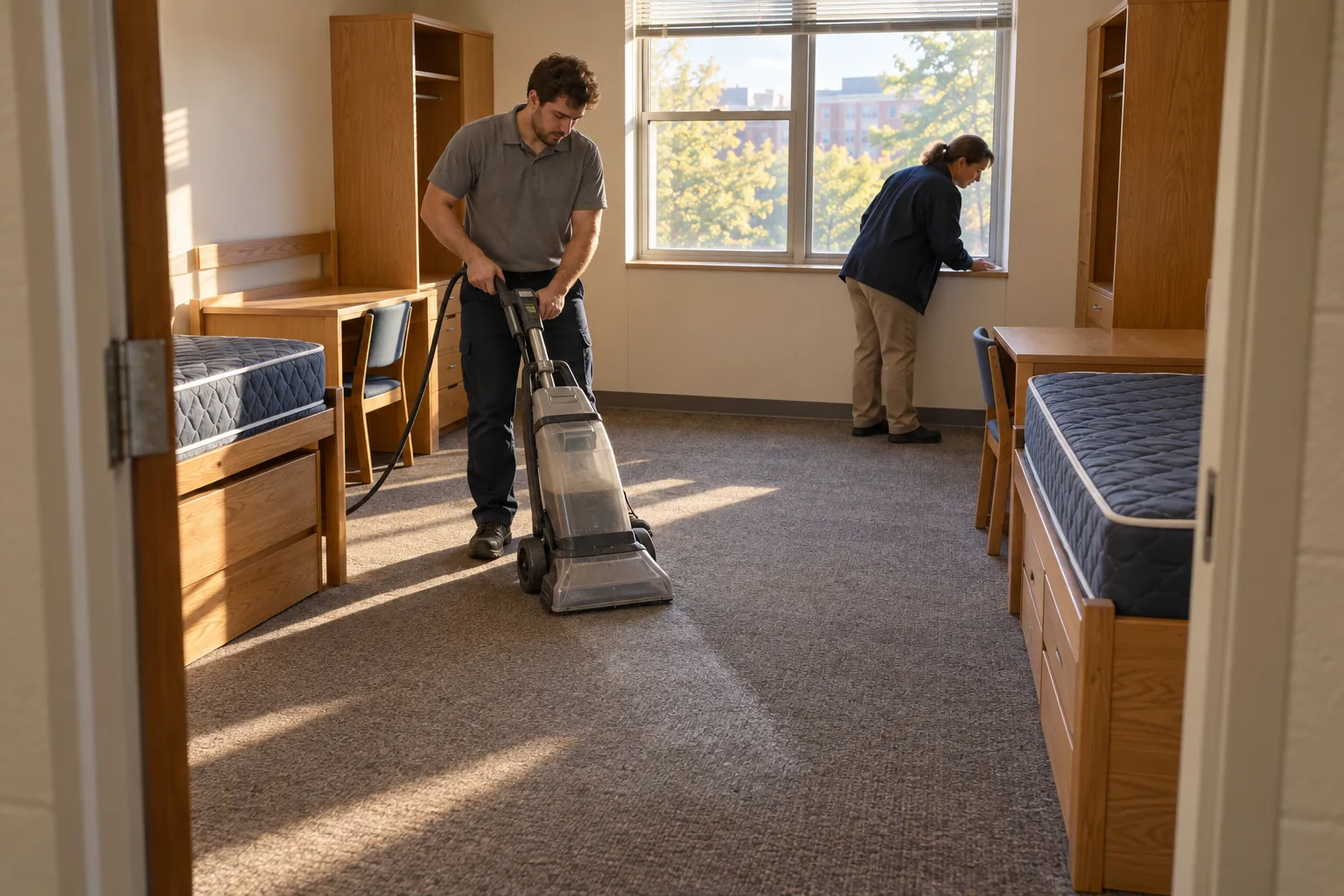
Individual student rooms are the resident's own living space during the academic year. Custodial staff clean them between occupants, at move-out and during the summer, and enter them in term only for a reported problem, an inspection or an emergency. Tell residents plainly what custodians clean for them and what is their job. Most complaints about dorm cleaning start with a different assumption about who does what.
03
Cleaning during the semester
Semester cleaning is about keeping shared spaces sanitary, safe and pleasant to live in, not picking up after residents. APPA, the association for educational facilities, publishes Operational Guidelines for Educational Facilities: Custodial, which it describes as "the industry benchmark for custodial staffing, with service-level standards, task frequencies, and matrices covering every space type on campus", built around five service levels. Many campuses use it to decide how often each space is cleaned and how many custodians that takes. A workable schedule for a large traditional hall looks something like this:
- Daily: community bathrooms, cleaned and restocked, with a second check in the evening in busy halls; lobbies, the front desk area and elevators; high-touch surfaces such as door handles, handrails and elevator buttons; trash rooms checked and cleared.
- Several times a week: corridor floors, lounges and study rooms, laundry rooms and floor kitchens.
- Weekly or biweekly: suite bathrooms where the contract includes them, stairwells, glass and baseboards.
- At the end of each semester and over breaks: carpet extraction in corridors and lounges, hard floor scrub and recoat, high dusting, vents and a deep clean of bathrooms and kitchens.
The CDC's guidance on when and how to clean and disinfect a facility is a sound basis for a residence hall. It says that "in most situations, cleaning regularly is enough to prevent the spread of germs", and that areas where people have obviously been ill, such as where someone has vomited, should be disinfected. It also says the surface "should stay wet during the entire contact time" and warns: "Do not mix products or chemicals with each other as this could be hazardous."
Set clear rules for floor kitchens and shared spaces. Custodians clean surfaces that are clear; they do not wash residents' dishes or throw away their food. When a kitchen or lounge is too cluttered to clean, the custodian should record it, with a photo, and the resident assistant (RA) or hall director should take it up with the floor.
Watch for the problems that are cheaper to catch early:
- Mold on shower ceilings, around windows and behind furniture, often from poor ventilation and wet towels. EPA's Mold Remediation in Schools and Commercial Buildings Guide advises: "Clean and dry wet or damp spots within 48 hours." Clean the surface and report the cause as a work order.
- Bed bugs: students bring them back from travel and move them between rooms. EPA's page on controlling bed bugs using integrated pest management says control "is most effective when an IPM approach is implemented with diligent participation by the residents". Custodians should know the signs, report a suspected case at once, and never move furniture or bedding out of an affected room until pest control says so.
- Fire safety: fire doors propped open, furniture and trash in exit routes, tampered or covered smoke detectors, and appliances the housing contract prohibits. Custodians see these first and need a route to report them the same day.
- Resident welfare: custodians are sometimes the first to notice a room nobody has left in days, or a room in a very poor state. They should know who to tell in residence life, and should not be expected to deal with it themselves.
04
Outbreaks, vomit and blood
Residence halls, with shared bathrooms and dining, are exactly where stomach bugs spread. When residence life reports several ill students on a floor, the custodial plan should change the same day: more frequent disinfection of community bathrooms and high-touch surfaces on that floor, a product on the label list for the organism, and the extra cleans recorded.
For norovirus, the CDC's page on how to prevent norovirus advises wearing rubber or disposable gloves to wipe up the contamination, then disinfecting with "a chlorine bleach solution with a concentration of 1,000 to 5,000 ppm (5 to 25 tablespoons of household bleach [5% to 8%] per gallon of water)", left on the surface "for at least 5 minutes", or with "an EPA-registered disinfecting product against norovirus". Those products are in EPA's List G, one of the lists on its Selected EPA-Registered Disinfectants page, which reminds users that they "must read and understand the label to determine if the product is approved for the intended-use site or pest." The CDC adds that hand sanitizer does not work well against norovirus.
A spill kit on each custodial cart, or in each janitor closet, with disposable gloves, absorbent powder, a scoop, bags and a disinfectant labeled for norovirus, makes the response the same every time, so a dirty or contaminated area can be dealt with quickly by whoever finds it.
Blood, found needles and broken glass fall under the employer's bloodborne pathogens exposure control plan where custodians are expected to deal with them. Train custodians on that plan, give them a sharps container and tongs or a brush and dustpan, and make sure they know that a needle found in a room or a trash bag is reported, not just thrown away.
05
Room inspections, move-out and the summer turnover
Most housing offices record each room's condition at move-in, on a room condition report (RCR) or room condition inventory the student reviews and signs, and inspect rooms during the year for health and safety, often at each break. These records decide damage and cleaning charges at move-out, so run them consistently:
- Give notice. The housing contract says when staff may enter; tell residents when inspections will happen and what they are for.
- Use one form everywhere: cleanliness, damage, mold, smoke detector present and uncovered, windows and screens, furniture, and prohibited items under the housing contract.
- Take dated photos of anything recorded as a problem, and of each room's general condition at move-out.
- Follow up: maintenance faults as work orders, hygiene problems in writing with a date to re-check, fire safety problems at once.
The summer turnover is the hardest cleaning job of the year. Hundreds of rooms empty in May, many host summer sessions and conferences, and all must be cleaned, repaired and inspected before move-in in August. It works like a building-wide make-ready program, and many campuses add temporary custodians or contract crews for the peak. A turnover that stays on schedule usually has:
- A plan by building and floor, with the order of work, the date each room becomes free and the date it must be ready, including summer occupancy.
- A move-out inspection of every room against its RCR, recording condition, damage and anything left behind.
- A clear sequence: abandoned property and trash out first, then maintenance, painting and furniture repair, then the deep clean, so custodians are not cleaning rooms the trades will come back to.
- A deep clean standard for each room type: mattresses checked, floors extracted or scrubbed, closets and drawers wiped out, windows, blinds and sills, vents, and suite bathrooms and kitchenettes descaled and degreased.
- A room-ready sign-off by a custodial supervisor who did not do the clean, before the room goes back to the housing office.
The usual failure is a backlog nobody sees until late July: rooms marked clean that were never inspected. Track progress room by room, every day, against the plan.
06
Where the residence hall record fails, and what SiteClara does about it
Residence halls are often run from spreadsheets and a paper sheet taped inside each community bathroom door. A parent says the bathroom on the third floor has not been cleaned all week; the custodial crew says it was cleaned every morning; the sheet is initialed for the whole week in the same pen. In July, the turnover spreadsheet shows every room ready while the supervisor knows the true number is lower.
SiteClara puts a printed QR poster at each location, such as a community bathroom, a floor kitchen or a trash room, or each room during the turnover, with an optional NFC tag behind it. Custodians scan the code or tap the tag on their own phone, with no app to install. They see the checks due at that location and mark each one done, or say what stopped them, such as a kitchen too cluttered to clean or no supplies, with a photo when one is asked for. A problem found there, such as mold, a leaking shower valve or a propped fire door, goes onto the team's list of jobs until someone closes it.
The custodial supervisor sees what is due, done and missed, and the open jobs grouped by building and floor, and can record why a check was missed. A job that needs the building's manager can be escalated to them to answer. The housing office and a contract janitorial company can work on the same site. Each day the supervisor reviews and approves a short report, which goes to nominated contacts, such as the director of housing or the facility manager, at 8 a.m. the next morning, showing what was reported, what was completed, what is still open and how the scheduled checks went.
07
Questions people ask
Do college dorms get cleaned?
Yes, but usually only the shared spaces during the semester. The University of Texas at Austin's What to Bring and Leave Behind guide says its custodial staff clean residence hall common areas and community bathrooms daily, and that residents are responsible for cleaning all areas inside their room or suite, including private or connecting bathrooms. Some colleges go further: UC Santa Barbara's How often are the residence halls cleaned? answer says its housekeeping staff clean residents' rooms every other week and the hallways, bathrooms and lounges daily. The housing contract for each hall says which applies.
What is the best way to clean a dorm room?
Clean first, then disinfect only where it is needed. The CDC's guidance on when and how to clean and disinfect a facility says to clean surfaces with soap and water or a product suited to the surface, to clean high-touch surfaces such as door handles, counters, desks and restroom fixtures regularly, and to clean before disinfecting, because dirt can make it harder for disinfecting chemicals to kill germs. It says regular cleaning is enough in most situations, and that areas where someone has obviously been ill, such as where they have vomited, should be disinfected, with gloves worn and the room ventilated.
08
Where to read more, and a list to take away
OSHA publishes its standards in full on osha.gov; check your state plan first. The CDC, EPA and APPA pages cited above are the places to start for cleaning, disinfection, mold, bed bugs and custodial service levels, and your campus Clery or fire safety office can explain how fires in student housing are logged.
Before the next academic year, check that:
- the custodial scope of work matches what the housing contract says the college cleans;
- residents are told plainly what custodians clean and what is their job;
- floor kitchens and lounges have a rule for clutter, with a record and a follow-up;
- custodians know how to report mold, pests, bed bugs, fire safety problems and welfare concerns the same day;
- every cart or closet has a spill kit and a disinfectant labeled for norovirus;
- room inspections use one form, with notice given and dated photos;
- the summer turnover has a plan by building, a clear sequence and a room-ready sign-off, tracked room by room every day.
Sources
Every document this guide quotes or links to, in the order it first cites them.
- 29 CFR 1910.22 osha.gov
- 29 CFR 1910.141 osha.gov
- OSHA Hazard Communication Standard, 29 CFR 1910.1200 osha.gov
- OSHA Bloodborne Pathogens Standard, 29 CFR 1910.1030 osha.gov
- NFPA 101, Life Safety Code nfpa.org
- 20 U.S.C. 1092(i) govinfo.gov
- OSHA's State Plans overview osha.gov
- Operational Guidelines for Educational Facilities: Custodial appa.org
- When and how to clean and disinfect a facility cdc.gov
- Mold Remediation in Schools and Commercial Buildings Guide epa.gov
- Controlling bed bugs using integrated pest management epa.gov
- How to prevent norovirus cdc.gov
- Selected EPA-Registered Disinfectants epa.gov
- What to Bring and Leave Behind housing.utexas.edu
- How often are the residence halls cleaned? housing.ucsb.edu
Related guides
 Premises and facilities managementThe apartment make-ready checklist: how to turn a unit properly, and prove itAn apartment make-ready checklist room by room: the order of work, the safety items HUD, EPA and state law require, and the photos and sign-off that prove it.
 CleaningRestroom cleaning log: what to record, and how to make it believableWhat a restroom cleaning log should record, how often to check, the OSHA and Food Code rules behind it, and how to keep a log a client or inspector will believe.
 CleaningHigh-touch surfaces: a cleaning routine you can show was doneHigh-touch surfaces as the CDC describes them: which ones to list area by area, how often to clean and disinfect them, the right method, and a record that holds up.
 CleaningTrash room cleaning: the codes, the schedule and the recordHow to keep a trash room clean, safe and pest-free: the property maintenance, fire and OSHA rules behind it, a cleaning schedule, and what to record.