Premises and facilities management
Rope descent systems: what OSHA 1910.27 asks of building owners and window cleaning contractors
A rope descent system (RDS) is the roof anchorage, support rope, descent device and seatboard that lets a window cleaner lower themselves down a building face, and under OSHA's 29 CFR 1910.27(b) it may not be used until the building owner has told the employer in writing that each anchorage has been identified, tested, certified and maintained to support at least 5,000 pounds in any direction for each worker attached.
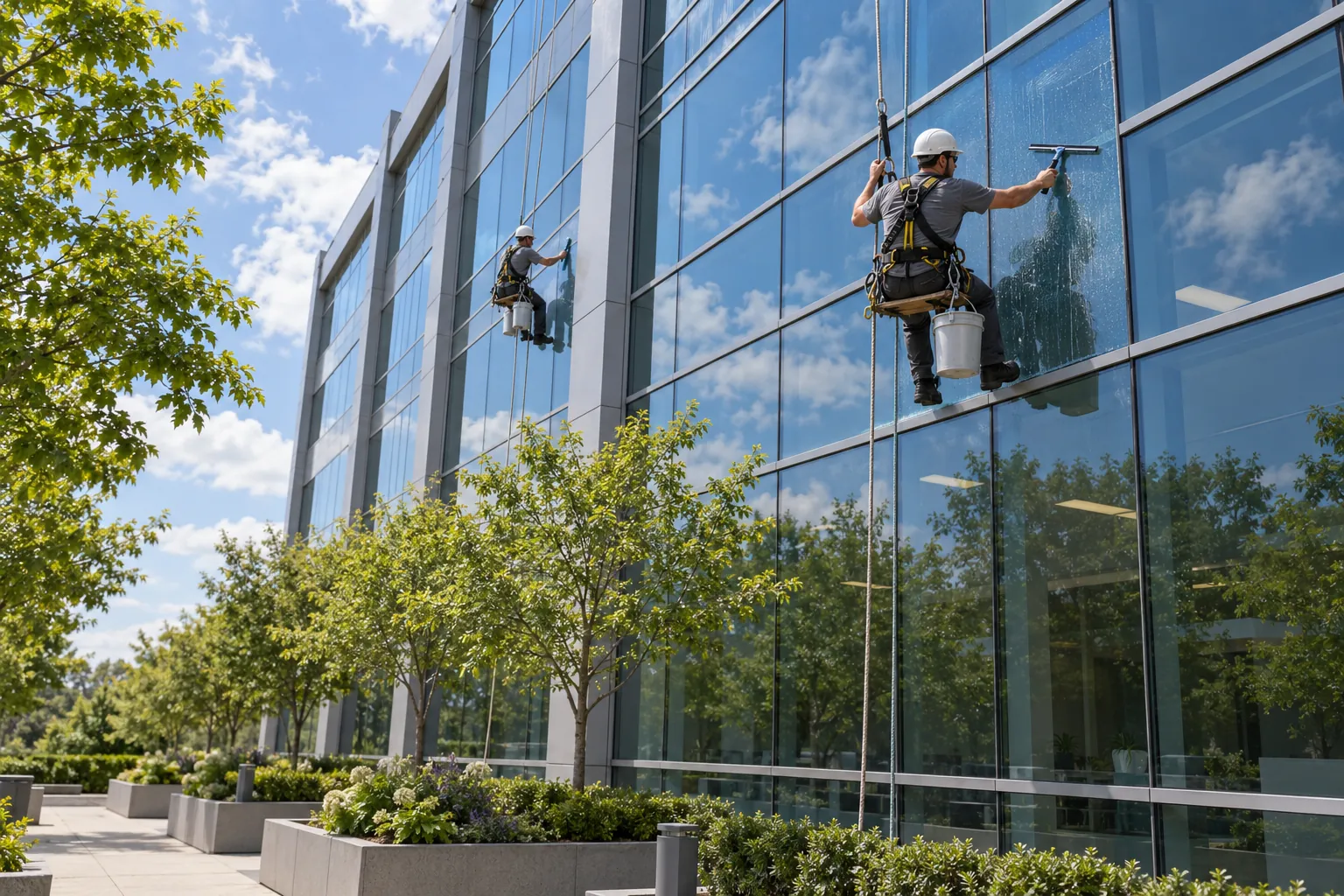
That one sentence splits the job in two. The building owner answers for the roof anchors: an annual inspection by a qualified person and certification at least every 10 years. The window cleaning contractor answers for everything that hangs from them: the training, the equipment check at the start of each shift, the separate fall arrest line and the plan for rescue. This guide covers both sides, and the record that shows the anchors were fit to use.
01
What OSHA's rope descent system rule says
Rope descent systems are regulated for general industry by 29 CFR 1910.27, Scaffolds and rope descent systems, part of the Walking-Working Surfaces rule OSHA published in November 2016. OSHA's definitions in 29 CFR 1910.21 describe a rope descent system as "a suspension system that allows an employee to descend in a controlled manner and, as needed, stop at any point during the descent", usually made up of "a roof anchorage, support rope, a descent device, carabiner(s) or shackle(s), and a chair (seatboard)." It is also called controlled descent equipment or apparatus.
The anchorage paragraph, 1910.27(b)(1)(i), reads: "Before any rope descent system is used, the building owner must inform the employer, in writing that the building owner has identified, tested, certified, and maintained each anchorage so it is capable of supporting at least 5,000 pounds (2,268 kg), in any direction, for each employee attached. The information must be based on an annual inspection by a qualified person and certification of each anchorage by a qualified person, as necessary, and at least every 10 years."
The employer's side is 1910.27(b)(1)(ii): the employer "must ensure that no employee uses any anchorage before the employer has obtained written information from the building owner that each anchorage meets the requirements", and "must keep the information for the duration of the job." Both duties applied from November 20, 2017.
The rule places a written duty on the building owner, who may employ nobody on the rope. A property manager or facility manager acting for the owner is usually the person who has to produce the letter when the window cleaning contractor asks for it.
02
What the rule covers, and what it does not
OSHA's FAQ says employers have used rope descent systems "for exterior building cleaning, particularly window cleaning; maintenance; and inspection operations." In practice the rule reaches any building where a contractor drops a line from the roof to wash windows, clean or seal the facade, inspect it or carry out a small repair. It covers:
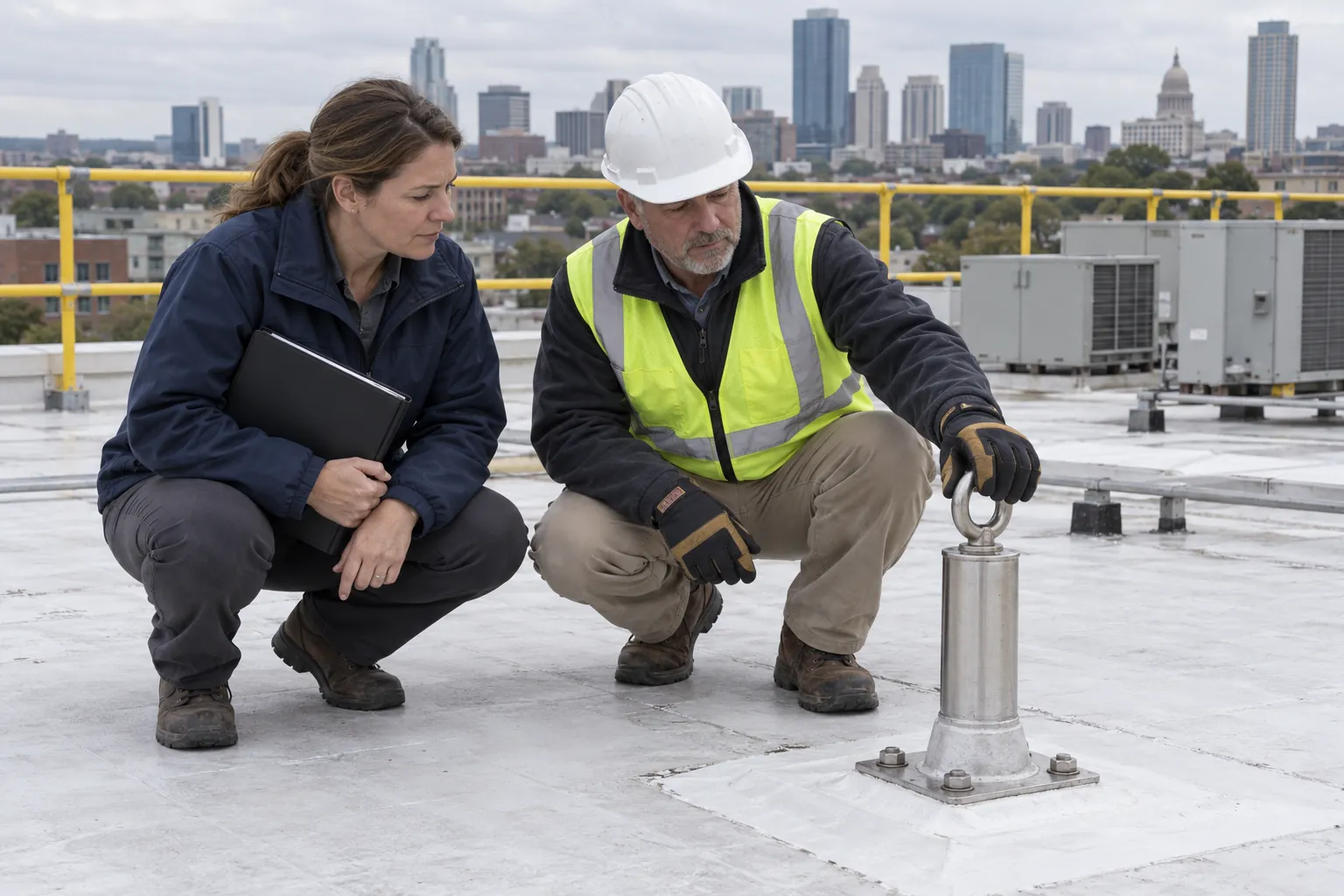
- Permanent roof anchors. OSHA's enforcement memorandum of November 20, 2017 describes rope descent system anchorages as "devices installed specifically to support an RDS or fixed structural members of a building, such as posts, beams, girders, and columns that may also serve as RDS anchorages in some cases." A structural member used as an anchor needs the same identification and certification as a purpose-made window washing anchor.
- Davits and similar arms. In a 2020 letter on rope descent systems used with davit booms, OSHA accepted a davit with two independent anchor points on the same boom, one for the support line and one for the lifeline, provided each anchor meets its own requirement.
- Non-permanent rigging. Paragraph (b)(2)(v) requires proper rigging "with particular emphasis on providing tiebacks when counterweights, cornice hooks, or similar non-permanent anchorages are used." The tieback goes to an anchorage, so the roof still needs certified anchor points.
- The fall arrest anchor. Each worker must use a separate, independent personal fall arrest system, and 29 CFR 1910.140(c)(12) requires anchorages for personal fall protection to "be independent of any anchorage used to suspend employees or platforms on which employees work." Under 1910.140(c)(13), that fall arrest anchorage must support at least 5,000 pounds for each employee attached, or be part of a complete system designed, installed and used under a qualified person's supervision with a safety factor of at least two. Every drop therefore needs at least two independent anchor points.
It does not cover:
- Industrial rope access. The definition ends: "Rope descent systems do not include industrial rope access systems." OSHA's 2020 letter to the International Window Cleaning Association on rope access confirms that 1910.27(b), including the anchorage certification duty, does not apply to industrial rope access, which falls under OSHA's other fall protection rules, with anchorage requirements in 1910.140(c)(12) and (c)(13).
- Powered platforms. Permanently installed platforms for building maintenance are covered by 29 CFR 1910.66, Powered platforms for building maintenance, which has its own duty on building owners to inform the employer in writing that the installation has been inspected, tested and maintained.
- Scaffolds. Under 1910.27(a), scaffolds used in general industry must meet the construction rules in 29 CFR 1926, Subpart L.
03
Roof anchor certification: what the building owner must do
The owner's duty has four verbs: identify, test, certify and maintain. Each has to be true of every anchorage a contractor might use, and the written information has to be in the contractor's hands before the first descent.
- Identify every anchorage. Know where each anchor, davit base and structural member used as an anchorage is, and which drops it serves. A roof plan with each anchor numbered is the practical answer, because the letter has to describe the anchors the crew will actually use.
- Have each one inspected every year by a qualified person. OSHA's definition of qualified in 1910.21 is a person "who, by possession of a recognized degree, certificate, or professional standing, or who by extensive knowledge, training, and experience has successfully demonstrated the ability to solve or resolve problems relating to the subject matter, the work, or the project." The annual inspection is not a walk by the building engineer.
- Have each one certified as necessary, and at least every 10 years. Certification by a qualified person usually means testing. In a 2019 letter on rope descent system anchorage testing, OSHA said the standard "does not specify criteria for testing anchorages", so the qualified person "may utilize any scientifically-valid testing criteria", generally criteria accepted by an industry consensus group or certified by a registered professional engineer. It accepted the method in ANSI/IWCA I-14.1-2001, the window cleaning safety standard, of testing an anchor with a 5,000-pound ultimate capacity at 2,500 pounds, twice its 1,250-pound design load.
- Maintain them between inspections. The 2017 memorandum recognizes that an anchorage can fall "out of compliance due to damage or shock loading." An anchor that has arrested a fall, been struck, corroded, or been disturbed by reroofing or new rooftop equipment needs the qualified person again before anyone hangs from it. That is the "as necessary" in the rule.
- Inform each employer in writing. Before any rope descent system is used, every contractor who will use the anchors gets the written information. The employer must keep it for the duration of the job, so a copy goes to each new contractor and each new job, not only the first.
OSHA's 2017 memorandum told its compliance officers to "review the building owner's written records" for each of those steps: identification, annual inspection, testing and certification "as frequently as necessary and at least every 10 years", maintenance, and the notice to the employer. Those records are what an owner should be able to produce.
04
What the window cleaning contractor must do on the day
Once the anchors are covered, paragraph (b)(2) of 1910.27 makes the employer responsible for how the system is used. In summary, it requires:
- a 300-foot limit above grade, unless the employer shows that no other means of reaching that height is feasible, or that those means are more hazardous than a rope descent system;
- use under the manufacturer's instructions and limits, or a qualified person's direction, by workers trained under 29 CFR 1910.30, Training requirements, which covers "proper rigging and use of the equipment";
- an inspection "at the start of each workshift that it is to be used", with damaged or defective equipment removed from service immediately;
- proper rigging, including tiebacks, and a separate, independent personal fall arrest system for each worker;
- 5,000-pound components, except the seatboard, which must support a live load of 300 pounds;
- "Prompt rescue of each employee" in the event of a fall;
- ropes padded at edges and kept away from open flames, hot work and corrosive chemicals, and stabilization for descents greater than 130 feet;
- no use in "storms or gusty or excessive wind", and tools, squeegees and buckets secured against falling.
Two other rules apply on the roof and below it. Rigging at the parapet is work near a roof edge, so 29 CFR 1910.28, Duty to have fall protection and falling object protection applies: on a low-slope roof, work less than 6 feet from the edge needs a guardrail, safety net, travel restraint or personal fall arrest system. Where employees are exposed to falling objects, 1910.28(c) requires head protection and one or more controls, such as barricading the area into which objects could fall and keeping employees out of it.
The owner has a part in the day too, though the rule does not list it: opening the roof, telling the crew what has changed since the last inspection, keeping other trades' hot work away from the ropes, and agreeing how people are kept out of the drop zone.
05
What a sound anchor record looks like
Two files matter: the owner's anchor file, which proves the anchors are fit to use, and the contractor's job file, which proves the crew used them properly. For the building owner, a record that holds up has:
- A roof plan with every anchorage numbered, including davit bases, tieback points and any structural member used as an anchorage, with the drops each one serves.
- An anchor register, one line per anchor: its number, type and location, the date of the last annual inspection and who did it, the date and method of the last certification and test, and the date the next of each falls due.
- The qualified person's reports, kept in full, with any anchor found defective, the repair or replacement and its recertification.
- Anchors out of service, marked on the plan and in the register until they are repaired and recertified, so no crew rigs from them.
- A copy of each written notice given to a contractor, with the date and the anchors it covered.
- A record of roof work that could disturb an anchor: reroofing, new rooftop units, antennas or solar panels, and anything a contractor reports as damaged.
For the contractor, the file for each job holds the owner's written information, the training record for each worker on the ropes, the start-of-shift equipment inspection, the rescue plan for that building and the decision on weather each day.
Between the qualified person's visits, the building team can still look. A glance at each anchor on the regular roof walk and after a storm, noting corrosion, a bent eye, a cracked seal around a base or roofing work nearby, inspects and certifies nothing, but it catches the damage that should bring the qualified person back early.
Set the annual inspection date in the building's maintenance calendar well before the window cleaning season, so a failed anchor can be repaired and recertified without cancelling the job.
06
Where the record fails, and what SiteClara does about it
Anchor records fail in quiet ways. The certification letter is a PDF in a former property manager's inbox, and nobody can find the report it was based on. The roofing contractor replaces the membrane around two anchor bases, and nobody tells the anchor inspector. A building engineer notices a corroded eye on the roof walk, mentions it to the window cleaning foreman in the loading dock, and it is never written down. The new contractor arrives in spring, asks for the written information, and the owner sends last year's letter for an inspection that is now overdue.
SiteClara records routine checks and reports at the place they happen. A printed QR poster, with an optional NFC tag behind it, goes where the check starts, such as inside the roof hatch or at the door to the roof. The building engineer or technician on the regular roof walk scans the code or taps the tag on their own phone, with no app to install, sees the checks due there, such as a look at each anchor for visible damage after a storm, and marks each one done or says what stopped them. A defect, such as a bent anchor or roofing work around an anchor base, is reported there with a photo and stays on the team's list of jobs until someone closes it.
The supervisor sees what is due, done and missed, and can record why a check was missed; a job that needs the building manager, such as booking the qualified person early, can be escalated to them to answer. Each day the supervisor reviews and approves a report that goes to nominated management or client contacts at 8 a.m. the next morning, showing what was reported, completed and still open, and how the scheduled checks went. When the next contractor asks about the anchors, that working record shows what the building team saw on the roof since the last inspection, and when.
07
Questions people ask
How often do roof anchors need to be certified under OSHA?
At least every 10 years, and sooner when necessary, with an inspection by a qualified person every year. 29 CFR 1910.27(b)(1)(i) requires the building owner's written information to be "based on an annual inspection by a qualified person and certification of each anchorage by a qualified person, as necessary, and at least every 10 years."
Does an anchor have to be tested at 5,000 pounds?
Not necessarily. In its 2019 letter on anchorage testing, OSHA said the qualified person may use any scientifically valid testing criteria to show the anchorage can support at least 5,000 pounds per attached worker, and accepted a proof test at 2,500 pounds for an anchor with a 5,000-pound ultimate capacity and a four to one safety factor. OSHA said testing to the full ultimate capacity of 5,000 pounds is also acceptable.
What are the OSHA requirements for rope access systems?
Industrial rope access is not a rope descent system, so 1910.27(b) and its anchorage certification duty do not apply to it. OSHA's 2020 letter to the International Window Cleaning Association on rope access says its other fall protection standards apply instead, including 29 CFR 1910.28, 1910.29, 1910.30 and 1910.140, with the anchorage requirements in 1910.140(c)(12) and (c)(13).
08
Further reading, and a checklist to take away
Read the rule itself in 29 CFR 1910.27, the rope descent system section of OSHA's Walking-Working Surfaces FAQ, and the November 20, 2017 enforcement memorandum on rope descent system anchorages, which lists the records OSHA expects building owners and employers to hold. The window cleaning industry's consensus standard is ANSI/IWCA I-14.1-2001, published by the International Window Cleaning Association. In a State Plan state, read your state's rule as well; in California that is Title 8, Article 5, Window Cleaning.
Before the next crew goes over the edge, check that:
- every anchorage on the roof, including davits and structural members used as anchors, is numbered on a roof plan;
- each anchorage had an inspection by a qualified person within the last year, and certification within the last 10 years and since any damage, shock load or roofing work;
- the qualified person's reports are on file and match the written information you give the contractor;
- each contractor received the written information before the first descent, and you kept a copy;
- the contractor has a rescue plan for your building and trained workers with independent fall arrest lines;
- the building team reports visible damage to an anchor at once, with a photo, and the qualified person is called before the anchor is used again.
Sources
Every document this guide quotes or links to, in the order it first cites them.
- 29 CFR 1910.27, Scaffolds and rope descent systems osha.gov
- 29 CFR 1910.21 osha.gov
- State Plans page osha.gov
- Walking-Working Surfaces FAQ osha.gov
- Title 8, section 3286 dir.ca.gov
- Enforcement memorandum of November 20, 2017 osha.gov
- 2020 letter on rope descent systems used with davit booms osha.gov
- 29 CFR 1910.140(c)(12) osha.gov
- 2020 letter to the International Window Cleaning Association on rope access osha.gov
- 29 CFR 1910.66, Powered platforms for building maintenance osha.gov
- 2019 letter on rope descent system anchorage testing osha.gov
- 29 CFR 1910.30, Training requirements osha.gov
- 29 CFR 1910.28, Duty to have fall protection and falling object protection osha.gov
Related guides
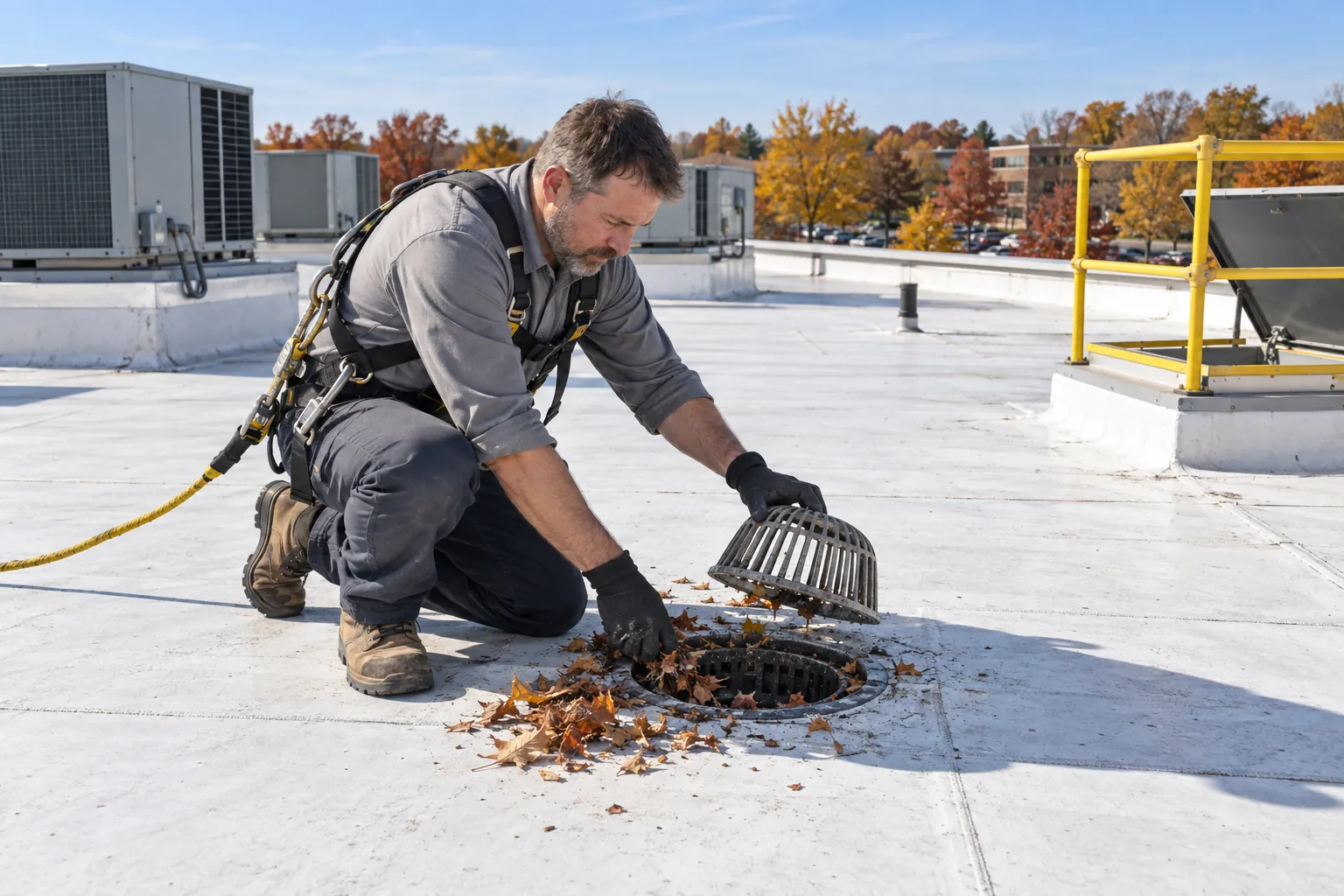 Premises and facilities managementCommercial roof inspection checklist: what to check, how often, and how to do it safelyA commercial roof inspection checklist: what to check, how often, who goes up, what OSHA 1910.28 requires on a low-slope roof, and a record that holds up.
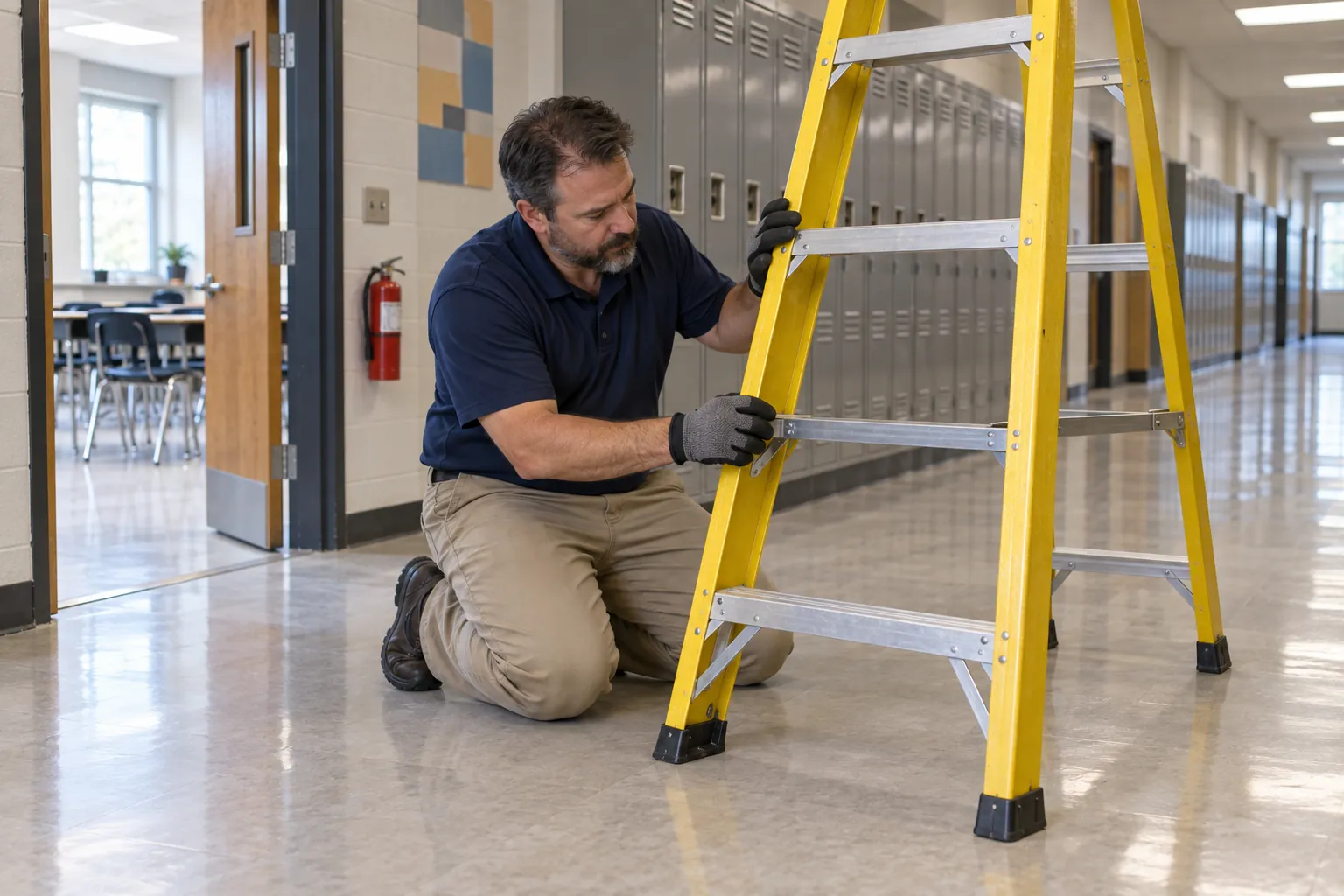 Premises and facilities managementLadder inspection: what OSHA requires, and a checklist people actually useWhat OSHA 29 CFR 1910.23 says about inspecting ladders each shift, a checklist for stepladders, extension, fixed and rolling ladders, and what to do with a defect.
 Premises and facilities managementBuilding maintenance checklist: what the code expects, how often to check, and who does itA building maintenance checklist for US commercial buildings, built on the International Property Maintenance Code: daily to annual tasks, who does each, the record.
 Premises and facilities managementProperty manager responsibilities: the job, the law and the recordWhat a property manager does for an owner: leasing, rent, budgets, repairs and vendors, and the licensing, fair housing and landlord-tenant laws behind the job.