Premises and facilities management
Ladder inspection: what OSHA requires, and a checklist people actually use
A ladder inspection is a check of a ladder for visible defects, such as cracked rails, loose rungs, worn feet or a spreader that will not lock, and OSHA requires one before the ladder is first used in each work shift.
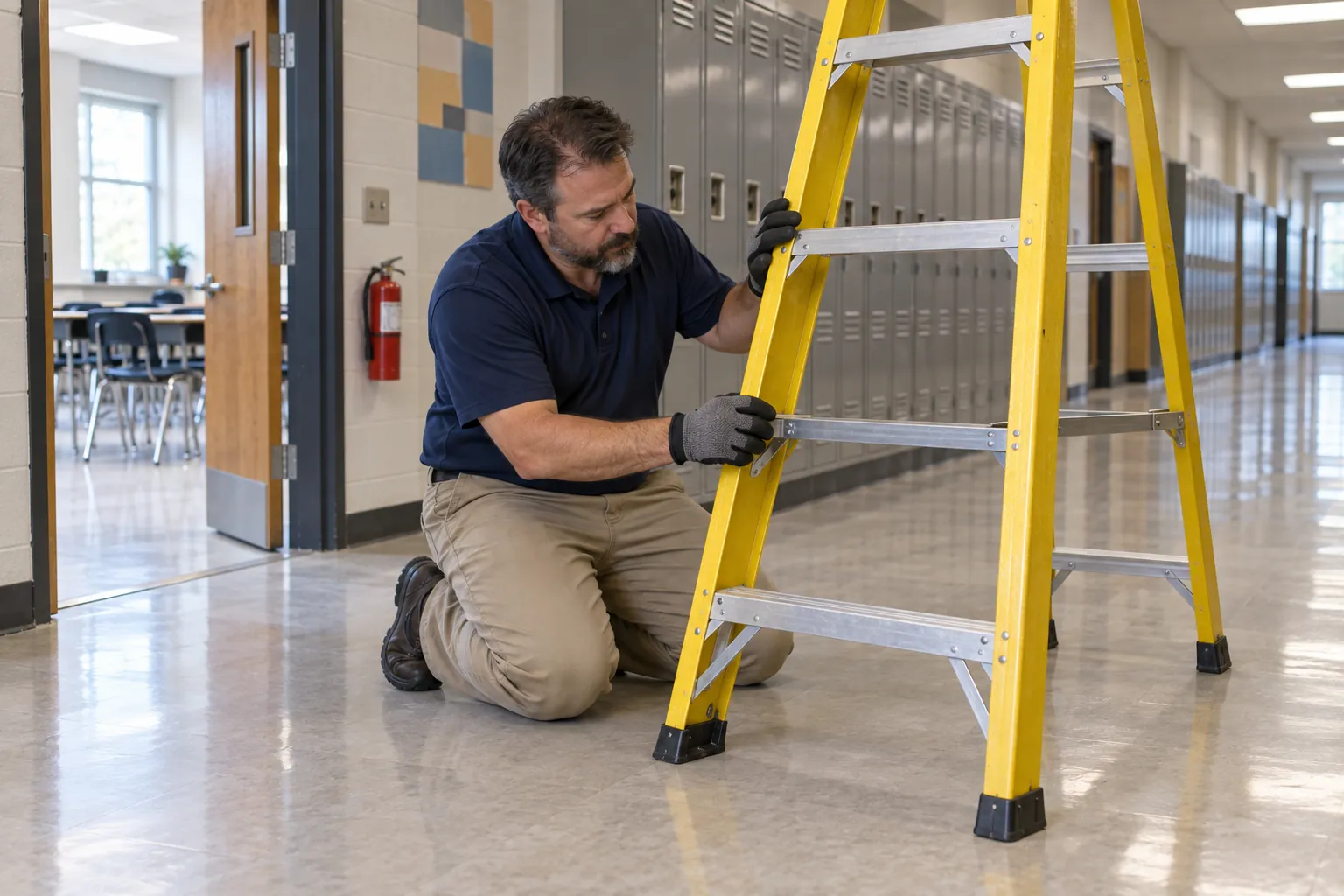
A ladder with a defect has to be tagged and taken out of use at once. Those are two sentences of OSHA's ladder standard; the checklist, the routine and the record are up to the employer. This guide covers what 29 CFR 1910.23 says, what a ladder inspection checklist should cover for stepladders, extension ladders, fixed ladders and rolling ladder stands, who should do it and when, what happens to a defective ladder, and how to keep a record that shows the check really happened.
01
What OSHA requires: 29 CFR 1910.23
For general industry, which covers offices, schools, stores, hospitals, warehouses and most of the buildings facility teams look after, ladders are governed by 29 CFR 1910.23, Ladders, part of the walking-working surfaces rule in Subpart D. It applies to every ladder except those used in emergency operations such as firefighting and rescue, and ladders designed into or forming part of a machine or piece of equipment. Portable stepladders, extension ladders, fixed ladders to roofs and mezzanines, and mobile ladder stands are all in scope.
The inspection duty is in paragraph (b)(9). The employer must ensure that "ladders are inspected before initial use in each work shift, and more frequently as necessary, to identify any visible defects that could cause employee injury." Paragraph (b)(10) says what happens next: any ladder with structural or other defects is "immediately tagged 'Dangerous: Do Not Use' or with similar language", in accordance with the accident prevention tag rule at 1910.145, and removed from service until it is repaired or replaced.
Behind both sits the general inspection duty for all walking-working surfaces in 29 CFR 1910.22. Paragraph (d)(1) requires surfaces to be "inspected, regularly and as necessary, and maintained in a safe condition"; (d)(2) requires a hazardous condition to be "corrected or repaired before an employee uses the walking-working surface again"; and (d)(3) requires a qualified person to perform or supervise the repair where structural integrity is involved.
The check is per shift, not per week, so a ladder used by day and again at night is looked at by each shift. And the standard asks for visible defects: this is a look-and-feel check, not a teardown.
02
What a ladder inspection checklist covers
A good checklist is short enough to be used at the start of every shift and specific enough to catch what actually goes wrong. Start with the checks that apply to every ladder, then add the ones for its type. The ladder's own labels come first: OSHA's Portable Ladder Safety QuickCard tells users to "read and follow all labels/markings on the ladder".
Every ladder:
- Labels and markings present and readable, including the maximum load. Paragraph (c)(3) says ladders are "not loaded beyond the maximum intended load", and the QuickCard reminds users to count the weight of tools and materials they carry.
- Side rails straight, with no cracks, splits, bends, dents, or burn or chemical damage.
- Rungs, steps and cleats present, tight and undamaged; on portable metal ladders, the corrugated, knurled, dimpled or skid-resistant surface that (c)(1) requires is not worn smooth.
- No oil, grease, paint, mud or other slippery material on the rungs, steps or feet.
- Rivets, bolts, hardware and fittings all present and tight.
- No sharp edges, burrs or splinters that could puncture or cut a hand, which (b)(7) rules out.
- Wooden ladders not painted or coated with anything that could hide a defect, which (b)(5) prohibits; a clear finish is fine.
Stepladders, the ladders custodians and building engineers use most:
- The metal spreader or locking device that (c)(2) requires is present, straight, and locks fully open.
- Feet present, with their slip-resistant pads intact.
- The top cap and pail shelf secure; the cap and top step are marked as not steps, since (c)(8) forbids using them as steps.
- The ladder stands square without rocking on a level floor.
Extension and straight ladders:
- Rung locks and guide brackets work and engage fully; the QuickCard asks users to make sure "all locks on an extension ladder are properly engaged".
- The rope and pulley are not frayed, and the rope is secured.
- Feet and shoes swivel freely, with pads and spurs intact.
- The ladder is long enough for the job: a ladder used to reach an upper landing needs side rails extending at least 3 feet above it, under (c)(11).
Fixed ladders, such as roof hatch, mezzanine, elevator pit and mechanical room ladders:
- Rungs and rails secure and free of corrosion, which (b)(6) requires metal ladders to resist or be protected against.
- Anchorages to the wall or structure tight, with no loose bolts or cracked welds.
- Clearance behind the rungs not blocked by pipes, conduit or stored materials.
- Grab bars or rail extensions at the top in place and firm.
- Any cage, well, ladder safety system or anchor point in good order. 29 CFR 1910.28(b)(9) requires fixed ladders extending more than 24 feet above a lower level to have fall protection, and says that on and after November 18, 2036, all such ladders are to be equipped with a personal fall arrest system or a ladder safety system.
Mobile ladder stands and rolling platforms, common in stockrooms, libraries and warehouses: steps and treads slip-resistant, handrails firm, and the wheel locks or other device that stops the stand moving while in use working properly; under 1910.23(e)(1)(viii), no mobile ladder stand or platform moves when an employee is on it.
03
Who inspects, when, and which ladders
In most buildings the pre-use check is done by the person about to climb, which only works if they know what to look for. 29 CFR 1910.30(b)(1) requires employers to train each employee "in the proper care, inspection, storage, and use of equipment covered by this subpart before an employee uses the equipment", which includes ladders, and 1910.30(d) requires the training to be given "in a manner that the employee understands". Paragraph (c) requires retraining when there is reason to believe someone no longer has the understanding or skill.
A pre-use check by each user is the floor, not the whole program. Most facility teams add a second layer:
- Before first use each shift: the user, or the first person on the shift to take the ladder out, checks it against the card.
- After any incident: a ladder that has fallen, been struck, been exposed to heat or chemicals, or been used outside its rating is checked before it is used again, which is what "more frequently as necessary" means in practice.
- A periodic, documented inspection, often monthly or quarterly, by a supervisor, the chief engineer or a safety lead, covering every ladder on the inventory, including the spare in the basement and the fixed ladders nobody has climbed since last season.
- Fixed ladders and their fall protection on the schedule the manufacturer of any ladder safety system or anchor sets.
Know which ladders you have. Give each portable ladder a number, its type, length and duty rating, and where it lives; list fixed ladders by location, such as the roof hatch at stair 2. A ladder not on the list will not be inspected.
Construction work is different. When a ladder is used for construction, renovation or alteration, 29 CFR 1926.1053 applies. Paragraph (b)(15) requires ladders to be "inspected by a competent person for visible defects on a periodic basis and after any occurrence that could affect their safe use".
California goes further. Cal/OSHA's Title 8, Section 3276, Portable Ladders requires in (e)(2) that ladders be "inspected by a qualified person for visible defects frequently and after any occurrence that could affect their safe use", and in (f) that employees are trained in ladder safety, including maintenance and inspection, before using one. Other State Plan states may have their own rules.
04
When a ladder fails the check: tag it, take it out, repair or replace
A defective ladder has to come out of use immediately, not at the end of the shift. Under 1910.23(b)(10) it is tagged "Dangerous: Do Not Use" or with similar language and removed from service until it is repaired or replaced. The tag rule at 29 CFR 1910.145 says tags "shall contain a signal word and a major message", with the signal word "readable at a minimum distance of five feet". A piece of tape with "broken" scrawled on it is not a tag.
A workable defect routine looks like this:
- Tag it where a climber's hand would go, and move it to a quarantine spot away from the rack.
- Report it with the ladder number, the defect and a photo, to whoever decides on repair or disposal.
- Provide a replacement so nobody is tempted to use the damaged one.
- Repair it properly, or destroy it; return a repaired ladder only once the repair is checked.
Repairs have a standard to meet. Under 1910.22(d)(3), a qualified person performs or supervises a repair where structural integrity is involved, which it usually is with a ladder. The construction standard, 1926.1053(b)(18), puts it plainly: "Ladder repairs shall restore the ladder to a condition meeting its original design criteria, before the ladder is returned to use." Bending a rail back straight, bolting a splint across a cracked rail or replacing a rung with something from the hardware store does not meet that test.
A fixed ladder cannot be quarantined, so close the access instead: lock or tag the hatch or gate, and tell anyone who might need the roof or pit, including contractors and elevator mechanics. A ladder thrown out whole is often retrieved, so cut it before disposal and take it off the list.

05
Does a ladder inspection have to be written down?
1910.23 requires the inspection, the tag and the removal from service. It does not itself require the pre-use inspection to be written down, and there is no OSHA ladder inspection form.
Most employers keep a record anyway, for good reasons:
- It shows the check happened. When an OSHA compliance officer, an insurer or a client asks how you meet 1910.23(b)(9), "we tell people to check" is not an answer.
- It closes the defect loop. A dated defect is harder to lose than a comment in passing.
- It helps after a fall. A record made at the time is worth far more than a recollection.
A useful ladder inspection record has:
- the ladder's number, type and location, so the entry refers to one ladder;
- the date and time, and the name of the person who did the check;
- the result against each item, not a single tick for the whole card;
- any defect in words, with a photo where it helps;
- what was done: tagged, removed, reported, and to whom;
- for the periodic inspection, a sign-off by the person responsible, and the date the defect was closed.
Keep the pre-use check light: if the card takes five minutes, it will be filled in without looking. A dated sticker from the periodic inspection is a useful cue, but it is not a record of what was found.
06
Where the record fails, and what SiteClara does about it
Ladder records fail in familiar ways. The checklist on a clipboard in the janitor's closet has a week of ticks in the same pen, all added on Friday. The fixed roof ladder is on the monthly list but nobody has signed for it since spring, because nobody has been up. A custodian notices a cracked rail, mentions it to whoever is passing, and the ladder is back on its hook the next morning. The periodic inspection is done, but it lives in one supervisor's notebook, and when the question comes after an incident, nobody can say when that ladder was last checked or by whom.
SiteClara records routine checks and reports at the place they happen. A printed QR poster goes at each location where a check is scheduled, such as the ladder storage rack, the janitor's closet or the foot of a fixed roof ladder, with an optional NFC tag behind it. The person doing the check scans the code or taps the tag on their own phone, with no app to install, sees the checks due there, and marks each one done or says what stopped them. A defect, such as a split rail or a spreader that will not lock, is reported there with a photo and goes onto the team's list of jobs until someone closes it, so it does not depend on who happened to be passing.
The supervisor sees what is due, done and missed, and can record why a check was missed; a job that needs the building manager can be escalated to them to answer. Each day the supervisor reviews and approves a report that goes to nominated management or client contacts at 8 a.m. the next morning, showing what was reported, completed and still open, and how the scheduled checks went. After a fall or a near miss, that record shows who checked the ladders kept at that location, when, and what had been reported.
07
Questions people ask
What are OSHA requirements for ladder inspections?
Under 29 CFR 1910.23, Ladders, paragraph (b)(9), the employer must ensure ladders are "inspected before initial use in each work shift, and more frequently as necessary, to identify any visible defects that could cause employee injury". Paragraph (b)(10) requires any ladder with structural or other defects to be tagged "Dangerous: Do Not Use" or with similar language and removed from service until it is repaired or replaced. The standard does not require the inspection to be written down.
How often do ladders need to be inspected?
In general industry, before initial use in each work shift and more frequently as necessary, under 29 CFR 1910.23, Ladders, paragraph (b)(9). For construction work, 29 CFR 1926.1053, Ladders, paragraph (b)(15), requires inspection by a competent person "on a periodic basis and after any occurrence that could affect their safe use".
Do ladders have to be tagged?
Only when they are defective. 29 CFR 1910.23, Ladders, paragraph (b)(10), requires a ladder with structural or other defects to be "immediately tagged 'Dangerous: Do Not Use' or with similar language" and removed from service. The standard does not require a sound ladder to carry an inspection tag.
How do you complete a ladder inspection tag?
OSHA does not prescribe an inspection tag; the tag it does specify is the one on a defective ladder. 29 CFR 1910.145, Specifications for accident prevention signs and tags, says tags "shall contain a signal word and a major message", with the signal word readable at a minimum distance of five feet, and that they are affixed as close as safely possible to the hazard "by a positive means such as string, wire, or adhesive that prevents their loss or unintentional removal".
08
Where to read more, and a list to take away
The rule itself is 29 CFR 1910.23, Ladders, on OSHA's site, read with 1910.22 for inspection and repair and 1910.30 for training. For construction work, read 29 CFR 1926.1053. In California, read Title 8, Section 3276, and in any State Plan state check the state's own standard.
OSHA's two-page Portable Ladder Safety QuickCard is a good handout to put beside the ladder rack. NIOSH's article Ladder Safety: There's an App for That describes its free Ladder Safety app, which has an angle indicator for setting an extension ladder and information on ladder selection, inspection, accessorizing and use.
Before you rely on your ladder inspection program, check that:
- every ladder, portable and fixed, is on a numbered list with its location;
- each ladder is checked before first use on every shift, and again after any drop or impact;
- the people who check have been trained in what to look for, in a way they understand;
- the checklist separates the ladder's condition from how it is set up;
- defective ladders are tagged with a proper "Dangerous: Do Not Use" tag and moved out of reach;
- repairs meet the original design, or the ladder is destroyed;
- fixed ladders over 24 feet have fall protection, with a plan for the 2036 deadline;
- there is a periodic, documented inspection, and someone reads it;
- you know whether federal OSHA or a State Plan applies to your building.
Sources
Every document this guide quotes or links to, in the order it first cites them.
- 29 CFR 1910.23, Ladders osha.gov
- 29 CFR 1910.22 osha.gov
- OSHA's State Plans page osha.gov
- Portable Ladder Safety QuickCard osha.gov
- 29 CFR 1910.28(b)(9) osha.gov
- 29 CFR 1910.30(b)(1) osha.gov
- 29 CFR 1926.1053 osha.gov
- Title 8, Section 3276, Portable Ladders dir.ca.gov
- 29 CFR 1910.145 osha.gov
- Ladder Safety: There's an App for That cdc.gov
Related guides
 Premises and facilities managementThe forklift daily inspection: what OSHA requires, and a checklist that gets usedWhat OSHA 29 CFR 1910.178(q)(7) requires before a forklift is used, a daily inspection checklist by truck type, and what to do with a defect.
 Premises and facilities managementSafety walkthroughs: how to walk a building, talk to the crew and fix what you findWhat a safety walk is under OSHA's Recommended Practices, what to look at in a commercial building, how often to walk, how to record findings and close them out.
 Premises and facilities managementPreventive maintenance checklist: what to check in a commercial building, how often, and how to prove itA preventive maintenance checklist for commercial buildings: HVAC, electrical, fire and life safety, plumbing, how often, and what the record should show.
 Premises and facilities managementNear miss reporting: catching the close calls before they become injuriesWhat counts as a near miss, what OSHA recommends, what a near miss report should capture, and how to follow it up so people keep reporting in your buildings.