Premises and facilities management
Commercial roof inspection checklist: what to check, how often, and how to do it safely
A commercial roof inspection checklist covers the drains, the membrane and its seams, the flashing at walls, curbs and penetrations, the rooftop equipment, the edges, skylights and access, and the ceilings below, so that regular inspections find cracks, splits and blocked drains before they become leaks.
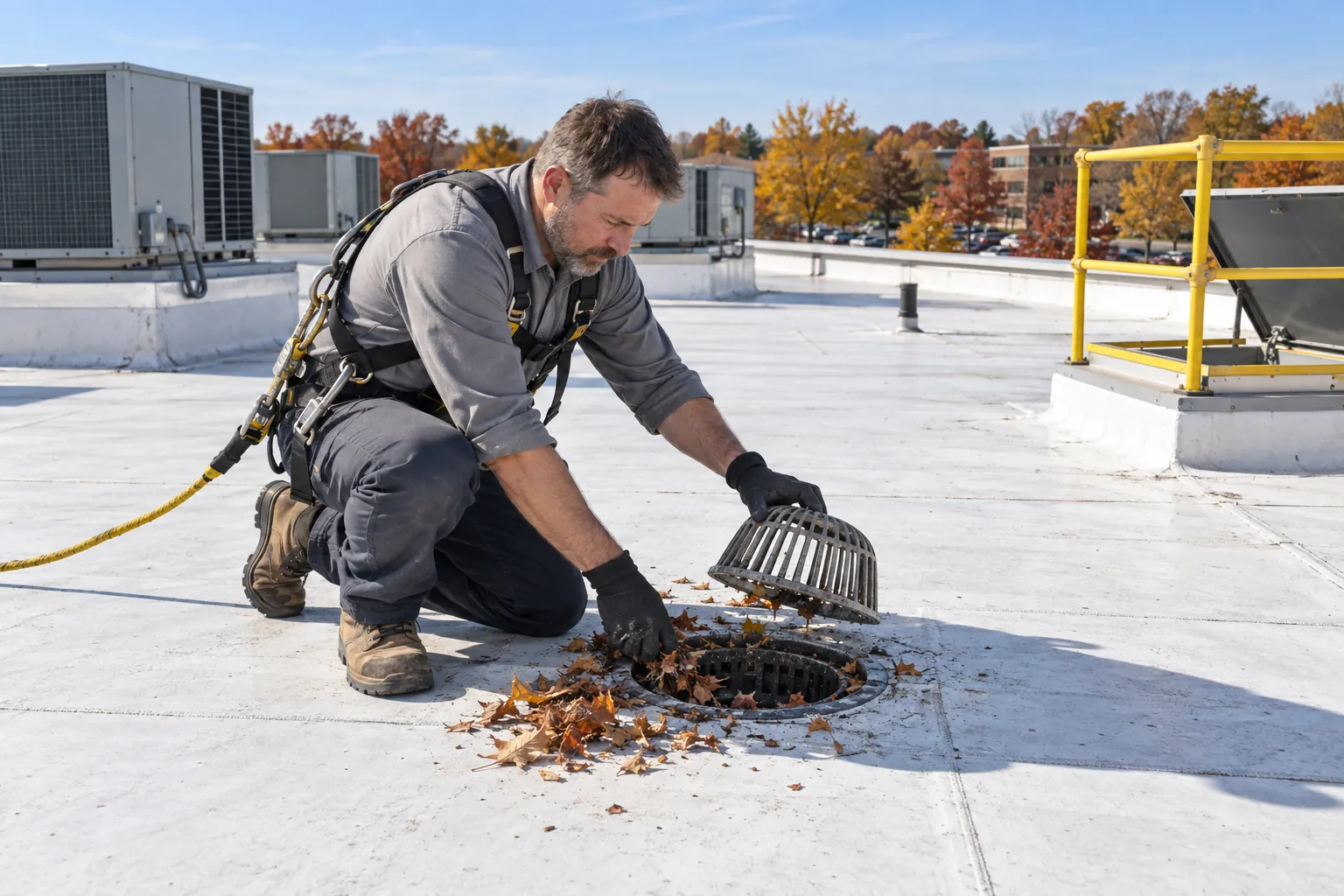
A commercial roof fails slowly and then all at once: a blocked drain, a split seam, a flashing pulled loose by a technician's hose, and then a ceiling tile on the floor of a classroom or a server room. Regular inspections catch those problems while they are cheap to fix and help prevent the major damage that follows. This guide sets out what a commercial roof inspection checklist should cover, how often to walk the roof, who should do it, what OSHA requires for the person on the roof, and how to keep a record that shows the work was actually done.
01
Is there a rule for commercial roof inspections?
No federal regulation tells a building owner how often to inspect a commercial roof. The frequency comes from the owner's maintenance program, the roof warranty, the insurer and, in some cities, local codes. What federal law does regulate is the person on the roof: for most private employers, OSHA's general industry standards in 29 CFR Part 1910, mainly Subpart D, Walking-Working Surfaces, with personal fall protection systems in 1910.140.
A roof that people walk on to inspect it, clear a drain or service a rooftop unit is a walking-working surface. The general rule in 29 CFR 1910.22 is that "Walking-working surfaces are inspected, regularly and as necessary, and maintained in a safe condition", and that "Hazardous conditions on walking-working surfaces are corrected or repaired before an employee uses the walking-working surface again." Where a repair involves the structural integrity of the surface, a qualified person performs or supervises it. The same section requires surfaces to be kept free of hazards such as "sharp or protruding objects, loose boards, corrosion, leaks, spills, snow, and ice."
Fall protection on the roof is set by 29 CFR 1910.28, which has its own paragraph for work on low-slope roofs, and the systems it allows are specified in 29 CFR 1910.29. OSHA's definitions in 1910.21 treat a low-slope roof as one with a slope of 4 in 12 or less, which covers the flat membrane roofs on most offices, schools and warehouses. Section 04 below sets out what those rules mean for the person carrying the checklist.
02
What a commercial roof inspection checklist covers
A good checklist follows the water. Most leaks start where the membrane stops, turns or is cut through, and most damage starts with water that does not drain. Walk the roof in the same order every time, zone by zone, and look at:
- Drains, scuppers, gutters and downspouts. Strainers in place and clear of leaves, gravel and debris; scuppers and overflows open; gutters attached and draining. A blocked drain is the quickest item to fix and the costliest to miss.
- Ponding. Standing water, or the stains and debris rings left where water stood after rain. Note where it forms and how large the area is.
- The field of the roof. Blisters, splits, cracks, punctures, bare spots in gravel or granule surfacing, displaced ballast and soft spots underfoot.
- Seams and laps. Open, lifting or fishmouthed seams in single-ply membranes (TPO, PVC, EPDM), and cracked or separating laps on modified bitumen and built-up roofs.
- Flashings. Base and counterflashing at walls, parapets and curbs, termination bars, sealant and pitch pans; anything pulled away, cracked or dried out.
- Penetrations. Vent stacks, conduit, gas lines, supports and every hole cut for a new service since the last inspection.
- Rooftop equipment. HVAC units and exhaust fans on sound curbs; access panels closed; condensate piped to a drain, not onto the membrane; kitchen exhaust grease contained; no screws, filters or offcuts left after service.
- Roof edges and parapets. Edge metal and coping secure, not lifted by wind; parapet walls and caps free of cracks; masonry sound.
- Skylights, smoke vents and roof hatches. Glazing and domes intact, frames sealed, guards or screens in place, hatches opening and closing properly.
- Access and fall protection. Fixed ladders and hatch rails secure; guardrails intact; warning lines standing; anchorages undamaged; walkway pads in place on the routes technicians use.
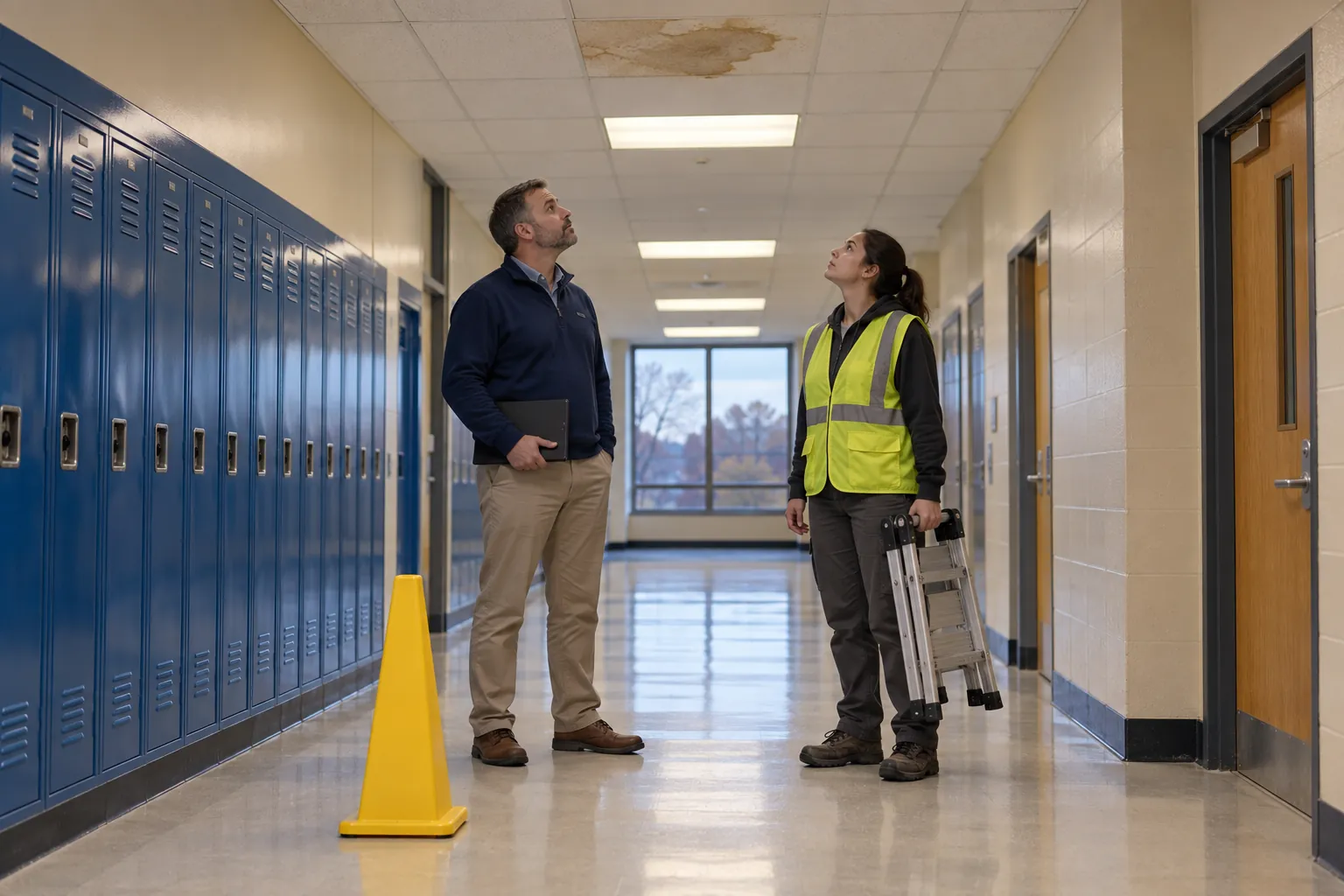
- From inside the building. Ceiling stains, damp insulation, drips, rust on the deck and any leak occupants have reported, especially above critical spaces such as server rooms, electrical rooms and archives.
Add what belongs to your roof, such as lightning protection, solar arrays, antennas, snow guards or rooftop fire equipment. A sloped metal warehouse roof needs a different list from a ballasted membrane on a school, because the materials fail in different ways.
03
How often to inspect, and who does it
With no federal frequency, the schedule comes from the building. A sound program has three layers, written down:
- A routine walk by the building's own team. A building engineer, maintenance technician or trained custodian walks the roof on a set schedule to clear drains, pick up debris and report anything wrong. Walk it at least seasonally, and monthly where the risk is higher: heavy equipment traffic, trees nearby or a history of leaks. This walk finds problems; it does not diagnose or repair them.
- A periodic inspection by a roofing professional. A roofing contractor or roof consultant inspects the whole system, often in spring and fall, and writes a report with photographs and recommended repairs. Many owners time it before their region's worst weather: snow in the Northeast and Midwest, hurricane season on the Gulf and Atlantic coasts.
- An inspection after events. After a severe storm, hail, high wind, a heavy snowfall, a reported leak, or any time another trade has worked on the roof, such as an HVAC replacement or a new antenna. Other trades working on the roof are a common source of new punctures and open penetrations.
Read the roof warranty. Some manufacturers' warranties make periodic inspection or maintenance by the owner a condition, require repairs by an authorized contractor, and exclude damage caused by neglect or by other trades. The warranty and the original installation documents belong in the roof file, together with a roof plan.
Control roof access: a locked hatch or door, a key held by the engineering team, and a rule that nobody goes up alone or unannounced. Contractors should sign in and out. Name who does the routine walk, who books the professional inspection and who decides on repairs.
04
Staying safe on the roof: what OSHA 1910.28 requires
Falls are the reason a roof inspection needs a safety plan before it needs a checklist. OSHA's fall protection trigger in general industry is 4 feet: under 1910.28(b)(1)(i), each employee on a walking-working surface with an unprotected side or edge 4 feet or more above a lower level must be protected by guardrails, safety nets or a personal fall protection system. On a low-slope roof, paragraph (b)(13) sets out what that means by distance from the roof edge:
- Less than 6 feet from the edge: the employer must protect each employee "by a guardrail system, safety net system, travel restraint system, or personal fall arrest system."
- At least 6 feet but less than 15 feet: the same systems, except that "The employer may use a designated area when performing work that is both infrequent and temporary."
- 15 feet or more: fall protection or a designated area, except that "The employer is not required to provide any fall protection, provided the work is both infrequent and temporary"; and the employer must "Implement and enforce a work rule prohibiting employees from going within 15 feet (4.6 m) of the roof edge without using fall protection".
A designated area is marked out by a warning line. Under 1910.29(d), the line must have a minimum breaking strength of 200 pounds, stand not less than 34 inches and not more than 39 inches high, be set back not less than 6 feet from the roof edge for work that is both temporary and infrequent (15 feet for other work), and be clearly visible from 25 feet away. A weekly drain round is harder to call infrequent and temporary than an annual survey; when in doubt, provide guardrails or a fall protection system.
Skylights are the other hazard. OSHA requires employees to be protected "from falling through any hole (including skylights) that is 4 feet (1.2 m) or more above a lower level" by covers, guardrails, travel restraint or personal fall arrest. Covers must support at least twice the maximum intended load and be secured so they cannot be displaced. Nobody should sit, lean or step on a skylight dome.
Getting onto the roof matters as much as walking it:
- Ladders. Under 1910.23, ladders are inspected "before initial use in each work shift", and a defective ladder is tagged "Dangerous: Do Not Use" or similar and removed from service.
- Personal fall protection. Under 1910.140, personal fall protection systems (harnesses, lanyards, lifelines and connectors) "must be inspected before initial use during each workshift for mildew, wear, damage, and other deterioration, and defective components must be removed from service", and an anchorage must generally support at least 5,000 pounds for each employee attached.
- Training. OSHA's fact sheet on the walking-working surfaces final rule explains that workers using personal fall protection must be trained by a qualified person, and retrained when operations or equipment change.
- Snow and ice. OSHA's winter weather hazards page warns that "Snow covered rooftops can hide hazards such as skylights that workers can fall through" and that a surface weighed down by snow "must be inspected by a competent person to determine if it is structurally safe for workers to access it". Where possible, it suggests snow removal methods that do not involve workers going on roofs.
Roofing contractors doing repairs work under the construction standard, 29 CFR 1926.501, where the trigger for low-slope roofing work is 6 feet. The contractor manages its own crew, but the owner controls access and should know the contractor's fall protection plan before the crew goes up.
05
What good evidence of a roof inspection looks like
The record has to answer three questions after a leak, a property damage claim or a warranty dispute: when was the roof last looked at, by whom, and what was found and done. A record that answers them has:
- A roof plan with numbered zones, with drains, units, skylights, hatches and access points marked, so that "split seam, zone 4" means the same thing to everybody.
- A dated entry for each walk, naming the person who did it, the zones covered, and the result of each checklist item, including the ones that were fine.
- Photographs of every defect, close enough to see the damage and wide enough to see where it is, and of each drain once cleared.
- A defect list with each item's location, severity, the date it was reported, the person responsible, and the date it was repaired, so that an open item cannot quietly disappear.
- A leak log recording each interior leak with the room, date, weather and the roof zone above. Repeated leaks under one zone point to one cause.
- Contractor reports kept in the roof file with the warranty, installation documents and any moisture surveys.
- A record of who went on the roof, so new damage can be traced to the work that caused it.
Keep the routine walk short enough to be done every time. A one-page list by zone, drains first, will be walked; a two-page one will be signed.
Review the records yearly, before budgets are set: the pattern of repairs, ponding and leaks is your best evidence for restoring or replacing the roof.
06
Where the record fails, and what SiteClara does about it
Roof records fail in familiar ways. The drain round is on the monthly list, but the clipboard in the engineering office has the same initials in the same pen for three months, filled in on the last day of each. A technician servicing a rooftop unit notices a lifted flashing, mentions it to whoever is at the front desk, and nobody writes it down. A top-floor ceiling stain is fixed with a new tile and never connected to the roof. After the storm nobody can say whether anyone went up, and when the warranty claim comes there is nothing to show the drains were ever cleared.
SiteClara records routine checks and reports at the place they happen. A printed QR poster, with an optional NFC tag behind it, goes where the check starts, such as inside the roof hatch, at the door to the roof or at the foot of the fixed roof ladder. The person doing the walk scans the code or taps the tag on their own phone, with no app to install, sees the checks due there, and marks each one done or says what stopped them. A defect, such as a blocked drain that will not clear or a split seam, is reported there with a photo and goes onto the team's list of jobs until someone closes it. A poster on the top floor lets anyone report a ceiling stain the same way.
The supervisor sees what is due, done and missed, and can record why a check was missed; a job that needs the building manager can be escalated to them to answer. Each day the supervisor reviews and approves a report that goes to nominated management or client contacts at 8 a.m. the next morning, showing what was reported, completed and still open, and how the scheduled checks went. After a leak, that record shows when the roof was last walked, by whom, and what had already been reported.
07
Questions people ask
Can I do a roof inspection myself?
Your own team can do the routine walk, but the employer must protect whoever goes up. Under 29 CFR 1910.28, Duty to have fall protection and falling object protection, work less than 6 feet from the edge of a low-slope roof needs a guardrail system, safety net system, travel restraint system or personal fall arrest system. Under 29 CFR 1910.30, Training requirements, each employee who uses personal fall protection must be trained by a qualified person before being exposed to a fall hazard. The routine walk does not replace a roofing professional's inspection.
What is the 25 rule in roofing?
It is a building code rule about roof repairs, not inspections, and the rule that applies depends on your state and city. In Florida, Florida Statutes section 553.844, Windstorm loss mitigation says that where an existing roof or roof section was built, repaired or replaced to the 2007 Florida Building Code or a later edition, and 25 percent or more of it is being repaired, replaced or recovered, only that portion has to meet the Florida Building Code in effect. Elsewhere, ask the local building department before a large repair.
08
Further reading, and a checklist to take away
OSHA's Walking-Working Surfaces page explains the 2016 final rule, most of which took effect on January 17, 2017, and its Fall Protection page sets out the height triggers by industry. The National Roofing Contractors Association publishes roofing guidelines and The NRCA Roofing Manual, and your roof manufacturer publishes its own maintenance and warranty requirements. In a state-plan state, read your state's rule as well.
Before the next roof walk, check that:
- the roof has a plan with numbered zones, and the checklist follows it, drains first;
- the routine walk, the professional inspection and the after-storm check each have an owner and a schedule;
- roof access is locked and everyone who goes up, contractors included, is recorded;
- fall protection is decided before anyone goes up: nobody goes within 15 feet of an unprotected edge without guardrails, a fall protection system or, for infrequent and temporary work at least 6 feet back, a designated area;
- skylights are guarded or covered and the route keeps clear of them;
- ladders and harnesses are inspected before use in each shift;
- every defect is photographed, logged by zone and tracked until repaired;
- interior leaks are logged and matched to the roof zone above;
- the warranty terms are known and the records are reviewed yearly.
Sources
Every document this guide quotes or links to, in the order it first cites them.
- 29 CFR 1910.22 osha.gov
- 29 CFR 1910.28 osha.gov
- 29 CFR 1910.29 osha.gov
- State Plans page osha.gov
- 1910.23 osha.gov
- 1910.140 osha.gov
- Fact sheet on the walking-working surfaces final rule osha.gov
- Winter weather hazards page osha.gov
- 29 CFR 1926.501 osha.gov
- 29 CFR 1910.30, Training requirements osha.gov
- Florida Statutes section 553.844, Windstorm loss mitigation leg.state.fl.us
- Walking-Working Surfaces page osha.gov
- Fall Protection page osha.gov
- Roofing guidelines and The NRCA Roofing Manual nrca.net
Related guides
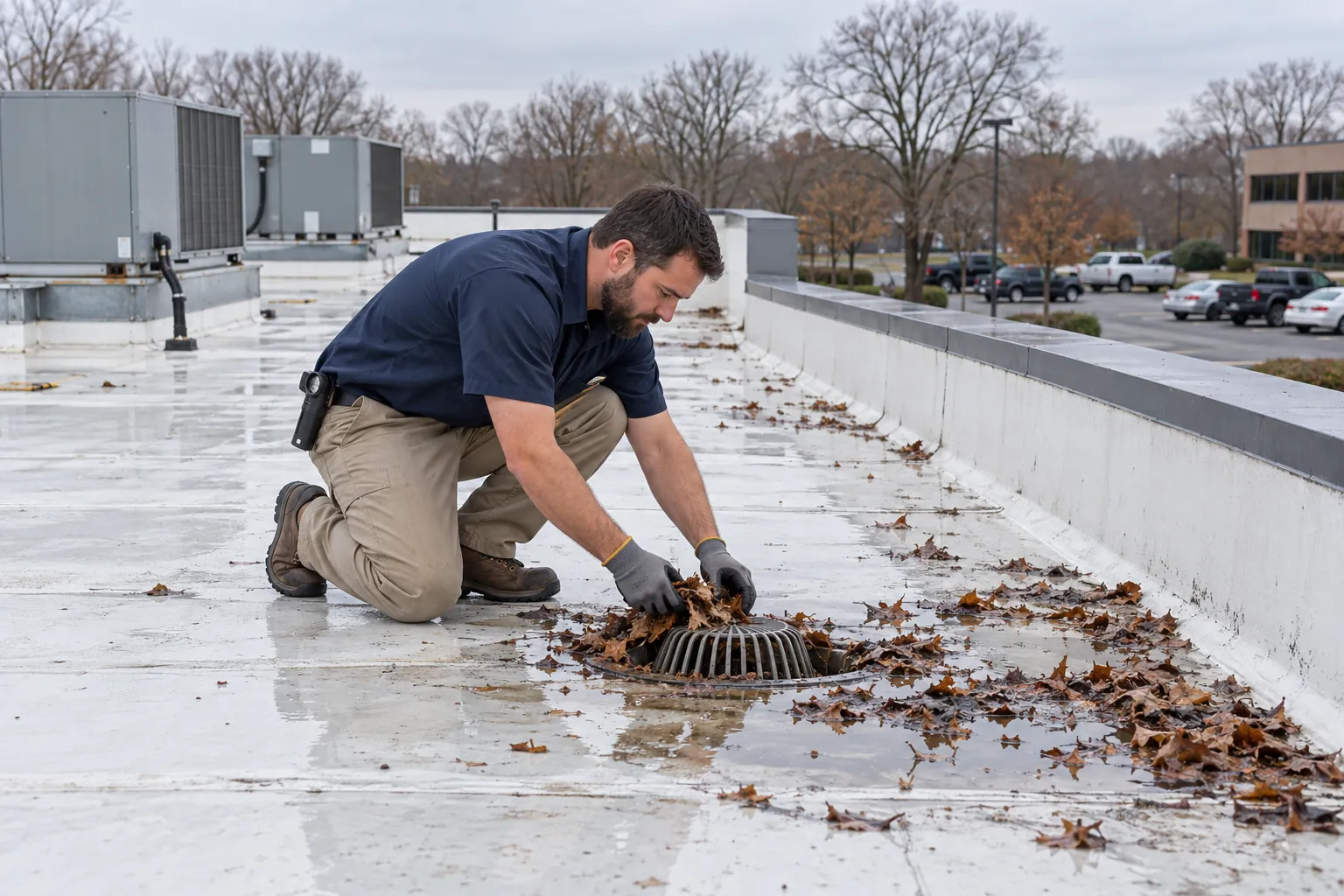 Premises and facilities managementBuilding maintenance checklist: what the code expects, how often to check, and who does itA building maintenance checklist for US commercial buildings, built on the International Property Maintenance Code: daily to annual tasks, who does each, the record.
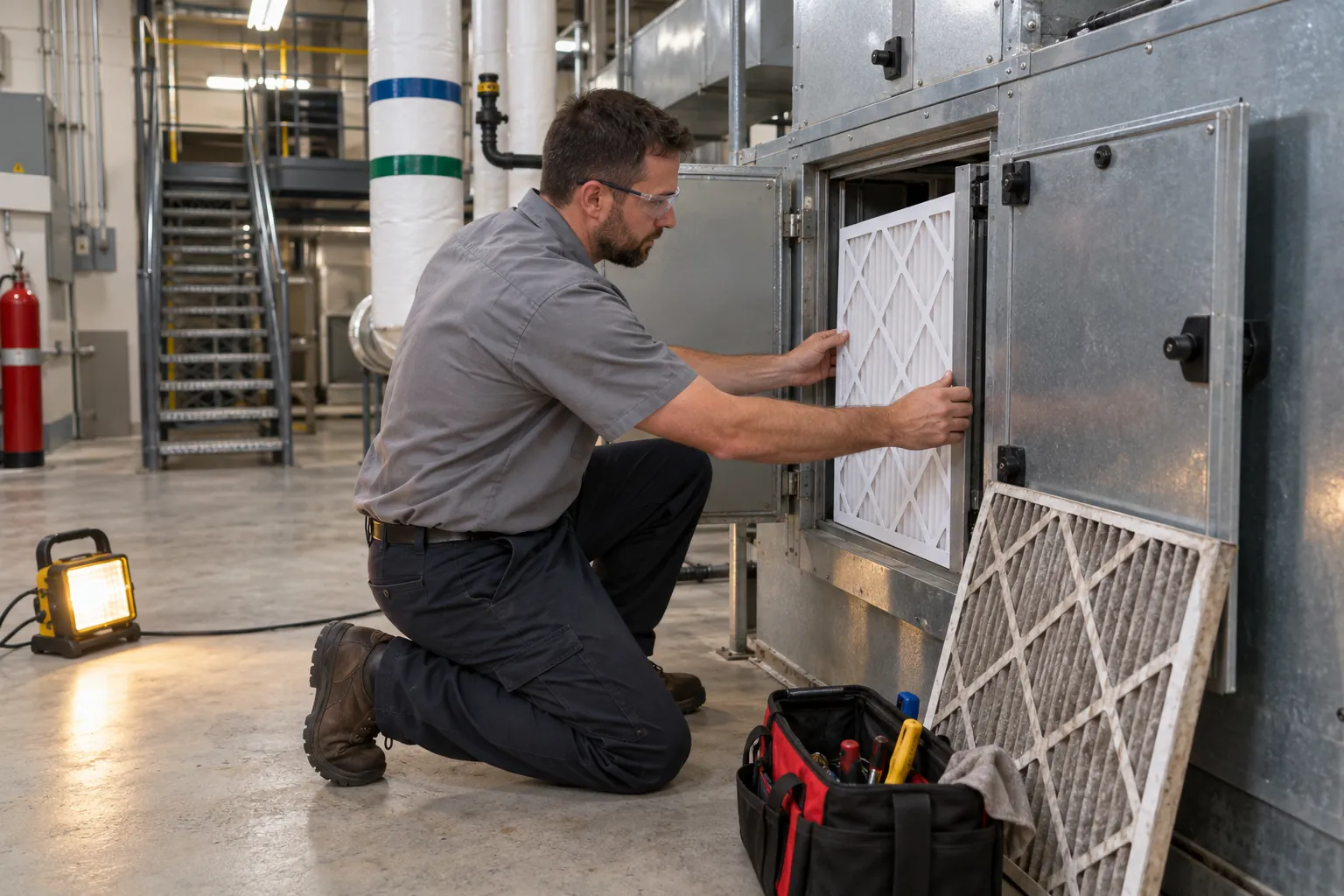 Premises and facilities managementPreventive maintenance checklist: what to check in a commercial building, how often, and how to prove itA preventive maintenance checklist for commercial buildings: HVAC, electrical, fire and life safety, plumbing, how often, and what the record should show.
 Premises and facilities managementWinterization checklist: getting a commercial building ready for freezing weatherA winterization checklist for commercial buildings: freeze protection, sprinklers, heating, roofs, snow and ice, when to check, who does it, and what to record.
 Premises and facilities managementLadder inspection: what OSHA requires, and a checklist people actually useWhat OSHA 29 CFR 1910.23 says about inspecting ladders each shift, a checklist for stepladders, extension, fixed and rolling ladders, and what to do with a defect.