Premises and facilities management
The scissor lift inspection: what OSHA requires, and a checklist that gets used
A scissor lift inspection checklist is the pre-use check made before each shift – the walk-around of guardrails, scissor arms, hydraulics, tires, batteries and placards, then a function test of the ground controls, platform controls, emergency stop, emergency lowering and brakes – and OSHA, which treats a scissor lift as a mobile scaffold, requires a competent person to inspect it for visible defects before each work shift.
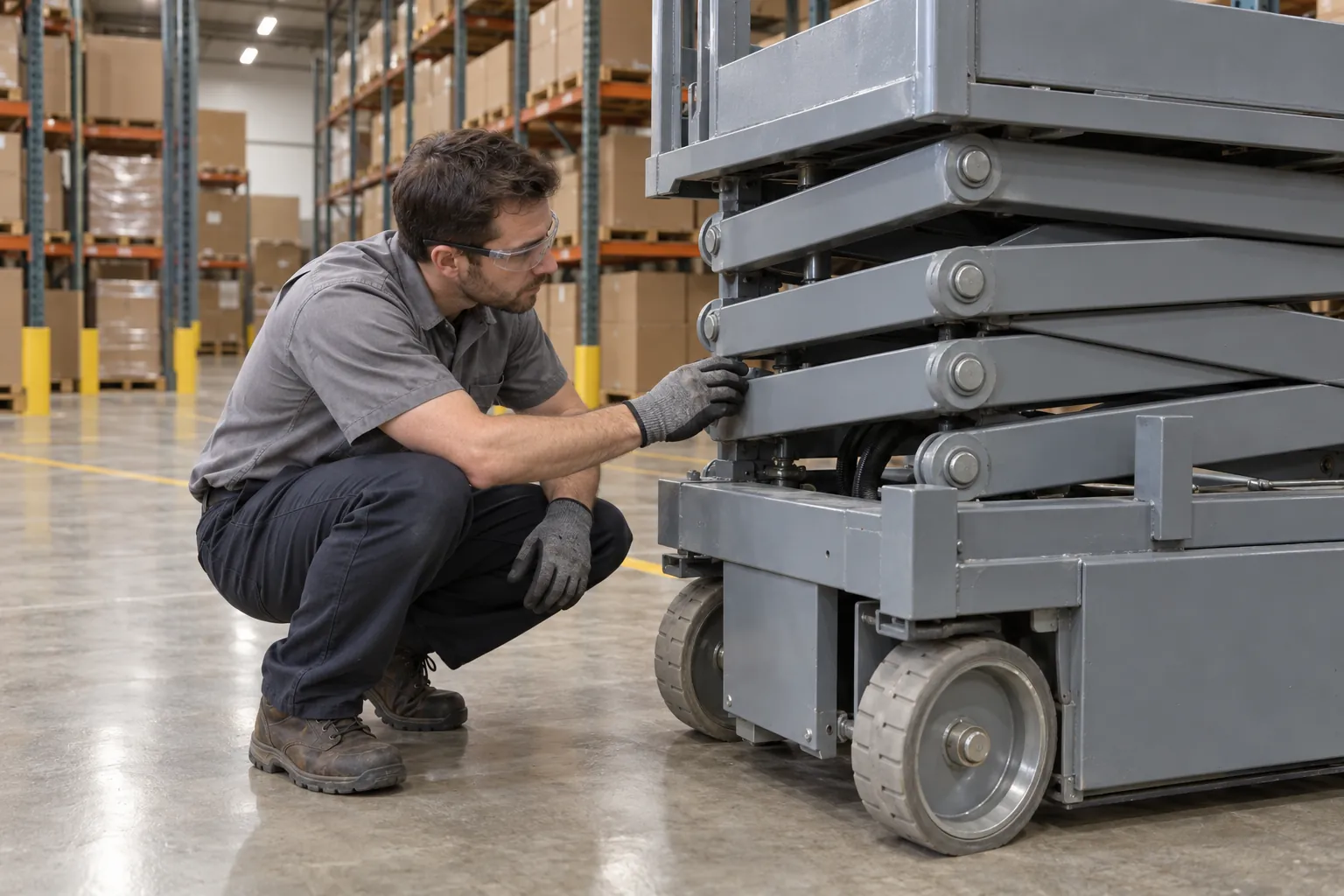
There is no OSHA form: the rule is one sentence of the scaffold standard, and the checklist that carries it out comes from the ANSI A92 standards and the manufacturer's operator's manual. This guide covers which OSHA rules apply and why, what a scissor lift inspection checklist should cover, who does it and how often, the deeper inspections behind it, how boom lifts differ, what to do when an item fails, and how to keep a record that shows the check was really done.
01
What OSHA requires: a scissor lift is a scaffold
No OSHA standard is written for scissor lifts by name. In its letter of interpretation of August 1, 2000, Scissor lifts are not aerial lifts, are considered scaffolds, OSHA explained that scissor lifts, "including those with platforms that extend beyond the equipment's wheelbase," are not among the aerial lifts covered by 29 CFR 1926.453, but that "they do meet the definition of a scaffold." So the scaffold rules apply: the general requirements in 29 CFR 1926.451, Scaffolds: general requirements and the mobile scaffold rules in paragraph (w) of 29 CFR 1926.452, Additional requirements applicable to specific types of scaffolds.
Those are construction standards, but they reach ordinary buildings too. The general industry rule, 29 CFR 1910.27, Scaffolds and rope descent systems, says at (a): "Scaffolds used in general industry must meet the requirements in 29 CFR part 1926, subpart L (Scaffolds)." A maintenance technician relamping a warehouse, a building engineer working on ductwork above a school gym, or a custodial crew cleaning high windows in a hotel atrium is held to the same scaffold inspection rule as a contractor on a construction site.
The inspection itself is paragraph (f)(3) of the general requirements:
The next paragraph, (f)(4), says what happens to a failure: "Any part of a scaffold damaged or weakened such that its strength is less than that required by paragraph (a) of this section shall be immediately repaired or replaced, braced to meet those provisions, or removed from service until repaired."
So the check comes before each work shift, and again after anything that could affect the lift's structure, such as a strike from a forklift. It covers visible defects: a look-and-test check, not a teardown. And it is done by a competent person, whom 29 CFR 1926.32, Definitions defines at (f) as "one who is capable of identifying existing and predictable hazards in the surroundings or working conditions which are unsanitary, hazardous, or dangerous to employees, and who has authorization to take prompt corrective measures to eliminate them." The person doing the check must be allowed to take the lift out of service.
02
What a scissor lift inspection checklist covers
OSHA does not publish a scissor lift form. Its hazard alert Working Safely with Scissor Lifts (OSHA 3842) says the manufacturer's instructions "will generally include how to" test and inspect controls and components before each use, ensure guardrail systems are in good working condition, and verify that brakes once set will hold the lift in position. The fuller list comes from the older ANSI A92.6 standard for self-propelled elevating work platforms, as quoted in the Scaffold and Access Industry Association's ASC A92 Aerial Work Platforms Interpretations, 1986–2022: "Before each use or at the beginning of each shift, the aerial platform shall be given a visual inspection and functional test," ending with "items specified by the manufacturer." A complete daily inspection checklist built on those sources has three parts.
The walk-around, with the platform stowed and the power off:
- guardrails, midrails and toeboards all in place, pins and fasteners in, and the entry gate or chain closing and latching;
- the platform deck and any roll-out extension deck: no cracks or bent sections, and the extension slides out and locks;
- the chassis frame, scissor arms, pivot pins and their retaining fasteners: no bends, cracks or missing pins;
- the lift cylinder, hydraulic hoses and fittings: no leaks, chafing or kinks, and the hydraulic fluid level where the manual says to check it;
- tires and wheels: cuts, chunks and wheel nuts;
- batteries, battery cables and the electrical wiring harness on an electric lift, and fuel and engine fluid leaks on an engine-powered one;
- the capacity decal, warning placards and control markings present and legible, and the operator's manual in its storage box on the machine;
- outriggers or stabilizers, where the model has them;
- the safety features the manufacturer lists for that model, such as pothole protection and a tilt alarm.
The function test, on a firm, level surface with nobody near the machine:
- the ground controls: raise and lower, and the ground emergency stop;
- the platform controls: the enable switch, drive forward and reverse, steering, lift and lower, and the platform emergency stop;
- the emergency or manual lowering system, which brings the platform down if power is lost;
- the brakes: once set, they hold the lift in position;
- the horn, the motion alarm and any lights;
- any limit the manual describes, such as reduced drive speed when the platform is raised, working as it should.
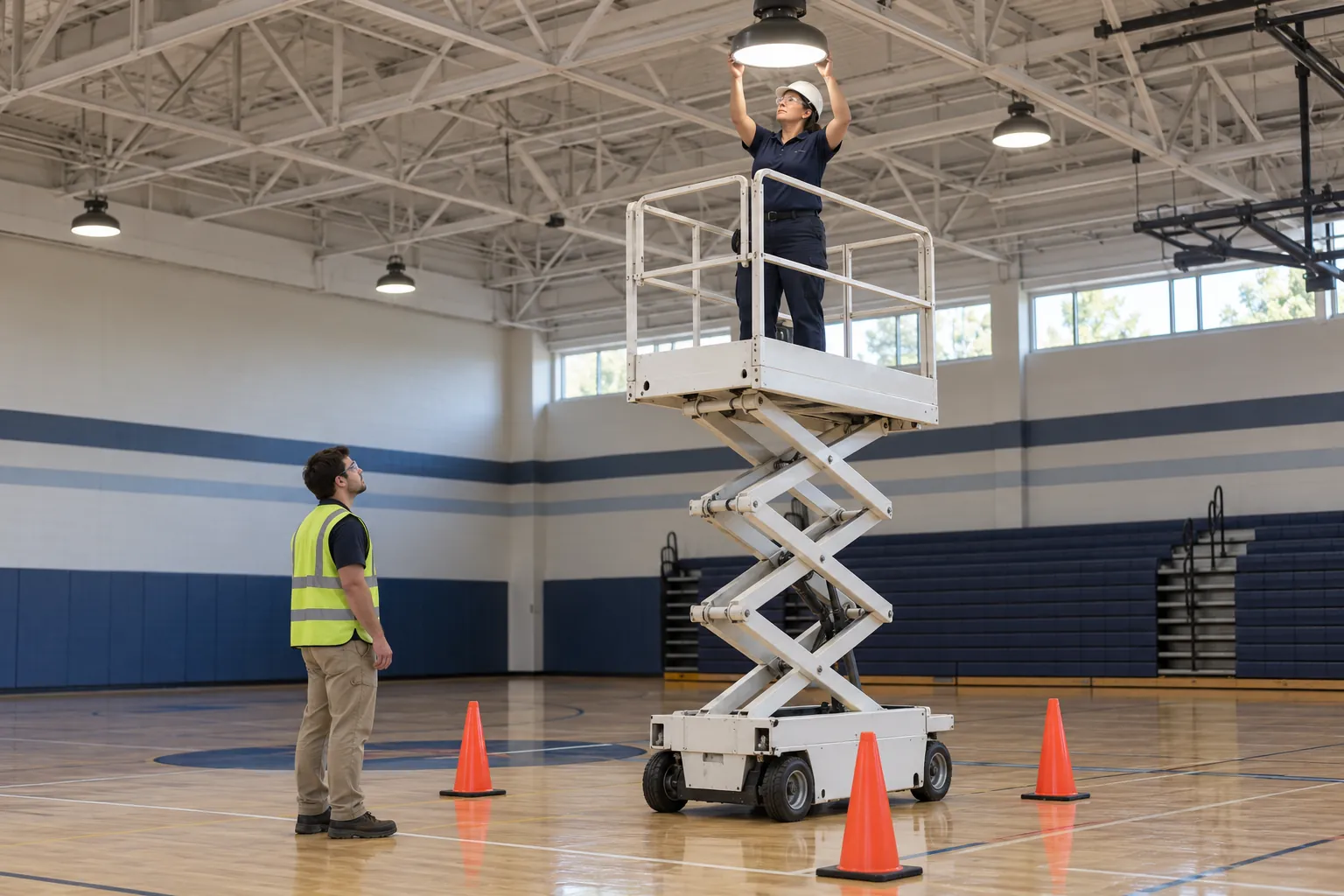
The workplace check, before and during use. The A92.6 text lists "Drop-offs and holes; Bumps and floor obstructions; Debris; Overhead obstructions and high voltage conductors" among the hazards to look for, with the surface, hazardous locations, and wind and weather. OSHA's hazard alert adds traffic control so other equipment cannot strike the lift, staying at least 10 feet from power lines and transformers, and working outdoors only in good weather: "Scissor lifts rated for outdoor use are generally limited to wind speeds below 28 miles per hour."
The manufacturer's operator's manual is the definitive list for each model. California's section 3646(b) says: "Units shall be assembled, used, and disassembled in accordance with the manufacturer's instructions." A generic checklist is a starting point to be matched to the manual, not a substitute for it.
03
Who does the check, how often, and the inspections behind it
Before each work shift. The A92 committee reads its own pre-start wording the same way as OSHA's. Asked whether an 8 a.m. check covered a second shift at 4 p.m., its interpretation group answered: "The intent of this section is that an inspection should be conducted per the manufacturer's requirements each time there is a shift change." On a lift shared by day and evening crews, the check belongs in the shift change.
Lifts that sit idle. OSHA's letter of February 23, 2000 on fall protection, training, inspection and design requirements of aerial lifts and scissor lifts says that "Scaffolds that are not in use generally do not need to be inspected daily, but they must be inspected by a competent person before the first work shift uses the scaffold and reinspected each time there is a change in work shifts." A lift kept in the basement for twice-a-year relamping is checked when it comes out.
Who. In practice trained operators do the pre-use check on the lift they are about to use, and each must meet the competent person definition, including the authority to stop the lift being used. 29 CFR 1926.454, Training requirements says at (a) that each employee who works on a scaffold must be "trained by a person qualified in the subject matter to recognize the hazards associated with the type of scaffold being used." OSHA's hazard alert says that training must include "Reporting any equipment defects or maintenance needs."
The deeper inspections. Under the older A92 standards a lift also needed a frequent and an annual inspection by a mechanic. Genie's guide to aerial work platform inspections, written in 2018 under those standards, describes frequent inspections for a platform "in service for three months, or 150 hours, whichever comes first," and annual inspections "no later than thirteen (13) months from the date of the prior annual inspection." Those standards have been replaced by ANSI/SAIA A92.22, Safe Use of Mobile Elevating Work Platforms (MEWPs) and its companion on training, ANSI/SAIA A92.24. Asked whether a frequent inspection at 150 hours or 3 months is required anywhere in A92.22-2018, the A92.22 interpretation group answered: "No." So the fixed 3-month or 150-hour frequent inspection has gone, and the service intervals for that model come from the manufacturer's manual. The annual inspection remains: as JLG's summary of the A92.22 annual inspection puts it,"Owners shall ensure an annual inspection is performed no later than thirteen (13) months from the date of the prior annual inspection," by "a person qualified to inspect the specific make and model of MEWP." California's section 3640(a)(1) says inspection, maintenance and repairs "shall be performed by a qualified person in accordance with the manufacturer's specifications." On a rented lift, ask the rental company when the last one was done.
Boom lifts are different. A boom lift is an aerial lift, not a scaffold. In construction, 29 CFR 1926.453, Aerial lifts says at (b)(2)(i) that "Lift controls shall be tested each day prior to use to determine that such controls are in safe working condition," and at (b)(2)(v) that "A body belt shall be worn and a lanyard attached to the boom or basket when working from an aerial lift." In general industry, 29 CFR 1910.67, Vehicle-mounted elevating and rotating work platforms has the same daily test at (c)(2)(i) and requires fall arrest or travel restraint attached to the boom or basket. A boom lift checklist keeps the same walk-around and function test, and adds the boom sections, the turntable and the lanyard anchorage, as the manual lists them.
04
When the check finds a defect
The rules agree: a damaged lift does not go up. California's section 3646(d) says units "shall be taken out of service when damaged or weakened from any cause," and the older A92.6 text tells the operator, on any suspected malfunction, to "cease operation of the aerial platform and request further information as to safe operation from management, or from the owner, dealer or manufacturer before further operation." A routine that meets that looks like this:
- Stop. There is no "just this one fixture" for a missing guardrail pin, a gate that will not latch, a hydraulic leak, or an emergency stop or emergency lowering that does not work.
- Make it obvious. Leave the platform fully lowered, switch it off, take the key where it has one, and hang a do-not-operate tag on the controls so the next shift does not take it.
- Report it the same shift to the supervisor or whoever arranges repairs, with the lift's number, what was found and, where it helps, a photo. If the lift is rented, call the rental company.
- Repair by a qualified person to the manufacturer's specifications, never by the operator improvising.
- Return to service deliberately. Someone confirms the repair, removes the tag and records that the lift is back in use.
OSHA's hazard alert also says to "Ensure that safety systems designed to stop collapsing are maintained and not bypassed." A tilt alarm silenced with tape or an overload sensor disconnected so the lift will rise is a finding in itself, whatever the rest of the checklist says.
05
Does the scissor lift inspection have to be written down?
Federal OSHA's rule requires the inspection; the text of 1926.451(f)(3) does not say it must be documented. Some states go further. California's section 3640(d) says: "Records of inspections and repairs shall be maintained for at least three years and be made available to the Division upon request," with the date, any deficiencies found, the corrective action recommended and who performed the inspection.
Most employers keep a written or electronic record of the pre-use check anyway, wherever the building is, because:
- it is how a supervisor knows the check happened on every lift, on every shift it was used;
- it is how you show compliance with the shift inspection rule if an OSHA inspector asks;
- it carries a defect from the operator who found it to the person who arranges the repair;
- after a fall, a tip-over or a near miss, it is the first thing anyone asks for: was the lift checked that morning, by whom, and what did they find.
A useful record answers five questions: which lift (by unit or serial number), who checked it, when, any item that failed, and what happened to the failure. The hour meter reading is worth taking too, for the manufacturer's service intervals.
If you use a printable checklist, keep it where the check happens, not on a clipboard filled in later from memory, and make sure a missed check shows as missed rather than as a blank nobody notices.
06
Where the record fails, and what SiteClara does about it
Scissor lift checklists fail in familiar ways. The sheet in the storage box has a week of checks in the same pen, all added on Friday. Every box reads "OK" for months, including the day the motion alarm stopped sounding. The operator who wrote "gate latch loose" finds the lift in use the next morning, because the sheet stayed with the machine and nobody read it. The lift in the basement used twice a year has no record at all.
SiteClara records routine checks and reports at the place they happen. A printed QR poster goes at each location where a check is scheduled, such as the bay where a lift is parked and charged, with an optional NFC tag behind it. The operator scans the code or taps the tag on their own phone, with no app to install, sees the check due there, and marks it done or says what stopped them. A defect, such as a hydraulic leak or a gate that will not latch, is reported there with a photo and goes onto the team's list of jobs until someone closes it, so it does not sit in a storage box.
The supervisor sees what is due, done and missed, and can record why a check was missed; a job that needs the building manager can be escalated to them to answer. Each day the supervisor reviews and approves a report that goes to nominated management or client contacts at 8 a.m. the next morning, showing what was reported, completed and still open, and how the scheduled checks went. After an incident, that record shows who checked the lift kept at that location, when, and what was reported. Where a state requires inspection records, SiteClara is the working record the team keeps day to day; it is not the statutory record itself.
07
Questions people ask
Does OSHA require a daily scissor lift inspection?
Yes, before each work shift. OSHA treats a scissor lift as a scaffold, and 29 CFR 1926.451(f)(3) says scaffolds "shall be inspected for visible defects by a competent person before each work shift, and after any occurrence which could affect a scaffold's structural integrity." In general industry, 1910.27(a) applies the same construction rules.
Do you need to wear a harness on a scissor lift?
Not under OSHA's scaffold rules, where the guardrails are properly maintained. In its letter of August 1, 2000, OSHA wrote: "No, neither §1926.451 or §1926.452(w) require employees to be tied-off when working from scissor lifts that have properly maintained guardrails." Your employer, the site or the manufacturer may still require one, and a boom lift is different: OSHA requires fall protection attached to the boom or basket.
Can you drive a scissor lift while it is raised?
Only as the manufacturer allows. OSHA's hazard alert Working Safely with Scissor Lifts says to follow the manufacturer's instructions for safe movement, which it says "usually rules out moving the lift in an elevated position." Where riding a moving scaffold is allowed at all, 1926.452(w)(6)(i) requires that "The surface on which the scaffold is being moved is within 3 degrees of level, and free of pits, holes, and obstructions."
08
Where to read more, and a list to take away
The rules are on OSHA's site: 29 CFR 1926.451, Scaffolds: general requirements, with the inspection at (f)(3); the mobile scaffold rules in 29 CFR 1926.452(w); training in 29 CFR 1926.454; and, for general industry, 29 CFR 1910.27. OSHA's Scaffolding eTool: Scissor Lifts and its hazard alert Working Safely with Scissor Lifts explain fall protection, stabilization and positioning. Two letters of interpretation settle the common questions: OSHA's letter of August 1, 2000, Scissor lifts are not aerial lifts, are considered scaffolds, and OSHA's letter of February 23, 2000 on aerial lifts and scissor lifts. For boom lifts, read 29 CFR 1926.453, Aerial lifts and 29 CFR 1910.67.
The consensus standards are ANSI/SAIA A92.22 (safe use) and A92.24 (training), sold through ANSI; the Scaffold and Access Industry Association, secretariat of the A92 committee, publishes the ASC A92 Aerial Work Platforms Interpretations free. In California, read Title 8, section 3646 and section 3640. And keep the manufacturer's operator's manual with every lift.
Before the next shift, check that:
- every lift has a fleet or serial number on it and on its checklist;
- the checklist matches the model's operator's manual, and the manual is on the machine;
- the person checking is trained under 1926.454 and can take the lift out of service;
- the check happens before each shift the lift is used, and after anything that could have damaged it;
- a lift that fails is lowered, switched off, tagged and reported the same shift;
- the service inspections follow the manufacturer's schedule, and the annual inspection is done within 13 months of the last one, including on rented lifts;
- a missed check shows as missed.
Sources
Every document this guide quotes or links to, in the order it first cites them.
- Letter of interpretation of August 1, 2000, Scissor lifts are not aerial lifts, are considered scaffolds osha.gov
- 29 CFR 1926.451, Scaffolds: general requirements osha.gov
- 29 CFR 1926.452, Additional requirements applicable to specific types of scaffolds osha.gov
- 29 CFR 1910.27, Scaffolds and rope descent systems osha.gov
- 29 CFR 1926.32, Definitions osha.gov
- State Plans osha.gov
- Title 8, section 3646, Operating Instructions (Elevating Work Platforms) dir.ca.gov
- Title 8, section 3640, Maintenance and Repairs dir.ca.gov
- Working Safely with Scissor Lifts (OSHA 3842) osha.gov
- ASC A92 Aerial Work Platforms Interpretations, 1986–2022 saia.org
- Letter of February 23, 2000 on fall protection, training, inspection and design requirements of aerial lifts and scissor lifts osha.gov
- 29 CFR 1926.454, Training requirements osha.gov
- Genie's guide to aerial work platform inspections genielift.com
- JLG's summary of the A92.22 annual inspection jlg.com
- 29 CFR 1926.453, Aerial lifts osha.gov
- 29 CFR 1910.67, Vehicle-mounted elevating and rotating work platforms osha.gov
- Scaffolding eTool: Scissor Lifts osha.gov
Related guides
 Premises and facilities managementThe forklift daily inspection: what OSHA requires, and a checklist that gets usedWhat OSHA 29 CFR 1910.178(q)(7) requires before a forklift is used, a daily inspection checklist by truck type, and what to do with a defect.
 Premises and facilities managementLadder inspection: what OSHA requires, and a checklist people actually useWhat OSHA 29 CFR 1910.23 says about inspecting ladders each shift, a checklist for stepladders, extension, fixed and rolling ladders, and what to do with a defect.
 Premises and facilities managementPreventive maintenance checklist: what to check in a commercial building, how often, and how to prove itA preventive maintenance checklist for commercial buildings: HVAC, electrical, fire and life safety, plumbing, how often, and what the record should show.
 Premises and facilities managementMaintenance technician duties: what the job covers, and how to show it was doneMaintenance technician duties in apartments, schools and offices: work orders, preventive maintenance, OSHA and EPA rules, levels 1 to 3, and the record.