Premises and facilities management
The forklift daily inspection: what OSHA requires, and a checklist that gets used
A forklift inspection checklist is the list of items an operator checks before using the truck – tires, forks, fluid levels, brakes, steering, horn, lights and the seat belt – and OSHA requires every forklift to be examined that way before it is placed in service, at least daily, and after each shift where it runs around the clock.
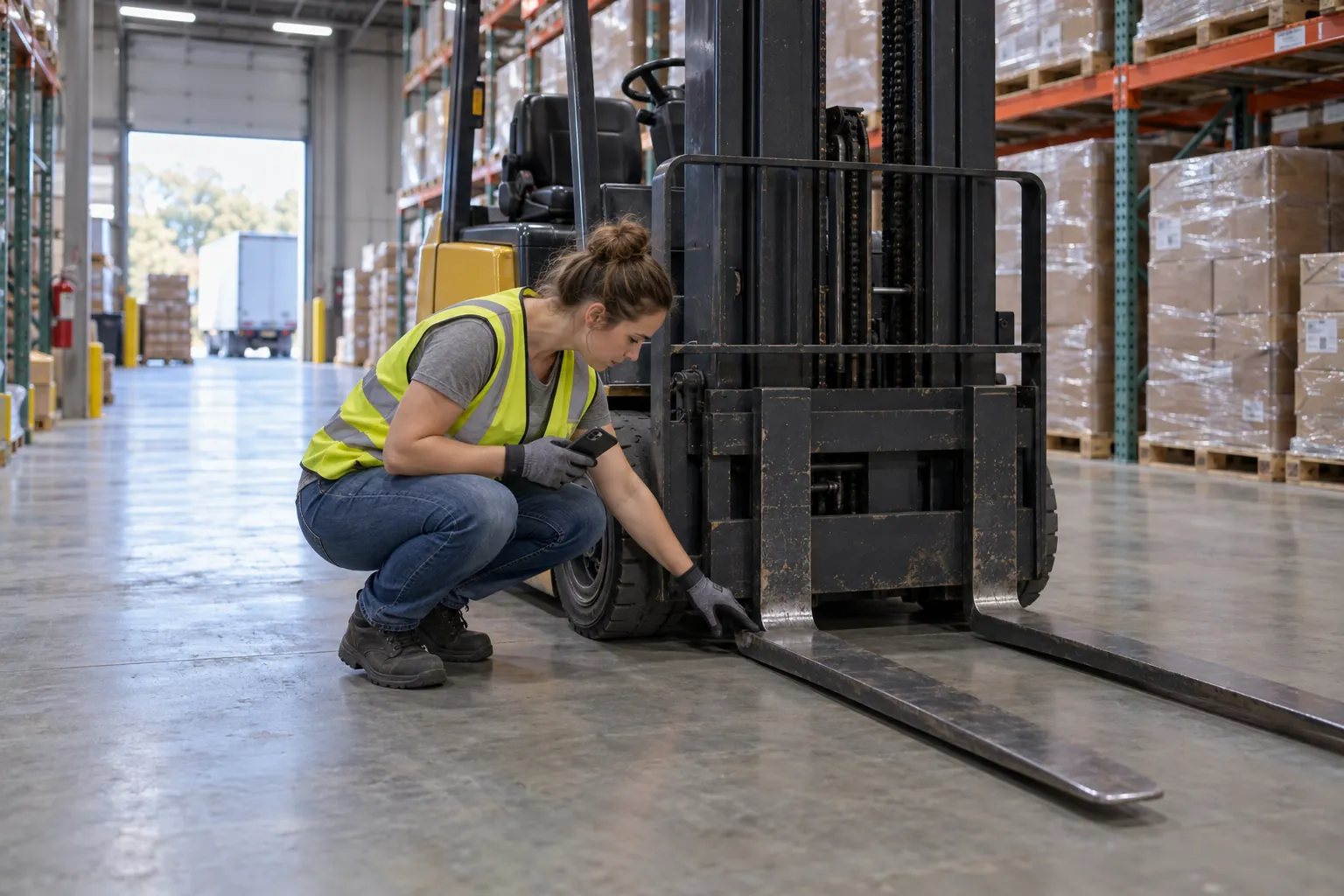
The rule is one sentence of OSHA's forklift standard; the checklist that carries it out is up to the employer. This guide covers what 29 CFR 1910.178(q)(7) says, what a pre-shift inspection checklist should cover for electric, internal combustion and propane trucks, what happens when a defect turns up, and how to keep a record that shows the check was really done.
01
What OSHA requires: 29 CFR 1910.178(q)(7)
Forklifts are covered by OSHA's general industry standard for powered industrial trucks, 29 CFR 1910.178, Powered industrial trucks. Its scope, in paragraph (a)(1), is "fire protection, design, maintenance, and use of fork trucks, tractors, platform lift trucks, motorized hand trucks, and other specialized industrial trucks powered by electric motors or internal combustion engines." That takes in the sit-down counterbalanced forklift in a warehouse, the reach truck and order picker in a distribution center, and the walkie pallet jack a building's receiving team uses at the loading dock.
The daily inspection is paragraph (q)(7), which reads in full:
Two neighboring paragraphs say what happens next. Paragraph (q)(1): "Any power-operated industrial truck not in safe operating condition shall be removed from service. All repairs shall be made by authorized personnel." And paragraph (p)(1): "If at any time a powered industrial truck is found to be in need of repair, defective, or in any way unsafe, the truck shall be taken out of service until it has been restored to safe operating condition." Together they make the pre-shift check a gate, not a formality: a truck that fails it does not run.
Read the rule closely and four points follow. The check comes before the truck is placed in service, not at the end of the day. It is at least daily, and after each shift on a round-the-clock operation. It is an examination of the truck's safe condition, so the person doing it needs to know what a safe condition looks like. And a defect has to be reported and corrected, not just noted.
02
What a forklift inspection checklist covers
OSHA does not prescribe a form. Its Powered Industrial Trucks eTool: pre-operation inspection sets out the checks in two stages, the visual checks with the truck off and the operational checks with it running, and OSHA publishes Sample Daily Checklists for Powered Industrial Trucks for an internal combustion truck and an electric truck. A working checklist built on them looks like this.
With the truck off, walking around it:
- fluid levels: engine oil, hydraulic fluid, coolant, brake fluid as the truck requires;
- leaks, cracks or other visible damage, including hydraulic hoses and mast chains;
- tires: condition and pressure, cuts, gouges, chunking, and wheel nuts;
- forks: cracks, bends and wear, the heel, and the retaining pin that holds each fork on the carriage;
- the load backrest extension, the overhead guard and the finger guards;
- warning decals and the data plate in place and legible, and the operator's manual on the truck;
- the operator's compartment free of grease, debris and loose objects;
- the seat belt and any other operator restraint working.
With the truck running, before any load:
- accelerator, inching control and the direction control, forward and reverse;
- service brake and parking brake;
- steering;
- tilt, lift and lower, and any attachment control;
- horn, lights and backup alarm;
- the hour meter reading, and any warning light or fault code on the dash;
- unusual noise or vibration, which the eTool says "should be reported immediately."
By power type, the eTool adds:
- Electric trucks: battery cables and connectors, battery restraints, electrolyte level where the battery needs it, and the hood latch.
- Internal combustion trucks: engine oil, brake reservoir, coolant, air filter, belts, hoses, radiator and hood latch.
- Propane (LP gas) trucks: the tank mounting and restraint brackets, the pressure relief valve, the hoses and the condition of the cylinder.
OSHA's second page of sample daily checklists goes further, with a separate list for each type: electric and propane forklifts, yard forklifts, walking pallet trucks, reach trucks, order pickers, tow tractors and others. It says plainly that the lists are "a guide only and may not be totally inclusive." The manufacturer's operator's manual is the other half of the checklist: it says what that model needs checked and at what reading a gauge is out of range.
Whatever form you use, operators should inspect each item rather than assume it, look for signs of excessive wear, leaks or damage, and test each control rather than glance at it. A missing fork retaining pin or an unreadable data plate is a defect to report, not a note in the margin.
03
Who does the check, when, and on which trucks
The standard places the duty on the employer and does not name the person. In practice the operator who is about to use the truck does the pre-shift check, because they are there when it is placed in service, and because paragraph (l) already requires them to be trained in it. The truck-related training topics in 29 CFR 1910.178(l)(3) include "vehicle inspection and maintenance that the operator will be required to perform," alongside refueling and battery charging.
Some questions come up on every site, and OSHA has answered several of them in letters of interpretation:
- One check a day, or one per driver? In its letter of July 28, 2004 on examination prior to being placed in service, OSHA restated the rule, that trucks "be examined before being placed in service," daily or after each shift on round-the-clock work, and said that "there is no specific OSHA requirement that a checklist be used," although the employer must still make sure trucks are properly inspected. The standard sets the minimum; it does not add a separate check for each driver. Many employers still ask each new driver to do a short walk-around, which costs a minute and catches damage from the last shift.
- Round-the-clock operations. Where trucks run on two or three shifts with no break, the rule is after each shift, so the check belongs in the shift change, not only first thing in the morning.
- Trucks that sit idle. OSHA's letter of March 3, 2005 on trucks not used for significant time periods says a truck that "is stored or is not used every day" does not need an examination "until it is ready to be placed in service," and that one stored for a long time "may require some service or maintenance before being returned to use." A spare truck kept for peak weeks is checked when it comes out, not every day it stands.
The daily check is not the whole maintenance picture. Planned maintenance at the hours or intervals the manufacturer sets, the annual or periodic inspection a service provider may carry out, and repairs "made by authorized personnel" under (q)(1) all sit alongside it. The operator's check finds what can be seen, heard and tested from the seat in a few minutes; it does not replace a mechanic.
04
When the check finds a defect
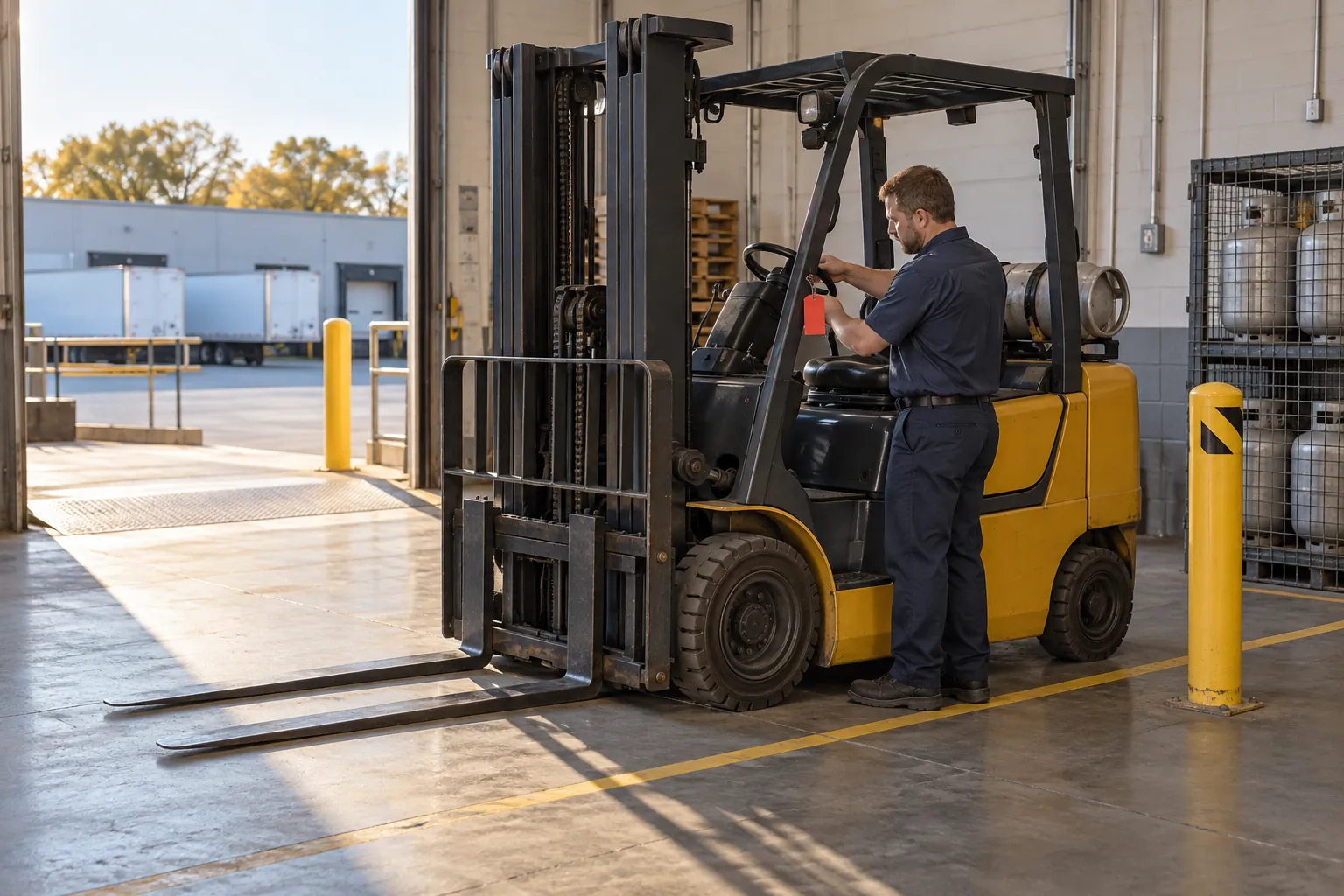
The rule has one sentence for this: "Defects when found shall be immediately reported and corrected." OSHA's eTool says a truck "in need of repair, defective or in any way unsafe, should not be driven and should be taken out of service immediately," with the problem "recorded on the appropriate documents and reported to a supervisor." A routine that meets that looks like this:
- Stop. The operator does not use the truck. There is no "just this one load" for brakes, steering, a hydraulic leak, a damaged fork or chain, or a seat belt that will not latch.
- Make it obvious. Park it as paragraph (m)(5) requires, forks fully lowered, controls neutral, power off and brakes set, remove the key where the truck has one, and hang a do-not-operate tag so the next shift does not take it.
- Report it the same shift to the supervisor or whoever arranges repairs, with the truck's number, what was found and, where it helps, a photo.
- Repair by an authorized person, never by the operator improvising, and never in a hazardous (classified) location, which (q)(2) forbids.
- Return to service deliberately. Someone confirms the repair, removes the tag and records that the truck is back in use.
Paragraph (a)(4) is the one that trips up building teams: modifications and additions that affect capacity and safe operation need the manufacturer's prior written approval, and the capacity and instruction plates must be changed to match. A home-made fork extension, a work platform bolted to the carriage, or an attachment added without updating the data plate is a finding in itself, whatever the rest of the checklist says.
05
Does the daily inspection have to be written down?
No, not under federal OSHA. In its letter of February 7, 2000, titled Powered industrial truck examinations do not have to be documented, OSHA wrote: "The standard does not require documentation of a powered industrial truck examination. Therefore, it would be at the employer's discretion to determine the duration of powered industrial truck examination record retention." What the standard does require in writing is the operator training certification in paragraph (l)(6), with the operator's name, the date of training and evaluation and who did it, and the performance evaluation at least once every three years in (l)(4)(iii).
Most employers keep a written or electronic record of the daily check anyway, for good reasons:
- it is how a supervisor knows the check happened on every truck, on every shift;
- it carries a defect from the operator who found it to the person who arranges the repair;
- it shows a pattern, such as the same truck failing on its brakes every few weeks;
- after an accident or a near miss, it is the first thing anyone asks for: was the truck checked that morning, by whom, and what did they find.
A useful record answers five questions: which truck (by fleet number, not "the red one"), who checked it, when, the result of each item or at least any item that failed, and what happened to a failure. The hour meter reading is worth taking too: it ties the check to the truck's use and helps plan service intervals.
Keep the record where the check happens, not on a clipboard in the office filled in from memory. Decide how long you keep it, since OSHA leaves that to you, and make sure a missed check shows as missed rather than as a blank nobody notices.
06
Where the record fails, and what SiteClara does about it
Forklift checklists fail in familiar ways. A week of sheets is checked off in the same pen on Friday afternoon. Every box on every truck reads "OK" for months, including the day the horn stopped working. The operator who wrote "brakes soft" on the night shift finds the truck in use the next morning, because the sheet went in a tray and nobody read it. The spare truck used twice a month has no record at all, and nobody can say whether it was checked on the day it was needed.
SiteClara records routine checks and reports at the place they happen. A printed QR poster goes at each location where a check is scheduled, such as the charging bay or the parking spot where a truck is kept at the end of each shift, with an optional NFC tag behind it. The operator scans the code or taps the tag on their own phone, with no app to install, sees the check due there, and marks it done or says what stopped them. A defect, such as a hydraulic leak or a damaged fork, is reported there with a photo and goes onto the team's list of jobs until someone closes it, so it cannot sit in a tray.
The supervisor sees what is due, done and missed, and can record why a check was missed; a job that needs the building manager can be escalated to them to answer. Each day the supervisor reviews and approves a report that goes to nominated management or client contacts at 8 a.m. the next morning, showing what was reported, completed and still open, and how the scheduled checks went. After an incident, that record shows who checked the truck kept at that location, when, and what was reported.
07
Questions people ask
What is the OSHA standard for forklift inspection?
It is paragraph (q)(7) of 29 CFR 1910.178, Powered industrial trucks: "Industrial trucks shall be examined before being placed in service, and shall not be placed in service if the examination shows any condition adversely affecting the safety of the vehicle. Such examination shall be made at least daily." On round-the-clock work the examination is after each shift, and defects must be reported and corrected immediately.
Does OSHA publish a daily forklift inspection checklist?
Yes, as a sample rather than a required form. OSHA's Sample Daily Checklists for Powered Industrial Trucks has an operator's daily checklist for an internal combustion truck (gas, LPG or diesel) and one for an electric truck, each split into checks with the engine or motor off and checks with it on. OSHA says the lists "serve as a guide only and may not be totally inclusive."
What are the pre-start checks on a forklift?
OSHA's Powered Industrial Trucks eTool: pre-operation inspection lists, among others, fluid levels (oil, water and hydraulic fluid), tire condition and pressure including cuts and gouges, safety devices including the seat belt, and leaks, cracks or other visible defects including hydraulic hoses and mast chains. With the engine running, it adds brakes, steering, the hoist and lowering control, horn, lights and the back-up alarm if fitted.
What are the basic safety rules for driving a forklift?
Several are written into 29 CFR 1910.178, Powered industrial trucks: observe traffic regulations and plant speed limits and stay about three truck lengths behind the truck ahead (n)(1); slow down and sound the horn at cross aisles and where vision is obstructed (n)(4); look in the direction of travel (n)(6); drive at a speed that lets the truck stop safely (n)(8); carry no unauthorized riders (m)(3); and, when leaving the truck, lower the forks fully, neutralize the controls, shut off the power and set the brakes (m)(5)(i).
08
Where to read more, and a list to take away
The rule itself is 29 CFR 1910.178, Powered industrial trucks, on OSHA's site; paragraph (q) covers maintenance and the daily examination, and paragraph (l) covers operator training. OSHA's Powered Industrial Trucks eTool explains the pre-operation inspection, and its Sample Daily Checklists for Powered Industrial Trucks are a starting point for your own form. Two letters of interpretation settle two common questions: OSHA's letter of February 7, 2000, Powered industrial truck examinations do not have to be documented, and OSHA's letter of March 3, 2005 on trucks not used for significant time periods.
Design and manufacture are covered by the consensus standards of the Industrial Truck Standards Development Foundation. Its B56 standards page lists ANSI/ITSDF B56.1-2020, Safety Standard for Low Lift and High Lift Trucks, and says copies are available free on request. OSHA's own text still incorporates the 1969 edition of B56.1 for the design of newly acquired trucks, so read the current edition as good practice unless your contract or your state requires it. In California, read Title 8, section 3650 alongside the federal rule.
Before the next shift, check that:
- every truck, including pallet jacks and spares, has a fleet number on it and on its checklist;
- the checklist matches the truck's power type and the manufacturer's manual;
- every operator who does the check has been trained in it and certified under 1910.178(l);
- the check happens before use, at least daily, and after each shift on round-the-clock work;
- a truck that fails is parked, tagged out and reported the same shift;
- someone reads every reported defect and records when the truck went back into service;
- only authorized people repair trucks, and no attachment is added without the manufacturer's written approval;
- a missed check shows as missed, and you have decided how long records are kept.
Sources
Every document this guide quotes or links to, in the order it first cites them.
- 29 CFR 1910.178, Powered industrial trucks osha.gov
- State Plans osha.gov
- Title 8, section 3650, Industrial Trucks. General dir.ca.gov
- Powered Industrial Trucks eTool: pre-operation inspection osha.gov
- Sample Daily Checklists for Powered Industrial Trucks osha.gov
- Sample daily checklists osha.gov
- Letter of July 28, 2004 osha.gov
- Letter of March 3, 2005 osha.gov
- Letter of February 7, 2000 osha.gov
- B56 standards page itsdf.org
Related guides
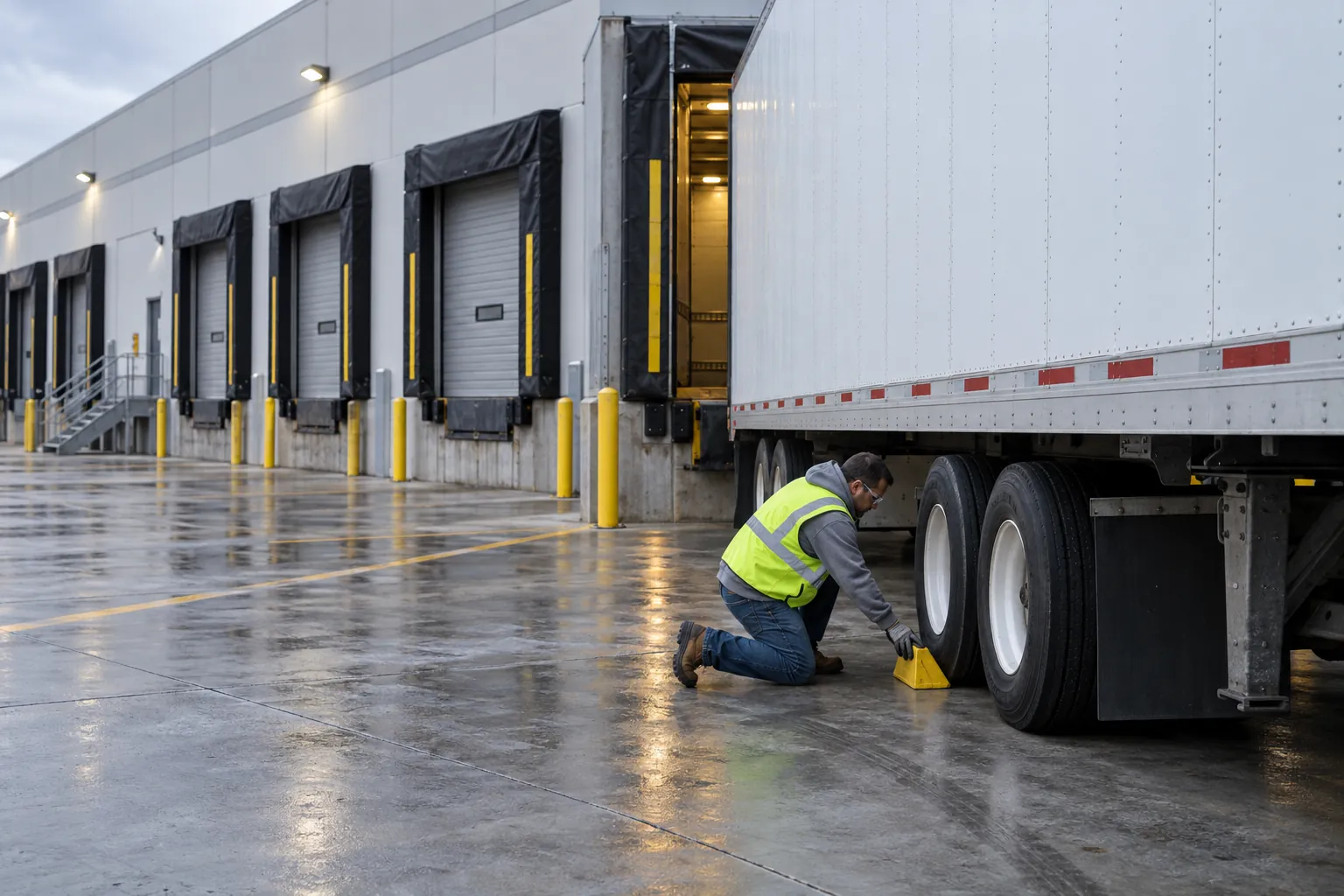 Premises and facilities managementLoading dock safety: what OSHA requires, and the checks that keep a dock safeThe OSHA rules that apply at a loading dock, from wheel chocks to dock edges and dockboards, and a daily check routine that shows the dock was really safe.
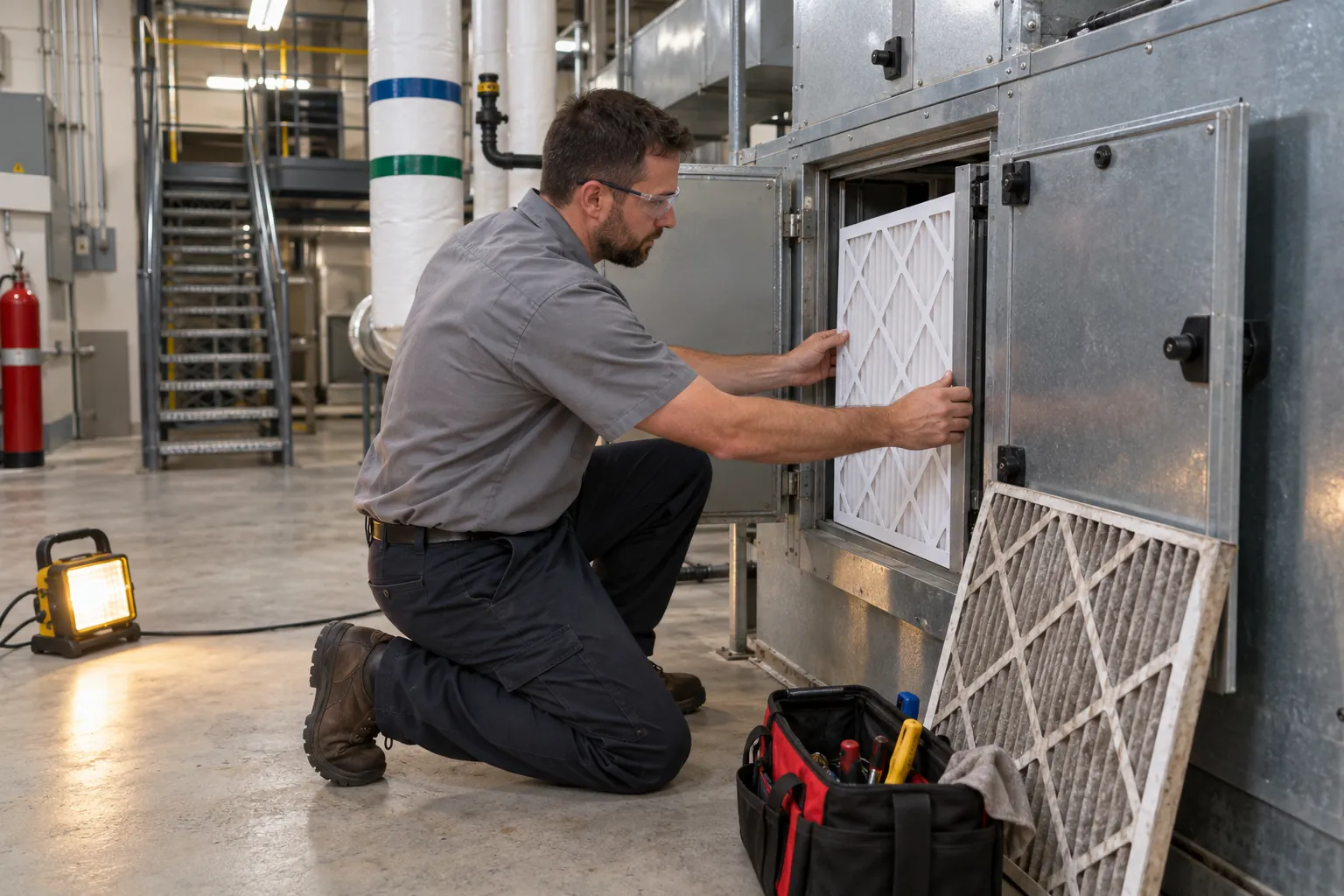 Premises and facilities managementPreventive maintenance checklist: what to check in a commercial building, how often, and how to prove itA preventive maintenance checklist for commercial buildings: HVAC, electrical, fire and life safety, plumbing, how often, and what the record should show.
 Premises and facilities managementLadder inspection: what OSHA requires, and a checklist people actually useWhat OSHA 29 CFR 1910.23 says about inspecting ladders each shift, a checklist for stepladders, extension, fixed and rolling ladders, and what to do with a defect.
 Premises and facilities managementNear miss reporting: catching the close calls before they become injuriesWhat counts as a near miss, what OSHA recommends, what a near miss report should capture, and how to follow it up so people keep reporting in your buildings.