Premises and facilities management
Maintenance technician duties: what the job covers, and how to show it was done
Maintenance technician duties are to inspect, maintain and repair a building and its equipment, from plumbing, electrical fixtures and heating and air conditioning to doors, floors, walls and appliances, through work orders, preventive maintenance and routine checks, and to keep records of the work.
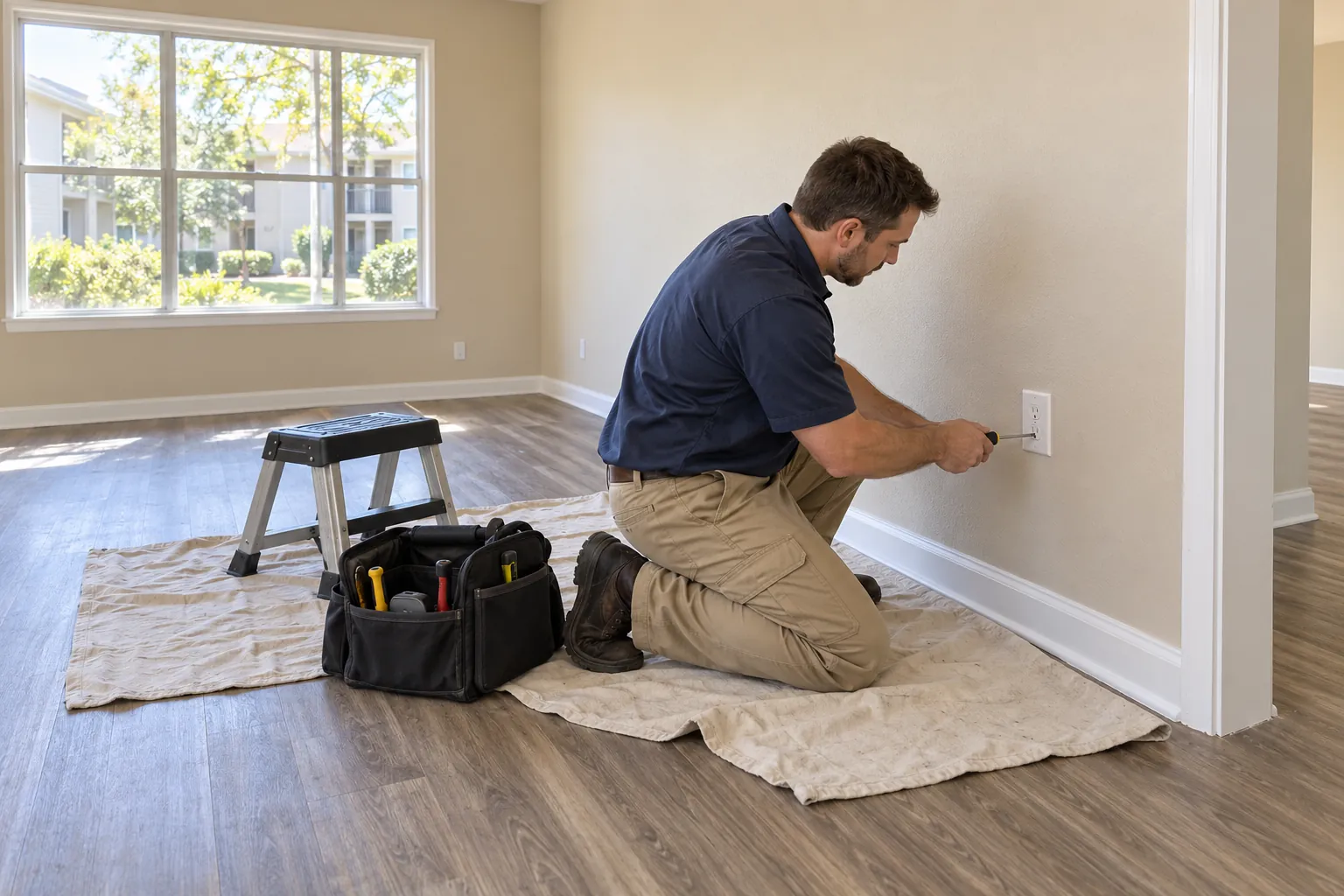
The Bureau of Labor Statistics files the job as general maintenance and repair work, and says these workers "fix and maintain machines, mechanical equipment, and buildings." This guide sets out what the job involves in an apartment community, a school or a commercial building, the federal rules that shape the everyday work, how technician levels 1, 2 and 3 usually differ, and how to show the routine work was actually done.
01
What a maintenance technician is, and what the job is called
A maintenance technician is the all-round tradesperson who keeps a building and its equipment working. The title varies with the employer: maintenance technician, maintenance tech, facilities technician, maintenance mechanic, building mechanic, and in apartments often service technician or make-ready technician. Unlike a licensed electrician or plumber, the technician works across several trades at a level the job and the local rules allow, and calls in a specialist for the rest.
The Bureau of Labor Statistics describes the occupation in its Occupational Outlook Handbook entry for general maintenance and repair workers. It says they "fix and maintain machines, mechanical equipment, and buildings", and that they "paint, repair flooring, and work on plumbing, electrical, and air-conditioning and heating systems." O*NET OnLine's profile of Maintenance and Repair Workers, General (49-9071.00) describes work "involving the skills of two or more maintenance or craft occupations" and lists Maintenance Technician, Facilities Technician, Maintenance Mechanic and Building Mechanic among its reported job titles.
Technicians may look after one building or many. The BLS says they may work "inside a single building, such as a hotel or hospital, or be responsible for the maintenance of many buildings, such as those in an apartment complex or on a college campus." Real estate and rental and leasing is the largest employing industry, with 20% of the jobs. This guide is written for the building side: apartments, schools, offices, hotels and campuses. Industrial maintenance technicians in manufacturing, who keep production lines and machinery running, do similar work on different equipment.
The role sits beside the building engineer, who runs a large building's central plant, and below the maintenance supervisor or facility manager, who sets priorities and budgets. In a small property one technician may be the whole maintenance department; in a large one, several maintenance technicians share the work orders and the on-call schedule under a supervisor.
02
Maintenance technician duties and responsibilities in practice
The BLS lists the core duties as maintaining and repairing "machines, mechanical equipment, and buildings"; fixing or replacing "faulty electrical switches, outlets, and circuit breakers"; inspecting and diagnosing problems; performing "preventive maintenance and service"; ordering parts and supplies; and keeping "detailed records of their work." In a building, a maintenance technician job description usually turns that into these responsibilities:
- Work orders: answer service requests from residents, tenants and staff, from a dripping faucet or a running toilet to a dead outlet or a door that will not latch, by priority, and close each one with what was done. See the maintenance request form.
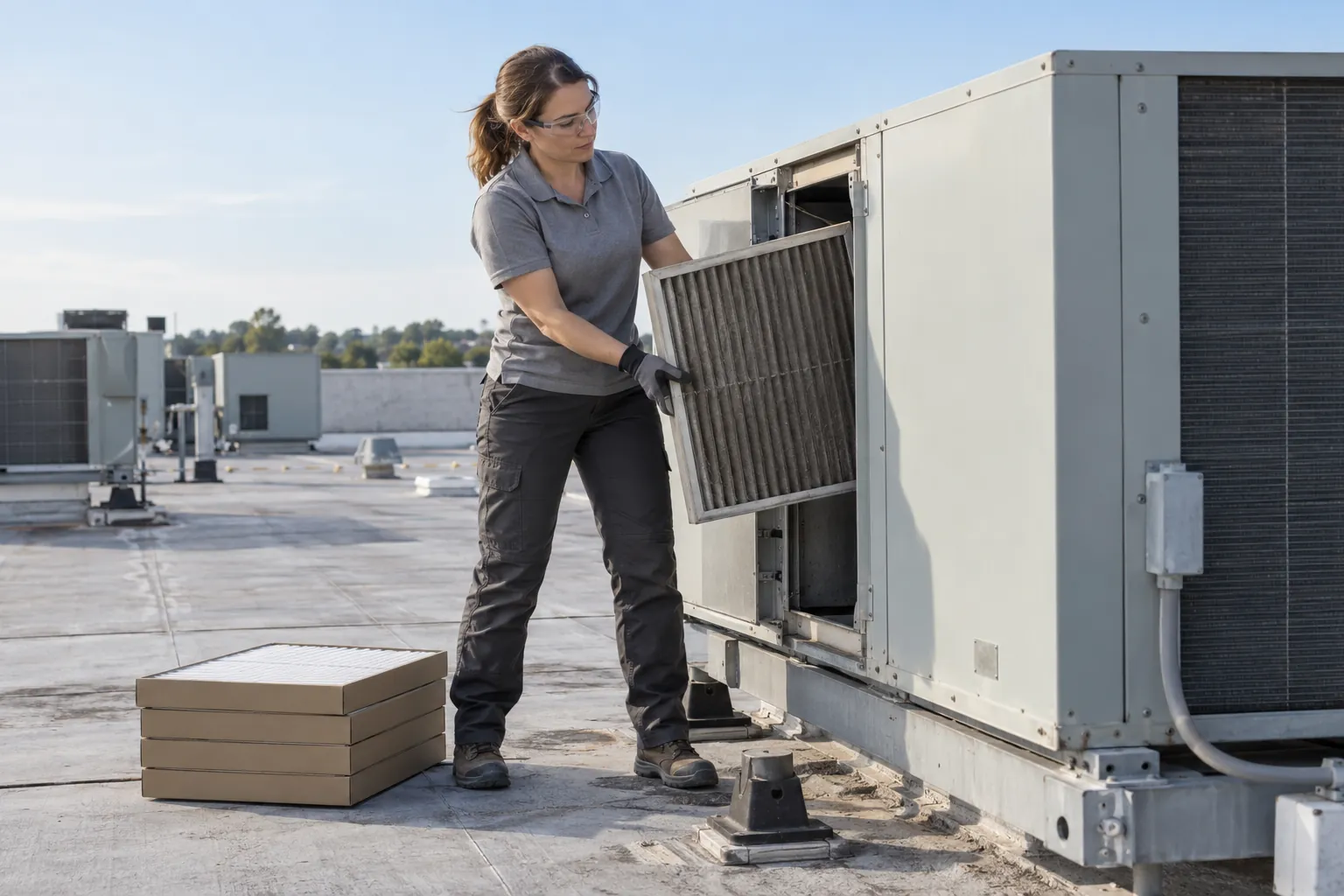
- Preventive maintenance: change HVAC filters, clean coils and condensate drains, test smoke alarm and emergency light circuits where assigned, lubricate and check belts, and carry out the tasks on the property's preventive maintenance checklist.
- Plumbing, electrical and HVAC repairs: within the technician's training and any license the state or city requires, such as replacing fixtures, switches and thermostats, clearing drains and troubleshooting heating and cooling faults.
- Carpentry, drywall, painting and flooring: patching walls, hanging doors, replacing trim and ceiling tiles, and repairing vinyl, tile and carpet.
- Appliances and equipment: ranges, refrigerators, dishwashers, disposals, washers and dryers in apartments; ice machines, motors, pumps and small equipment in commercial buildings.
- Grounds and common areas: lighting, gates, pool equipment, playground and parking lot checks, snow and storm preparation, in many properties alongside a grounds crew.
- Inspections and rounds: walking the property on a set route to find problems before residents or tenants report them. See building rounds.
- Emergencies and on-call: floods, no heat, no cooling, lockouts and power failures. The BLS notes workers "may need to be on call outside normal business hours, such as during evenings and weekends, for emergency repairs."
Apartment maintenance technician duties add the unit turn. When a resident moves out, the technician repairs and readies the unit for the next one, with painting, appliance checks, smoke alarm tests and a final walk, often against a make-ready checklist. In federally assisted housing the technician also helps the property prepare for HUD's NSPIRE inspection. Facilities maintenance technician duties in an office, school or hospital lean more toward building systems, preventive maintenance schedules and supporting the building engineer or the contractors who service them.
03
The federal rules behind the everyday work
The BLS says general maintenance and repair workers "have one of the highest rates of injuries and illnesses of all occupations", with sprains, cuts and fractures among the common injuries. These are the federal rules a building maintenance technician meets most often:
- Lockout/tagout. 29 CFR 1910.147, The control of hazardous energy (lockout/tagout), covers servicing and maintenance where "the unexpected energization or start up of the machines or equipment, or release of stored energy could cause injury to employees." The employer must "establish a program consisting of energy control procedures, employee training and periodic inspections" so that equipment is "isolated from the energy source, and rendered inoperative" before work starts. The procedure must be inspected "at least annually", and the employer must certify each inspection with the equipment, the date, the employees included and the inspector. Cord-and-plug equipment is outside the standard when unplugging controls the hazard and the plug stays under the exclusive control of the person doing the work.
- Electrical work. 29 CFR 1910.333, Selection and use of work practices, requires safety-related work practices "when work is performed near or on equipment or circuits which are or may be energized", and says "Only qualified persons may work on electric circuit parts or equipment that have not been deenergized" under the standard's procedures.
- Ladders. Under 29 CFR 1910.23, Ladders, ladders must be "inspected before initial use in each work shift, and more frequently as necessary", and a defective ladder must be "immediately tagged 'Dangerous: Do Not Use' or with similar language" and removed from service until repaired or replaced. See the ladder inspection checklist.
- Chemicals. 29 CFR 1910.1200, Hazard Communication, requires employers to keep safety data sheets "readily accessible during each work shift to employees when they are in their work area(s)", and to train employees on hazardous chemicals "at the time of their initial assignment" and whenever a new hazard is introduced.
Refrigerant. Under the Clean Air Act, the EPA's Section 608 technician certification requirements say "technicians who maintain, service, repair, or dispose of equipment that could release refrigerants into the atmosphere must be certified." There are four types: Type I for small appliances, such as window units and refrigerators; Type II for high- or very high-pressure appliances, which takes in most split systems and rooftop units; Type III for low-pressure appliances; and Universal for all types. The EPA says "Section 608 Technician Certification credentials do not expire."
Lead-based paint. Apartment technicians in older buildings meet the EPA's lead Renovation, Repair and Painting (RRP) Rule. The EPA's Renovation, Repair and Painting Program page for contractors says "In general, anyone who is paid to perform work that disturbs paint in housing and child-occupied facilities built before 1978 must be certified", and the EPA's Renovation, Repair and Painting Program page says property management companies doing that work must become lead-safe certified firms. Small jobs are carved out: the EPA's answer on how it interprets minor repair and maintenance activities covers work disturbing less than 6 square feet of painted surface per room inside, or 20 square feet outside, with no prohibited practices, window replacement or demolition; jobs "performed in the same room within the same 30 days must be considered the same job."
04
Work orders, preventive maintenance and rounds: how the work is organized
A maintenance technician's day is usually split between three streams of work, and each needs its own kind of record:
- Reactive work orders: requests that arrive from a resident portal, a front desk, a phone call or a passing conversation. They are sorted by priority, with emergencies such as a flood, a gas smell, no heat in winter or a stuck elevator answered at once, and the rest scheduled. See reactive maintenance.
- Preventive maintenance (PM): the planned routine maintenance tasks on a calendar, from monthly filter changes and quarterly coil cleaning to seasonal changeover and the winterization checklist, usually issued from a CMMS or a property management system.
- Routine checks and rounds: the daily or weekly walk of boiler and mechanical rooms, laundry rooms, the pool, parking lots, stairwells and exterior lighting, which finds problems nobody has reported yet.
The work order system usually holds the first two well. The third, and the problems a technician notices on the way to something else, often sit on a clipboard, in a notebook or in memory. That is where a manager's question, whether the weekly checks were done in every building last month, gets an assurance rather than an answer.
What good evidence looks like, for any routine check a technician does:
- What was checked, named the same way every time: the building, the room or the unit.
- When it was done, not when it was written up at the end of the shift.
- Who did it, by name.
- The result, and what was done about anything wrong, with a photo where the condition matters.
- What stopped the check, such as a locked room, an occupied unit or a part on order, so a missed check has a reason rather than a blank.
A short line on what was found, what was done and whether a return visit is needed protects the technician as much as the property.
05
Maintenance technician 1, 2 and 3, and the skills behind them
Levels such as maintenance technician I, II and III, or tech 1, 2 and 3, are an employer's own job grades, not a federal classification: the BLS and O*NET describe one occupation without levels, so each employer's job descriptions define what each level means. Most follow the same arc the BLS describes for training. Workers "usually start by watching and learning from skilled maintenance workers. They begin by doing simple tasks, such as fixing leaky faucets and replacing lightbulbs. After gaining experience, general maintenance and repair workers move on to more difficult tasks, such as overhauling machinery or building walls." A sensible ladder looks like this: a level 1 technician handles routine work orders and turns under supervision; a level 2 diagnoses and repairs across the trades with little supervision and takes on-call shifts; and a level 3 or lead technician takes the hardest faults, holds the certifications the property relies on, and trains the others. Read the job description, because pay and duties at each level vary from one employer to the next.
On education, the BLS says "A high school diploma or equivalent is typically required to enter the occupation", with skills often learned in high school technical classes, trade schools or community colleges, and that some workers "complete an apprenticeship program, which usually combines paid on-the-job training with technical instruction."
The BLS names six important qualities: adaptability, customer-service skills, dexterity, mechanical skills, physical strength and problem-solving skills. On problem solving it says technicians "must diagnose and repair a wide variety of building and equipment issues. They may perform tests to figure out the cause of a problem before fixing it." In apartments the customers are residents in their own homes, so courtesy, communication skills, attention to detail and a clear note of what was done matter as much as the repair.
Beyond those, a building maintenance technician typically needs:
- knowledge of hand and power tools, meters and testers, and the ability to troubleshoot a fault safely before replacing parts;
- EPA Section 608 certification of the type that covers the equipment serviced: Type I for small appliances, Type II for most split systems and rooftop units, or Universal;
- EPA RRP certified renovator training where the property has pre-1978 housing or child-occupied facilities;
- lockout/tagout, electrical safety, ladder and hazard communication training appropriate to the work;
- any trade license the state or city requires for the electrical, plumbing, HVAC or boiler work done;
- working knowledge of the work order system and the property's PM calendar.
06
Where the record fails, and what SiteClara does about it
A maintenance team's work orders are usually in reasonable order. The weak part is the routine work in between. The filter change log in the mechanical room was filled in for the whole month on the last day. The pool and laundry room checks were done, but the only record is memory. A leak mentioned to the leasing office or the day porter never reached the technician.
SiteClara records that routine work at the place it happens. A printed QR poster at each location, such as a mechanical room, a laundry room, a pool equipment room, a roof hatch or a parking structure, with an optional NFC tag behind it, lets maintenance, janitorial or security staff scan the code or tap the tag on their own phone, with no app to install. They see the scheduled checks due there and mark each one done, or say what stopped them, with a photo when one is asked for. A problem found there goes onto the team's list of jobs until someone closes it, and the supervisor's queue groups open jobs by building and floor. A supervisor can escalate a job to the building's manager, who can answer it.
Each day the supervisor reviews the day's checks and photos, gives a reason for any check that was missed, and approves a report, which goes to the property manager and other nominated contacts at 8 a.m. the next morning. It shows what was reported, what was completed, what is still open and how the scheduled checks went. Where a maintenance team, a janitorial vendor and a security vendor work in the same property, each can run its own staff, forms and approval.
07
Questions people ask
What are the 5 basic maintenance skills?
There is no official list of five, but the BLS Occupational Outlook Handbook entry for general maintenance and repair workers names six important qualities: adaptability, customer-service skills, dexterity, mechanical skills, physical strength and problem-solving skills. In trade terms, most building maintenance job descriptions ask for basic plumbing, electrical, HVAC, carpentry and painting.
Is maintenance tech a good career?
As a career, it is a large, steady occupation that can be entered without a degree. The BLS reports 1,621,800 general maintenance and repair jobs in 2025, a median annual wage of $49,590 in May 2025, projected employment growth of 4% from 2025 to 2035, and about 148,700 openings a year on average over the decade. It also notes one of the highest rates of injuries and illnesses of all occupations, which is why training on lockout/tagout, ladders and electrical safety matters.
08
Further reading, and a list to take away
Start with the BLS entry for general maintenance and repair workers and the O*NET profile, OSHA's standards on lockout/tagout, electrical work practices, ladders and hazard communication (checking your state plan), and the EPA's Section 608 and lead RRP pages, all linked above. Your state and city publish the trade licensing, boiler, elevator and building code requirements for your property.
In your first month as a maintenance technician, or when you hire one, make sure you know:
- how work orders arrive, how they are prioritized, and what counts as an emergency;
- the PM calendar for the property, and which tasks are yours;
- the lockout/tagout procedures for the equipment you service, and when they were last inspected;
- which work you are qualified and licensed to do, and which goes to a contractor;
- your Section 608 certification type, and which equipment it covers;
- whether the property has pre-1978 housing or child-occupied facilities, and who holds RRP certification;
- the routine checks and rounds you are expected to make, and where they are recorded.
Sources
Every document this guide quotes or links to, in the order it first cites them.
- Occupational Outlook Handbook entry for general maintenance and repair workers bls.gov
- Maintenance and Repair Workers, General (49-9071.00) onetonline.org
- OSHA-approved State Plans osha.gov
- 29 CFR 1910.147, The control of hazardous energy (lockout/tagout) osha.gov
- 29 CFR 1910.333, Selection and use of work practices osha.gov
- 29 CFR 1910.23, Ladders osha.gov
- 29 CFR 1910.1200, Hazard Communication osha.gov
- Section 608 technician certification requirements epa.gov
- Renovation, Repair and Painting Program page for contractors epa.gov
- EPA's Renovation, Repair and Painting Program page epa.gov
- How it interprets minor repair and maintenance activities epa.gov
Related guides
 Premises and facilities managementBuilding engineer duties: what the job covers, and how to show it is doneBuilding engineer duties in a commercial building: running the plant, rounds and logs, lockout, refrigerant and boiler rules, vendors, and a record that holds up.
 Premises and facilities managementPreventive maintenance checklist: what to check in a commercial building, how often, and how to prove itA preventive maintenance checklist for commercial buildings: HVAC, electrical, fire and life safety, plumbing, how often, and what the record should show.
 Premises and facilities managementMaintenance request form: what to include, with a worked templateA maintenance request form template for US commercial buildings, with worked examples, essential fields, emergency instructions and a clear completion record.
 Premises and facilities managementThe apartment make-ready checklist: how to turn a unit properly, and prove itAn apartment make-ready checklist room by room: the order of work, the safety items HUD, EPA and state law require, and the photos and sign-off that prove it.