Premises and facilities management
SPCC plan: who needs one, what it must contain, and how to keep the inspection record
An SPCC plan is the written Spill Prevention, Control, and Countermeasure Plan that the EPA's Oil Pollution Prevention rule, 40 CFR Part 112, requires at a non-transportation-related facility that could reasonably be expected to discharge oil to navigable waters or adjoining shorelines and that has more than 1,320 gallons of oil storage capacity aboveground, counting only containers of 55 gallons or more, or more than 42,000 gallons in completely buried tanks.
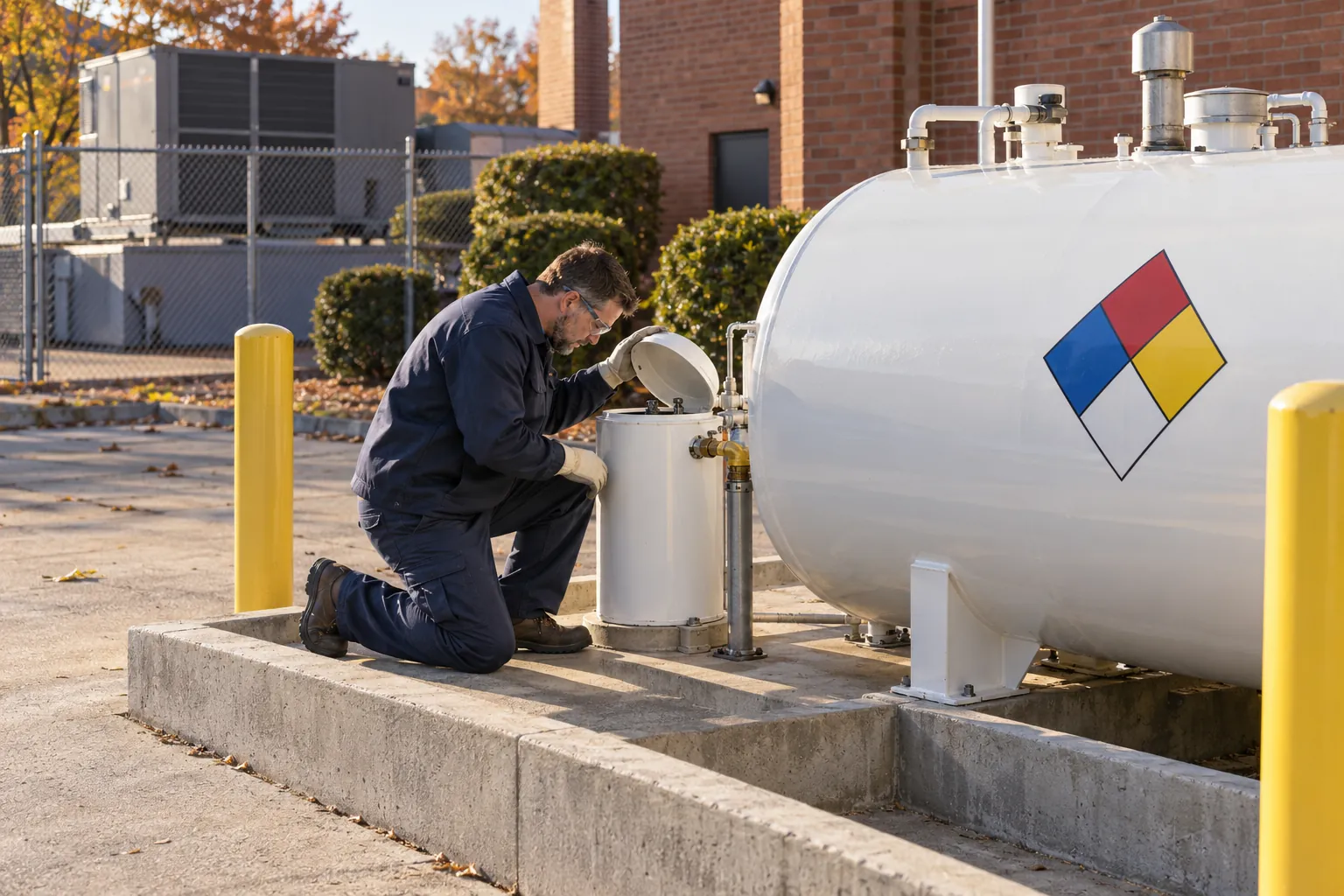
Generator tanks, a heating oil tank and a shop full of drums add up quickly. The plan has to be certified, kept on site and followed, and the part that slips most often is the routine one: the inspections it schedules and the signed record of each. This guide explains who needs a plan, what it must contain, how often the tanks are inspected, and what a good inspection record looks like.
01
What an SPCC plan is, and which facilities need one
The Spill Prevention, Control, and Countermeasure (SPCC) rule is part of the EPA's Oil Pollution Prevention regulation, 40 CFR Part 112, made under the Clean Water Act to prevent oil spills from reaching navigable waters and adjoining shorelines. Under 40 CFR 112.1, it applies to a facility "storing, processing, refining, transferring, distributing, using, or consuming oil and oil products" which, "due to its location, could reasonably be expected to discharge oil in quantities that may be harmful" into navigable waters or adjoining shorelines, unless its aggregate aboveground capacity is 1,320 gallons or less, where "only containers with a capacity of 55 U.S. gallons or greater are counted," and its completely buried capacity is 42,000 gallons or less, leaving out buried tanks under the federal underground storage tank rules.
Three details catch building owners out. Capacity is the shell capacity, not the contents: the EPA's A Facility Owner/Operator's Guide to Oil Pollution Prevention says to use "the shell capacity of the container (maximum volume) and not the actual amount of product stored." Oil is defined broadly in 40 CFR 112.2, from fuel oil and synthetic oils to "vegetable oils" and animal fats. And equipment counts as well as tanks: the guide lists hydraulic systems, gear boxes, transformers, circuit breakers and electrical switches among the oil-filled equipment that does "count toward facility storage capacity."
In an ordinary building the oil sits in generator tanks, a heating oil tank, drums in the engineering shop, transformers and kitchen totes of cooking oil. A hospital with a 1,000-gallon generator sub-base tank, a 275-gallon day tank and two 55-gallon drums has 1,385 gallons aboveground and is over the threshold; the 5-gallon pails on the shelf do not count. Left out of the count are permanently closed containers (emptied, disconnected, blanked off and signed with the date of closure), a vehicle's own fuel tank, and containers used exclusively for wastewater treatment.
The location test is about geography alone: under 112.1(d)(1)(i) it "must exclude consideration of manmade features such as dikes," and the EPA's guide asks whether ditches, gullies or storm sewers "may transport an oil spill to nearby streams." A parking lot storm drain that empties into a creek is that kind of route.
States can go further. In California, Health and Safety Code section 25270.3, part of the Aboveground Petroleum Storage Act, brings in any tank facility with "a storage capacity of 1,320 gallons or more of petroleum," and section 25270.4.5 requires an SPCC plan in the Part 112 format even from facilities "not subject to the general provisions in Section 112.1." Check your own state's regulations.
02
SPCC plan requirements: what the plan must contain
40 CFR 112.7 sets the general requirements for all SPCC plans, and 40 CFR 112.8 adds the specific ones for onshore facilities other than oil production facilities, which takes in offices, campuses, hospitals and warehouses. The plan is written "in accordance with good engineering practices" and "must have the full approval of management at a level of authority to commit the necessary resources to fully implement the Plan." It contains:
- A facility diagram and description marking "the location and contents of each fixed oil storage container and the storage area where mobile or portable containers are located," with transfer points, piping, and each container's oil type and capacity.
- Secondary containment for each bulk storage installation, for "the entire capacity of the largest single container and sufficient freeboard to contain precipitation" (112.8(c)(2)), the same for drums and totes, and general containment such as curbing, drip pans or sorbents where a spill is likely, such as the fill point.
- Overfill prevention: at least one of a high level alarm, a high level pump cutoff, direct communication between the person gauging and the pump station, or a fast-response gauge with someone watching the fill, with the level sensing devices tested regularly (112.8(c)(8)).
- Handling procedures and countermeasures: how oil is loaded, unloaded and transferred, how a discharge is found, contained and cleaned up, and a contact list that includes the National Response Center and cleanup contractors.
- Inspections, tests and records, training and briefings, and security: controlled access to oil storage areas, secured drain valves and pump controls, and lighting adequate to deter vandalism and help find a discharge.
A licensed Professional Engineer certifies the plan under 40 CFR 112.3(d), attesting that "he or his agent has visited and examined the facility" and that "procedures for required inspections and testing have been established." A qualified facility may certify its own: 10,000 gallons or less aboveground, and no single discharge to navigable waters over 1,000 gallons and no two over 42 gallons each in any twelve months, in the three years before certification. One that also has no aboveground container over 5,000 gallons is Tier I and may use the EPA's Tier I Qualified Facility SPCC Plan Template, which warns that "some states do not allow self-certification."
Writing the plan is only half of compliance: 40 CFR 112.3 requires you to "prepare in writing and implement" it. Keep a complete copy of the plan at the facility if it is normally attended at least four hours a day, or at the nearest field office if it is not, available to the EPA Regional Administrator for on-site review during normal working hours. Under 40 CFR 112.5, amend it within six months of any change that "materially affects its potential for a discharge," such as "commissioning or decommissioning containers; replacement, reconstruction, or movement of containers," and implement the amendment within six months after that. Review the whole plan at least once every five years, and sign a statement such as "I have completed review and evaluation of the SPCC Plan for (name of facility) on (date), and will (will not) amend the Plan as a result."
03
SPCC inspection requirements: what is inspected, by whom and how often
Under 40 CFR 112.7(e), inspections and tests follow written procedures, and you "must keep these written procedures and a record of the inspections and tests, signed by the appropriate supervisor or inspector, with the SPCC Plan for a period of three years."
The tank duty is in 40 CFR 112.8(c)(6): "test or inspect each aboveground container for integrity on a regular schedule and whenever you make material repairs," setting the inspector's qualifications and the frequency and type of testing "in accordance with industry standards." You must also keep comparison records, inspect supports and foundations, and "frequently inspect the outside of the container for signs of deterioration, discharges, or accumulation of oil inside diked areas."
The rule does not put a number on "frequently"; SPCC plans do. The EPA's SPCC Guidance for Regional Inspectors, Chapter 7: Inspection, Evaluation, and Testing (December 16, 2013) calls it "a routine walk-around" and says "industry standards typically require monthly visual inspections, although some facilities conduct daily or weekly visual inspections." Once the plan sets a schedule, "the owner or operator must conduct inspections according to that schedule."
For the shop-built tanks most buildings have, the usual standard is the Steel Tank Institute's SP001 Standard for the Inspection of Aboveground Storage Tanks, which the EPA's Tank Inspections page says covers "aboveground shop-fabricated tanks, small field-erected tanks, portable containers, and associated secondary containment." It works in two layers:
- Monthly and annual inspections by the owner's inspector, on checklists. STI says this visual inspection "does not require a Certified Inspector"; a building engineer or trained technician usually does it.
- Formal inspections and integrity testing by a certified inspector, at intervals set by the tank's size, configuration and protection. The EPA's chapter notes that "for tanks larger than 5,000 gallons, most industry standards require more than a visual inspection by the owner or operator."
For drums and totes the bar is lower: under SP001, the chapter says, "when portable containers have adequate secondary containment then visual inspection of these containers is acceptable." The same schedule should carry the other recurring duties in 112.8: regular inspection of "all aboveground valves, piping, and appurtenances"; inspecting rainwater in a dike before draining it, and keeping "adequate records of such events"; and promptly correcting visible leaks and removing oil from diked areas, which the EPA reads as "beginning the cleanup of any accumulation of oil immediately after discovery." Keep signed records for at least three years; the EPA "recommends that formal testing and inspection records or reports be retained for the life of the container."
04
An SPCC inspection checklist for the monthly walk
STI publishes free model forms for SP001, in versions dated February 2024: the STI SP001 Monthly Inspection Checklist, an annual checklist and one for portable containers. They are "intended as a model," and "locally developed checklists are acceptable as long as they are equivalent." The procedure in your plan governs. A typical monthly walk asks:
- Is the tank exterior, with its fittings and valves, free of visible leaks, and is the ground and containment around it free of signs of leakage?
- Is the level gauge readable and working, and is the tank free of water?
- Are the shell and supports clear of soil, vegetation and debris at grade?
- On a double-wall tank, is the interstitial monitor working and the interstice dry?
- Does the overfill alarm sound or light when tested, and is the spill bucket at the fill point empty and sound?
- Are pipe connections, valves and pumps free of leaks?
- Is the containment free of standing liquid, debris and cracks, with its drain valves closed?
- Are drums and totes in their designated area, on containment, and free of leaks, dents and bulges? STI's portable checklist says to stop using one that is not.
- Is anything else wrong?
In a building the walk takes in places nobody passes by chance: the generator room or enclosure, the boiler room's oil tank, the drum store, the fill box where the fuel truck connects. Check the spill kits on the same walk, so small spills are soaked up before they reach a drain. STI's annual checklist adds settlement, cracked concrete, coating failure, bulging, blocked vents and a test of the level sensing devices.

05
Training, briefings, and what to do when oil is spilled
Under 40 CFR 112.7(f), oil-handling personnel are trained in equipment operation and maintenance, discharge procedures, pollution control laws, general facility operations and "the contents of the facility SPCC Plan." One person must be designated "who is accountable for discharge prevention and who reports to facility management," and discharge prevention briefings must be held "at least once a year," highlighting known discharges, failures, malfunctioning components and new precautions. A custodian or a security officer on a night round may be first to see a drip, so they should know who to tell too. Record who attended each briefing.
When oil gets out, a discharge that causes "a film or sheen upon or discoloration of the surface of the water or adjoining shorelines" is harmful under 40 CFR 110.3, and 40 CFR 110.6 requires the person in charge to "immediately notify the National Response Center (NRC) (800-424-8802)." The EPA's guide adds that the NRC report "only satisfies your federal reporting requirements" and that "in most cases it makes sense to call 911," particularly for flammable or combustible oil.
Under 40 CFR 112.4, a facility that discharges more than 1,000 gallons at once, or more than 42 gallons in each of two discharges within twelve months, also sends the EPA Regional Administrator a written account within 60 days, including the cause and the corrective action, with a copy to the state. The EPA's What are the oil discharge reporting requirements in the SPCC Rule? explains that those gallon amounts refer to "the amount of oil that actually reaches navigable waters or adjoining shorelines, not the total amount of oil spilled."
06
Where the record fails, and what SiteClara does about it
SPCC records fail in the routine the plan depends on. The monthly checklist is filled in at the end of the month from memory, or a year of them is signed in one sitting before an inspection. The locked generator room was skipped and nobody wrote down why. The drum store moved to the loading dock and fell off the round. A sheen in the containment tub, mentioned to whoever was passing, was still there after the next rain.
SiteClara records routine checks at the place they are done. A printed QR poster, with an optional NFC tag behind it, sits at each place a check is scheduled, such as the generator day tank or the drum store. Staff scan the code or tap the tag on their own phone, with no app to install, see the checks due there, and mark each one done or say what stopped them, such as a locked room. The time and the named person are recorded as it happens, with a photo when the check asks for one, for example of the containment tub. A problem such as a weeping valve is reported there with a photo and goes onto the team's list of jobs until someone closes it.
The supervisor sees what is due, done and missed, and records the reason a check was missed. Each day the supervisor reviews and approves a report that goes to nominated management or client contacts at 8 a.m. the next day, showing what was reported, completed and still open, and how the scheduled checks went, for example 4 of 4 tank checks completed. That gives the person accountable for discharge prevention a dated working record to set beside the signed checklists.
07
Questions people ask
What does SPCC stand for, and what is an SPCC plan for?
SPCC stands for Spill Prevention, Control, and Countermeasure. The EPA's Overview of the Spill Prevention, Control, and Countermeasure (SPCC) Regulation says "the goal of this regulation is to prevent oil from reaching navigable waters and adjoining shorelines, and to contain discharges of oil."
What are the three criteria that subject a facility to the SPCC rule?
The EPA's Does the Spill Prevention, Control, and Countermeasure (SPCC) Rule Apply to Your Facility? asks five questions that come down to three criteria: whether the facility is non-transportation-related and stores, processes, transfers, uses or consumes oil; whether its aboveground oil storage capacity is over 1,320 gallons or its completely buried capacity is over 42,000 gallons; and whether it could reasonably be expected to discharge oil in quantities that may be harmful into navigable waters or adjoining shorelines. A facility that meets all three is subject to the rule and must prepare and implement a plan.
How often must an SPCC plan be reviewed?
At least once every five years. 40 CFR 112.5(b) requires a documented review and evaluation, an amendment within six months if field-proven technology "will significantly reduce the likelihood of a discharge," and a signed statement saying whether the plan will be amended. A change that materially affects the potential for a discharge needs an amendment in between.
Does an emergency generator need an SPCC plan?
The generator has no plan of its own, but its fuel tanks count toward the facility's total. A sub-base tank or day tank of 55 gallons or more is an aboveground container under 40 CFR 112.1, so if the facility's total is over 1,320 gallons and a spill could reasonably reach navigable waters, its plan must cover the generator's tanks.
Do you have to submit an SPCC plan to the EPA?
No. The plan is kept at the facility, and the EPA's A Facility Owner/Operator's Guide to Oil Pollution Prevention says to submit it "only when requested."
08
Where to read the official guidance, and a list to take away
Start with the regulations themselves, 40 CFR Part 112, especially 112.1, 112.3 to 112.5, 112.7 and 112.8. The EPA's Does the Spill Prevention, Control, and Countermeasure (SPCC) Rule Apply to Your Facility? walks through applicability in five questions. For inspections, read Chapter 7 of the EPA's SPCC Guidance for Regional Inspectors and STI's SP001 page with its free checklists.
Before the next inspection, check that:
- every container and piece of oil-filled equipment of 55 gallons or more is counted by shell capacity;
- the plan is certified, approved by management, kept on site and reviewed within the last five years;
- every tank and drum store is where the facility diagram says, and every change has been through an amendment;
- the plan names the inspection standard and schedule, and someone owns each monthly and annual inspection;
- the certified inspector's formal inspections are booked;
- each record has the date, the inspector's signature, every item answered and every fault with its corrective action;
- the annual briefing is on the calendar, and everyone near the tanks knows how to report a leak;
- signed records are kept with the plan for at least three years.
Sources
Every document this guide quotes or links to, in the order it first cites them.
- Oil Pollution Prevention regulation, 40 CFR Part 112 ecfr.gov
- 40 CFR 112.1 ecfr.gov
- A Facility Owner/Operator's Guide to Oil Pollution Prevention epa.gov
- Health and Safety Code section 25270.3 leginfo.legislature.ca.gov
- Section 25270.4.5 leginfo.legislature.ca.gov
- 40 CFR 112.7 ecfr.gov
- 40 CFR 112.8 ecfr.gov
- 40 CFR 112.3(d) ecfr.gov
- Tier I Qualified Facility SPCC Plan Template epa.gov
- 40 CFR 112.5 ecfr.gov
- SPCC Guidance for Regional Inspectors, Chapter 7: Inspection, Evaluation, and Testing epa.gov
- SP001 Standard for the Inspection of Aboveground Storage Tanks stispfa.org
- Tank Inspections epa.gov
- STI SP001 Monthly Inspection Checklist stispfa.org
- 40 CFR 110.3 ecfr.gov
- 40 CFR 110.6 ecfr.gov
- 40 CFR 112.4 ecfr.gov
- What are the oil discharge reporting requirements in the SPCC Rule? epa.gov
- Overview of the Spill Prevention, Control, and Countermeasure (SPCC) Regulation epa.gov
- Does the Spill Prevention, Control, and Countermeasure (SPCC) Rule Apply to Your Facility? epa.gov
Related guides
 Premises and facilities managementGenerator testing: what NFPA 110 asks, and what to write downEmergency generator testing under NFPA 110: the weekly inspection, the monthly exercise under load, batteries, fuel, the 36-month test, and what the record shows.
 Premises and facilities managementStormwater inspection: what the permits and your city expect, and how to keep the recordWhich stormwater inspections a US property needs: industrial permit checks, construction site inspections and post-construction BMP maintenance, and the records.
 Premises and facilities managementBoiler log: what to record, how often, and what the state expectsWhat a boiler log should record, how often to take readings and test the low-water cutoff, what state boiler rules and ASME CSD-1 expect, and where logs fail.
 Premises and facilities managementBuilding engineer duties: what the job covers, and how to show it is doneBuilding engineer duties in a commercial building: running the plant, rounds and logs, lockout, refrigerant and boiler rules, vendors, and a record that holds up.