Premises and facilities management
Stormwater inspection: what the permits and your city expect, and how to keep the record
A stormwater inspection is a scheduled check that the drains, ponds and other controls that collect, treat and carry away a property's rainwater are working, and that nothing but rainwater is getting into them.
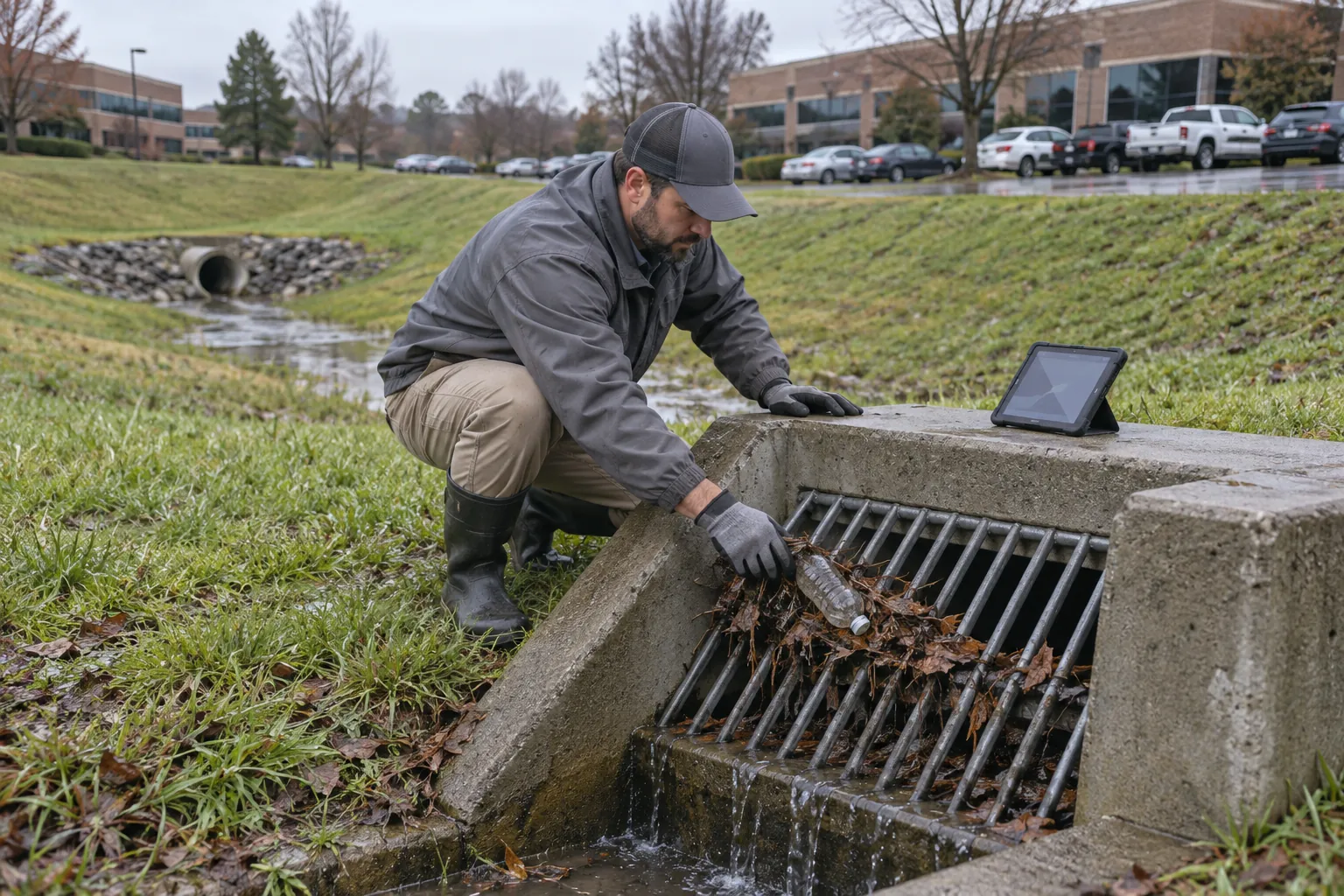
It covers the catch basins, the detention pond or vault, the rain garden, the oil-water separator, the outfall, and the places where something could get into the water first, such as the dumpster pad and the loading dock. Depending on the property, the inspection may be required by a federal or state stormwater permit, by a local ordinance, or by a maintenance agreement recorded on the deed. This guide explains which rule applies, what to look at, how often, and what a record that will stand up to an inspector looks like.
01
What a stormwater inspection is, and which rules require one
Stormwater is regulated under the Clean Water Act through the National Pollutant Discharge Elimination System (NPDES). In the words of the EPA's NPDES Stormwater Program page, the program "regulates some stormwater discharges from three potential sources: municipal separate storm sewer systems (MS4s), construction activities, and industrial activities." Each leads to a different kind of inspection, and a facility manager can meet all three on the same property over its life:
- Industrial stormwater inspections, where the property carries on an industrial activity listed in the federal rules, set by the facility's industrial permit.
- Construction site inspections, while land is being disturbed, typically one acre or more, set by the project's construction permit.
- Post-construction inspections of the permanent stormwater controls built with the property, often called BMPs (best management practices), set by the city or county.
That last category reaches ordinary buildings. Under 40 CFR 122.34, the permit for a regulated small MS4 must require a program for runoff from new development and redevelopment that disturbs one acre or more, and must require the city or county to "use an ordinance or other regulatory mechanism to address post-construction runoff" and to "ensure adequate long-term operation and maintenance of BMPs." Local governments usually meet that duty by putting the maintenance on the property owner, through the stormwater ordinance, the approved site plan and a maintenance agreement recorded against the property. So an office park, a school or a shopping center may owe inspections of its pond or underground vault without ever holding a federal permit.
Who writes the permit depends on where you are. The same EPA page says "most states are authorized to implement the stormwater NPDES permitting program" and that "EPA remains the permitting authority in a few states, territories, and on most land in Indian Country." In an authorized state the industrial and construction general permits are the state's, with its own inspection terms. The EPA permits quoted below are a useful model, but the permit you are covered by is the one that binds you, and municipal rules differ from city to city.
02
What a stormwater inspection covers on a typical property
The approved stormwater management plan, or the stormwater pollution prevention plan (SWPPP) for a permitted facility, says which controls are yours and where. Most commercial and institutional properties have some of these:
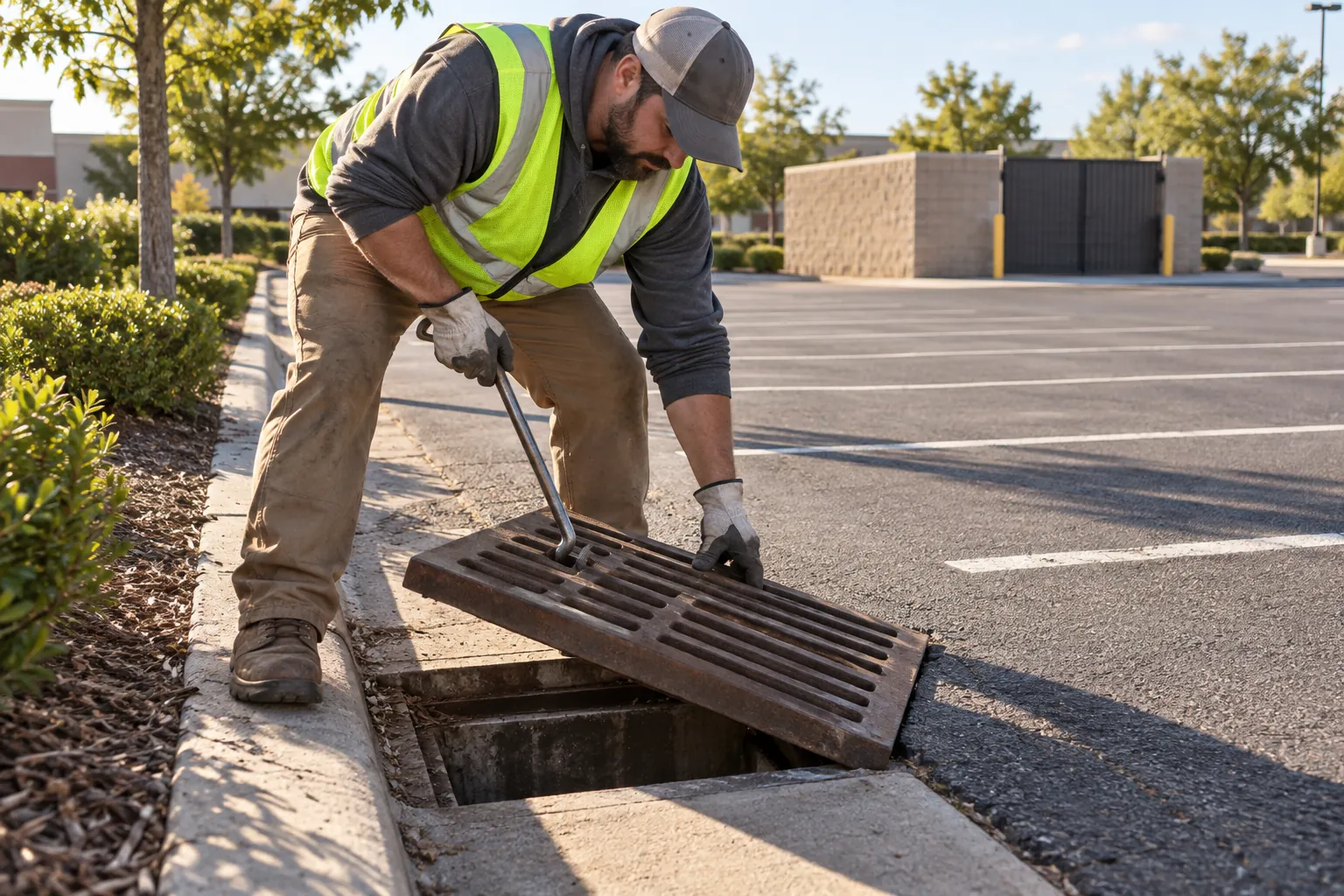
- Catch basins, curb inlets and area drains: grates clear, no trash or sediment built up in the sump, no oil sheen, no sign of anything poured in.
- Pipes, manholes and the outfall: structures intact, no erosion where the pipe discharges, no flow in dry weather.
- Detention and retention ponds: inlets, outlet structure and trash rack clear, banks stable, no trees on the embankment, the forebay not filling with sediment.
- Underground vaults and chambers: covers secure, sediment within the plan's limits. Entry is usually a confined space and a job for a trained contractor.
- Oil-water and oil-grit separators: oil and sediment levels, pumped out at the plan's or manufacturer's trigger.
- Bioretention cells, rain gardens, swales and permeable pavement: water draining within the design time after a storm, plants and mulch in place, no erosion, surfaces not clogged.
- Pollutant sources: dumpster and compactor pads, grease bins, loading docks, fueling areas, vehicle washing, salt piles and de-icing areas in winter, landscape chemicals and outdoor storage.
Look out above all for anything that is not rainwater. Under 40 CFR 122.26, an illicit discharge is "any discharge to a municipal separate storm sewer that is not composed entirely of storm water," apart from discharges under an NPDES permit and those from firefighting. Mop water dumped into a parking lot drain, sidewalk wash water and a leaking dumpster all count, and the storm drain usually runs to a creek, not a treatment plant.
It helps to split the inspection into two layers. The routine walk can be done by a porter, custodian, grounds crew or building engineer on a set round: grates clear, lids closed, no spills, a photo of anything wrong. The periodic inspection of the structures themselves is done by someone who knows the design, often a specialist contractor for vaults and ponds. The routine walk catches today's trash and spill; the periodic inspection catches the pond slowly filling with sediment.
03
Industrial facilities: routine inspections and quarterly visual assessments
Where a property holds an industrial stormwater permit, the permit sets the inspection program. The EPA's 2021 Multi-Sector General Permit, Parts 1-7 (as modified), shows what such a permit asks. Under Part 3.1:
- Who. "Qualified personnel" inspect. If you hire a contractor, at least one member of your stormwater pollution prevention team must take part.
- Where. Areas where industrial materials or activities are exposed to stormwater, potential pollutant sources in the SWPPP, areas of spills and leaks in the past three years, discharge points, and the control measures used to meet effluent limits.
- What. Materials or trash that could reach stormwater, leaks from equipment, drums and tanks, material or sediment tracked off site, erosion near discharge points, non-stormwater discharges, and control measures needing maintenance or repair.
- How often. "At least quarterly (i.e., once each calendar quarter), or in some instances more frequently (e.g., monthly)," and at least once a year while a stormwater discharge is occurring.
Part 3.1.6 lists what the report must record: date and time, the inspectors' names and signatures, weather, observations of the control measures and discharge points, control measures needing maintenance or additional measures needed, any noncompliance, and a signed certification. It is kept with the SWPPP and summarized in the annual report. Part 3.2 adds a quarterly visual assessment of a sample from each discharge point, in "a clean, colorless glass or plastic container," taken within the first 30 minutes of a discharge where possible, checked for color, odor, clarity, solids, foam and oil sheen.
When an inspection finds a problem, Part 5 sets the clock: reasonable steps "immediately," meaning the same day (or the next work day morning if found late), then corrective action "before the next storm event if possible, and within 14 calendar days," or, where that is infeasible and documented, no later than 45 days after discovery. The permit says "these time intervals are not grace periods." Records are kept for at least three years after permit coverage ends.
Which buildings does this reach? The industrial list in 40 CFR 122.26 includes, for example, transportation facilities in certain classifications that "have vehicle maintenance shops, equipment cleaning operations, or airport deicing operations," and then only those parts of the facility. A bus depot with a maintenance shop may be covered; an ordinary office is not. A facility with nothing exposed to stormwater may claim the "no exposure" exclusion in 40 CFR 122.26(g), recertified "once every five years." Whether you need coverage is a question for your state permitting agency or environmental consultant.
04
Construction and renovation: inspections while the ground is open
A parking lot expansion or a new wing can bring a construction stormwater permit onto a property. The EPA's page on stormwater discharges from construction activities says coverage is needed where construction disturbs "1 acre or more of land," or less as part of a common plan of development or sale that will disturb one acre or more.
The EPA's 2022 Construction General Permit (as modified) requires inspection by a "qualified person" either "at least once every seven (7) calendar days," or "once every 14 calendar days and within 24 hours of the occurrence of" a storm producing 0.25 inches or more of rain within 24 hours, or of a snowmelt discharge from 3.25 inches or more of snow within 24 hours. Sites discharging to sediment or nutrient-impaired waters, or to waters given extra antidegradation protection, inspect every seven days and within 24 hours of such a storm. State permits set their own schedules.
For a facility manager: ask for the contractor's SWPPP and inspection schedule before work starts, tell building staff not to move silt fence or inlet protection, keep your own routine walk going on the parts of the site still in use, and at handover collect the as-built drawings and the operation and maintenance plan for every permanent control installed. Once the construction permit closes, those controls are the owner's long-term job.
05
Post-construction BMPs: your maintenance agreement and your city's inspections
For most commercial buildings, the inspection and maintenance that matter year to year are the ones owed under the local program. Read the city or county stormwater ordinance, the approved stormwater management plan and the maintenance agreement on the deed. Two local programs show the range.
Philadelphia Water Department's Maintenance page (Development Services) explains that "an Operations and Maintenance Agreement is recorded to the deed of the property to notify future owners of their responsibility to preserve and maintain their SMPs and site configuration," and that "records of inspections and maintenance should be retained to submit to PWD if required." It tells owners to "remove all trash, sediment, and debris at least twice a year, and on an as-needed basis" from inlets and to vacuum porous pavement "on a quarterly basis." After a PWD inspection, "report deadlines are 60 days from issuance."
Montgomery County, Maryland, runs its own cycle. Its page on stormwater management inspections says "inspections are conducted on a triennial basis, or every 3 years," and its page on stormwater management on private property says "commercial properties such as offices, apartment complexes, and shopping centers are responsible for both structural and non-structural maintenance." Problems found become a work order, carried out by a contractor from the county's approved list and closed by a final inspection.
Neither program lets the owner wait for the city. A sensible routine, checked against your own agreement and plan:
- Every round, staff check the inlets, dumpster pads and loading docks they already pass, and report anything blocked, spilled or overflowing with a photo.
- After a significant storm, someone walks the ponds, rain gardens, outlet structures and outfall to see that water is moving and nothing is blocked or washed out.
- On the maintenance plan's schedule, the building engineer or a contractor inspects each control against its checklist and arranges sediment and trash removal when it is due.
- Every year, the facility manager reviews the records, confirms cleanouts and repairs were done, and checks whether a report is due to the jurisdiction.
- Whenever the city inspects, its findings and the date each item was closed go into the same record.
Good evidence is specific: which control, who inspected it, the date and time, the recent rain, its condition, a photograph where condition matters, what was wrong, who was asked to fix it and when it was put right. A photograph of a clear trash rack is worth more than a check mark next to the word "pond."
06
Where the record fails, and what SiteClara does about it
Stormwater records fail quietly. The quarterly form is filled in at the end of the quarter from memory. The routine walk happens but nobody writes it down, so when the city finds a blocked outlet there is nothing to show it was clear last month. A porter sees oil in a catch basin, mentions it to whoever was passing, and it is still there after the next storm. When the inspector asks for a year of records, they are assembled from three places, and the gaps show.
SiteClara records the checks at the location. A printed QR poster, with an optional NFC tag behind it, sits at each place a check is scheduled, such as the dumpster enclosure, the loading dock or the pond's outlet structure. Staff scan the code or tap the tag on their own phone, with no app to install, see the checks due there, and mark each one done or say what stopped them, such as a flooded path or a locked gate. The time and the named person are recorded as it happens, with a photo when one is asked for, for example of the inlet grate or trash rack. A problem, such as a spill or a broken grate, is reported there with a photo and goes onto the team's list of jobs until someone closes it.
The supervisor sees what is due, done and missed, and records the reason a check was missed. Each day the supervisor reviews and approves a report that goes to nominated management or client contacts at 8 a.m. the next day, showing what was reported, completed and still open, and how the scheduled checks went, for example 6 of 6 inlet checks completed. That gives the facility manager a dated, attributed record of the routine walks to set beside the formal inspections and contractors' reports.
07
Questions people ask
What is a stormwater inspector?
A stormwater inspector is whoever a stormwater permit counts as qualified to carry out its inspections. The EPA's 2021 Multi-Sector General Permit describes a qualified person as one "knowledgeable in the principles and practices of industrial stormwater controls and pollution prevention," with the education and ability to assess conditions at the facility and the effectiveness of its controls. Under Part 6.3 of the 2022 Construction General Permit, an inspector on a project covered on or after February 17, 2023 must either have completed the EPA construction inspection course and passed the exam, or hold a current construction inspection certification or license from a program that covers erosion and sediment control, pollution prevention practices and how to carry out and document inspections.
What is stormwater testing?
Stormwater testing usually means sampling the runoff from a site with an industrial stormwater permit. Part 3.2 of the 2021 Multi-Sector General Permit requires a visual assessment of a sample from each discharge point once each quarter, and Part 4 requires laboratory monitoring for some sectors: indicator monitoring for pH, total suspended solids and chemical oxygen demand each quarter, which is "report-only," and benchmark monitoring, whose thresholds "are not effluent limitations" but can trigger additional measures when exceeded.
Why am I being billed for stormwater?
Many cities and counties pay for their stormwater programs through a stormwater utility, which, in the words of the EPA fact sheet Funding Stormwater Programs, "may collect fees related to the control and treatment of stormwater that can be used to fund a municipal stormwater management program." The fact sheet says impervious area "is the most important factor influencing stormwater runoff," so a property with large roofs and parking lots usually pays more, and that stormwater fees are "charged to both tax-paying and tax-exempt properties." How your own bill is calculated is set by your local utility.
How do I get certified as a stormwater inspector in Florida?
Through the Florida Department of Environmental Protection's Florida Stormwater, Erosion, and Sedimentation Control Inspector Training & Certification Program. It is a two-day class followed by a one-hour proctored exam, and a pass mark of 70 percent earns the FSESCI Qualified Inspector certificate. The department says that becoming a FSESCI Qualified Inspector "allows one to perform stormwater inspections in the State of Florida in fulfillment of the requirements of the NPDES Construction Generic Permit (CGP)."
08
Where to read the official guidance, and a list to take away
Start with the EPA's NPDES Stormwater Program page and its page on stormwater discharges from industrial activities. The 2021 MSGP and 2022 CGP show in full what a federal permit asks for, and the definitions and MS4 requirements are in 40 CFR 122.26 and 40 CFR 122.34. For your own building, what binds you is your state permit if you hold one, your local stormwater ordinance and the maintenance agreement on your deed.
Before the next storm, check that:
- you know whether the property holds an industrial or construction stormwater permit, who the qualified personnel are, and where the SWPPP is kept;
- you have the stormwater management plan and maintenance agreement, and know what they require and how often;
- every inlet, pond, vault, separator, rain garden and outfall is on a list with a location someone can find;
- the routine walk of inlets, dumpster pads and loading docks is on somebody's round;
- someone walks the controls after significant storms;
- each inspection records date, time, inspector, weather, condition, photographs and follow-up;
- every problem has an owner and a closing date, and permit deadlines are tracked;
- contractor cleanout and repair reports are filed with the inspection record;
- records are kept as long as your permit, ordinance or agreement requires.
Sources
Every document this guide quotes or links to, in the order it first cites them.
- NPDES Stormwater Program epa.gov
- 40 CFR 122.34 ecfr.gov
- 2021 MSGP page epa.gov
- 2022 Construction General Permit epa.gov
- 40 CFR 122.26 ecfr.gov
- 2021 Multi-Sector General Permit, Parts 1-7 (as modified) epa.gov
- Stormwater discharges from construction activities epa.gov
- 2022 Construction General Permit (as modified) epa.gov
- Maintenance page (Development Services) water.phila.gov
- Stormwater management inspections montgomerycountymd.gov
- Stormwater management on private property montgomerycountymd.gov
- Funding Stormwater Programs epa.gov
- Florida Stormwater, Erosion, and Sedimentation Control Inspector Training & Certification Program floridadep.gov
- Stormwater discharges from industrial activities epa.gov
Related guides
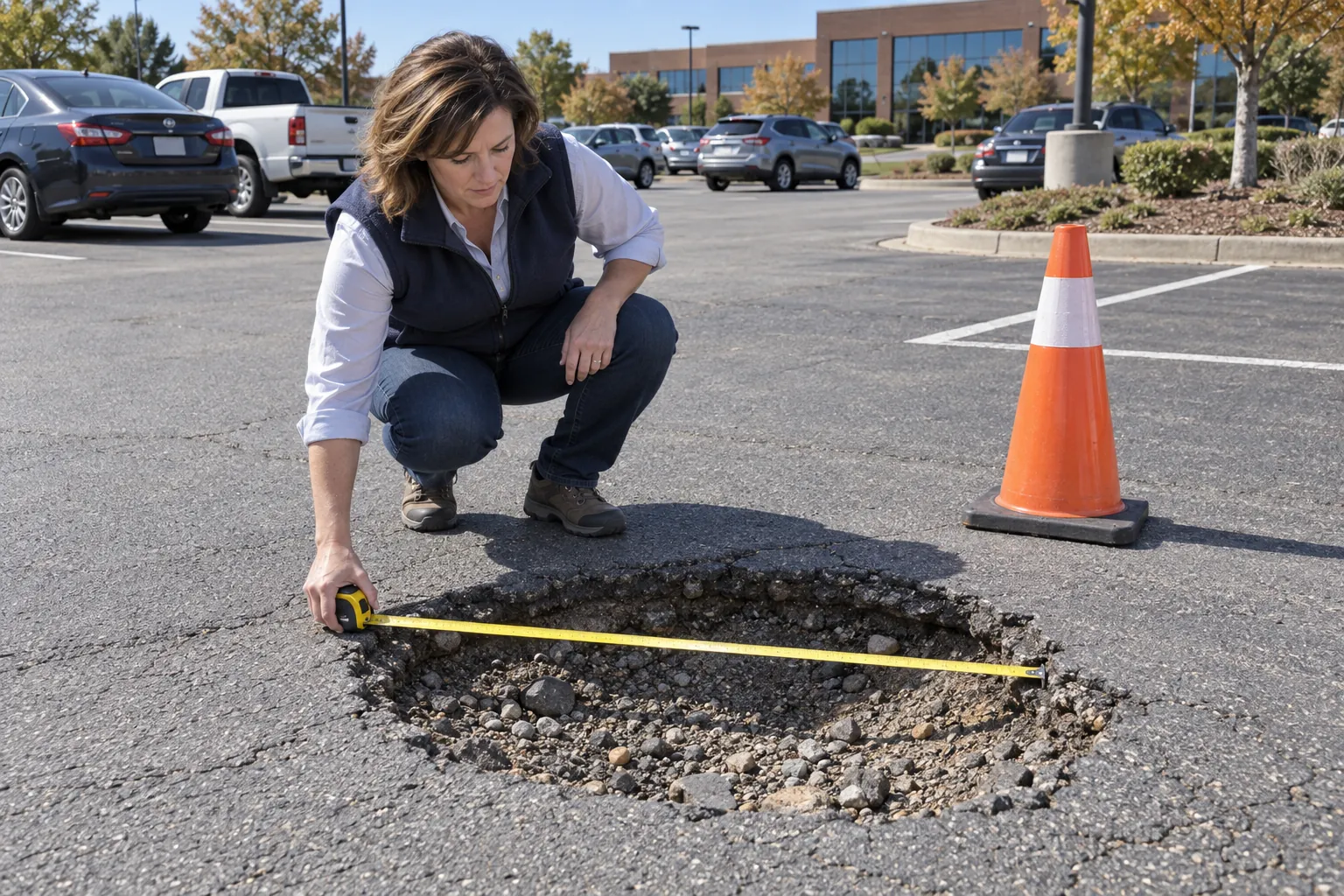 Premises and facilities managementParking lot inspection checklist: what to check, how often, and what to recordA parking lot inspection checklist for commercial property: pavement, striping, ADA spaces, lighting and drainage, how often to check, and a record that holds up.
 Premises and facilities managementGrease trap cleaning log: what to record, how often, and what the FOG inspector expectsWhat a grease trap cleaning log should record, how often interceptors are pumped, what local FOG programs and inspectors expect, and where the log usually fails.
 Premises and facilities managementGrounds maintenance checklist: what to check outside the building, how often, and what to recordA grounds and landscape maintenance checklist for US commercial properties: walkways, turf, trees, irrigation and play areas, by season, with OSHA and ADA duties.
 Premises and facilities managementPreventive maintenance checklist: what to check in a commercial building, how often, and how to prove itA preventive maintenance checklist for commercial buildings: HVAC, electrical, fire and life safety, plumbing, how often, and what the record should show.