Premises and facilities management
Generator testing: what NFPA 110 asks, and what to write down
Generator testing for an emergency or standby generator in a US building follows NFPA 110: an inspection every week (every month for a Level 2 system), an exercise under load every month for at least 30 minutes, and, for a Level 1 system, a longer test at least once every 36 months.
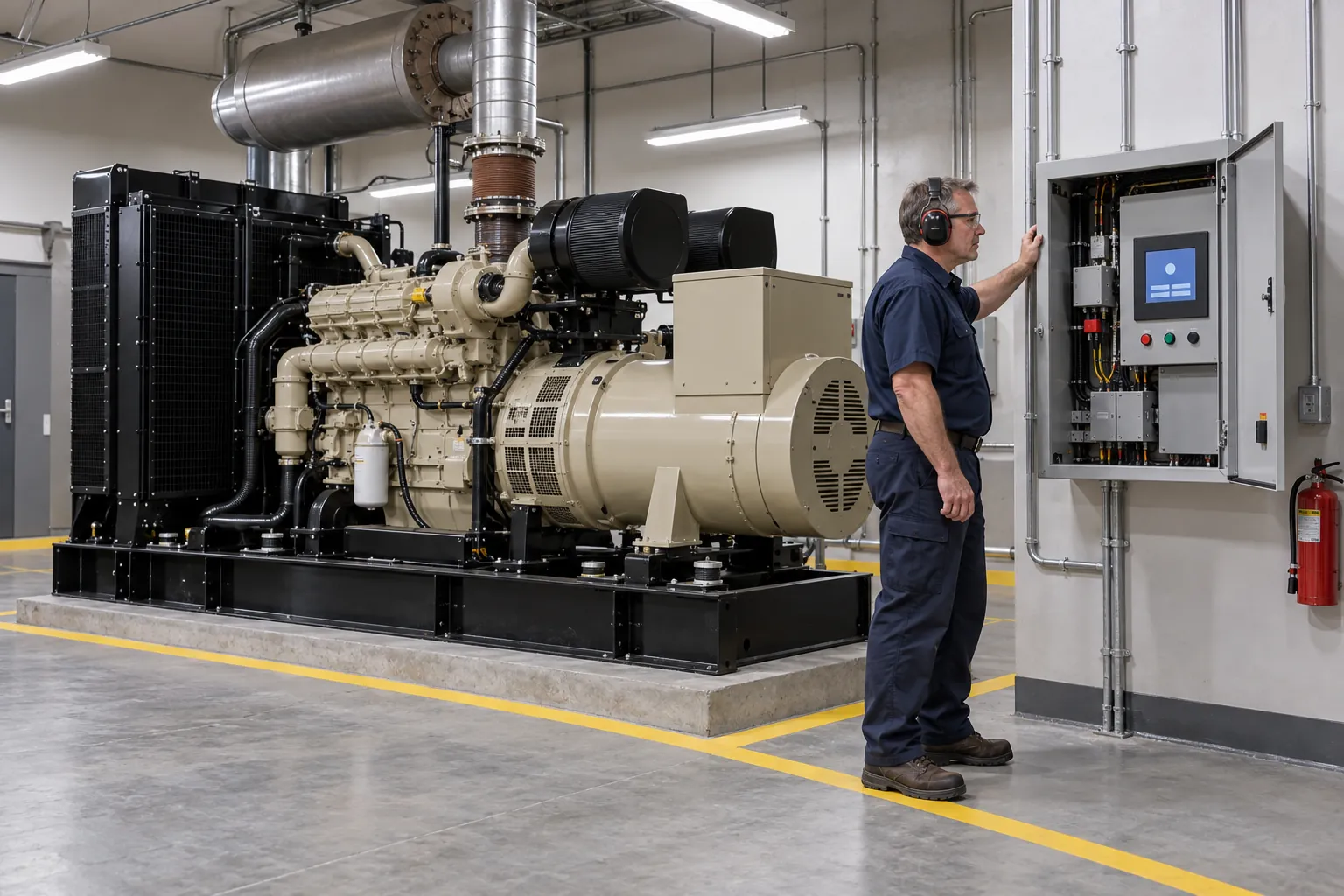
The generator spends almost its whole life waiting, and when the utility fails a Type 10 system has 10 seconds to start and pick up the egress lighting, the fire alarm, the fire pump, the elevators and, in a hospital, the equipment that keeps patients alive. This guide covers where the rule comes from, what each check involves, who does it, and what the record should show.
01
The rule: NFPA 110, Chapter 8, and the codes that call it up
In the United States, generator testing in commercial and institutional buildings follows NFPA 110, Standard for Emergency and Standby Power Systems, published by the National Fire Protection Association. Chapter 8, Routine Maintenance and Operational Testing, is the part a facility team lives with.
NFPA's article An Overview of NFPA 110 explains the scope: emergency and standby power systems "provide an alternate source of electrical power in buildings when the normal electrical power source fails." The standard covers the whole chain, not just the engine: the fuel, the generator, the starting batteries, the transfer switches, and the controls up to the load terminals of the transfer equipment. NFPA calls the generator, its fuel and accessories such as the starting batteries the emergency power supply (EPS), and the whole chain the emergency power supply system (EPSS).
NFPA 110 is a standard, not a law, until something adopts it. NFPA's article Maintaining Your Emergency Power Supply System Is Critical says its requirements "are invoked by direct reference in several major codes and standards," naming NFPA 101, NFPA 99, the National Electrical Code and the International Building Code. In practice your state or city fire code, usually the International Fire Code or NFPA 1 with local amendments, makes it enforceable. The fire marshal or code official who enforces it is the authority having jurisdiction (AHJ), and the edition that applies is the one the AHJ enforces, which may be older than the current one.
Local codes can spell the duty out. The New York City Fire Code (2022), Chapter 6, Building Services and Systems, as published by the FDNY, says in FC 604.4 that emergency power systems "shall be periodically inspected and tested under load in accordance with NFPA 110, as modified by FC Appendix B, and NFPA 111," and FC 604.5 limits who may supervise the work, for example a licensed electrician or stationary engineer.
02
Level, class and type: what your generator is rated for
Before a test means anything, the team needs to know what the system is meant to do. NFPA 110 describes every EPSS by three ratings, and the codes that require emergency power say which ones a building needs. NFPA's two articles explain them:
- Level is about consequences. If failure of the equipment "could result in the loss of life or serious injury," it is a Level 1. "Otherwise, the emergency power supply system is a Level 2." Level 1 systems typically serve egress lighting, fire alarms, elevators, fire pumps, smoke control and life-sustaining medical equipment.
- Class is how long the system must run at its rated load without refueling or recharging, in hours: a Class 2 runs for 2 hours, a Class 48 for 48.
- Type is the most time allowed between losing power and restoring it, in seconds: a Type 10 restores power within 10 seconds. Type M has no time limit and can be started by hand.
The level decides how often most of the routine happens, and the class decides how long the three-yearly test lasts. Both should be on the acceptance paperwork and, ideally, on a label at the generator. If nobody on site can say what they are, find out first, because every schedule below depends on it.
The fuel is rated too. NFPA's overview says that whatever the fuel, the supply "needs to be sized to 133 percent of the fuel required to run the generator for the time required by the class of the system." A tank not topped up after tests and outages can drift below that.
03
The weekly inspection: batteries, leaks and the controller
NFPA's maintenance article sets the rhythm: "the EPSS needs to be inspected weekly, exercised monthly, and Level 1 EPSSs need to be tested at least once every 36 months." The inspection is the part a trained building engineer can own, and the part most likely to slip.
How often. "A Level 1 EPS and all its appurtenant components needs to be inspected weekly. A Level 2 EPS and components needs to be inspected monthly."
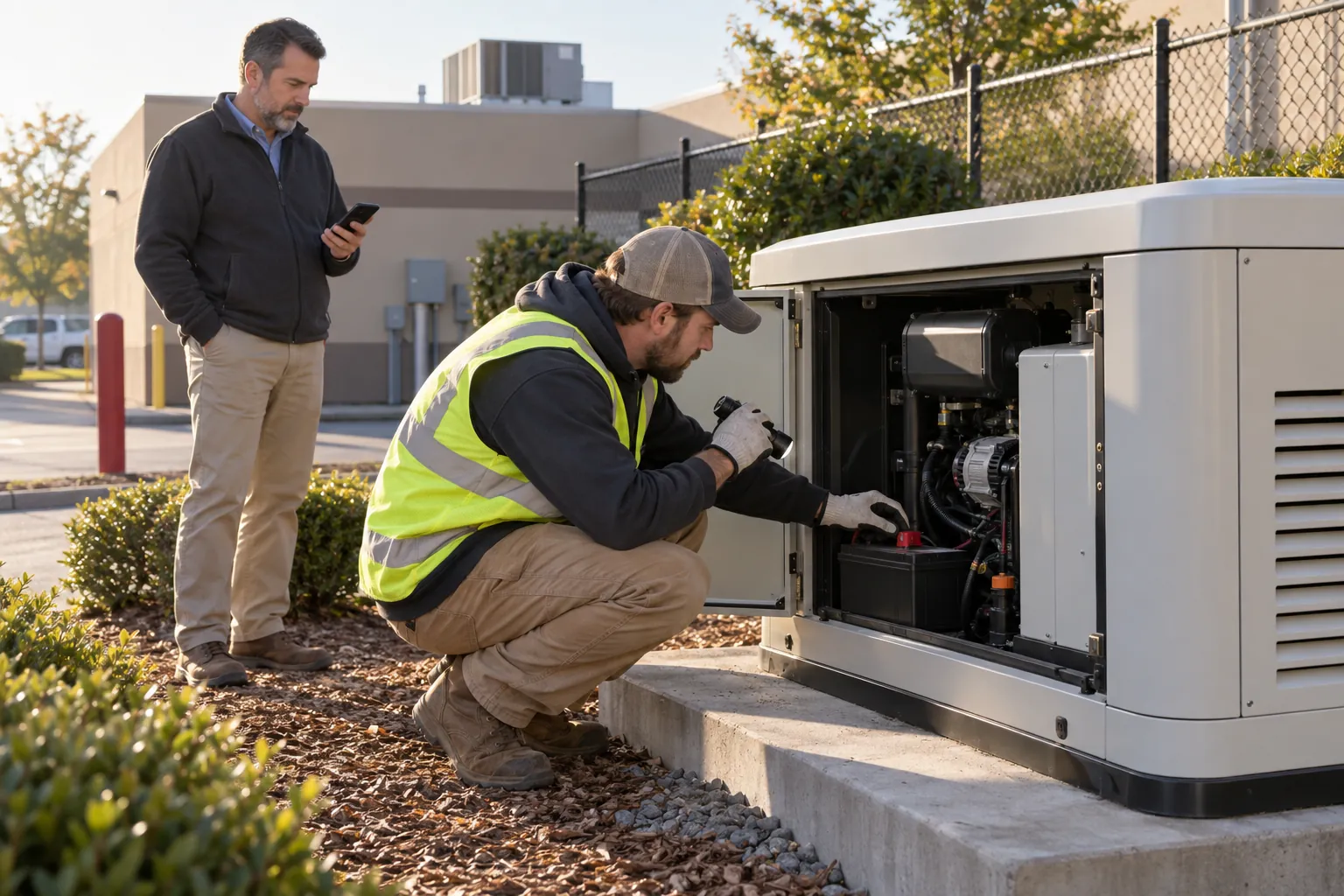
What it covers. The generator does not need to run. NFPA says the inspector should check "items such as trouble signals on the generator controller, oil or coolant leaks, damage to the starting batteries, room temperature, and any damage to the generator that could affect its operation." A weekly round at the generator room or enclosure usually takes in:
- the controller: in automatic, with no alarm or trouble lamps lit;
- the engine: no oil, coolant or fuel on the floor or in the drip pan;
- the starting batteries and charger: terminals clean and tight, the charger showing a normal charge;
- the fuel: the tanks at the expected level, no leaks at the lines or the fill point;
- the room: within the manufacturer's temperature range, louvers clear, no storage against the unit;
- the transfer switches: in the normal position, with no alarms.
Batteries deserve their own line. NFPA's overview is blunt: "battery failure is the most common cause of generator failure." For Level 1 systems, NFPA's maintenance article says storage batteries "need to be inspected weekly (including the electrolyte levels and battery voltage)," with a monthly recording of electrolyte specific gravity and a battery load test quarterly. Batteries with no access to the electrolyte are tested monthly instead, with a conductance, ohmic, carbon pile or cranking voltage drop test. For Level 2 systems the weekly battery inspection becomes monthly.
NFPA's articles summarize the standard. The tables in Chapter 8 of the edition your AHJ enforces, and the manufacturer's schedule for your engine and transfer switch, are what an inspector will read against.
04
The monthly exercise under load, and the transfer switch
The monthly run is the heart of generator testing. NFPA says "a monthly exercise under load needs to be conducted for Level 1 and Level 2 EPSSs to ensure the system remains operational." It is not an idle run: a diesel set run without load can suffer wet stacking, when unburned fuel builds up in the exhaust. NFPA 110 sets the load the exercise must reach and what to do when the building's own load is too light; read that part of Chapter 8 in your edition, and ask your contractor whether your set meets it.
NFPA's maintenance article gives a procedure to follow and record each month:
- Record the run time on the run time meter.
- Simulate a normal power failure from the test switch on the automatic transfer switch, or by opening the normal power supply.
- Observe and record the time delay on start.
- Record the cranking time.
- Transfer the load to the generator.
- Record AC voltage, frequency, amperage and kW.
- Record the initial oil pressure and battery charging rate.
- Record oil pressure, battery charging rate, and water or air temperature after 15 minutes of running.
- Return the test switch to normal, or restore normal power, after a minimum run time of 30 minutes.
- Record the prime mover and AC instruments just before transfer.
- Record the time delay on re-transfer.
- Record the time delay on shutdown, for units so equipped.
- Place the unit in automatic operation mode.
The last step matters more than it looks: a generator left in manual after a test will not start by itself at 3 a.m. During the run, NFPA also asks that someone watches the room temperature against the manufacturer's maximum and checks that ventilation shutters work and are not blocked.
The transfer switch. NFPA says "a monthly test of the transfer switches needs to be completed by electrically operating the transfer switch from the primary position to the alternate position and then returning to the primary position." A building with several transfer switches needs each one exercised, not just the one nearest the generator.
Readings are the evidence. A log showing the same voltage, frequency and oil pressure every month for a year is either a very steady machine or a copied line. The value of writing readings down is comparing this month with last: a cranking time creeping up, or a coolant temperature higher than it used to be.
05
Fuel, the 36-month test, repairs, and who does what
Fuel. Stored diesel degrades. NFPA says a fuel quality test is needed at least annually "to ensure that the fuel is not degrading." Keep the lab result with the log.
The 36-month test. "A Level 1 EPSS needs to be tested at least once every 36 months for the duration of its assigned class, but the test is not required to exceed 4 hours." The intent, NFPA says, is "reasonable assurance that the EPSS, with all of its auxiliary subsystems, is capable of running for the duration of its assigned class with its running load." Book it with the contractor well ahead, not when a survey finds it overdue.
After maintenance or repair. NFPA says that if any maintenance is performed on any portion of the system, "a 30-minute operational test needs to be performed after maintenance or repair." A new battery or a replaced transfer switch contact each needs its own run and its own line in the record.
Who does which part. NFPA says "all ITM needs to be performed by a qualified person," and adds that "some of these tests can be completed by a competent owner or facility managers with the proper training, or a separate contractor can be hired." In most buildings the building engineer or maintenance team does the weekly inspection and runs the monthly exercise, and a generator service contractor does the annual service, the fuel test and the 36-month test. Whoever does the work, the owner has to show it was done.
06
Where the record fails, and what SiteClara does about it
The contractor's reports are usually thorough. The weak part is the routine between visits: the weekly inspection ticked off for a month at a sitting, the monthly readings copied from the line above, a run done without load, a set left in manual after the test, a battery warning noticed by someone passing who told nobody in particular.
SiteClara records the checks at the location. A printed QR poster, with an optional NFC tag behind it, sits at each place a check is scheduled, such as the generator room, the outdoor enclosure or the transfer switch room. Staff scan the code or tap the tag on their own phone, with no app to install, see the checks due there, and mark each one done or say what stopped them, such as a locked enclosure or a generator already out for repair. The time and the named person are recorded as it happens, with a photo when one is asked for, for example of the controller display and hour meter at the end of the monthly run. A problem, such as coolant on the floor or a charger fault lamp, is reported there with a photo and goes onto the team's list of jobs until someone closes it.
The supervisor sees what is due, done and missed, and can record the reason a check was missed. A job that needs the building manager can be escalated to them to answer. Each day the supervisor reviews and approves a report that goes to nominated management or client contacts at 8 a.m. the next morning, showing what was reported, completed and still open, and how the scheduled checks went, for example 4 of 4 completed.
07
Questions people ask
How can I test my generator?
For a building's emergency generator, NFPA's article Maintaining Your Emergency Power Supply System Is Critical sets the rhythm: "the EPSS needs to be inspected weekly, exercised monthly, and Level 1 EPSSs need to be tested at least once every 36 months." The monthly exercise starts from a simulated power failure at the automatic transfer switch, transfers the load to the generator and records the readings, following the procedure listed above.
How long should you run a generator to test it?
At least 30 minutes under load for the monthly exercise: the procedure in NFPA's article Maintaining Your Emergency Power Supply System Is Critical returns the test switch to normal "after a minimum run time of 30 minutes." A Level 1 system is also tested at least once every 36 months "for the duration of its assigned class, but the test is not required to exceed 4 hours," and any maintenance or repair is followed by a 30-minute operational test.
What is the most common reason a generator won't start?
For a standby diesel generator, NFPA points to the starting batteries. Its article An Overview of NFPA 110 says that if the batteries in a diesel generator fail, "the entire system will not operate; in fact, battery failure is the most common cause of generator failure." The batteries of a Level 1 system are inspected every week, with further battery tests monthly or quarterly.
08
Where to read more, and a list to take away
Read Chapter 8 of NFPA 110 through NFPA's free read-only access, in the edition your AHJ enforces, with NFPA's two articles above as a plain-language way in. Your fire marshal can tell you which fire code and edition apply; a hospital should read 42 CFR 482.15(e) with its accreditor's standards. See also our guides to fire pump testing, emergency lighting testing and power outage procedures.
Before the next contractor visit, check that:
- you know the generator's level, class and type, and which loads it carries;
- you know which fire code and edition of NFPA 110 your AHJ enforces, and whether CMS applies;
- the weekly (Level 1) or monthly (Level 2) inspection is scheduled, assigned and recorded as it happens;
- the monthly exercise starts from a simulated power failure and runs under load for at least 30 minutes;
- every transfer switch is operated monthly, not just the main one;
- readings and the hour meter are recorded each month and compared with the last;
- the unit is confirmed in automatic after every test;
- the fuel test, battery load tests and the 36-month test are booked, with dates;
- every deficiency on the last contractor's report has a date it was corrected, or a plan;
- the records are kept together and can be shown to the AHJ or surveyor on request.
Sources
Every document this guide quotes or links to, in the order it first cites them.
- NFPA 110, Standard for Emergency and Standby Power Systems nfpa.org
- An Overview of NFPA 110 nfpa.org
- Maintaining Your Emergency Power Supply System Is Critical nfpa.org
- New York City Fire Code (2022), Chapter 6, Building Services and Systems nyc.gov
- 42 CFR 482.15, Condition of participation: Emergency preparedness ecfr.gov
- 42 CFR 482.41, Condition of participation: Physical environment ecfr.gov
- 40 CFR 63.6640, paragraph (f) ecfr.gov
- 40 CFR 60.4211, paragraph (f) ecfr.gov
- 40 CFR 63.6655, paragraph (f) ecfr.gov
Related guides
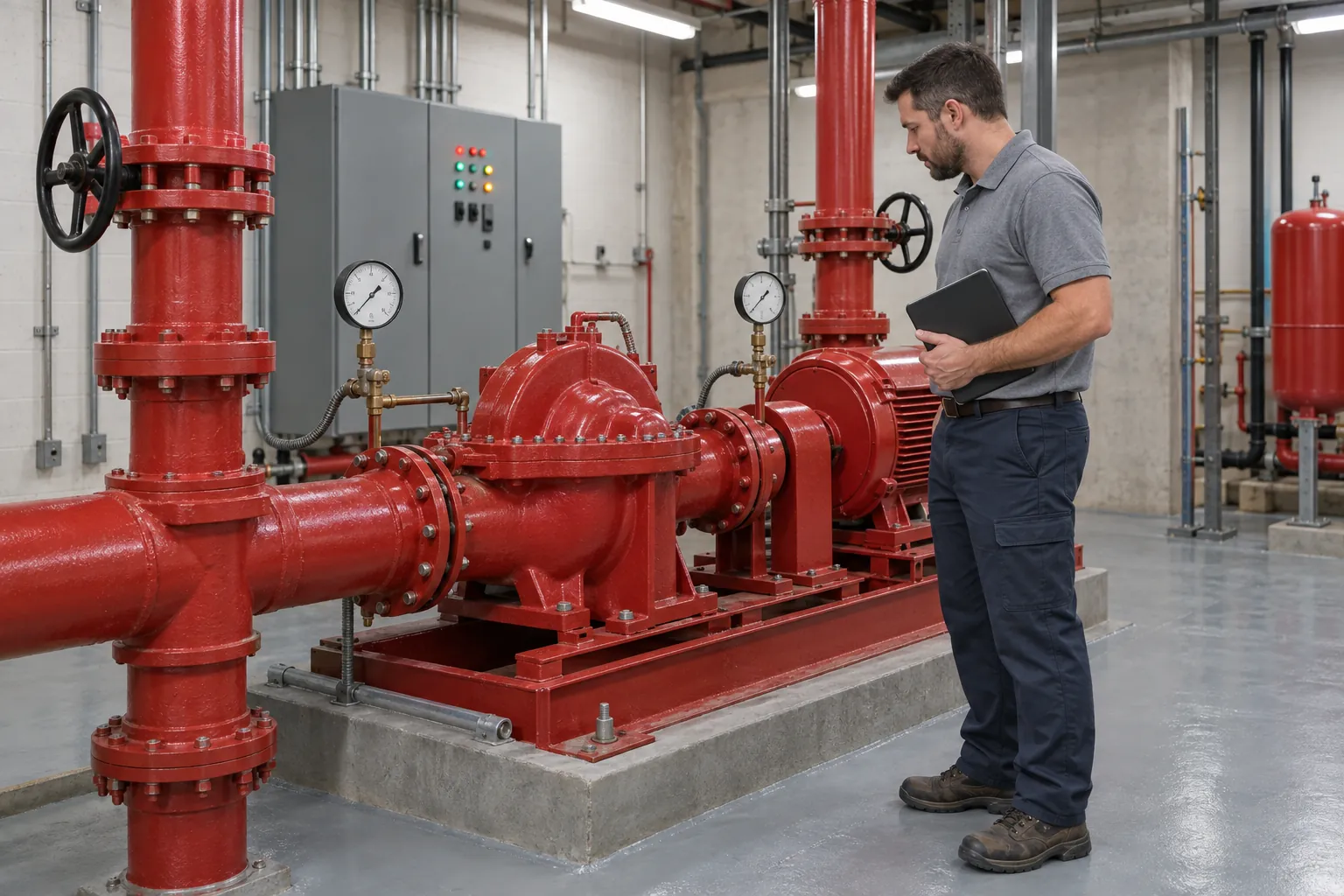 Fire and water checksFire pump testing: what NFPA 25 asks, week by weekWhat fire pump testing involves under NFPA 25: the weekly inspection, the weekly or monthly churn test, the annual flow test, who does each, and what to record.
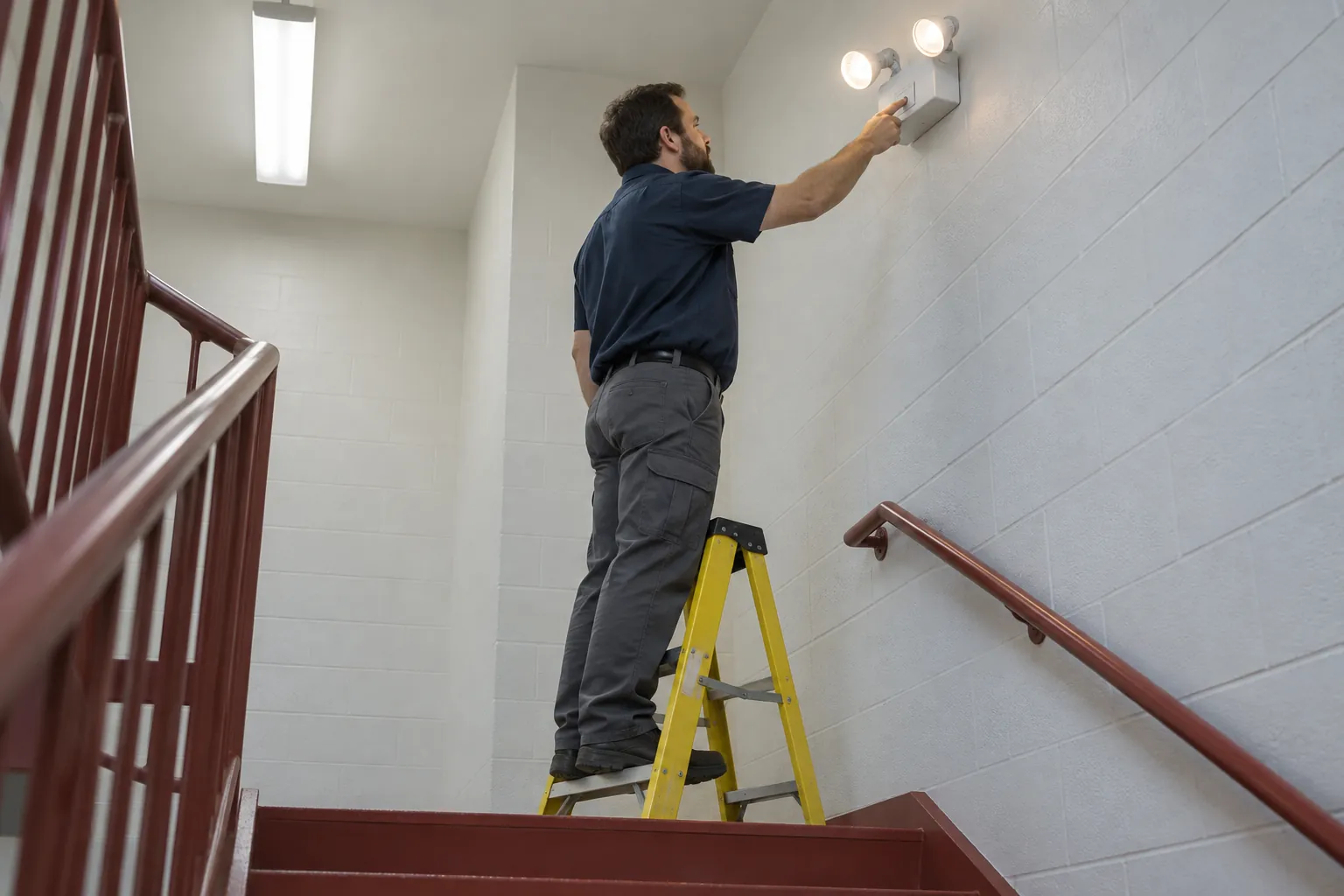 Fire and water checksEmergency lighting testing: the codes, the two tests, and the recordEmergency lighting testing in the US: what OSHA, NFPA 101, CMS and HUD ask, how to run the short and full-duration tests, and what the record should show.
 Premises and facilities managementPower outage procedures: what building staff do when the power goes outA power outage checklist for facility teams: what goes dark, the first hour, generators and food safety, restoring power safely, and what the record should show.
 Premises and facilities managementBuilding engineer duties: what the job covers, and how to show it is doneBuilding engineer duties in a commercial building: running the plant, rounds and logs, lockout, refrigerant and boiler rules, vendors, and a record that holds up.