Premises and facilities management
Store opening and closing checklist: the walk before the doors open and the lock-up at night
A store opening checklist is the short list of checks the opening keyholder works through before the first customer comes in: the outside and entrance, exit doors and routes, the sales floor, restrooms and fitting rooms, the registers and the alarm, each confirmed by name and time.

Its partner, the store closing checklist, runs the same building in reverse: the last customer out, the floor and back of house checked, the cash secured, the doors locked against the street but still openable from inside, and the alarm set. No federal rule prescribes either list, but OSHA's exit route and walking-working surface standards, the ADA's maintenance rule and the fire code your city has adopted decide much of what goes on them. This guide sets out both checklists, the rules behind them, who does each part, and what a record worth keeping looks like.
01
What a store opening and closing checklist is, and the rules behind it
Opening and closing procedures take a store from locked and alarmed to ready for customers, and back again. The checklist is their written form, so the result does not depend on which keyholder is on the schedule. A good one is short, ordered the way the store is walked, and specific to the building: a mall store with a roll-down grille and a shared service corridor differs from a stand-alone store with its own lot and back door.
No federal regulation requires a store to keep an opening or closing checklist. The law sets conditions that must be true while people are inside, and the opening and closing walks are where a store confirms them:
- Exit doors. OSHA's 29 CFR 1910.36, design and construction requirements for exit routes, says: "Employees must be able to open an exit route door from the inside at all times without keys, tools, or special knowledge." A panic bar that locks only from the outside is permitted on exit discharge doors. This is the rule a closing crew is most likely to break: the back door chained, or staff locked in while they count down the registers.
- Exit routes. 29 CFR 1910.37 says exit routes "must be free and unobstructed", with no materials or equipment placed in them "either permanently or temporarily", adequately lighted, and each exit marked by a sign reading "Exit".
- Floors. 29 CFR 1910.22, walking-working surfaces, requires floors kept clean and, as far as feasible, dry, free of hazards such as leaks, spills, snow and ice, and "inspected, regularly and as necessary", with a hazard corrected or guarded before an employee uses the surface again.
- Accessible features. Under the ADA Title III regulations, 28 CFR 36.211, a public accommodation "shall maintain in operable working condition" its required accessible features, allowing "isolated or temporary interruptions in service or access due to maintenance or repairs."
Two more layers sit on top. OSHA's State Plans page lists 22 State Plans covering private-sector as well as public workers, and they can go further than federal OSHA. Fire and building codes are adopted locally, and the fire marshal enforces them. Washington's adoption of the International Fire Code, WAC 51-54A-1010, for example, lets the main door of a Group M (mercantile) building have a key-operated lock on the inside only if the lock is readily distinguishable as locked and a sign on or beside the door reads "THIS DOOR TO REMAIN UNLOCKED WHEN BUILDING IS OCCUPIED" in letters 1 inch high. Check your own jurisdiction's wording: the opening routine unlocks that door, and the closing routine must not leave staff behind a door that needs a key to leave.
02
What the opening and closing checks cover
Split the store into areas and check them in the order a keyholder walks. The areas are the same morning and night; what is checked in them changes.
- Outside: the lot or mall frontage, sidewalk, lot lighting, accessible parking spaces and their access aisles, and anything left by the door or the dumpster.
- Entrance: doors or roll-down grille, automatic door operation, mats, and the entry floor in wet or icy weather.
- Sales floor: lighting, aisles and the accessible route, displays and endcaps, spills, and stained ceiling tiles that show a leak.
- Fitting rooms and customer restrooms: open and stocked at opening; empty and secured at closing.
- Registers and cash office: POS terminals, cash drawers, the safe and drop safe, the deposit.
- Stockroom, receiving and the back door: the exit route through the back of house, freight, cardboard, trash and the baler or compactor.
- Life safety and systems: exit signs, emergency lights, fire extinguishers, the alarm, cameras, HVAC, and coolers where the store sells food.
A mall store adds the mall's rules: when the grille may go up, which service corridor door staff use after hours, and who to call about the common area. In a strip center the landlord often maintains the lot and its lighting, so the checklist's job there is to report a problem, not fix it.
03
The store opening checklist
Open with two people where you can. OSHA's advisory booklet Recommendations for Workplace Violence Prevention Programs in Late-Night Retail Establishments (OSHA 3153, 2009) recommends the "buddy system" where personal safety may be threatened, and building into daily procedures checks "such as checking lighting, locks, and security cameras". It is guidance, not a standard, but it reads like an opening checklist.
- Look before you unlock. Check the front and, where safe, the back for forced doors, broken glass, anyone waiting, and lot lights out. If something is wrong, do not go in: call the police and the district manager.
- Enter, lock behind you, disarm the alarm. OSHA 3153 recommends keeping doors locked before and after official business hours. Locked against the street is the point; exit doors still open from inside without a key.
- Lights, systems and cameras. Lights, HVAC, cameras recording, POS terminals and card readers up. Note any dark exit sign or light out on an exit route.
- Walk the exit routes. Push every exit door from inside, including the stockroom and back door. Clear freight, cardboard, carts and returns; 1910.36 sets an exit access at least 28 inches wide at all points.
- Floors and entrance. Dry or guard spills and leaks, lay the mats flat, and in winter clear and treat the walk.
- Accessible route. Aisles, the accessible fitting room and the lowered checkout counter clear of stock and returns; accessible parking free of carts, pallets and snow.
- Restrooms and fitting rooms. Clean, stocked, unlocked and working; report anything out of order now.
- Life safety. Extinguishers in their places and not hidden by displays, the alarm panel normal, emergency lights and exit signs lit.
- Cold storage, if any. Read cooler and freezer temperatures and record them where your company or health department requires.
- Registers. Count the cash drawers in, keep cash in each low, confirm the drop safe works.
- Brief the team, then open. Pass on what the closer reported, then unlock the customer door, which stays unlocked until close.
Mark each step as it is done, with the time, rather than signing the whole sheet at 9:55 a.m. An opening that found nothing is worth recording too: it is what shows the broken window happened after it.
04
The store closing checklist
Closing carries most of the risk: fewer staff, cash being counted, trash runs out the back, and a building locked with people still inside. A retail store closing checklist runs in roughly this order.
- Stop new customers. Lock the customer entrance against the street once the last customer has left; staff exits stay openable from inside.
- Sweep for people. Sales floor, fitting rooms, restrooms, stockroom and offices, before anything is locked or the alarm set.
- Recover the floor. Clear carts, returns and fitting-room stock from aisles and the accessible route, and deal with spills now.
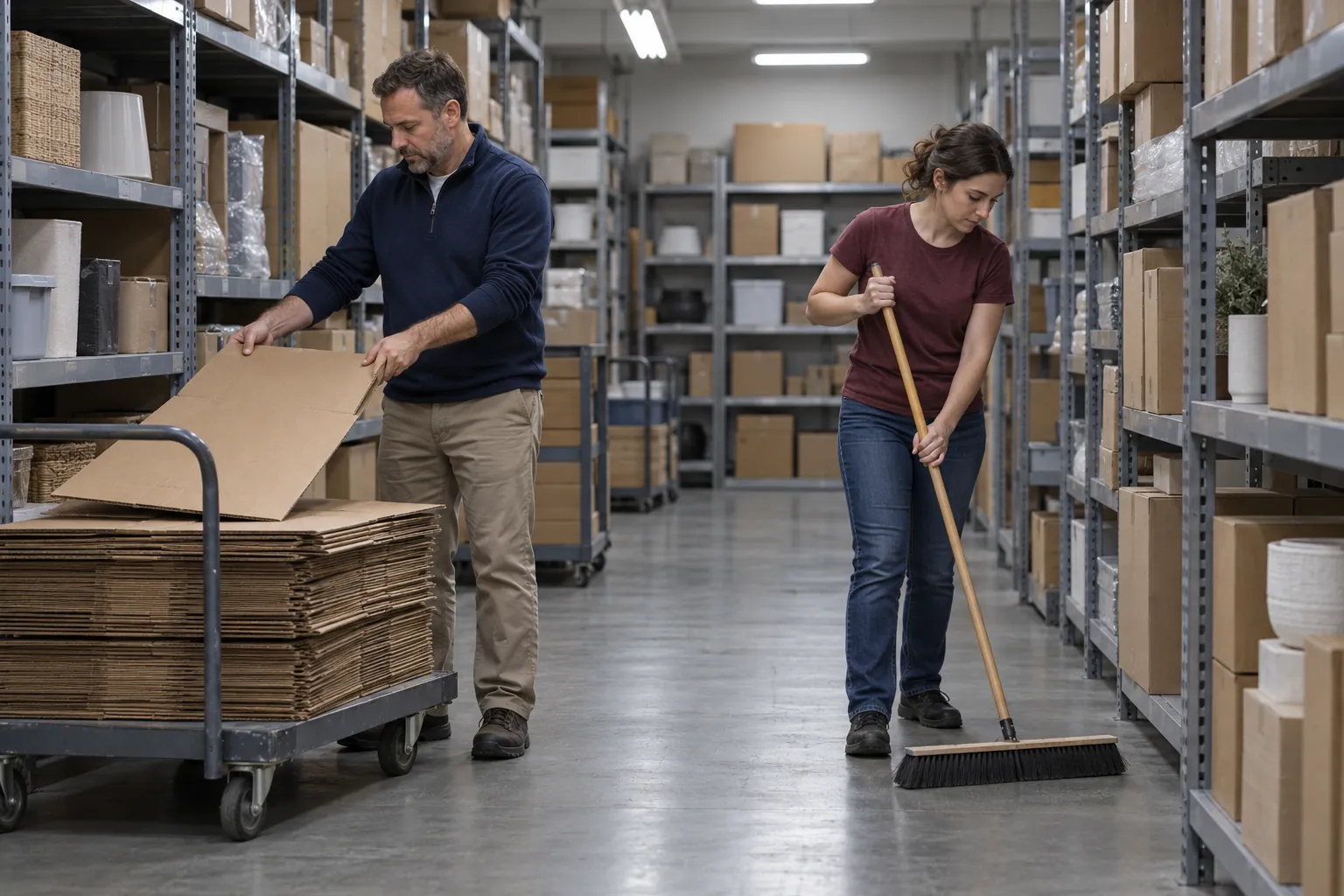
- Clear the back of house. Freight and cardboard out of the exit routes and away from the back door, electrical panels and sprinkler heads. OSHA 3153 recommends rules so workers "can walk to garbage areas and outdoor storage areas without increasing their risk of assault", and locking doors used for deliveries and garbage removal when not in use. Make the last run before dark where you can.
- Cash. Count down away from the windows. OSHA 3153 recommends requiring workers to use drop safes and keep a minimal amount of cash in each register.
- Turn off what should be off. Steamers, space heaters and coffee makers off; emergency lighting, exit signs, refrigeration and security lighting left on.
- Check the exits from inside. Every exit door locked against entry and still openable from inside with no key. No chain, padlock or bar while anyone is inside.
- Set the alarm and leave together. Check the last door and walk to the cars together; OSHA 3153 recommends security escorts to parking areas in the evening.
- Leave a note for the opener. Anything broken, out of order or reported during the day, and who it was reported to.
If staff stay after close to count, restock or reset, the doors stay locked against the street and openable from inside, exactly as during the day.
05
Who opens and closes, and what a good record shows
Name the keyholders and alarm-code holders, normally the store manager, assistant managers and a few key leads; keep the list current and change codes when someone leaves. The opener owns the building until the manager arrives, including the decision not to open. The closer owns the sweep, the cash, the exits, the alarm and the note to the opener. The store manager owns the checklist and follows up what it records. The district or facility manager takes what the store cannot fix and chases the landlord, the mall or the contractor. Where a janitorial contractor or overnight crew works the store, the checklist shows what they left.
When something goes wrong, such as a customer slipping at the entrance at 10:05 a.m. or a back door found unlocked, the questions are the same: was the check done, by whom, when, and what did they find? A good record answers without anyone having to remember:
- each step marked when it is done, with the time and the person, not one signature at the foot of the sheet;
- exceptions written down, with what was done and who was told, and a photo for damage, a blocked route or a leak;
- faults reported through one route, so the store sees what is open and the district sees which stores are waiting;
- clean walks recorded too, because they show when a problem did not exist;
- incidents reported separately: OSHA 3153 recommends keeping log books and reports of assaults and threats to help prevent recurrences.
A store manager who works an opening or a close against the list now and then learns more than one who signs what is handed in. The DOJ's ADA Update: A Primer for Small Business says businesses must ensure that repairs are made promptly and that "improper or inadequate maintenance does not cause repeated failures": the same fault at three openings in a month is a maintenance problem, not three separate days.
06
Where the opening and closing record fails, and what SiteClara does about it
Most stores have an opening and closing checklist; far fewer can show it was followed. The binder at the register is initialed in a block at the end of the shift, the back door is checked "every night" on a sheet that has never recorded an exception, and the opener hears about the broken restroom from a customer.
SiteClara puts a printed QR poster at each place a check belongs, such as the entrance, the back door, the stockroom, the restrooms and the fitting rooms, with an optional NFC tag behind it. The opener or closer scans or taps with their own phone, with no app to install, sees the checks due there, and marks each one done or explains what stopped them, with a photo when one is asked for. The time and the named person are recorded as it happens. A problem found on the walk, such as a back door that will not latch, is reported with a photo and stays on the team's list of jobs until someone closes it.
The store manager sees what was due, done and missed, records the reason a check was missed, and each day approves a report that goes to nominated management or client contacts at 8 a.m. the next morning: what was reported, completed and still open, and how the scheduled checks went. A store and its janitorial or maintenance contractor can work from the same site.
07
Questions people ask
What is an opening checklist?
In a store, it is the list of checks the opening keyholder completes before customers are let in: the outside, the exits, the floor, restrooms and fitting rooms, the registers and the alarm. It is where the store confirms conditions the law requires while people are inside, such as the rule in 29 CFR 1910.37, maintenance, safeguards and operational features for exit routes that exit routes be "free and unobstructed".
What is a closing checklist?
In a store, it is the list the closing keyholder works through to empty, secure and lock the building: the sweep for people, the floor, the cash, the exits, the alarm and a note for the opener. OSHA's advisory booklet Recommendations for Workplace Violence Prevention Programs in Late-Night Retail Establishments (OSHA 3153) recommends keeping doors locked before and after business hours and using drop safes.
Can a store lock employees in after closing?
No. Under 29 CFR 1910.36(d)(1), design and construction requirements for exit routes, employees must be able to open an exit route door from the inside at all times without keys, tools or special knowledge. Locking the doors against the street is fine, as long as the people inside can still get out.
08
Further reading, and a list to take away
Read the rules at their source: OSHA's 1910.36, 1910.37 and 1910.22 cited above, and 29 CFR 1910.157, portable fire extinguishers, which keeps extinguishers "in their designated places at all times except during use"; the 2010 ADA Standards for Accessible Design, which set a 36-inch minimum clear width on an accessible route; and OSHA 3153, whose Appendix A has sample checklists. NFPA makes its codes and standards, NFPA 101, the Life Safety Code, among them, free to read online once you sign in, as its free access NFPA codes and standards page explains; ask your fire marshal which code and edition your city has adopted.
Before the next shift, check that your store opening and closing checklist:
- follows the way the store is walked, from the lot to the back door;
- starts with a look outside before anyone unlocks, and says what to do if something is wrong;
- proves every exit door opens from inside, morning and night;
- clears the exit routes and the accessible route before customers come in;
- sweeps fitting rooms, restrooms and the stockroom for people before the alarm is set;
- covers cash, trash runs and leaving the building, with nobody alone where the risk is real;
- names the keyholders and changes codes when one leaves;
- records each step with the time and the person, and every exception with what was done;
- passes what the closer found to the opener;
- is walked now and then by the store manager, not only signed.
Sources
Every document this guide quotes or links to, in the order it first cites them.
- 29 CFR 1910.36, design and construction requirements for exit routes osha.gov
- 29 CFR 1910.37 osha.gov
- 29 CFR 1910.22, walking-working surfaces osha.gov
- ADA Title III regulations ada.gov
- State Plans page osha.gov
- WAC 51-54A-1010 app.leg.wa.gov
- Recommendations for Workplace Violence Prevention Programs in Late-Night Retail Establishments osha.gov
- ADA Update: A Primer for Small Business ada.gov
- 29 CFR 1910.157, portable fire extinguishers osha.gov
- 2010 ADA Standards for Accessible Design ada.gov
- Free access NFPA codes and standards page nfpa.org
Related guides
 Premises and facilities managementRetail store maintenance checklist: what to check, how often, and who owns itA retail store maintenance checklist for US stores: doors, lighting, exits, fire extinguishers, ADA features, HVAC and the parking lot, with who owns each check.
 Premises and facilities managementRestaurant opening and closing checklist: what to check, place by placeA restaurant opening and closing checklist by area: kitchen, bar, dining room, restrooms and doors, with the Food Code, OSHA exit and hood checks behind each item.
 Premises and facilities managementCustomer incident report: recording a customer or guest injury on your premisesA customer incident report records a customer or guest injury on your premises: what to include, the first hour, OSHA's limits, your insurer, and what to keep.
 Premises and facilities managementSlip, trip, and fall prevention: keeping floors, stairs, and walkways safe every daySlip, trip, and fall prevention in a commercial building: what OSHA 1910.22 requires, where people fall, the controls that work, and how to check and record them.