Premises and facilities management
Customer incident report: recording a customer or guest injury on your premises
A customer incident report is a business's own written record of an injury, illness, or loss that happens to a customer, guest, or other visitor on its premises: who was involved, where and when it happened, what the area looked like, who saw it, and what staff did.

It is not an OSHA form, because OSHA's injury and illness records cover employees, not customers. It serves the business, its insurer, and any later claim, which is decided under state premises liability law and, in a slip and fall, usually turns on whether the business knew or should have known about the hazard. That is why the report matters, and why the record behind it, when that floor or restroom was last checked and by whom, often matters more. This guide covers what a store, hotel, or venue manager should write down, the first hour after an incident, the insurer, how long to keep the file, and the routine checks that make the report worth having.
01
What a customer incident report is, and which rules apply
A customer incident report, also called a customer accident report or, in a hotel, a guest incident report, is written when someone who is not on the payroll is hurt, taken ill, or loses property on the premises. No single federal rule sets its format. Three things shape it: OSHA's recordkeeping rule, which it is not part of; state premises liability law, which decides any claim; and the business's general liability policy.
- OSHA covers employees only. Under 29 CFR 1904.31, Covered employees, an employer must record on the OSHA 300 Log "the recordable injuries and illnesses of all employees on your payroll," and those of workers not on its payroll that it supervises day to day. A customer or hotel guest is neither, so a customer's injury does not go on the 300 Log or a 301 form. The severe injury reporting deadlines in 29 CFR 1904.39 (eight hours for a fatality, 24 hours for an in-patient hospitalization, amputation, or loss of an eye) are for employees too.
- Premises liability is state law. It mostly comes from court decisions and varies by state. Florida has written its slip-and-fall rule down: Florida Statutes section 768.0755, Premises liability for transitory foreign substances in a business establishment, says a person who slips and falls on a transitory foreign substance in a business "must prove that the business establishment had actual or constructive knowledge of the dangerous condition and should have taken action to remedy it." Constructive knowledge may be shown by how long the condition existed, or because it "occurred with regularity and was therefore foreseeable."
- The insurance policy sets the notice. The Texas Department of Insurance's guide to commercial general liability insurance explains that premises and operations coverage "pays for bodily injury or property damage that occurs on your premises." When and how the insurer must be told is set by your own policy's conditions; read them before you need them.
That is why the report and the record behind it belong together. The incident report says what happened at 4:12 p.m.; the floor check record says whether anyone had looked at that aisle since noon.
02
What counts as a customer incident, and who writes the report
Write a report for anything that hurt a customer or guest, or could lead to a claim, even when the person says they are fine. In stores, hotels, and venues the same incidents come up again and again:
- Slips, trips, and falls: a spill in an aisle, rain tracked in at the entrance, a wet restroom floor, a curled mat, a step nobody saw, ice on the sidewalk or in the parking lot.
- Falling or moving objects: merchandise falling from a high shelf, a display tipping, a shopping cart or pallet jack striking someone.
- Guest rooms and amenities in a hotel: a fall in the bathtub or shower, a broken chair or bed frame, a scald from a faucet, an injury at the pool or fitness room.
- Equipment and fittings: an escalator stopping suddenly, a loose handrail.
- Illness on the premises: a customer who faints or has a sudden health problem, recorded even when the building did not cause it.
- Property damage or loss: a car damaged in the parking lot, a guest's belongings damaged in a room.
Older customers and guests deserve particular care. The CDC's Facts About Older Adult Falls page says "more than one out of four older people falls each year," meaning adults 65 and older, with about 4.5 million emergency department visits a year from those falls.
An altercation or a theft goes in the security officers' own security incident report, and a customer incident report too if a customer was hurt.
The report is written by whoever was in charge at the scene, usually the store manager or manager on duty, the hotel's front office or night manager, or the venue's duty manager. Where security officers are posted, their post orders often make them first on the scene. Custodial and day porter crews, in-house or contracted, often cleaned that floor last and need to say so. Decide in advance who writes it on every shift, including nights and weekends.
03
What to include in a customer incident report
A good customer incident report is factual, specific, and written quickly, on the same day. It records what people saw and said, not who was at fault. A practical template has these essential parts:
- The people: the customer's or guest's name and contact details if they are willing to give them; for a hotel guest, the room number and reservation; the names of staff involved; and everyone who witnessed it, with a phone number.
- When: the date and the time of the incident, and when a manager heard of it if later.
- Where, exactly: not "the store" but "aisle 7, by the end cap at the back," "the second-floor guest restroom," "the pool deck by the north steps."
- What happened, in the person's own words: quote what the customer said, and collect short signed witness statements, kept separately. Write "customer said she slipped on something wet," not "customer slipped on water."
- What staff saw: a description of the condition of the floor or the area when a staff member arrived (dry, wet, a substance, its size and color, any tracks through it), the lighting, the weather, and whether a wet floor sign was out and where.
- The injury as described or visible: where on the body, without diagnosing. "Customer said his right knee hurt; a graze was visible" is a fact; "sprained knee" is not, unless a medical professional said so.
- What was done: first aid offered or given, whether 911 was called, whether the customer left on their own, by car, or by ambulance.
- The evidence kept: photographs of the area taken before it was cleaned, which cameras may have recorded it, and the routine check record for that location for the day: when it was last checked, by whom, and what they found.
- Who wrote the report and when, with their signature or name, and who it was passed to.
A short sample, written the same afternoon: "4:12 p.m., aisle 7 by the rear end cap. Customer (name and phone on file) said she slipped on something wet and her right wrist hurt. Clear liquid about a foot across, one shoe mark through it, no wet floor sign out. Witnessed by a cashier, statement attached. First aid offered and declined; customer left on foot at 4:30 p.m. Area photographed at 4:15 p.m., then cleaned. Last floor check of aisle 7 recorded at 3:40 p.m."
A printed customer incident report form at the service desk or front desk and a short online form both work, as long as every field is completed the same day. Free templates are easy to find; whichever form template you use, test it against the list above before you rely on it. Accuracy matters more than length: a short report with exact times and names is worth more than a long one written from memory a week later.
04
The first hour: from the fall to the finished report
Most of what makes a customer incident report useful is decided in the first hour. A routine that every manager on duty knows looks like this:
- Look after the person first. Ask what happened and whether they are hurt, offer first aid within your staff's training, and call 911 for anything serious or if they ask.
- Guard the area. Stop anyone else using it: a cone, a staff member standing by, the aisle closed.
- Photograph before you clean. Take several photographs of the spot from different distances, with something for scale. Then clean or fix it.
- Find the witnesses before they leave, and take their names and statements.
- Keep the video. Have the footage of that area saved, from well before the incident to after it, before the system records over it.
- Pull the check record for that location: the last floor or restroom check, who did it, and what they found.
- Tell the right people. The general or property manager, the insurer or broker as your policy requires, and any cleaning contractor's supervisor.
- Finish writing the report the same day, signed by the person who wrote it, with the photos and witness details attached.
Hotels have one extra step. A guest hurt in a room may mention it only at checkout, so any mention of a fall or injury, at any hour, goes to the manager on duty and starts a report. Engineering checks the room before it is sold again.
05
After the report: the evidence behind it, the insurer, and how long to keep it
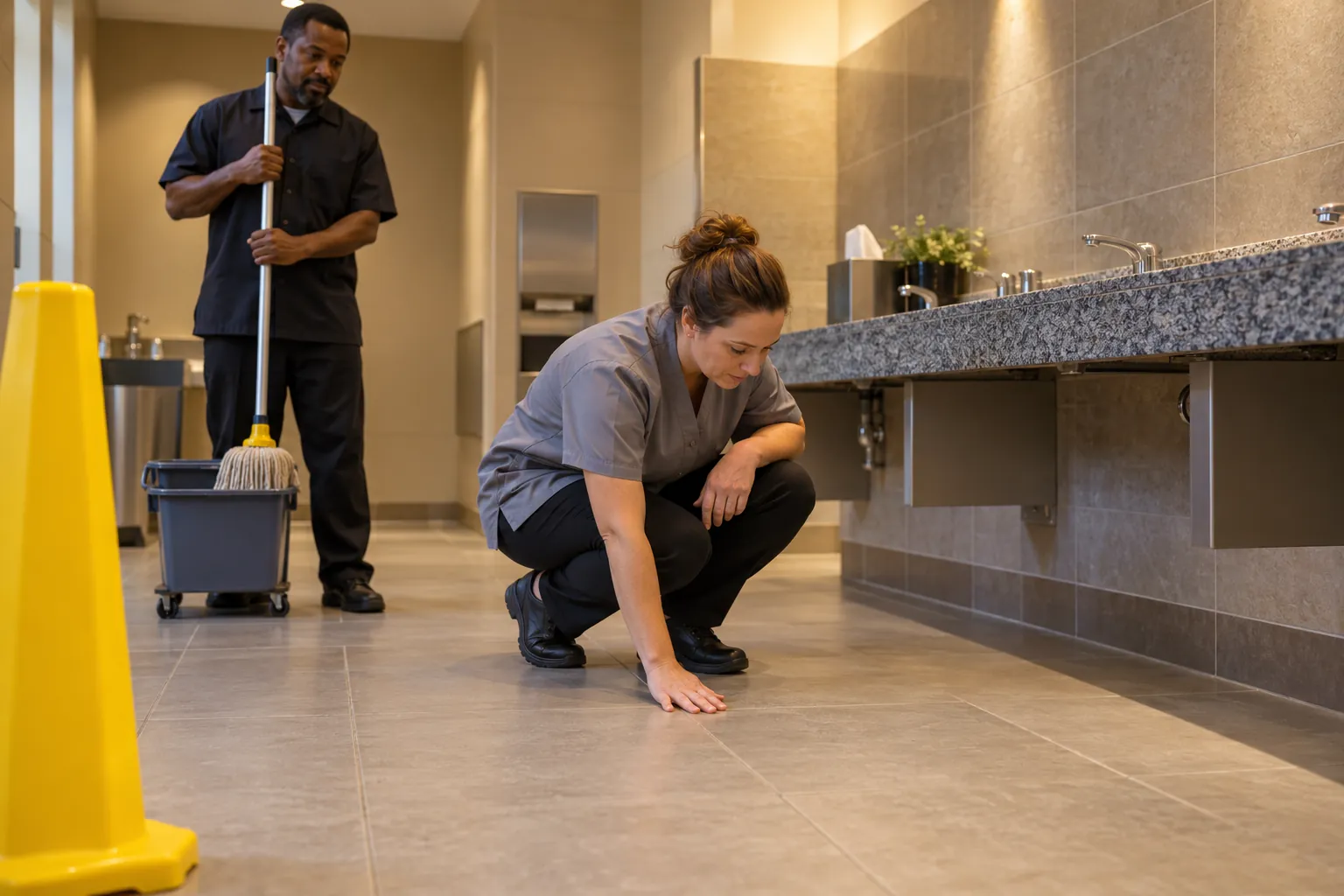
A report says what happened. A claim usually turns on what happened before: was the hazard known, how long had it been there, and was the area checked. The evidence is the record of routine checks, made as they happened:
- Floor and aisle sweeps in a store, with the time and the name of the person who walked each area.
- Restroom checks, on the building's normal round; see the restroom cleaning log guide.
- Entrance checks in wet weather, with mats changed and wet floor signs put out and taken in.
- Pool, fitness room, and guest room checks in a hotel.
- Faults and customer complaints about hazards: the leak under the cooler, the lamp out in the parking garage, each with when it was reported and closed.
Florida's statute makes the point directly: a condition that "occurred with regularity" can be enough to show the business should have known about it. A record showing the same freezer aisle wet every afternoon is a reason to fix the freezer. Review incidents together with the near misses (see near-miss reporting) at least once a quarter, by location, so whoever handles safety and risk management can see where the same hazard keeps returning.
The insurer. Follow your policy's reporting conditions, and note when you reported. The Texas Department of Insurance's guide to commercial general liability insurance notes that under a claims-made policy, claims "reported to the insurer outside the policy period are not covered" unless special coverage is arranged, which is one more reason not to sit on a report.
How long to keep it. The practical guide is how long a customer has to sue, which each state sets in its own statute of limitations. In Florida, Florida Statutes section 95.11(5)(a) gives two years for "an action founded on negligence"; in New York, CPLR 214 gives three years for "an action to recover damages for a personal injury," with exceptions in both. A claim can arrive close to the deadline, so keep the report, the photographs, the saved video, and the check records for that day together until your insurer or counsel says they can go.
Privacy. The report holds a member of the public's personal information; keep it where only those handling the incident can read it.
06
Where the record fails, and what SiteClara does about it
Customer incident reports usually fail before the incident. The restroom sheet on the back of the door is initialed for the whole afternoon at noon. The aisle sweeps are in the store's procedures and nowhere else. The night porter mentions the leak under the cooler to whoever is passing, and nothing is written down until a shopper falls there. Months later the incident report is fine, and nobody can show when that floor was last looked at.
SiteClara works on the record behind the report: the routine checks and the faults reported in the building. A printed QR poster goes at each location, such as an aisle, a restroom, an entrance, or a pool deck, with an optional NFC tag behind it. Staff scan the code or tap the tag with their own phone, with no app to install. They see the checks due at that location, such as the hourly floor check on a busy afternoon, and mark each one done or say what stopped them, with a photo when one is asked for. A hazard found there is reported with a photo and stays on the team's list of jobs until someone closes it.
The supervisor sees what was due, done, and missed, and why. A job the team cannot fix, such as a repair the landlord must pay for, can be escalated to the building manager to answer. Each day the supervisor approves a report that goes to designated managers or client contacts at 8 a.m. the next morning: what was reported, what was completed, and what is still open. After a customer is hurt, that record shows when the area was last checked, by whom, and whether the hazard had been reported.
07
Questions people ask
What is a reportable incident, and is a customer's injury one?
Under 29 CFR 1904.39, Reporting fatalities, hospitalizations, amputations, and losses of an eye as a result of work-related incidents to OSHA, an employer must report to OSHA the work-related death of an employee within eight hours, and an employee's in-patient hospitalization, amputation, or loss of an eye within 24 hours. A customer's injury is not one: 29 CFR 1904.31, Covered employees, limits OSHA's records to employees on your payroll and workers you supervise day to day. A customer or guest who is hurt is recorded in your own customer incident report and reported to your insurer as your policy requires.
How long should a business keep a customer incident report?
At least as long as a customer could bring a claim, which is set by your state's statute of limitations. In Florida, Florida Statutes section 95.11, Limitations other than for the recovery of real property, allows two years for an action founded on negligence; in New York, CPLR 214, Actions to be commenced within three years, allows three years for personal injury, with exceptions.
08
Where to read more, and a list to take away
For who OSHA's records cover, read 29 CFR 1904.31 and 29 CFR 1904.39, and for staff injuries use the workplace incident report guide. For premises liability, read your own state's law with counsel; Florida's section 768.0755 is a clear example. Read your general liability policy's conditions, and the Texas Department of Insurance's plain guide to commercial general liability insurance. The slip, trip, and fall prevention guide covers the checks that stop the next one.
Before the next incident, check that:
- every shift has a named person who writes the report, and staff know where the form is;
- the form asks for the exact location, the time, the person's own words, witnesses, the condition of the area, and what was done;
- staff photograph the area before cleaning it, and know who saves the video;
- the routine floor, restroom, entrance, and amenity checks are recorded as they happen, with a time and a name, and can be found for any location on any day;
- you know what your policy says about telling the insurer, and who does it;
- reports, photographs, video, and check records are kept together for at least your state's limitation period;
- the reports and near misses are reviewed by location every quarter, and repeat hazards are fixed at the source.
Sources
Every document this guide quotes or links to, in the order it first cites them.
- 29 CFR 1904.31, Covered employees osha.gov
- 29 CFR 1904.39 osha.gov
- Florida Statutes section 768.0755, Premises liability for transitory foreign substances in a business establishment leg.state.fl.us
- Commercial general liability insurance tdi.texas.gov
- Facts About Older Adult Falls cdc.gov
- Florida Statutes section 95.11 leg.state.fl.us
- CPLR 214 nysenate.gov
Related guides
 Premises and facilities managementThe workplace incident report: what to write, when, and who needs to see itHow to write a workplace incident report: what to include, the OSHA 301 and its seven-day rule, the 8- and 24-hour calls to OSHA, and what happens next.
 Premises and facilities managementSlip, trip, and fall prevention: keeping floors, stairs, and walkways safe every daySlip, trip, and fall prevention in a commercial building: what OSHA 1910.22 requires, where people fall, the controls that work, and how to check and record them.
 Security patrolsSecurity incident report: what to write, and how to make it hold upHow a US security officer writes an incident report: what to include, state rules on report writing and reporting to regulators, and how to make it hold up later.
 CleaningWet floor sign requirements: what OSHA asks for, and how to use the sign wellWhat OSHA and ANSI Z535 require of a wet floor sign, when one is needed, where to place it, when to take it in, and how to show the wet floor was managed.