Premises and facilities management
Grease trap cleaning log: what to record, how often, and what the FOG inspector expects
A grease trap cleaning log is the running record of every time a building's grease trap or grease interceptor was checked, cleaned or pumped out: when, by whom, how full it was, how much came out and where it went.
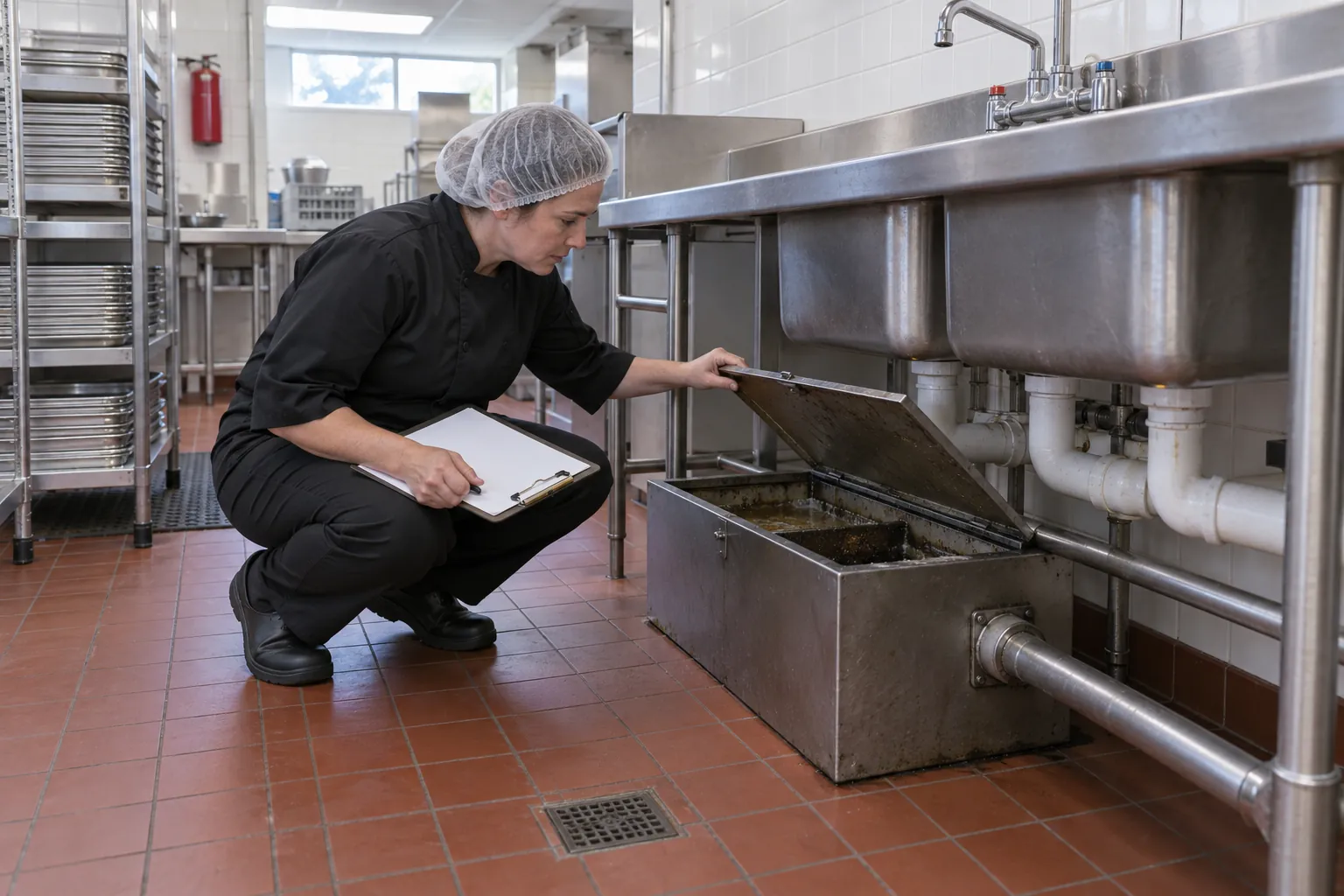
Restaurants keep one, but so do office cafeterias, school and hospital kitchens, hotel kitchens and church kitchens, and in many cities the facility manager or property manager is the person who has to produce it. There is no single national rule. The requirement comes from your local sewer utility's fats, oils and grease (FOG) program and the plumbing code your city has adopted. This guide covers where the duty comes from, what the log should hold, how often to clean, who does what, and why so many logs fall apart at inspection.
01
What a grease trap cleaning log is, and whose rule asks for one
Grease from cooking and dishwashing looks harmless while it is hot. It cools in the pipes, sticks to the walls and builds up until the line blocks. As the City of Portland's Fats, Oil, and Grease page puts it, FOG blockages "can cause sewer backups and overflows that can endanger public health, damage private property, harm the environment, and result in violations." A grease trap or interceptor holds the grease back, but only while someone empties it.
At the federal level, the EPA's National Pretreatment Standards, 40 CFR 403.5, prohibit putting into a public sewer "solid or viscous pollutants in amounts which will cause obstruction to the flow" and require publicly owned treatment works with pretreatment programs to develop and enforce local limits. That is why the working rules for grease are local. Your sewer utility or city writes a FOG ordinance or program, and it is usually that document, not a federal one, that says how often to clean and what records to keep.
Three other sources sit alongside it:
- The plumbing code your jurisdiction has adopted decides whether a kitchen needs an interceptor, what size and where. Many jurisdictions adopt the International Code Council's International Plumbing Code, Chapter 10: Traps, Interceptors and Separators, with local amendments; San Antonio's FOG ordinance, for example, requires interceptors to comply with the International Plumbing Code as the City has adopted it. Other states use their own code: Portland points to the 2023 Oregon Plumbing Specialty Code.
- The food code your state or county health department enforces. The FDA's Food Code 2022, a model offered for adoption by state and local governments, says at 5-402.12: "If used, a grease trap shall be located to be easily accessible for cleaning." Its annex explains why: a trap that cannot be cleaned "could result in the harborage of vermin and/or the failure of the sewage system."
- Your lease or management agreement, which decides whether the tenant, the landlord or the food service contractor pays for pumping and keeps the records.
Two local programs show the range. San Antonio's Fats, Oils and Grease Ordinance (City Code Chapter 34, Division 5, adopted May 2011 and administered by the San Antonio Water System) requires records of "each inspection, repair, cleaning, evacuation, service, or pumping of each interceptor", kept for five years and available on the premises. Portland's ENB-4.26 Fats, Oils, and Grease Removal Program Administrative Rules (July 2019 version) require a maintenance report to the city within 14 days after each cleaning. The details differ from city to city, so check your own utility's rules first.
02
What goes on a grease trap cleaning log
Start with what your local program asks for, then add what you need to run the kitchen well. Portland's rule lists the minimum for each cleaning report: the date of cleaning, the estimated depth of FOG and solids in each interceptor before cleaning, any defects, the name and signature of the hauler or other person maintaining the interceptor, and the name and location of the disposal site. San Antonio, for a small interceptor cleaned without a permitted hauler, asks for a cleaning log that lists the location and type of each interceptor, the date and time of each evacuation, the quantity removed, where it was disposed of, and the signature of the employee who did the work.
A log that will stand up in most jurisdictions carries these columns:
- Which device: an ID, its location (under the three-compartment sink, in the dish room floor, in-ground in the parking lot), its type and its capacity in gallons or gallons per minute.
- Date and time of the check or the pump-out.
- How full it was before cleaning: the depth of the floating grease layer and the settled solids, and what share of the working depth that is.
- What was done: a routine check, a full pump-out, a partial cleaning, a repair.
- How much was removed, in gallons.
- Who did it: the employee's name, or the hauler's company name, permit number and the driver's signature.
- Where the waste went: the disposal or processing facility, and the hauler's manifest or ticket number so the log can be matched to the paperwork.
- Condition after cleaning: baffles, inlet and outlet fittings, lid and gasket, and any defect found.
- Follow-up: the repair raised, who owns it, and when it was closed.
- Next due date, from the frequency your utility sets or the fill rate you have measured.
If your utility publishes its own log sheet, use it, because it asks for what your inspector expects. Some cities offer a free printable log sheet as a PDF: the City of Middletown, Connecticut's Grease Trap Monitoring and Cleaning Log Sheet has columns for the date and time, who cleaned the unit, who witnessed it, the grease depth, the volume removed and the waste disposal location or method, and notes that service invoices and manifests must be kept on site for five years.
Keep the used cooking oil record separate: fryer oil collected for recycling is a different waste stream from interceptor grease.
03
How often a grease trap or interceptor needs cleaning
The first thing to know is what kind of device you have. Portland's page on Grease Interceptors and How to Maintain Them describes two types. Hydromechanical grease interceptors, "sometimes called grease traps", are installed indoors above or below the floor, or in-ground outside, and are rated by flow, from 20 to 50 gallons per minute. Gravity grease interceptors are installed outdoors, above or below ground, and are large tanks of 1,000 to 4,000 gallons. A small under-sink trap may fill in days; a large outdoor interceptor may run for months.
Most FOG programs set cleaning by two tests, whichever comes first:
- A fill limit. The common one is 25 percent. Portland says most interceptors "need to be cleaned when they become 25 percent full of FOG and solids", while some high-efficiency hydromechanical units can accumulate up to 75 percent. San Antonio requires pumping within two working days whenever 25 percent or more of the wetted height, "measured from the bottom of the device to the invert of the outlet pipe", holds floating material, sediment, oils or grease.
- A maximum interval. San Antonio requires every interceptor to be pumped at least every 90 days. An establishment that operates for fewer than 120 days in a calendar year may ask SAWS in writing for a longer interval, but the two-working-day rule at 25 percent still applies. Portland's ENB-4.26 sets no less often than every 30 days for a hydromechanical interceptor and every 90 days for a gravity interceptor, and the city's current page says it sets the cleaning frequency by the type of establishment, the size of the interceptor and the volume of flow.
The practical answer is to measure. Record the depth of the grease layer and the solids at a fixed interval and work out how quickly this kitchen fills its device; a school kitchen closed for the summer and a hotel banquet kitchen in wedding season fill at very different rates. Set the pump-out schedule from the measured rate, never longer than your utility's maximum, and bring it forward when the menu or volume changes. Slow drains, odors and backups are signs the device is overdue, and Portland warns that a FOG obstruction in the city sewer can cause an overflow into other buildings, with the establishment liable for the damage.
04
Who does what: kitchen staff, the hauler and the facility manager
Kitchen staff decide how much grease reaches the device in the first place. Portland's FOG Best Management Practices for Businesses include dry wiping pots, pans and dishware into the trash before washing, screens on all kitchen sink drains with openings under 3/16 of an inch, recycling waste cooking oil rather than pouring it down a drain, removing garbage disposals, posting "No Grease" signs above sinks, and routinely cleaning kitchen exhaust filters. WSSC Water, which serves Montgomery and Prince George's counties in Maryland, adds on its Fats, Oils & Grease page that water from cleaning duct or range filters must be routed through the grease treatment system and that mop water should go only into drains connected to it.
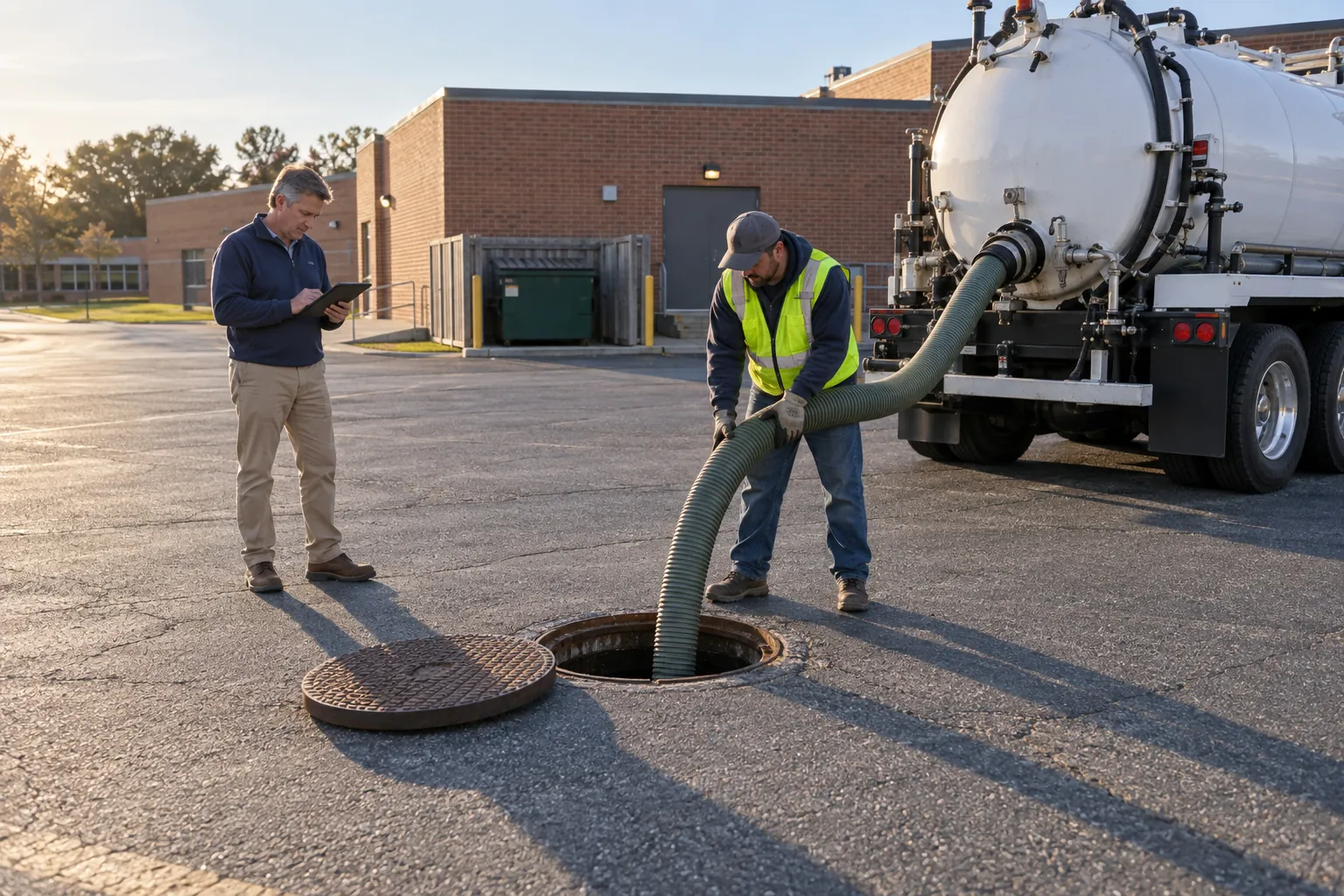
The hauler pumps the interceptor and takes the waste to a facility permitted to receive it. Many programs require a hauler permitted by the utility for anything above a set size: San Antonio requires a SAWS-permitted liquid waste hauler for any interceptor over 100 gallons, requires the interceptor to be "completely evacuated" at each pump-out, and forbids returning removed grease to any interceptor or the sewer. Portland encourages a hauler in its regional Preferred Pumper Program, whose pumpers certify that they follow standard pump-out criteria and can file the city's cleaning report on the business's behalf.
The facility or property manager owns the schedule and the records. Portland's rule is plain that the facility operator bears "the ultimate responsibility for providing maintenance records even if using an agent." WSSC Water advises inspecting each device after a pump-out "to be sure they were adequately cleaned". It makes sense for a person from the building, not only the driver, to see the empty interceptor and sign the log. Where a landlord pays the utility's FOG fee, WSSC notes the property owner can collect it from the tenant, so the lease should say who keeps the log too.
A licensed plumber or other qualified professional may be required for a periodic inspection. San Antonio requires one each calendar year, with photographs of the emptied interceptor's fittings, baffles, walls and floor, a written report, and defects fixed within 90 days.
05
What the FOG inspector looks for, and what good evidence looks like
FOG inspections are often unannounced and go straight to the records. WSSC Water says every food service establishment is subject to annual inspections, and investigators check that all required fixtures are connected to an adequately sized device and "review maintenance records." Portland's rule allows inspections "at any time without warning during and after normal working hours." San Antonio's ordinance lets SAWS staff inspect and copy the documents the establishment must keep, and photograph what they find.
On the day, an inspector will typically want to see:
- the log, on the premises, covering the full retention period your program sets (five years in San Antonio);
- hauler manifests or tickets that match the log's dates and volumes;
- a gap between pump-outs no longer than the maximum interval;
- fill levels at pump-out that stay under the limit, which shows the schedule is right, and action when one did not;
- the annual inspection report, where one is required, and proof that defects were fixed;
- no additives. Portland prohibits chemicals, enzymes and bacteria that break up FOG in any interceptor, and San Antonio prohibits discharging solvents, emulsifiers, enzymes, chemicals or bacteria that "digest, liquefy, dissolve, or emulsify" grease. A drum of "grease eater" under the sink is a finding in itself;
- a written record of any bypass during repair. San Antonio allows one only with written approval, for no more than 18 consecutive hours, recorded with start and end times.
Good evidence is dated, attributable and specific: the device, the fill level before, the gallons removed, the hauler's permit and manifest numbers, and the defect with its work order. A line that reads "cleaned – OK" shows only that someone had the pen.
06
Where the record fails, and what SiteClara does about it
Grease trap logs fail in familiar ways. The sheet taped inside the dish room door has the same neat initials every Friday, written up at the end of the month. The under-sink trap has check marks but no depth readings. The hauler came at 5 a.m., pumped the parking lot interceptor and left a ticket nobody filed. A worn lid gasket or a slow floor drain was mentioned to whoever was passing and never written down, so the property manager hears of it only at the backup. When the food service contractor is replaced, the log leaves with them.
SiteClara records the checks at the location. A printed QR poster, with an optional NFC tag behind it, sits at each place a check is scheduled, such as beside the under-sink trap in the dish room, on the wall by the floor-mounted interceptor, or at the door nearest the in-ground interceptor. Staff scan the code or tap the tag on their own phone, with no app to install, see the checks due there, and mark each one done or say what stopped them, such as a lid blocked by a parked delivery van or a hauler who did not arrive. The time and the named person are recorded as it happens, with a photo when one is asked for, for example of the reseated lid or the hauler's ticket. A problem, such as a slow drain or a damaged lid, is reported there with a photo and goes onto the team's list of jobs until someone closes it.
The supervisor sees what is due, done and missed, and can record the reason a check was missed. A job that needs the building manager can be escalated to them to answer. Each day the supervisor reviews and approves a report that goes to nominated management or client contacts at 8 a.m. the next morning, showing what was reported, completed and still open, and how the scheduled checks went, for example 3 of 3 grease trap checks completed.
07
Questions people ask
How often should a grease trap be cleaned out?
When it reaches your utility's fill limit or its maximum interval, whichever comes first. Portland's Grease Interceptors and How to Maintain Them says most interceptors need cleaning when they become 25 percent full of FOG and solids, and San Antonio's Fats, Oils and Grease Ordinance also requires every interceptor to be evacuated at least every 90 days. Your own utility's rule decides the figures.
Who is responsible for cleaning the grease trap?
The business whose kitchen drains into it. Portland's Grease Interceptors and How to Maintain Them says a business must file a cleaning report with the city after every interceptor cleaning or pump-out, and San Antonio's Fats, Oils and Grease Ordinance puts the cleaning, inspection and record duties on each food service or food processing establishment. Between a landlord and a tenant, the lease decides who pays and who keeps the log.
Do you need a license to clean grease traps?
It depends on the size of the device and your utility's rules. San Antonio's Fats, Oils and Grease Ordinance requires a liquid waste hauler permitted by SAWS for any interceptor over 100 gallons; a smaller one may be cleaned by the establishment's own staff, who must then keep a cleaning log, and the waste may go only to a facility permitted to receive it. Portland's Grease Interceptors and How to Maintain Them encourages businesses to use a pumper from its Preferred Pumper Program.
What happens if you don't clean grease traps?
Grease passes into the drains and can block them, and Portland's Grease Interceptors and How to Maintain Them warns that a FOG obstruction in the city sewer can cause a sewage overflow into other buildings, with enforcement action and liability for the damage. San Antonio's Fats, Oils and Grease Ordinance makes a violation a class C misdemeanor, with each day a new offense, allows civil penalties, and lets SAWS, with its board's approval, terminate water or sewer service if a violation is not remedied within 90 days of written notice.
08
Further reading, and a list to take away
Start with your own sewer utility's FOG program, and ask its staff which plumbing code and record format apply. For worked examples of how programs are written, read Portland's ENB-4.26 Fats, Oils, and Grease Removal Program Administrative Rules, the San Antonio Water System's Fats, Oils & Grease Abatement Program and its ordinance, and WSSC Water's Fats, Oils & Grease permit program. The federal background is 40 CFR 403.5, and the FDA's Food Code 2022 covers where a grease trap goes in a food establishment.
Before the next FOG inspection, check that:
- you have the current version of your utility's FOG rules;
- every device on the log has an ID, location, type and capacity;
- each entry has a date, time, named person and fill depth;
- pump-out intervals are set from measured fill rates, under the maximum;
- every hauler manifest matches a log entry;
- someone from the building signs for each pumped device;
- defects have a job, an owner and a close date;
- no additives are used in any device;
- the lease says who keeps the log, and records stay on site as long as required.
Sources
Every document this guide quotes or links to, in the order it first cites them.
- Fats, Oil, and Grease portland.gov
- EPA's National Pretreatment Standards, 40 CFR 403.5 ecfr.gov
- International Plumbing Code, Chapter 10: Traps, Interceptors and Separators codes.iccsafe.org
- Food Code 2022 fda.gov
- Fats, Oils and Grease Ordinance saws.org
- ENB-4.26 Fats, Oils, and Grease Removal Program Administrative Rules portland.gov
- Grease Trap Monitoring and Cleaning Log Sheet middletownct.gov
- Grease Interceptors and How to Maintain Them portland.gov
- FOG Best Management Practices for Businesses portland.gov
- Fats, Oils & Grease wsscwater.com
- Permit-required confined spaces standard, 29 CFR 1910.146 osha.gov
- Fats, Oils & Grease Abatement Program saws.org
Related guides
 Fire and water checksKitchen hood inspection: grease, cleaning and the fire suppression systemHow commercial kitchen hood inspection works under NFPA 96: grease buildup, cleaning, the six-month suppression service, daily checks and the records to keep.
 Premises and facilities managementStormwater inspection: what the permits and your city expect, and how to keep the recordWhich stormwater inspections a US property needs: industrial permit checks, construction site inspections and post-construction BMP maintenance, and the records.
 Premises and facilities managementPest sighting log: recording pest activity so it gets dealt withWhat a pest sighting log should record, who fills it in, how sightings reach your pest control provider, and the US rules behind it: FDA Food Code, OSHA and CMS.
 Premises and facilities managementPreventive maintenance checklist: what to check in a commercial building, how often, and how to prove itA preventive maintenance checklist for commercial buildings: HVAC, electrical, fire and life safety, plumbing, how often, and what the record should show.