Cleaning
Day porter duties: what the job covers, and how to prove the rounds
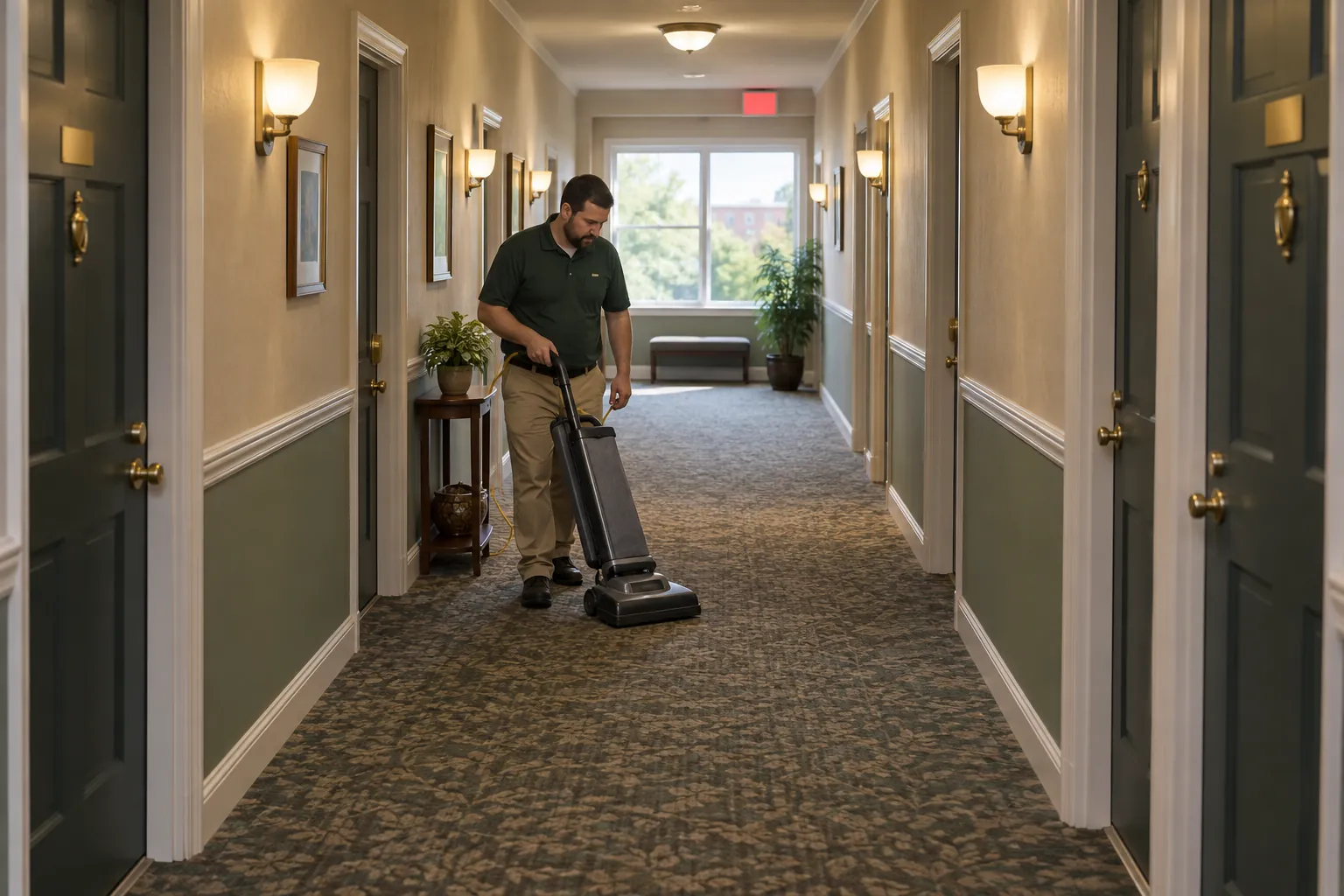
A day porter is a janitorial worker who keeps a commercial building clean, safe and presentable throughout the day while people are in it: restrooms checked and restocked, the lobby kept clear, spills dealt with before someone slips, trash emptied before it overflows.
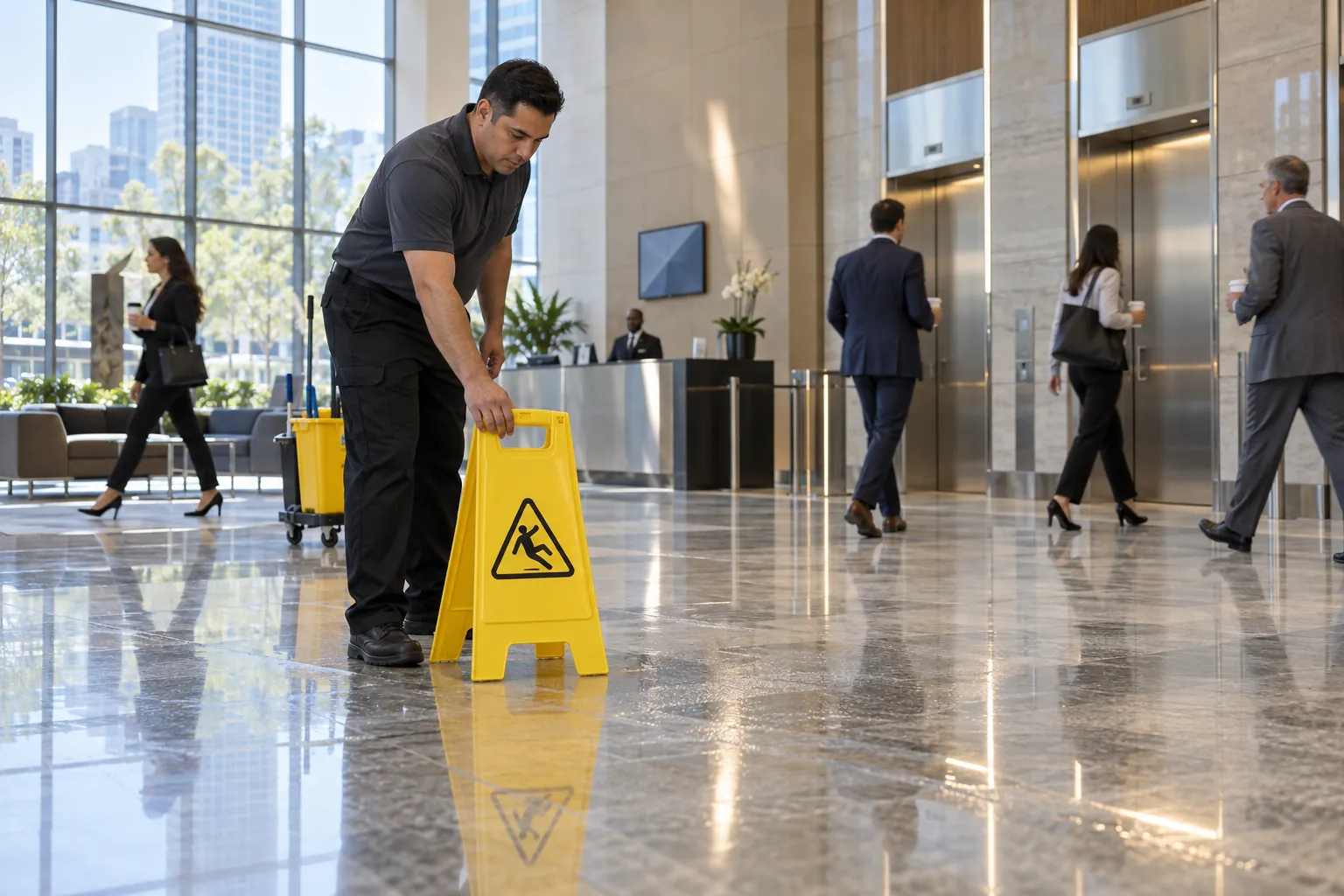
The night crew does the deep cleaning; the day porter handles everything that happens during business hours. This guide covers what the role includes, the federal rules behind it, how to build a daily route, and how a janitorial contractor can show a client that the rounds were actually walked.
01
What a day porter is, and the rules behind the work
A day porter is a janitorial worker assigned to a building during business hours. In offices, medical office buildings, retail centers and schools, much of the cleaning is done in the evening or at night by a crew that works when the building is empty. The day porter is on site while tenants, visitors and staff are using the space, keeping it clean, safe and presentable as it gets used. Some contracts say day matron, day custodian or utility porter; the timing and the visibility are the same.
No federal law defines a day porter. What the rules require is the result the day porter produces. For most private employers, two OSHA standards set it out:
- 29 CFR 1910.22, Walking-working surfaces, general requirements: "All places of employment, passageways, storerooms, service rooms, and walking-working surfaces are kept in a clean, orderly, and sanitary condition" (1910.22(a)(1)); the floor of each workroom is maintained "in a clean and, to the extent feasible, in a dry condition" (a)(2); and surfaces are kept free of hazards "such as sharp or protruding objects, loose boards, corrosion, leaks, spills, snow, and ice" (a)(3). Surfaces must be "inspected, regularly and as necessary" (d)(1), and hazardous conditions "corrected or repaired before an employee uses the walking-working surface again" (d)(2).
- 29 CFR 1910.141, Sanitation: "All places of employment shall be kept clean to the extent that the nature of the work allows" (1910.141(a)(3)(i)); waste must be removed "in such a manner as to avoid creating a menace to health" (a)(4)(ii); and washing facilities "shall be maintained in a sanitary condition" (d)(1), with hand soap or a similar cleansing agent and individual hand towels or air blowers at the lavatories (d)(2).
Read together, those sections describe most of the shift. Spills and tracked-in water have to be corrected before people walk there again, which the night crew cannot do; restrooms have to be sanitary and stocked all day; and trash has to go often enough to keep the building sanitary.
When janitorial services are contracted out, the building owner or tenant keeps its duty to its own employees; the contract and its scope of work are how it shows the duty is met, and the day porter is the most visible part of that contract.
02
Day porter duties: what the job covers in practice
Every building is different, but most day porter job descriptions and janitorial specifications draw from the same list. A typical day porter handles:
- Restroom checks: floors, toilets, urinals, sinks, counters and mirrors spot-cleaned; toilet paper, paper towels, soap and seat covers restocked; sanitary napkin receptacles emptied; clogs, leaks and broken fixtures reported.
- Lobby and entrances: entry mats straightened or swapped when saturated, glass doors and sidelights spot-cleaned of fingerprints, the reception area and seating kept tidy, the sidewalk and entry swept of litter and cigarette butts; the lobby sets the building's appearance for every visitor.
- Spills and wet floors: responding to spills, tracked-in rain or snowmelt, and leaks, putting out wet floor signs, and mopping or drying the floor before the area is used again.
- Trash and recycling: emptying lobby, restroom, break room and common area receptacles before they overflow, and moving bags to the trash room or compactor.
- High-touch surfaces: elevator buttons, door handles and push plates, stair rails, drinking fountains, and restroom fixtures, cleaned on a set schedule during the day.
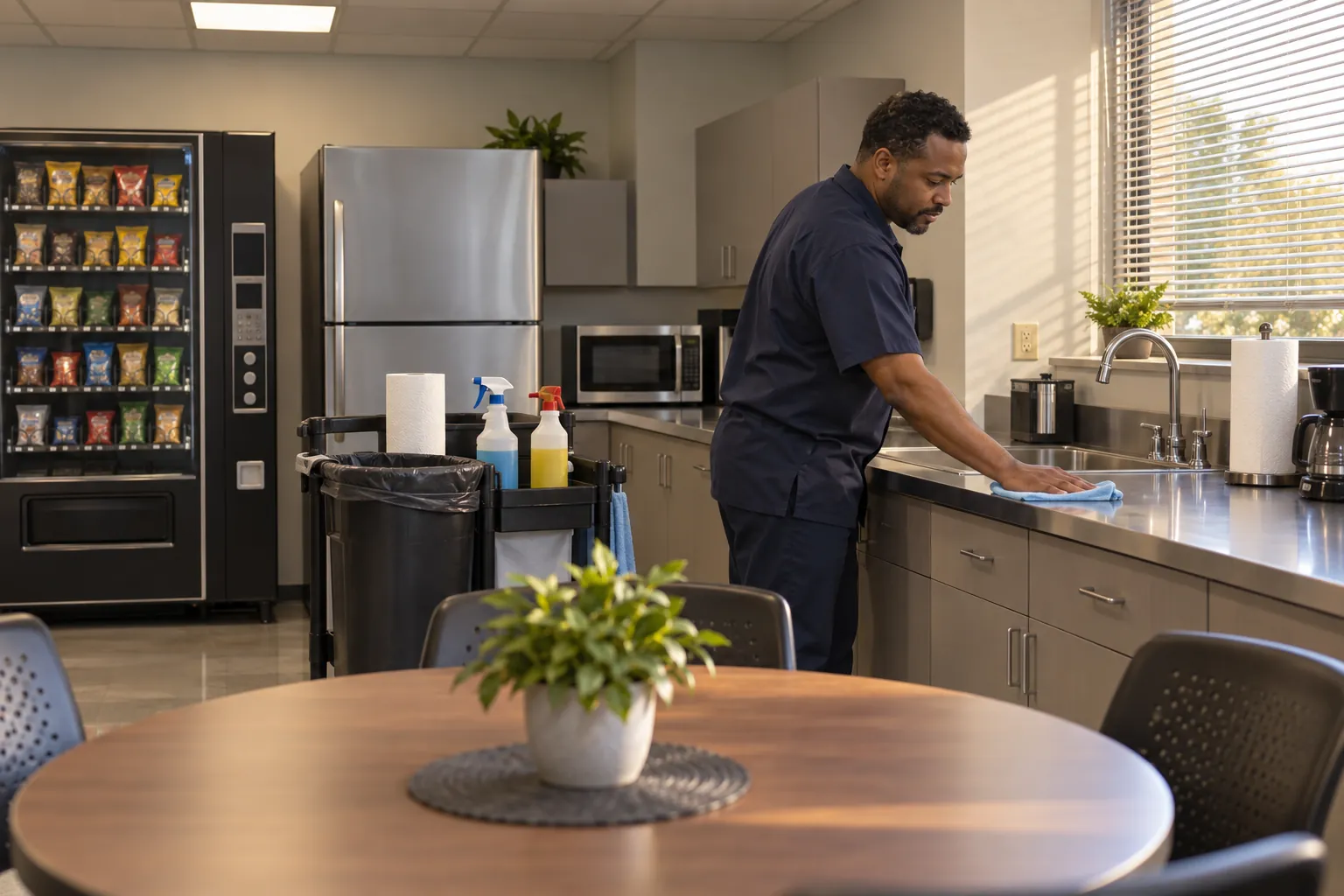
- Break rooms and kitchens: counters and tables wiped, sinks cleared, microwaves and coffee areas spot-cleaned, refrigerators cleared on the agreed day.
- Elevators and stairwells: cabs spot-cleaned; stairwells checked for litter, spills and anything stored where it should not be.
- Meeting rooms and events: conference rooms reset between bookings, and extra trash, restroom and spill checks around catered lunches, tenant events and other busy periods.
- Responding to calls: tenant requests from the property manager, building engineer or front desk.
- Reporting: telling the building engineer or property manager about burned-out lights, leaks, damaged flooring, broken fixtures and anything unsafe.
Write down what the day porter does not do, too. Floor refinishing, carpet extraction, high dusting and full office detailing belong to the night crew; repairs to the building engineer; security to the security officers. A porter expected to cover all of those will not finish the rounds they are paid for.
In apartment and condominium buildings the role leans toward mail rooms, hallways, laundry rooms, trash chutes and amenity spaces; in a medical office building, toward waiting rooms and public restrooms. The list above is the menu; the building's scope of work picks from it.
03
Building a day porter route and schedule
A day porter without a route spends the day answering calls and reaches the far end of the building only when someone complains. A route turns the job into timed stops with a short list of checks at each, and leaves room for the calls that will come anyway: if calls take an hour a day, fit the route into seven hours, not eight.
Build the route around the building's traffic and its peaks: the morning arrival, the lunch rush and the mid-afternoon. A sample eight-hour shift for a mid-size office building, with a half-hour meal break, where each block is paced to leave room for the calls that interrupt it:
- 7:30 to 8:30: walk the entrances and lobby, set out mats, check the sidewalk and entry, first restroom check on every floor, restock supplies.
- 8:30 to 10:00: lobby glass and elevator cabs after the arrival rush; high-touch surfaces in lobbies and elevator buttons; break rooms after the morning coffee.
- 10:00 to 11:30: second restroom round, trash in common areas, stairwell check, conference rooms booked for the afternoon.
- 11:30 to 1:00: cafeteria and break room support during lunch, trash and recycling, restrooms nearest food areas checked again.
- 1:00 to 1:30: meal break, taken after the lunch rush.
- 1:30 to 3:00: third restroom round, high-touch surfaces again, parking garage entrance and exterior litter.
- 3:00 to 4:00: final restroom round and restock, lobby and entrance reset, notes for the night crew about anything left for them.
Frequencies come from the building, the contract and the tenants. A busy public restroom in a transit center or retail center may need a check every hour; a restroom on a quiet office floor may be fine at three checks a day. The CDC's guidance on when and how to clean and disinfect a facility tells building operators to "clean high-touch surfaces regularly," naming door handles, stair rails, elevator buttons, restroom fixtures and desks among its examples, and to weigh how much traffic a space gets rather than setting one frequency for everything. The same logic applies to the whole route.
Write the route down, post it where the shift starts, give the property manager a copy, and review it whenever tenants, layouts or complaints change.
04
Safety, chemicals and training for day porters
Day porters work around the public. Wet floor signs go down before the mop does, a spill is guarded until it is dry, and machine cords stay out of walkways. Under 1910.22(d)(2) a hazard has to be corrected before an employee uses the surface again; a building open to visitors has every reason to hold itself to the same standard for them.
Cleaning chemicals are the other main hazard. OSHA's Hazard Communication standard, 29 CFR 1910.1200, requires employers to have a written hazard communication program, to keep safety data sheets "readily accessible during each work shift to employees when they are in their work area(s)," and to train employees on hazardous chemicals "at the time of their initial assignment." A consumer product is exempt only where the employer can show it is used as the manufacturer intended and the exposure is no greater than a consumer's would be; a concentrated janitorial chemical diluted and used all day by a porter is unlikely to meet that test.
The OSHA and NIOSH InfoSheet Protecting Workers Who Use Cleaning Chemicals lists safe work practices that fit a day porter's cart closely: warn workers not to mix products containing bleach and ammonia, which "can cause severe lung damage or death"; make sure they know which chemicals must be diluted and how; label every container; provide the right gloves and goggles; and run ventilation during cleaning. It adds that training must be given "in a language and vocabulary that they can understand," which matters on crews where English is often a second language.
Blood and body fluids come up more often in public-facing work: a nosebleed in the lobby, vomit in a restroom, a needle in a trash can. OSHA's Bloodborne Pathogens standard, 29 CFR 1910.1030, applies to "all occupational exposure to blood or other potentially infectious materials." In its April 17, 1992 letter, Coverage of Janitorial Workers Under Bloodborne Pathogens Standard, OSHA said it "does not generally consider maintenance personnel/janitorial/housekeeping staff employed in non-health care facilities to have occupational exposure," but that "it is the employer's responsibility to determine which job classifications or specific tasks and procedures involve occupational exposure." If cleaning up blood is part of the job, the employer has to assess it and, where exposure is reasonably anticipated, provide the standard's protections. Either way, have a written body fluid procedure, the right kit on the cart, and a rule that broken glass is never picked up by hand.
05
How day porter work is supervised and checked
A day porter often works alone, with the janitorial supervisor covering several buildings, while the property manager sees the building daily but does not employ the porter. That is where disputes start: the tenant says a restroom had no paper at 2 p.m., the contractor says it was checked at 1:30, and nobody can show which is true.
Good supervision rests on a few things agreed in advance:
- A written route and frequency for each area, agreed with the property manager and attached to the scope of work, so both sides measure against the same list.
- A record of each round, made at the location as it happens: the area, the time, who did it, and anything found or fixed.
- A route for problems: how the porter reports a leak, a broken dispenser or a damaged floor, who picks it up, and how the porter and the tenant know it was dealt with.
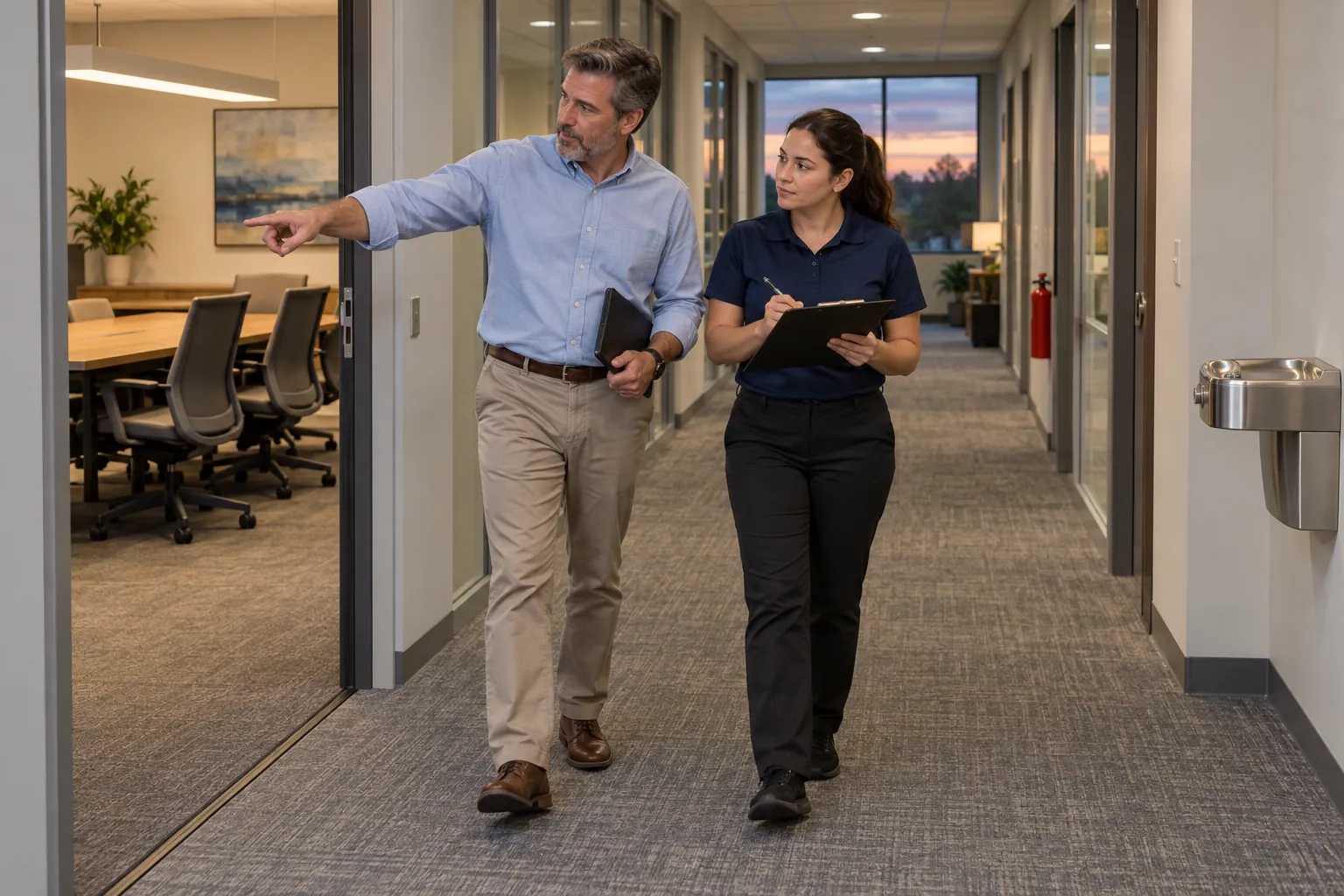
- Inspections: regular walk-throughs by the janitorial supervisor, and joint walk-throughs with the property manager, with cleanliness scored against the specification.
- A daily summary the property manager can read in a minute: rounds completed and missed, issues reported and still open.
That record is what separates a trusted day porter contract from one renewed on hope. A property manager who can see that the 10, 12, 2 and 4 o'clock restroom checks were done, and that the one missed was missed because the porter was cleaning up a lobby spill, has something to tell the tenant who complained.
Round records show whether the scheduled work happened and where the day went; they are not a productivity score, and a porter pulled away by five tenant calls should not look worse than one who had a quiet day. Use them to fix the route, add hours where the building needs them, and back the crew when a complaint is unfair.
06
Where the day porter record fails, and what SiteClara does about it
Most day porter records are sheets on the back of restroom doors, initialed every hour or two, as easy to fill in ahead of time as at the time. The client sees them only when they walk the building, and the clogged toilet noted at 11 a.m. is still clogged at 4 p.m. because nobody in maintenance read the back of the door.
SiteClara records the round at the location. A printed QR code poster, with an optional NFC tag behind it, sits at each stop on the route: a restroom, the lobby, a break room, a stairwell. The day porter scans the code or taps the tag on their own phone, with no app to install, sees the checks due there, and marks each one done or says what stopped them. The time and the named person are recorded as it happens, with a photo when one is asked for or helps. A problem such as a leak, a broken dispenser or a stall that will not lock can be reported there, and it goes onto the team's list of open jobs until someone closes it.
The janitorial supervisor sees what is due, done and missed across the building, and records the reason a check was missed. At the end of the day they review it, add a note and approve a report that goes to the nominated property manager or client contacts at 8 a.m. the next morning: what was reported, what was completed, what is still open, and how the scheduled rounds went, for example 22 of 24 restroom checks completed, with the reason for the two that were not.
07
Questions people ask
What is the difference between a day porter and a janitor?
Mainly the hours and the visibility: a day porter does janitorial work while the building is occupied, keeping up with restrooms, spills and trash as people use the space, while much of the rest of the cleaning is done after hours. Federal job data does not treat them as separate jobs. A search for "day porter" in the Department of Labor's O*NET OnLine occupation search returns Janitors and Cleaners, Except Maids and Housekeeping Cleaners as the closest match, and the BLS Occupational Outlook Handbook entry for janitors and building cleaners says their work schedules "may vary to include evenings, nights, or weekends."
Is a porter like a janitor?
In a building, yes: a day porter on a janitorial contract cleans. The word covers other jobs too. The Department of Labor's O*NET OnLine search for "porter" returns Baggage Porters and Bellhops first, with Janitors and Cleaners, Except Maids and Housekeeping Cleaners among the first few results; the O*NET summary for Janitors and Cleaners describes that work as keeping "buildings in clean and orderly condition." A porter in a hotel carries luggage; a porter in an office or apartment building keeps it clean.
08
Further reading, and a list to take away
The standards most of a day porter's work answers to are OSHA's 29 CFR 1910.22, Walking-working surfaces and 29 CFR 1910.141, Sanitation. The OSHA and NIOSH InfoSheet Protecting Workers Who Use Cleaning Chemicals is a short, three-page sheet worth giving every porter, and the CDC's When and How to Clean and Disinfect a Facility covers high-touch surfaces. If your state runs its own program, start from OSHA's State Plans page.
Before you start or review a day porter contract, check that:
- the scope of work lists the day porter's duties and what belongs to the night crew, maintenance and security instead;
- there is a written route with times, built around the building's traffic;
- each area has an agreed frequency, with busier restrooms and entrances checked more often;
- the route leaves time for tenant calls and spills;
- wet floor signs, spill kits and a body fluid cleanup kit are on the cart;
- safety data sheets are accessible on every shift and every chemical container is labeled;
- the porter has been trained on the building's chemicals, in a language they understand;
- each round is recorded at the location, with the time and the person;
- problems found on a round reach someone who fixes them, and the fix is recorded;
- the property manager sees a daily summary of rounds completed, rounds missed and why, and issues still open.
Sources
Every document this guide quotes or links to, in the order it first cites them.
- 29 CFR 1910.22, Walking-working surfaces, general requirements osha.gov
- 29 CFR 1910.141, Sanitation osha.gov
- OSHA-approved State Plans osha.gov
- CDC's guidance on when and how to clean and disinfect a facility cdc.gov
- Hazard Communication standard, 29 CFR 1910.1200 osha.gov
- Protecting Workers Who Use Cleaning Chemicals osha.gov
- Bloodborne Pathogens standard, 29 CFR 1910.1030 osha.gov
- Coverage of Janitorial Workers Under Bloodborne Pathogens Standard osha.gov
- O*NET OnLine occupation search onetonline.org
- Occupational Outlook Handbook entry for janitors and building cleaners bls.gov
- O*NET OnLine search for "porter" onetonline.org
- O*NET summary for Janitors and Cleaners onetonline.org
Related guides
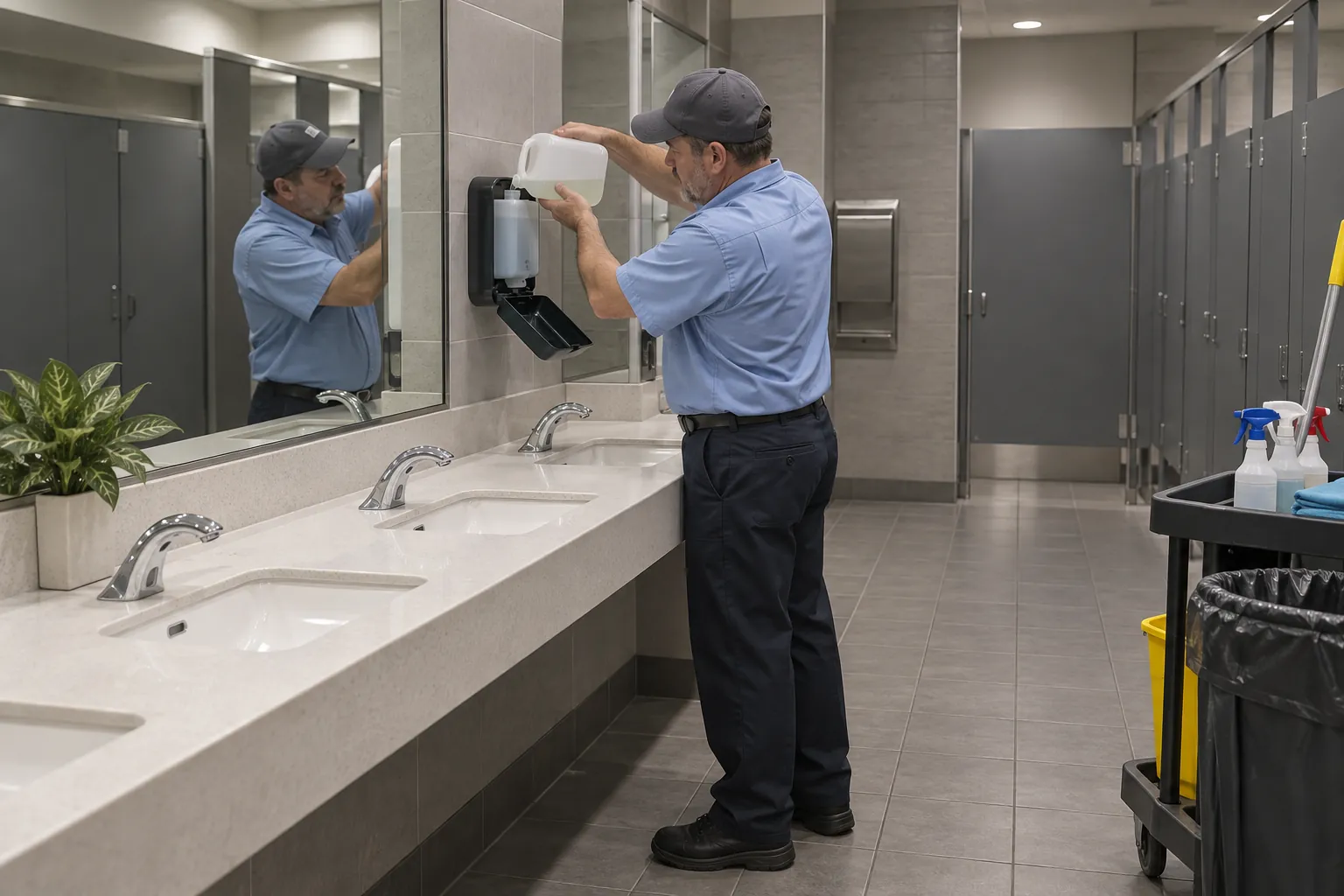 CleaningRestroom cleaning log: what to record, and how to make it believableWhat a restroom cleaning log should record, how often to check, the OSHA and Food Code rules behind it, and how to keep a log a client or inspector will believe.
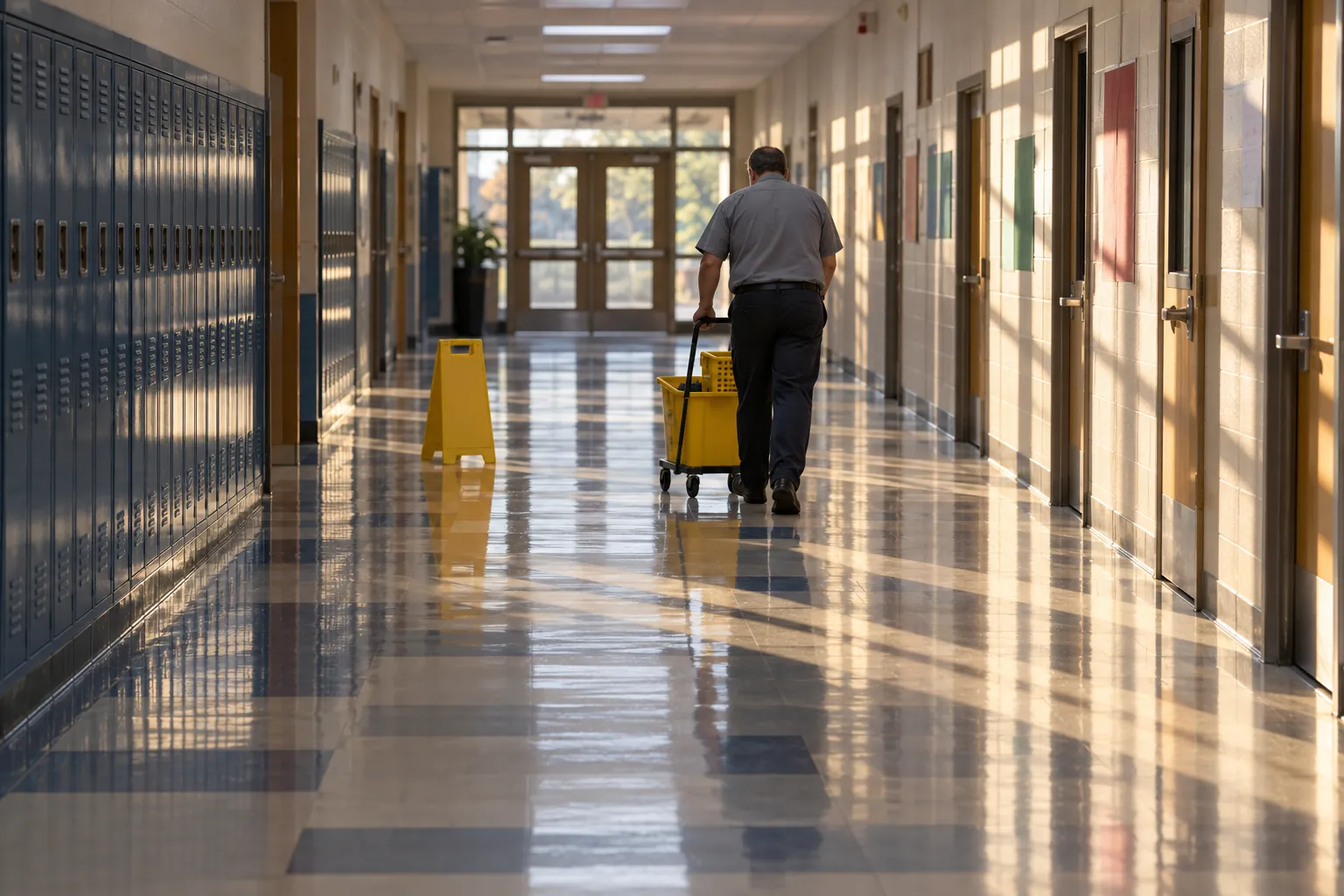 Premises and facilities managementCustodian duties: what the job involves, and how to show it was doneCustodian duties in schools, offices, churches and public buildings: cleaning, restrooms, opening and locking, safety checks, OSHA rules and a record of the work.
 CleaningCommon area cleaning: what it covers, how often, and how to show it was doneWhat common area cleaning covers in apartment, condo and commercial buildings, how often, the OSHA and code rules behind it, and how to show each visit happened.
 CleaningJanitorial scope of work: what it should say, and how to show it is metWhat a janitorial scope of work should cover, how to set cleaning frequencies by room type, output versus input standards, and how to show the work is being done.