Cleaning
Certificate of acceptability: getting one, and keeping the premises to R638
A certificate of acceptability is the certificate a municipality issues, on the recommendation of an environmental health practitioner, confirming that food premises meet the hygiene standards in regulations 5 and 6 of R638 of 2018, and no one may handle food on premises without a valid one.
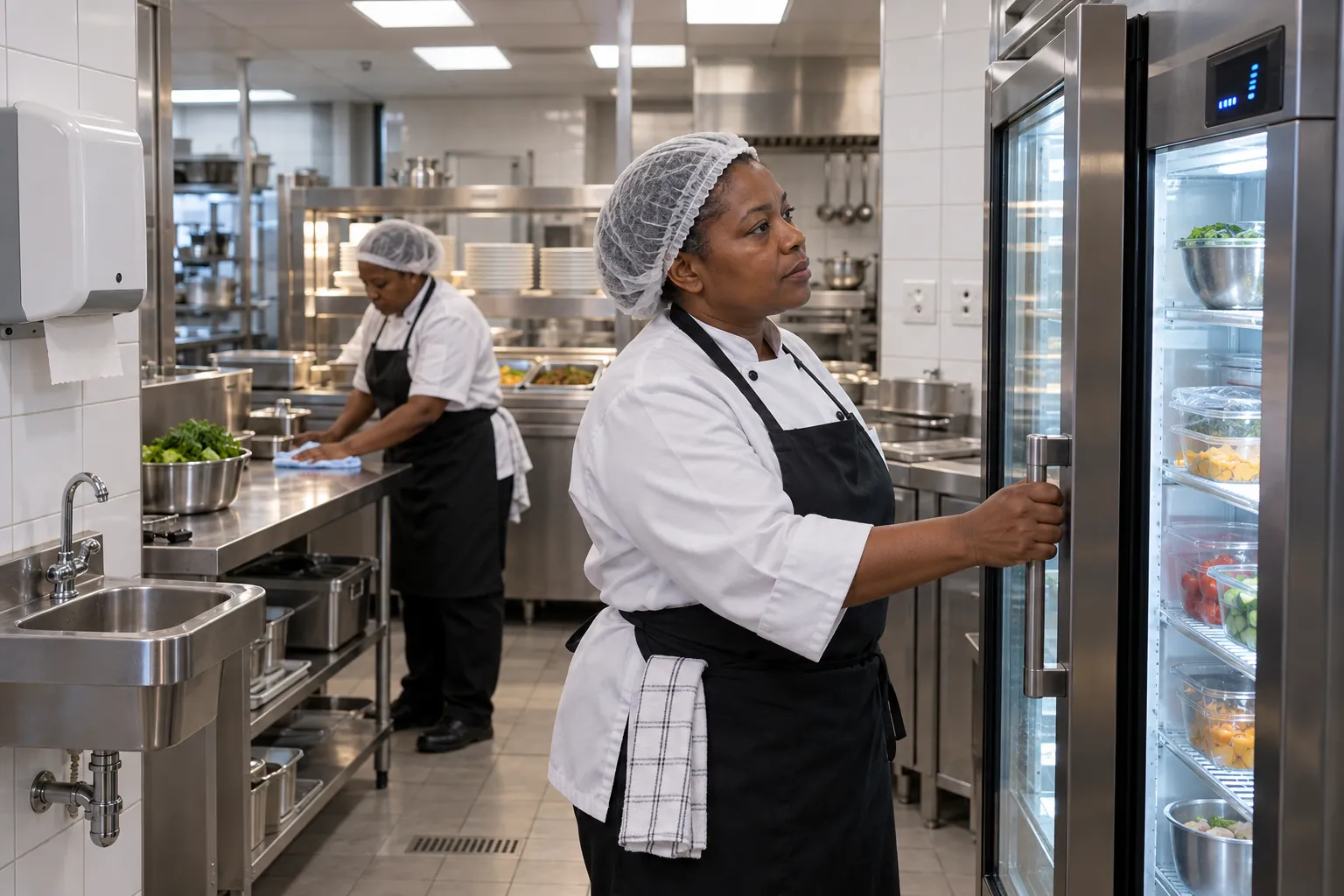
In an office park, school, hospital or factory that means the staff canteen, the coffee kiosk, the tuck shop and the caterer's kitchen. Getting the certificate takes one inspection; keeping it depends on what happens every day in between. This guide covers the law, who needs one, how it is issued, and the checks and records that keep it.
01
What a certificate of acceptability is, and the law behind it
The certificate comes from the Regulations governing general hygiene requirements for food premises, the transport of food and related matters, Government Notice R. 638 of 22 June 2018, usually called R638, made under section 15(1) of the Foodstuffs, Cosmetics and Disinfectants Act 54 of 1972. They replaced the earlier hygiene regulations, R962 of 2012.
Regulation 3(1) is the rule: a person may not handle food, or permit food to be handled, on food premises for which a valid certificate of acceptability has not been issued or is not in force, or in breach of a condition written on the certificate. It also covers an outsourced vehicle carrying perishable food for the premises.
Two definitions decide how far that reaches. Food premises means "a building, structure, stall or other similar structure, and includes a caravan, vehicle, stand or place used for or in connection with the handling of food". Serve means the provision of food "whether for a consideration or otherwise", so a canteen giving staff a free lunch serves food just as a restaurant does.
The certificate is issued by the local authority for the area. Under section 32(1) of the National Health Act 61 of 2003, every metropolitan and district municipality must ensure that municipal health services, which include food control and the surveillance of premises, are provided in its area. In a metro the application goes to the metro's environmental health office; elsewhere it usually goes to the district municipality's environmental health practitioners (EHPs), acting as inspectors under section 10 of the 1972 Act.
What the certificate certifies is narrow: that the premises comply with regulations 5 and 6 of R638 for the food handling described in the application. As the City of Cape Town puts it, a certificate of acceptability "is not a license to trade".
02
Which premises need one, and in whose name
Any premises where food is handled for other people needs a certificate. In the buildings that facilities managers, managing agents and contract cleaners look after, that means staff canteens and dining halls, paid or free; coffee kiosks, delis and tuck shops in office parks, shopping centres, hospitals and schools; catering kitchens in hospitals, old age homes and residences; function kitchens and serveries; and the food stores and cold rooms that serve them.
R638 exempts a private household handling food for itself or giving it away without compensation (regulation 14(7)). An office pantry where staff make their own tea is not a kitchen preparing food for others; for anything in between, such as a shared kitchen a tenant uses for catered meetings, ask the environmental health office rather than guess.
The certificate is issued in the name of the person in charge: "a natural person who is responsible for the food premises or the owner of such food premises". With a contract caterer that is normally the caterer's manager, not the landlord or the facilities manager, even though the landlord owns the kitchen. Under regulation 3(9) it is not transferable between people or premises, so:
- a change of caterer means a new certificate;
- under regulation 3(8), when the person in charge is replaced the municipality must be told in writing within 30 days, and issues a new certificate in the new name; if it is not told, the certificate expires permanently (regulation 3(9)(f));
- a second kiosk on another floor needs its own certificate.
A caterer or cleaning company working under contract is usually covered by a section 37(2) agreement under the OHS Act. That deals with safety at work; it does not move the R638 duties, which stay with the person in charge.
03
How the certificate is applied for and issued
Under regulation 3(2) the person in charge applies in writing to the local authority on a form like Annexure A of R638. It asks for the person in charge's details, the premises down to floor level and erf number, the food categories, quantities and nature of handling, the number of staff, and, where applicable, a layout plan at 1:50 showing all equipment. It also asks where the sanitary, wash-up and hand-washing facilities are if they are not on the food premises, which matters where canteen staff use the building's shared ablution facilities.
The municipality refers the application to an inspector, who inspects and, if the premises comply in all respects with regulations 5 and 6, recommends that the certificate be issued (Annexure B). If they fall short, the municipality may allow up to six months to put them right (regulation 3(5)(a)(ii)).
Outside the metros, the district municipality's environmental health office usually serves the local municipalities and towns in its district. Ask that office for its certificate of acceptability application form, and whether a fee applies, before you submit.
Each municipality runs its own process. The City of Cape Town takes applications through its e-Services portal; its Apply for a Certificate of Acceptability page gives a standard processing time of ten working days once all documents are in, with the EHP assessing the "structural design and construction of the premises, food safety practices, waste disposal / pest control management and overall hygiene". The City's guide, How to apply for a Certificate of Acceptability in the City of Cape Town, lists what to have ready for the inspection:
- food safety and hygiene training records;
- a documented pest control programme;
- temperature control monitoring records;
- adequate waste management and cleaning schedules;
- a list of suppliers, and stock control and rotation.
Once issued, regulation 3(7) requires the certificate to be displayed conspicuously, or a copy produced at once on request. Under regulation 3(6) any change to the premises that touches regulations 5 and 6, such as a new layout or a new cold room, must be notified in writing in advance.
04
What R638 expects of the premises between inspections
The certificate is issued once; the standards it certifies apply every day. Regulation 5 requires premises to be kept so they can be used at all times without creating a health hazard, and sets out specifics, including:
- Surfaces: walls, ceilings and floors in the food-handling area smooth, cleanable, non-absorbent and water-resistant, with no open joints.
- Ventilation and light: natural openings of at least 5% of the floor area or compliant mechanical ventilation; daylight openings of at least 10% of the floor area or at least 200 lux, with fittings protected against broken glass.
- Cleaning and pests: a wash-up facility with hot and cold water, pest-proofing, and effective means of keeping out flies and cockroaches.
- Hands and sanitation: the toilets, urinals and basins in Annexure D, and hand-washing facilities with soap, clean disposable hand-drying material or a dryer, and hot water where possible.
- Refuse and staff areas: lidded, liquid-proof refuse containers with a separate area to store and clean them, and a separate changing area.
Regulation 6 covers the facilities. Food-contact surfaces must be cleaned before use and as needed, and then carry no more than 100 viable micro-organisms per square centimetre on a swab taken to SANS 5763. Chipped or cracked crockery may not be used, and every fridge, freezer and hot display needs a readable thermometer.
Annexure E sets the core temperatures for stored, transported or displayed food: ice cream and frozen fish at -18 °C or colder, other frozen food at -12 °C, raw fish, poultry, offal and milk at 4 °C or below, other chilled perishables at 5 °C or below, and hot food above 60 °C. Food eaten or sold within four hours of preparation is excluded (regulation 8(4)(b)(i)).
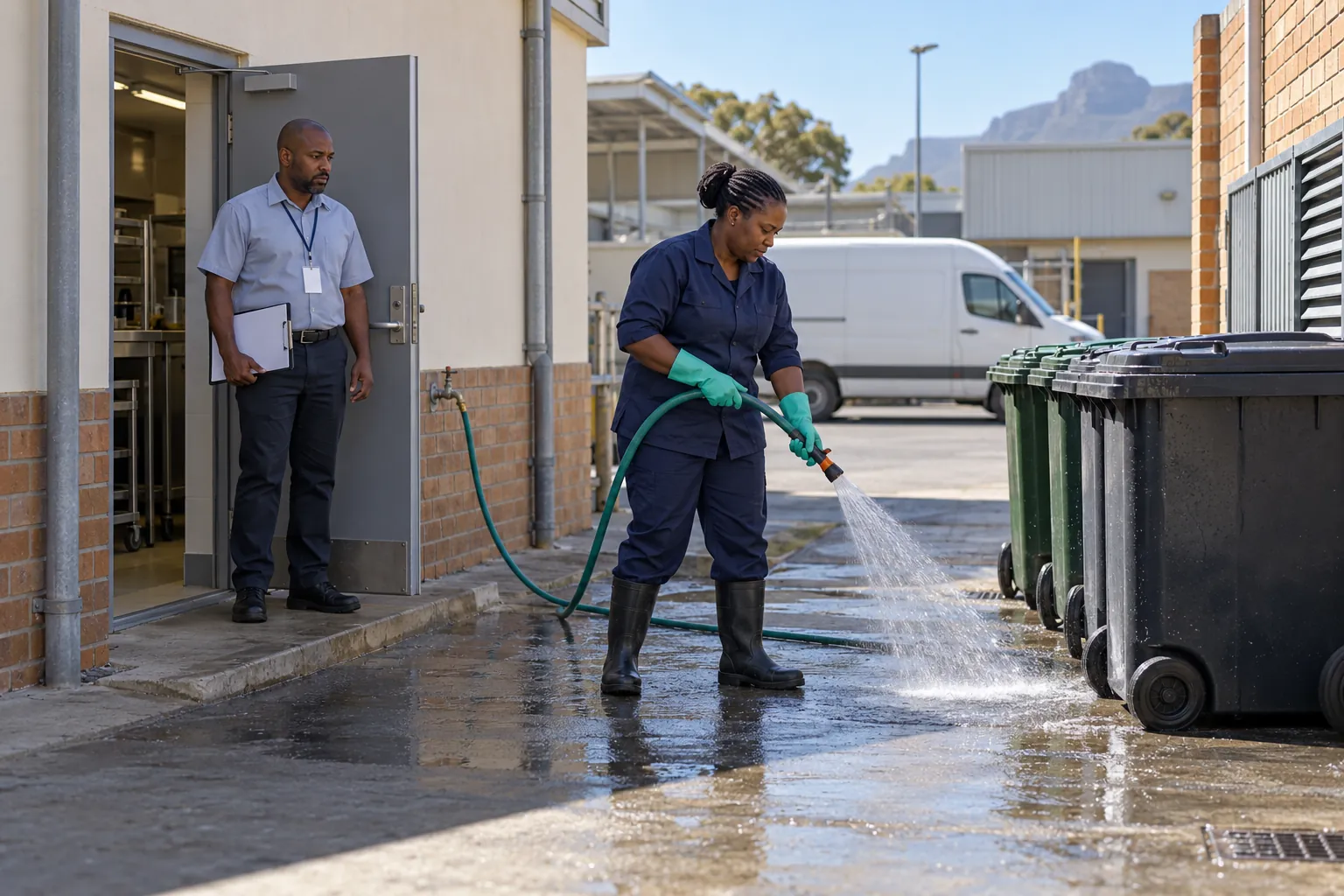
Regulation 10 places the daily duties on the person in charge: food handlers trained, with training records kept and shown to an inspector on request; pests prevented; refuse removed as often as necessary and bins cleaned regularly; and the premises and all facilities kept clean and free of clutter. Regulation 11 requires food handlers to wash their hands at the start of each shift, after a break and after every visit to a toilet.
05
The checks and records that keep the certificate
R638 prescribes no checklist or frequency. Regulation 10(16) says compliance is shown "through the keeping of appropriate records", and names training records and the reporting of illness among food handlers. A kitchen that keeps the standard usually runs:
- Opening checks: fridge, freezer and cold room temperatures read and recorded; hand-wash basins stocked; no sign of pests overnight.
- During service: hot and cold display temperatures at set times; surfaces cleaned as used; spills dealt with at once.
- Closing clean: floors, surfaces, equipment and the scullery to the cleaning schedule; refuse out and bins cleaned.
- Weekly and periodic: extraction canopies, cold rooms and behind equipment; the refuse area washed down.
- Faults: a dripping tap, a torn cold room door seal, a failed light or a missing fly screen reported to maintenance and chased until fixed.
Where a caterer, a cleaning company and a maintenance team share the kitchen, write the split into each contract and the housekeeping routine: typically the caterer owns food-contact surfaces, temperatures and training, the cleaners floors, walls and refuse areas, and maintenance the fabric, ventilation and plumbing. An EHP who finds a blocked floor drain will not ask whose job it was.
The consequences are in regulation 4. If an inspector finds a health hazard, the municipality may summarily prohibit use of the premises or a facility by a written prohibition order. The certificate may not be displayed while it stands. Once the conditions are put right the person in charge can ask in writing for the order to be lifted, and the inspector must investigate within 72 working hours. If the order is not lifted within the period set, at most six months, the certificate expires permanently. Contravening R638 is an offence (regulation 15): under section 18(1) of the Act, a first conviction carries a fine, up to six months' imprisonment, or both, and later convictions carry longer terms.
A record is believable only if it is made at the time, names the person who did each check, shows the exceptions (a fridge at 7 °C, food thrown away) and shows what was done about each fault. A sheet with every reading at exactly 3 °C, in the same pen, tells an EHP more about the record than about the fridge.
06
Where the paper record fails, and what SiteClara does about it
Most canteen and kiosk records are still paper: a temperature sheet on the cold room door, a cleaning schedule in a cupboard. It works while the same manager is there every day. It struggles when the caterer runs many sites, when the cleaners cover the kitchen at night, or when the facilities manager wants to know before the EHP does that the closing clean was missed. Nobody can tell from a tick whether it was made at 18:00 or the next morning, and a fault written on a sheet has told nobody who can fix it.
SiteClara replaces the sheet with a tag at each place that is checked: a printed QR poster, with an optional NFC tag behind it, in the kitchen, the cold room, the scullery and the refuse area. The cook, cleaner or supervisor scans or taps it on their own phone, with no app to install, and completes the check there; the time and the named person are recorded as it happens, and a check can ask for a photo, for example of the fridge display. A fault such as a leaking tap is reported on the spot, with a photo if it helps, and stays on the team's list of open jobs until someone closes it.
Scheduled checks are set per location. Staff see what is due there and mark it done, or say what stopped them. The supervisor sees what was done and what was missed, gives the reason for a missed check, and approves a daily report that goes to the client's facilities manager or other nominated contacts at 08:00 the next morning: what was reported, completed and still open.
07
Questions people ask
How do I get a certificate of acceptability in South Africa?
Under regulation 3(2) of R638 of 2018, the person in charge applies in writing to the local authority, on a form like Annexure A, and an environmental health practitioner inspects the premises before the certificate is issued. The City of Cape Town takes applications through e-Services, as its Apply for a Certificate of Acceptability page explains; elsewhere, ask the metro or district municipality's environmental health office.
How long is a certificate of acceptability valid?
Regulation 3(9) of R638 of 2018 sets no expiry date: the certificate is valid for the person, the premises and the nature of handling it describes. It may expire temporarily while a prohibition order stands, and expires permanently if the order is not lifted within the period set, at most six months, if the municipality is not told of a new person in charge within 30 days, or if the food handling goes beyond what the certificate describes.
How much does a certificate of acceptability cost?
R638 of 2018 sets no fee, and the City of Cape Town's Apply for a Certificate of Acceptability page publishes none. Where the cost is not published, ask the environmental health office that serves your premises.
How long does it take to get a certificate of acceptability?
The City of Cape Town's Apply for a Certificate of Acceptability page gives a standard processing time of ten working days once all the required documents are in. Other municipalities set their own.
Is a certificate of acceptability a business licence?
No. It certifies only that the premises meet regulations 5 and 6 of R638 of 2018. The City of Cape Town's Apply for a Certificate of Acceptability page adds: "You will still need to apply for a business licence if you prepare meals."
08
Where to read the official text, and a list to take away
The Department of Health publishes R638 of 2018 and the Foodstuffs, Cosmetics and Disinfectants Act 54 of 1972; the National Health Act 61 of 2003 is on gov.za. For how to apply, go to your metro or district municipality's environmental health office; the City of Cape Town's Apply for a Certificate of Acceptability page is a clear example. SANS 5763 is sold by the SABS. Check the current text before relying on an old copy.
For every canteen, kiosk or kitchen in the building, check that:
- a valid certificate is displayed, in the name of the current person in charge, and covers the food handling actually done;
- the municipality was told in writing within 30 days of any change of person in charge, and in advance of any change to the premises;
- the contracts say who cleans what: the caterer, the cleaning company and the maintenance team;
- temperatures are read and recorded at set times, with the exceptions and what was done about them;
- the cleaning schedule, the pest control programme and the training records are current and to hand for an EHP;
- hand-wash basins, ablutions and refuse areas are checked and stocked every day;
- every fault is reported to someone who will fix it, and stays open until it is fixed.
Sources
Every document this guide quotes or links to, in the order it first cites them.
- Regulations governing general hygiene requirements for food premises, the transport of food and related matters health.gov.za
- Foodstuffs, Cosmetics and Disinfectants Act 54 of 1972 health.gov.za
- National Health Act 61 of 2003 gov.za
- Apply for a Certificate of Acceptability capetown.gov.za
- How to apply for a Certificate of Acceptability in the City of Cape Town westerncape.gov.za
Related guides
 CleaningAblution facilities: the legal requirements, and how to keep them cleanWhat the Facilities Regulations, 2004 require of workplace ablution facilities, where the toilet numbers come from, and how to check and record them properly.
 CleaningCleaning schedule: what to clean at work, how often, and how to show it was doneWhat a workplace cleaning schedule should cover in South Africa, which tasks are daily, weekly or monthly, who does what, and how to show the schedule was kept.
 CleaningHousekeeping in the workplace: what the law requires, and how to keep it upWhat regulation 13H of the General Safety Regulations requires of housekeeping at work in South Africa, how to prevent slips and trips, and how to check it daily.
 Premises and facilities managementSection 37(2) agreement: what the mandatary agreement does, and what it cannot doWhat a section 37(2) mandatary agreement under the OHS Act does and does not do, what goes in one for cleaning and security contracts, and how to show it is kept.