Cleaning
Ablution facilities: the legal requirements, and how to keep them clean
Ablution facilities are the toilets, urinals, washbasins and showers that a workplace, school or public building provides for the people who use it.
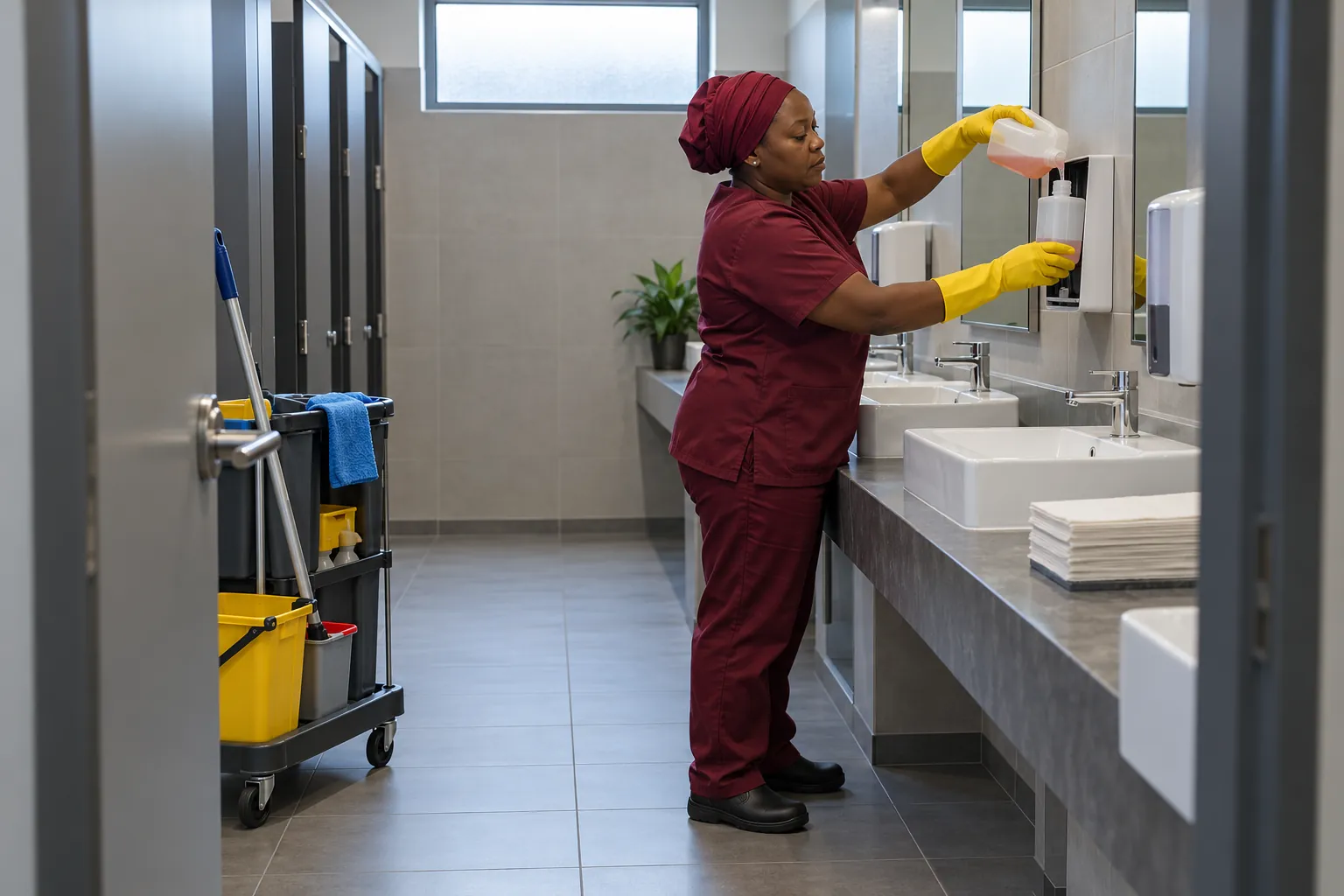
In South Africa the Facilities Regulations, 2004, made under the Occupational Health and Safety Act 85 of 1993, require every employer to provide them in line with the National Building Regulations and to keep them clean, hygienic, safe, whole, leak-free and in a good state of repair. The regulations set the outcome; the number of toilets comes from the building standard, and the day-to-day condition comes from whoever cleans and checks the ablutions. This guide covers what the law asks for, where the numbers come from, what a check should cover, how often, and what makes the record of it believable.
01
What the law says about ablution facilities
The starting point is section 8(1) of the Occupational Health and Safety Act 85 of 1993: every employer must provide and maintain, as far as is reasonably practicable, a working environment that is safe and without risk to the health of its employees. The detail for ablutions sits in the Facilities Regulations, 2004 (Government Notice R. 924 of 3 August 2004), made under section 43 of the Act. Their main requirements are:
- Regulation 2(1): every employer must provide sanitary facilities at a workplace in accordance with Parts F, P and Q of the application of the National Building Regulations, that is, the building standard SANS 10400.
- Regulation 2(2): where fewer than 11 people are employed on one premises, the employer may arrange in writing for them to use the closets and washbasins on adjoining premises, provided those facilities are freely and readily accessible and comply with the regulations, and with the building standard (SABS 0400, now SANS 10400), for the total number of employees who will use them and for their condition.
- Regulation 2(3): toilet paper and toilet soap, or a similar cleansing agent, free of charge; a seat on every water closet pan designed to have one; and, at the washbasins, a towel for each employee's sole use, disposable paper towels, hot air blowers or clean portions of a continuous cloth towel.
- Regulation 2(4): showers where Table 4 of Part P of the building standard calls for them, with running hot and cold, or premixed, water and a slip-free floor sloped to drain.
- Regulation 2(5): for every room with closets, urinals, showers or washbasins, a conspicuous sign outside the entrance showing the gender of the people it is for, ventilation in line with Part O of the National Building Regulations, the screen walls, partitions or doors needed for privacy, and, where water to the showers or basins does not come from the municipal supply, water that meets the drinking water standard.
- Regulation 9: every room and facility the regulations prescribe must be maintained "in a clean, hygienic, safe, whole and leak-free condition, and in a good state of repair".
Regulation 10 makes a failure to comply an offence, with a fine or imprisonment of up to six months, and more for each day a continuing offence goes on. The same regulations also cover changing rooms, dining rooms, drinking water and seating.
Two more duties reach the ablutions from elsewhere. The General Safety Regulations amendment of 2025 (Government Notice 5954, Government Gazette 52226 of 6 March 2025) adds regulation 13H, which requires every indoor workplace to be kept clean and orderly and every floor, walkway and passage to be in a good state of repair, skid-free and free of obstructions and waste. And section 14(d) of the Act requires every employee who notices an unsafe or unhealthy situation to report it to the employer or the health and safety representative as soon as practicable. A flooded ablution floor or a leaking cistern is exactly that kind of situation.
02
How many toilets, and where the numbers come from
The most common question about ablution facilities is how many toilets a workplace needs. The Facilities Regulations do not give the numbers. Regulation 2(1) points to the National Building Regulations, and the tables of how many toilets, urinals and washbasins a building needs, for each kind of occupancy and population, are in SANS 10400-P:2010, The application of the National Building Regulations Part P: Drainage. It is a paid standard sold by the SABS, and the figures depend on what the building is used for and how many people it is designed for, so read the current edition rather than a table copied from a website.
In practice the count was fixed when the building's plans were approved. An office floor re-planned as a call centre, or a warehouse that adds a night shift, can outgrow ablutions that were right on the day the plans were passed, so check the facilities again when the headcount changes.
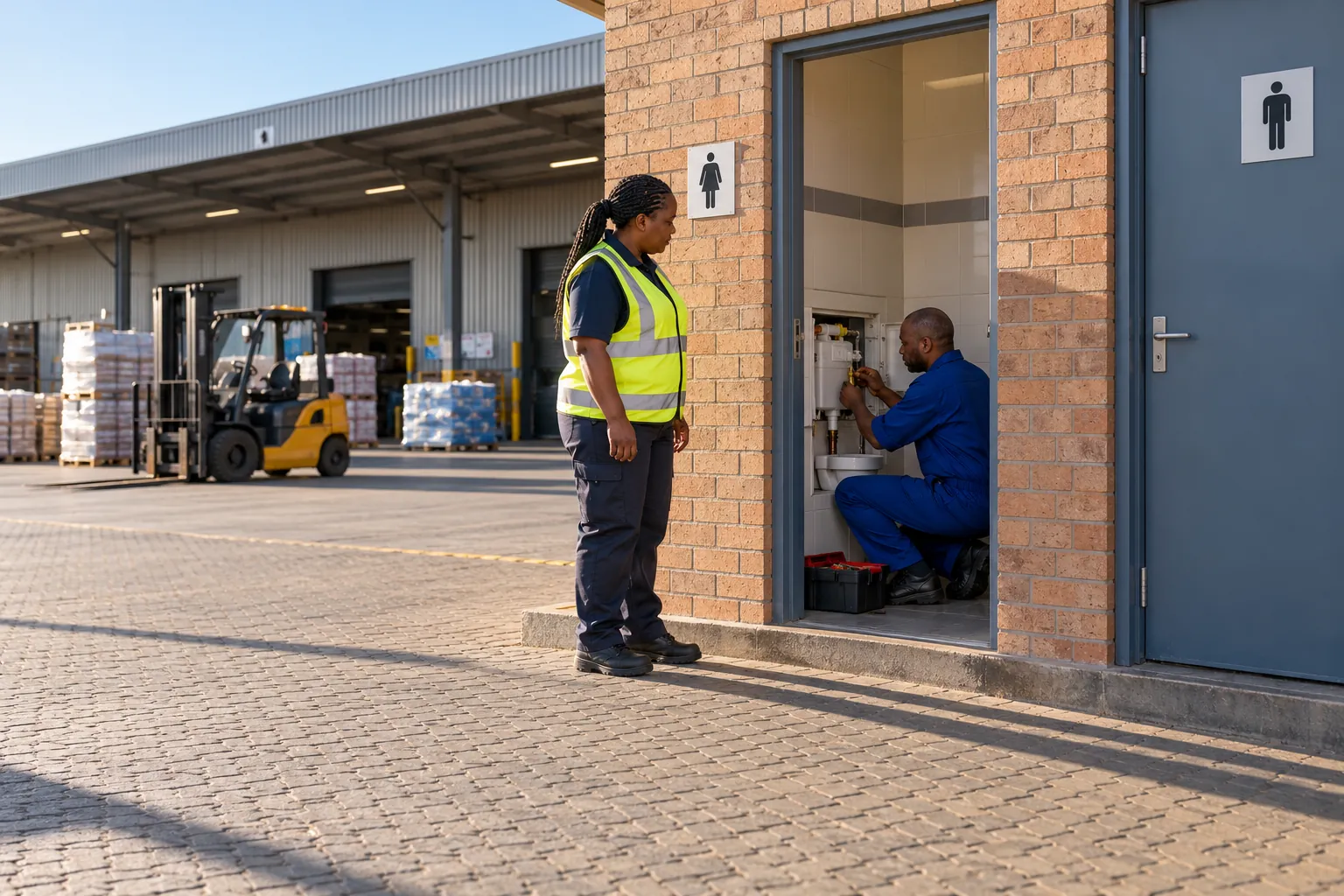
Temporary and modular ablution units, hired for a building project, an event or a site with no permanent block, are still sanitary facilities at a workplace while people work there. The rental company supplies the units; the employer still has to provide enough of them for the demand, and keep them to the standard of regulation 9, which usually means servicing them more often than a permanent block.
Two other sets of regulations give their own numbers:
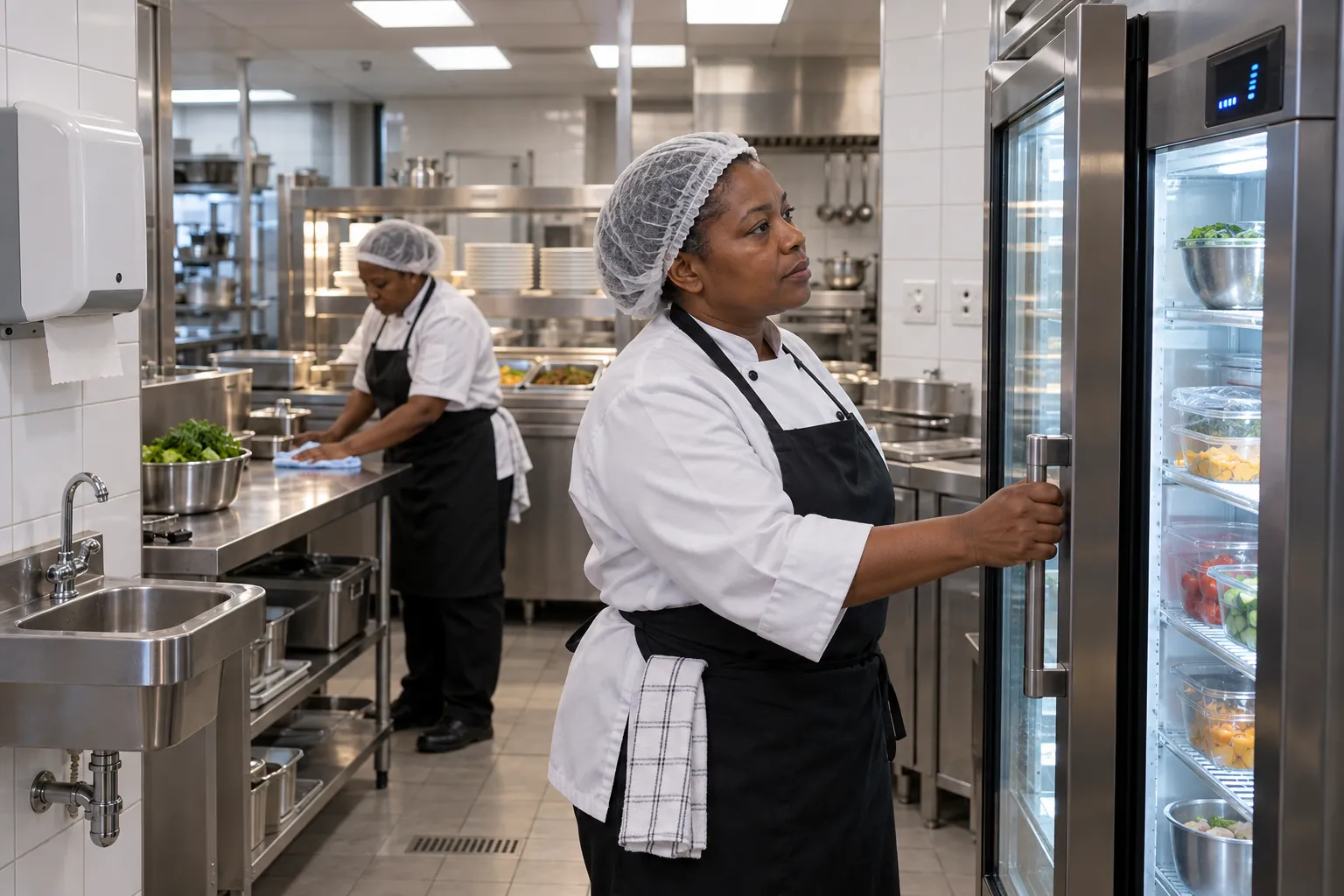
- Food premises. The Regulations governing general hygiene requirements for food premises, the transport of food and related matters (R638 of 22 June 2018, under the Foodstuffs, Cosmetics and Disinfectants Act 54 of 1972) set, in Annexure D, the number of toilets, urinals and hand washbasins for the staff plus the most customers who can eat on the premises at one time. Above a population of 120 they add, for men, one toilet, one urinal and one hand washbasin for every 100 people and, for women, one toilet for every 50 and one hand washbasin for every 100. Hand-washing facilities need soap and clean disposable hand-drying material or drying equipment, with hot water where possible. A canteen or restaurant in an office park needs its certificate of acceptability from the municipality, and the application for it asks where the sanitary facilities are.
- Public schools. The Regulations Relating to Minimum Uniform Norms and Standards for Public School Infrastructure (Government Notice 4895 of 28 May 2024, under the South African Schools Act 84 of 1996) require, in regulation 12, a sufficient number of sanitation facilities, as set out in their Annexure D, that are easily accessible to all learners and educators, provide privacy and security, promote health and hygiene and are maintained in good working order. Regulation 12(4) does not allow plain pit toilets or bucket latrines at a school, and regulation 18, on design, requires obscure glazing in all toilet windows and boys' and girls' toilets separated as far as reasonably practicable.
03
What a check of the ablutions should cover
Regulation 9 is the standard a check is measured against: clean, hygienic, safe, whole, leak-free and in a good state of repair. A useful check of an ablution block takes a few minutes and covers what the regulations name, plus the faults that make a facility unusable:
- The date and the actual time of the check, and who did it: a name that identifies one person, not "cleaning team".
- Consumables: toilet paper in every cubicle, soap in every dispenser, paper towels stocked or the hand dryer working. Under regulation 2(3) an empty dispenser is a compliance gap, not a nuisance.
- Toilets and urinals: clean, flushing, not blocked, with a seat on every pan designed for one.
- Washbasins and taps: clean, water running, hot water where it is provided (the regulations define hot water as more than 35 degrees Celsius, so a geyser that has tripped is a fault), no dripping taps.
- Leaks: cisterns, valves, pipes under the basins and the floor around the pans. "Leak-free" is in regulation 9 for a reason.
- Floors: dry, skid-free and free of paper and waste, as regulation 13H of the General Safety Regulations expects of every passage and walkway.
- Privacy and signs: cubicle doors that close and lock, partitions intact, the gender sign outside the entrance still in place.
- Ventilation and light: extractor fans running, no lingering odour, every light working.
- Bins: waste bins and sanitary bins emptied or within capacity, and the sanitary bin service on schedule.
- Faults found: what was wrong, and who it was reported to and when.
Keep the list short enough to complete honestly on every visit; twenty boxes get ticked in one stroke at the end of the shift.
Where the building runs on its own supply, for example a borehole or a rainwater tank, regulation 2(5)(d) requires the water to the basins and showers to meet the drinking water standard, now SANS 241:2025, Drinking water, where the regulation still names its predecessor, SABS 241. Testing it is a specialist's job, but a check that notes discoloured water or no water at all is how the problem gets to them.
04
How often ablutions should be cleaned and checked
No regulation sets a frequency. Regulation 9 sets the outcome, and the frequency needed to achieve it depends on how many people use each ablution block and when. It should be written into the cleaning schedule and the contract, not left to the cleaner on the day. As a starting point:
- Every 30 to 60 minutes at peak times: shopping centres, taxi ranks and transport interchanges, stadiums and events, and other public ablutions.
- Every one to two hours: busy offices and call centres, schools during the day, clinic and hospital waiting areas, gyms.
- Two or three times a day: lightly used offices and staff-only ablutions.
- At least once a day, with a full clean: every ablution block in use.
Checks should follow the pattern of use, not only the clock: after the morning arrival, after lunch, at a shift change, after second break at a school. An hourly check through a quiet afternoon and nothing over the lunch rush gives a tidy record and a dirty ablution block.
Three kinds of visit are often recorded in the same box, and they should not be:
- A check: look, restock, pick up, wipe what needs it, report faults. A few minutes, many times a day.
- A full clean: every fitting, surface and floor, with colour-coded cloths and the right chemicals. Once or twice a day, often outside busy hours.
- A deep clean: descaling, grout, vents, high surfaces, behind fittings. Weekly or monthly, on its own schedule.
Record which was done: a client who reads "cleaned 10:00, 11:00, 12:00" assumes three full cleans. The chemicals used for the full and deep clean bring their own duties, covered in hazardous chemical agents.
05
Who is responsible, and what makes the record believable
The duty in the Facilities Regulations sits with the employer. In a building with one occupier that is simple. In a multi-tenant office block or a shopping centre the common ablutions are often provided by the landlord or the body corporate, cleaned by a contract cleaning company and used by the staff of many employers. Each employer still has to be able to show that its people have facilities that meet the regulations. The cleaning contract, the section 37(2) agreement with the contractor and the record of checks are how that is shown in practice.
Anyone who has managed a cleaning contract has seen a check sheet signed ahead for the afternoon, and so have clients and managing agents. What makes a record believable is simple:
- It is written at the time. The time recorded is when the check happened, not when it was due.
- It names a person. One identifiable person per entry, not a team or a company.
- It shows exceptions. A record where nothing ever ran out and nothing ever leaked is not believed. "Soap refilled" or "cistern leaking, reported to maintenance 11:40" shows someone looked.
- Someone else checks it. A cleaning supervisor who walks the ablutions unannounced and signs the record gives it independence.
- Faults go somewhere. Writing "tap leaking" on the sheet records that it was seen; it does not tell the maintenance team. The record should say who was told, and the fault should stay open until it is fixed.
- Gaps are explained. "Block closed, no water" or "cleaner redeployed to spill in the canteen" is more credible than a record with no gaps at all.
Whether the question comes from a client, a managing agent, a health and safety representative or an inspector of the Department of Employment and Labour, it is the same: when were the ablutions last checked, by whom, and what happened about the problem found. A good record answers all three.
06
Where the paper record fails, and what SiteClara does about it
The paper sheet behind the ablution door works in one building with a steady team. It struggles when a contract cleaning company looks after many sites, or when a client wants the record rather than an assurance. The client sees the sheet only if they visit, a missed check goes unnoticed until the next complaint, and nobody can tell from an initial whether it was written at 10:00 or at 16:00.
SiteClara replaces the sheet with a tag at the ablution entrance: a printed QR poster, with an optional NFC tag behind it for staff who would rather tap than scan. A cleaner or supervisor scans or taps it on their own phone, with no app to install, and completes the check there. The time and the named person are recorded as it happens. If something is wrong, such as a leaking cistern or a broken lock, they record it on the spot, with a photo if it helps, and it goes onto the team's list of open jobs until someone closes it.
Scheduled checks are set per location. Staff see what is due at that ablution block and mark it done, or say what stopped them. The supervisor sees what was done and missed, gives the reason for a missed check, and approves a daily report that goes to the client's facilities manager or other nominated contacts at 8am the next morning: what was reported, completed and still open.
07
Questions people ask
Do ablution facilities have to be separate for males and females?
The Facilities Regulations, 2004 assume they are allocated by gender: regulation 2(5)(a) requires a conspicuous sign outside every room with closets, urinals, showers or washbasins showing the gender of the people it is for, and regulation 4(1) requires separate changing rooms for males and females where showers are prescribed or employees need to undress. On food premises, the R638 food premises regulations do not require separate facilities for workers of different sexes where only one sex, or no more than ten people, work there.
Can a small business share ablution facilities with the premises next door?
Yes, within limits. Regulation 2(2) of the Facilities Regulations, 2004 allows an employer with fewer than 11 people on one premises to arrange in writing for them to use the closets and washbasins on adjoining premises, meaning premises with a common boundary line, provided the facilities are freely and readily accessible and meet the regulations, and the building standard (SABS 0400, now SANS 10400), for the total number of employees using them and for their condition.
Do ablution facilities need hot water?
Where showers are required, regulation 2(4)(a) of the Facilities Regulations, 2004 requires running hot and cold, or premixed, water for the washbasins and showers, and regulation 1 defines hot water as water at more than 35 degrees Celsius. On food premises, the R638 food premises regulations require hand-washing facilities with hot water where possible.
What ablution facilities must a school have?
Regulation 12 of the Regulations Relating to Minimum Uniform Norms and Standards for Public School Infrastructure requires a sufficient number of sanitation facilities, as set out in Annexure D, that are easily accessible, give privacy and security and are maintained in good working order. They may be water-borne, septic or conservancy tank systems, ventilated improved pit latrines or composting toilets, but never plain pit toilets or bucket latrines (regulation 12(4)), and regulation 18 requires obscure glazing in toilet windows and boys' and girls' toilets separated as far as reasonably practicable.
08
Where to read the official text, and a list to take away
The Facilities Regulations, 2004 and the Occupational Health and Safety Act 85 of 1993 are on gov.za; SANS 10400-P and SANS 241 are sold by the SABS; the Department of Health publishes R638. Regulations are amended from time to time, so check the current text before relying on an old copy.
Before the next contract review, check that:
- the number of toilets, urinals and washbasins still suits the number of people who use each block;
- toilet paper, soap and hand drying are supplied free and never run out;
- every room has its gender sign, working locks, privacy partitions and ventilation;
- the check and cleaning frequency for each ablution block is written into the cleaning schedule and follows how it is used;
- each entry has the actual time and one named person;
- faults are reported to someone who will fix them, and stay open until they are fixed;
- a supervisor checks the ablutions unannounced and signs the record.
Sources
Every document this guide quotes or links to, in the order it first cites them.
- Occupational Health and Safety Act 85 of 1993 gov.za
- Facilities Regulations, 2004 gov.za
- General Safety Regulations amendment of 2025 gov.za
- SANS 10400-P:2010, The application of the National Building Regulations Part P: Drainage store.sabs.co.za
- Regulations governing general hygiene requirements for food premises, the transport of food and related matters health.gov.za
- Regulations Relating to Minimum Uniform Norms and Standards for Public School Infrastructure gov.za
- SANS 241:2025, Drinking water store.sabs.co.za
- Facilities Regulations, 2004 gov.za
Related guides
 CleaningCleaning schedule: what to clean at work, how often, and how to show it was doneWhat a workplace cleaning schedule should cover in South Africa, which tasks are daily, weekly or monthly, who does what, and how to show the schedule was kept.
 CleaningHousekeeping in the workplace: what the law requires, and how to keep it upWhat regulation 13H of the General Safety Regulations requires of housekeeping at work in South Africa, how to prevent slips and trips, and how to check it daily.
 CleaningCertificate of acceptability: getting one, and keeping the premises to R638What a certificate of acceptability is under R638, who needs one for a canteen or kiosk, how it is issued, and how to keep the premises to standard.
 Premises and facilities managementThe OHS Act: what it asks of cleaning, security and facilities employersThe OHS Act 85 of 1993 in plain terms: employer and employee duties, the sections that matter on site, the key regulations and the records an inspector asks for.