Cleaning
Cleaning schedule: what to clean at work, how often, and how to show it was done
A cleaning schedule is a written list of every area of a building, the cleaning tasks in each, how often they are done and who does them.
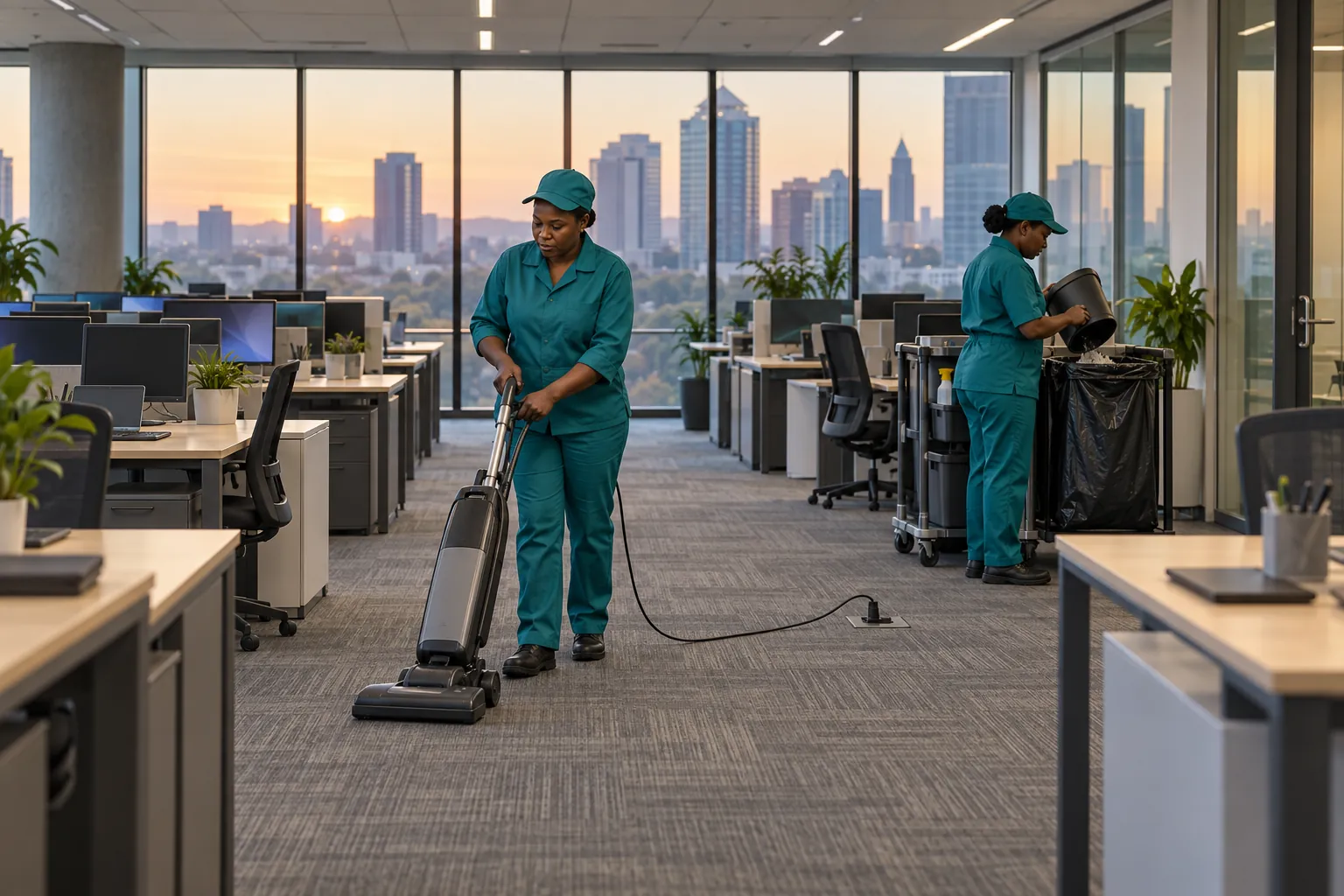
No South African law asks a workplace for one by name, but it is the practical way for an employer to show that the workplace is kept clean and orderly, as regulation 13H of the General Safety Regulations and section 8 of the Occupational Health and Safety Act 85 of 1993 require. It turns "keep the place clean" into tasks a cleaner can follow and a cleaning supervisor can check. This guide covers the duty behind it, what the schedule should include, which tasks are daily, weekly, monthly or periodic, who is responsible for what, and how to keep a record that shows the schedule is actually being followed.
01
Why a workplace needs a cleaning schedule
The general duty is in section 8(1) of the Occupational Health and Safety Act 85 of 1993: every employer must provide and maintain, as far as is reasonably practicable, a working environment that is safe and without risk to the health of its employees. Section 8(2)(a) adds the provision and maintenance of safe systems of work, and section 8(2)(e) the information, instructions, training and supervision needed to make them work. A cleaning schedule is a system of work in exactly that sense.
The specific duties come from regulations made under the Act:
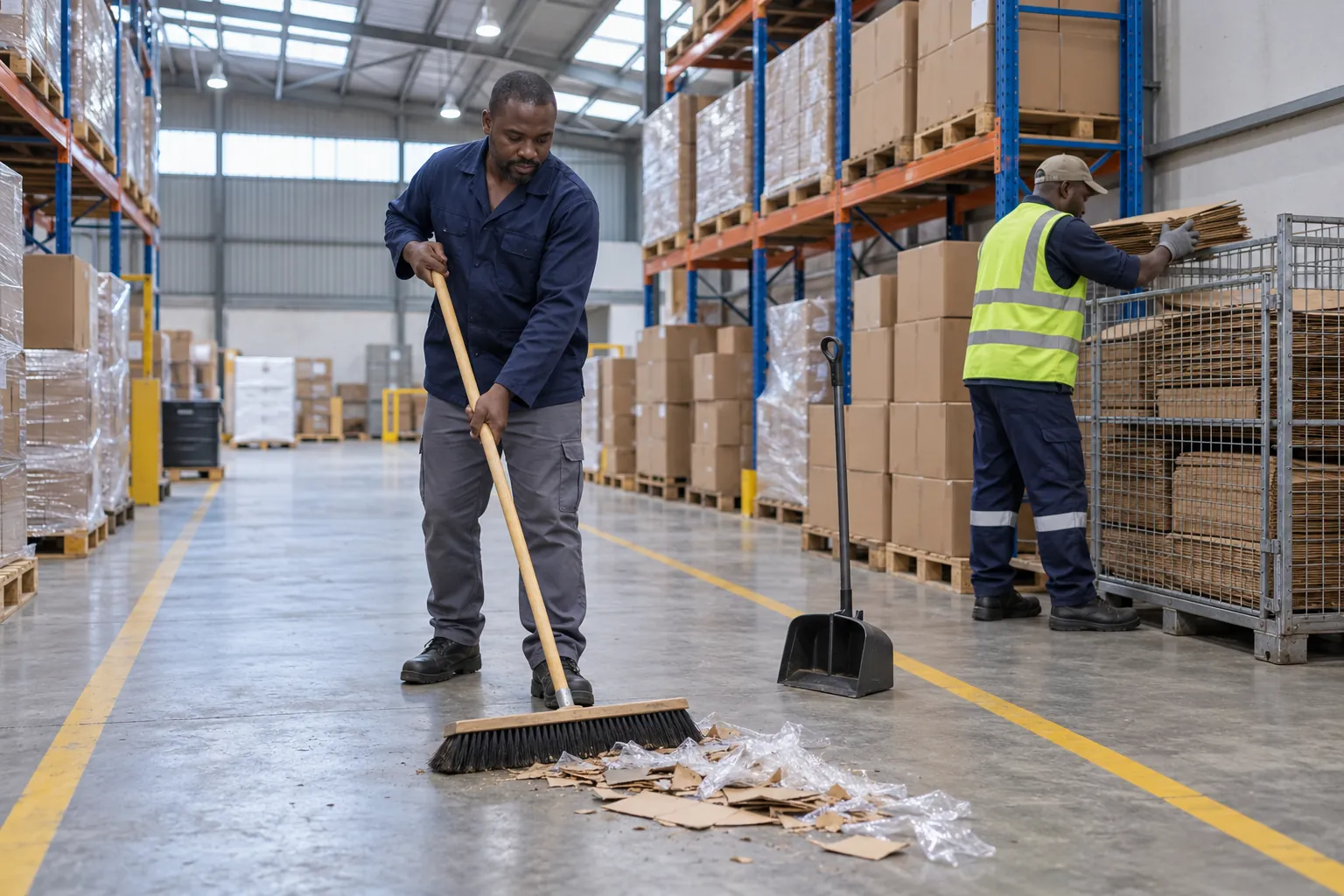
- Regulation 13H(2) of the General Safety Regulations, as set out in the General Safety Regulations, 2025 (Government Notice 5954), published in Government Gazette 52226 of 6 March 2025, requires every employer to keep every indoor workplace "clean, orderly and free of materials, tools and similar things which are not necessary for the work done", and to keep all floors, walkways, stairs, passages and gangways in a good state of repair, skid-free and free of obstructions, waste or materials.
- Regulation 9 of the Facilities Regulations, 2004 requires every employer to maintain the rooms and facilities the regulations provide for, which include the ablutions, change rooms and dining rooms, "in a clean, hygienic, safe, whole and leak-free condition, and in a good state of repair".
- On food premises, such as a staff canteen or the restaurant in an office park, regulation 10 of the Regulations governing general hygiene requirements for food premises, the transport of food and related matters (R638 of 22 June 2018) makes the person in charge ensure that refuse is removed as often as necessary, that refuse bins are cleaned regularly and disinfected when necessary, and that the premises and all facilities are kept clean.
None of these says how often a floor must be mopped or a kitchen wiped. The law sets the outcome, and the schedule is how an employer, a building manager or a contract cleaning company shows how that outcome is achieved and who is doing the work. Under regulation 14 of the General Safety Regulations, failing to comply with regulation 13H is an offence, with a fine or imprisonment of up to six months.
Handing the cleaning to a contractor does not hand over the duty. Under section 37(2) of the Act, the presumption in section 37(1), that an employer did what its employee did or failed to do, also applies to what its mandatary does or fails to do, unless the two have agreed in writing the arrangements and procedures between them that ensure the mandatary complies with the Act. That section 37(2) agreement, with the cleaning schedule attached to the contract, is what makes clear which party is responsible for which part of keeping the building clean.
02
What a workplace cleaning schedule covers
A good cleaning schedule, sometimes called a cleaning programme, cleaning plan or cleaning routine, names every area of the building, the tasks in each, how often, and who does them. Whether the building is an office block, a school, a factory's admin block or a shopping centre, most schedules cover the same kinds of space:
- Entrance, reception and the security desk: floors and mats, glass doors, the reception counter, visitor seating. This is the first impression, and where dust and mud are carried into the rest of the building.
- Offices and open-plan areas: desks, chairs, bins, floors, and the high-touch points people share, such as door handles, light switches and shared phones.
- Boardrooms and training rooms: tables, chairs, whiteboards, screens and remotes, cleared and wiped between busy days.
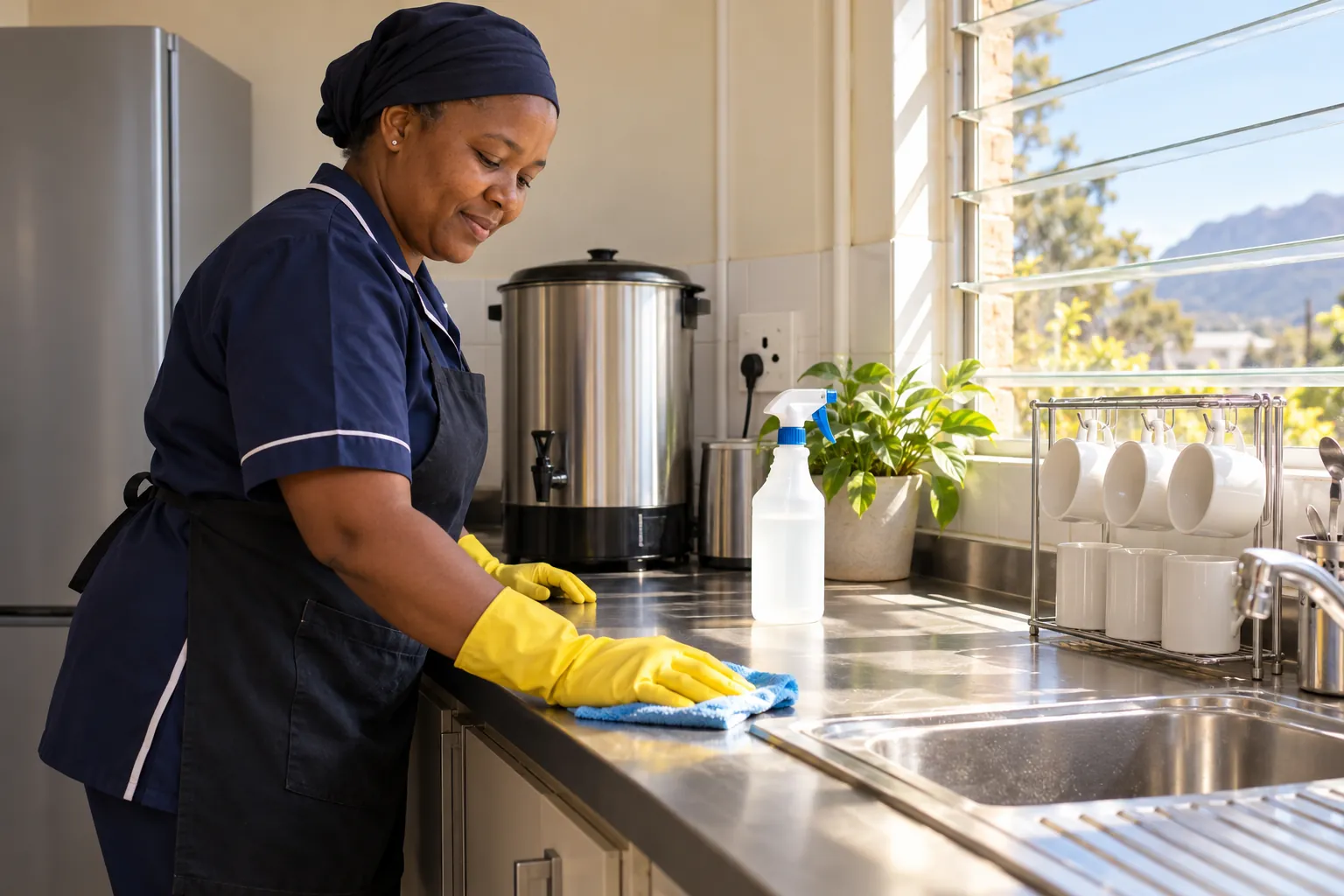
- Kitchens, tea rooms and canteens: worktops, sinks, taps, fridges, microwaves, urns and kettles, and the floor beneath them. Food is prepared and eaten here all day, so kitchen cleaning is a daily task in almost every building.
- Ablution facilities: toilets, urinals, basins, mirrors, dispensers, sanitary bins, showers and floors, with toilet paper, soap and hand drying restocked.
- Change rooms and locker rooms, where the Facilities Regulations require them: benches, lockers, floors and showers.
- Passages, stairs and lifts: floors, handrails, lift buttons and door plates, kept free of obstructions and waste as regulation 13H requires.
- The refuse area: bins emptied and lined, recycling separated, the refuse room or bin yard swept and washed, and the bins themselves cleaned.
- Outside and basement areas: parking basements, loading bays, paving and walkways swept of leaves and debris, smokers' areas.
- Low-use rooms: stores, server rooms, plant rooms and archives, on a slower cycle.
Write each task as something a person can do and a supervisor can check: "mop the ground-floor passage and stairwell" rather than "floors". A schedule written in general terms is hard to follow and impossible to audit.
For a larger building, write the schedule per floor or zone, because a cleaning team works in routes and one list for the whole building hides which area was missed. The cleaner carries the checklist for their route; the schedule is the master list it comes from.
03
Daily, weekly, monthly and periodic cleaning tasks
Frequencies follow foot traffic and risk, not habit. A call centre of three hundred people on shifts and a small professional office of eight need the same list of areas but very different frequencies. As a starting point for a typical workplace, split into daily tasks, a weekly cleaning schedule, monthly tasks and periodic deep cleaning:
- Daily cleaning tasks: empty bins and replace liners; clean the ablutions and restock supplies; clean kitchen and tea room worktops, sinks and appliances; wipe high-touch surfaces such as door handles, light switches, lift buttons and handrails; sweep and mop entrance and reception floors; spot-clean glass doors; tidy and wipe boardroom tables; clear passages and stairs of anything left in them.
- Checks through the day: ablutions and kitchens fail first in a busy building, so they usually need checking and restocking once or more after the morning clean, especially after lunch and at shift changes.
- Weekly tasks: vacuum all carpets if not done daily; mop hard floors throughout; dust window sills, partitions and cleared desks; clean inside microwaves and fridges; wipe office equipment; clean internal glass; wash refuse bins.
- Monthly tasks: high-level dusting of air-conditioning vents, light fittings and the tops of cupboards; skirting boards and door frames; descaling taps and showers; clean under desks and chair fabric; defrost and deep clean fridges.
- Periodic deep cleaning: carpet shampooing, typically once or twice a year and more often on busy routes; stripping and sealing hard floors; external windows and façade glass; high-pressure cleaning of paving and the basement; upholstery. These belong on a calendar with dates, because they are never urgent on any given day.
Say whether "wipe desks" means every desk or only cleared ones, and who looks after kitchen cupboards, fridges and personal items; write it down and tell staff.
Review the frequencies when the building changes: a new floor, hybrid working that empties the offices on Fridays, a kitchen refit, a new tenant, or a complaint that keeps coming back.
04
Who does what, and the cleaning chemicals
A cleaning schedule only works if every task has an owner. In most buildings there are five:
- The cleaners, employed directly or through a contract cleaning company, carry out the scheduled tasks, often early in the morning or after hours when the building is quiet.
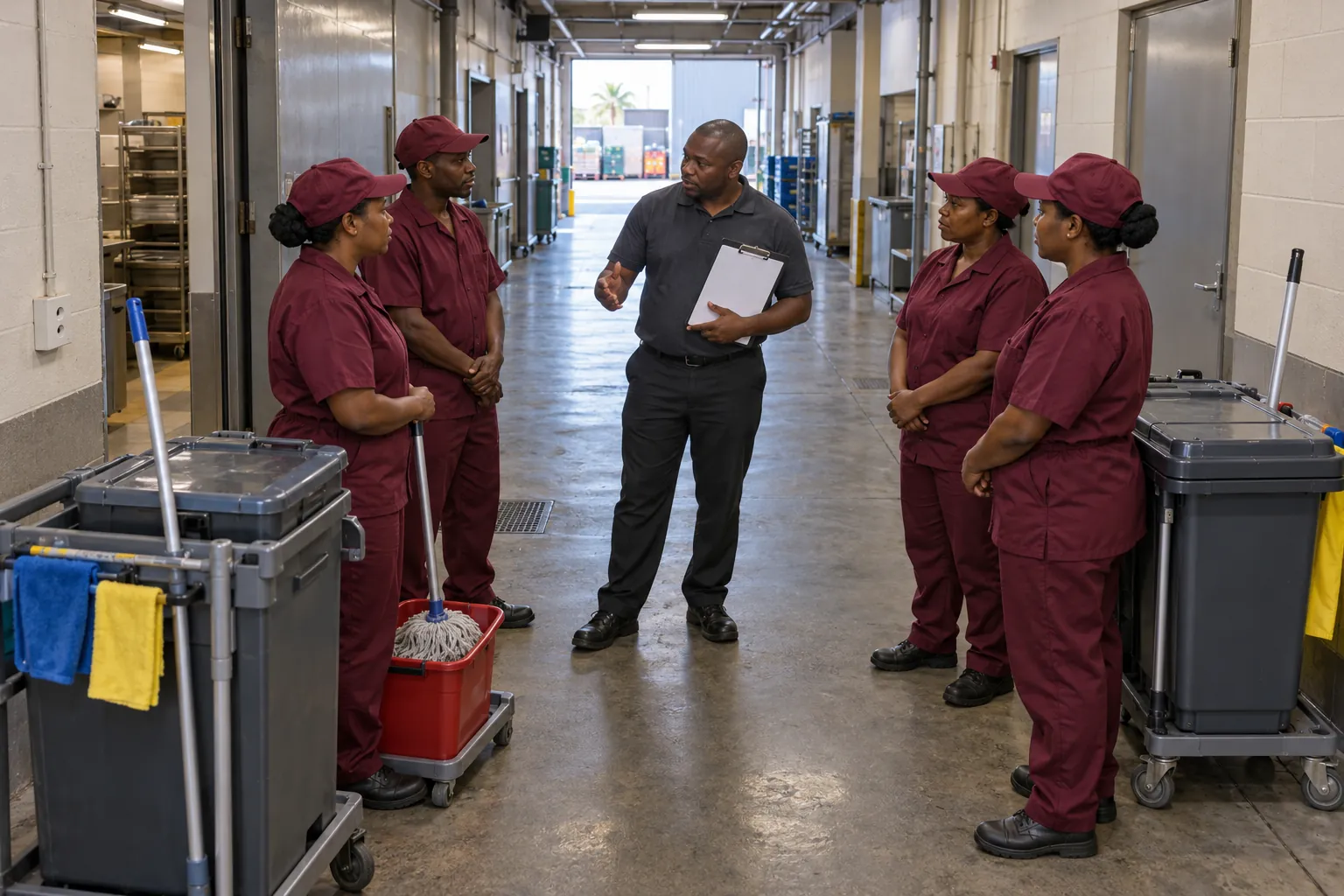
- The cleaning supervisor plans routes, checks the work, covers absences, and reports to the client.
- The facilities or building manager owns the schedule, agrees changes with the contractor, and receives complaints and requests.
- The health and safety representative may inspect the workplace and raise hazards, such as a wet floor with no warning sign or waste left in a fire escape, with the employer.
- Staff keep their desks clear of clutter so they can be cleaned, leave the tea room as they found it, and, under section 14(d) of the Act, report any unsafe or unhealthy situation, such as a spill or a leak, as soon as practicable.
Cleaning products belong in the schedule too, because many of them are hazardous chemical agents under the Regulations for Hazardous Chemical Agents, 2021, and a product's safety data sheet (SDS) gives its hazard classification. The Regulations for Hazardous Chemical Agents, 2021 (Government Notice R. 11263, Government Gazette 44348 of 29 March 2021, as corrected by Government Notice R. 11266 of 31 March 2021) set duties for both sides, among them:
- Regulation 3: the employer must, after consultation with the health and safety committee, give each employee who may be exposed suitable and sufficient information, instruction and training before exposure, including the names of the chemicals and where they are kept, how to find and read the safety data sheet and the label, and the work practices for use, storage, spillage, disposal, good housekeeping and personal hygiene. Under regulation 3(4), the employer and a mandatary such as a cleaning contractor must agree in writing how this training requirement will be met.
- Regulation 4: every person who may be exposed must obey the employer's lawful instructions on protective equipment, the cleaning up and disposal of materials containing a hazardous chemical agent, and housekeeping and personal hygiene.
- Regulation 5: the employer must have an assessment made of whether employees may be exposed, repeated at intervals of no more than two years, and keep a record of it.
In practice the schedule says who supplies the chemicals and consumables such as toilet paper, soap and paper towels, which products may be used where, and where the safety data sheets are kept. Colour-coded cloths and mops, with separate colours for ablutions and kitchens, stop cleaning spreading germs from one area to another. The duties for chemicals are covered in more detail in the guide to hazardous chemical agents.
05
How to check the schedule is being kept
A schedule is a promise. Whether it is being kept is a separate question, and it needs its own answer. The usual ways to keep a cleaning schedule honest, whether the work is in-house or contracted, are:
- Walk-rounds: the cleaning supervisor or facilities manager inspects the cleanliness of a sample of areas against the schedule, at different times of day and without warning.
- Joint quality inspections: client and contractor walk the building together every month or quarter and score it against an agreed cleaning checklist, which settles disagreements before they become disputes.
- Records of work done: entries showing each task or check was carried out, by whom and when.
- Complaints and requests: logged with the time they were raised and the time they were put right.
A record of work done is only as good as the way it is kept. A believable one has four things:
- The actual time. When the task was done, not when it was due.
- A named person. One identifiable cleaner per entry, not "day shift" or the company's name.
- Exceptions. "Tea room not cleaned, closed for a meeting until 11:30, done 11:45" shows someone was paying attention; a record where nothing ever went wrong is not believed.
- A second pair of eyes. A supervisor who checks a sample and signs for it gives the record independence.
A schedule that cannot be done in the hours paid for will not be done, so ask the contractor how the hours were worked out from the site survey.
06
Where the cleaning record fails, and what SiteClara does about it
Most workplaces can show a cleaning schedule. Far fewer can show it was followed. The daily tasks happen early in the morning or after hours, when nobody from the client is in, and the record is usually a sheet in the cleaners' store room, a signature on the back of the ablution door, or a line in the contractor's monthly report. A missed kitchen clean comes to light when someone complains about the fridge, not on the day it was missed.
SiteClara puts a printed QR poster at each location on the schedule, such as the kitchen, each ablution block and reception, with an optional NFC tag behind it. The cleaner scans the code or taps the tag on their own phone, with no app to install, and sees the scheduled checks due there. They mark each one done, or say what stopped them, and can add a photo. If something needs fixing, such as a leaking tap or a broken dispenser, they report it there and it goes onto the team's list of open jobs until someone closes it.
The cleaning supervisor sees what is due, done and missed, and can record the reason a check was missed. At the end of the day they review the checks and photos, add a note and approve the report, which goes to the facilities manager or the client's nominated contacts the next morning, showing what was completed, what is still open and how the scheduled checks went.
07
Questions people ask
What is a good cleaning schedule?
A good workplace cleaning schedule is one that achieves what the law requires. Regulation 13H(2) of the General Safety Regulations, as set out in the General Safety Regulations, 2025 (Government Notice 5954), requires every employer to keep every indoor workplace "clean, orderly and free of materials, tools and similar things which are not necessary for the work done in such work place", and to keep all floors, walkways, stairs, passages and gangways in a good state of repair, skid-free and free of obstructions, waste or materials. In practice that means every area listed, every task specific enough to check, a frequency and a named owner for each, and a record that shows it was done.
How can I create my own cleaning schedule?
When creating a cleaning schedule, start from the outcomes regulation 13H(2)(c) and (d) of the General Safety Regulations, 2025 (Government Notice 5954) set: a clean, orderly indoor workplace, and floors, walkways, stairs, passages and gangways free of obstructions, waste or materials. List every area of the building, write the tasks each area needs to reach that standard, give each task a frequency based on foot traffic, name who does it, and decide how completed work will be recorded and checked.
08
Where to read the official text, and a list to take away
The Occupational Health and Safety Act 85 of 1993, the Facilities Regulations, 2004 and the 2025 amendment to the General Safety Regulations are on gov.za; the Department of Employment and Labour publishes the Regulations for Hazardous Chemical Agents, 2021, and the Department of Health publishes R638 for food premises. Regulations are amended from time to time, so check the current text before relying on an old copy.
Before you agree the next version of your cleaning schedule, check that:
- every area of the building is listed, including low-use rooms, the refuse area and the basement;
- each task is specific enough to check, with a frequency and an owner;
- periodic deep cleaning has dates on a calendar;
- high-touch surfaces are named, not left to judgement;
- chemicals, safety data sheets, consumables and colour coding are covered, with training recorded;
- the section 37(2) agreement with any cleaning contractor is signed and current;
- there is a plan for load shedding and water interruptions;
- you know how completed work will be recorded and who will see the record;
- there is a date to review the schedule against how the building is actually used.
Sources
Every document this guide quotes or links to, in the order it first cites them.
- Occupational Health and Safety Act 85 of 1993 gov.za
- General Safety Regulations, 2025 (Government Notice 5954) gov.za
- Facilities Regulations, 2004 gov.za
- Regulations governing general hygiene requirements for food premises, the transport of food and related matters health.gov.za
- Regulations for Hazardous Chemical Agents, 2021 labour.gov.za
Related guides
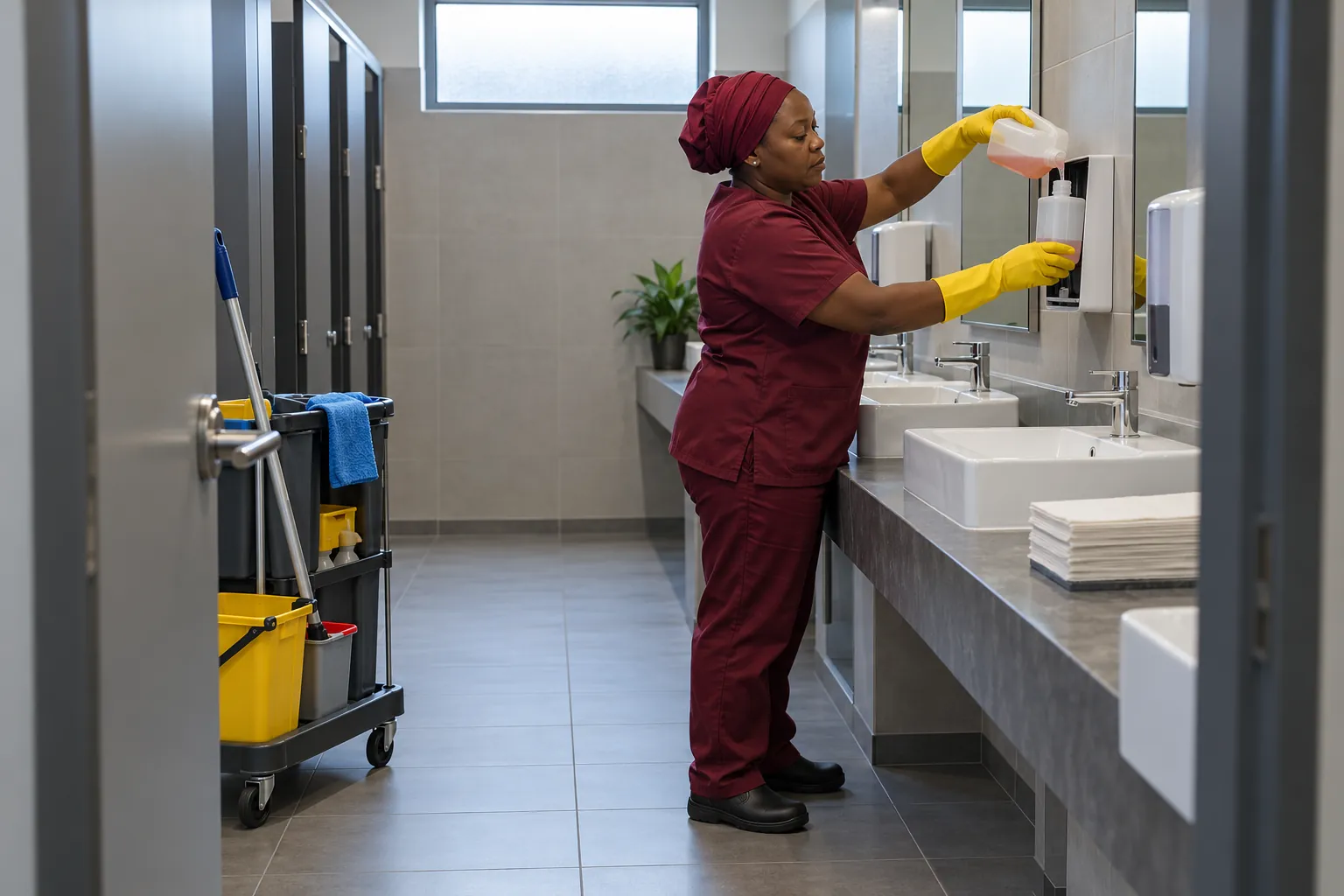 CleaningAblution facilities: the legal requirements, and how to keep them cleanWhat the Facilities Regulations, 2004 require of workplace ablution facilities, where the toilet numbers come from, and how to check and record them properly.
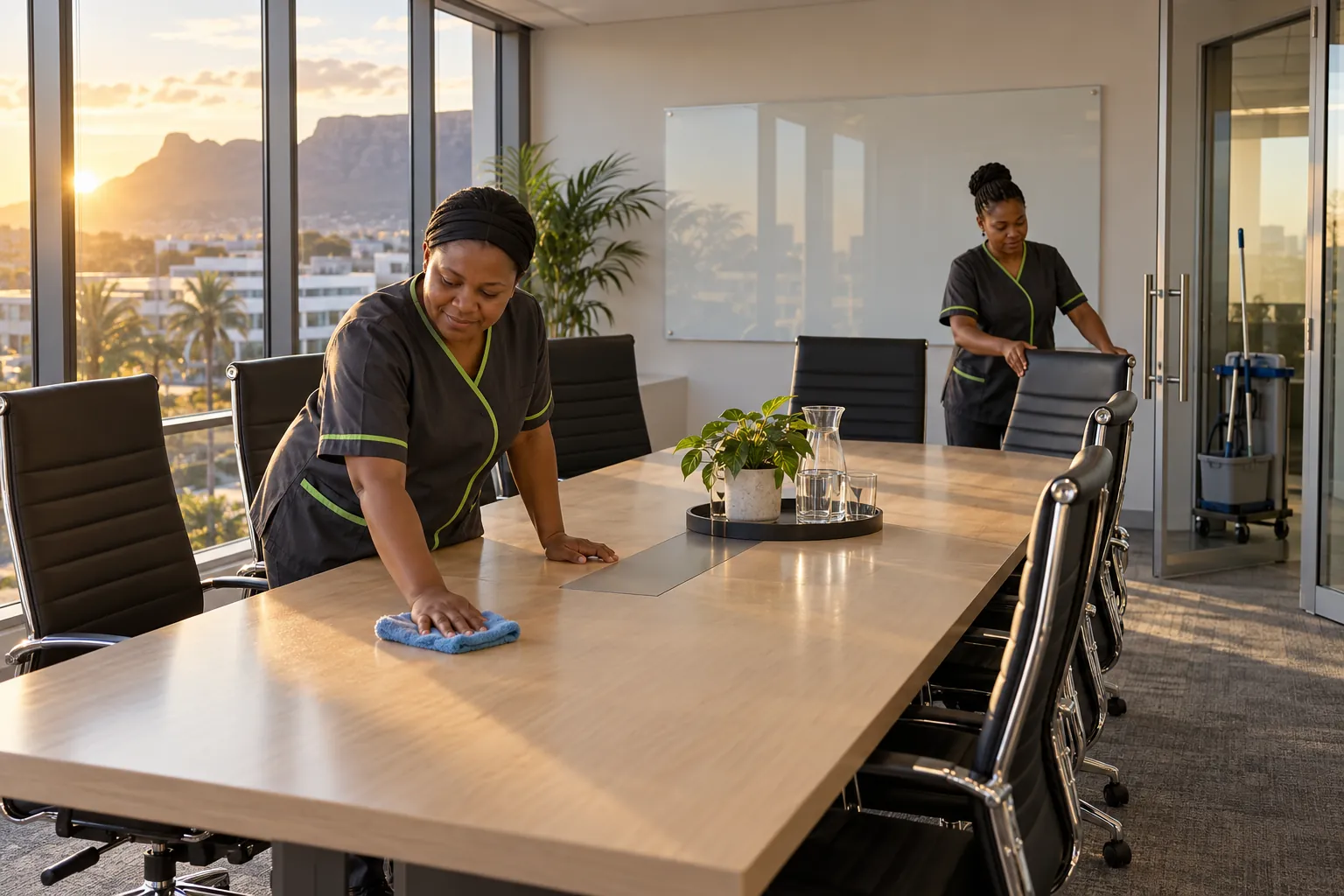 CleaningCommercial cleaning checklist: area by area, and how to use it on shiftA cleaning checklist for offices and other workplaces in South Africa, area by area, with the OHS Act duties behind it, how to use it on shift and how to check it.
 CleaningCleaning supervisor duties: what the role involves, and what good looks likeWhat a cleaning supervisor does in South Africa: the main duties, a typical shift, the OHS Act, managing the team, checking the work and reporting to the client.
 CleaningHousekeeping in the workplace: what the law requires, and how to keep it upWhat regulation 13H of the General Safety Regulations requires of housekeeping at work in South Africa, how to prevent slips and trips, and how to check it daily.