Cleaning
Hazardous chemical agents: what the 2021 regulations mean for cleaning chemicals
The Regulations for Hazardous Chemical Agents, 2021 (Government Notice R. 280 of 29 March 2021) are South Africa's rules, made under the Occupational Health and Safety Act 85 of 1993, for every workplace where people may be exposed to a hazardous chemical agent, and they require the employer to assess that exposure at least every two years, train the people who use the chemicals, give them the safety data sheets, keep every container correctly labelled and keep the records.
They replaced the Regulations for Hazardous Chemical Substances, 1995, and they reach the degreaser, bleach and toilet cleaner on a contract cleaner's trolley as much as a factory's process chemicals. This guide covers what the regulations say, what they mean for a cleaning contract, the safety data sheet file, labels and the chemical store, and the assessment, training and records. It does not recommend products.
01
What the Regulations for Hazardous Chemical Agents, 2021 are
The Regulations for Hazardous Chemical Agents, 2021 were published as Government Notice R. 280 in Government Gazette 44348 of 29 March 2021, under section 43 of the Occupational Health and Safety Act 85 of 1993. Regulation 17 repealed the Regulations for Hazardous Chemical Substances, 1995, which is why older safety files still talk about HCS and newer ones about HCA.
A hazardous chemical agent, or HCA, is defined in regulation 1 as "a GHS-aligned chemical agent as provided for in Annexure 1". The GHS is the United Nations Globally Harmonized System of classification and labelling of chemicals, and Annexure 1 lists its physical, health and environmental hazard classes, among them skin corrosion, serious eye damage and sensitisation. In practice, a product whose label carries a GHS pictogram, a signal word such as "Danger" or "Warning" and hazard statements has been classified as hazardous.
Under regulation 2 the regulations apply to an employer or self-employed person whose work may expose any person to an HCA at the workplace, and to the manufacturers, importers, suppliers and retailers of HCAs intended for use at work. They do not apply where the Lead Regulations or the Asbestos Abatement Regulations apply.
They build on the Act: section 8(2)(d) requires every employer to establish the hazards of any substance used, handled or stored in the business and the precautions against them, and section 13(a) requires employees to be made conversant with both.
Regulation 16 makes a breach an offence, with a fine or imprisonment of up to six months and, for a continuing offence, an additional R500 or an additional day's imprisonment for each day it continues, the additional imprisonment capped at 90 days. Regulation 18(2) delayed the classification, safety data sheet, labelling, packaging and ingredient disclosure rules (regulations 14 to 14D), the ban in regulation 13(d) on prohibited HCAs and certain other substances, and the annexure tables until 18 months after publication; all of them now apply.
02
What the regulations mean for a cleaning contract
Much of the text was written for industrial processes: air monitoring, respirator zones and occupational exposure limits. But many cleaning chemicals are HCAs, and on an ordinary cleaning contract these duties apply:
- Assess the exposure (regulation 5), immediately and then at least every two years.
- Inform, instruct and train (regulation 3), before anyone is exposed.
- Give people the safety data sheets (regulation 14A(1)(d)).
- Keep every container correctly labelled (regulation 14B(1)(d)), decanted ones included.
- Prevent or control exposure (regulation 10), with written work procedures.
- Provide and look after personal protective equipment (regulation 11) where exposure cannot otherwise be adequately controlled.
- Maintain the controls (regulation 12), such as extraction in a dilution room.
- Dispose of chemical waste properly (regulation 15).
- Keep the records (regulation 9).
Regulation 4 binds the people using the chemicals too: they must obey lawful instructions on preventing a release, wearing protective equipment, cleaning up and disposing of HCA material, and housekeeping and personal hygiene. Section 14(d) of the Act adds that an employee who notices an unsafe situation, such as a leaking drum or an unlabelled bottle, must report it as soon as practicable.
Regulation 13(c) matters when buying: no label or packaging of an HCA may call it "non-toxic", "non-harmful", "non-polluting" or "non-hazardous", or say anything else inconsistent with its GHS classification. A "non-toxic" claim on a drum carrying a corrosion pictogram is a question for the supplier.
03
The safety data sheet file
Regulation 14A sets who produces a safety data sheet (SDS) and who must have it. The manufacturer or importer prepares it, reviews it at least once every five years and dates it with the latest issue, review or amendment. The supplier provides it when the product is first supplied, whenever it is amended, and to anyone at the workplace who asks. The employer obtains it and gives it to anyone who uses, handles or may be exposed to the product, anyone assessing the risk, a health practitioner treating someone exposed, and emergency services.
Regulation 14A(3) fixes sixteen sections in a set order. The ones a cleaning supervisor reaches for most are section 2 (hazards identification), 4 (first-aid measures), 6 (accidental release measures, for spills), 7 (handling and storage, including what not to store it with), 8 (exposure controls and personal protection), 10 (stability and reactivity, which is why some products must never be mixed) and 13 (disposal considerations).
For a cleaning contract that usually means an SDS file at every site where chemicals are stored. A useful one:
- holds a sheet for every product actually on site, and none for products no longer used;
- matches the product on the shelf: a new supplier's bleach needs its own sheet;
- is current, and a sheet more than five years old prompts a request to the supplier;
- can be reached on every shift, not locked in an office that closes at five;
- can be handed to a paramedic or doctor treating someone who has been exposed.
Regulation 3(2) expects the training to cover how to get the SDSs and what each part of an SDS and a label means. A file nobody has been shown how to read does not meet that.
04
Labels, decanting and the chemical store
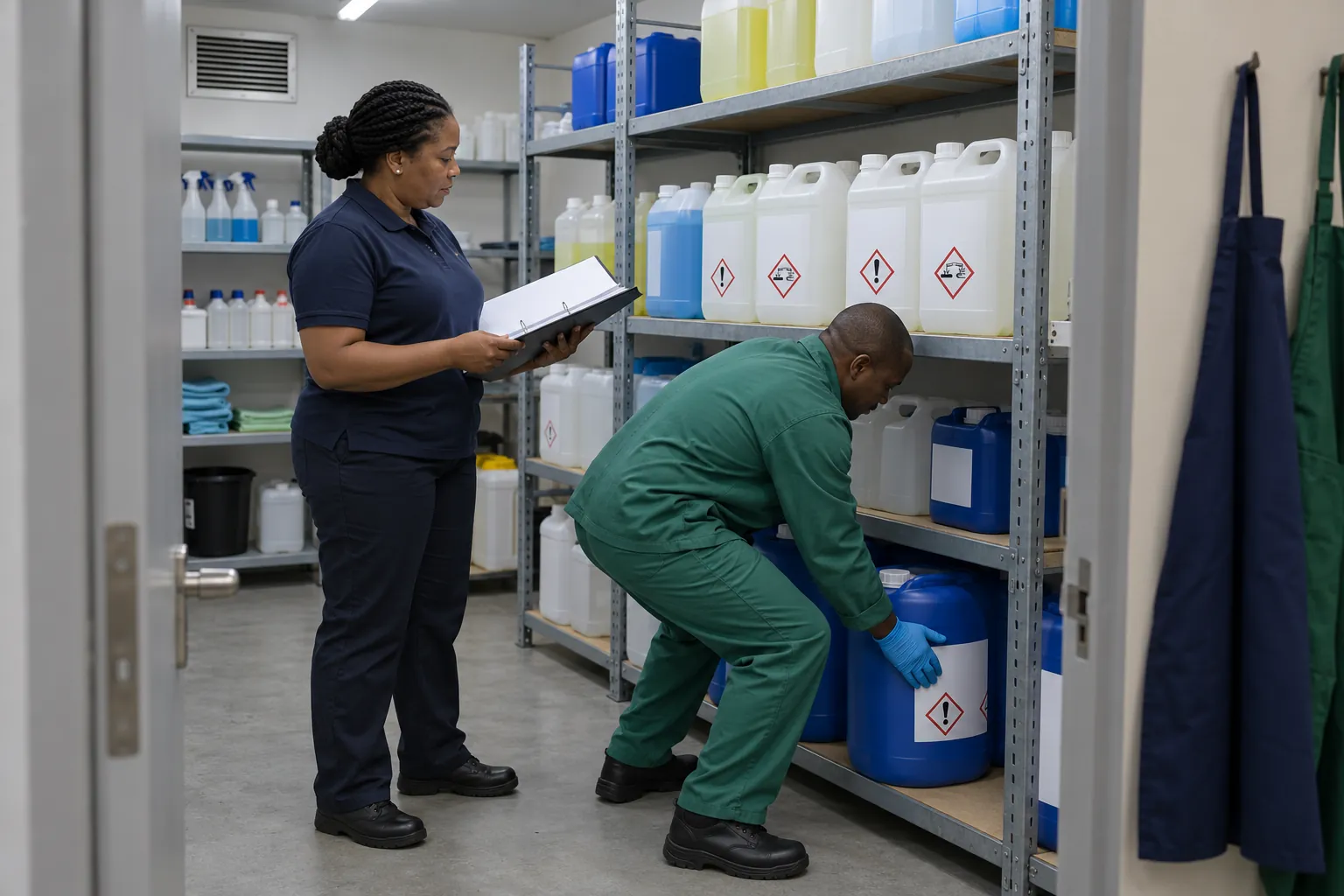
Under regulation 14B(1)(d) the employer must ensure that every HCA at the workplace is correctly labelled, that a container labelled for one HCA is used only for that HCA and, as far as reasonably practicable, that a product decanted into another container is labelled for it there. A correct label, under regulation 14B(2), carries the product identifier, the ingredients that drive the classification, the manufacturer's or importer's name, address and telephone number, an emergency number, and the signal word, hazard and precautionary statements and pictograms.
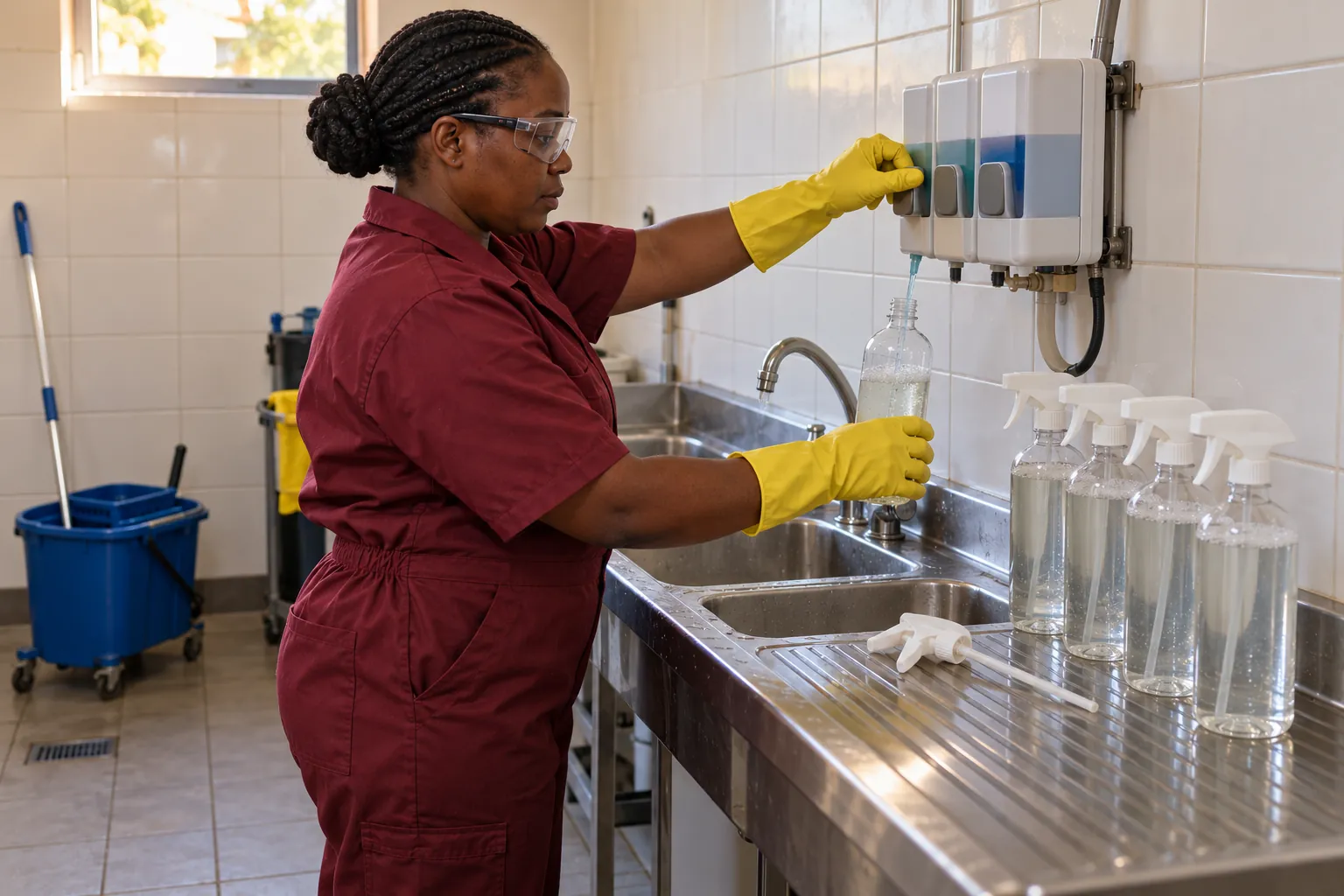
Cleaning is where decanting happens most. The common failures show up on any walk round: a spray bottle with no label or only a handwritten name, a bottle refilled with a different product, a product decanted into a cool drink bottle, and a label too faded or stained to read.
The regulations do not describe a chemical store, but several meet there. Regulation 10(2) requires exposure to be controlled, including by limiting the amount used; regulation 11(3) requires protective equipment to be stored separately when not in use; regulation 11(6) requires washing facilities for people using it, where reasonably practicable; and regulation 12 requires the controls to be kept in good working order. Section 7 of each SDS says how that product must be stored. A store check draws those together:
- the store is locked, ventilated, lit and tidy, with nothing blocking the door;
- every container is labelled, closed and upright, heavy drums low down, and nothing is leaking;
- products are kept apart where their SDSs say so;
- the SDS file is present and matches the shelves;
- gloves, eye protection and aprons are in stock and stored apart from personal clothing;
- the spill kit is complete and there is water for rinsing eyes and skin;
- empty containers and chemical waste are set aside for proper disposal;
- there is no food or drink in the store;
- the extractor fan runs, where there is one, including after load shedding.
No regulation sets how often to check the store. Weekly, and after every delivery, is a common rhythm; it belongs in the cleaning schedule rather than being left to whoever holds the key.
Regulation 15 covers what leaves. As far as reasonably practicable, the employer must recycle HCA waste, classify and dispose of it under the Waste Classification and Management Regulations, 2013 and the related landfill norms and standards, keep it in containers that prevent exposure, and write into any waste contractor's contract that the contractor must comply with the regulations too.
05
The assessment, the training and the records to keep
The assessment. Regulation 5(1) requires the employer, after consulting the health and safety representative or committee, to cause an assessment to be made immediately, and thereafter at intervals not exceeding two years, of whether any employee may be exposed by any route of intake. It must consider which HCAs are involved, their effects, where they are and in what form, the route and extent of exposure, and the work itself, including a control failing, and a record must be kept. Regulation 5(5) requires an immediate review when a process, method, piece of equipment or procedure changes: a new product, a new dilution system or a new task such as floor stripping all count. If the assessment shows an employee may be exposed, regulation 5(4) brings in air monitoring, medical surveillance and control. It sits alongside the site's wider hazard identification and risk assessment.
Control before protective equipment. Regulation 10 requires exposure to be prevented or, where that is not reasonably practicable, adequately controlled: by limiting the amount used, the people exposed and for how long, by substitution, by engineering controls and by written work procedures. Section 8(2)(b) of the Act makes the same point: eliminate or mitigate a hazard before resorting to personal protective equipment. For cleaning, measured dosing rather than pouring by eye and good ventilation both count.
The training. Under regulation 3(2), a cleaner must be told the names of the HCAs they will use and where they are kept, how harmful they are and what the assessment found; how to get the SDSs and read them and the labels; the procedures for use, storage, spills, disposal and emergencies; and the protective equipment needed and how to look after it. It comes before a new cleaner's first shift with the trolley, and again at intervals the health and safety committee recommends. Show and demonstrate, and use the pictograms, which are the same in every language.
The records. Regulation 9 requires the employer to keep the results of every assessment, air monitoring and medical surveillance report, with personal medical records open only to an occupational health practitioner; to make them available to an inspector, and the assessments and air monitoring to the health and safety representative or committee; to keep assessment and air monitoring records for at least 30 years; and to keep for at least three years the record of the tests of engineering controls, which regulation 12(b) requires an approved inspection authority to carry out at intervals not exceeding 24 months.
Those are the statutory records. The working records, the store checks, the SDS file review and who was trained on which product and when, show day to day that the assessment's controls are actually in place.
06
Where the chemical record fails, and what SiteClara does about it
On most cleaning contracts the assessment and the SDS file are done properly once. What slips is everything between: the store check signed for the whole month on the first day, the unlabelled spray bottle a supervisor noticed and told nobody about, the leaking drum mentioned to whoever was passing. When a client or an inspector asks when the store was last checked, by whom, and what happened to the problem found, the paper often cannot say.
SiteClara keeps that working record. A printed QR poster, with an optional NFC tag behind it, goes on the chemical store door. A cleaner or supervisor scans or taps it with their own phone, with no app to install, and completes the store check there; the time and the named person are recorded as it happens. Scheduled checks are set per location, so staff see what is due and mark it done or say what stopped them. A problem, such as a leaking container or an unlabelled bottle, is recorded on the spot, with a photo if it helps, and stays on the team's list of open jobs until someone closes it. The supervisor sees what was done and missed, gives a reason for a missed check, and approves a daily report that goes to the client's facilities manager or other nominated contacts at 08:00 the next morning.
07
Questions people ask
What are the regulations regarding hazardous chemical substances in South Africa?
The Regulations for Hazardous Chemical Agents, 2021, made under the Occupational Health and Safety Act 85 of 1993 and published on 29 March 2021, repealed the Regulations for Hazardous Chemical Substances, 1995 (Government Notice R. 1179 of 25 August 1995). They cover information and training, assessment of exposure, air monitoring, medical surveillance, records, control of exposure, personal protective equipment, maintenance of controls, classification, safety data sheets, labelling, packaging and disposal.
Are cleaning chemicals hazardous chemical agents?
Many are. Regulation 1 of the Regulations for Hazardous Chemical Agents, 2021 defines a hazardous chemical agent as a GHS-aligned chemical agent as provided for in Annexure 1, and a cleaning product whose label carries a GHS pictogram, a signal word and hazard statements has been classified that way. Section 2 of the product's safety data sheet gives its classification.
How long must hazardous chemical agent records be kept?
Under regulation 9(e) of the Regulations for Hazardous Chemical Agents, 2021, records of assessments and air monitoring must be kept for at least 30 years. Under regulation 9(g), the record of the tests of engineering controls, and of any repairs that followed, must be kept for at least three years.
What is section 7 of the OHS Act?
Section 7 of the Occupational Health and Safety Act 85 of 1993 lets the chief inspector direct an employer in writing, or a category of employers by notice in the Gazette, to prepare a written health and safety policy, with guidelines on its contents. An employer so directed must display a copy, signed by the chief executive officer, prominently where employees normally report for service.
08
Where to read the official text, and a list to take away
The Regulations for Hazardous Chemical Agents, 2021 are on gov.za as gazetted, with their annexures, and the Occupational Health and Safety Act 85 of 1993 is published by the Department of Employment and Labour. The annexure notes say SANS 10234, the SABS standard aligned with the GHS (now in its third edition, SANS 10234:2024), may be used as an alternative guide to classification, safety data sheets and labelling, although the latest version of the GHS still applies. Check for amendments before relying on an old copy.
Before the next contract review or site audit, check that:
- an exposure assessment exists, is less than two years old, and was reviewed when products or methods last changed;
- every product on site has a current safety data sheet the cleaners can reach on every shift;
- every container, decanted spray bottles included, is correctly labelled and holds one product only;
- the chemical store is checked on a schedule by a named person, with problems reported and followed up;
- everyone using the chemicals was trained before they started, and again when a product changed;
- chemical waste goes to proper disposal, and the waste contractor's contract says so;
- the section 37(2) agreement with any contractor covers chemical training.
Sources
Every document this guide quotes or links to, in the order it first cites them.
- Regulations for Hazardous Chemical Agents, 2021 gov.za
- Occupational Health and Safety Act 85 of 1993 labour.gov.za
- Draft Regulations for Hazardous Chemical Agents gov.za
- Third edition, SANS 10234:2024 store.sabs.co.za
Related guides
 CleaningHousekeeping in the workplace: what the law requires, and how to keep it upWhat regulation 13H of the General Safety Regulations requires of housekeeping at work in South Africa, how to prevent slips and trips, and how to check it daily.
 CleaningCleaning schedule: what to clean at work, how often, and how to show it was doneWhat a workplace cleaning schedule should cover in South Africa, which tasks are daily, weekly or monthly, who does what, and how to show the schedule was kept.
 CleaningCleaning supervisor duties: what the role involves, and what good looks likeWhat a cleaning supervisor does in South Africa: the main duties, a typical shift, the OHS Act, managing the team, checking the work and reporting to the client.
 Premises and facilities managementHazard identification and risk assessment: how a HIRA is done, and how it stays trueWhat a HIRA is under the OHS Act and its regulations, how to identify hazards and rate risks, who takes part, when to review it, and how rounds keep it honest.