Premises and facilities management
PPE register: what the law requires, what to record and how to keep it honest
A PPE register is the record an employer keeps of the personal protective equipment issued to employees: who received which item, when, in what size and quantity, and the employee's signature confirming it was received.

In South Africa it is how an employer shows it has met regulation 2 of the General Safety Regulations, which requires safety equipment to be provided free of charge, kept in a good and clean condition, and explained to the people who wear it. No South African regulation uses the words "PPE register": the law sets the duties, and the register is the evidence that they were carried out. This guide covers the duty, what a register should record, issuing and replacing equipment, checking that it is in good condition and actually worn, contractors' staff, and where the record usually fails.
01
The duty: section 8 of the OHS Act and regulation 2
Personal protective equipment is the last line of defence, and South African law says so. Section 8(2)(b) of the Occupational Health and Safety Act 85 of 1993 requires every employer to take "such steps as may be reasonably practicable to eliminate or mitigate any hazard or potential hazard to the safety or health of employees, before resorting to personal protective equipment".
Where equipment is still needed, the rule is regulation 2 of the General Safety Regulations, 1986 (Government Notice R1031 of 30 May 1986), headed "Personal safety equipment and facilities". The law says safety equipment rather than PPE, but means the same thing. In summary:
- Regulation 2(1): every employer must evaluate the risk of any condition or situation arising from its activities to which people at the workplace are exposed, and take the steps needed to make it safe. The General Safety Regulations, 2025 (Government Notice 5954 of 6 March 2025) amended this subregulation without changing that duty.
- Regulation 2(2): where the condition cannot practicably be made safe, the employer must reduce the risk as much as is practicable, and "provide free of charge and maintain in a good and clean condition" the safety equipment and facilities needed to make the people exposed safe.
- Regulation 2(3): that equipment includes, as necessary, goggles, face shields, hard hats, gloves, aprons, protective footwear and overalls; waterproof, high-visibility and chemical-resistant clothing; harnesses and fall arresters; ear-muffs, ear-plugs, respirators and masks; and generally whatever is necessary to make the people concerned safe.
- Regulation 2(4): no safety equipment may be removed from the workplace except for cleaning, repair, maintenance, modification, mending or replacement.
- Regulation 2(5): the employer must instruct employees "in the proper use, maintenance and limitations" of the equipment provided.
- Regulation 2(6): the employer must not require or permit an employee to work unless the employee uses the required equipment.
Regulation 2(7) keeps any specific regulation that prescribes particular equipment in force alongside it. Regulation 14, as reprinted in the 2025 notice, makes a breach of regulations 2(1), 2(2), 2(4), 2(5) and 2(6) an offence, punishable by a fine or up to six months' imprisonment, with a further R200 or one day for each day a continuing offence goes on.
Two sections of the Act close the loop. Section 23 forbids an employer to make any deduction from an employee's pay, or to require or permit any payment, for anything the Act requires the employer to provide in the interest of health or safety. Section 38(1)(o) makes it an offence for any person to fail to use safety equipment an employer has provided, and section 38(1)(n) to tamper with or misuse it.
02
What a PPE register should record
No regulation prescribes its form or its fields, so a PPE register can be a book in the stores, an issue card per employee, a spreadsheet or a printed register template, as long as it shows an inspector or a client's SHE auditor what was issued, to whom, when, and whether the person was shown how to use it. A register that works records:
- The employee: name, employee or clock number, job title and the site or section they work at.
- The item: the type (safety boots, gumboots, overalls, rubber gloves, goggles, dust mask, reflective vest, rain suit, hard hat, ear-plugs), the size, the quantity issued, and a serial or batch number where the item carries one, such as a harness or a respirator.
- The dates: the date of issue, and whether it was a first issue or a replacement for a worn, damaged or lost item.
- The instruction given, which is the regulation 2(5) duty: a line such as "shown fit and use of half-mask respirator" with the name of the person who showed them.
- The employee's signature or mark confirming the item was received, and the signature of whoever issued it.
- The item returned on replacement, and what was done with it.
- The risk it answers: the line of the hazard identification and risk assessment that calls for it, so the register and the HIRA agree.
Keep it short and lawful. Section 10 of the Protection of Personal Information Act 4 of 2013 allows personal information to be processed only if it is "adequate, relevant and not excessive" for the purpose, so an ID number, home address or medical detail has no place in a PPE register, and section 14 says such records must not be kept longer than their purpose needs unless a law requires or authorises it.
Many employers keep a PPE matrix beside the register: jobs down the side, items across the top. A new cleaner, general worker or security officer is issued from the matrix on their first day, and the register shows it was done.
03
Issuing, replacing and storing PPE
Most of the legal duties meet at the issue, so do it properly each time:
- Select the right item for the risk and the person. The Department of Employment and Labour's booklet What every worker and employer should know about health and safety in the workplace says eye protection should be "suitable for the task in hand and fits correctly", and footwear selected for the risks in each workplace.
- Issue it free of charge, under regulation 2(2) and section 23 of the Act, and record the issue.
- Show the person how to use it, how to check it and what its limits are, and record that too.
- Replace it when it is worn, damaged or lost, again free of charge. No regulation sets a replacement interval for ordinary items; the manufacturer's instructions and the item's condition decide. In the Department's booklet, the Chief Inspector reminds wearers to replace head protection if it is damaged.
- Take back what is replaced, so a cracked hard hat or split gloves do not go back into use.
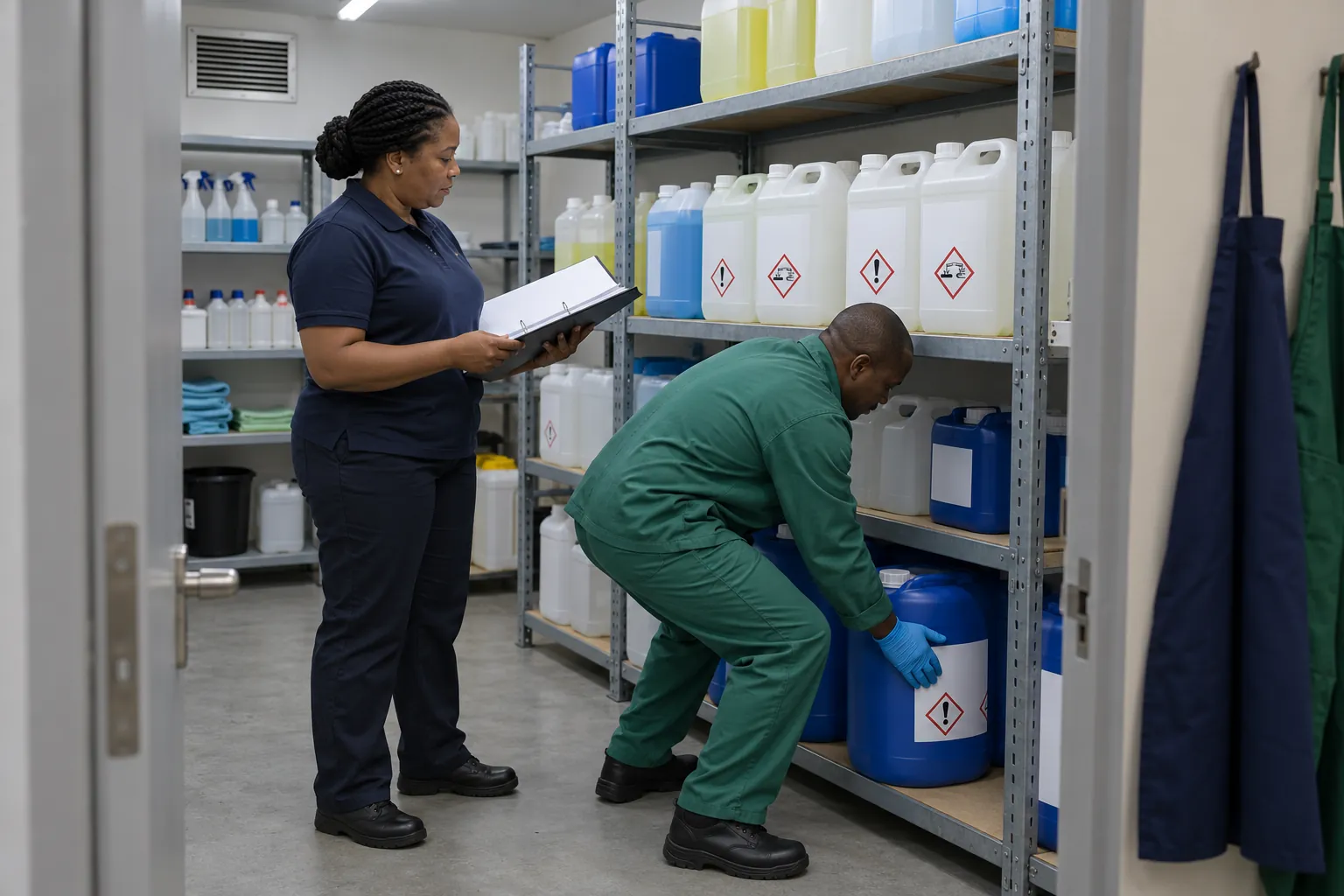
Where cleaners or maintenance staff may be exposed to a hazardous chemical agent, the Regulations for Hazardous Chemical Agents, 2021 (Notice R 11263 of 29 March 2021) are stricter. Equipment may be relied on only after exposure has been reduced as far as reasonably practicable by other means (regulation 10). As far as is reasonably practicable, the employer must not issue used equipment unless it has been decontaminated and sterilised, and must provide separate storage for equipment not in use and keep it there (regulation 11(3)). The employer must also ensure that no one removes dirty or contaminated equipment from the premises, except when it goes to a cleaning contractor packed in tightly sealed impermeable containers marked as contaminated (regulation 11(4) and (5)). Regulation 3(2)(i) makes the use and maintenance of PPE part of the required training, and regulation 4(b) requires everyone who may be exposed to obey a lawful instruction about wearing it.
04
Checking that PPE is in good condition and actually worn
A register shows that equipment was handed over. It does not show that it is still in a good and clean condition, as regulation 2(2) requires, or that it is being worn, as regulation 2(6) requires. That takes checks at three levels:
- The wearer's check before use: soles intact, gloves without splits, goggles clear enough to see through, a respirator with whole straps and valves and the right filter, a harness with no cuts or frayed webbing. Section 14(d) of the Act requires every employee to report an unsafe situation to the employer or the health and safety representative as soon as practicable.
- A periodic check by a supervisor or the SHE officer of items that wear out or have a life, such as respirator filters, harnesses, lanyards and hard hats, and of the stock in the PPE store. Under the chemical agents regulations, respiratory protective equipment must be "kept in good condition and efficient working order" (regulation 11(2)(d)).
- Spot checks in the workplace: a supervisor walking the chemical store, the plant room, the kitchen or the loading bay and noting whether people are wearing what the task needs. This is the check that proves regulation 2(6) in practice.
Section 37(1) of the Act explains why the spot check matters. When an employee does something that would be an offence for the employer, the employer is presumed to have done it unless it proves, among other things, that all reasonable steps were taken to prevent it, and the Act adds that issuing instructions forbidding it is not, in itself, sufficient proof. A signed register is an instruction; a record of supervisors checking, and acting when equipment is not worn, is closer to reasonable steps.
Where a standard applies, buy to it. Safety footwear, for example, is covered by SANS 20345:2023, Personal protective equipment – Safety footwear, the national adoption of ISO 20345. It is voluntary unless a regulation or a contract calls it up.

05
Contractors' staff, and whose register it is
In most buildings the people who need the most PPE, such as cleaners, security officers, gardeners and maintenance technicians, work for contractors. The contractor is their employer, so the contract cleaning company issues and records its cleaners' gloves and boots, and the security company its officers' reflective vests and rain suits.
The client is not off the hook. The Act defines a mandatary as including "an agent, a contractor or a subcontractor for work", and section 37(2) makes the employer answerable for a mandatary's acts and omissions unless the parties have agreed in writing on how the mandatary will comply with the Act. That is the section 37(2) agreement, and it commonly requires the contractor to keep a PPE register and matrix for its staff on site, with copies in its safety file. A facilities manager or managing agent then checks three things:
- the contractor's PPE matrix matches the tasks in its risk assessment and method statements;
- the register shows an issue for each person actually on site, including new starters and relief staff;
- the people on site are wearing it, which only a walk round shows.
The client's own register covers its own employees. Shared items kept at a location for anyone to use, such as the face shield at a battery charging point or the ear-muffs at a generator room door, belong on a checklist for that location rather than against a person's name.
06
Where the record fails, and what SiteClara does about it
PPE records usually fail in the same ways. The register is complete on the first day of the contract and never touched again. Signatures are collected in a batch at month end for items issued weeks before. The respirator cabinet in the chemical store is on nobody's round. A supervisor sees a cleaner decanting acid without goggles and says something, but nothing is written down, so there is no evidence it happened or was followed up.
SiteClara records routine checks where they happen. A printed QR poster, with an optional NFC tag behind it, sits at each location, such as the PPE store, the chemical store, the cleaners' room or the generator room door. A supervisor or SHE officer scans or taps on their own phone, with no app to install, sees the checks due there, such as "PPE store stocked and tidy" or "goggles and gloves worn at the dispensing point", and marks each one done or says what stopped them, with a photo when one is asked for. The time and the named person are recorded as it happens. A problem reported there, such as an empty glove box or a damaged face shield, goes onto the team's list of open jobs until someone closes it.
The supervisor sees what was due, done and missed, gives the reason a check was missed, and approves a daily report that goes to the facilities manager, managing agent or other nominated contacts the next morning.
07
Questions people ask
Is a PPE register a legal requirement in South Africa?
No regulation uses the words "PPE register", but regulation 2 of the General Safety Regulations, 1986 requires an employer to provide safety equipment free of charge, keep it in a good and clean condition, instruct employees in its use and not let them work without it. A register of issue and instruction is the usual way to show those duties were met.
Can an employer charge employees for PPE in South Africa?
No. Regulation 2(2) of the General Safety Regulations requires safety equipment to be provided free of charge, and section 23 of the Occupational Health and Safety Act, 1993 forbids any deduction from pay, or payment by the employee, for anything the Act requires the employer to provide in the interest of health or safety.
What are the 7 types of PPE?
The Department of Employment and Labour's booklet What every worker and employer should know about health and safety in the workplace lists seven types of PPE: eye protection, head and neck protection, ear protection, hand and arm protection, feet and legs protection, lung protection (respiratory protective equipment) and whole-body protection, such as high-visibility and flame-retardant clothing.
Where can I find the PPE requirements?
The general rule is regulation 2 of the General Safety Regulations, 1986, read with section 8(2)(b) of the Occupational Health and Safety Act 85 of 1993. Specific regulations add requirements for particular hazards, such as regulation 11 of the Regulations for Hazardous Chemical Agents, 2021.
08
Where to read the official text, and a list to take away
The Act is on gov.za (Occupational Health and Safety Act 85 of 1993). The Department of Employment and Labour publishes the General Safety Regulations, 1986, the Regulations for Hazardous Chemical Agents, 2021 and its booklet on health and safety in the workplace, and the 2025 amendment is Government Notice 5954 of 6 March 2025. Check for the current text before relying on an old copy. To take away:
- equipment comes after every other practicable control, and each item traces to a line of the risk assessment;
- every item is issued free of charge, and nothing is deducted from pay for it or its replacement;
- each issue is recorded with the person, item, size, date, instruction given and a signature;
- the register covers relief staff and new starters, not only the people there on day one;
- respirators, harnesses and hard hats are checked on a schedule, and worn items are taken back and replaced;
- supervisors check that equipment is worn, and write down what they saw and did;
- contractors keep their own register and matrix, and the section 37(2) agreement says so.
Sources
Every document this guide quotes or links to, in the order it first cites them.
- Occupational Health and Safety Act 85 of 1993 gov.za
- General Safety Regulations, 1986 labour.gov.za
- General Safety Regulations, 2025 (Government Notice 5954 of 6 March 2025) gov.za
- Protection of Personal Information Act 4 of 2013 gov.za
- What every worker and employer should know about health and safety in the workplace labour.gov.za
- Regulations for Hazardous Chemical Agents, 2021 labour.gov.za
- SANS 20345:2023, Personal protective equipment – Safety footwear store.sabs.co.za
- Occupational Health and Safety Act, 1993 labour.gov.za
Related guides
 CleaningHazardous chemical agents: what the 2021 regulations mean for cleaning chemicalsWhat the Regulations for Hazardous Chemical Agents, 2021 require of cleaning chemicals: the assessment, the SDS file, labels, the store, training and records.
 Premises and facilities managementHazard identification and risk assessment: how a HIRA is done, and how it stays trueWhat a HIRA is under the OHS Act and its regulations, how to identify hazards and rate risks, who takes part, when to review it, and how rounds keep it honest.
 Premises and facilities managementHealth and safety inspection checklist: what to look at, and what to do nextWhat a workplace health and safety inspection should cover in South Africa, how often, who inspects, and how to record and close findings under the OHS Act.
 Premises and facilities managementSafety file: what goes in it, who keeps it, and how to keep it currentWhat a health and safety file is under the Construction Regulations, 2014, who must keep one, what goes in it, and why clients ask service contractors for one.