Fire and water checks
The annual fire safety statement: what a NSW building owner declares, and how to make it true
An annual fire safety statement is the declaration that the owner of a New South Wales building with essential fire safety measures must issue each year, on the approved form, that an accredited practitioner has assessed every measure and inspected the building's exits.
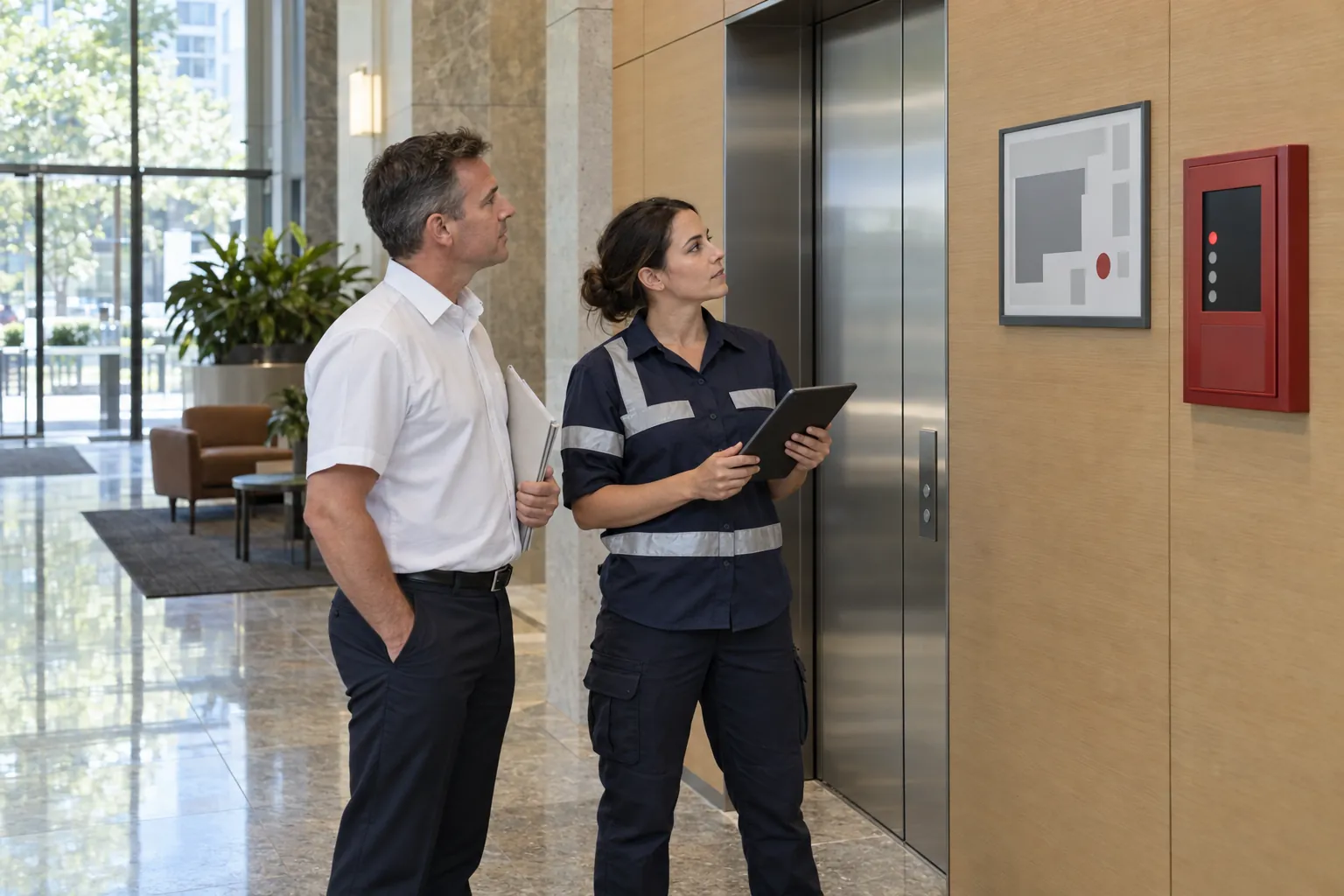
It goes to the council and to Fire and Rescue NSW, and a copy hangs in the building. This guide explains what the statement declares, which buildings need one, how the yearly cycle runs, what evidence should sit behind it, and what the building team can do in the months between assessments.
01
What an annual fire safety statement is
The annual fire safety statement (often shortened to AFSS) is a requirement of the Environmental Planning and Assessment (Development Certification and Fire Safety) Regulation 2021 (NSW), Part 12. The NSW Department of Planning's Fire safety statements – Frequently asked questions (October 2022) describes a fire safety statement as "a declaration from the building owner that the fire safety measures that apply to a building have been checked and continue to perform to the relevant standard". The statement must be issued "by or on behalf of the owner of an affected building".
An annual statement declares two things. According to the same FAQ, the owner is declaring that an accredited practitioner (fire safety) has:
- "assessed, inspected and verified the performance of each essential fire safety measure that applies to the building"; and
- "inspected the exit systems serving the building and found they do not contravene the provisions of part 15 of the Regulation".
The FAQ adds that the practitioner's assessment "would necessarily involve conducting an inspection of the fire safety measure/s whilst physically attending the property", and that the exit inspection is "for compliance with the Regulation". The owner must ensure the statement "is issued each year and that a copy of the statement is provided to the local council and Commissioner of Fire and Rescue NSW". The Department's guide Selecting an accredited practitioner (fire safety) (April 2022) adds that a copy "must also be displayed in a prominent position in the building alongside a copy of the building's fire safety schedule".
The declaration is about process, not engineering. The FAQ is explicit: "The person making the declaration is not certifying the performance of the fire safety measures", and is not expected to have the specialist expertise to do so; that is the accredited practitioner's role. What the owner is signing is that the right people did the right assessments within the right window. Separately, and all year round, section 81 of the Regulation makes the owner responsible for maintaining each fire safety measure to the standard in the fire safety schedule, and the FAQ adds that "an agent cannot be made responsible for this requirement".
The statement is a New South Wales instrument. Victoria handles the same ground through essential safety measures, and Queensland has its own building fire safety regime. What most of them share is the Australian Standard AS 1851 routine service as the usual method for the maintenance work underneath.
The statement is also not a fire safety certificate. The Department's Fire safety certification page says "A fire safety certificate is issued by or on behalf of a building owner when new building work is complete", and that it "confirms that a properly qualified person has installed and checked the measures listed in the fire safety schedule". The certificate comes once, when the work is finished; the annual statement follows every year after that.
02
Which buildings need one, and which measures it covers
The requirement falls on the owners of buildings that contain essential fire safety measures. The FAQ lists the ways a measure becomes essential: it is or was included in the building's fire safety schedule, or it was included in the "essential services" attached to an approval or order under the older local government legislation, up to 30 June 1997. In the Department's words, "In most cases, the above circumstances would apply to new buildings (other than single dwellings), where the construction approval was issued in or after July 1988", together with older buildings that have since had a change of classification, an addition, an alteration or a fire safety order.
The fire safety schedule is the list that drives everything. It "specifies each of the fire safety measures that apply to the building" and the minimum standard of performance for each. The Department's guide says the buildings that will have one include "commercial, industrial, multi-unit residential, and institutional buildings", but not houses, and that owners "should keep a copy of this schedule", which the local council can supply. Since 1 August 2023, a new schedule must be issued on the NSW Government's fire safety schedule template (version 1.1 was released on 28 July 2025).
Typical measures on a schedule, as the Department's guide lists them:
- fire sprinkler systems, fire hose reel systems and fire hydrant systems;
- portable fire extinguishers;
- illuminated exit signs and emergency lighting;
- fire detection and alarm systems, and building occupant warning systems;
- smoke control systems and emergency lifts;
- fire-resistant building elements of lightweight construction, and fire safety strategies.
Some measures are also critical fire safety measures: ones the schedule says must be assessed at intervals of less than 12 months. A critical measure is still an essential one, so it appears on the annual statement too, but it also needs a supplementary fire safety statement at the interval the schedule sets.
The owner may be an individual, a company or an owners corporation. In a strata scheme the FAQ lists a strata manager or an "executive committee of an owners' corporation" among the agents who may issue the statement, provided they have "appropriate prior authority from the owners". Where a building has several owners, one may issue the statement if each of the others has authorised them to act as their agent.
03
The yearly cycle: who does what, and when
The statement is due each year, so the anniversary of the last one is the date that matters. Working back from it, a well-run cycle looks like this:
- Get the current fire safety schedule. The Department's guide recommends it as the first step, because the schedule is what each practitioner's accreditation has to be matched against.
- Select accredited practitioners (fire safety). The first approved industry scheme is the Fire Protection Association Australia's Fire Protection Accreditation Scheme, approved on 1 July 2020, according to the NSW Government's Fire safety practitioners page. Where someone is accredited for a function, the owner must choose an accredited person. Check the scheme's register rather than relying on the contractor's word: the guide warns that an owner or agent "should not rely solely on a statement or declaration from a practitioner or another party". A large building may need more than one practitioner, since accreditation to assess exit signs, for example, is not accreditation to inspect exit systems.
- Assess the measures and inspect the exits within the window. The notes to the approved fire safety statement form (version 4) say the dates of assessment "must be within the 3 months prior to the date the annual fire safety statement is issued", and the same applies to the exit inspection. Book too early and the assessment falls outside the window; book too late and the statement is overdue.
- Put right what the assessment finds. The owner can only declare that each measure was assessed as capable of performing to its standard, so defects found at assessment have to be fixed and reassessed before that can be said.
- Collect the signatures. Each practitioner signs the form, or gives the owner a separate signed document, and the form records each practitioner's accreditation number against the measures they assessed.
- Make the declaration. The owner or the owner's agent signs section 8. The person declaring must not be a practitioner listed on the form, "or their employer/employee or direct associate".
- Lodge and display. The form must go to both the local council and Fire and Rescue NSW (the form's notes point to Fire and Rescue NSW's online submission; ask the council how it wants its copy). As soon as practicable, a copy goes up in a prominent place in the building with the current fire safety schedule.
The form itself is fixed. The Regulation requires the form approved by the Planning Secretary, version 4 has been required since 1 September 2022, and the FAQ warns that changes, "including adding or altering letterheads and logos or adding and removing sections of the form", may contravene the Regulation. The Department's Fire safety certification page links the current template.
Supplementary statements run on their own clock. The form's notes say the assessment of each critical measure "must be within 1 month prior to the date the supplementary fire safety statement is issued", at the interval the fire safety schedule sets.
04
What should sit behind the statement
The form records the headline facts: each measure, its minimum standard of performance, the dates assessed and the practitioner's accreditation number (section 4); the parts of the building inspected for exits and when (section 5); and each practitioner's details and signature (section 6). The owner signs a declaration that relies on all of that being true.
Because the owner is declaring without being the technical expert, the sensible habit is to keep the file that shows why the declaration was reasonable. The notes to the form itself suggest that an owner "could obtain documentation from each APFS to verify that the standard of performance has been met" before signing. A useful file for each year holds:
- the fire safety schedule the statement was made against, and any newer schedule issued during the year;
- each practitioner's signed assessment, with a note of where their accreditation was checked on the register;
- the routine service reports from the fire services contractor for the year, which are not the assessment but show the measures were maintained between assessments;
- defects found, who was told, and the date each was rectified and reassessed;
- the written authority for whoever signed as the owner's agent;
- proof of lodgement with the council and Fire and Rescue NSW, and a dated photograph of the displayed copy;
- any supplementary statements for critical measures, in date order.
The Department's guide draws a line worth keeping in mind: "there is a need to make a distinction between those who maintain fire safety measures by conducting routine servicing, and those who assess and, if needed, test measures for the purposes of enabling the issue of the annual or supplementary fire safety statement." A contractor's monthly service sheet is maintenance evidence; it is not the annual assessment, and one does not substitute for the other.
05
The months between assessments
An annual statement is a snapshot taken within a three-month window. The maintenance duty in section 81 runs every day. The gap between those two is where buildings get into trouble: a fire door propped open for a delivery and never closed, a storeroom that creeps into an exit path, an exit sign that went dark in March and was noticed in the assessment in November.
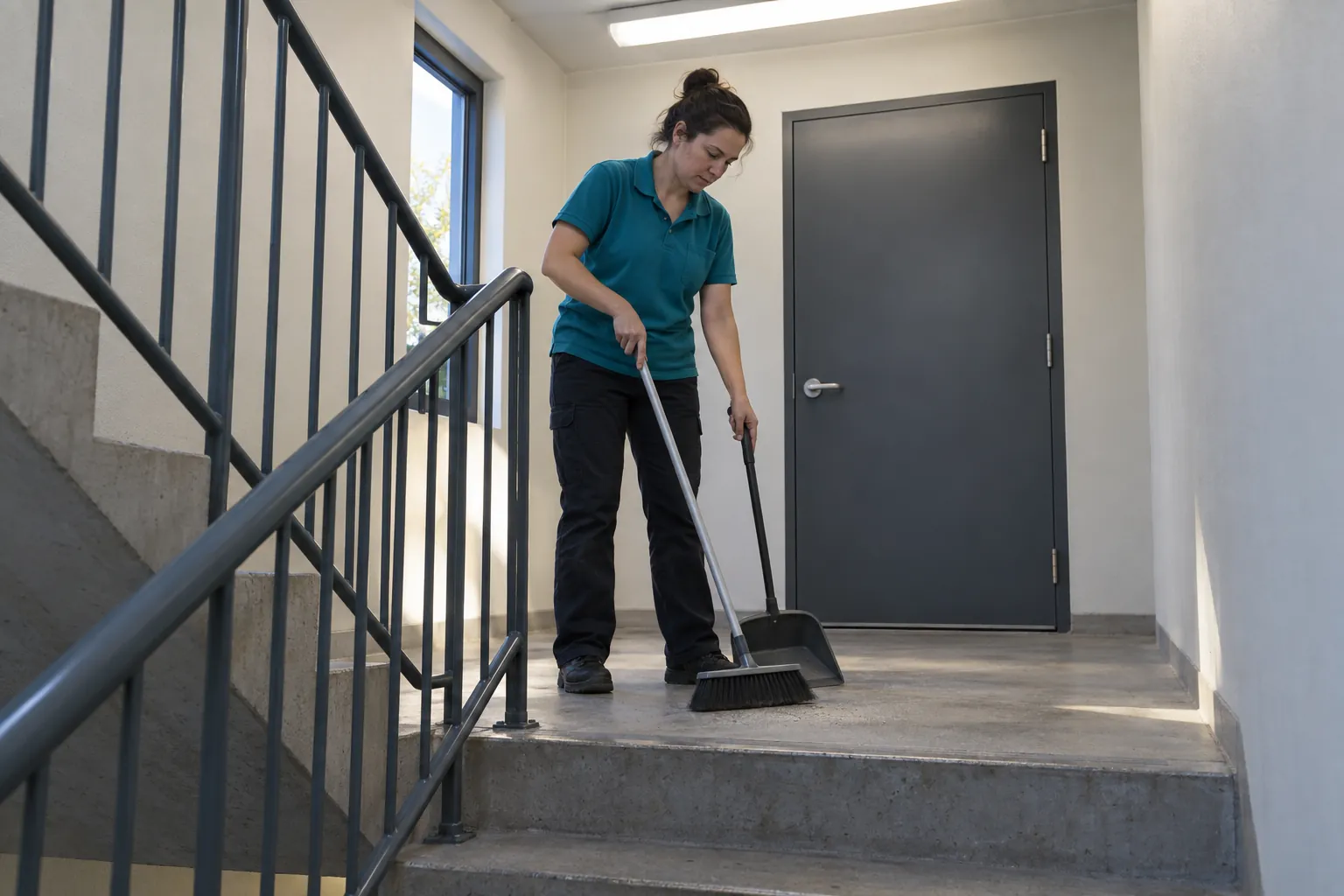
The exit inspection shows what the building team can watch for. The form's notes describe it as confirming that a practitioner "has inspected the fire safety notices, fire exits, fire exit doors and the paths of travel to fire exits" and found no breach of Part 15 of the Regulation. None of those needs a practitioner to notice when something has gone wrong. A regular walk by the building manager, the cleaners or the security officers on their rounds can cover:
- exit doors that open freely and are not locked, chained or blocked from either side;
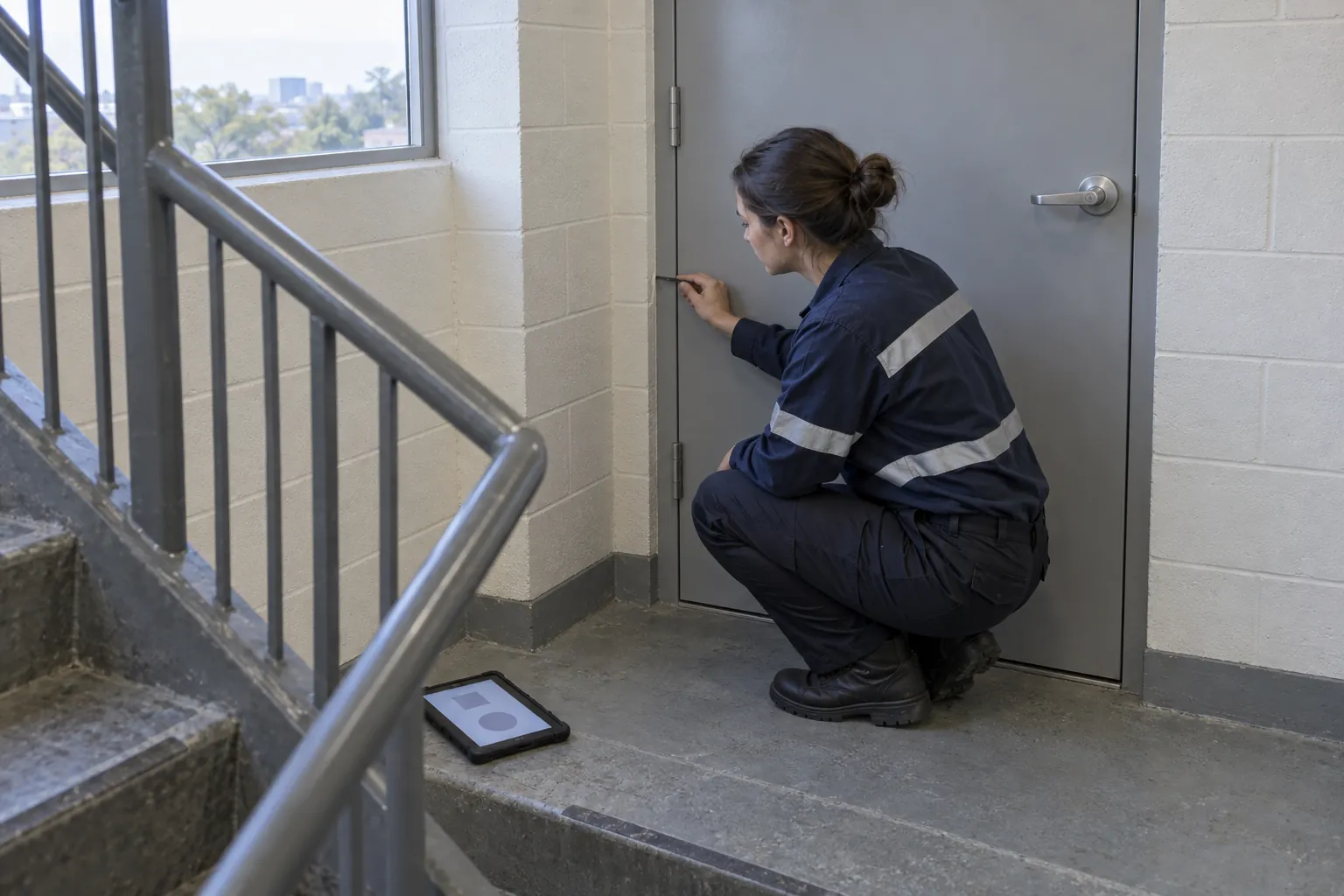
- fire doors that close and latch on their own, with nothing wedging them open (see fire door inspection);
- paths of travel to exits, stairs and discharge points kept clear of stock, furniture, bins and trolleys;
- exit signs lit and emergency lights with no fault indicator showing;
- extinguishers present, on their brackets, with seals intact and nothing in front of them;
- hose reel cabinets and hydrant boosters unobstructed and accessible;
- the fire indicator panel showing normal, with any fault or isolation reported straight away;
- the displayed statement and fire safety schedule still in place and legible.
How often these inspections happen is a judgement for the building, not a figure set by the Regulation: busy exits and loading docks may justify a daily look, quiet plant floors a weekly one. What matters is that someone is named for each area, that the walk leaves a dated record, and that a fault found goes to whoever can fix it, the fire services contractor, the facility manager or the strata manager, the same day.
The calendar needs the same care. Put the statement's anniversary in the diary with the three-month window marked, book practitioners for the start of it so that defects can be fixed inside it, and diary each supplementary statement at its own interval.
06
Where the record fails
The statement itself rarely fails for want of a form. It fails because of what happens around it. The exit walk is recorded on a sheet on the plant room door, signed for the week in advance. A cleaner notices a fire door that no longer closes and mentions it to whoever is passing. The contractor's service report arrives weeks later, as a PDF nobody opens until the assessment finds the same defect.
SiteClara is built for the everyday part of that. A tag at each exit, fire door, hose reel or extinguisher point lets the person doing the walk scan it and confirm the check with their phone, with a photograph when one is asked for, so the record shows which point was checked, by whom and when. A check that was due and not done shows as not done. A fault reported at the tag goes to the team responsible for it, and a daily report tells the building manager what was checked and what is still open.
It is just as important to say what SiteClara does not do. It is not an accredited practitioner and does not assess, test or verify any fire safety measure. It is not the annual or supplementary fire safety statement, it does not fill in or lodge the approved form, and it sends nothing to the council or Fire and Rescue NSW. It does not replace the fire services contractor's AS 1851 service records or the fire safety schedule. It is not a facilities management (CAFM) system and does not do rostering or time and attendance. Where the Regulation or a contract requires a particular record, SiteClara is the working record of the checks between visits, not the statutory one.
07
Questions people ask
Who is responsible for the annual fire safety statement in NSW?
The building owner. The Department's Fire safety statements – Frequently asked questions says "A building owner must ensure that an annual fire safety statement for the building is issued each year and that a copy of the statement is provided to the local council and Commissioner of Fire and Rescue NSW." An authorised agent, such as a strata manager, may issue it on the owner's behalf, but the owner stays responsible for maintaining the measures, and a practitioner who assessed a measure or inspected the exits must not make the declaration.
How do I submit an annual fire safety statement in NSW?
Send it to both the local council and Fire and Rescue NSW. The notes to the fire safety statement form (version 4) say "The completed fire safety statement form must be submitted to both the local council and Fire and Rescue NSW", that you should contact your local council about how it wants the statement submitted, and that completed statements go to Fire and Rescue NSW through its online submission at fire.nsw.gov.au/afsssubmission. A copy is then displayed in the building with the fire safety schedule.
Where can I find a template for an annual fire safety statement in NSW?
On the NSW Department of Planning's Fire safety certification page, which says "Fire safety statements must use the Fire safety statement template" and links the current version as a Word document. It is the approved form, version 4, and the FAQ warns against changing it, including adding letterheads or logos or removing sections.
How do you get a fire safety certificate?
A fire safety certificate belongs to new building work, not to the yearly cycle. The Department's Fire safety certification page says it "is issued by or on behalf of a building owner when new building work is complete" and "confirms that a properly qualified person has installed and checked the measures listed in the fire safety schedule". After that, the owner issues an annual fire safety statement each year.
08
Where to read more, and a list to take away
The NSW Government's own documents are the ones to rely on:
- Fire safety statements – Frequently asked questions (October 2022), NSW Department of Planning.
- Fire safety statement form (version 4), with its notes.
- Selecting an accredited practitioner (fire safety) (April 2022), a guide for building owners.
- Fire safety certification, NSW Department of Planning, for the current templates.
- Fire safety practitioners, NSW Government, for the approved accreditation scheme and its register.
- The Environmental Planning and Assessment (Development Certification and Fire Safety) Regulation 2021 itself, on the NSW legislation website: Part 10 (fire safety schedules), section 81 (maintenance), Part 12 (fire safety statements) and Part 15 (exits).
A list to take away:
- Keep the current fire safety schedule on file and check that the next statement is made against it.
- Mark the anniversary and the three-month window in the diary, with any supplementary statements at their own intervals.
- Choose accredited practitioners from the scheme's register, for every measure and for the exit inspection.
- Leave time inside the window to fix defects and have them reassessed.
- Make sure the person signing is the owner or an authorised agent, and not a practitioner or their associate.
- Lodge with the council and Fire and Rescue NSW, and display the statement with the schedule.
- Walk the exits, doors and equipment regularly between assessments, and keep a dated record of it.
- Send every fault found to whoever can fix it, the same day, and keep the rectification date.
Sources
Every document this guide quotes or links to, in the order it first cites them.
- Fire safety statements – Frequently asked questions (October 2022) planning.nsw.gov.au
- Selecting an accredited practitioner (fire safety) (April 2022) planning.nsw.gov.au
- Fire safety certification planning.nsw.gov.au
- Fire safety schedule template nsw.gov.au
- Fire safety practitioners nsw.gov.au
- Fire safety statement form (version 4) planning.nsw.gov.au
- Environmental Planning and Assessment (Development Certification and Fire Safety) Regulation 2021 legislation.nsw.gov.au
Related guides
 Fire and water checksAS 1851 routine service: what it asks of owners, fire contractors and building teamsWhat AS 1851-2012 routine service covers, how intervals and competent persons work, what the records must show, and how Victoria's regulations call it up.
 Fire and water checksEssential safety measures in Victoria: the duties, the annual report and the recordsWhat essential safety measures are under Victoria's Building Regulations 2018, who maintains them, the annual ESM report, the records to keep and the checks between.
 Fire and water checksFire safety logbook: what to record, who keeps it and for how longWhat a fire safety logbook should hold in Australia: AS 1851 service records, Victoria's ESM records, the NSW fire safety statement and Queensland's rules.
 Fire and water checksFire door inspection: what the inspector checks, and what the owner keepsFire door inspection in Australia: what AS 1905.1 and the NCC require of a fire door, how AS 1851 and state law set the checks, who may inspect, and the records.