Fire and water checks
Fire safety logbook: what to record, who keeps it and for how long
A fire safety logbook is the record of every routine service, test, defect, repair, evacuation drill and piece of training for a building's fire safety measures, kept on the premises where an inspector can see it.
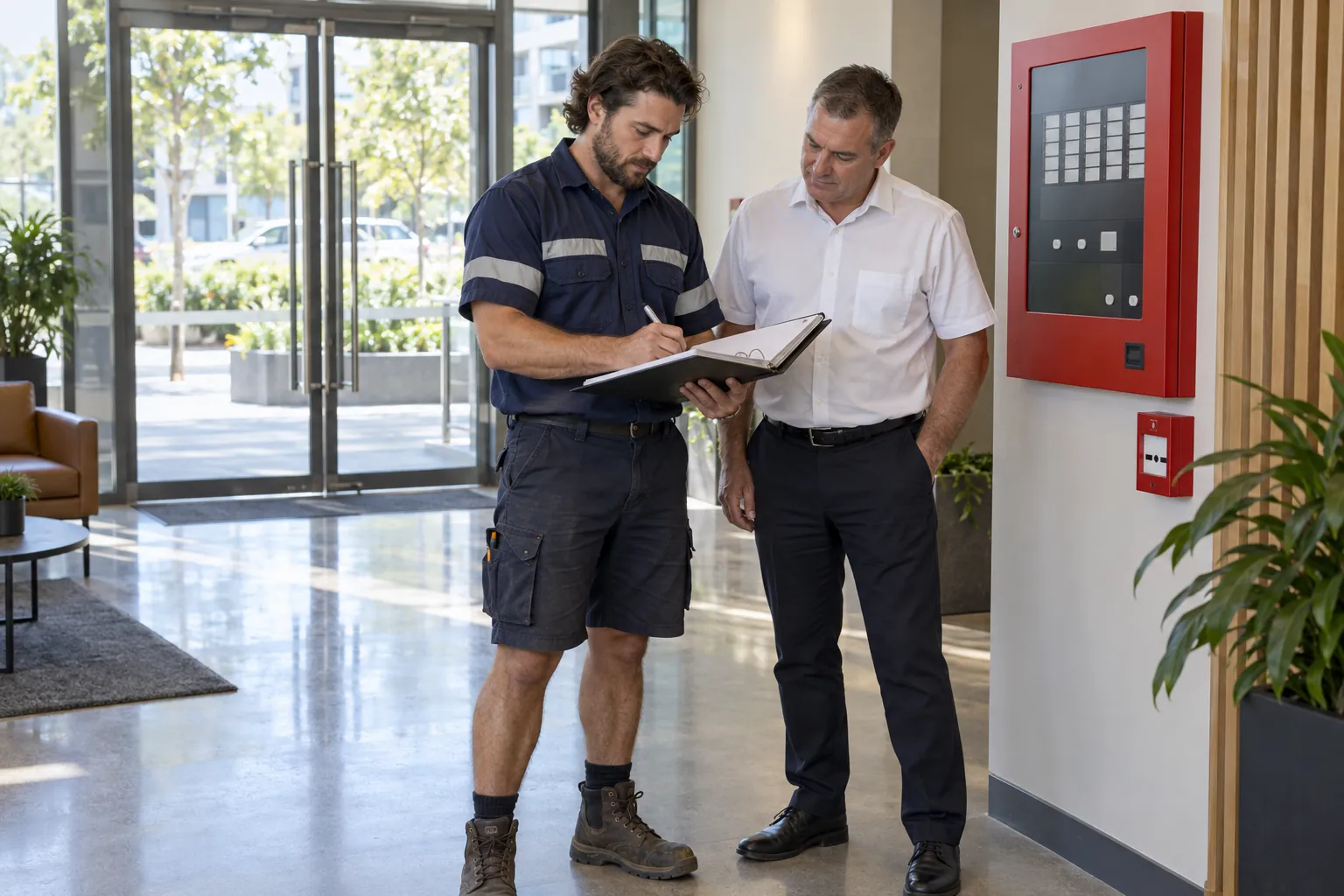
In Australia the rules that require it are state building and fire safety law, with AS 1851 as the common standard for the servicing. This guide covers what belongs in the logbook, what Victoria, New South Wales and Queensland each require, who keeps it and for how long.
01
What a fire safety logbook is, and where the duty comes from
A fire safety logbook is the running record of how a building's fire safety measures are inspected, tested, maintained and repaired. It holds the fire services contractor's routine service entries, the defects found and when they were fixed, and, in many buildings, the evacuation exercises and warden training too. It is also written as a fire safety log book; the name matters less than whether the entries are complete.
There is no single national law that says "keep a fire safety logbook". The duty comes from two directions. The first is state and territory law, which requires the owner or occupier of most non-domestic buildings to keep fire safety measures maintained and to be able to prove it. The rules, the words and the person responsible differ from state to state:
- Victoria: essential safety measures under Part 15 of the Building Regulations 2018 (Vic), with the owner responsible for maintenance, an annual essential safety measures report and records available on request.
- New South Wales: essential fire safety measures under the Environmental Planning and Assessment (Development Certification and Fire Safety) Regulation 2021, with the owner issuing an annual fire safety statement each year.
- Queensland: prescribed fire safety installations under the Building Fire Safety Regulation 2008 (Qld), with the occupier keeping a record of maintenance and preparing an occupier statement.
The second is the Australian Standard the servicing follows. AS 1851-2012 Routine service of fire protection systems and equipment is the common reference across the states, and its opening section includes a clause on routine service records that deals with logbooks, tags and labels, summary records and records retention. Emergency lighting and exit signs have their own standard, AS/NZS 2293.2:2019 Emergency lighting and exit signs for buildings, Part 2: Routine service and maintenance, which also has clauses on records, their format and their retention. Standards Australia lists both as pending revision; the edition that applies is the one the building's own approval documents or state code call up.
02
What a fire safety logbook should contain
The fire services contractor usually supplies the logbook pages for the systems they service, set out to follow AS 1851. A complete set of fire safety records for a building, whether in one binder or several, covers:
- Building details: the address, the owner and occupier and their contacts, the building's classification, and the documents that set its fire safety measures: the occupancy permit and maintenance schedule in Victoria, the fire safety schedule in New South Wales, or the equivalent in other states.
- Routine service entries for each system: sprinklers, fire pumpsets, hydrants, water storage tanks, the fire detection and alarm system, hose reels, portable extinguishers, fire blankets, passive fire and smoke systems such as fire doors, and smoke hazard management in the mechanical services. Each entry should give the date, the system, the work done and the tests carried out, the result and the technician's name.
- Emergency lighting and exit signs: the six-monthly and annual routine service, with any failed fittings and their repair.
- Defects and repairs: each defect found, whether it was critical, what was done, by whom and when it was put right.
- Isolations and impairments: when a system or zone was isolated, why, and when it was reinstated.
- Evacuation exercises: each drill's date, the start and finish times, what went well and what needs to change.
- Training and instruction: who received instruction in the building's fire safety procedures and evacuation, who gave it, and when, including the chief warden and wardens.
- The annual documents: the annual essential safety measures report (Victoria), the annual and any supplementary fire safety statements (New South Wales) or the occupier statement (Queensland).
- Visits: inspections by the council, the fire service or the insurer, with anything they asked for.
Keep one section per system, so each system's history can be read on its own. The emergency plan behind the exercises and the wardens follows AS 3745-2010 Planning for emergencies in facilities; our guide to AS 3745 emergency planning covers it in more depth.
03
What each state requires the records to show
The detail is state law, and it matters, because each state names a different person and a different set of documents.
Victoria. Part 15 of the Building Regulations 2018 applies to Class 1b, 2, 3, 5, 6, 7, 8 and 9 buildings, a Class 4 part of a building and places of public entertainment (regulation 213). Under regulation 225 the owner must ensure that these documents are available for inspection at the building within 24 hours after a request by the municipal building surveyor or the chief officer:
- all annual essential safety measures reports prepared within 10 years before the request;
- all maintenance schedules for the essential safety measures;
- all maintenance determinations requiring an essential safety measure to be provided;
- the records of all inspections, testing and maintenance (including repairs) of any essential safety measure.
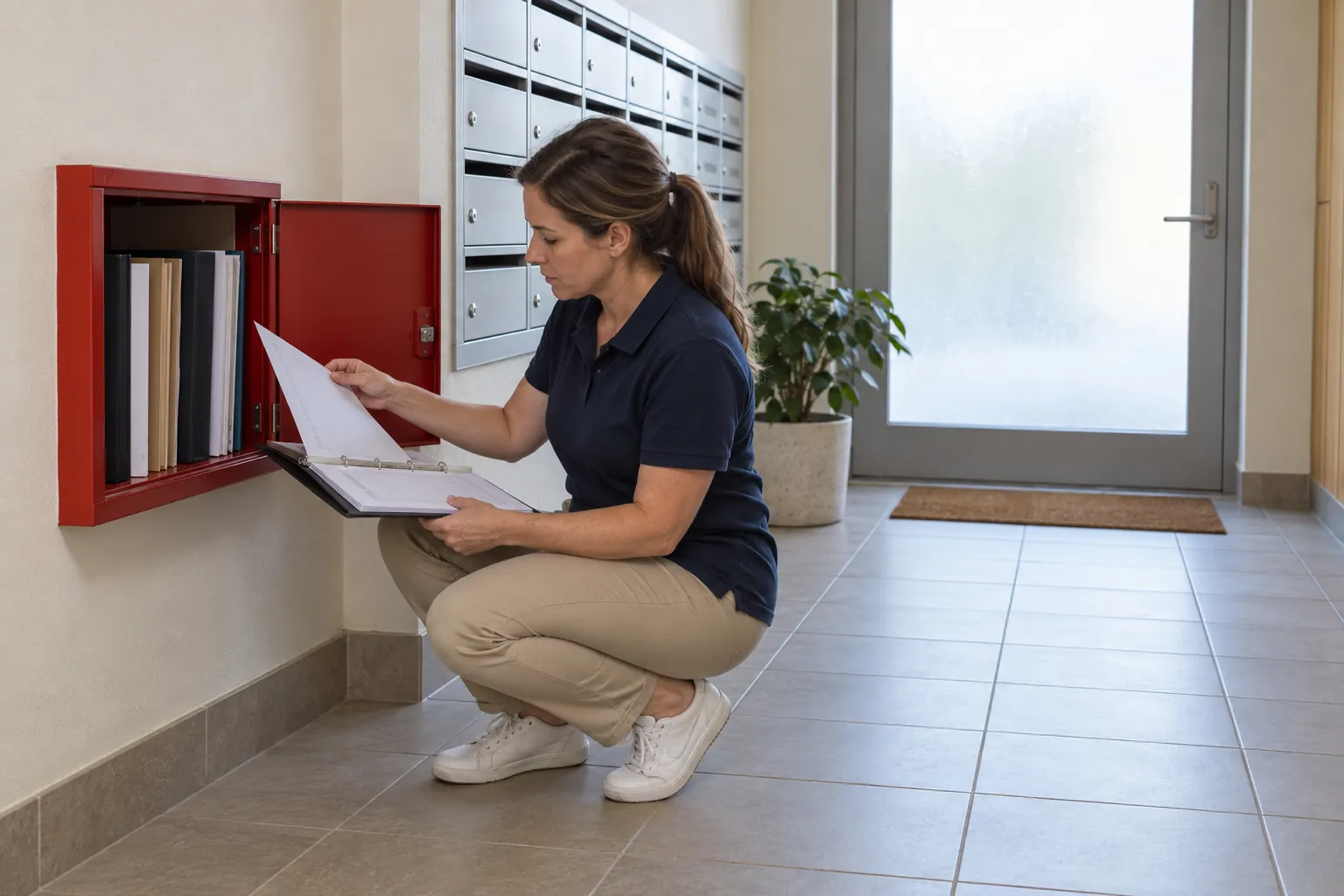
The annual essential safety measures report must be prepared within 28 days before each anniversary of the relevant date (regulation 223), in the approved form and signed by the owner, stating among other things that the owner has taken all reasonable steps to ensure each measure is operating, has been maintained so it can fulfil its purpose, and has been inspected, tested and maintained in accordance with the Act and the Regulations (regulation 224). The CFA's guidance on essential safety measures for businesses describes the red Essential Safety Measures box in a front entry or common space, holding a logbook or individual documents, and says the responsibility for the documentation should be clearly stated in the lease.
New South Wales. The NSW planning department's fire safety statements frequently asked questions explain that the owner is responsible for maintaining each fire safety measure to the standard of performance in the fire safety schedule, and that an agent cannot be made responsible for this. Each year the owner must ensure an annual fire safety statement is issued, declaring that an accredited practitioner (fire safety) has assessed, inspected and verified the performance of each essential fire safety measure and inspected the exit systems, and must give a copy to the local council and the Commissioner of Fire and Rescue NSW. Critical fire safety measures need supplementary statements at the intervals in the fire safety schedule. The owner who signs it, often an owners corporation acting through its strata manager, relies on the service records behind it; see our guide to the annual fire safety statement.
Queensland. The Building Fire Safety Regulation 2008 is the most prescriptive. Section 55 requires the occupier to keep a record of maintenance for each prescribed fire safety installation, stating the installation, the name and licence number of the appropriately qualified person, the date, a description of the maintenance, that it complied with the Queensland Development Code MP 6.1, the results, any repair or corrective action needed, and the date of any repair made, with a signed statement from the person who did the work and any critical defect notice. Section 54 requires the repair to be done within one month unless the occupier has a reasonable excuse. The occupier also keeps a fire and evacuation instruction record (section 45) and an evacuation practice record with the date, start and end times and any follow-up action (section 46). Our guide to Queensland building fire safety covers the occupier statement and the rest.
04
Who keeps it, where, and for how long
The legal duty sits with the owner in Victoria and New South Wales, and with the occupier in Queensland, but the entries come from several people:
- the fire services contractor, whose technicians write up each routine service and leave the reports;
- the building manager or facility manager, who usually keeps the records, books the contractor and chases defects;
- the strata manager, or the body corporate or owners corporation committee, in a strata building, who arranges the annual statement or report on the owners' behalf;
- the chief warden and wardens, who record evacuation exercises and their findings;
- security officers, cleaners and caretakers, who often notice a blocked exit or a propped fire door first.
Where. Keep the records in the building. Victoria requires them to be available for inspection at the building within 24 hours of a request. Queensland's section 71 requires a copy of each prescribed document to be kept in the building and in a secure place in other premises, and allows electronic copies if the information is readily accessible at that place. The Queensland Fire Department's Fire Safety Management Tool with Advisory Notes suggests lockable metal boxes fixed to a wall in Class 2 or Class 3 buildings or buildings with no common areas, as a solution rather than a requirement.
For how long. Victoria's regulation 225 reaches back 10 years for the annual essential safety measures reports and covers all records of inspection, testing and maintenance. Queensland's section 72 requires the occupier to keep each prescribed document for at least 2 years after it was made, or after its last entry, and a departing occupier must hand them to the new occupier within one month. AS 1851 and AS/NZS 2293.2 each have their own clause on records retention. Keeping completed logbooks and service reports rather than discarding them when a new book starts preserves the history an investigator, insurer or new contractor will need.
05
Paper or electronic, and what makes the record credible
Neither format is required everywhere, and neither proves compliance on its own. Queensland's advisory notes say records required by the Regulation, other than logbooks required by an Australian Standard for the maintenance of fire safety installations, may be kept electronically as long as they are available for inspection, and that the emergency lighting logbook can be electronic. They are also blunt about what is not enough: a maintenance tag, invoice or summary report is not acceptable as a record of maintenance, though it may indicate that routine service is being carried out.
A credible fire safety logbook, on paper or on screen:
- is written at the time, with the actual date of each service or check, not filled in at the end of the quarter;
- names the person and, where the law asks for it, their licence number and company;
- is specific: which hydrant, which hose reel, which fire door, which zone, not "all OK";
- records defects and what happened next: a defect with no repair recorded suggests the defect is still there, and in Queensland the one-month clock is running;
- has no unexplained gaps: a missed six-monthly service with a reason is better than a blank;
- keeps the supporting documents with it: service reports, critical defect notices, the maintenance schedule or fire safety schedule, and the annual report or statement.
Paper exists in one place, can be lost or water-damaged, and cannot tell anyone a check was missed. Electronic records can show gaps as they happen, but only if everyone uses them and they can be produced on the day. Whatever the format, the record has to be true: in Queensland, section 70 makes it an offence to give an authorised fire officer a document, including a record required under an Australian Standard named in MP 6.1, that the person knows is false or misleading in a material particular.
06
Where the logbook fails, and what SiteClara does about it
Fire safety logbooks rarely fail on the contractor's service day. They fail in between. A defect is written on page twelve of the hydrant section and nobody reads it until the next service. An exit door that has stopped latching is mentioned to whoever was at the desk and goes no further. The fire panel shows an isolated zone for a fortnight after a fit-out because nobody owned reinstating it. The owner signs the annual report or statement in good faith without seeing any of it.
SiteClara is built for that everyday part. A printed QR poster, with an optional NFC tag behind it, goes at a location such as the fire indicator panel, a stair door, a hose reel or an exit. Staff scan the code or tap the tag on their own phone, with no app to install. They see the scheduled checks due there, such as a weekly walk of the exits or a look at the panel, and mark them done, or say what stopped them. A fault is reported there with a photo and goes onto the team's list of jobs until someone closes it, and a supervisor can escalate it to the building manager, who can answer it.
The supervisor sees what is due, done and missed across the building, and can record the reason a check was missed. Each day the supervisor reviews and approves a report that goes to nominated management or client contacts the next morning, showing what was reported, completed and still open, and how the scheduled checks went. That gives the owner a running picture before the annual paperwork is signed.
07
Questions people ask
What should be in a fire safety log book?
Queensland spells it out most fully. Section 55 of the Building Fire Safety Regulation 2008 (Qld) requires each record of maintenance to describe the installation, identify the appropriately qualified person and their licence number, give the date and a brief description of the maintenance, state that it complied with the Queensland Development Code MP 6.1, and give the results, including any repair needed, with a signed statement from the person who did the work and any critical defect notice. The same entries make a sound record in any state.
Do I need a fire safety certificate in NSW?
Yes, when new building work is complete. The NSW planning department's page on fire safety certification explains that a fire safety certificate is issued by or on behalf of the building owner once the work is finished, while an existing building needs an annual fire safety statement each year, covering all the essential fire safety measures that apply to it.
How do you get a fire safety certificate?
In New South Wales you do not apply for one; the owner issues it. The NSW planning department's page on fire safety certification says the certificate confirms that a properly qualified person has installed and checked the measures listed in the fire safety schedule, so the owner arranges that check before issuing it.
08
Further reading, and a list to take away
Read the rules for your own state first. In Victoria, the Building Regulations 2018 (Part 15) and the CFA's guidance on essential safety measures for businesses. In New South Wales, the NSW planning department's page on fire safety certification and its fire safety statements FAQ. In Queensland, the Building Fire Safety Regulation 2008 and the Queensland Fire Department's page for Building occupiers, owners, lessees and bodies corporate, with its Fire Safety Management Tool. AS 1851-2012, AS/NZS 2293.2:2019 and AS 3745-2010 are available from Standards Australia.
Check that your fire safety records:
- name the owner or occupier responsible and the documents that set the building's fire safety measures;
- have a section for each system, with every routine service entered, dated and signed;
- record every defect with the action taken and the date it was fixed, and any isolation with the date it was reinstated;
- include the evacuation exercises and warden training, with the next due dates;
- keep the service reports, critical defect notices and the annual report or statement with them;
- are kept in the building and can be produced within the time your state allows;
- are kept for the period your state and the standards require, and handed on when the occupier changes.
Sources
Every document this guide quotes or links to, in the order it first cites them.
- Building Regulations 2018 (Vic) legislation.vic.gov.au
- Annual fire safety statement planning.nsw.gov.au
- Building Fire Safety Regulation 2008 (Qld) legislation.qld.gov.au
- AS 1851-2012 Routine service of fire protection systems and equipment store.standards.org.au
- AS/NZS 2293.2:2019 Emergency lighting and exit signs for buildings, Part 2: Routine service and maintenance store.standards.org.au
- AS 3745-2010 Planning for emergencies in facilities store.standards.org.au
- Essential safety measures for businesses cfa.vic.gov.au
- Fire safety statements frequently asked questions planning.nsw.gov.au
- Fire Safety Management Tool with Advisory Notes fire.qld.gov.au
- Building occupiers, owners, lessees and bodies corporate fire.qld.gov.au
Related guides
 Fire and water checksAS 1851 routine service: what it asks of owners, fire contractors and building teamsWhat AS 1851-2012 routine service covers, how intervals and competent persons work, what the records must show, and how Victoria's regulations call it up.
 Fire and water checksEssential safety measures in Victoria: the duties, the annual report and the recordsWhat essential safety measures are under Victoria's Building Regulations 2018, who maintains them, the annual ESM report, the records to keep and the checks between.
 Fire and water checksThe annual fire safety statement: what a NSW building owner declares, and how to make it trueWhat a NSW annual fire safety statement declares, which buildings need one, the 3-month assessment window, lodging and display, and the checks that make it true.
 Fire and water checksQueensland building fire safety: the occupier statement and the duties behind itThe Queensland occupier statement and the occupier's other duties under the Building Fire Safety Regulation 2008: maintenance, records, instructions and drills.