Fire and water checks
Fire door inspection: what the inspector checks, and what the owner keeps
A fire door inspection is a door-by-door check, by a competent person on the schedule the building's maintenance regime sets, that each fire door still closes, latches and seals as the doorset was certified to under Australian Standards.
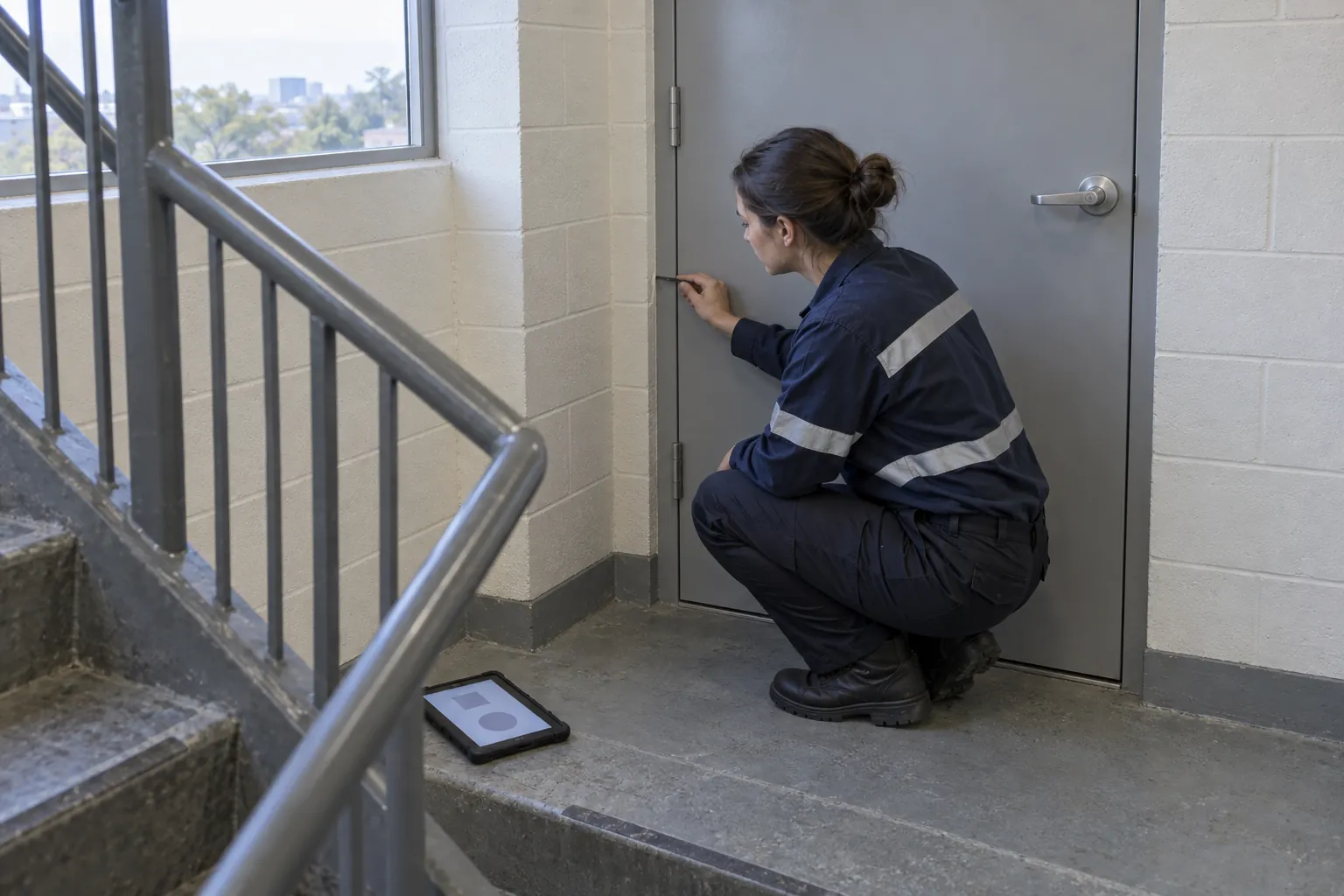
A fire door holds back fire and smoke only while every part of it still works: the leaf, the frame, the closer, the latch, the seals and the gaps. This guide covers the standards behind a fire door in Australia, what an inspection looks at, how often it happens under state law, who may carry it out, and what the owner needs to keep.
01
What a fire door inspection is, and where the duty comes from
In Australia a fire door is properly a fire-resistant doorset: the leaf, frame and hardware tested and certified together. Set in walls built as fire barriers, fire doors give occupants a way through those walls and, when closed, restrict the spread of smoke, flames and toxic gases. In commercial property and apartment buildings alike they sit on stairs, in corridors and at unit entrances.
The National Construction Code 2025 Volume One, Specification 12 (Fire doors, smoke doors, fire windows and shutters) says that a required fire door must "comply with AS 1905.1" and must not fail by radiation through any glazed part during the period specified for integrity in its required fire-resistance level (FRL). The standard it points to is AS 1905.1:2015 Components for the protection of openings in fire-resistant walls, Part 1: Fire-resistant doorsets, amended in 2016, which Standards Australia describes as setting out "requirements for the construction and installation of fire-resistant doorsets that are used to protect openings in walls, and for partitions that are required to resist the passage of fire".
Where fire doors are needed is set out in NCC 2025 Volume One, Part C4 (Protection of openings). Two examples show the pattern. Doorways opening to fire-isolated stairways, passageways or ramps "must be protected by –/60/30 fire doors that are self-closing, or automatic closing", with the automatic closing set off by a smoke detector near the doorway (clause C4D9). In a Class 2 or 3 building of Type A construction, the door from a sole-occupancy unit to a public corridor must be at least "a self-closing –/60/30 fire door" (clause C4D12).
The NCC governs how a building is built. Keeping the doors working afterwards is state and territory law, and each state words it differently:
- Victoria. Schedule 8 of the Building Regulations 2018 (Vic) lists "Fire doors (including sliding fire doors and their associated warning systems) and associated self-closing, automatic closing and latching mechanisms", and smoke doors, as essential safety measures. Regulation 226 requires the owner to keep each one "maintained in a state which enables the essential safety measure to fulfil its purpose".
- Queensland. Section 146M of the Fire Services Act 1990 (Qld) requires the occupier to "maintain at all times every prescribed fire safety installation to a standard of safety and reliability in the event of fire", and the Queensland Fire Department's Fire Doors (Fire Resistant Door sets) information sheet confirms that fire doors are one such installation.
- New South Wales. The owner certifies the building's essential fire safety measures each year through the annual fire safety statement.
Maintaining fire doors takes two kinds of work: the fire door inspection, door by door, by a competent person, usually a fire services contractor working to AS 1851 routine service or the building's maintenance schedule; and the everyday attention of the building team, who see the door wedged open or the closer that has stopped latching. This guide is mainly about the first; section 06 comes back to the second.
02
What a fire door inspection covers
An inspection looks at whether each door is still the doorset that was tested and approved to Australian Standards, and whether it will close and latch on its own, including when a hold-open device releases on the alarm. For each door the inspector works through:
- The tag. Queensland's information sheet says fire doors "need to be tagged in accordance with Australian Standard AS/NZS 1905.1", with the component standard, the fire-resistance level (for example –/60/30), the manufacturer's name, the applicant's name, the certifier, the door tag number and the year of manufacture. The inspector matches the tags on the door and frame, and reports a missing, painted-over or mismatched tag.
- The leaf. Damage, holes from removed fittings, warping, and alterations outside the tested design, with glazing intact in its correct beads.
- The frame. Secure fixing to the wall, no distortion, and no gaps between frame and wall that have not been properly sealed.
- Clearances. The gaps at the head, sides and threshold, measured against the limits for that doorset. A gap that has grown can point to a dropped hinge or a moving frame.
- Closing and latching. The door must close fully from any angle of opening and latch without help. Queensland's sheet puts it simply: "Fire doors are required to be self-closing and latching."
- Hold-open devices. Where a door is held open on a magnetic device, the inspector checks that it releases and the door closes fully when the smoke detector or fire alarm operates, as the NCC's automatic-closing clauses require.
- Hardware. Hinges, closers, locks, handles, seals, vision panels and air grilles. Queensland's sheet says all hardware components "must be tested and approved by a registered testing authority", and that every fitting added to a fire door, including a security door on a unit entrance, must comply with the door's fire rating.
- Smoke doors. Smoke doors are a separate measure with their own rules. NCC Specification 12 expects smoke seals and leaves that "return to the fully closed position after each manual opening".
- Signage. Clause D3D28 of NCC 2025 Volume One, Part D3 (Construction of exits) requires a sign on certain fire and smoke doors, in capital letters at least 20 mm high; for a self-closing door it reads "FIRE SAFETY DOOR DO NOT OBSTRUCT DO NOT KEEP OPEN". Queensland's sheet notes that signage must meet the requirements that applied when the building was approved, and recommends signs that meet the current code.
Queensland's sheet also warns that some buildings constructed before January 1990 may have fire doors with asbestos-containing thermal insulation. Where the asbestos is bonded or enclosed, the door must be on the building's asbestos register, labelled, and managed under its asbestos management plan. A door damaged so that loose asbestos is exposed must be removed by an asbestos removalist certified by WorkCover Queensland.
Inspectors also note how doors are used: a door chocked open every visit, or with its closer disconnected, points to a management problem as much as a repair.
03
How often fire doors are inspected
There is no single national frequency; the interval comes from the building's maintenance regime.
AS 1851-2012 Routine service of fire protection systems and equipment deals with fire doors in Section 12, Passive fire and smoke systems. Its contents list a clause on frequency (12.3) and routine service schedules for fire-resistant doorsets, split into hinged and pivoted doorsets and horizontal sliding doors (12.4.3), and for hinged and pivoted smoke doors (12.4.4), alongside fire shutters, fire-rated glazing and the fire and smoke barriers the doors sit in. It also covers baseline data, the labelling and schedule of doors, service records and reports. The standard is a paid document and is listed by Standards Australia as pending revision, so ask the contractor which edition and which intervals their contract uses, and check them against your own copy.
How the interval becomes binding depends on the state:
- Victoria. The occupancy permit or maintenance determination specifies the essential safety measures, and the building's maintenance schedule lists each one with its maintenance requirements: the level of performance it must achieve and "the frequency and type of inspection, testing and maintenance required" (regulation 222 of the Building Regulations 2018). Where the permit or determination names AS 1851-2005 or an earlier equivalent, the owner may comply with AS 1851-2012 instead, and must then keep to it (regulations 196 and 217); the annual essential safety measures report must say so (regulation 224).
- Queensland. The Queensland Fire Department's sheet says fire doors must be maintained under Queensland Development Code MP 6.1, "by an appropriately qualified person at adequate intervals", and that Schedule 1 of MP 6.1 outlines maintenance schedules for each building class.
- New South Wales and elsewhere. The building's fire safety schedule or certificate lists the measures and the standard of performance for each; the servicing contract usually brings in AS 1851. Check with the certifier or the state regulator if the schedule is silent.
Whatever the routine interval, arrange extra fire door inspections when:
- you take on a building with no reliable record of its doors;
- routine checks keep finding the same fault on the same doors;
- a door has been damaged, altered, or fitted with new locks or access control;
- doors or frames have been repaired or replaced, to confirm the work.
04
Who can carry out a fire door inspection
The answer is set state by state, and Queensland is the clearest. Its information sheet says an appropriately qualified person "holds a specific licence to carry out work on that particular prescribed fire safety installation", issued by the Queensland Building and Construction Commission. A licensed carpenter or joiner can install and repair fire doors, "but they cannot certify, inspect or test these doors unless they hold the Passive Fire Protection – Fire Doors and Fire Shutters licence". Locksmith work on locks, closers, seals and hinges is exempt from the definition of building work and needs no licence, though the parts fitted must still suit the door's rating.
Other states rely more on the contract and the standard's own competence requirements. Before appointing anyone, ask:
- what licence, accreditation or training the inspector holds, and whether your state requires one for this work;
- which edition of AS 1851, or which maintenance schedule, the inspection will follow;
- whether every door will be listed by its own reference and location, with photographs of defects and a clear statement of compliance or non-compliance for each.
Keep the roles apart. The contractor inspects and reports; a building surveyor or certifier decides what the building requires; the owner, or in Queensland the occupier, carries the duty and signs the annual statement or report. In a strata building the owners corporation or body corporate carries it, usually through its strata or building manager.
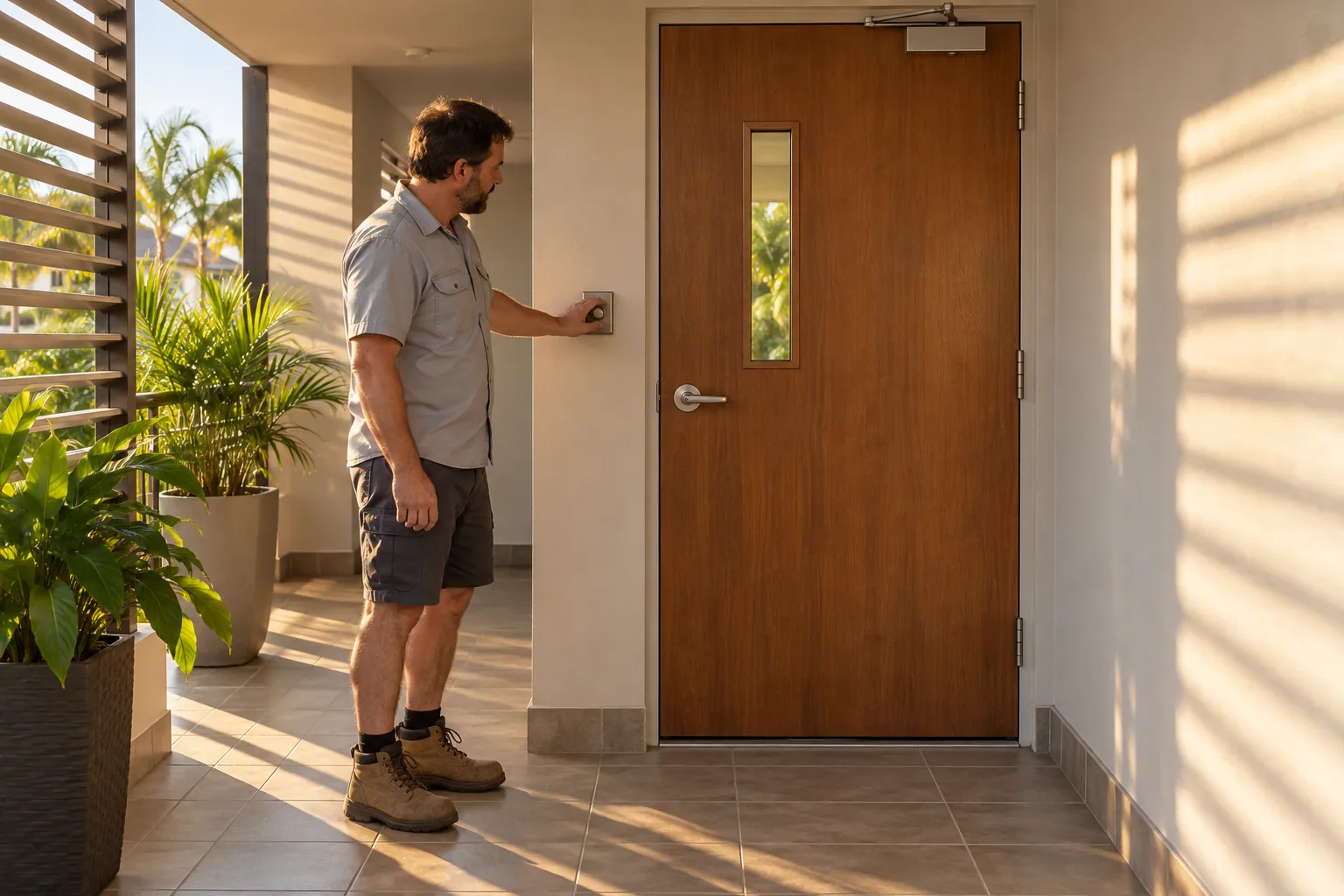
05
The report, repairs and the records the owner keeps
A useful report gives each door a reference and location that match the building, its tag details or that none were found, each defect with a photograph, whether it passed or needs adjustment, repair or replacement, and the priority. A door on a fire-isolated stair that will not latch is urgent; a faded sign can wait.
Repairs should keep the door within its certification, with compatible parts fitted by someone competent, and a replacement should be a tagged fire-resistant doorset installed to AS 1905.1. Planing a sticking door, packing a hinge or drilling for access control can reduce fire resistance without anyone noticing.
The records matter as much as the repairs, and in Victoria they are set out in law. Regulation 225 of the Building Regulations 2018 (Vic) requires the owner to make the following available at the building within 24 hours of a request by the municipal building surveyor or the chief officer:
- all annual essential safety measures reports prepared within the previous 10 years;
- all maintenance schedules for the essential safety measures;
- all maintenance determinations for the building;
- "the records of all inspections, testing and maintenance (including repairs)" of any essential safety measure.
The annual essential safety measures report, signed by the owner, must state that the owner "has taken all reasonable steps" to ensure each measure is operating and has been inspected, tested and maintained in accordance with the Act and the regulations. That statement is only as good as the fire door records behind it.
06
Where the record fails, and what SiteClara does about it
The contractor's inspection report is thorough, and arrives once or twice a year. In between, the record fails: a stair door chocked open for the cleaners' trolleys, a closer that stopped latching after a delivery, a seal a security officer mentioned to whoever was on shift. When the owner signs the annual statement or report, nothing shows whether anyone looked at the doors, or what happened to what they saw.
SiteClara records those checks at the door. A printed QR poster, with an optional NFC tag behind it, goes by each fire door or group of doors on a floor. Cleaners, security officers and building staff scan the code or tap the tag on their own phone, with no app to install, see the checks due there, such as a weekly walk of the fire stair doors, and mark each one done or explain what stopped them. The named person and the time are recorded as it happens, with a photo when one is asked for. A fault, such as a door that will not latch or a missing seal, is reported there with a photo and goes onto the team's list of jobs until someone closes it, and a supervisor can escalate it to the building manager, who can answer it.
The supervisor sees what is due, done and missed across the building, and records the reason a check was missed. Each day they review the checks and photos and approve a report that goes to nominated contacts, such as the owner's facility manager, at 8am the next morning, showing what was reported, what was completed, what is still open, and how the scheduled checks went.
07
Questions people ask
Do fire doors need to be inspected?
Yes, as part of keeping them maintained. The Queensland Fire Department's Fire Doors (Fire Resistant Door sets) information sheet says that under section 146M of the Fire Services Act 1990 "the occupier of a building must maintain every prescribed fire safety installation to a standard of safety and reliability in the event of fire. Fire doors are one such fire safety installation." It adds that "Penalties may apply for failure to maintain fire doors." Other states reach the same place through their own laws, such as Victoria's essential safety measures and the NSW annual fire safety statement.
What are the inspection requirements for fire doors in Queensland?
The same Fire Doors information sheet says fire doors must be maintained in accordance with Queensland Development Code MP 6.1, which requires building fire safety installations to be maintained "by an appropriately qualified person at adequate intervals", with Schedule 1 of MP 6.1 setting out maintenance schedules for each building class. A licensed carpenter or joiner can install and repair fire doors, but certifying, inspecting or testing them takes the QBCC's Passive Fire Protection – Fire Doors and Fire Shutters licence. Buildings approved after 1 April 1976, and fire doors replaced since, need tags fitted to the doors. To check which fire doors and other fire safety installations your building has, the sheet points to the approved plans, a building certifier or the local government's approval records.
What are the requirements for fire doors in Australia?
Clause S12C2 of NCC 2025 Volume One, Specification 12 (Fire doors, smoke doors, fire windows and shutters) says a required fire door must "comply with AS 1905.1" and must "not fail by radiation through any glazed part during the period specified for integrity in the required FRL". Part C4 of the NCC sets where fire doors are required and whether they must be self-closing or automatic closing. Once installed, the Queensland Fire Department's Fire Doors information sheet sums up what the door must do: "Fire doors are required to be self-closing and latching."
08
Further reading, and a list to take away
The Australian Building Codes Board publishes the NCC free online: Specification 12 for what a fire door must be, Part C4 for where one is required and Part D3 for the signs. Its NCC 2025 state and territory adoption information shows that NCC 2025 applies in Victoria, Western Australia and the ACT from 1 May 2026, and in New South Wales and Queensland from 1 May 2027, so check which edition applied to your building. Standards Australia sells AS 1905.1:2015 and AS 1851-2012. In Victoria, Part 15 and Schedule 8 of the Building Regulations 2018 set the owner's and occupier's duties. In Queensland, read the Queensland Fire Department's guidance for building owners and occupiers, its Fire Doors information sheet and Part 4 of Chapter 4A of the Fire Services Act 1990.
Before and after the next fire door inspection, check that:
- every fire and smoke door has a reference, a location and its tag details on a schedule;
- you know which regime applies: essential safety measures, the annual fire safety statement, or Queensland's occupier duties;
- the contract names the edition of AS 1851 or the maintenance schedule it follows;
- the inspector holds any licence your state requires, such as Queensland's fire doors and fire shutters licence;
- the report covers every door, with photographs, defects, priorities and a statement of compliance for each;
- repairs keep each door within its certification, and replacements are tagged doorsets;
- hold-open devices release on the alarm, and no door is chocked open;
- the building team checks the doors between inspections and reports faults to one named person.
Sources
Every document this guide quotes or links to, in the order it first cites them.
- National Construction Code 2025 Volume One, Specification 12 (Fire doors, smoke doors, fire windows and shutters) ncc.abcb.gov.au
- AS 1905.1:2015 Components for the protection of openings in fire-resistant walls, Part 1: Fire-resistant doorsets store.standards.org.au
- NCC 2025 Volume One, Part C4 (Protection of openings) ncc.abcb.gov.au
- Building Regulations 2018 (Vic) legislation.vic.gov.au
- Fire Services Act 1990 (Qld) legislation.qld.gov.au
- Fire Doors (Fire Resistant Door sets) information sheet fire.qld.gov.au
- NCC 2025 Volume One, Part D3 (Construction of exits) ncc.abcb.gov.au
- AS 1851-2012 Routine service of fire protection systems and equipment store.standards.org.au
- NCC 2025 state and territory adoption information ncc.abcb.gov.au
- Guidance for building owners and occupiers fire.qld.gov.au
Related guides
 Fire and water checksAS 1851 routine service: what it asks of owners, fire contractors and building teamsWhat AS 1851-2012 routine service covers, how intervals and competent persons work, what the records must show, and how Victoria's regulations call it up.
 Fire and water checksEssential safety measures in Victoria: the duties, the annual report and the recordsWhat essential safety measures are under Victoria's Building Regulations 2018, who maintains them, the annual ESM report, the records to keep and the checks between.
 Fire and water checksThe annual fire safety statement: what a NSW building owner declares, and how to make it trueWhat a NSW annual fire safety statement declares, which buildings need one, the 3-month assessment window, lodging and display, and the checks that make it true.
 Fire and water checksFire safety logbook: what to record, who keeps it and for how longWhat a fire safety logbook should hold in Australia: AS 1851 service records, Victoria's ESM records, the NSW fire safety statement and Queensland's rules.