Cleaning
Bin room cleaning: who is responsible, what to do, and how to show it was done
Garbage room cleaning is the regular cleaning of a building's bin room, chute rooms and bins: picking up spilt rubbish, hosing the floor down to the drain, washing the bins, walls and doors, and reporting pests, faults and dumped items, every day or after each collection in a busy building and weekly or fortnightly in most apartment blocks.
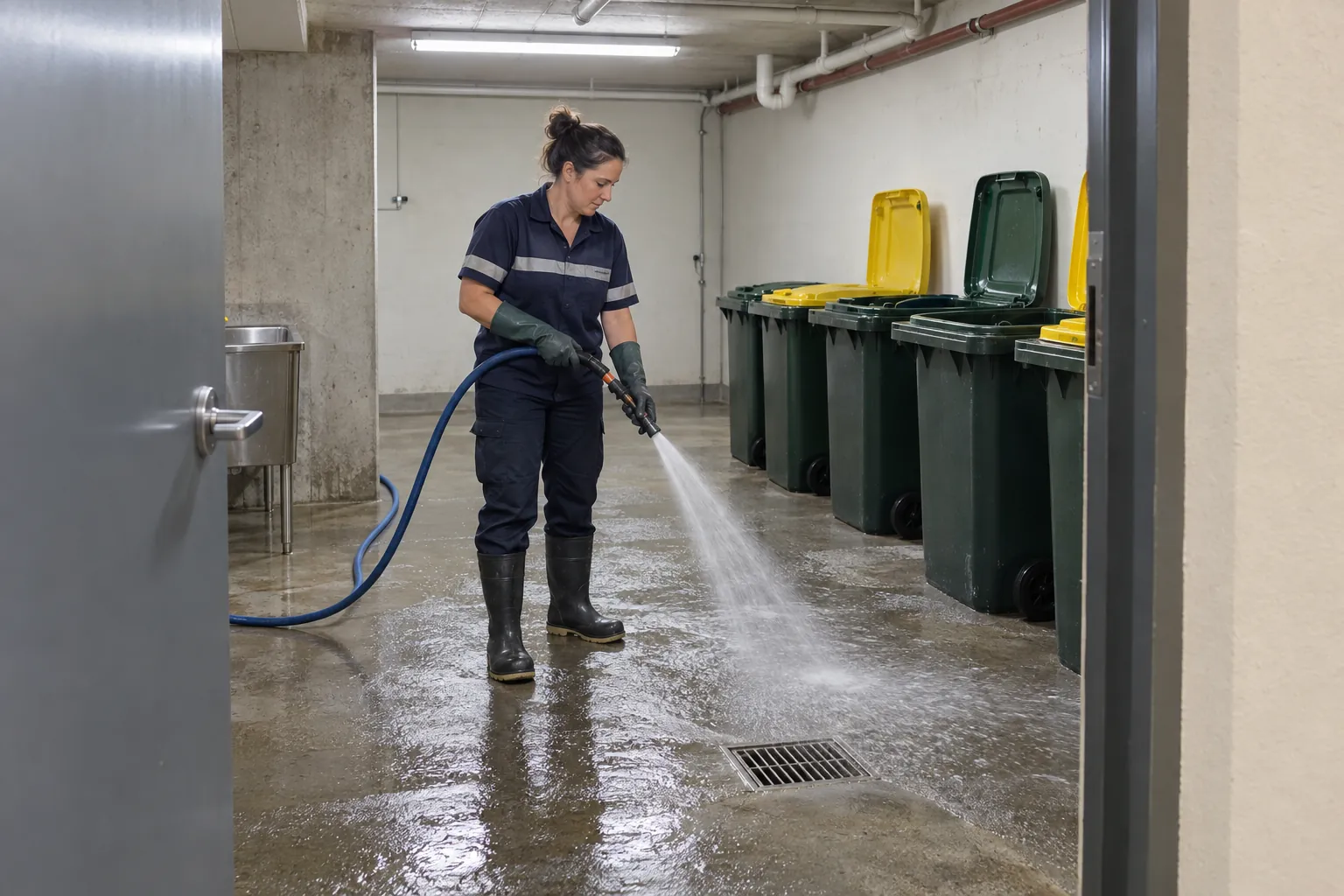
The bin room is the part of a building everyone uses and nobody wants to own. In an apartment block it is common property, in an office tower it sits behind the loading dock, and in a shopping centre it serves every food tenant at once. When it is looked after, nobody notices. When it is not, the smell reaches the lift lobby, the cockroaches reach the café, and the council's waste truck leaves without emptying a bin that was blocked in. This guide covers who is responsible for garbage room cleaning in Australia, what the job includes, how often, how to do it safely, and what a record worth trusting looks like.
01
Who is responsible for the bin room
No Australian law is titled bin room cleaning. The duty comes from the law on who looks after the building, the law protecting the people who work in it, and the council's conditions on the building's approval.
Strata buildings. In New South Wales the owners corporation must maintain and repair common property, and in most strata schemes the garbage room, the chute rooms and the bin bay are common property. NSW Fair Trading's Common Property Repairs and Maintenance Compliance and Enforcement Policy (version 1.0, October 2025) explains that section 106 of the Strata Schemes Management Act 2015 (NSW) places a statutory duty on owners corporations to properly maintain and repair common property, and that the NSW Civil and Administrative Tribunal (NCAT) can award damages for a failure to comply. Each scheme's by-laws set the rules for residents (the NSW Government's page on strata by-laws points to the model by-laws in Schedule 3 of the Strata Schemes Management Regulation 2016). In Queensland, the page on body corporate maintenance responsibilities states that a body corporate must maintain the common property in a good and structurally sound condition. Victoria calls it an owners corporation.
Workplaces. Anyone running a business or undertaking (a PCBU) has duties under work health and safety law for the facilities its workers use. Regulation 41 of the Work Health and Safety Regulations 2011 (Cth), which follow the national model, requires a PCBU to ensure, so far as is reasonably practicable, that facilities for workers are maintained in good working order and are clean, safe and accessible. Each state and territory has adopted the model law as its own, except Victoria, which has the Occupational Health and Safety Act 2004 and its 2017 regulations, with WorkSafe Victoria's Compliance code: Workplace facilities and the working environment (December 2023) covering how to maintain, clean and monitor workplaces.
Council conditions. A development approval for a large building usually comes with a waste management plan, and the council's own guidelines shape it. The City of Sydney's Guidelines for Waste Management in New Developments are a clear example. For residential buildings they say that responsibility for regular cleaning of waste and recycling storage areas (including mobile garbage bins) and transfer of bins rests with the managing body and is to be detailed in the Waste and Recycling Management Plan; that all waste and recycling storage areas, chute rooms and access paths are to be kept clean and free of obstructions at all times; and that bin cleaning will be conducted on a regular basis by the managing body. For commercial buildings they say that contracts with cleaners, building managers and tenants are to clearly outline the waste management and collection system and allocate responsibilities. Other councils publish their own rules; check the one that approved your building.
Food tenants. Where a café, restaurant or food court uses the room, the food business has duties of its own. Standard 3.2.3 Food Premises and Equipment of the Australia New Zealand Food Standards Code (which applies in Australia only) requires food premises to have facilities for the storage of garbage and recyclable matter that adequately contain the volume and type of waste, enclose it if this is necessary to keep pests and animals away from it, and are designed and constructed so that they may be easily and effectively cleaned. Where a shared room serves food tenants, the landlord's cleaning arrangements and the tenants' obligations meet in the same few square metres, so agree in the lease or the tenancy rules who cleans what.
02
What a garbage room clean covers
A bin room is built to be washed. Council design rules expect floors, walls and ceilings of a smooth, non-absorbent finish that is easy to clean, a floor graded to a drain, a hose cock for water, and ventilation and lighting. Inner West Council's requirements for residential shared bin storage areas, for example, call for floors graded and drained to a Sydney Water approved drainage fitting and bin washing facilities including a bin wash bay with hot and cold taps. A clean uses those features. The work usually includes:
- Floor: sweeping up spilt rubbish and glass, scraping up anything stuck, then hosing or scrubbing down to the floor waste and squeegeeing dry so the room is not left slippery.
- Bins: the lids, handles and outsides wiped or washed, and the insides washed after collection, with bins that are cracked, missing a lid or missing a wheel reported for replacement.
- Walls, doors and ceiling: splashes and smears washed off, especially behind the bins and around the chute discharge, with the door and its self-closer checked.
- Chute rooms and hoppers: the hopper door and surrounds on each floor wiped, anything left beside the chute removed, and blockages reported.
- Drains: the floor waste grate cleared of debris so wash water can leave the room.
- Odour and pests: signs of cockroaches, rats or birds noted and reported, so the pest contractor visits the room and not only the rest of the building.
- Dumped items: mattresses, furniture, e-waste, paint and anything else that is not general waste or recycling moved out of the way and reported, so it can be booked for collection or removed.
- Signage and access: bin labels and posters kept legible, and the route to the collection point kept clear and lit.
A good specification separates the routine clean from bin washing, often done by a specialist contractor, and from bin transfer to the kerb or loading dock and back. Each is often done by a different person, and the record should show each one.
03
How often a bin room should be cleaned
No regulation sets a frequency. The Code of Practice: Managing the work environment and facilities (SafeWork NSW, August 2019, based on the national model code) gives the principle: workplaces and facilities should be cleaned regularly, taking into account the type of work performed, the likelihood of contamination, the number of workers using them and the type of facility. Its housekeeping section adds that spills on floors should be cleaned up immediately and that containers for waste should be conveniently located and regularly emptied. The frequency follows from the building:
- Every day in a busy building, and more often with food tenants: a walk-through to pick up spilt rubbish, check the floor and door, and move anything dumped.
- After each collection: the floor swept and hosed while the room is emptiest, the drain grate cleared, and the bins returned to their places.
- Weekly or fortnightly in most residential buildings: a full wash of the floor, the lower walls and the outsides of the bins, and a wipe of each chute hopper.
- On a longer cycle, set in the contract: bin washing inside and out, a full wash of walls and ceiling, degreasing where food waste is stored, and a chute clean by a specialist.
- At once, whenever it happens: a burst bag of food waste, a leaking bin, a broken bottle or a sharps find.
Tie regular cleaning to the collection days. Cleaned after collection, a room stays cleaner for longer and the bins can be washed while empty. Summer heat and a public holiday that shifts the collection both change the pattern.
04
Who does what, and doing it safely
Garbage rooms go wrong at the handovers between people. In a strata building the owners corporation is responsible, the strata manager arranges contracts, a building manager or caretaker runs the day-to-day, a contractor cleans and the council or a private contractor empties the bins. Write it down: who cleans the room, who washes the bins, who takes the bins out and brings them back, who removes dumped items, who calls the pest contractor, and who reports a fault. The City of Sydney guidelines expect exactly this allocation to be clear in the contracts.
The work itself carries real risks, and the cleaning company as a PCBU must manage them, working with the building's own PCBU where their duties overlap:
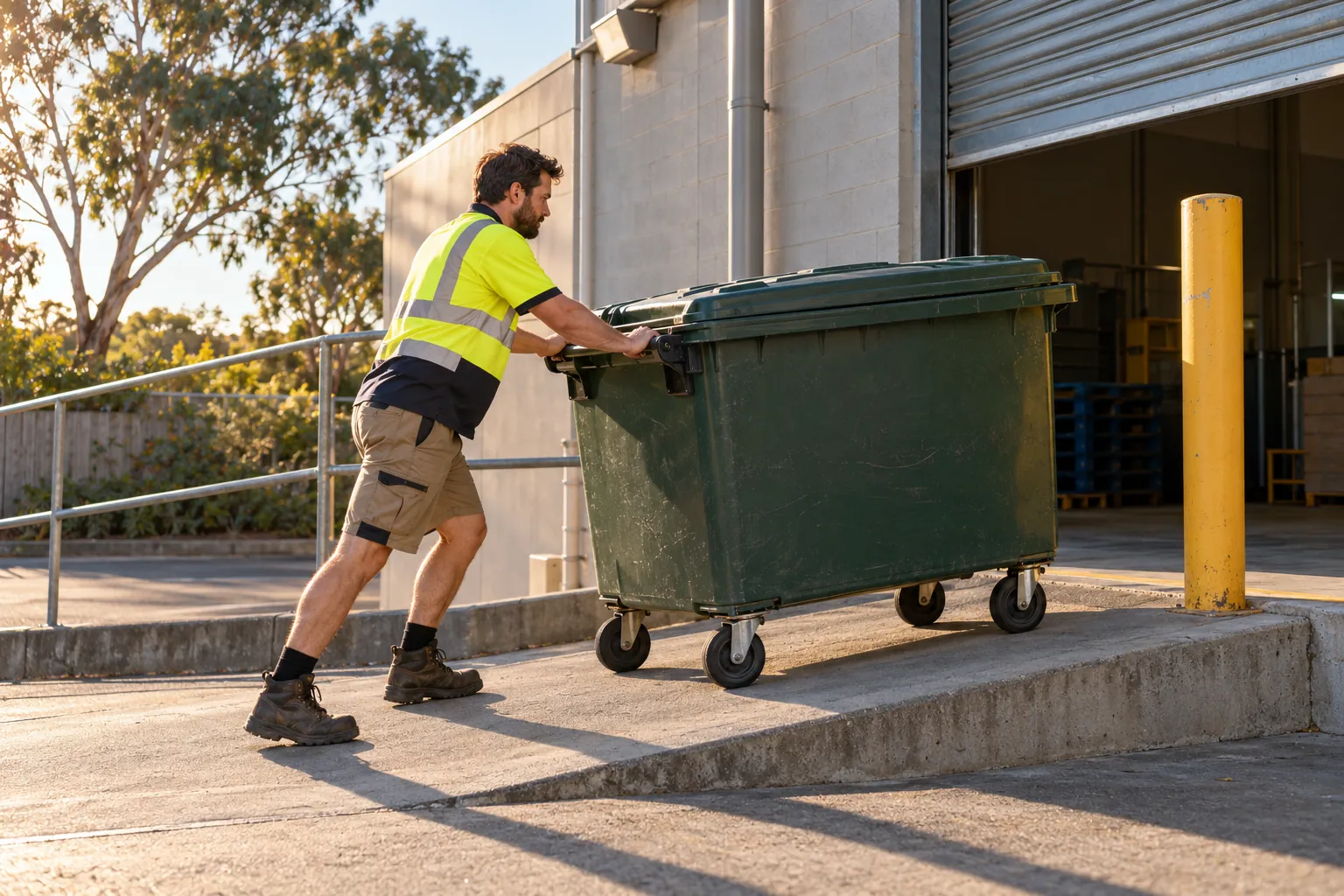
- Moving bins. A full bulk bin is heavy and hard to start and stop, particularly on a ramp. The Code of Practice: Hazardous manual tasks (SafeWork NSW, August 2019) lists pushing or pulling an object that is hard to move or stop as an example of high force. It says pushing loads is preferable to pulling, suggests motorised push or pull equipment such as tugs, and asks for equipment to be well maintained. Worn castors, a steep ramp and a narrow door are reasons to change the task, not to try harder.
- Slips. A hosed floor is wet, and food waste makes it greasy. Squeegee to the drain, put out a wet floor sign, and report a floor waste that does not drain.
- Chemicals. Detergents, degreasers and disinfectants need their safety data sheets and the right gloves and eye protection, and must never be mixed.
- Sharps. Needles turn up in bin rooms, in bags and on the floor. Nobody should compress a bag with their hands or feet. In New South Wales, NSW Health's community sharps management page says that if you have found a sharp that does not belong to you, do not touch it, and to call the NSW Needle Clean Up Hotline on 1800 633 353 to organise its safe removal. Other states have their own services; put the local arrangement in the cleaner's instructions.
- Working alone and out of hours. Lighting, a door that opens from inside and a way to call for help are part of the job.
- Compactors and chutes. Only trained people should clear a chute or touch a compactor, and never while it can operate.
Wash water is the last trap. The room drains to the sewer for a reason; hosing it out across the loading dock sends food scraps and detergent towards the stormwater pit, which is meant for rain.
05
What good evidence looks like
When the smell reaches the lobby or a resident complains to the strata committee, the question is the same: when was it last cleaned, and by whom? A useful record answers it for each room:
- Which room, named the way the building uses it: Basement 1 garbage room, Level 4 chute room, the loading dock bin bay.
- What was done: the routine clean, the post-collection wash, the bin wash, the bin transfer.
- When, as a date and time recorded at the time, not filled in at the end of the week.
- Who, as a named person, not a company.
- What was found: a broken bin, a failed light, a door that will not close, a blocked drain, signs of pests, dumped items, a sharps find, with a photo where it helps.
- What happened next: who the problem went to, and when it was put right.
Photographs help most in bin rooms, because the condition changes so quickly. A photo taken after the post-collection wash settles an argument that a written tick cannot.
06
Where the bin room record fails, and what SiteClara does about it
Bin room records usually fail in three ways. The sheet on the garbage room door is ticked for the week in one sitting. The fortnightly bin wash quietly becomes monthly, and nothing shows when. And the broken bin lid or the mattress dumped by the door is mentioned to the caretaker in passing, then again by a resident a week later.
SiteClara records the checks at the location. A printed QR poster, with an optional NFC tag behind it, sits at each place a check is scheduled, for example each garbage room, each floor's chute room and the loading dock bin bay. Cleaners and other staff scan or tap on their own phone, with no app to install, see the checks due there, and mark each one done, or say what stopped them, at the time and in the place. The time and the named person are recorded as it happens, with a photo when one is asked for, so the post-collection wash can carry its photograph. A problem found there, such as a broken bin, a blocked drain, a failed light or dumped furniture, is reported with a photo and goes onto the team's list of open jobs until someone closes it.
The supervisor sees what is due, done and missed in each room, records the reason a check was missed, adds a note and approves a daily report that goes to nominated management or client contacts the next morning. For a strata committee or a facilities manager, the bin room is cleaned twice a week becomes a dated record of each clean in each room, and I told the caretaker about the bin becomes a job with a place, a time, a name and a photo.
07
Further reading, and a list to take away
Start with your state's strata guidance (in NSW, the Common Property Repairs and Maintenance Compliance and Enforcement Policy), your council's waste guidelines (the City of Sydney's Guidelines for Waste Management in New Developments are a detailed model), and the codes of practice for the work: Managing the work environment and facilities and Hazardous manual tasks, or WorkSafe Victoria's compliance code in Victoria.
Before you agree or review a bin room cleaning arrangement, check that:
- every garbage room, chute room and bin bay in the building is listed by name;
- the routine clean, the post-collection wash, bin washing and bin transfer each have an owner and a frequency;
- the schedule follows the collection days and changes when they change;
- the contracts with cleaners, the building manager, tenants and the waste contractor say who does what, as the council's waste management plan expects;
- moving full bins, chemicals, sharps and working alone are covered in the cleaner's safe work method or risk assessment;
- wash water goes to the floor waste, not the stormwater;
- faults, pests and dumped items have a way to be reported on the spot, and someone who closes them;
- the record shows each clean in each room, with a time and a name, and photos where they help;
- someone compares the record with the contract at least every few months.
Sources
Every document this guide quotes or links to, in the order it first cites them.
- Common Property Repairs and Maintenance Compliance and Enforcement Policy nsw.gov.au
- Page on strata by-laws nsw.gov.au
- Body corporate maintenance responsibilities qld.gov.au
- Work Health and Safety Regulations 2011 legislation.gov.au
- Compliance code: Workplace facilities and the working environment worksafe.vic.gov.au
- Guidelines for Waste Management in New Developments cityofsydney.nsw.gov.au
- Standard 3.2.3 Food Premises and Equipment legislation.gov.au
- Residential shared bin storage areas innerwest.nsw.gov.au
- Code of Practice: Managing the work environment and facilities safework.nsw.gov.au
- Code of Practice: Hazardous manual tasks safework.nsw.gov.au
- Community sharps management health.nsw.gov.au
Related guides
 Premises and facilities managementStrata maintenance: keeping common property in repair, and showing that you haveStrata maintenance in Australia: the duty to repair common property in NSW, Victoria and Queensland, the plans a scheme needs, who does what and the records to keep.
 CleaningCar park cleaning: what to clean, how often, and how to show it was doneCar park cleaning in Australia: the WHS and OHS duties, what to clean and how often, working safely among traffic, wash water, and a record worth trusting.
 CleaningCleaning log sheet: what to record, who signs it, and what a signature provesWhat a cleaning log sheet should record in Australian workplaces and food businesses, the WHS and food safety rules behind it, and what a signature proves.
 CleaningCommercial cleaning checklist: area by area, and how to know it is followedA commercial cleaning checklist for Australian offices and shared buildings, area by area, with the WHS duties behind it and how a supervisor checks it is followed.