Cleaning
Car park cleaning: what to clean, how often, and how to show it was done
Car park cleaning is the regular sweeping, scrubbing, litter picking, spill treatment and drain clearing that keeps a car park's bays, ramps, stairwells and lift lobbies clean and safe for the people who park and work there.
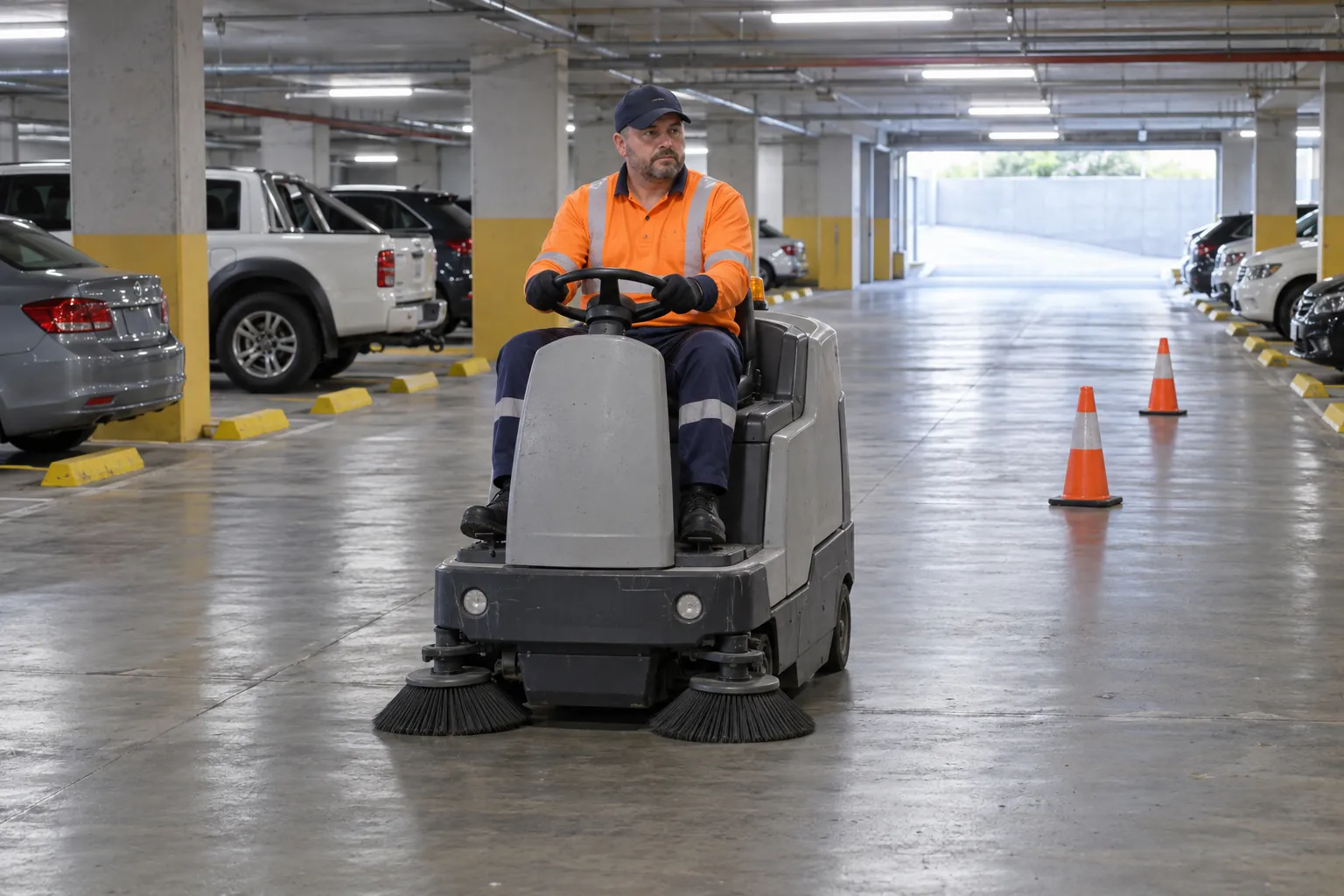
A car park is the first and last part of a building many people see each day, and one of the easiest to neglect. Oil stains spread, leaves block the drainage pits, a stairwell becomes somebody's toilet, and a light that went out in winter is still out in spring. It is ordinary work done in an unusual workplace: among moving vehicles, often at night, often alone, and next to a stormwater drain. This guide covers the work health and safety duties behind it in Australia, what a commercial car park clean should include, how often, how to do it safely and lawfully, and what a record worth trusting looks like.
01
The duty behind car park cleaning
No Australian law sets a cleaning frequency for a car park. The duty is the outcome: the car park is a workplace for the cleaners, security officers and attendants who work in it, and it has to be kept without risks to health and safety so far as is reasonably practicable, for them and for the tenants, customers and visitors who park there.
In every state and territory except Victoria, the model work health and safety laws apply (in Western Australia as the Work Health and Safety Act 2020, in force since 31 March 2022). Section 20 of the Work Health and Safety Act 2011, quoted here from Queensland's Work Health and Safety Act 2011, says that the person with management or control of a workplace "must ensure, so far as is reasonably practicable, that the workplace, the means of entering and exiting the workplace and anything arising from the workplace are without risks to the health and safety of any person". For a car park, that person is usually the building owner, the owners corporation or body corporate, or the car park operator under its lease, and often more than one of them. One exception: a strata body corporate whose common areas are used only for residential purposes may be taken not to be a person conducting a business or undertaking for those areas unless it engages a worker as an employee (regulation 7 of the model regulations), though the cleaning contractor still owes its own duties to its cleaners.
Regulation 40 of the model regulations turns that into specifics. In Queensland's Work Health and Safety Regulation 2011 (the version current from 29 March 2026), a person conducting a business or undertaking at a workplace must ensure, so far as is reasonably practicable, that people can "enter and exit and ... move about without risk to health and safety, both under normal working conditions and in an emergency", that "floors and other surfaces are designed, installed and maintained to allow work to be carried out without risk to health and safety", and that lighting lets people move about and evacuate safely. An oil slick on a ramp, a pond at the lift lobby and a dark stairwell are each a regulation 40 problem before they are a cleaning problem.
The approved code of practice spells out the housekeeping. SafeWork NSW's version of the code of practice Managing the work environment and facilities (August 2019), based on Safe Work Australia's model code, says "the work environment must be maintained so that it remains in a clean and safe condition", that "floors must be inspected regularly and maintained to eliminate or minimise slip and trip hazards", that "spills on floors should be cleaned up immediately", and that "adequate lighting after dark may be required for outdoor paths around the workplace and car parks".
Section 46 of the Act matters more in a car park than almost anywhere. Where more than one person has a duty about the same matter, each must "consult, cooperate and coordinate activities" with the others. The owner, the strata or facility manager, the car park operator, the cleaning contractor and the security provider all touch the same concrete, so somebody has to write down who cleans what, and who fixes what the cleaners find.
02
What a car park clean covers
A useful car park specification lists the places and the items, not just "carpark cleaned". Most car parks, whether a basement under an office tower, a multi-deck at a shopping centre or retail park, or an open-air lot at a hospital, have the same parts:
- Parking bays and aisles: litter, leaves, glass, cigarette butts and sand swept or scrubbed; wheel stops and speed humps kept clear so they can be seen.
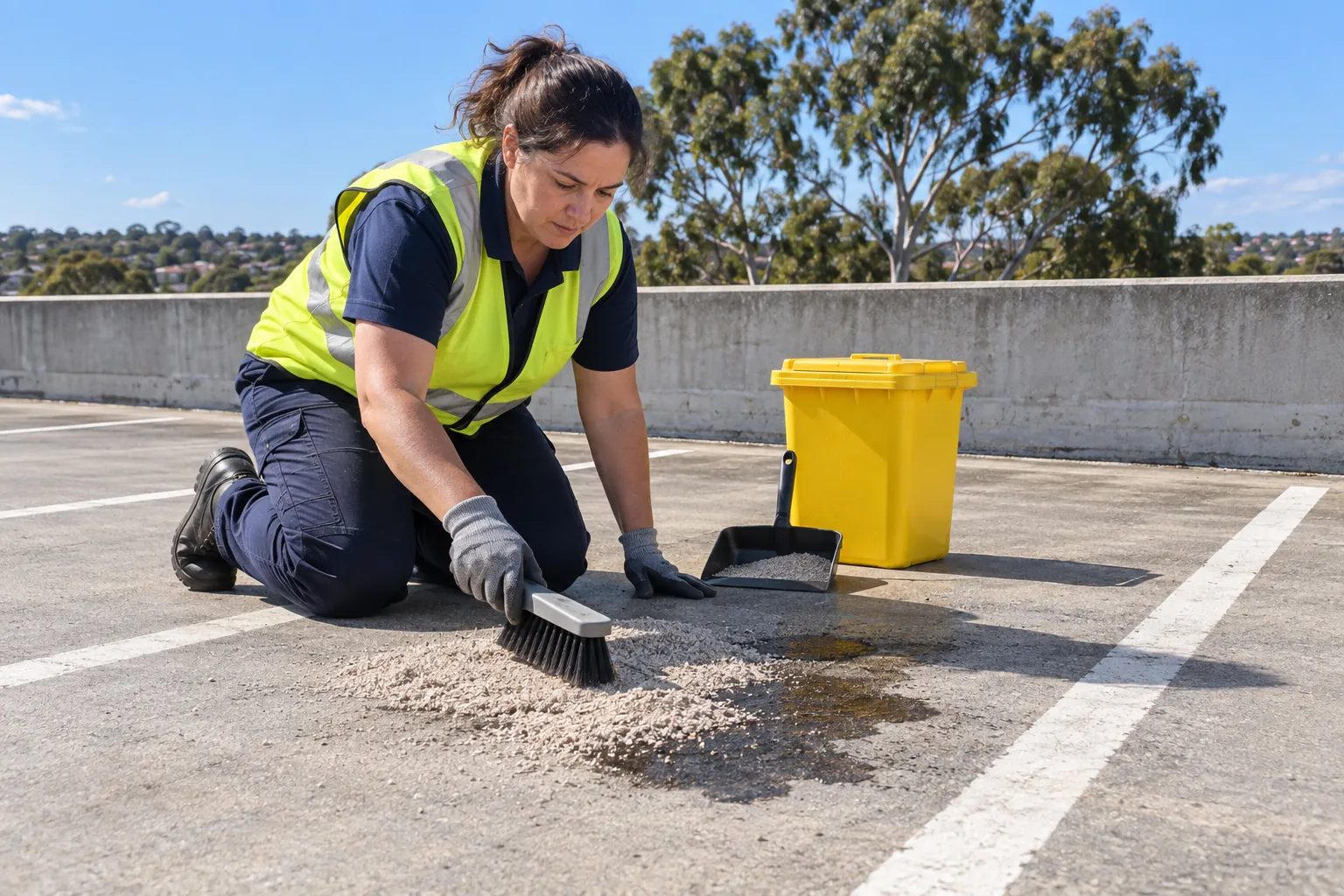
- Oil and fluid spills: fresh drips and leaks from parked vehicles, coolant and fuel spills, treated with absorbent the same day, and stained bays scrubbed periodically.
- Ramps and entries: the surfaces most likely to be wet, oily or covered in tyre dust, and the places a slip or a skid does most harm.
- Drainage: grates, pits, spoon drains and silt arrestors cleared of leaves and rubbish, so rain and wash water go where they are meant to and do not pool at doors and lift lobbies.
- Lift lobbies, stairwells and fire stairs: swept, mopped and spot cleaned, handrails wiped. They are exit paths, so nothing may be stored in them.
- Pay stations, boom gates and intercoms: screens and buttons wiped.
- Trolley bays, bin enclosures and waste points: litter bins emptied, bin areas washed, overflow cleared.
- Signage and line marking: wiped where grime hides a speed or height sign; faded marking reported rather than cleaned over.
- Walls, columns and ceilings: cobwebs, dust and bird droppings removed at high level on a periodic cycle; graffiti reported and removed.
- Lights, barriers and fittings: noticed rather than cleaned. A cleaner walks every aisle, so a failed light, damage to a barrier or column, or a lifted drain cover should be reported from the round.
Car parks also produce things a cleaner should not deal with alone: needles and syringes, human waste, broken glass on a ramp, abandoned property, or a person sleeping in a stairwell. The specification should say who the cleaner calls in each case and how to make the area safe meanwhile.
03
How often: building a car park cleaning schedule
Frequency follows use and risk. A shopping centre car park needs litter patrols through trading hours; a basement under a small office may need a daily walk and a weekly sweep. A starting point, to adapt to the site:
- Every day, or through the day in busy car parks: a litter and hazard round of every level; fresh spills treated; lift lobbies and stairwells swept and spot cleaned; bins emptied; pay stations and lift buttons wiped.
- Weekly: aisles and ramps swept, by hand or with a ride-on sweeper; drainage grates cleared; stairwells mopped; handrails cleaned; bin enclosures washed down to a drain connected to sewer, never to stormwater.
- Monthly: stained bays degreased; walls and columns spot cleaned at low level; signage and line marking wiped; pits and silt arrestors inspected.
- Quarterly to yearly: a full scrub or pressure clean of each level with the wash water captured; high-level dusting of ceilings, pipes, cable trays and light fittings; a joint inspection by the client and the provider.
- After events: storms, leaf fall, a public event, a vehicle fire or a major leak, each with its own clean and a note of what happened.
Open-air car parks add weather: leaves and sand after wind, pooled water after rain. Basements add exhaust dust, darker corners and poorer air. Write the schedule by level and zone, so each round has a defined start and end, rather than "the car park" as one task that is easy to report as done when half of it was.
Timing matters as much as frequency. Machine and wet work is safer when the car park is quiet, but a quiet car park at 2 am is also where lone work risks are highest. Many sites clean by machine early in the morning, run litter and spill rounds through the day, and keep water on the ramps for the lowest-traffic window.
04
Doing the work safely and lawfully
Car park cleaners work in a traffic area. WorkSafe Victoria's guidance on safety in workplace car parks names the risks as slips, trips and falls, collisions with structures, vehicles or pedestrians, temperature and airborne contaminants such as carbon monoxide and diesel exhaust, and occupational violence and aggression. Its controls include physical barriers or "clearly marked and adequate walkways and pedestrian crossings", pathways, entries and exits that are "slip-resistant under wet and dry conditions", and "systems for identifying and removing oil leaks, pooled water, rubbish or debris". For the cleaner, that means:
- Being seen: high-visibility clothing, cones or barriers around the work area, flashing beacons on sweepers and scrubbers, and working with the traffic flow, not against it.
- Traffic management: closing a lane or level for machine or wet work where practicable, agreed with the operator, and never working a blind ramp or corner without barriers or a spotter.
- Wet floors: signs out before the floor is wet and removed once it is dry; ramps and entries left dry at opening time.
- Air quality: in enclosed basements, limit time near idling vehicles and check the ventilation is running; many sites choose battery-powered sweepers and scrubbing equipment underground.
- Chemicals: degreasers and absorbents chosen for the surface, with the safety data sheet on hand and the right gloves and eye protection.
- Sharps and waste: tongs and a rigid sharps container for needles, a procedure for human waste, and no picking up by hand.
- Working alone: a way to call for help and a check-in routine for anyone cleaning a car park alone at night.
That last point is a legal duty. Regulation 48 of the model regulations requires a person conducting a business or undertaking to manage the risks of remote or isolated work, work "isolated from the assistance of other persons because of location, time or the nature of the work", including "a system of work that includes effective communication with the worker". The code of practice gives "a cleaner working by themselves at night in a city office building" as an example.
Wash water is the other trap. As the NSW Environment Protection Authority's The drain is just for rain explains, stormwater "runs through an underground system of pipes and eventually flows directly into local rivers and creeks, untreated and unfiltered". The guidance says that "when undertaking any kind of washing activity, the runoff water must not enter any stormwater drains", that washing belongs in a wash bay draining to sewer under a trade waste agreement approved by the local council, and that "spills should be cleaned up immediately by dry methods". In practice: sweep and absorb before using water, capture pressure cleaning water with a recovery unit, and know which drains go to sewer and which to stormwater. In most cities the trade waste agreement is with the water utility rather than the council. Other states have their own environment protection laws, so check your state's rules and your council's or water utility's before the first wash-down.
05
The specification, the evidence and the check
Most arguments about car park cleaning are arguments about scope, whether the cleaning services come from a contractor or from the building's own team. A car park clause in a cleaning contract works best when it says, for each level or zone:
- which areas are included (bays, aisles, ramps, lobbies, stairwells, pay stations, bin areas, drainage), and which are someone else's (line marking, lighting repairs, pit pump-outs and other building maintenance, graffiti on the street frontage);
- the tasks and their frequency, as above, and the times of day they happen;
- the standard to be met, in words a walk-through can test: "no litter larger than a bottle cap in any bay", "no standing water at lift lobby doors";
- what the cleaner reports rather than fixes, and to whom;
- the response time for a reported spill or hazard during operating hours;
- how the method deals with traffic, lone work and wash water.
Good evidence is specific to a place and a time: for each round, which levels and zones were done, when and by whom; what was found (a spill treated, a light out, a needle collected); and what happened to each thing reported. A before and after photograph earns its place for a large spill or a reported defect, because it settles the later question of what was there and when.
The client's check should not rely on the provider's paperwork alone. Walk a sample of levels at different times and compare what you see with what was recorded for that level that day, starting where neglect shows first: drainage grates, stairwell corners and the far end of the lowest basement. Keep each reported defect open until it is fixed, and review the list at the contract meeting alongside any cleaning checklist for the rest of the building.
06
Where the car park record fails, and what SiteClara does about it
Car park cleaning usually fails in the record before it fails on the concrete. The sheet in the cleaners' store says "car park – daily" with a tick for each day, filled in on Friday. Nobody can say whether level B3 was walked on Tuesday, when the ramp spill was reported, or who saw the light out by the stairwell door.
SiteClara records the work at the location. A printed QR poster, with an optional NFC tag behind it, sits at each point where a check is scheduled, for example each level's lift lobby, the ramp, the bin enclosure or the stairwell. Cleaners and other staff scan or tap on their own phone, with no app to install, see the checks due there, and mark each one done, or say what stopped them, at the time and in the place. The time and the named person are recorded as it happens, with a photo when one is asked for. A spill, a failed light, a blocked pit or a needle is reported there with a photo, and goes onto the team's list of open jobs until someone closes it.
The supervisor sees what is due, done and missed at each level, records the reason a check was missed, adds a note and approves a daily report that goes to nominated management or client contacts the next morning. "Car park – daily" becomes a dated record of each round at each level, and "I told someone about the light" becomes a job with a location, a time, a name and a photo.
07
Questions people ask
How do you clean a car parking area?
Dry first, then wet, and keep the water out of the stormwater. Sweep litter, leaves and grit, treat oil and fluid spills with absorbent, and only then scrub or pressure clean, level by level. The NSW Environment Protection Authority's The drain is just for rain says "spills should be cleaned up immediately by dry methods" and that "when undertaking any kind of washing activity, the runoff water must not enter any stormwater drains", so wash water from a scrubber or pressure cleaner is recovered, or sent to sewer only under a trade waste agreement with the local council or water utility. The schedule earlier in this guide sets out which tasks to do daily, weekly and periodically.
Is it legal to wash my car in my driveway in Victoria?
EPA Victoria's Stormwater page does not single out driveway washing, but it puts a duty on the wash water. It says the general environmental duty applies to activities that may affect stormwater, and that everyone "must eliminate or reduce risk of harm and prevent waste from entering stormwater drains so far as reasonably practicable", which "includes wastewater". Its advice for households is to "wash your car on the grass or at a car wash that recycles the water". The same duty applies to a business washing down a car park, with far more water and oil involved.
Is it legal to wash my car in my driveway in Queensland?
Washing is not the offence; letting the wash water reach the gutter or a stormwater drain can be. Section 440ZG of Queensland's Environmental Protection Act 1994 says a person must not unlawfully deposit a prescribed water contaminant "in a roadside gutter or stormwater drainage", or somewhere it "could reasonably be expected to wash, blow, fall or otherwise move" there. Schedule 10 of the Environmental Protection Regulation 2019 lists oil among those contaminants, and waste water "generated from outdoor cleaning", including "high pressure water blasting of commercial or industrial premises" and of vehicles. For a car park, that means sweeping and absorbing first and capturing the wash water.
How much should I pay a cleaner an hour?
At least the award minimum. Cleaners employed in the contract cleaning services industry are covered by the Cleaning Services Award 2020, whose minimum hourly rates from the first full pay period on or after 1 July 2026 are $27.08 at level 1, $27.97 at level 2 and $29.45 at level 3, before the 15% part-time allowance, the 25% casual loading and any penalty rates the award sets for the hours worked. One detail matters in car parks: the award's minimum shift lengths depend on the "cleaning area", which it defines as the area the employer is contracted to clean "but excluding car parks".
08
Where to read the official guidance, and a short list to take away
Start with your state or territory's Work Health and Safety Act and Regulations (the 2011 Act, or the Work Health and Safety Act 2020 in Western Australia; sections 20 and 46 of the Act, regulations 40 and 48), the code of practice Managing the work environment and facilities, and in Victoria the Compliance code: Workplace facilities and the working environment. For wash water, read The drain is just for rain or your own state's equivalent, and ask your local council or water utility about trade waste.
To take away:
- Agree in writing who has management or control of the car park, and who cleans, repairs and reports what.
- Write the schedule by level and zone, with daily, weekly, monthly and periodic tasks and the time of day for each.
- Treat spills the same day with dry methods, and keep wash water out of stormwater pits.
- Plan machine and wet work for quiet periods, with high-visibility clothing, barriers and signs.
- Give anyone cleaning alone at night a way to call for help and a check-in routine.
- Tell cleaners what to do about needles, human waste, abandoned property and people sleeping rough.
- Record each round at each level with a time and a name, and keep every reported defect open until it is fixed.
- Walk a sample of levels at different times and compare what you see with what was recorded.
Read more in our guides to shopping centre cleaning, graffiti reporting and removal and strata common property maintenance.
Sources
Every document this guide quotes or links to, in the order it first cites them.
- Queensland's Work Health and Safety Act 2011 legislation.qld.gov.au
- Queensland's Work Health and Safety Regulation 2011 legislation.qld.gov.au
- The code of practice Managing the work environment and facilities safework.nsw.gov.au
- Occupational Health and Safety Act 2004 legislation.vic.gov.au
- Compliance code: Workplace facilities and the working environment worksafe.vic.gov.au
- Safety in workplace car parks worksafe.vic.gov.au
- The drain is just for rain epa.nsw.gov.au
- Stormwater epa.vic.gov.au
- Environmental Protection Act 1994 legislation.qld.gov.au
- Environmental Protection Regulation 2019 legislation.qld.gov.au
- Cleaning Services Award 2020 awards.fairwork.gov.au
Related guides
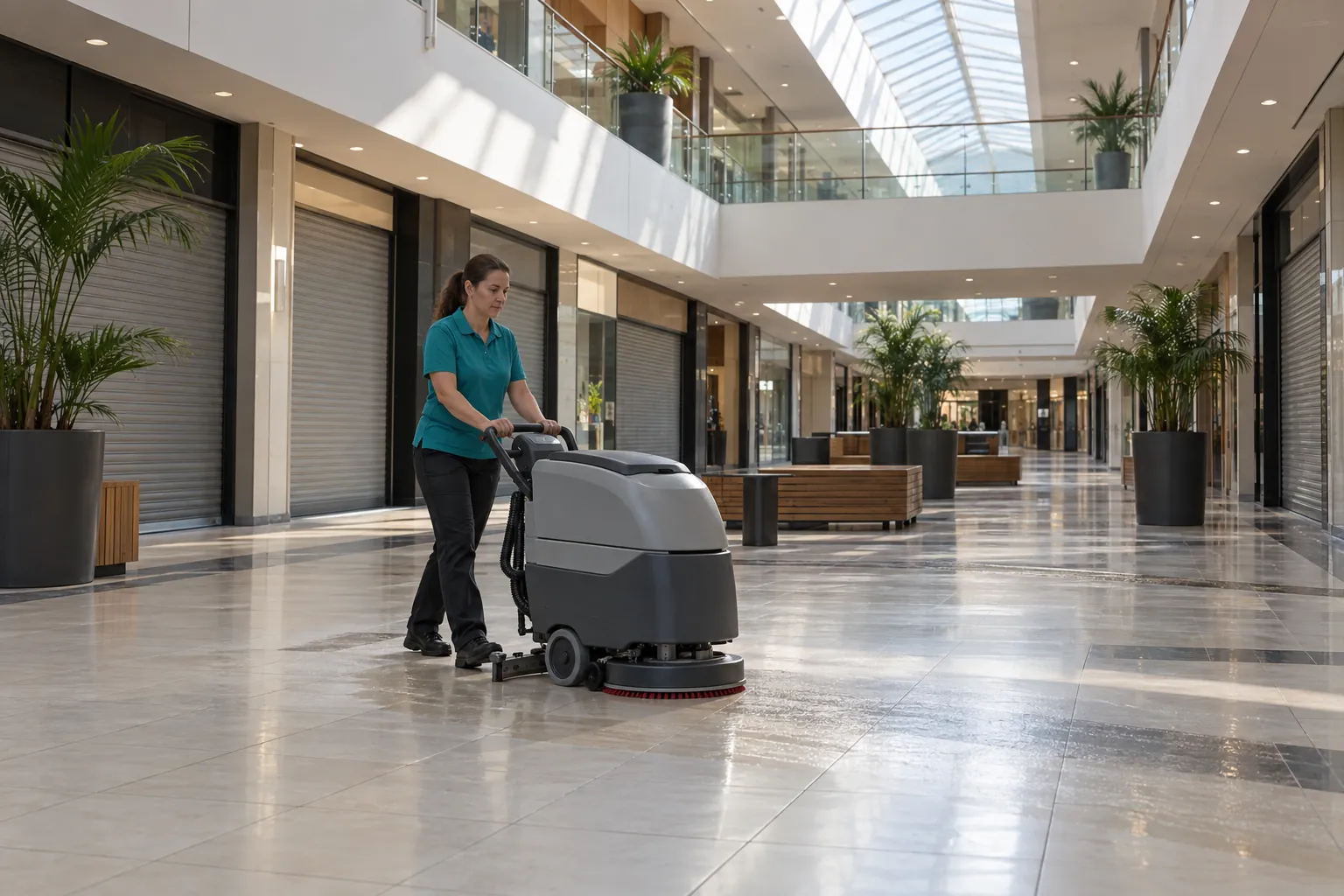 CleaningShopping centre cleaning: common areas, amenities, food courts and spillsShopping centre cleaning in Australia: the WHS and OHS duties, the areas and trading-day schedule, spills, food courts, contractors and a record worth trusting.
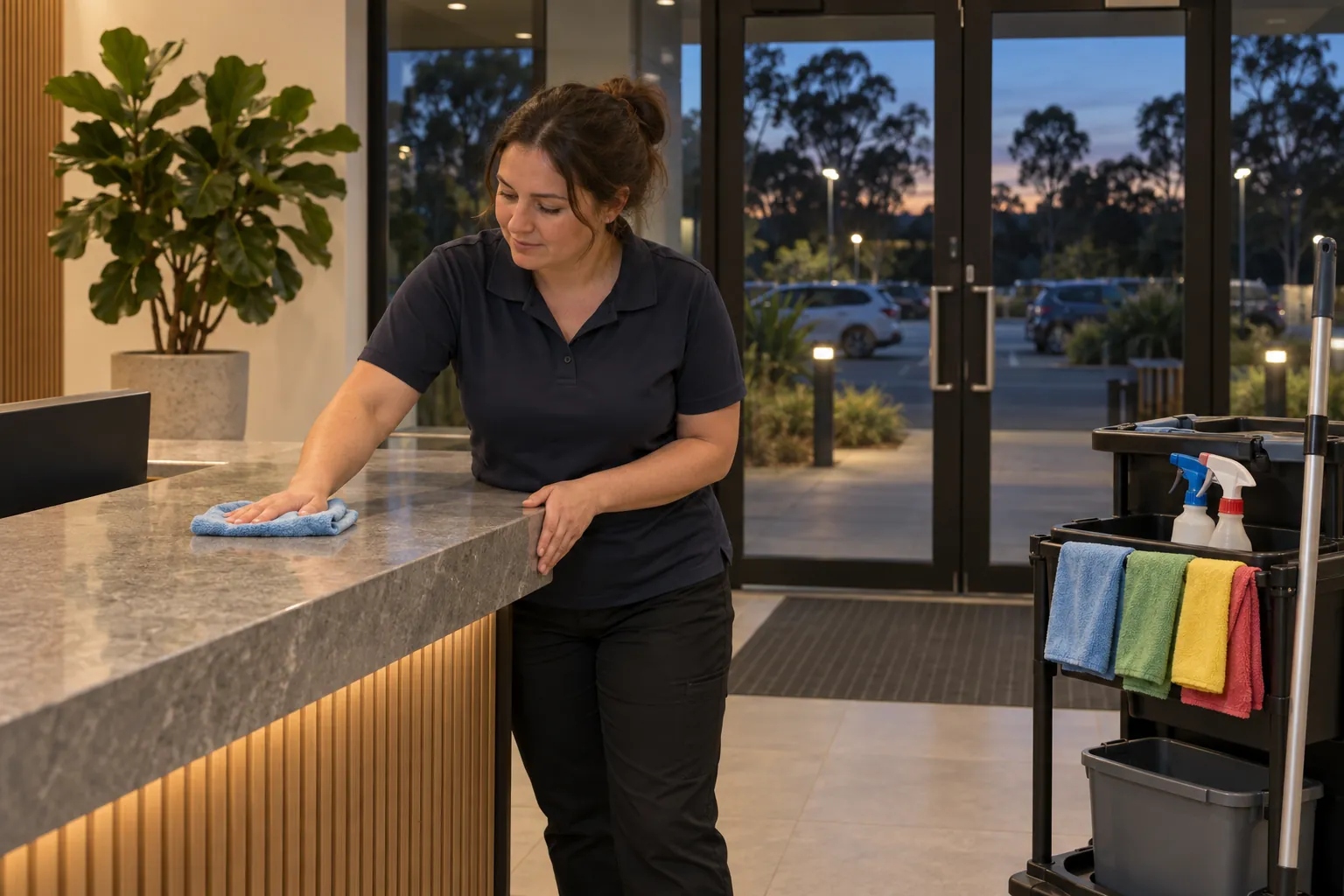 CleaningCommercial cleaning checklist: area by area, and how to know it is followedA commercial cleaning checklist for Australian offices and shared buildings, area by area, with the WHS duties behind it and how a supervisor checks it is followed.
 CleaningGraffiti reporting and removal: from the first photo to a clean wallHow to report graffiti in Australia, who removes it, what state law and councils say, and how cleaners and building managers record each tag from report to removal.
 Premises and facilities managementStrata maintenance: keeping common property in repair, and showing that you haveStrata maintenance in Australia: the duty to repair common property in NSW, Victoria and Queensland, the plans a scheme needs, who does what and the records to keep.