Cleaning
Shopping centre cleaning: common areas, amenities, food courts and spills
Shopping centre cleaning is the cleaning of a retail centre's common areas – the entries, malls, amenities, food courts, car park and back of house – usually by a commercial cleaning contractor that does the heavy work overnight and patrols for spills and litter while the centre trades.
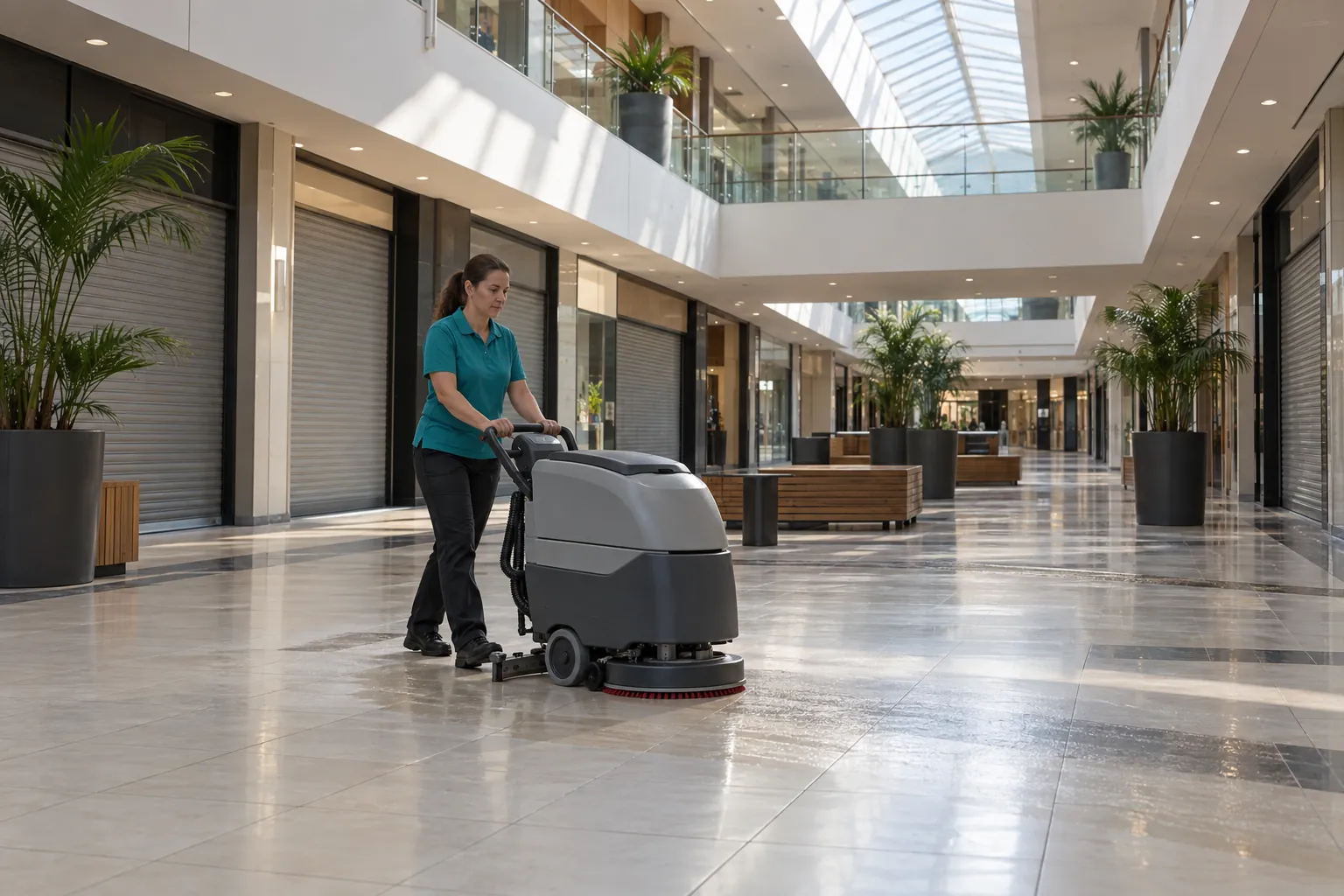
A shopping centre is cleaned in front of thousands of people a day. The mall floor is walked from before opening until well after the last tenancy shuts, the food court turns over its tables every lunchtime, and a storm at 3pm puts water across every entry at once. Behind the shopfronts sit loading docks, bin rooms and service corridors that shoppers never see but cleaners do. This guide covers the work health and safety duties behind shopping centre cleaning in Australia, the areas a specification should list, a schedule across the trading day, spills and wet weather, who does what between centre management, the cleaning contractor and the tenants, and what a record worth trusting looks like.
01
The duty behind shopping centre cleaning
No Australian law says how often a shopping centre must be cleaned. The duty is an outcome: the centre is a workplace, and it has to be kept without risks to health and safety, so far as is reasonably practicable, for the people who work there and every shopper who walks through it.
In every state and territory except Victoria, the model work health and safety laws apply. Section 19 of the Work Health and Safety Act 2011, quoted here from Queensland's Work Health and Safety Act 2011, requires a person conducting a business or undertaking (PCBU) to ensure, so far as is reasonably practicable, the health and safety of its workers, and "that the health and safety of other persons is not put at risk from work carried out as part of the conduct of the business or undertaking". In a centre, the other persons are the shoppers. Section 20 adds a duty for the person with management or control of a workplace: to ensure "that the workplace, the means of entering and exiting the workplace and anything arising from the workplace are without risks to the health and safety of any person". For the malls, entries, amenities and car park, that person is usually the owner or its centre manager.
The regulations make it specific. Regulation 40 of Queensland's Work Health and Safety Regulation 2011 (the version current from 29 March 2026) requires, among other things, that "floors and other surfaces are designed, installed and maintained to allow work to be carried out without risk to health and safety". Regulation 41 requires facilities for workers, including toilets, drinking water, washing and eating facilities, to be maintained in good working order and kept "clean, safe and accessible".
The approved code of practice spells out the housekeeping. SafeWork NSW's version of the code of practice Managing the work environment and facilities (August 2019), based on Safe Work Australia's model code, says that "the work environment must be maintained so that it remains in a clean and safe condition", that "floors must be inspected regularly and maintained to eliminate or minimise slip and trip hazards", and that "spills on floors should be cleaned up immediately".
A shopping centre is the code's own example of a shared workplace. It says the duty to provide and maintain a safe work environment "may be shared between duty holders", for example between a tenant and "the landlord or property manager", and that emergency planning for "a workplace shared by a number of businesses, for example a shopping centre" should be coordinated by the person with management or control. Section 46 of the Act puts that into law: where more than one person has a duty about the same matter, each must "consult, cooperate and coordinate activities" with the others. The owner, the centre manager, the cleaning contractor, the security provider and every tenant touch the same floor, so the specification has to say who cleans what.
02
What shopping centre cleaning covers
A useful specification lists the places and the items, not just "common areas cleaned". Shopping centres range from a neighbourhood centre with a supermarket and a dozen specialty shops to a regional centre over several levels, but the parts are much the same:
- Entries and forecourts: automatic doors and glazing at hand height, entry matting, the forecourt paving, bins and ashtray points, bike racks and the area around taxi and bus set-down.
- Malls and common areas: hard floors and carpet, seating, planters, balustrades and glass, directory boards, kiosks' surrounds, lift cars and landings, escalator and travelator handrails and the floor plates at each end.
- Amenities: customer toilets, accessible toilets, parents' rooms and baby change, including consumables, bins and sanitary units.
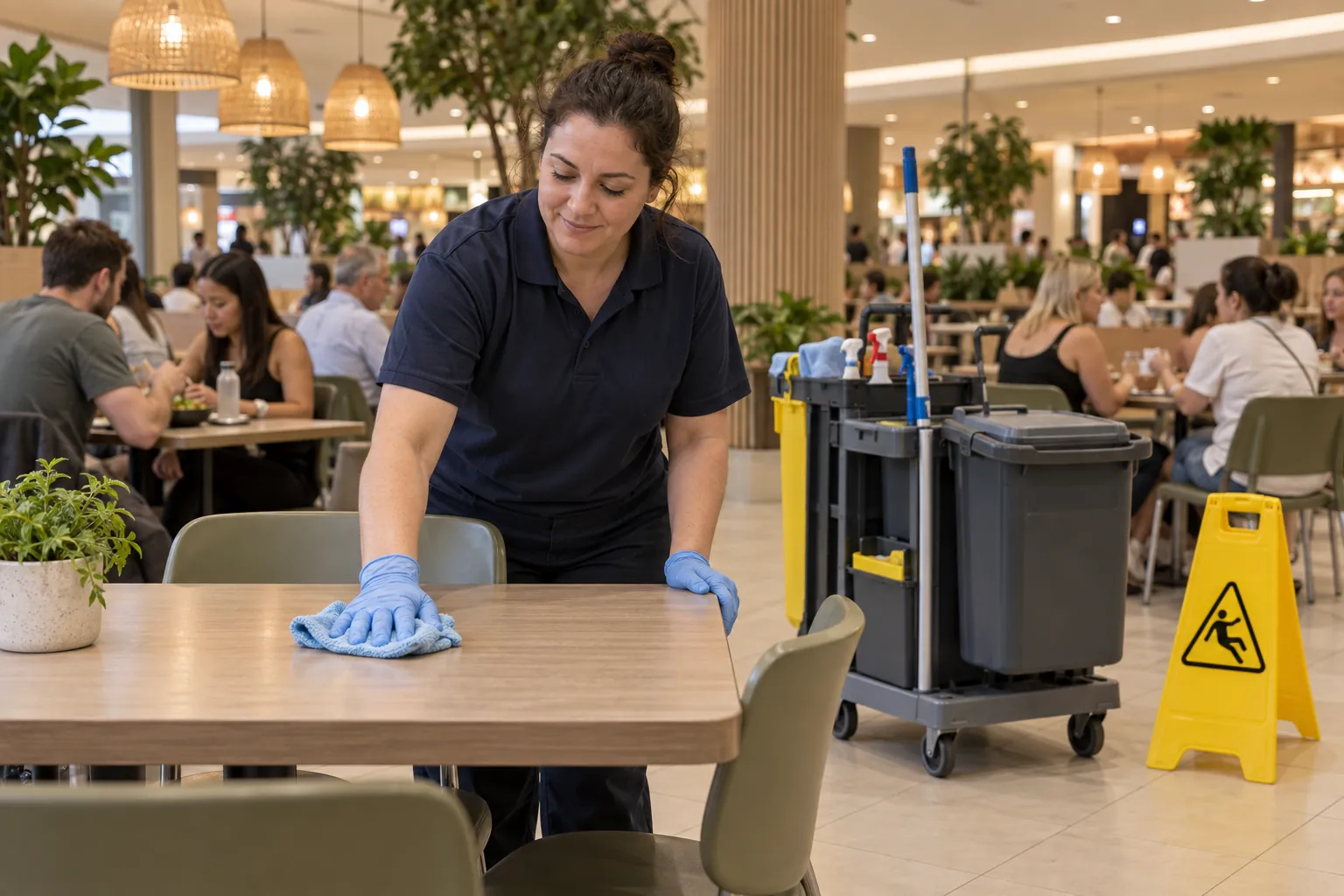
- Food court: tables, chairs, high chairs, tray return points, condiment stations, the floor between tables and the bins, which fill fastest at lunchtime.
- Car park and trolley bays: ramps, lift lobbies, stairwells, trolley bays and travelator landings from the car park.
- Back of house: service corridors, loading docks, bin and compactor rooms, the cleaners' store, and the centre staff's own amenities and meal room.
Draw the line between common areas and tenancies. Each retail tenancy normally cleans inside its own shopfront, and a food retailer cleans its own kitchen and counter; the centre's cleaners take the malls, amenities, food court seating and back of house. Where the line sits for shopfront glass, a kiosk's footprint, a tenant's bin or a shared cool room should be written into the specification, because a spill each side assumes is the other's is the one that injures someone.
03
A shopping centre cleaning schedule across the trading day
Most of the heavy work happens outside trading hours, with a day crew keeping the centre presentable while it trades. Plan by area and by time of day, with more attention where footfall and food meet. Adjust the list to the centre's trading hours, late-night trading and floor types.
Overnight or before opening
- Machine-scrub the mall floors with a scrubber-dryer and vacuum carpeted areas, working in sections so there is always a dry route for early staff.
- Full clean of every amenity: toilets, basins, mirrors, floors, sanitary units and consumables.
- Clean the food court seating, tray returns and floor, and empty and wash bins.
- Wipe escalator and travelator handrails, lift buttons and door push plates.
- Clean entry doors and glass, and lay out or clean entry matting.
- Walk the fire exits and service corridors to check they are clear of cartons, cages and equipment.
During trading
- Regular mall patrols to find and deal with spills, dropped food and litter, with more patrols in the food court and at the supermarket entry.
- Amenity checks on a timetable that matches footfall, more often at lunchtime, on weekends and in school holidays; see the public toilet cleaning guide.
- Food court table turning at peak times: clear trays, wipe tables, spot-clean the floor and empty bins before they overflow.
- Check and dry entries in wet weather and swap saturated mats.
- Trolley collection from the car park and surrounds, where it is part of the contract.
After close
- Empty all common area bins and take waste and cardboard to the compactor or collection point.
- Clean the loading dock and bin rooms, hosing down only where wash water can go to a trade waste or sewer point and not a stormwater drain.
Weekly and periodic
- High dusting of shopfront bulkheads, signage frames, balustrade tops and air-conditioning grilles.
- Deep clean of hard floors, stripping and resealing where the floor type needs it; carpet extraction.
- External glazing, awnings and high windows, usually by a specialist working at height.
- Car park sweeps and pressure cleaning; see the car park cleaning guide.
04
Spills, wet weather and slip resistance
Slips are the hazard that makes shopping centre cleaning a safety job as much as a presentation job, and they affect shoppers as well as workers. The code of practice notes that "cleaning methods should also take account of the potential for slips, which may be increased by the use of some cleaning agents". A few principles cover most of it:
- Find spills quickly. Patrols at a set interval, shorter at peak times and in the high-traffic spots such as the food court, the supermarket entry and drink outlets, and a rule that any centre or contractor worker who sees a spill guards it until the cleaner arrives.
- Deal with them properly. Stop people walking through, clean up with the right method, and leave the floor dry. A mop that leaves a wet film only moves the hazard.
- Use signs honestly. Put a wet floor sign out while the floor is wet and take it away when it is dry.
- Control the entries. Enough matting to take water off shoes before the hard floor, extra mats and more frequent checks when rain is forecast.
- Match the cleaning to the floor. The wrong product, or too much of it, leaves a residue that makes a floor slippery when wet. Follow the floor manufacturer's guidance, and where the same spot keeps causing falls, have the floor tested; AS 4663 covers slip resistance measurement of existing pedestrian surfaces, and AS 4586 is the standard for the slip resistance classification of new pedestrian surface materials.
- Record it. Note patrols and spills dealt with, with the time and place. If a shopper says they fell outside a café at 12:40, a record of the patrol at 12:30 and the spill cleared at 12:35 is the first thing the centre's insurer will ask for.
Cleaning chemicals are a hazard of their own. The PCBU keeps a register of hazardous chemicals with a current safety data sheet for each. SafeWork NSW's code of practice Managing risks of hazardous chemicals in the workplace says the register "must be readily accessible to workers involved in using, handling or storing hazardous chemicals", and that domestic cleaning chemicals bought from a supermarket can present greater risks when used "in a way or quantity which is not consistent with home use".
05
Who does the cleaning, and how it is checked
Many Australian centres buy their shopping centre cleaning services from a commercial cleaning contractor under a specification set by centre management, with the security provider and the maintenance contractor alongside. Employees of a contract cleaning business are usually covered by the Cleaning Services Award 2020, which describes the contract cleaning services industry as including cleaning, hygiene and pollution control, trolley collection (other than trolley collection covered by the General Retail Industry Award 2020) and minor property maintenance incidental to cleaning. Whatever the arrangement, each task needs a named owner:
- Centre management sets the specification, agrees the boundary with tenants, inspects the centre, and decides what goes to maintenance.
- The cleaning contractor staffs the night and day cleaning teams, trains them, supplies chemicals and machines with their safety data sheets, and supervises the work.
- Security often finds spills, damage and needles on patrol and at opening, and needs a quick way to pass them to cleaning.
- Tenants clean inside their tenancy and report problems in the common areas; food retailers clean their own premises and equipment.
- Specialists handle glazing at height, escalators, grease traps and floor restoration.
Food retailers answer to food safety law as well. Standard 3.2.2 of the Food Standards Code, Food Safety Practices and General Requirements, applies to each food business in the food court, and Food Standards Australia New Zealand explains it in Safe Food Australia: A guide to the food safety standards (fourth edition, February 2023), including an appendix on cleaning and sanitising surfaces and utensils. The centre's cleaners do not take on a tenant's food safety duty by clearing the tables.
Plan for lone work: the code of practice gives "a cleaner working by themselves at night in a city office building" as an example of isolated work, and a night crew spread across a closed centre is in the same position. Agree check-in times with security.
Audit the quality of the result the way any standard is audited: a scheduled walk-through by centre management against the specification, with scores by area; a look at complaints, incident reports and slips by location; and a joint review with the contractor each month. The Cleaning Accountability Framework runs contractor prequalification, a systems and compliance check of a contractor's employment practices, and building certification, which it describes as "an asset-based assurance mechanism that takes into account the responsibilities and input of the entire supply chain"; see the cleaning accountability framework guide.
06
Where the shopping centre cleaning record fails, and what SiteClara does about it
Most centres can show a cleaning specification. Far fewer can show that the level 1 amenities were checked at 12:30 on Saturday, and by whom. The sign-off sheet on the toilet door is filled in ahead of time, the night crew's work sits in the contractor's folder, and the spill security found went to whoever was on the radio.
SiteClara records the work where it is done. A printed QR poster, with an optional NFC tag behind it, sits at each point where a check is scheduled: each amenity block, the food court, the entries, the loading dock, the bin room. Cleaners and other staff scan the code or tap the tag on their own phone, with no app to install, see the checks due there, and mark each one done, or say what stopped them, at the time and in the place. The time and the named person are recorded as it happens, with a photo when one is asked for. A problem found, such as a blocked toilet, a broken seat or a leaking tap, is reported there with a photo and goes onto the team's list of open jobs until someone closes it.
The supervisor sees what is due, done and missed across the centre, records the reason a check was missed, and approves a daily report that goes to nominated centre management or client contacts the next morning. "Amenities – hourly" becomes a dated record of each check at each block, and "I told someone about the leak" becomes a job with a location, a time, a name and a photo.
07
Further reading, and a list to take away
Start with the model code of practice Managing the work environment and facilities, published by Safe Work Australia and adopted by the regulators in states and territories that have the model laws, and with Managing risks of hazardous chemicals in the workplace for the cleaners' store. In Victoria, read WorkSafe Victoria's compliance code on workplace facilities and the working environment. Food retailers should read FSANZ's Safe Food Australia.
Before the next peak trading period, check that your shopping centre cleaning plan:
- lists every area by name, from the entries to the bin room, not just "common areas";
- draws the line between the centre's cleaning and each tenancy, including food retailers;
- is split into overnight, during trading, after close and periodic work;
- sets mall patrols and amenity checks at intervals that match footfall, with more on weekends, in school holidays and in wet weather;
- has a spill procedure that ends with a dry floor and the sign removed;
- keeps a hazardous chemicals register with current safety data sheets for the cleaners' store;
- says how security, tenants and centre staff pass on a spill or a fault, and who closes it;
- covers night work and lone work with agreed check-ins;
- records patrols, checks and spills with the time, place and person;
- is audited by someone other than the person who does the work.
Sources
Every document this guide quotes or links to, in the order it first cites them.
- Queensland's Work Health and Safety Act 2011 legislation.qld.gov.au
- Queensland's Work Health and Safety Regulation 2011 legislation.qld.gov.au
- The code of practice Managing the work environment and facilities safework.nsw.gov.au
- Occupational Health and Safety Act 2004 legislation.vic.gov.au
- Compliance code: Workplace facilities and the working environment worksafe.vic.gov.au
- Code of practice Managing risks of hazardous chemicals in the workplace safework.nsw.gov.au
- Cleaning Services Award 2020 awards.fairwork.gov.au
- Safe Food Australia: A guide to the food safety standards foodstandards.gov.au
- Cleaning Accountability Framework cleaningaccountability.org.au
Related guides
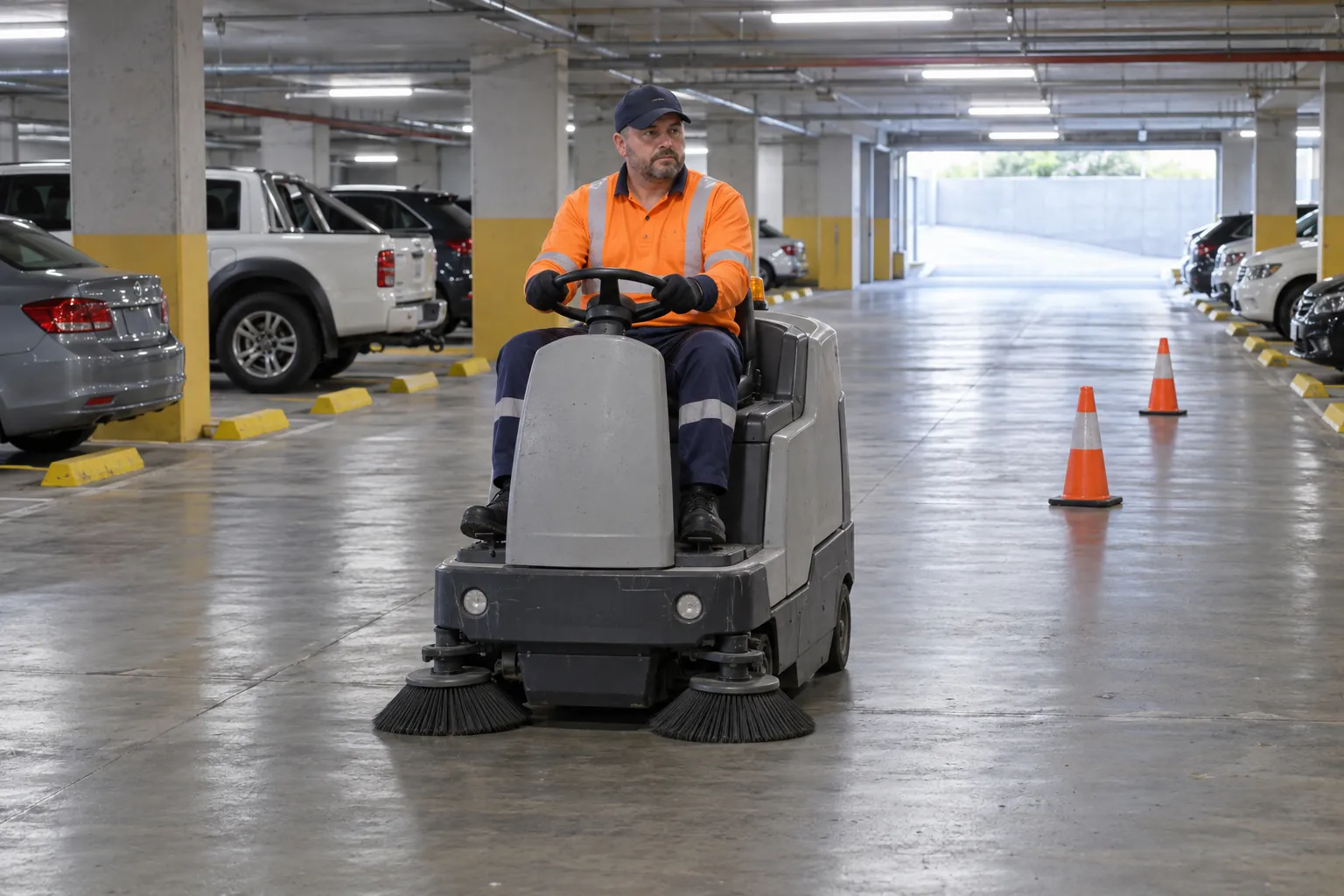 CleaningCar park cleaning: what to clean, how often, and how to show it was doneCar park cleaning in Australia: the WHS and OHS duties, what to clean and how often, working safely among traffic, wash water, and a record worth trusting.
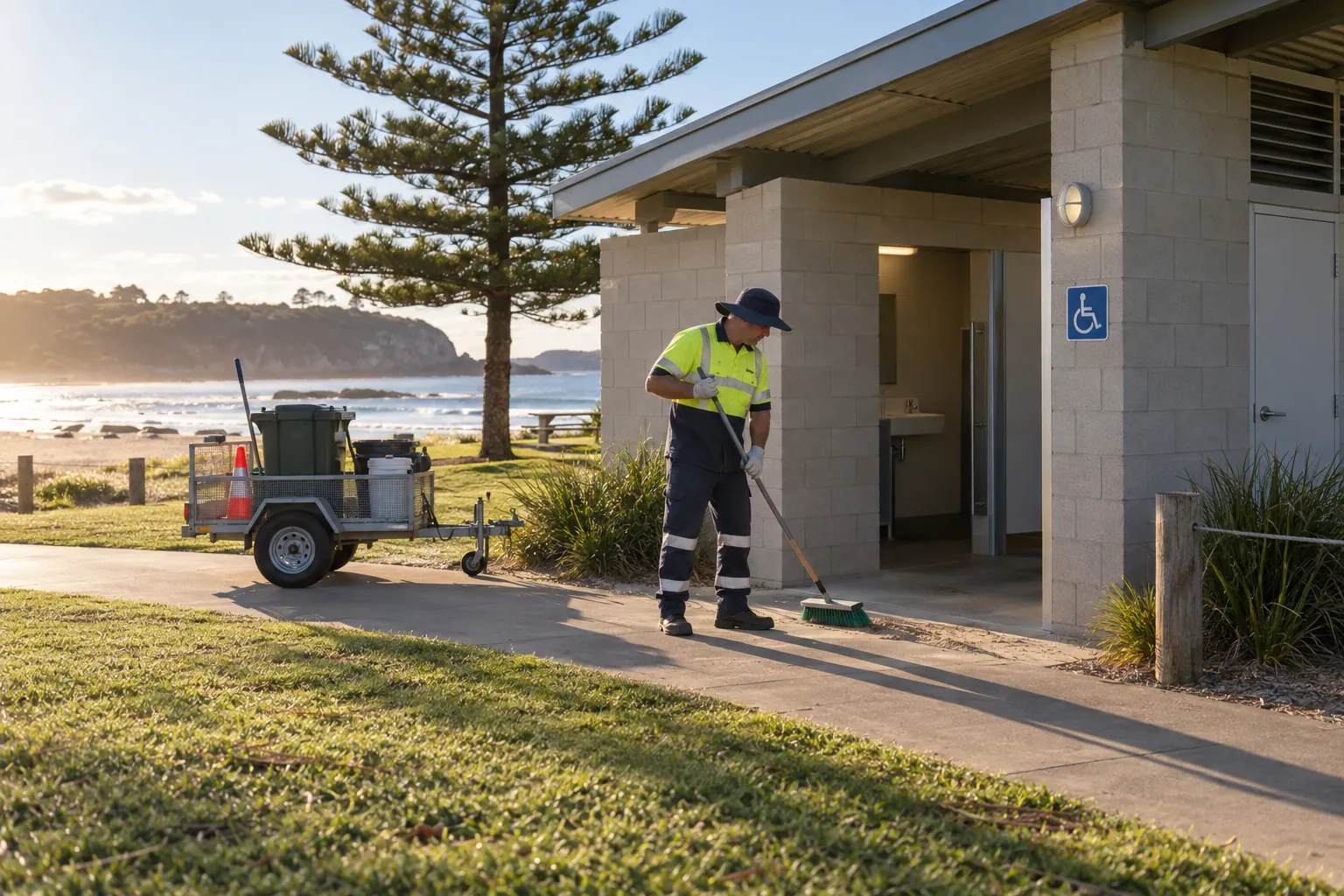 CleaningPublic toilet cleaning: frequencies, sharps and accessible facilitiesRunning public toilets for councils, parks, beaches and venues in Australia: the WHS and access duties, how often to clean, sharps, vandalism and Changing Places.
 CleaningCommercial cleaning checklist: area by area, and how to know it is followedA commercial cleaning checklist for Australian offices and shared buildings, area by area, with the WHS duties behind it and how a supervisor checks it is followed.
 CleaningThe Cleaning Accountability Framework: certification, prequalification and the records behind themWhat the Cleaning Accountability Framework is, how CAF building certification and contractor prequalification work, and the records behind them.