Cleaning
Colour coding cleaning in Australia: the colours, whose scheme they are, and how to keep to them
Colour coding cleaning means keeping separate cloths, mops, buckets and other cleaning equipment for each kind of area, told apart by colour, and the scheme NSW Health sets for its hospitals uses red for toilets, bathrooms and dirty utility rooms, blue for general cleaning, green for food service and food preparation areas, yellow for infectious and isolation areas, and white for operating theatres.
Also written for United Kingdom
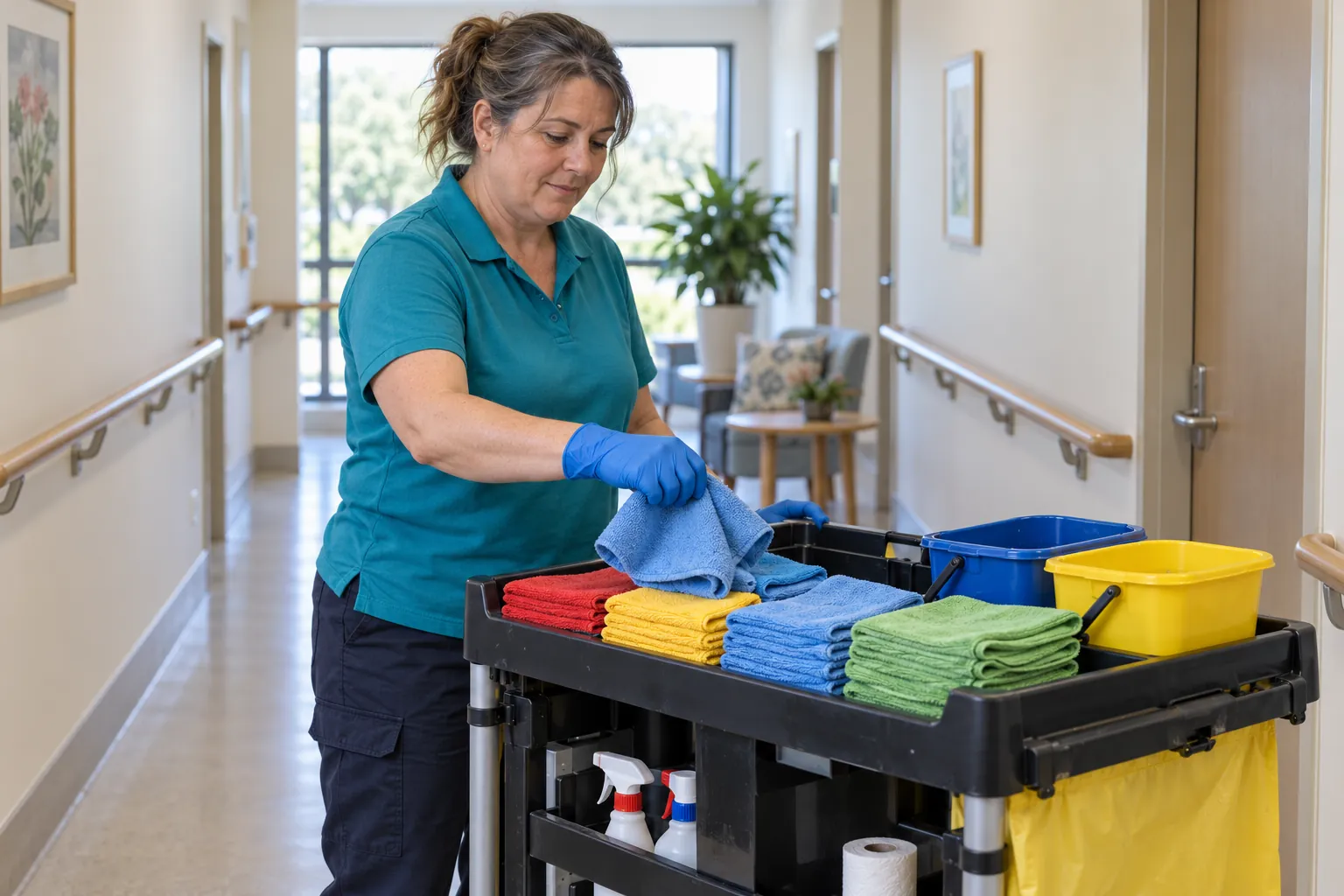
The point is simple: the cloth that wiped a toilet must never reach a kitchen bench or a classroom desk. No Australian law fixes the colours for an ordinary workplace, but workplaces outside healthcare that colour code generally borrow the same ones, and a chart on the cleaner's room door is only the start. This guide covers where the colours come from, what each one covers, how food areas fit in, how to set the system up on a site, and how a supervisor checks it is really followed.
01
What colour coding is, and whose scheme it is
A colour coded cleaning system gives each type of area its own set of cleaning equipment and marks that set with one colour. A cleaner does not have to remember which cloth or mop was used where: the colour tells them, and anyone walking past can see at a glance whether the right kit is in the right room. Its job is to stop cross-contamination, the spread of germs from a high-risk area such as a toilet into a low-risk area or a food area on the equipment used to clean them. Once it is set up, it asks little more of a cleaner than picking up the right colour.
No Australian law sets cleaning colours for an ordinary workplace. The legal duty is the outcome. Under the work health and safety laws, a person conducting a business or undertaking (PCBU) must provide adequate facilities for workers, including toilets, drinking water, washing facilities and eating facilities, and must ensure, so far as is reasonably practicable, that they are maintained so as to be "in good working order" and "clean, safe and accessible". That is section 41 of Queensland's Work Health and Safety Regulation 2011, and the states and territories that have adopted the model WHS laws carry the same duty in their own regulations. Victoria has its own Occupational Health and Safety Act 2004 and regulations instead. Colour coding is one of the ordinary ways a cleaning team meets that duty without carrying dirt from one room to the next.
Healthcare is where the colours are written down. NSW Health's Cleaning of the Healthcare Environment policy directive (PD2023_018), published on 3 August 2023 and due for review on 3 August 2028, says that colour coding of reusable cleaning equipment used in the different areas of a NSW Health organisation "is recommended as the most effective method for restricting equipment to individual areas", and sets the colours in its Table 1. Compliance with the directive is mandatory for NSW Health, and it was also distributed to private hospitals and day procedure centres. It sits under Action 3.13 of the Preventing and Controlling Infections Standard in the National Safety and Quality Health Service (NSQHS) Standards, and under the Australian Guidelines for the Prevention and Control of Infection in Healthcare.
The Clinical Excellence Commission's Environmental Cleaning Standard Operating Procedure, Module 3: Work procedures for cleaning (October 2024) repeats the table and says the colour codes "are to be applied to reusable equipment". Its equipment lists then mark each cloth, mop and bucket "as per colour coding requirements".
Other states and territories publish their own health department policies, and a hospital, aged care home or day surgery should read its own. Outside healthcare the colours are good practice, not law. Offices, schools, childcare services, shopping centres and other workplaces that colour code generally borrow the same red, blue, green and yellow; Early Learning Victoria, for example, uses those four for its services.
02
The colours and what each one covers
Table 1 of PD2023_018 gives five colours for reusable cleaning equipment:
- Red: toilets, bathrooms and dirty utility rooms. Red equipment is used only in these areas and never leaves them. In an office, school or shopping centre this means every toilet block, accessible toilet, shower and parents' room.
- Blue: general cleaning. In a commercial building this is the everyday colour for desks, corridors, classrooms, receptions, meeting rooms, lifts and stairwells.
- Green: food service and food preparation areas. In NSW Health the directive covers small ward-based kitchenettes; outside hospitals, green usually covers staff kitchens, tea points, canteens and servery counters.
- Yellow: infectious and isolation areas, such as the room of a patient being cared for under transmission-based precautions.
- White: operating theatres.
The colour goes on the equipment. The procedures in Module 3 call for colour coded cleaning cloths (whether reusable, disposable or microfibre), flat or microfibre mop pads, mop handles, mop heads and pad holders, and roller, wringer or microfibre buckets. For toilets, Module 3 lists a cloth, a mop and a plastic bucket, each "as per colour coding requirements". The CEC's Environmental Cleaning Standard Operating Procedure, Module 4, which covers cleaning where the infection risk is high and specialised departments, goes further: there, "all cleaning equipment must adhere to colour coding not just reusable equipment".
03
Kitchens and food areas: what the Food Standards Code adds
Commercial kitchens in restaurants and hotels, school canteens and childcare kitchens have a food safety duty on top of the WHS one. Clause 19 of Standard 3.2.2, Food Safety Practices and General Requirements, in the Australia New Zealand Food Standards Code requires a food business to maintain its premises, and its fixtures, fittings and equipment "having regard to its use", to a standard of cleanliness with no accumulation of food waste, dirt, grease or other visible matter.
FSANZ's guide to the standard, Safe Food Australia, Standard 3.2.2 (fourth edition, February 2023), says the equipment covered includes "equipment used for cleaning food premises or equipment such as dishwashers, brooms, mops, buckets and hoses", and that a business is required to maintain cleaning equipment "to a standard of cleanliness appropriate for its use". On cloths it says that those used to wipe down food contact surfaces "should be clean and sanitary to avoid cross contamination", and should be frequently replaced, or washed and then soaked in a sanitiser between uses. FSANZ's page on cleaning and sanitising sums the duty up: food businesses must keep their premises, fixtures, fittings, equipment and food transport vehicles clean and sanitary.
Neither document names a colour. Green cleaning equipment for the kitchen is a way of keeping toilet and general equipment out of it; the kitchen team's own arrangements for chopping boards, wipes and sanitiser sit alongside it. NSW Health makes the same split: PD2023_018 notes that it refers only to small ward-based kitchenettes, and that kitchens where food is stored, prepared and cooked commercially or on a large scale are covered by the Food Act 2003 (NSW) instead.
04
Setting up a colour-coded cleaning system on a site
A colour coding system works when everyone on the site uses the same chart in the same way. To implement one, or take one over at the start of a cleaning contract, a site usually follows these steps:
- Choose the scheme and write it down. The NSW Health colours, or a four-colour commercial version, recorded in the cleaning specification and the site's safe work method or procedure, so that a new contractor inherits it rather than reinventing it.
- Map the areas. Give each room its colour: every toilet, bathroom and cleaner's sink red, kitchens and tea points green, the rest blue, and any isolation or special area as the scheme says. Awkward spaces, such as a kitchenette inside a meeting room or a basin in a classroom, need a decision in advance.
- Buy the whole set in each colour. Order cleaning supplies by colour: cloths, mop heads, mop handles or pad holders, buckets and squeeze bottles. Equipment made in its colour is safer than a white bucket with a coloured sticker that falls off. The colour shows the area, not the chemical, so a squeeze bottle needs both the colour of its area and the label for the chemical inside.
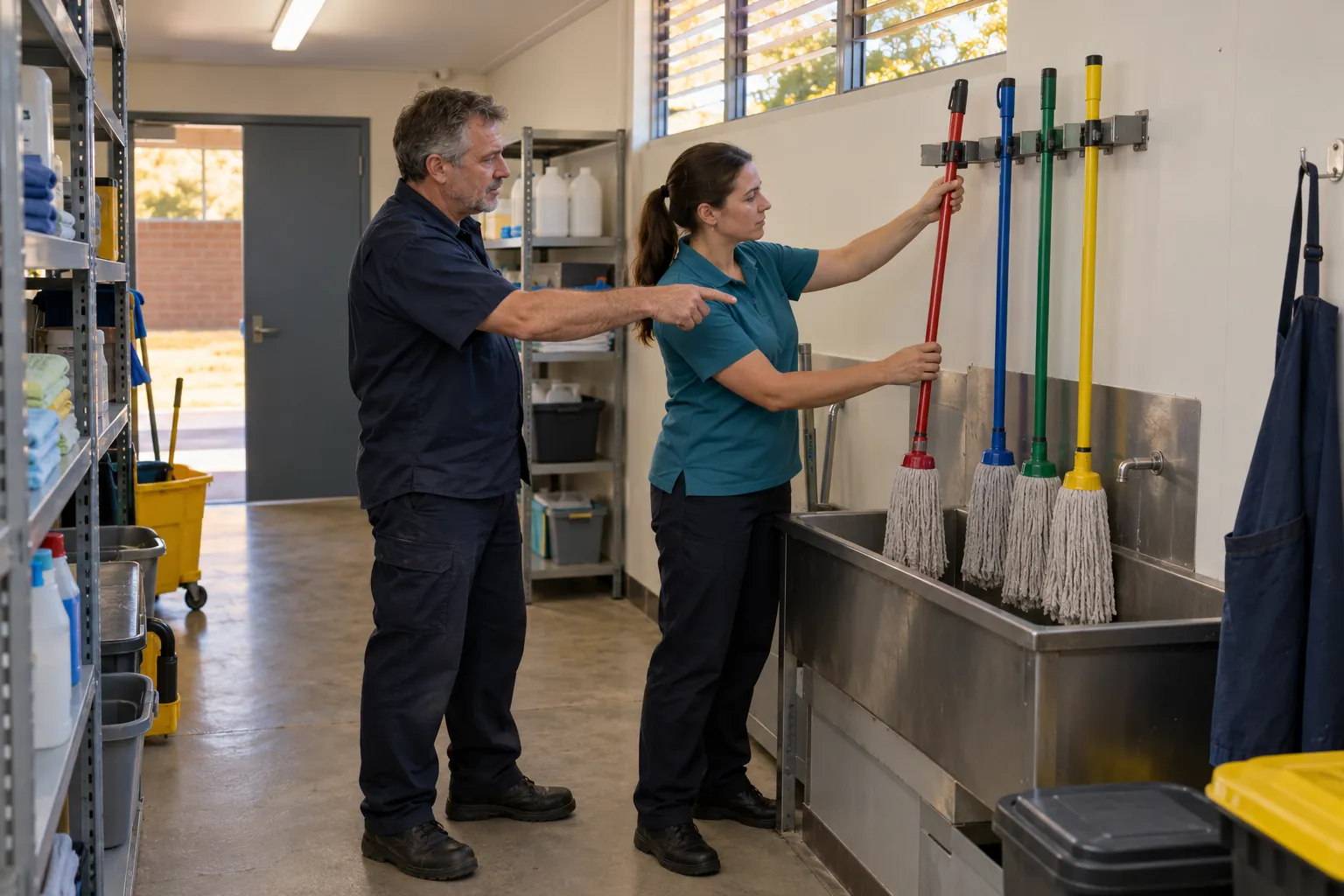
- Store it apart. PD2023_018 requires documented procedures for the use, maintenance and storage of cleaning equipment such as mops, cloths and solutions. Hang mops and keep buckets by colour in the cleaner's room, with red kept where it cannot drip onto or touch green or blue. A trolley with a separate compartment for each colour keeps the tools apart between rooms and makes the right choice the easy one.
- Launder by colour. Module 3 says to change the mop head when it is dry or visibly soiled, place the soiled head in a laundry bag, and use a clean mop head for the next area. Reusable cloths and mop heads are washed and dried so that red items cannot contaminate the others, and are replaced when worn or stained.
- Put up the chart. A colour chart in each cleaner's room and on each trolley, with pictures or plain words for each area beside the colour, so that a cleaner who has trouble telling colours apart can still match them.
- Train every cleaner, including relief and agency staff. PD2023_018 requires everyone who cleans in a NSW Health facility to be trained and assessed as competent, including in infection prevention and control principles and performing cleaning tasks safely and correctly. Outside healthcare, the induction for a new site should cover its chart.
- Work from clean to dirty. Module 3 says areas "should always be cleaned from high to low and from clean to dirty", and that when an area is finished, "all equipment and solutions should be cleaned, discarded or changed before moving on to the next area". Within a toilet block that means dispensers and basins before toilets and urinals, then the floor.
05
Checking that colour coding is followed
A colour coded cleaning system usually fails quietly: the green cloths run out on a busy night, a relief cleaner covers a floor they do not know, or mop heads come back from the laundry in a mixed bag. A cleaning supervisor or site manager checks the system, not only the result, and the useful checks are short and frequent:
- The cleaner's room: each colour present, stored apart, clean and dry, with red kept away from green and blue.
- Stock: enough cloths and mop heads of every colour for the shift, so nobody is tempted to borrow another area's.
- The trolley: the right colours for the areas on tonight's run, and nothing left over from another site or floor.
- In use: a spot check in a toilet block, a kitchen and an open area that the colour in the cleaner's hand matches the room.
- Before each task: PD2023_018 says health workers must check, before starting a cleaning task, that the selected equipment is clean, in good working order and appropriate for the task.
- Laundry and replacement: reusable items washed by colour, and worn or stained items taken out of use.
- Training: every cleaner on the site, including new starters and cover staff, inducted on this site's chart.
In NSW public health, these checks sit inside a formal audit system. PD2023_018 requires a cleaning audit system "that measures and records cleaning outcomes", with internal audits in every functional area at frequencies set by risk, from an aim of every room once a month in extreme risk areas (at minimum, half the rooms each month and all of them every two months) to every room once a year in low risk areas, and minimum acceptable quality levels from 90% down to 80%. Outside healthcare there is no set frequency, and colour coding is simply a standard line in a cleaning audit.
Good evidence that colour-coded cleaning is followed is ordinary and dated: a record that the cleaner's room on each floor was checked, by whom and when, what was short, and what was done about it.
06
Where colour coding fails, and what SiteClara does about it
Most sites can show a colour chart. Far fewer can show that the system behind it was kept: that the level 3 cleaner's room had green cloths on Tuesday night, or that the shortage someone mentioned in passing was put right. The chart is on the wall, the monthly audit sheet says "colour coding OK", and cross-contamination happens in the gap between them.
SiteClara records those routine checks where they happen. A printed QR poster, with an NFC tag behind it if staff prefer to tap, sits at each place a check is scheduled, such as the cleaner's room on each floor, a toilet block or a kitchen. Staff scan or tap with their own phone, with no app to install, and see the checks due there: colours stored apart, stock of each colour, the right kit on the trolley. They mark each one done or explain what stopped them, with a photo when one is asked for, such as the cleaner's room shelf. The time and the named person are recorded as it happens. A problem found on a check, such as no green cloths left, is reported there and goes onto the team's list of jobs until someone closes it.
The supervisor sees which checks are due, done and missed, and records the reason one was missed. Each day they approve a report that goes to nominated management or client contacts the next morning, showing what was completed, what was reported and what is still open: a working record made at the time, rather than a tick added before the audit.
07
Questions people ask
What are the cleaning colour codes used in Australia?
No national law fixes them, but Table 1 of NSW Health's Cleaning of the Healthcare Environment policy directive (PD2023_018) sets red for toilets, bathrooms and dirty utility rooms, blue for general cleaning, green for food service and food preparation areas, yellow for infectious and isolation areas, and white for operating theatres. Outside healthcare, charts generally use the same red, blue, green and yellow; Early Learning Victoria's chart for its services, for example, uses those four.
Which colour mop is for toilets?
Red. Table 1 of NSW Health's Cleaning of the Healthcare Environment policy directive (PD2023_018) gives red to toilets, bathrooms and dirty utility rooms, so a red mop, cloth and bucket are used there and nowhere else. In a toilet block or bathroom, basins, showers and floors are red too, so check that your site's chart says the same.
Why colour code cleaning equipment?
To keep each set of equipment in its own area. NSW Health's Cleaning of the Healthcare Environment policy directive (PD2023_018) says colour coding of reusable cleaning equipment "is recommended as the most effective method for restricting equipment to individual areas", so that a mop from a toilet never reaches a kitchen or a ward.
Is colour coding of cleaning equipment a legal requirement?
Not in an ordinary workplace. The law requires the outcome: section 41 of Queensland's Work Health and Safety Regulation 2011, like the other model WHS regulations, requires workplace facilities to be maintained so as to be "in good working order" and "clean, safe and accessible", and FSANZ's cleaning and sanitising guidance says food businesses need to keep their premises, fixtures, fittings and equipment clean and sanitary. In NSW public health, a mandatory policy directive, PD2023_018, recommends colour coding and sets the colours, and the Clinical Excellence Commission's cleaning procedures say the codes "are to be applied to reusable equipment".
How should colour coded mops and cloths be cleaned?
As their maker says. Section 2.6.2 of NSW Health's Cleaning of the Healthcare Environment policy directive (PD2023_018) says reusable cleaning equipment must be "maintained, used, cleaned, laundered, and stored" in line with the manufacturer's instructions and national and international standards, and that single-use equipment is disposed of as its manufacturer instructs. Washing and storing each colour apart keeps red items away from the rest.
08
Further reading, and a list to take away
For the colours themselves, read sections 2.6.2 and 2.6.3 of NSW Health's Cleaning of the Healthcare Environment policy directive (PD2023_018) and the step-by-step procedures in the CEC's Environmental Cleaning Standard Operating Procedure, Module 3. For kitchens and food areas, read FSANZ's Safe Food Australia, Standard 3.2.2. For the duty to keep facilities clean, read section 41 of your state's or territory's WHS regulations, such as Queensland's Work Health and Safety Regulation 2011. In a hospital or aged care home, read your own state's health department policy as well.
Before you rely on colour coding at a site, check that:
- one colour scheme is chosen, written into the cleaning specification and shown on a chart in every cleaner's room and on every trolley;
- every toilet, bathroom, kitchen and special area has been given its colour, including the awkward spaces;
- cloths, mop heads, mop handles, buckets and squeeze bottles are bought, stored and laundered by colour;
- red equipment is stored where it cannot touch green or blue;
- every cleaner, including relief and agency staff, has been inducted on this site's chart;
- staff work from clean to dirty and high to low, and change equipment between areas;
- supervisors check cleaner's rooms, stock and kit in use often enough to catch a shortage before it becomes a short cut;
- each check is recorded with the date, the place and the person who did it.
Sources
Every document this guide quotes or links to, in the order it first cites them.
- Work Health and Safety Regulation 2011 legislation.qld.gov.au
- Cleaning of the Healthcare Environment policy directive (PD2023_018) www1.health.nsw.gov.au
- Environmental Cleaning Standard Operating Procedure, Module 3: Work procedures for cleaning cec.health.nsw.gov.au
- Environmental Cleaning Standard Operating Procedure, Module 4 cec.health.nsw.gov.au
- Safe Food Australia, Standard 3.2.2 foodstandards.gov.au
- Cleaning and sanitising foodstandards.gov.au
Related guides
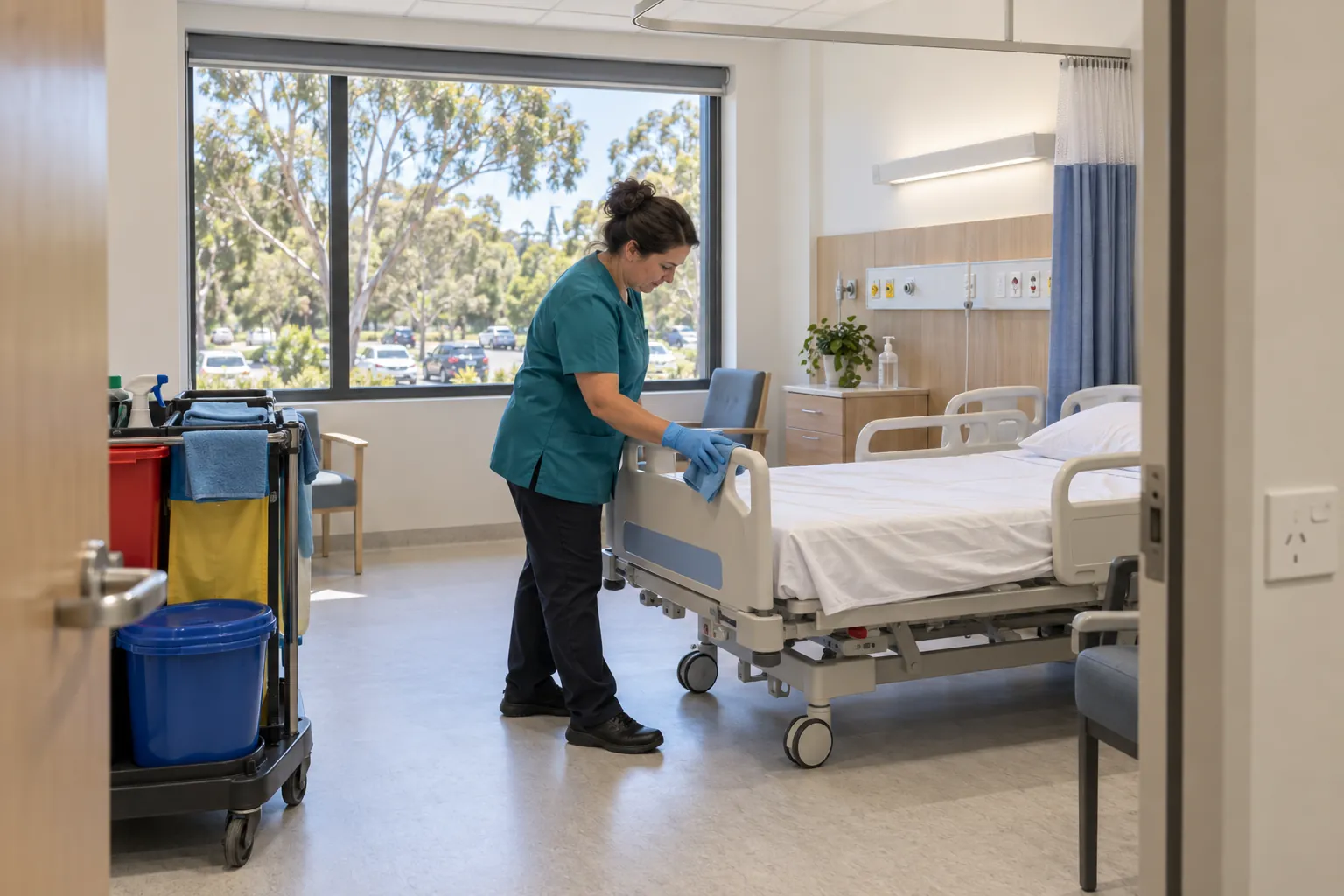 CleaningHospital cleaning standards in Australia: what is cleaned, how often, and how it is checkedHospital cleaning in Australia: NSQHS Action 3.13, risk categories, cleaning and audit frequencies, acceptable quality levels, and the record that shows it was done.
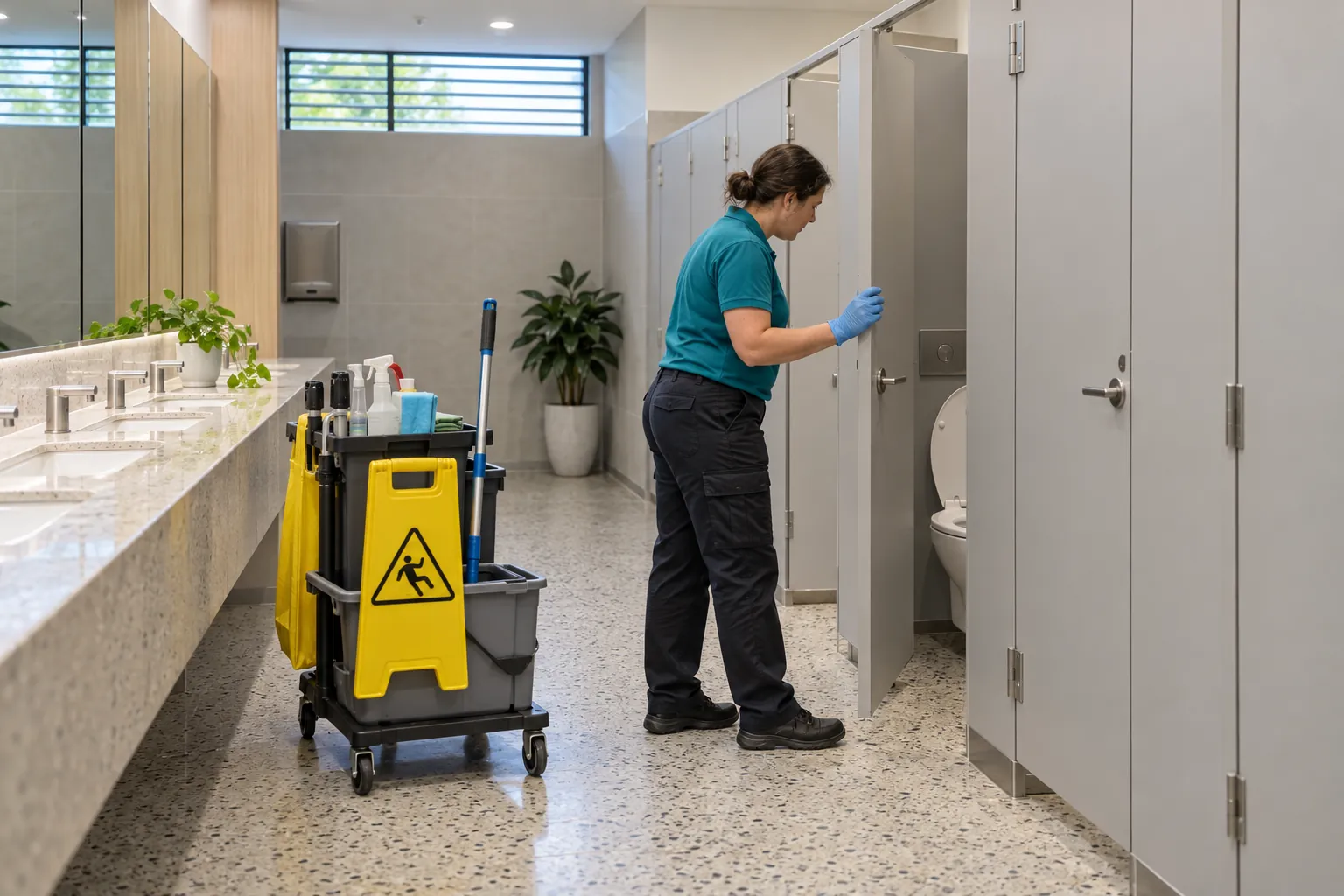 CleaningToilet cleaning checklist: what to check, how often, and how to make the record believableWhat a toilet cleaning checklist should cover in Australian workplaces, how often to check, the WHS and OHS duties behind it, and how to make the record believable.
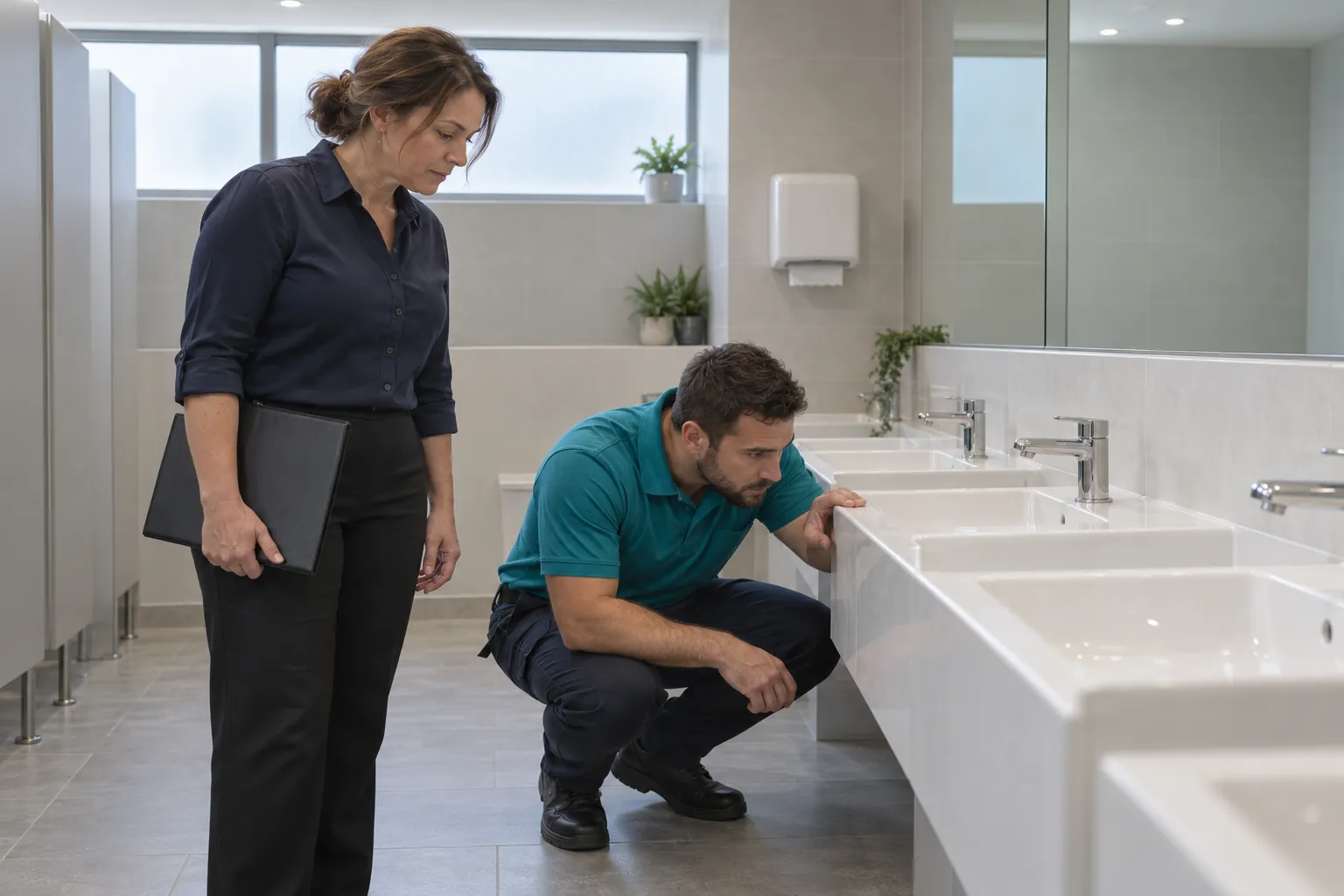 CleaningCleaning audit: what to inspect, how to score it and what happens nextHow to run a cleaning audit in Australia: what to inspect, sampling and frequency, scoring against an acceptable quality level, corrective action and the record.
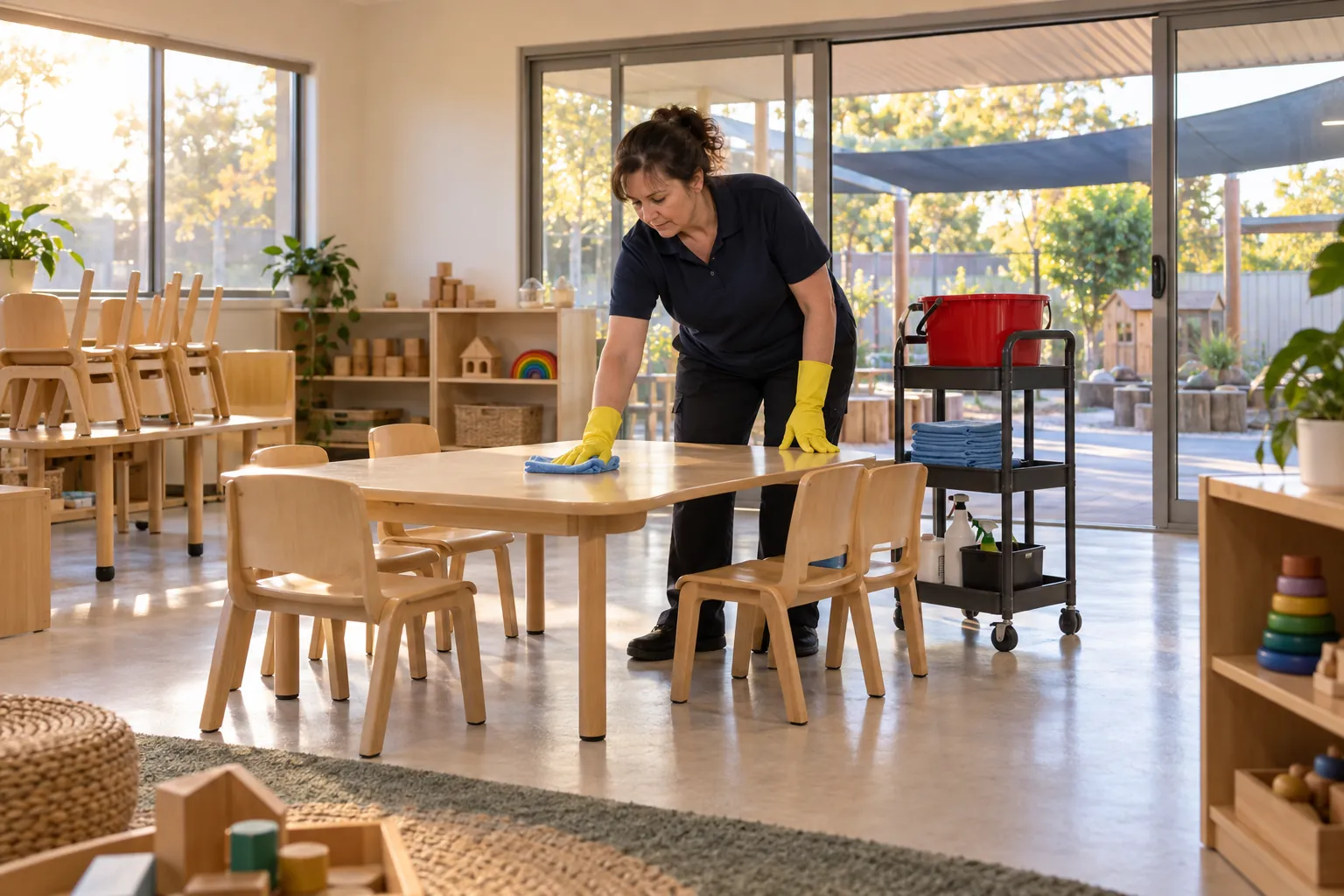 CleaningChildcare cleaning checklist: what an Australian service cleans, how often, and how to show it was doneA childcare cleaning checklist built on the National Regulations and NHMRC's Staying healthy: what to clean, how often, how, and who signs for it.