Cleaning
Cleaning audit: what to inspect, how to score it and what happens next
A cleaning audit is a structured inspection that checks the cleanliness and quality of cleaned areas against a written standard, scored element by element against an agreed pass mark, with every failure recorded, put right within a set time and checked again.
Also written for United Kingdom · United States · Canada
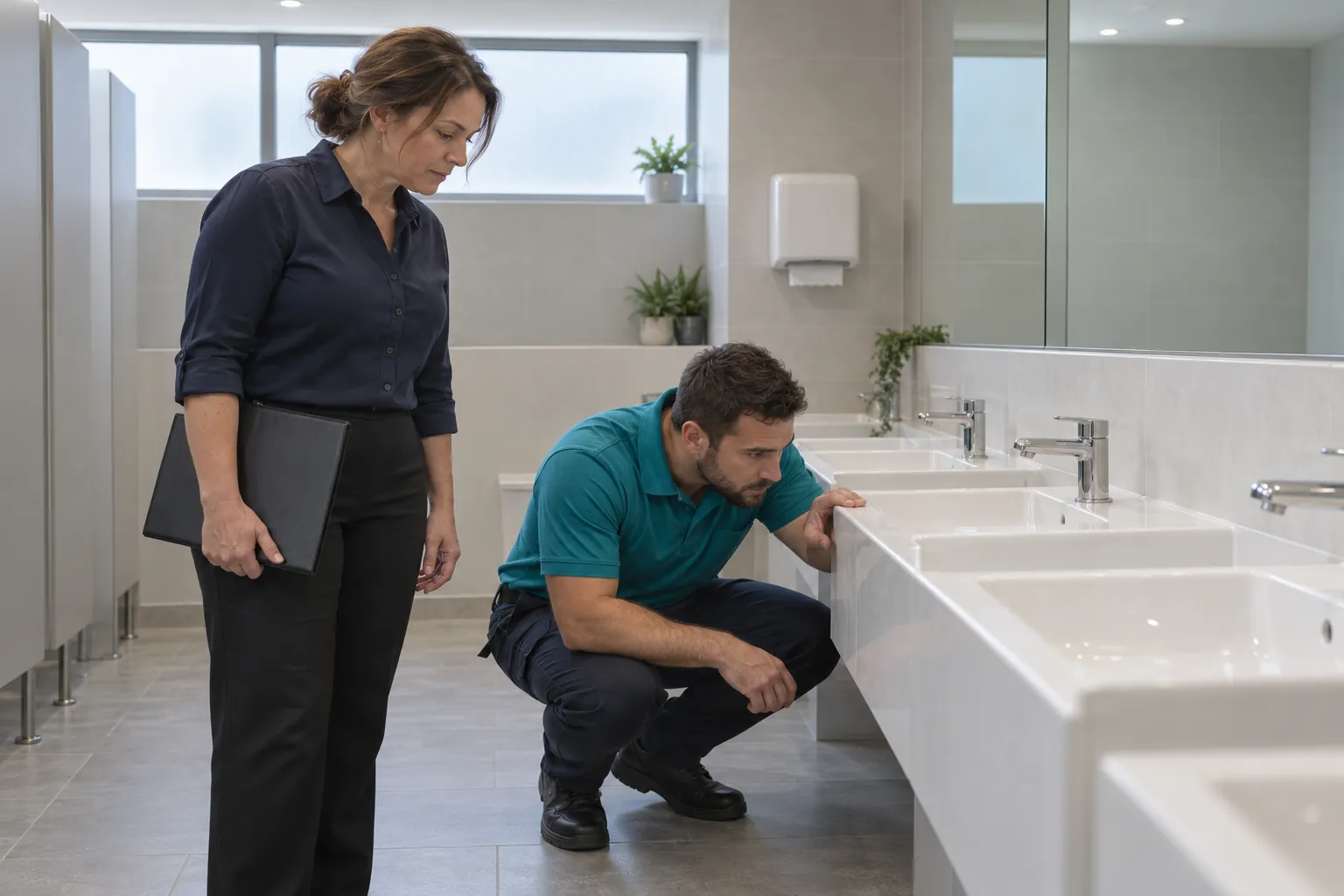
In most Australian buildings the standard comes from the cleaning contract and specification, the duty to keep the workplace and its facilities clean comes from work health and safety law, and the most detailed public model of how to audit comes from healthcare: the Australian Commission on Safety and Quality in Health Care's principles of environmental cleaning auditing and NSW Health's cleaning policy. This guide covers what a cleaning audit checks, how to sample and score it, who should do it, what happens after a failure, and the record that shows the cleaning between audits.
01
What a cleaning audit is, and what it measures against
A cleaning audit checks the result of cleaning, not the effort. An auditor walks a sample of rooms with a checklist, marks each element (a floor, a basin, a bench, a waste bin) as acceptable or not, and turns the marks into a score that can be compared with a pass mark and with last month. It is the quality control step in a cleaning contract: the way the client and the contractor evaluate cleaning performance and compliance with the contract specifications. A cleaning audit is not the same as the cleaning checklist an operative works through on shift: the checklist lists tasks, while the audit judges whether the finished room meets the standard.
Three things sit behind an audit in an Australian building.
- The contract and specification. For an office, school, shopping centre or strata building, the standard to audit against is usually the one the client and the contract cleaner agreed: the areas, the frequencies, the result expected in each area type, the pass mark and how quickly a failure must be fixed. If the cleaning contract does not say these things, an audit has nothing firm to measure.
- Work health and safety law. In every state and territory except Victoria, which has its own Occupational Health and Safety Act 2004, the model WHS Regulations require the person conducting a business or undertaking (PCBU) to keep workers' facilities clean. Queensland's version, section 41(2) of the Work Health and Safety Regulation 2011 (Qld), requires toilets, drinking water, washing and eating facilities to be kept "in good working order" and "clean, safe and accessible". SafeWork NSW's Managing the work environment and facilities code of practice adds that "the work environment must be maintained so that it remains in a clean and safe condition".
- Healthcare policy, where state policy can make the audit mandatory: NSW Health's PD2023_018 requires NSW Health organisations to have a cleaning audit system that measures and records cleaning outcomes. It is the most detailed public description of how to audit cleaning, and the method carries over to any building.
The Australian Commission on Safety and Quality in Health Care (ACSQHC) fact sheet Principles of environmental cleaning auditing sets out seven principles: when, who, where, how often, how, which surfaces and what to do with the results. It also says facilities with outsourced cleaning should build an auditing plan "as part of contract negotiation", good advice for any building that buys its cleaning in.
02
What a cleaning audit checklist covers
A cleaning audit checklist is written per area type from your own specification, and looks at hygiene points such as high-touch surfaces, soap and waste as well as appearance in washrooms, kitchens and meeting rooms. A useful audit looks at four things:
- The result in each room: floors and edges, surfaces, high-touch points (handles, light switches, taps, lift buttons, handrails), glass, bins and fixtures.
- The process: the right chemicals at the right dilution, colour-coded cloths and mops in the right areas, equipment clean, and personal protective equipment worn.
- Chemical safety: under the model WHS Regulations a PCBU must keep a register of the hazardous chemicals used, handled or stored at the workplace with the current safety data sheet for each, readily accessible to the workers who use them and anyone else likely to be affected. Consumer products used only in household quantities and in the way a household would use them are excluded (sections 344 and 346 of the Queensland regulation; SafeWork NSW's Managing risks of hazardous chemicals in the workplace code of practice explains it).
- The records: whether periodic work (high dusting, carpets, windows) was done when due, and whether last audit's failures were put right.
As a starting template, a cleaning inspection checklist for a commercial building might use these elements:
- Washrooms: floor clean and dry, behind pans and in corners; toilets and urinals clean inside and out; basins, taps and mirrors clean; soap, paper towel and toilet paper stocked; sanitary bins serviced; no odour.
- Offices and meeting rooms: floors and edges clean; clear desks and tables wiped; waste bins emptied; high-touch points wiped; no dust on sills and ledges.
- Kitchens and tea points: benches, sink and tap clean; appliances wiped outside; floor clean under the bench line; bins emptied.
- Reception, entries, corridors, lifts and stairs: matting clean; reception desk wiped; glass free of marks; lift floors, walls and buttons clean; handrails wiped; stairs clear.
- Cleaner's room and storage: tidy, chemicals stored and labelled, safety data sheets available, colour coding followed.
A checklist with a hundred lines is completed quickly and badly. Keep the operative's list of tasks separate: see the commercial cleaning checklist.
03
How to audit cleaning, step by step
The ACSQHC principles and NSW Health's Cleaning of the Healthcare Environment policy directive (PD2023_018) describe a method that works well beyond hospitals:
- Agree an audit plan. Settle the checklist, pass mark, sample and frequency with the cleaning provider.
- Read the previous audit first. PD2023_018 says the auditor "is to always refer to the previous cleaning audit to understand what sections were audited, identify any previous actions and to know what sections are required to be audited".
- Take someone from the area with you. Where possible, the NSW auditor is accompanied by a staff member from the area "to ensure identified issues are validated and understood". In a commercial building that might be the building manager, a tenant's representative or the cleaning supervisor.
- Inspect each element against the standard. Each passes or fails by the written standard, not by impression. Inspect edges and high-touch points too, and verify that consumables are stocked.
- Note where and when each issue was seen. When feeding back the results, the ACSQHC asks auditors to describe each issue, "providing detail regarding location, time of day and how the issue was observed", with the expected standard.
- Score the area and compare it with the pass mark (see the next section).
- Agree the corrective actions before you leave: what will be fixed, by whom and by when.
- Re-audit after a failure. Under PD2023_018, if an audit fails the pass mark "a new audit is to be conducted as soon as identified issues have been rectified".
Sampling and frequency. Audit more often where the risk is higher. The ACSQHC says the frequency of auditing routine cleaning "depends on the outcome of a risk assessment", higher risk areas should be audited more often, and non-patient care areas in a health facility should be audited by visual inspection "at least annually". NSW Health's minimums range from at least 50% of rooms each month, and all rooms every two months, in extreme risk areas to every room once a year in low risk areas such as offices. Many commercial contracts set a monthly audit, because the audit also measures the contract.
Spread the sample across floors, room types and times of day. A washroom audited at 7am tells you about the night clean; at 2pm it shows what tenants and visitors see. Some unannounced audits, and some joint audits with the client, keep the results honest.
04
Scoring a cleaning audit, pass marks and objective tests
A cleaning audit is usually scored as the percentage of inspected items that pass. If an auditor inspects 50 elements across a floor and 46 pass, the score is 92%. The Clinical Excellence Commission's Environmental Cleaning Standard Operating Procedure, Module 7: Evaluation of cleaning (October 2024) describes the same method: a trained auditor inspects the area visually, a score is placed next to each section that passes, and an overall score for the area is obtained.
The pass mark is usually called the acceptable quality level (AQL). In NSW public health services it is set by risk category in PD2023_018:
- Extreme risk (for example operating theatres and intensive care units): 90%, with failed elements rectified within 24 hours.
- High risk (for example general wards): 88%, rectified within 48 hours.
- Medium risk (for example outpatient departments and pharmacy): 85%, rectified within 72 hours.
- Low risk (for example offices): 80%, rectified within 7 days.
Outside healthcare, the AQL and rectification times are whatever the contract says, so write them down. Report failures by element and location, not only the total: a steady 92% can hide the same toilet failing every month. The ACSQHC asks for bathroom and bedroom results to be reported separately in health facilities, and the same idea suits washrooms in any building.
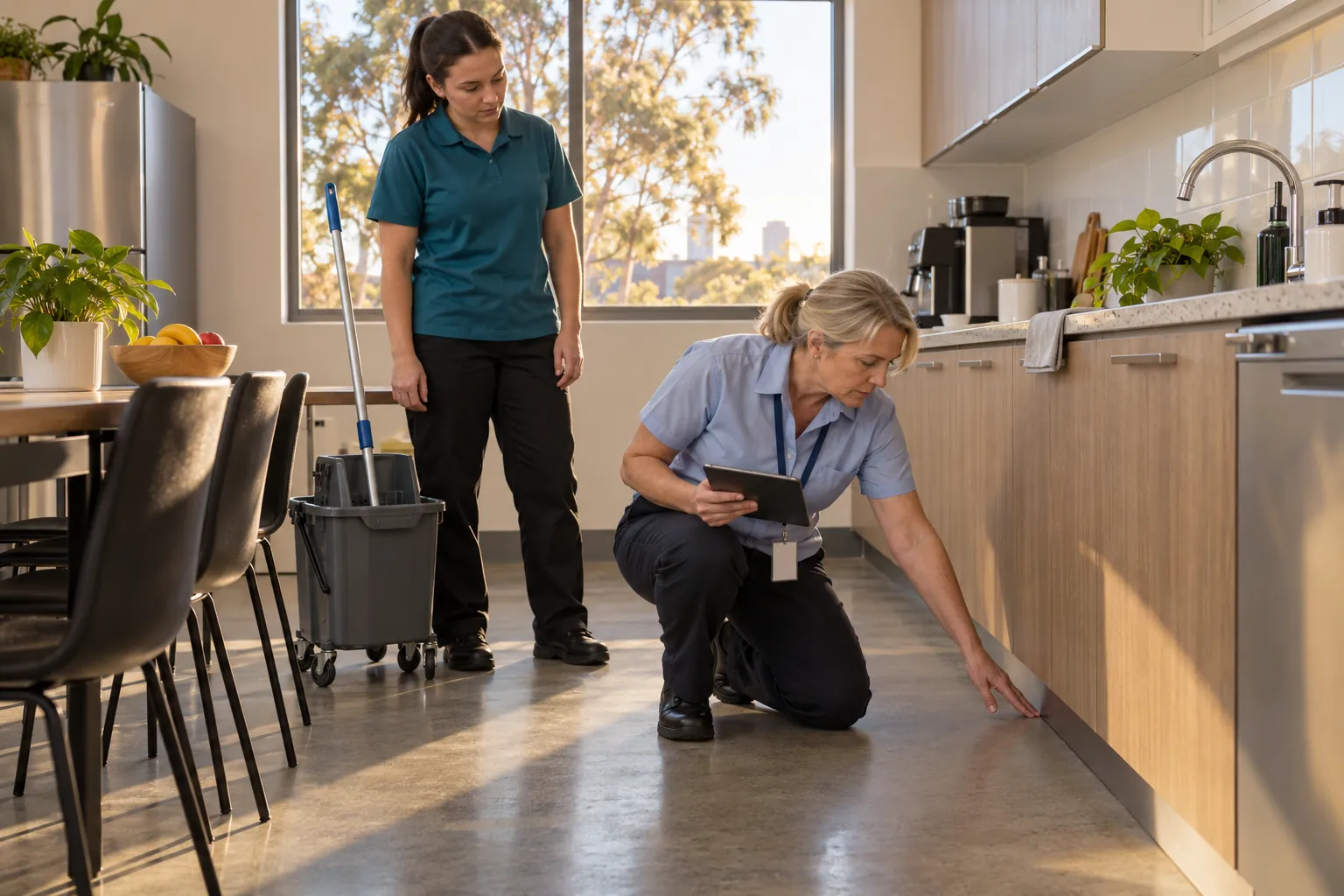
05
Who audits, corrective action and reporting the results
Who audits. The ACSQHC says auditors should be trained in auditing environmental cleaning, be given an orientation of the area, "not be from the area that they are auditing", and have a thorough knowledge of the cleaning standards and processes. In NSW healthcare, extreme and high risk areas are also externally audited at least every two years, never by staff of the external cleaning provider. For a commercial contract, the contractor's supervisor audits day to day and the client or its facility manager audits independently.
Corrective action. Each failure needs a corrective action with an owner, a timeframe and a check that it was done. The ACSQHC asks auditors to work with cleaning staff and the department to develop an action plan "including who will be responsible for each action and an appropriate timeframe for rectification". Failures that keep coming back need a cause, not only a re-clean: too few hours, a missing product, a training gap or a busier room. A cracked tile or broken dispenser is a maintenance job and should be reported as one.
Escalation. PD2023_018 escalates repeated failure: in an extreme risk area, two consecutive failed audits bring targeted cleaning and weekly inspection of all rooms until the benchmark is met. A commercial contract can do the same: a set number of failed audits triggers a recovery plan and more frequent audits.
Reporting. The ACSQHC says results should be centrally collated, reviewed regularly and "always fed back to cleaning, IPC and department staff members as well as management". In a commercial building, the regular contract meeting should see the scores, failures by area, open corrective actions and trend, and the cleaning team should hear the results too.
Working together. A contract cleaner and the client are both PCBUs with duties over the same matters. Section 46 of the Work Health and Safety Act 2011 (Qld), and the same section in the other states' and territories' WHS Acts (not Victoria's), requires each to "consult, cooperate and coordinate activities" with the other so far as is reasonably practicable. Sharing audit findings about slip hazards, chemicals and faults is part of that.
06
Where the audit record fails, and what SiteClara does about it
Most audit programs are strong on the audit and weak on the days between. The daily record lives on a sheet on the back of the washroom door, initialled for the whole shift at the end of it. A failed element is noted on the audit form and nobody can say later when it was fixed. When the client asks whether last week's afternoon washroom checks happened, the answer is a recollection.
SiteClara records the routine checks where they happen. A printed QR poster, with an optional NFC tag behind it, goes at each location with scheduled checks: a washroom, a kitchen, a lift lobby, a cleaner's room. The cleaner or supervisor scans or taps it with their own phone, with no app to install, sees the checks due there, and marks each one done or says what stopped them, with a photo when the check asks for one. A problem found on an audit, or reported by anyone at the tag, becomes an open job on the team's list until someone closes it, so a failed element has an owner and a closing time rather than a note in a margin.
The supervisor sees what is due, done and missed, records why a check was missed, and approves a daily report that goes to nominated managers or client contacts the next morning: what was reported, completed and still open, and how the scheduled checks went.
07
Questions people ask
What does "cleaning audit" mean?
A cleaning audit is an inspection of cleaned areas against a written standard, scored as the share of inspected elements that pass. The Clinical Excellence Commission's Module 7: Evaluation of cleaning describes it as a trained auditor's visual inspection of an area, documented with a score for each section that passes and an overall score for the area.
How often should cleaning be audited?
As often as the risk calls for, and as the contract says. The ACSQHC's Principles of environmental cleaning auditing say frequency depends on a risk assessment, with higher risk areas audited more often. NSW Health's PD2023_018 ranges from at least half the rooms each month in extreme risk areas to every room once a year in low risk areas such as offices.
How do you pass a cleaning audit?
By scoring at or above the acceptable quality level agreed for each area, then putting any failed elements right within the agreed time. NSW Health's Cleaning of the Healthcare Environment policy directive (PD2023_018) sets 90% for extreme risk areas, 88% for high, 85% for medium and 80% for low risk areas, and requires a new audit as soon as the issues from a failed one have been rectified; outside healthcare, the pass mark is set in the cleaning contract.
08
Further reading, and a list to take away
For the method, read the ACSQHC's Principles of environmental cleaning auditing, NSW Health's Cleaning of the Healthcare Environment policy directive (PD2023_018) and the Clinical Excellence Commission's Module 7: Evaluation of cleaning. For the duty to keep a workplace clean, read your state's WHS regulation, SafeWork NSW's Managing the work environment and facilities code of practice or, in Victoria, WorkSafe Victoria's compliance code on workplace facilities and the working environment. Hospitals should also read the hospital cleaning standards guide.
To check your own cleaning audit program, ask whether:
- the contract states the areas, the standard, the pass mark and the rectification times;
- each area type has a short checklist written from your own specification;
- the sample covers floors, room types and times of day, with some audits unannounced and some joint;
- failures are recorded by element, location and time, not only as a score;
- every failure has an owner, a timeframe and a re-check;
- repeated failures trigger more audits and a look at the cause;
- results go to the client, management and the cleaning team;
- there is a record of the cleaning between audits, made at the time.
Sources
Every document this guide quotes or links to, in the order it first cites them.
- Work Health and Safety Regulation 2011 (Qld) legislation.qld.gov.au
- Managing the work environment and facilities code of practice safework.nsw.gov.au
- Principles of environmental cleaning auditing safetyandquality.gov.au
- Managing risks of hazardous chemicals in the workplace code of practice safework.nsw.gov.au
- Cleaning of the Healthcare Environment policy directive (PD2023_018) www1.health.nsw.gov.au
- Clinical Excellence Commission's Environmental Cleaning Standard Operating Procedure, Module 7: Evaluation of cleaning cec.health.nsw.gov.au
- Work Health and Safety Act 2011 (Qld) legislation.qld.gov.au
- Compliance code on workplace facilities and the working environment worksafe.vic.gov.au
Related guides
 CleaningCleaning KPIs: what to measure, and how to know the figures are trueThe cleaning KPIs worth measuring in an Australian contract, how to define and target them, how to report them, and why a green dashboard can hide a dirty building.
 CleaningHospital cleaning standards in Australia: what is cleaned, how often, and how it is checkedHospital cleaning in Australia: NSQHS Action 3.13, risk categories, cleaning and audit frequencies, acceptable quality levels, and the record that shows it was done.
 CleaningCleaning supervisor duties: what the role involves in Australia, and what good looks likeWhat a cleaning supervisor does in Australia: the Cleaning Services Award, WHS duties, a typical shift, managing the team, checking the work and reporting.
 CleaningCommercial cleaning checklist: area by area, and how to know it is followedA commercial cleaning checklist for Australian offices and shared buildings, area by area, with the WHS duties behind it and how a supervisor checks it is followed.