Cleaning
End of trip facilities: keeping showers, lockers and bike rooms clean and working
End of trip facilities are the secure bike parking, showers, change rooms and lockers in a workplace or commercial building that let people ride, run or walk to work and arrive ready for the day.
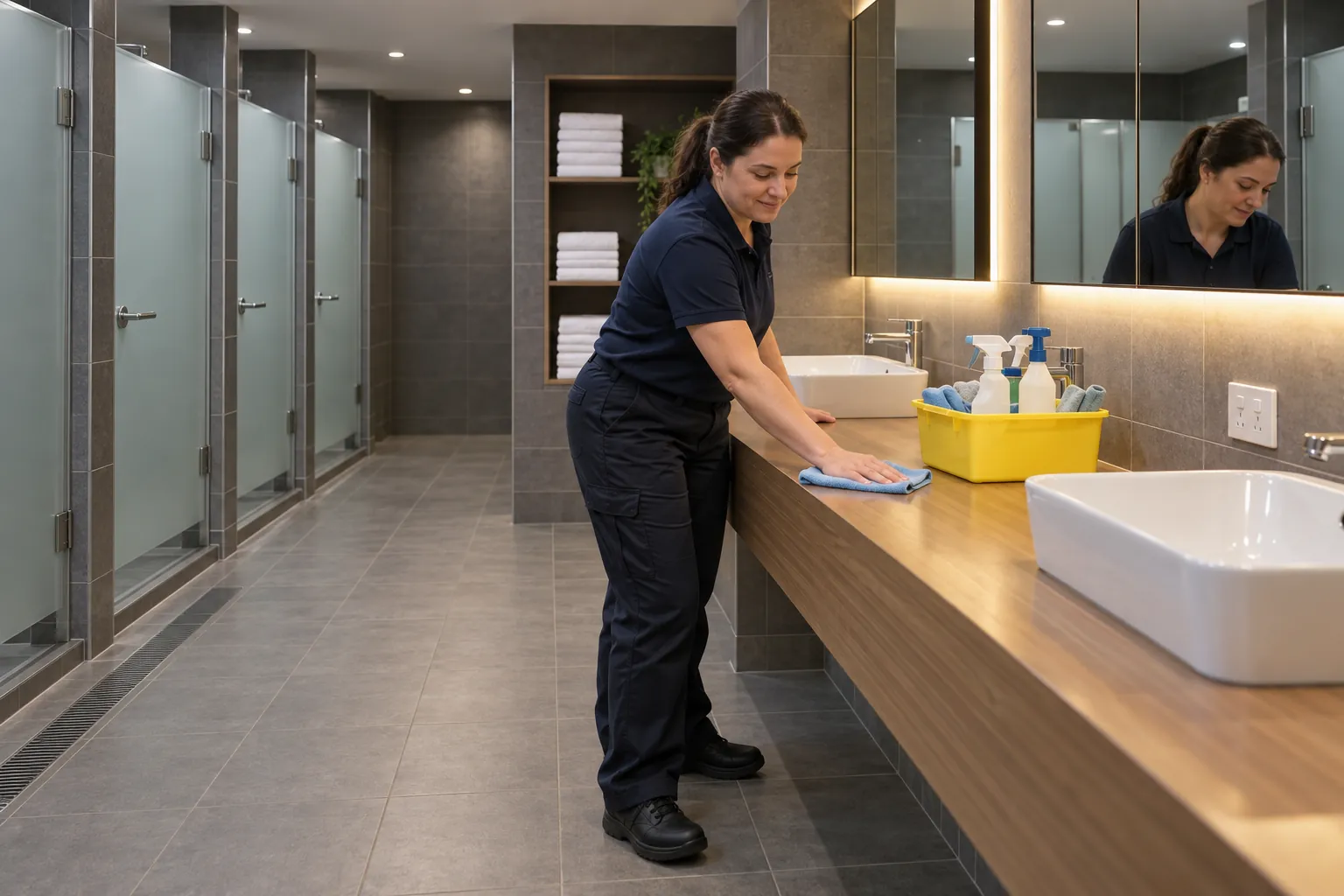
They are easy to show off at handover and easy to let slide afterwards: a blocked drain, a hair dryer that stopped working in March, a row of lockers nobody has emptied in months. This guide covers what end of trip facilities include, what Australian work health and safety and planning rules say about them, how often each part needs cleaning and checking, who is responsible in a multi-tenant building, and what a record worth trusting looks like.
01
What end of trip facilities are, and the rules behind them
End of trip facilities (EOT or EOTF) are the amenities at the end of an active commute: secure bike parking, showers, change rooms, lockers and, in larger office buildings, drying rooms, towel services, ironing stations and a bike repair stand. In an office tower they are usually a base building amenity shared by every tenant; in a hospital, university or depot they may belong to one employer. Often written end-of-trip facilities, they are designed to encourage cycling and other active travel, and the benefits run several ways: they improve the commute for the people who use them, building owners offer them because prospective tenants look for them, and they reduce demand for car parking.
Two quite different sets of rules touch them. Planning law decides whether they must be built. In Victoria, Clause 52.34 Bicycle facilities of the Victoria Planning Provisions has as its purpose "to provide secure, accessible and convenient bicycle parking spaces and associated shower and change facilities". Its Table 2 (as amended by VC274) asks for one shower for the first 5 employee bicycle spaces and one more for each further 10, where 5 or more employee spaces are required, and Table 3 asks for one change room, or direct access to a communal change room, for each shower. Other states and many councils set their own requirements through planning schemes and development control plans, so the numbers in your building came from its own consent.
Work health and safety law decides how they must be kept. Where showers, change rooms and lockers are provided for workers, they are workplace facilities. Regulation 41 of the Commonwealth Work Health and Safety Regulations 2011, which follow the model regulations, is headed "Duty to provide and maintain adequate and accessible facilities". The Managing the work environment and facilities code of practice, based on Safe Work Australia's model code (SafeWork NSW edition, August 2019), puts the result plainly: facilities "must be clean, safe, accessible and in good working order", consumables such as soap and toilet paper "should be replenished regularly", and facilities "should be cleaned regularly taking into account the type of work performed, the likelihood of contamination, the number of workers using them, including during shiftwork, and the type of facility, such as eating areas, toilets, handbasins and showers." States that have adopted the model laws approve their own editions of the code, so check the one for your state.
Victoria has its own law. Under the Occupational Health and Safety Act 2004, section 21(2)(d), an employer must provide, so far as is reasonably practicable, adequate facilities for the welfare of employees at any workplace under its management and control. WorkSafe Victoria's Compliance code: Workplace facilities and the working environment (edition 1, December 2023) goes further than the national code on the commuter shower. It notes that "Employers may also choose to support their employees by providing showers for commuters and for workplace wellbeing", and says that showers "need to be kept in a hygienic condition and cleaned regularly as needed depending on the number of employees and how often the facilities are used."
Nothing in the law sets a cleaning frequency for an end of trip facility, but once it exists, whoever controls it is expected to keep it clean, safe, working and available.
02
What an end of trip facility includes, area by area
A good routine starts with a list of what is actually there. Walk the facility with the floor plan and write down each part:
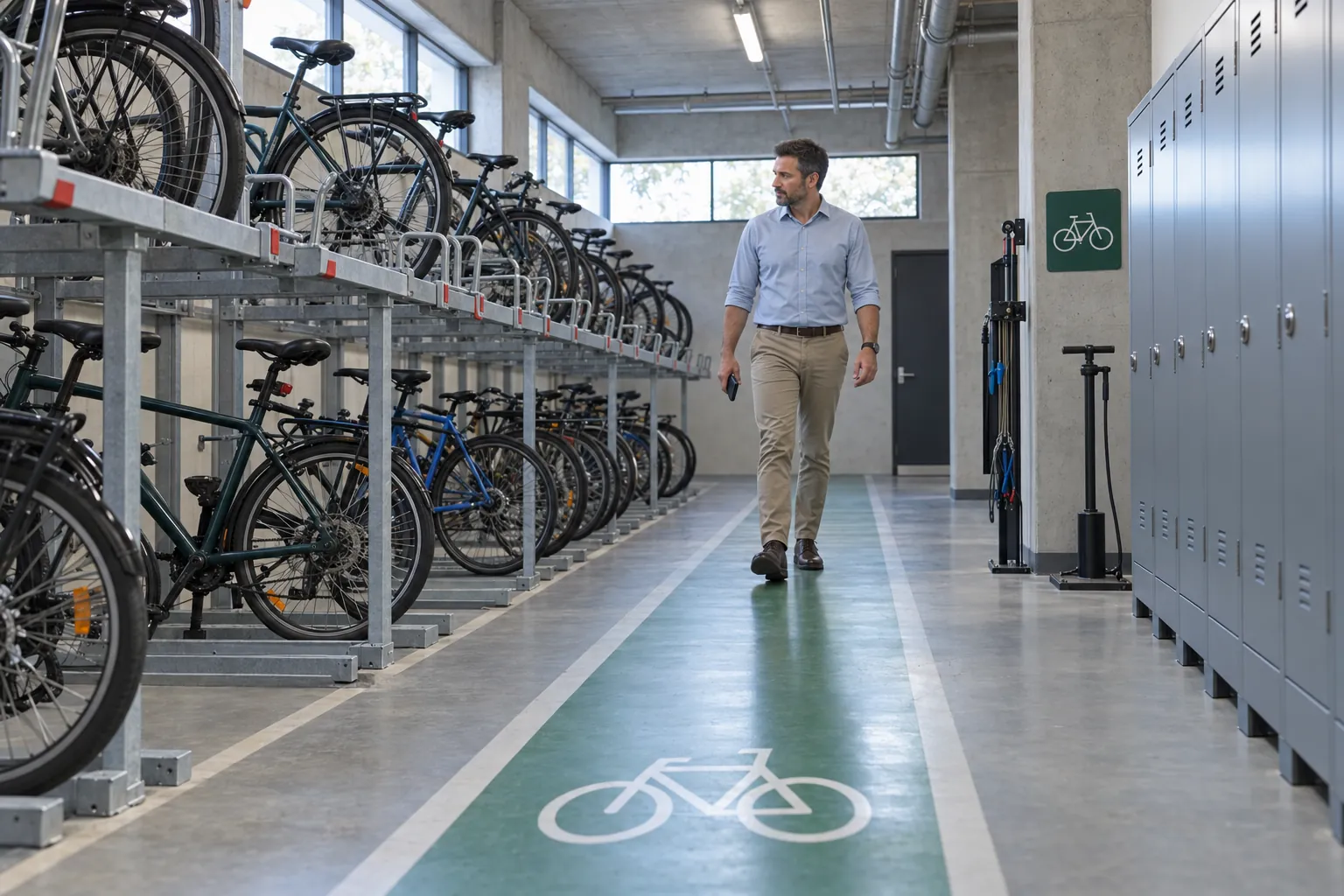
- Bike parking: the secure bike room or cage, wall and floor racks, e-bike charging points, the bike repair stand and pump, and the access-controlled door. Clause 52.34 in Victoria expects employee bike spaces in a lockable compound or bike locker, fully enclosed and able to be locked.
- Showers: cubicles and their doors, locks, screens, floor wastes and hair traps, shower heads, mixers, grab rails in the accessible shower, benches and hooks. The national code describes showers with "a slip-resistant surface that is capable of being sanitised", partitions, an adjacent dressing area with a seat and hooks, and a lockable door.
- Change rooms: benches, mirrors, hooks, shelves, vanities and basins, bins and sanitary disposal, and the floor, which is wet for much of the morning.
- Lockers: day-use lockers cleared each night, allocated long-term lockers, the locks or keypads, and the space in front of them. The code says lockers should be "well ventilated, accessible and secure" and recommends at least 1800 mm between facing rows of lockers and 900 mm between lockers and a seat or wall.
- Drying, towels and consumables: drying room or cabinets, hair dryers, irons, towel stock and hampers, soap and shampoo dispensers.
- The fabric and services: exhaust fans, lighting, hot water, grout, silicone and ceilings (where mould appears first), and the path from the bike room to the showers.
Each needs cleaning and a check that it works. The failures users notice most, such as cold water, a jammed locker or a dead hair dryer, are rarely cleaning failures, and a routine that covers only cleaning will not catch them.
03
How often to clean and check an end of trip facility
The Victorian compliance code makes frequency depend on use: cleaning "may be needed at each shift change or daily, but can be needed more often depending on the type or nature of the work", and the schedule "needs to account for the hygienic maintenance of facilities in high-use areas, like dining areas, toilets, urinals, hand washing facilities and showers." End of trip facilities have a sharp peak, in many buildings from about 7 am to 9:30 am and again after lunchtime runs and at the end of the day, so a schedule built only around the overnight clean leaves them at their worst when most people use them.
A workable pattern for a busy office facility, to adjust to your own usage:
Locker audits deserve their own line. Long-term lockers fill with forgotten gym bags, and day lockers left locked overnight block the next day's users. Publish a rule, clear what breaks it after notice, and record what was removed, from which locker and where it went, because someone will ask.
Water that stands still in pipes and shower heads is worth a thought when a facility goes quiet for weeks, for example over the Christmas shutdown. None of the documents quoted here sets a flushing routine for an office shower, so ask the plumber or the person who manages the building's water systems what, if anything, should be run through before the facility reopens, and put it on the schedule.
04
Who is responsible for what in a shared building
In a multi-tenant office the end of trip facility is typically run by the building owner through a property manager and an on-site building manager, cleaned under the base building contract. The tenants' staff use it, but the tenants do not control it, and that matters, because the duty follows control.
Under the Commonwealth Work Health and Safety Act 2011, which follows the model Act, section 20 places a duty on a person conducting a business or undertaking with management or control of a workplace to ensure, so far as is reasonably practicable, that the workplace, the means of entering and exiting it and anything arising from it are without risks to health and safety, and section 21 places the same duty on whoever manages or controls its fixtures, fittings and plant. Each tenant employer keeps its own primary duty of care to its workers under section 19, and section 46 requires duty holders who share a duty to consult, cooperate and coordinate with each other. In Victoria, the compliance code says that where an employer finds facilities inadequate but lacks the control to fix them, it needs to "attempt to influence the person who does manage or control that workplace to fix the issue", and should weigh the adequacy of facilities before entering a lease.
In practice, write down who does each of these, and agree it with everyone involved:
- Cleaning contractor: the daily and periodic clean, restocking, clearing day lockers, reporting damage and faults found while cleaning.
- Building or facility manager: the cleaning specification and schedule, checking the result, locker rules and audits, fault triage, and the link to maintenance and security.
- Maintenance contractors: plumbing, hot water, exhaust fans, lighting, locks and keypads, e-bike charging points, and any repair the cleaner reports.
- Security: bike room access control, CCTV where installed, and the patrol that notices a door propped open.
- Tenants and users: passing on the rules, following them, and reporting problems.
Where one employer owns and runs the facility, as in a hospital or council depot, the same jobs sit inside one organisation, and the questions are the same: who cleans, who checks it works, who fixes it, and how a problem reaches the right person.
05
What good evidence looks like, and how to check the standard
Clean is a judgement, so agree in advance what it means. The cleaning specification should say, for each element, what the finished result looks like (no hair on shower floors, no standing water, no mould on grout, dispensers never empty), how often it is cleaned, and who inspects it. The Victorian compliance code expects employers to monitor facilities and to review them when, among other things, a complaint has been lodged about their adequacy or an incident in relation to them affects the health, safety or welfare of employees.
Good evidence for a facility like this has a few features:
- It is made at the time, in the room. A clean or check recorded when and where it happened, by a named person, is worth more than a sheet signed at the end of a shift.
- It covers the peak. A record showing a clean at 5 am and nothing until the next night does not show the facility was fit for use at 8:30 am.
- It separates cleaning from function. "Showers cleaned" and "all showers running hot, all locks working" are different checks, and both belong in the record.
- It shows faults to closure. A broken lock reported on Monday should appear again with a date it was fixed, and who fixed it.
- It uses photographs on purpose. A mould patch before treatment answers a later question; a photo of every mirror every day buries the useful ones.
Check the standard in three ways: a scheduled inspection on the same route, scoring the same elements each month; spot checks at the peak, which catch what the overnight clean never sees; and feedback from users, the fastest way to learn about a failed hot water unit or a dead keypad, provided reporting is easy and someone answers.
Review the check record, open faults and user complaints with the cleaning contractor each month; it settles most disputes before they start.
06
Where the end of trip record fails, and what SiteClara does about it
End of trip facilities rarely fail for want of a cleaning schedule. They fail because the schedule lives on a sheet inside the cleaners' cupboard, signed for the whole week in one sitting, and because nothing records the mid-morning check that should follow the peak. A rider tells the concierge the second shower has been cold for three days, the concierge mentions it to the building manager at the lift, and nobody can later say when it was reported or fixed.
SiteClara records work and reports at the location. A printed QR poster, with an optional NFC tag behind it, sits at each place where checks are scheduled, such as the shower and change room, the locker bank and the bike room. Cleaners and other staff scan or tap on their own phone, with no app to install, and mark the scheduled check done, or say why it could not be done, at the time and in the room. They can report a problem there too, with a photo when one helps: the report carries the location, the time and the named person, and goes onto the team's list of open jobs until someone closes it.
The supervisor sees the open jobs and the day's checks, adds a note and approves a daily report that goes to nominated management or client contacts the next morning, showing what was checked, what was reported and what is still open. For an end of trip facility, that turns "cleaned daily" into a dated record of the early clean and the post-peak check at each room, and "I told someone about the shower" into a job with a time, a location and a name that stays open until it is fixed.
07
Questions people ask
What does end of trip facilities mean?
It means the facilities that serve people at the end of an active commute: somewhere secure to leave a bike, and showers, change rooms and lockers so cyclists, runners and walkers can get ready for work. Clause 52.34 Bicycle facilities of the Victoria Planning Provisions states the purpose in two lines: "To encourage cycling as a mode of transport" and "To provide secure, accessible and convenient bicycle parking spaces and associated shower and change facilities."
What is an EOT facility?
EOT is short for end of trip, so an EOT facility is the bike room, showers, change rooms and lockers treated as one set. Clause 52.34 Bicycle facilities of the Victoria Planning Provisions expects them to work together: a bicycle compound or locker must be located "to provide convenient access to other bicycle facilities including showers and change rooms", and a council deciding an application considers whether showers and change rooms provided for other users are available to cyclists.
What are the current Australian standards for bike parking?
The standard named in Victoria's planning rules is AS 2890.3:2015, Parking facilities Part 3: Bicycle parking, which Clause 52.34 Bicycle facilities of the Victoria Planning Provisions lists among the matters a council considers. The clause also sets its own design rules: each space should allow for a bicycle 1.7 metres long, 1.2 metres high and 0.7 metres wide at the handlebars, rails must be securely fixed to a wall or the floor, and a bicycle compound must be fully enclosed, able to be locked and have an internal access path at least 1.5 metres wide. Other states and councils set their own requirements, so check the building's development consent.
08
Where to read the official guidance, and a short list to take away
Under the model WHS laws, start with sections 1.3 and 3.6 to 3.8 of the Managing the work environment and facilities code of practice and its Appendix B checklist, then your own state's edition. In Victoria, read the maintaining, cleaning and shower paragraphs of the Compliance code: Workplace facilities and the working environment. For what a Victorian development must provide, Clause 52.34 Bicycle facilities also refers to AS 2890.3:2015, Parking facilities Part 3: Bicycle parking; elsewhere, the building's development consent sets what was required.
To take away:
- List every part of the facility, from floor wastes to e-bike chargers, and give each a cleaning task and a working check.
- Clean before the morning peak and check again straight after it, not only overnight.
- Write a locker rule, publish it, and record every clearance.
- Agree in writing who cleans, who checks, who fixes and who tells the tenants.
- Make reporting a fault easy for users, and track each one to a dated fix.
- Inspect on a fixed route, add peak-time spot checks, and review the record with the cleaning contractor each month.
- Plan for shutdowns: what is done before the facility reopens after standing unused.
Read more in our guides to workplace amenities, the toilet cleaning checklist and the cleaning log sheet.
Sources
Every document this guide quotes or links to, in the order it first cites them.
- Clause 52.34 Bicycle facilities of the Victoria Planning Provisions planning-schemes.app.planning.vic.gov.au
- Work Health and Safety Regulations 2011 legislation.gov.au
- Managing the work environment and facilities code of practice safework.nsw.gov.au
- Occupational Health and Safety Act 2004 legislation.vic.gov.au
- Compliance code: Workplace facilities and the working environment worksafe.vic.gov.au
- Work Health and Safety Act 2011 legislation.gov.au
Related guides
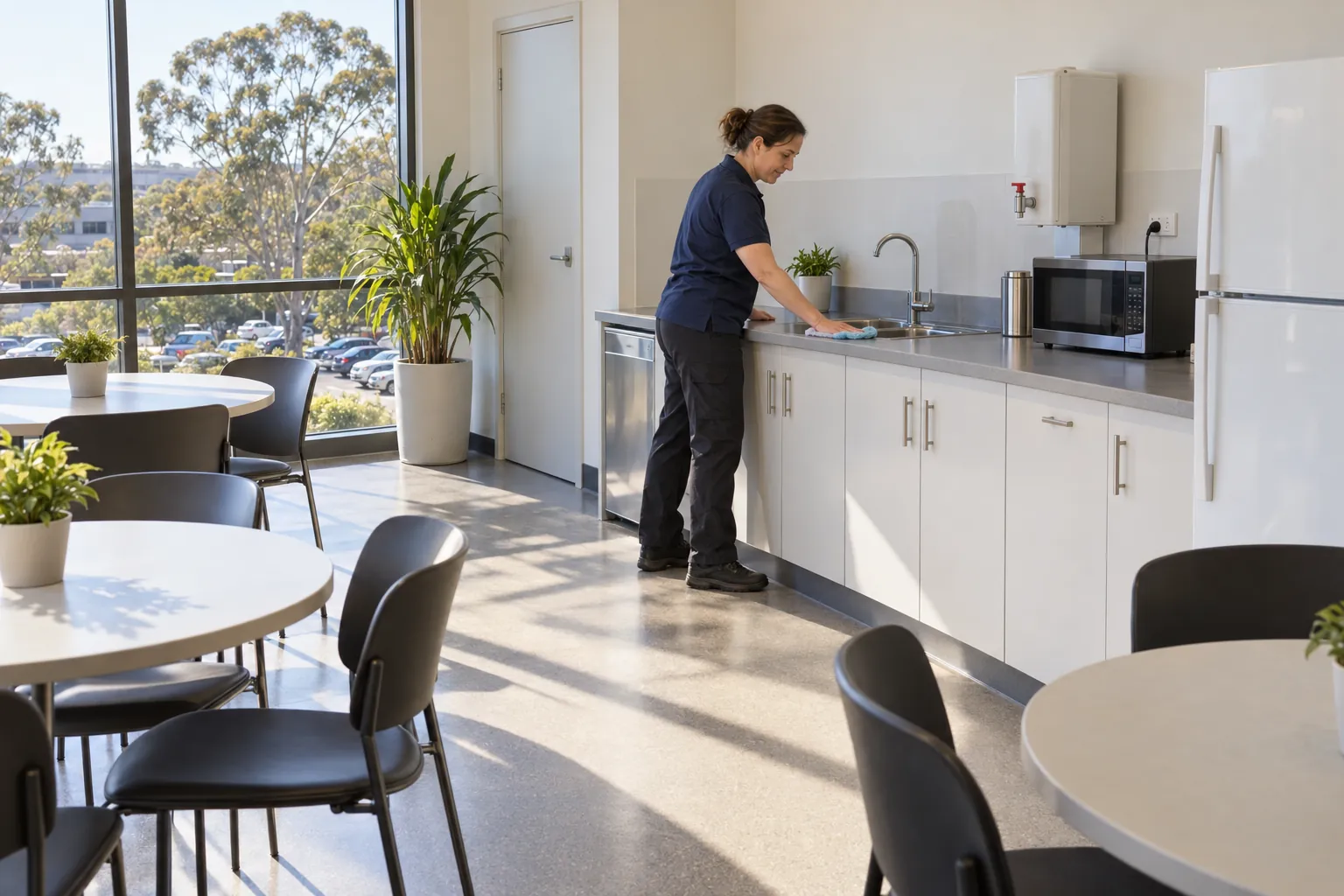 Premises and facilities managementWorkplace amenities: what the law asks for, and how to keep them clean and workingWorkplace amenities under Australian WHS and OHS law: what must be provided, the numbers the codes give, who cleans and maintains them, and what a good record shows.
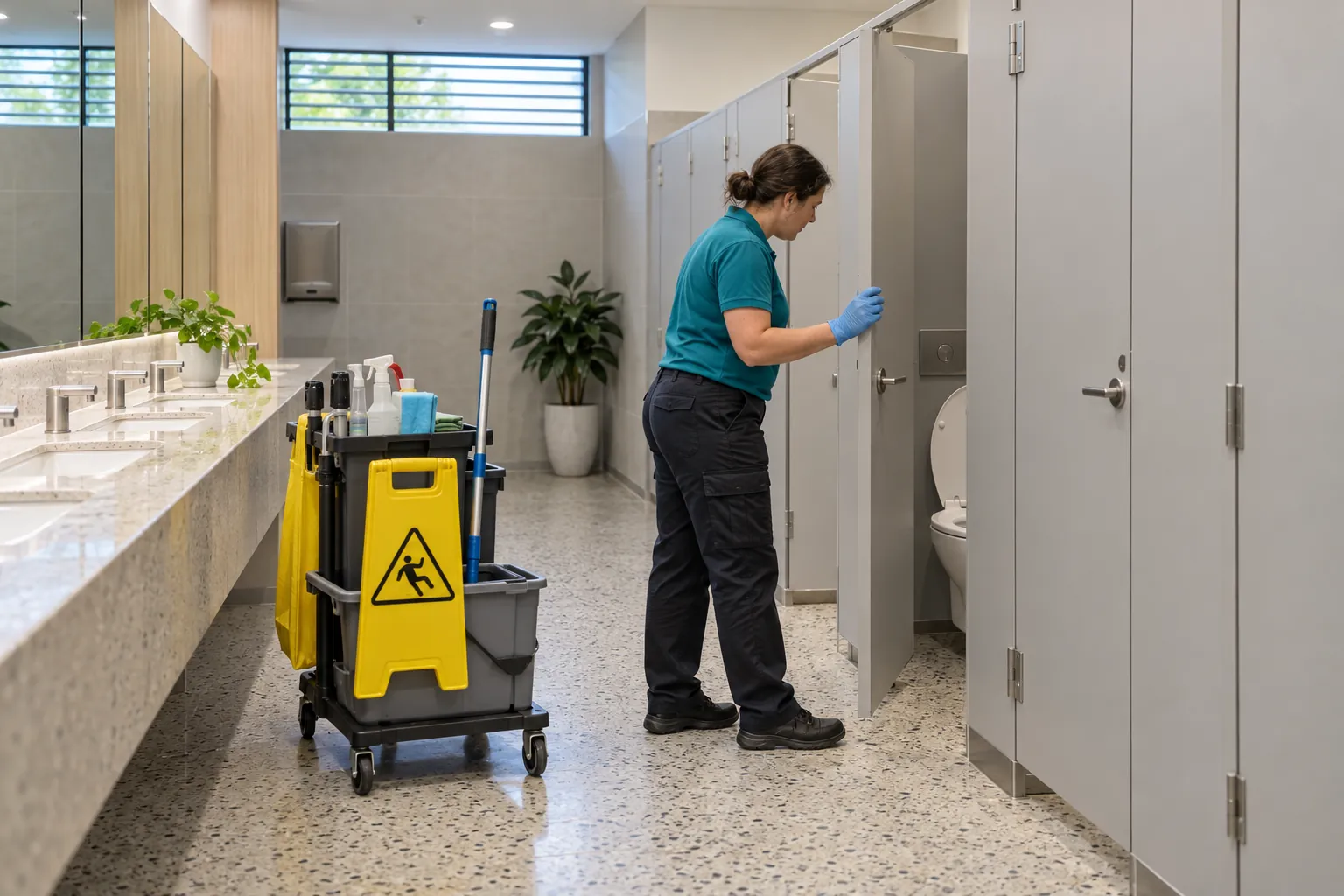 CleaningToilet cleaning checklist: what to check, how often, and how to make the record believableWhat a toilet cleaning checklist should cover in Australian workplaces, how often to check, the WHS and OHS duties behind it, and how to make the record believable.
 CleaningCleaning log sheet: what to record, who signs it, and what a signature provesWhat a cleaning log sheet should record in Australian workplaces and food businesses, the WHS and food safety rules behind it, and what a signature proves.
 CleaningCommercial cleaning checklist: area by area, and how to know it is followedA commercial cleaning checklist for Australian offices and shared buildings, area by area, with the WHS duties behind it and how a supervisor checks it is followed.