Fire and water checks
Emergency lighting testing: who tests what, how often, and what the record must show
Emergency and exit lighting in Australian buildings is tested at six-monthly and annual routine service to the standard AS/NZS 2293.2, usually by a licensed electrician or other appropriately qualified person, with the results kept in a logbook.
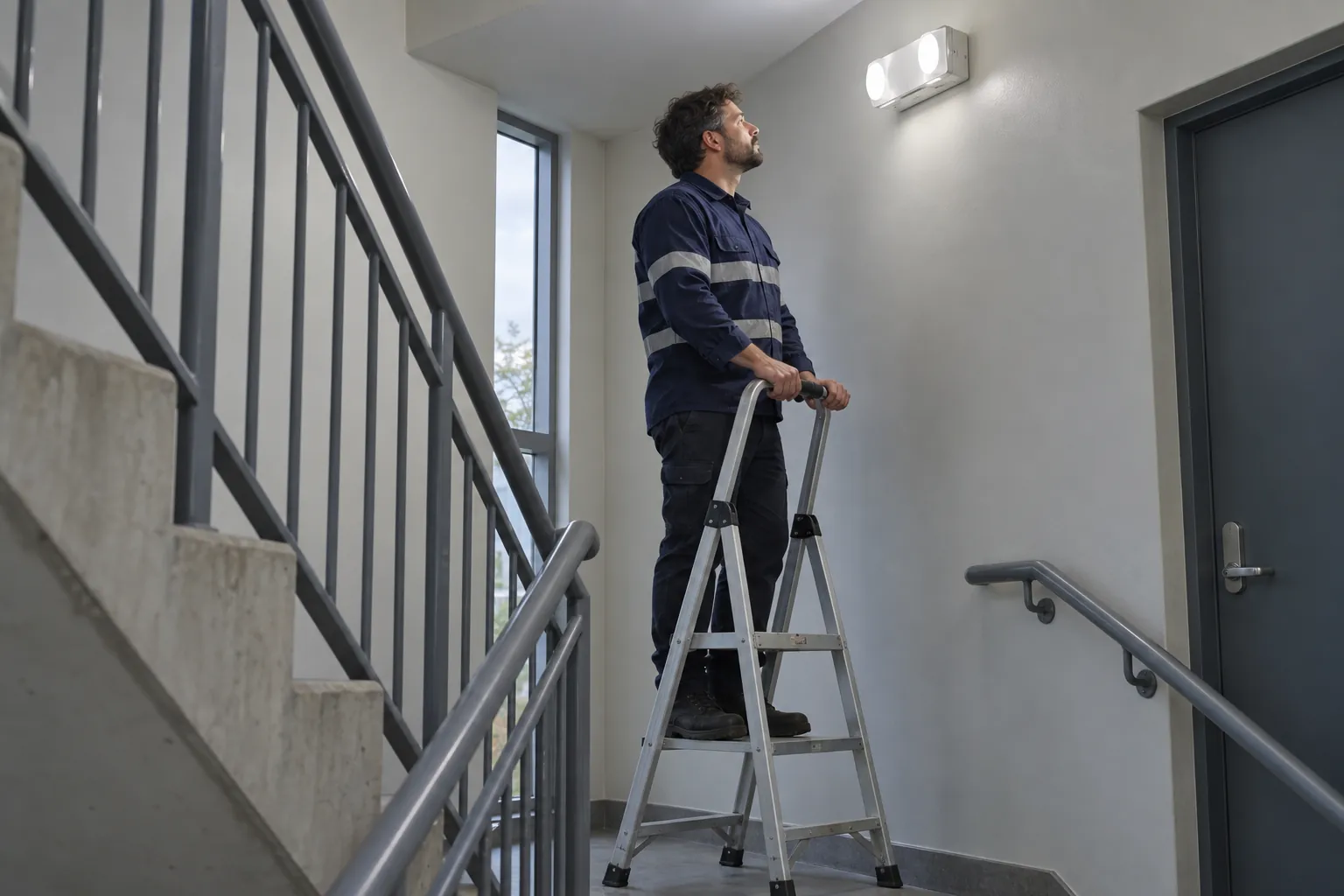
The lights only prove themselves when the power fails, usually at the worst possible moment. Until then, the evidence that it would work is the testing record. This guide covers where the duty to test comes from in Australia, what AS/NZS 2293.2 asks for, what the building team can check between the contractor's visits, and what the records need to show.
01
Where the duty to test emergency lighting comes from
Two layers meet: the National Construction Code decides where emergency lighting has to be installed, and state and territory law decides how it is kept working once the building is occupied.
The installation side is Part E4 of the National Construction Code 2025, Volume One, Part E4 (Visibility in an emergency, exit signs and warning systems). Its functional statement asks for "adequate visibility upon failure of normal artificial lighting during an emergency", and clause E4D4 says that "every required emergency lighting system must comply with AS/NZS 2293.1". Design and installation sit in AS/NZS 2293.1:2026 Emergency lighting and exit signs for buildings, Part 1: System design, installation and operation, published by Standards Australia in June 2026; a building is designed to the edition its approval called up, so older systems will have been installed to an earlier edition.
The maintenance side is AS/NZS 2293.2:2019 Emergency lighting and exit signs for buildings, Part 2: Routine service and maintenance, published on 9 April 2019 and listed by Standards Australia as pending revision. Standards Australia describes it as specifying "requirements for the periodic inspection and maintenance procedures for emergency evacuation lighting systems to ensure that such lighting systems will be in a state of readiness for operation at all times".
How the standard becomes a legal obligation depends on the state:
- Victoria: emergency lighting is item 1 of Part 4 (Lighting) of Schedule 8 to the Building Regulations 2018 (Vic), version 031, in force from 1 September 2026, so it is an essential safety measure. Regulation 226 requires the owner to ensure each one "is maintained in a state which enables the essential safety measure to fulfil its purpose", and the occupancy permit or maintenance determination sets the frequency and type of inspection, testing and maintenance.
- New South Wales: the owner issues an annual fire safety statement covering the essential fire safety measures in the building, under the Environmental Planning and Assessment (Development Certification and Fire Safety) Regulation 2021. NSW Planning's page on fire safety certification says the statement confirms that "an accredited practitioner (fire safety) has assessed, inspected and verified the performance of each fire safety measure that applies to the building".
- Queensland: section 54 of the Building Fire Safety Regulation 2008 (Qld) requires the occupier to ensure each prescribed fire safety installation is maintained "by an appropriately qualified person" and "inspected and tested at intervals in compliance with QDC, part MP6.1".
- South Australia: the Metropolitan Fire Service's page on the maintenance of fire safety systems says building owners must submit a Form 3 ESP maintenance verification notice to the local council at the start of each calendar year.
Workplace law adds a second thread. Under regulation 43 of the model WHS Regulations, as adopted in the states and territories that use the model law, a person conducting a business or undertaking (a PCBU) must have an emergency plan that provides for evacuation procedures and for "testing of the emergency procedures, including the frequency of testing" (see section 43 of the Work Health and Safety Regulation 2011 (Qld)). Victoria has its own Occupational Health and Safety Act 2004 rather than the model laws.
02
What counts as emergency lighting, and where it is required
Emergency lighting is the lighting that comes on automatically when the normal supply fails, so that people can see their way along a path of travel to an exit and see obstacles on the way. Exit signs, the illuminated green running man over doors and at changes of direction, belong to the same system and are tested with it.
Clause E4D2 of the NCC lists where a system must be installed. It includes:
- every fire-isolated stairway, fire-isolated passageway and fire-isolated ramp;
- every storey of a Class 5, 6, 7, 8 or 9 building with an area of more than 300 m², in the passageways and larger rooms that the clause describes;
- longer passageways leading from sole-occupancy units to exits in Class 2 and 3 buildings, such as apartment blocks and hotels;
- every required non-fire-isolated stairway;
- public areas of larger Class 6 shops and Class 9b assembly buildings, such as shopping centres, schools and halls, where the clause's size and distance tests are met;
- treatment areas and larger patient care rooms in Class 9a health-care buildings, and every Class 9c aged care building outside the sole-occupancy units;
- every required fire control centre.
The fittings are usually one of two types:
- Single point (self-contained) fittings, each with its own battery and charger, which are the most common in offices, schools and shops.
- Central battery systems, where one battery bank in a plant room supplies many fittings. They have their own inspection routine for the battery and charger as well as the fittings.
Self-testing or monitored fittings reduce the walking, not the responsibility: somebody still reads the results and acts on the faults.
03
Six-monthly and annual testing
AS/NZS 2293.2:2019 sets out routine service at six-monthly and annual intervals. The Queensland Fire Department's Fire Safety Management Tool with Advisory Notes puts it plainly for Queensland occupiers: "A log book (can be electronic) is required to record six monthly and annual inspections", and "A licensed electrician or appropriately qualified person is required to conduct the maintenance inspections".
A routine service visit generally involves the contractor switching the mains supply off to the emergency circuits, as a power outage would, so that every fitting runs on its battery, walking the building to confirm that each emergency luminaire and exit sign has come on and stays lit for the test period, then restoring the supply and checking that each fitting is charging again. The contractor confirms the discharge duration against the standard and the system's design. Fittings that go dim or out before the end are recorded as failures, and batteries, lamps or whole fittings are replaced.
Three practical points come up often:
- Timing. After a discharge test the batteries need time to recharge, and during that period the building does not have its full emergency lighting. Contractors often test out of hours, or test alternate fittings or floors at different times so that no area is left without cover.
- Access. Fittings in locked plant rooms, tenancies, car park levels and switch rooms are the ones most often missed. The facility manager or building manager needs to arrange keys and tenant notice before the visit, not on the day.
- Repairs. A failed fitting found at the six-monthly test is a defect, not a note for next time. In Queensland, section 54(4) of the Building Fire Safety Regulation 2008 requires the occupier to ensure the repair or corrective action shown in the record of maintenance is carried out "no later than 1 month after the maintenance of the installation was carried out, unless the occupier has a reasonable excuse".
04
What the building team checks between visits
Six months is a long time in an occupied building: a fitting gets knocked in the car park, a display goes up in front of an exit sign, a sign goes dark. The Queensland advisory notes say that "the occupier must ensure that exit sign covers are clean, in place and unbroken" and that lamps for exit signs and emergency lighting "must also be clean, in place and undamaged". The CFA adds that exit signs and emergency lighting "should be easy to see and not covered up".
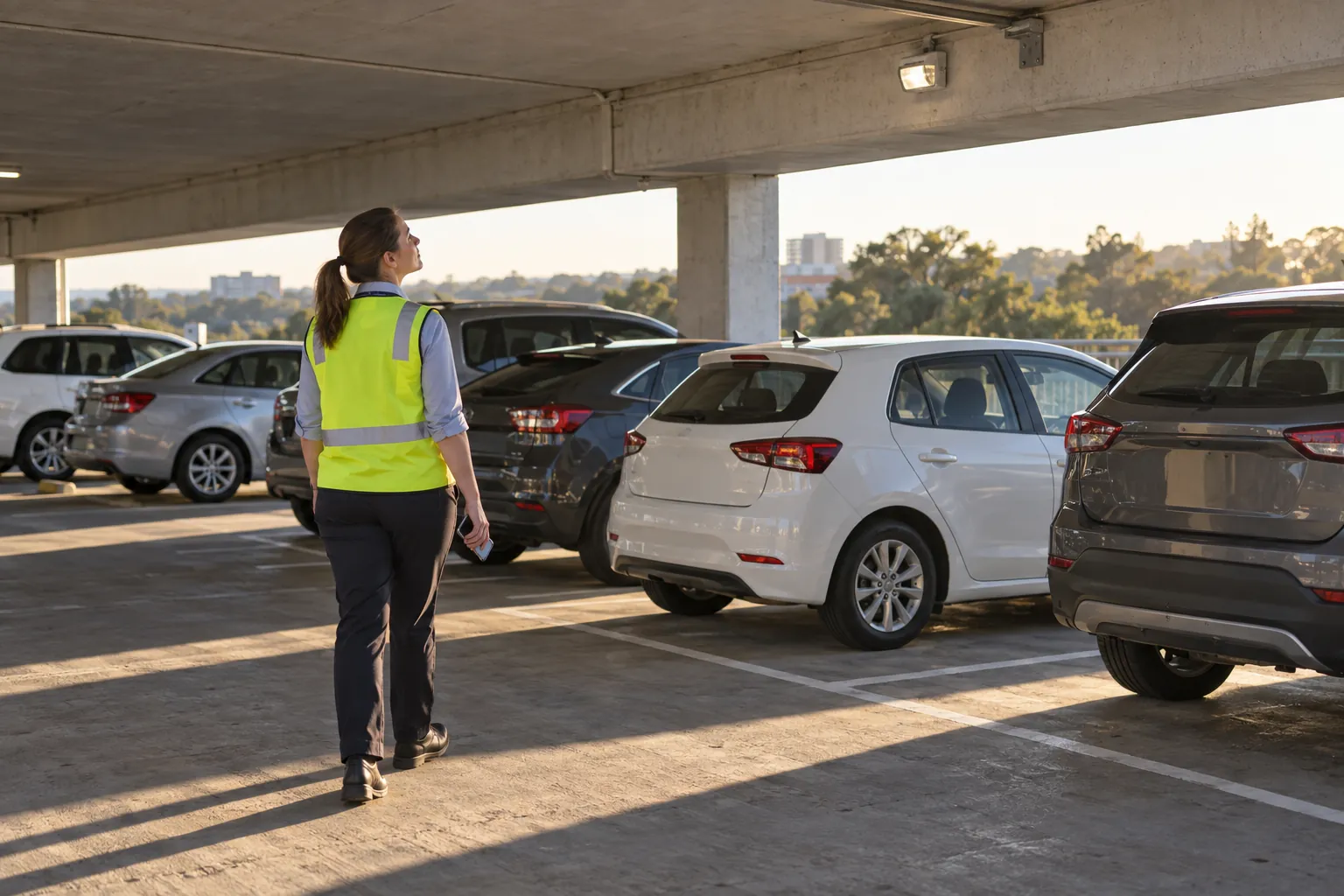
Those are things a building manager, caretaker, security officer or cleaning supervisor can look at on a regular walk, without switching anything off:
- every exit sign is lit, visible along the path of travel, and not hidden behind signage, stock, a banner or new partitions;
- emergency luminaires are in place, with diffusers clean and unbroken;
- charging indicators on single point fittings show normal, where the fitting has one;
- no fitting has been removed, covered or painted over during cleaning or fit-out works;
- for a central battery system, the charger panel shows no fault, and the battery room is clear and ventilated;
- for a self-testing or monitored system, the latest results have been read and any fault has been reported.
How often depends on the building, from an opening round in a shopping centre to a monthly walk in a small office. What matters is that the frequency is written down, someone is named, and the result is recorded, including the weeks when everything was fine.
Anything found goes straight to whoever arranges repairs, usually the facility manager, the building manager or, in a strata scheme, the strata or body corporate manager for the owners corporation. A dead exit sign on a stair is not a job for the next six-monthly visit.
05
What the records must show
The formal record is the contractor's. In Queensland, section 55 of the Building Fire Safety Regulation 2008 spells out what a record of maintenance must state, and the list is a good model anywhere:
- a description of the installation the maintenance was carried out on;
- the name and licence number of the appropriately qualified person who did it, or who personally supervised it;
- the date the maintenance was carried out, and a brief description of it;
- that it was carried out in compliance with QDC, part MP6.1;
- the results, including whether the person considered the installation was in proper working order, any repair or corrective action they considered was required, and the details and date of any repairs or corrective action taken;
- a statement signed by the person who carried out the maintenance certifying that the record is correct, and any critical defect notice given to the occupier.
In Victoria, regulation 225 of the Building Regulations 2018 requires the owner to make the records of all inspections, testing and maintenance (including repairs) of each essential safety measure, with the annual essential safety measures reports from the previous 10 years and the maintenance schedules, available for inspection at the building within 24 hours of a request by the municipal building surveyor or the chief officer of the fire brigade. In New South Wales, the accredited practitioner assessing emergency lighting for the annual fire safety statement will want the same history.
Beyond the letter of each law, the records that stand up share a few features:
- They identify each fitting. A schedule or plan with a reference for every luminaire and exit sign lets a test be recorded fitting by fitting, not as "all OK".
- Failures have outcomes. Every failed fitting has a matching repair, with a date, so the next reader can see the defect was closed.
- They are made at the time. The actual date of the test and the person who did it, not a batch of entries filled in before the audit.
- Gaps are explained. A tenancy that could not be accessed, with the date it was tested later, is more believable than a perfect year.
- Someone reads them. A facility manager who looks at the six-monthly report will see the same stairwell fitting failing three times running.
The building team's own checks sit alongside that record, showing somebody was looking in the months the contractor was not there.
06
Where the record fails, and what SiteClara does about it
The contractor's logbook is usually in order. The gaps sit in the building team's part: a walk-round sheet ticked for the whole month on the last Friday, an exit sign a cleaner mentioned to whoever was on the front desk, a car park fitting reported twice and never logged as a job, and a fit-out that covered two signs without anyone noticing until the six-monthly visit. Across a portfolio, a facility manager often cannot tell which buildings did their checks this month without ringing round.
SiteClara records those checks where they happen. A printed QR poster, with an optional NFC tag behind it, is placed at a location where a check is scheduled, such as a stair core, a car park level or the central battery room. Staff scan the code or tap the tag on their own phone, with no app to install, see the checks due at that location, such as this week's exit sign and emergency light walk for that floor, and mark each one done or say what stopped them. A problem, such as a sign that has gone dark or a broken diffuser, is reported there with a photo and stays on the team's list of jobs until someone closes it.
The supervisor sees what is due, done and missed, and records the reason a check was missed. A job that needs the building manager can be escalated to them to answer. Each day the supervisor reviews and approves a report that goes to nominated contacts, such as the owner's facility manager or the strata manager, the next morning, showing what was reported, what was completed, what is still open, and how the scheduled checks went.
07
Questions people ask
What are the emergency lighting testing requirements in Australia?
Emergency lights and exit signs are serviced to AS/NZS 2293.2 at six-monthly and annual intervals, and each state's law makes keeping them working the owner's or occupier's duty. In Queensland, for example, section 54 of the Building Fire Safety Regulation 2008 (Qld) requires the occupier to ensure each prescribed fire safety installation is "inspected and tested at intervals in compliance with QDC, part MP6.1", and the Queensland Fire Department's Fire Safety Management Tool with Advisory Notes says that "A log book (can be electronic) is required to record six monthly and annual inspections".
Do you have to be qualified to test emergency lighting?
For the routine service, yes. Section 54(1) of the Building Fire Safety Regulation 2008 (Qld) says the occupier "must ensure that maintenance of each prescribed fire safety installation for the building is carried out by an appropriately qualified person", and the Queensland Fire Department's Fire Safety Management Tool with Advisory Notes says that "A licensed electrician or appropriately qualified person is required to conduct the maintenance inspections". Other states set out who may do the work in their own law.
How do I test my emergency lights?
Leave the discharge test, with the mains switched off and every fitting on its battery, to the licensed electrician or other qualified person who does the routine service. Between their visits, the building team can check what the Queensland Fire Department's Fire Safety Management Tool with Advisory Notes asks of occupiers: that "exit sign covers are clean, in place and unbroken", and that lamps for exit signs and emergency lighting are "clean, in place and undamaged".
08
Further reading, and a list to take away
Start with the building's own documents: the occupancy permit, maintenance determination or maintenance schedule in Victoria, the fire safety schedule in New South Wales, and the record of maintenance in Queensland. They say which measures apply and how often each must be serviced. For the standards, Standards Australia publishes AS/NZS 2293.2:2019 for routine service and AS/NZS 2293.1 for design. For the law, read your own state's rules: Part 15 of the Building Regulations 2018 (Vic), NSW Planning's fire safety certification guidance, or the Queensland Fire Department's Fire Safety Management Tool with Advisory Notes.
Before the next six-monthly visit, check that:
- every emergency luminaire and exit sign has a reference and appears on a schedule or plan;
- the contractor has access arranged to plant rooms, switch rooms, car park levels and tenancies;
- the test is booked at a time that allows batteries to recharge before the building is busy;
- every failure from the last visit has a matching repair entry, with a date;
- the building team's walk between visits has a named person, a deputy and a written frequency;
- self-test or monitoring results, if you have them, are read and acted on;
- the records are kept together and can be produced quickly when an auditor, surveyor or fire authority asks.
Sources
Every document this guide quotes or links to, in the order it first cites them.
- National Construction Code 2025, Volume One, Part E4 (Visibility in an emergency, exit signs and warning systems) ncc.abcb.gov.au
- AS/NZS 2293.1:2026 Emergency lighting and exit signs for buildings, Part 1: System design, installation and operation store.standards.org.au
- AS/NZS 2293.2:2019 Emergency lighting and exit signs for buildings, Part 2: Routine service and maintenance store.standards.org.au
- Building Regulations 2018 (Vic) legislation.vic.gov.au
- Fire safety certification planning.nsw.gov.au
- Building Fire Safety Regulation 2008 (Qld) legislation.qld.gov.au
- Maintenance of fire safety systems mfs.sa.gov.au
- Work Health and Safety Regulation 2011 (Qld) legislation.qld.gov.au
- Fire Safety Management Tool with Advisory Notes fire.qld.gov.au
- Exit signs and emergency lighting cfa.vic.gov.au
Related guides
 Fire and water checksAS 1851 routine service: what it asks of owners, fire contractors and building teamsWhat AS 1851-2012 routine service covers, how intervals and competent persons work, what the records must show, and how Victoria's regulations call it up.
 Fire and water checksEssential safety measures in Victoria: the duties, the annual report and the recordsWhat essential safety measures are under Victoria's Building Regulations 2018, who maintains them, the annual ESM report, the records to keep and the checks between.
 Fire and water checksThe annual fire safety statement: what a NSW building owner declares, and how to make it trueWhat a NSW annual fire safety statement declares, which buildings need one, the 3-month assessment window, lodging and display, and the checks that make it true.
 Fire and water checksFire alarm testing in commercial buildings: who tests what, and what the record must showFire alarm testing in Australian commercial buildings: AS 1851 routine service, state maintenance law, what the building team checks, records and false alarms.