Security patrols
Mobile patrols: what you are buying, and how to know each visit happened
A mobile patrol is a licensed security officer, usually in a marked vehicle, who visits a run of client sites at scheduled or random times, mostly after hours, to check each one is secure, respond to alarms and report what they find, instead of staying on one site for the whole shift as a static guard does.
Also written for United Kingdom
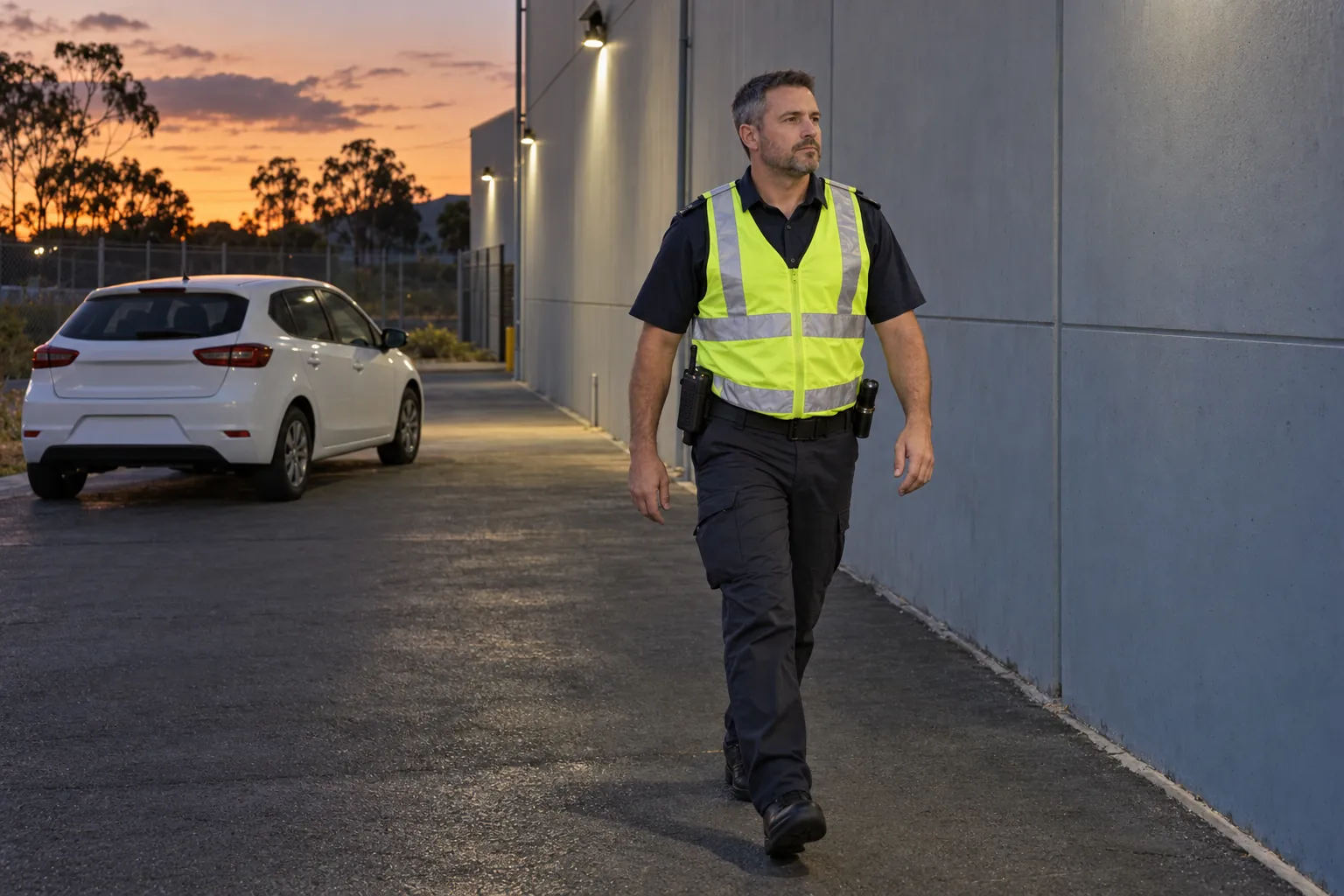
Mobile patrol security costs far less than a guard on site and covers far less time, so what the client is really buying is a few minutes of attention a night and a record of it. This guide explains what a mobile patrol visit covers on an Australian site, the state licence and award behind the work, when a patrol suits and when a static guard is the better buy, what to agree in the contract, and what a security patrol log should show.
01
What a mobile patrol is, and how it differs from a static guard
A mobile patrol service sends a licensed security officer to a client's premises at agreed times, usually in a marked patrol vehicle. The officer carries out the checks set for that site, deals with or reports what they find, and drives on to the next site on the run. One patrol vehicle may cover many clients in a night, so security patrol services are usually priced per visit or per month rather than per hour, and each site pays for minutes of an officer's time rather than a full shift.
The difference from a static guard is time on site. A static guard works from one post for the whole shift, controls who comes and goes, and can patrol the same building again and again, as our guide to security guard duties describes. A mobile patrol officer is present for a few minutes at a time, a few times a night. The client buys a visible presence at unpredictable moments, which is a deterrent to theft and vandalism, a check that the premises are secure, and someone who can attend when an alarm goes off. What the client does not buy is cover between visits.
Mobile patrols are usually sold to businesses and property owners alongside related services that use the same officers and vehicles:
- Alarm response: an officer sent when the site's intruder alarm activates, usually called out by the monitoring centre;
- Lock-up and unlock: securing the building after the last people leave and opening it again in the morning, covered in our guide to lock-up patrols;
- Random patrols: drive-throughs and walk-arounds at varying times, so nobody watching the site can learn when it is empty;
- Vacant property inspections: regular visits to empty buildings for signs of break-in, squatting, leaks and damage, often a condition of the insurance;
- Construction site patrols: visits to building sites after knock-off and at weekends, when plant, materials and fuel are left unattended.
02
What a mobile patrol visit covers: a security patrol checklist
A visit is whatever the contract and the site instructions say it is, so the list should be written for the building, not copied from a brochure. A typical security patrol checklist for an after-hours visit to an Australian commercial, industrial or community site covers:
- The approach. A slow drive past before stopping: forced doors, broken glass, people or vehicles that should not be there, lights on or off that should not be. If something looks wrong, the officer does not go in alone.
- The perimeter. Fences, gates and boom gates closed and locked, with no gaps cut or climbed.
- External doors, roller doors and windows locked, each one physically tested by pushing or pulling, not judged from a distance.
- Checkpoints inside, where agreed. An internal patrol of the floors, stores or plant areas the client names, reaching each checkpoint on the list.
- The alarm. The panel showing armed, with any zone fault or isolated zone noted.
- Lighting. External and security lighting working, with failed lights reported.
- Services and hazards. Water leaking, taps running, fire doors propped open, rubbish stacked against a wall, anything that could start a fire or flood.
- Signs of activity. Graffiti, dumped rubbish, damage, people sleeping rough, vehicles left in the car park.
- Specific tasks the client has asked for, such as checking a freezer alarm or closing a gate a contractor leaves open.
- The record. The time on and off site, the officer's name, each point checked, and any incidents or faults found.
A mobile patrol checklist is not the same as the checks an occupied building makes of itself during the day. For those, see our site security checklist.
03
The licence, the award and the officer working alone
Security licensing in Australia is state and territory law, so the licence an officer needs depends on where the site is. A few examples from the larger states:
- New South Wales. Service NSW's page Apply for a security operative licence says "if you're working in the security industry in NSW, you must hold the appropriate Class 1 or Class 2 security operative licence". The Class 1A subclass is Security Officer, and the licences are administered by the Security Licensing and Enforcement Directorate (SLED) of the NSW Police Force.
- Victoria. The Private Security Act 2004 (version 027, in force from 19 June 2025) governs the industry, and Victoria Police's private security licensing page states that "all private security activities are licensed activities" and that "an unarmed guard is a person who is employed or retained to protect, watch or guard any property while unarmed".
- Queensland. Section 7 of the Security Providers Act 1993 (current as at 26 May 2025) says a security officer "is a person who, for reward, guards, patrols or watches another person's property, including by (a) personally patrolling the property". Section 9 makes it an offence to carry out those functions without the appropriate licence, and also to engage another person, directly or indirectly, to carry them out for reward unless that person holds the appropriate licence.
- Western Australia. Section 12 of the Security and Related Activities (Control) Act 1996 (version 02-l0-00, current from 31 March 2025) says "a security officer is a person who for remuneration watches, guards or protects any property", and section 16 says "a person must not act as a security officer except under the authority of a security officer's licence".
So the officer who arrives should hold the licence for that state, and the patrol company the business licence its state requires; ask for both before the first visit. In Queensland, a licensee not wearing the prescribed identification must produce their licence when a person they are dealing with asks to inspect it (section 25A). Staff checking their own workplace are a different arrangement; where the line falls in a particular case is a question for the state's regulator.
Pay and conditions for patrol officers sit in the Security Services Industry Award 2020, whose coverage clause (4.2) says the security services industry includes "patrolling, protecting, screening, watching or guarding any people or property". Where an employer requires an officer to use their own vehicle, clause 17.9 sets a per-kilometre allowance ($1.00 for a motor vehicle from 1 July 2026). Tenders often cite AS 4421:2023 Guard and patrol security services, which Standards Australia describes as specifying "the minimum requirements for the operation and management of an organization providing protective security services": how the company is run, not what a visit to your site includes.
A mobile patrol officer usually works alone, at night, arriving at empty sites where an intruder may still be present, and the patrol company, as the person conducting a business or undertaking (PCBU), has to manage that risk and keep the officer safe. Section 48 of Queensland's Work Health and Safety Regulation 2011 (current as at 29 March 2026) requires a PCBU to manage risks associated with remote or isolated work, "work that is isolated from the assistance of other persons because of location, time or the nature of the work", and to "provide a system of work that includes effective communication with the worker". The Commonwealth Work Health and Safety Regulations 2011 have a regulation 48 on remote or isolated work too. Victoria has not adopted the model laws; there the Occupational Health and Safety Act 2004 (version 045, from 6 August 2025) applies.
In practice that means a check-in with the control room on arrival and departure at each site, a follow-up when an officer has not checked out on time, a duress alarm for an emergency, and a rule that an officer who finds signs of a break-in waits outside and calls triple zero (000) rather than searching alone.
04
Mobile patrol vs static guard, and what to agree before the first visit
A mobile patrol suits a site where the risk is real but does not justify an officer all night, or where a static guard is needed only some of the time. Typical clients are businesses and properties that stand empty after hours:
- factories, warehouses and depots closed overnight and at weekends;
- offices and business parks after hours;
- shopping centre car parks, loading docks and retail strips after trading;
- schools, sporting clubs and council halls, particularly in the holidays;
- construction sites between shifts;
- vacant buildings awaiting sale, lease or redevelopment;
- strata car parks and common property, arranged by the owners corporation or body corporate.
A static guard is the better buy where someone must be present to act at any moment: valuable stock, a live threat, access controlled all night, or crowds. Many sites combine the two, with a static guard at busy times and mobile patrols in the quiet hours. Mobile patrols work through deterrence and early discovery: a break-in found at 1am rather than at opening time means the police and the insurer are called hours sooner. The honest limit is the gap between visits.
Most disputes about mobile patrols come from a contract that never said what a visit is. Before the service starts, agree in writing:
- The number of visits in each period: per night, per weekend day and per public holiday, with any extra visits at higher-risk times.
- The time windows, such as one visit between 10pm and 1am and another between 1am and 5am. Random times are the point of the service, so fix windows, not exact times.
- What a visit includes: external only or internal as well, the checkpoints to reach, and a minimum time on site.
- Specific tasks for the site, such as arming the alarm, switching lights off or checking a freezer.
- Alarm response: the target time to attend after a call-out, what the officer does on arrival, and whether attendance is included or charged per call.
- Escalation: who on the client's team the officer calls about a break-in, a fault or a gate that will not lock, in what order and at what hours.
- Reporting: what the client receives after each visit, how quickly (in real time, the same night or the next morning), and what happens when a visit is missed.
- Keys, cards and alarm codes: which ones the provider holds, how they are labelled and stored, and who pays if one is lost.
The site-specific detail belongs in the security site instructions, which a new officer covering the run should be able to read before their first visit.
05
The security patrol log: how a client knows each visit happened
A mobile patrol happens when nobody from the client is there to see it. The client is paying for visits they cannot count themselves, so the record of each visit is the service as far as the client can tell. A detailed security patrol log worth having shows, for every visit:
- the date, the time the officer arrived and the time they left;
- the officer's name and licence number;
- each checkpoint reached, with the time, inside the perimeter and not only at the gate;
- what was checked, marked secure or not secure with the reason;
- the alarm status, and any zone that would not arm;
- incidents and faults found, such as an open door, damage, a leak or people on site, with a photo where it helps;
- who was told, when, and what they said;
- visits missed or late, with the reason, rather than silence.
Providers produce this with different technology: GPS tracking of the vehicle or the officer's phone, tags or codes scanned at checkpoints, and reports typed into an app or a portal. Each proves something different. Vehicle tracking shows the car reached the street; it does not show that anyone walked to the back of the building. A checkpoint scanned at the rear roller door says more, and a photo of what was found says more again.
Read the log against the contract now and then. Count the visits in a month against those agreed, check whether the times really vary or have settled into the same minute every night, which is a routine an intruder can learn too, and check that faults reported were fixed. Compare it with something independent: the monitoring centre's arming and call-out times, CCTV, or what the cleaners find in the morning.
An incident that needs more than a line belongs in a security incident report of its own, and where the site keeps a security occurrence book, the patrol's visits should appear in it too.
06
Where patrol records fail, and where SiteClara fits
The weak point of a mobile patrol is the handover from the officer to the client. The officer's notes sit in the patrol company's system, the client receives a monthly invoice with a count of visits, and a gate found open at 2am reaches the site manager only if someone remembers to ring. A line typed later in the patrol car, "site secure, all in order", looks the same whether the officer walked every checkpoint or stayed in the vehicle.
SiteClara gives the site its own record of each visit. A printed QR poster, with an optional NFC tag behind it, goes at each checkpoint: the gate, the rear roller door, the loading dock, the alarm panel. The patrol officer scans the code or taps the tag on their own phone, with no app to install, sees the checks due at that point, and marks each one done or explains what stopped them. The time and the named person are recorded as it happens, with a photo when one is asked for, and an issue they report, such as a broken lock or a light out, goes onto the site's list of jobs until someone closes it. A supervisor can escalate a job to the building manager, who can answer it.
The patrol supervisor sees what was due, done and missed, and records the reason a visit was missed. Each day they review the checks and photos and approve a report that goes to the client's nominated contacts at 8am the next morning, showing what was reported, what was completed, what is still open and how the scheduled checks went, for example 12 of 12 checkpoints completed.
07
Questions people ask
What is a security patrol?
A security patrol is a licensed security officer checking a client's property in person, and the law treats it as one of the ways of guarding property. Section 7 of Queensland's Security Providers Act 1993 says a security officer "is a person who, for reward, guards, patrols or watches another person's property, including by (a) personally patrolling the property". Victoria Police's private security licensing page likewise describes a security guard as a person employed or retained to protect, watch or guard any property, including "by patrolling the property in person".
What does "mobile patrol" mean?
"Mobile patrol" is a trade name for patrolling a run of sites rather than staying at one, not a separate licence class. The dictionary in Schedule 2 of Queensland's Security Providers Act 1993 defines four categories of a security officer's functions (cash in transit, dog patrol, monitoring and unarmed), and an officer who checks client sites in person, without a dog or a weapon, is carrying out the unarmed category: "personally guarding, patrolling or watching another person's property" without a weapon within the meaning of the Weapons Act 1990.
08
Further reading, and a list to take away
Licensing is state law, so start with your own state: Apply for a security operative licence in New South Wales, Victoria Police private security licensing, and the Queensland and Western Australian Acts named above. The Security Services Industry Award 2020 sets officers' pay and allowances. Your insurer may have its own conditions for vacant or unattended premises, which the contract should meet.
Before you sign or renew a mobile patrol contract, check that:
- the patrol company and each officer hold the right licence for your state;
- the number of visits and the time windows are written down for each day of the week;
- a visit is defined: external or internal, the checkpoints, and a minimum time on site;
- alarm response times, and what the officer does on arrival, are agreed;
- escalation contacts are listed, with who to call at which hours and in an emergency;
- keys, cards and alarm codes are labelled, logged and stored securely;
- officers check in and out with a control room that follows up, and never search alone after a break-in;
- each visit is logged at checkpoints on site, with the officer's name and the time;
- missed and late visits are reported, not left out;
- someone reads the log against the contract each month, and against the alarm records now and then.
Sources
Every document this guide quotes or links to, in the order it first cites them.
- Apply for a security operative licence service.nsw.gov.au
- Private Security Act 2004 legislation.vic.gov.au
- Victoria Police's private security licensing page police.vic.gov.au
- Security Providers Act 1993 legislation.qld.gov.au
- Security and Related Activities (Control) Act 1996 legislation.wa.gov.au
- Security Services Industry Award 2020 awards.fairwork.gov.au
- AS 4421:2023 Guard and patrol security services store.standards.org.au
- Work Health and Safety Regulation 2011 legislation.qld.gov.au
- Work Health and Safety Regulations 2011 legislation.gov.au
- Occupational Health and Safety Act 2004 legislation.vic.gov.au
Related guides
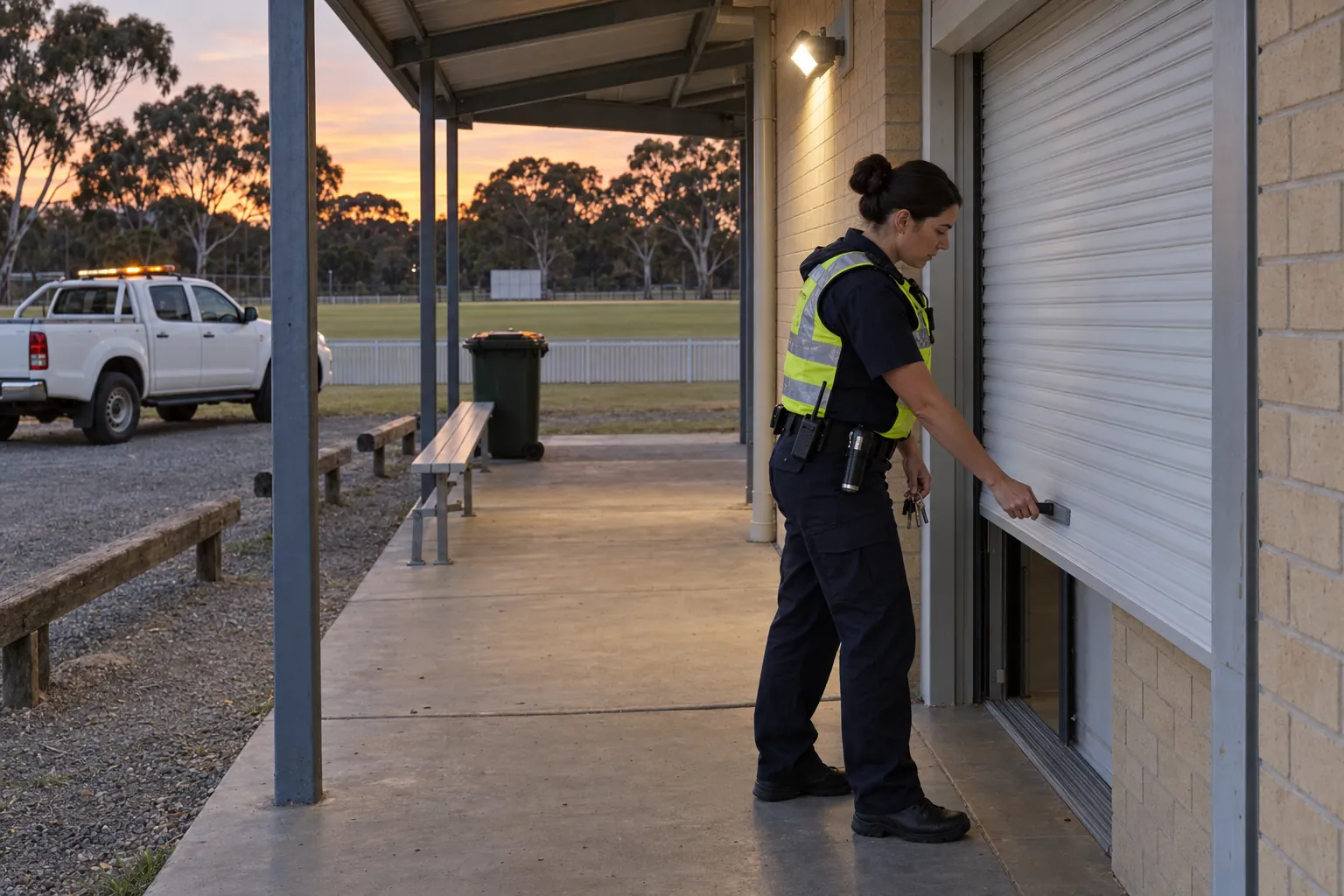 Security patrolsLock-up patrols: what a lock up service covers, and how to know it happenedWhat a lock-up patrol covers in Australia: the licence behind it, the lock-up and unlock routine, keys and alarm codes, working alone, and a record that holds up.
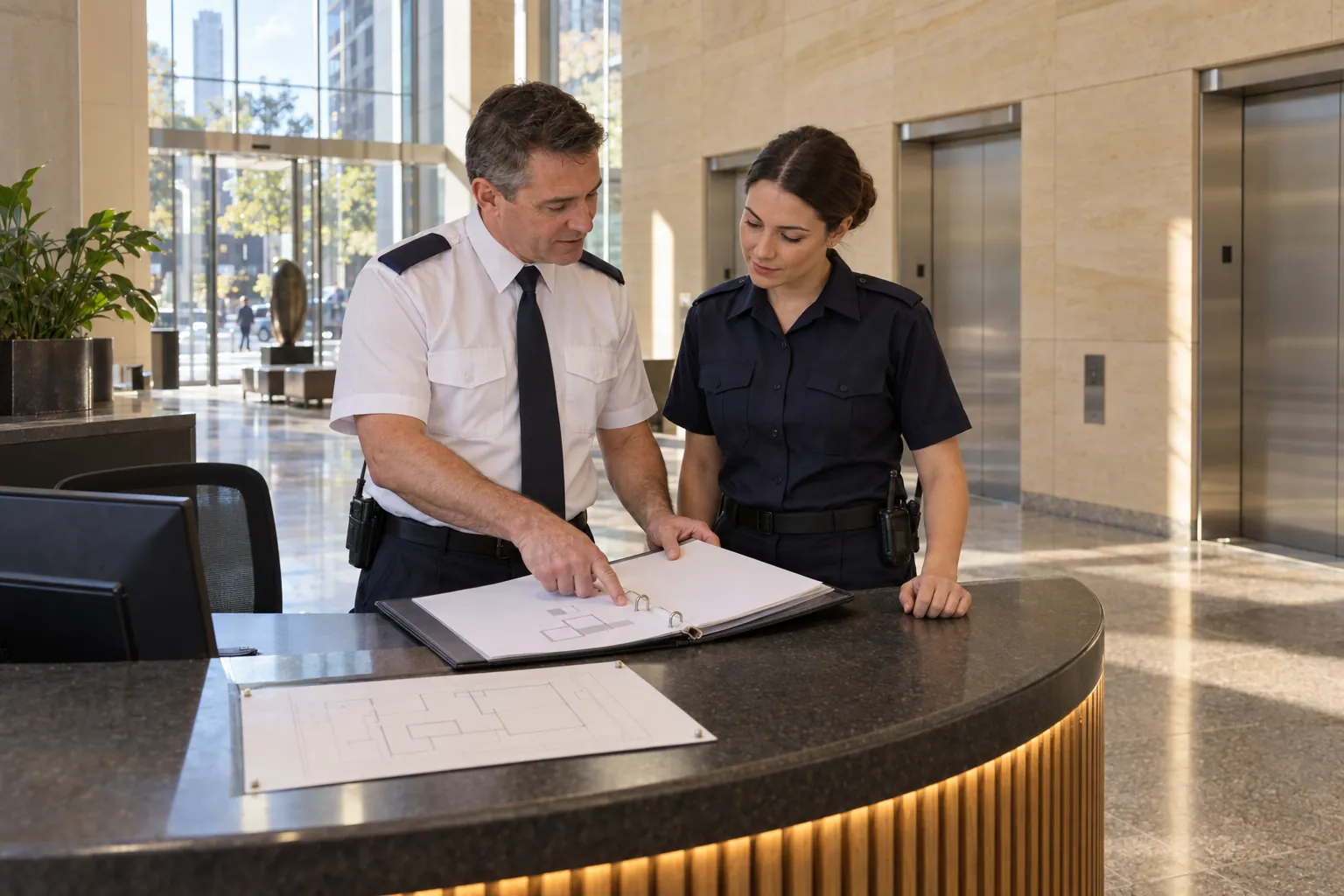 Security patrolsSecurity site instructions and post orders: what they should say, and how to keep them workingSecurity site instructions and post orders in Australia: what to include, the WHS duties behind them, how to agree and review them, and how to check they are used.
 Security patrolsSecurity occurrence book: what to record, and how to keep one that holds upThe security occurrence book in Australia: what to record each shift, how to write entries that hold up, the registers the law does require, and paper or digital.
 Security patrolsSecurity incident report: what to record, and how to write one that stands upWriting a security incident report in Australia: what it must record, the licensing and WHS rules behind it, privacy, and what happens once it is submitted.