Security patrols
Security guard duties and responsibilities in Australia: the role, its limits and the record
A security guard's duties and responsibilities are the protection of a site, the people on it and their property: maintaining a visible presence, patrolling, controlling access, monitoring alarms and CCTV, responding to incidents and emergencies, and keeping a record of the shift.
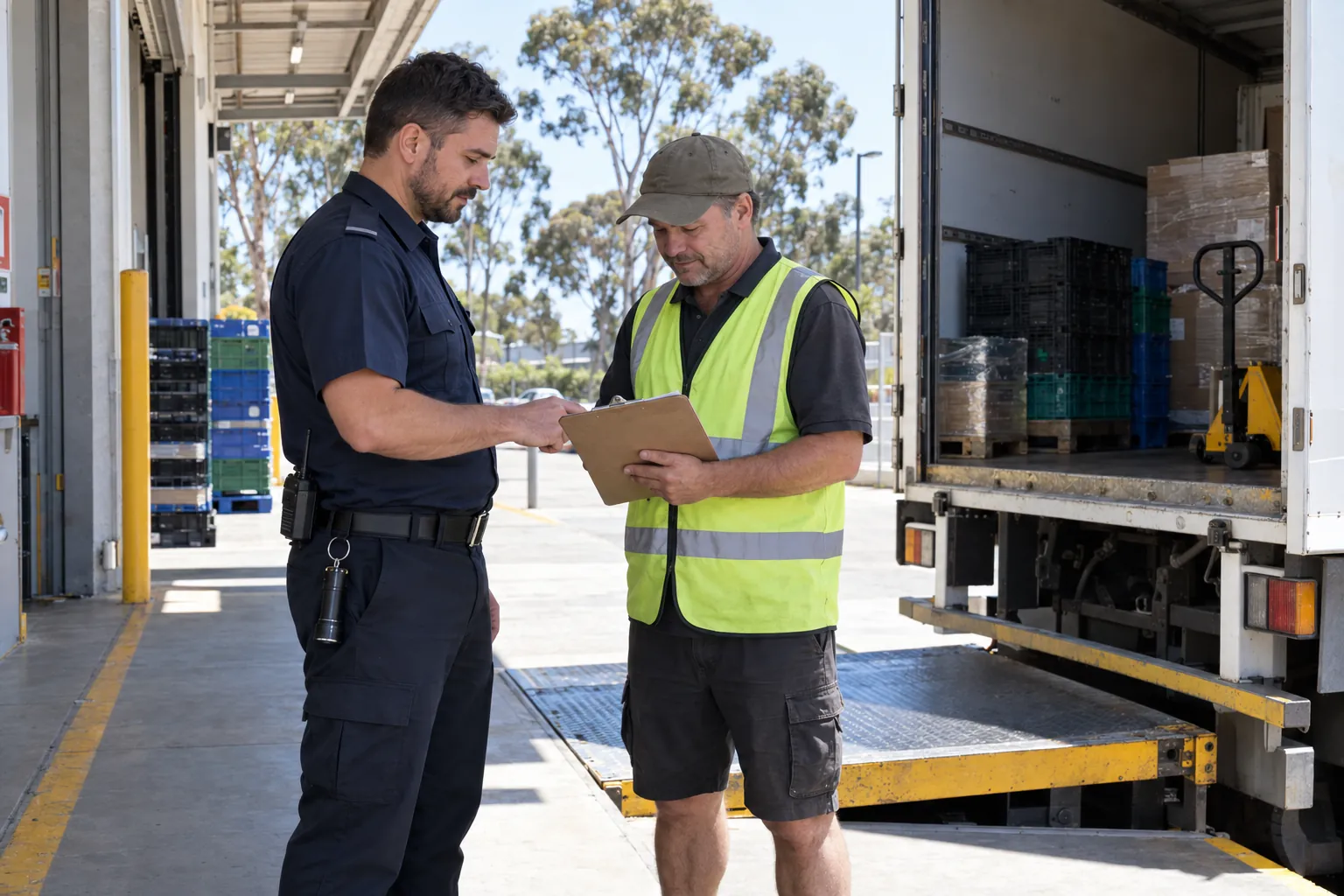
The job is simple to state and hard to see. This guide sets out the duties and responsibilities of a security guard in Australia, the licence and award behind the role, how the work changes between an office tower, a shopping centre and a construction site, what a guard may not do, and how a client or supervisor can tell the duties are being carried out.
01
What a security guard is, and the licence behind the role
A security guard, or security officer – Australian awards and contracts use the second title, most people use the first – protects premises, property and people against unauthorised entry, theft, damage and disorder, and is often the first person to respond to an alarm, an injury or an evacuation until the emergency services arrive. Most guards work for security companies that supply guarding under contract to building owners, shopping centres, builders, hospitals and councils; others are employed in-house by the organisation whose site they protect.
Private security is licensed by each state and territory, not by the Commonwealth, so the licence, the classes and the regulator depend on where the guard works. In Victoria the law is the Private Security Act 2004 (version 027, in force from 19 June 2025). It defines a security guard as "a person who is employed or retained to protect, watch or guard any property by any means", including by patrolling the property in person, with or without a dog, and by operating CCTV or other monitoring systems. Section 7 makes it an offence to carry on a security activity without a private security individual operator licence that authorises that activity, and within security guarding the licence names the specific activities: unarmed guard, armed guard, guard with a dog, cash-in-transit guard, control room operator and monitoring centre operator. Acting as a crowd controller is a separate security activity with its own authorisation.
Licences in Victoria are issued by the Licensing and Regulation Division of Victoria Police. Its eligibility and training requirements for an unarmed guard include being 18 or over, being a fit and proper person who is not a prohibited person, and holding the CPP20218 Certificate II in Security Operations, which includes a first aid unit. Under section 128 of the Act, a licence holder must produce the licence for inspection when a police officer or authorised person asks, and when a client they are providing services to asks. The Victoria Police private security pages also keep a public register, so an employer or client can check a licence is valid.
New South Wales, Queensland, Western Australia and the other states and territories each have their own Act, licence classes, training rules and regulator. A guard who moves interstate, or a provider with sites in more than one state, needs to check the rules of each one; the principle is the same everywhere, that nobody guards a site under contract without the right licence for the work.
The pay and classification side is national. The Security Services Industry Award 2020 covers employers in the security services industry throughout Australia and their employees, and its Schedule A sets out five levels of security officer, each with indicative tasks. It is the closest thing Australia has to a standard description of the job, and the next section draws on it.
02
The core duties of a security guard
Every site's duties are written down in its own site instructions, but the core duties of a security guard are much the same everywhere. The award's Level 1 tasks start with "watch, guard or protect persons, premises or property" and include basic crowd control, being stationed at an entrance or exit to control the movement of people, vehicles and goods, responding to basic fire or security alarms at the post, and providing safety inductions to employees, contractors or visitors. Level 2 adds responding to alarm signals with attendances, patrolling two or more sites in a vehicle, and recording or reporting security incidents on a computer-based system. In practice the list looks like this:
- A visible security presence, the simplest deterrent there is, at the front desk, the loading dock or the car park.
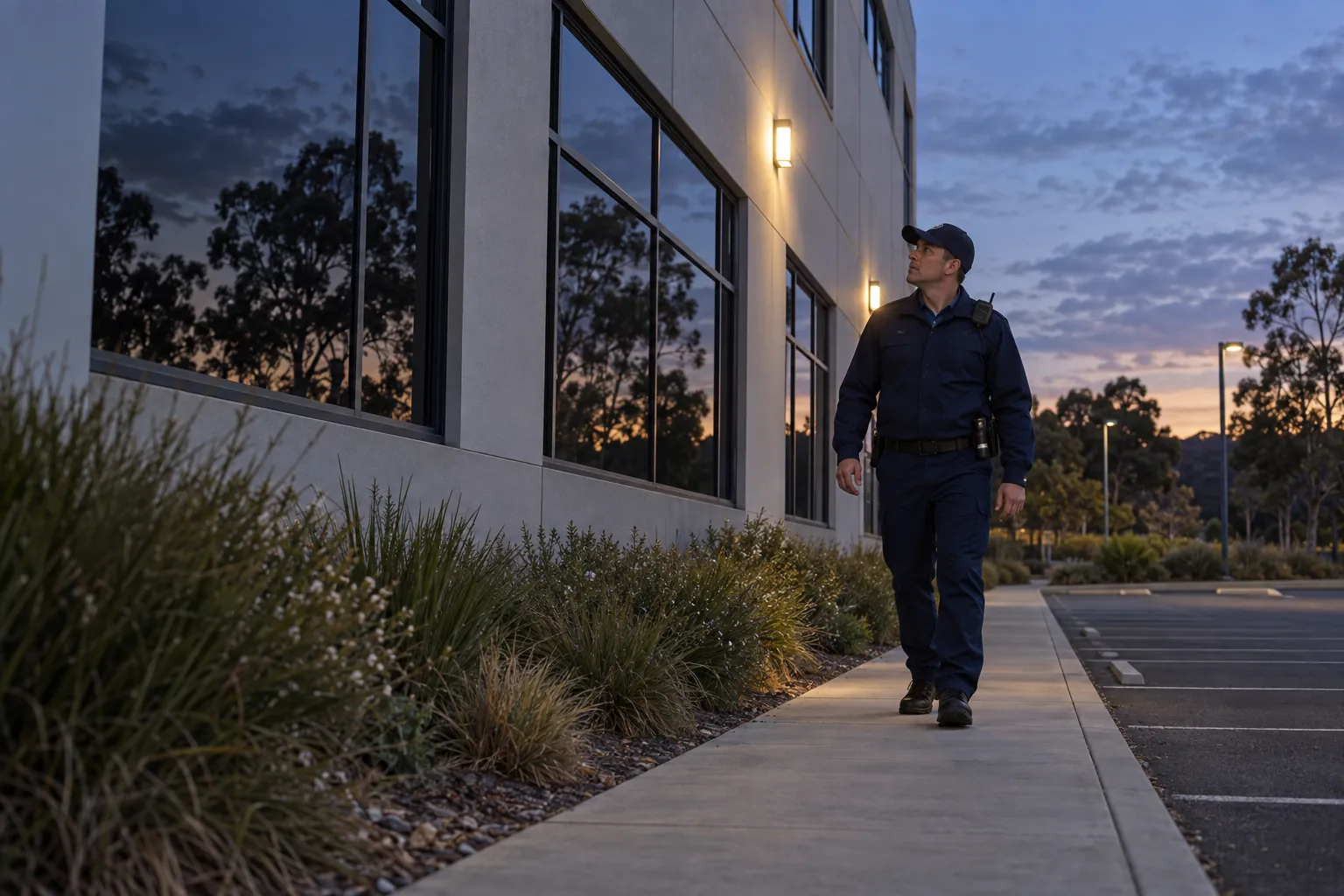
- Patrolling buildings and grounds on set routes and at set times, and at irregular times too, checking doors, windows, roller shutters, gates, fire exits, plant rooms and lifts.
- Access control: checking passes, signing in visitors and contractors, issuing and recovering keys and access cards, and refusing entry to restricted areas to people who should not be there.
- Monitoring security systems: CCTV surveillance, intruder alarms, access control panels and, where the site has one, the fire indicator panel.
- Responding to alarms and incidents: attending activations, dealing with trespassers, calming conflict before it escalates, and calling police on 000 when the situation needs them.
- Emergencies: supporting the fire wardens and chief warden during an evacuation, giving first aid in a medical emergency, meeting the fire brigade or ambulance at the entry point, and dealing with floods, power failures and lift entrapments.
- Lock-up and unlock: opening the building in the morning and securing it at night, with a round to check that every door, window and gate is closed and every area is empty.
- Keeping records: the occurrence book, patrol records, incident reports, key registers and visitor registers.
- Reporting hazards and faults: broken locks, failed lighting, leaks, blocked exits and anything unsafe, passed to whoever fixes them.
- Customer service: for many visitors the guard is the first person they meet, giving directions and helping calmly.
- Handover to the next shift: open incidents, keys out, alarms isolated, contractors still on site and anything that needs watching.
Behind every item on that list is one responsibility: the safety and security of the site and the people who use it, and a record that shows what was done to keep it that way.
03
How the responsibilities vary between sites
Security guards have different responsibilities on different sites, and the site instructions are where those differences are written down. Some common settings:
- CBD office towers and business parks: often as much a concierge and front-of-house role as a guarding one – visitor management, access cards, the loading dock, the car park and after-hours contractors – with lock-up rounds in the evening and tenants' satisfaction part of the measure.
- Shopping centres: a visible presence in the malls and car parks, responding to incidents reported by retailers, managing lost children and first aid calls, and securing the centre at close. Crowd control at a centre event is licensed separately in some states, including Victoria.
- Construction sites: gate control, checking plant, materials and fencing, and deterring trespass and theft, often through the night and at weekends.
- Industrial sites and warehouses: gatehouse duties, checking that vehicles and loads match their paperwork (a Level 1 task in the award), and patrolling large yards.
- Hospitals, universities and council buildings: open sites with many entrances, where the work leans towards de-escalation, welfare and assisting people rather than keeping them out.
- Strata and mixed-use buildings: concierge security in the foyer, car park and common property patrols, and working alongside the building manager and the owners corporation, body corporate or strata committee.
- Mobile patrols and alarm response: a guard in a vehicle visiting several sites a shift for lock-up checks and alarm attendances, a Level 2 task in the award.
Additional responsibilities may include a fire watch while a fire system is isolated for works, checks on staff working alone, key holding, or reception duties. Whatever they are, they should be in writing, and the guard should have the licence authorisation that each one needs.
04
What a security guard cannot do
Part of the role is knowing its limits. A security licence is permission to work in the industry; it gives the holder no police powers, and security guards are not law enforcement.
- Arrest is a citizen's power, used carefully. A guard has the same powers as anyone else. In Victoria, section 458 of the Crimes Act 1958 (version 322) lets any person apprehend someone they find committing an offence, but only where they believe on reasonable grounds it is necessary for a listed reason, such as preserving public order or preventing the offence continuing, and the person must then be delivered to police or a court. Section 462A allows force "not disproportionate to the objective" and only as the person believes on reasonable grounds to be necessary. Other states set their own tests. The safer course, and the one site instructions should set out, is usually to observe, record and call police rather than detain anyone.
- Searches need consent. A bag check at a shopping centre or event is usually a condition of entry that a person can refuse; refusing entry is the remedy, not a search against their will.
- No locking of fire exits while people are inside, whatever the security reason.
- No work outside the licence. A guard licensed as an unarmed guard cannot act as a crowd controller, monitoring centre operator or dog handler under contract without the authorisation for that activity.
- No personal information beyond the need. Visitor registers, CCTV and incident reports hold personal information, and where the Privacy Act 1988 applies to the organisation, the Australian Privacy Principles in its Schedule 1 govern how it is collected, kept secure and disclosed.
Guards also have duties of their own under work health and safety law. In most states and territories the law follows the model Work Health and Safety Act 2011, under which a person conducting a business or undertaking (PCBU) – the security company – must ensure, so far as is reasonably practicable, the health and safety of its workers (section 19), and a worker must take reasonable care for their own health and safety and not adversely affect others' (section 28). Victoria has its own Occupational Health and Safety Act 2004, where section 21 places the duty on the employer and section 25 requires an employee to take reasonable care and to co-operate with the employer. Night work, lone patrols and dealing with aggression are real hazards in security, and they belong in the risk assessment, not left to the guard's judgement alone.
05
How duties are set and checked
A security guard's duties on any site should come from three documents: the contract, which sets the service and the hours; the site risk assessment, which says what the security measures are for; and the site instructions (sometimes called assignment instructions, standing orders or post orders), which set out exactly what to do, when and how, from the patrol route to who to ring at 2am. A guard who is unsure what is expected should be able to find the answer in the site instructions without having to ask.
The security supervisor, or the provider's operations or account manager, then checks the work. The usual methods are:
- Site visits, announced and unannounced, including at night, to check that the guard is alert, in uniform, carrying their licence and following the site instructions.
- Record reviews: reading the occurrence book, incident reports and patrol records for completeness, and for patterns that point to a change in what the site needs.
- Patrol evidence: a record showing each checkpoint on the round was visited, when and by whom, and what was found.
- Licence and training checks: licence expiry dates against the state's register, first aid currency, site inductions and any site-specific training.
- Client feedback and KPIs: complaints, response times to alarms, incidents dealt with, and patrols completed against those scheduled.
Good guards need more than a licence. Communication, sound judgement and the ability to stay calm in difficult situations are essential in security work, and experience of a site teaches what its instructions cannot; the best way to show them is a clear, honest record of what happened on each shift.
06
Where the evidence of duties fails, and where SiteClara fits
Most of what a good security guard does leaves no trace. A patrol that finds nothing is written up as "all secure", and a client who never sees a problem may start to wonder what the contract is for. The occurrence book filled in at 5am for the whole night, the broken lock noted but never passed to the building manager, and the lock-up round nobody can prove happened are where confidence in a security contract wears away.
SiteClara gives the routine duties a record. A printed QR poster, with an optional NFC tag behind it, sits at each checkpoint on the round: a loading dock door, a fire stair, a plant room, a car park level, the perimeter gate of a building site. The guard scans the code or taps the tag on their own phone, with no app to install, and marks the scheduled check done, or explains what stopped them. The time and the named guard are recorded as it happens, with a photo when one is asked for. A fault or incident found on the round is reported there and goes onto the team's list of open jobs until someone closes it, and a supervisor can escalate a job to the building manager, who can answer it.
The security supervisor sees what is due, done and missed, and can record why a check was missed. At the end of the day the supervisor reviews the totals and photos, adds a note and approves the daily report, which goes to nominated management or client contacts at 8am the next morning, showing what was reported, what is still open and how the scheduled checks went.
07
Questions people ask
What are the main duties of a security guard?
The Security Services Industry Award 2020 gives the nearest thing to an official list. Its Level 1 indicative tasks, in Schedule A, begin with "watch, guard or protect persons, premises or property" and include basic crowd control, being stationed at an entrance or exit to control the movement of people, vehicles and goods, responding to "basic fire or security alarms at their designated post", and providing safety inductions to employees, contractors or visitors. Level 2 adds patrolling two or more sites in a vehicle, responding to alarm signals with attendances, and recording or reporting security incidents on a computer-based system.
What is main gate duty?
It is the post at a site's entrance, controlling who and what comes in and goes out. The Security Services Industry Award 2020 describes it as a Level 1 task: being stationed at an entrance to, or exit from, premises with principal duties including "the control of movement of persons, vehicles, goods, or property", including making sure the goods on a vehicle match "the relevant document or gate pass". Gatehouse work that relies on computer systems with data input is a Level 3 task.
What are the five roles of a security guard?
There is no official list of five roles. The nearest official five are the five levels of Security Officer in Schedule A of the Security Services Industry Award 2020, from Level 1, guarding, basic crowd control and gate control under general supervision, through vehicle patrols, crowd control and alarm response at Level 2, and computerised gatehouse and building systems work at Level 3, to monitoring centre and building security system work at Levels 4 and 5, where officers may co-ordinate other security officers. Each level may be asked to do the duties of the levels below it.
08
Further reading, and a list to take away
Start with the licensing body in the state or territory where the guard works; in Victoria that is the Victoria Police Licensing and Regulation Division, which publishes the licence activities, the eligibility and training requirements and the public register. The Private Security Act 2004 sets out the Victorian licence law in full. The Fair Work Commission publishes the Security Services Industry Award 2020 with its classification definitions and pay rates. For the safety side, read the WHS Act in force in your state, or the OHS Act in Victoria, and your state regulator's guidance on working alone and on workplace violence and aggression.
Before a guard starts on a new site, check that:
- they hold a current licence in that state that authorises the activities the site needs;
- their first aid qualification is in date;
- they have read and signed the site instructions;
- they know the patrol routes, the checkpoints and the times, and the lock-up sequence;
- they know who to call for each kind of incident, and the site's emergency procedures and wardens;
- they know how to record patrols, incidents and faults, and who reads the records;
- they understand what they may and may not do, including arrest, searches and fire exits;
- the risks of night work and working alone have been assessed, with a way to check on them;
- their supervisor has a plan for site visits and record reviews.
Sources
Every document this guide quotes or links to, in the order it first cites them.
- Private Security Act 2004 legislation.vic.gov.au
- Eligibility and training requirements for an unarmed guard police.vic.gov.au
- Victoria Police private security pages police.vic.gov.au
- Security Services Industry Award 2020 awards.fairwork.gov.au
- Crimes Act 1958 legislation.vic.gov.au
- Privacy Act 1988 legislation.gov.au
- Work Health and Safety Act 2011 legislation.gov.au
- Occupational Health and Safety Act 2004 legislation.vic.gov.au
Related guides
 Security patrolsSecurity site instructions and post orders: what they should say, and how to keep them workingSecurity site instructions and post orders in Australia: what to include, the WHS duties behind them, how to agree and review them, and how to check they are used.
 Security patrolsSecurity occurrence book: what to record, and how to keep one that holds upThe security occurrence book in Australia: what to record each shift, how to write entries that hold up, the registers the law does require, and paper or digital.
 Security patrolsSecurity incident report: what to record, and how to write one that stands upWriting a security incident report in Australia: what it must record, the licensing and WHS rules behind it, privacy, and what happens once it is submitted.
 Security patrolsLock-up patrols: what a lock up service covers, and how to know it happenedWhat a lock-up patrol covers in Australia: the licence behind it, the lock-up and unlock routine, keys and alarm codes, working alone, and a record that holds up.