Cleaning
Office kitchen cleaning: what the law asks, who does what, and a routine that survives the lunch rush
Office kitchen cleaning is the routine that keeps a workplace's shared kitchen hygienic: benches, sink, touch points, fridge, microwave, dishwasher, tables, floor and bins cleaned at least daily, the fridge cleared of expired food on a set day, and faults reported rather than cleaned around.
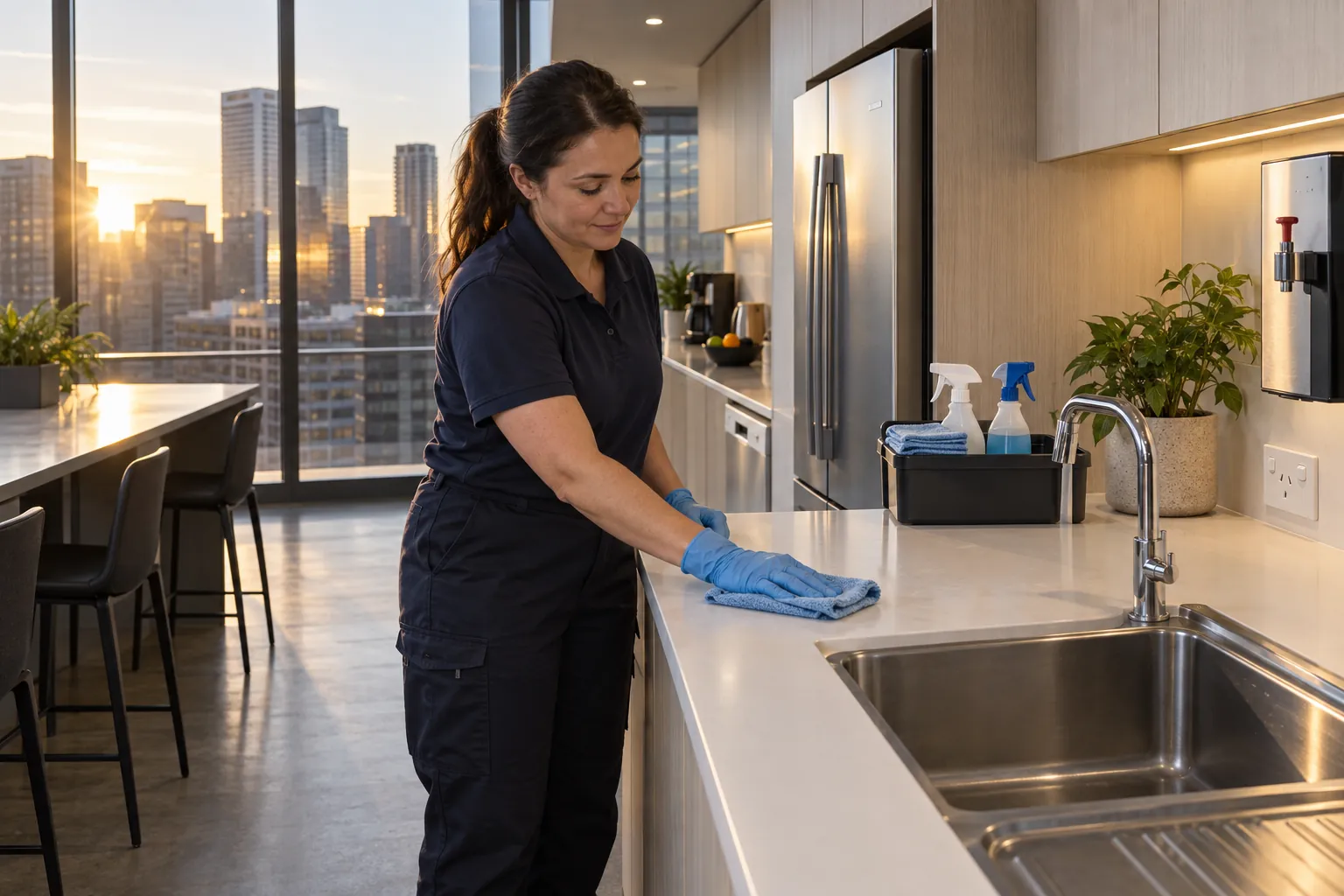
The office kitchen is the one room every worker uses, several times a day, with food, water, heat and cleaning chemicals in a few square metres. It is also the room most likely to fall between the cleaning contract, the office manager and everybody's good intentions. This guide covers what Australian work health and safety law and the codes of practice ask of eating facilities, what the kitchen clean should cover, who is responsible for which part, how often each task needs doing, how to handle the fridge and the cleaning products, and what a record worth keeping shows.
01
What the law asks of an office kitchen
No Australian law uses the words "office kitchen". The duty sits in the general rules on workplace facilities, which treat a staff kitchen, lunchroom or kitchenette as an eating facility. In every state and territory that has adopted the model work health and safety laws, which is all of them except Victoria, the person conducting a business or undertaking (PCBU) has a specific duty in regulation 41 of the WHS Regulations. Queensland's version, in the Work Health and Safety Regulation 2011 (Qld), section 41, reads the same way as the model: the PCBU must ensure, so far as is reasonably practicable, "the provision of adequate facilities for workers, including toilets, drinking water, washing facilities and eating facilities", and that those facilities are maintained so as to be "in good working order" and "clean, safe and accessible".
The detail is in the Code of Practice: Managing the work environment and facilities, a Safe Work Australia model code approved in each harmonised jurisdiction (the SafeWork NSW edition is dated August 2019). It says workers "must be provided with access to hygienic facilities for eating and for preparing and storing food", and that facilities "should be cleaned regularly taking into account the type of work performed, the likelihood of contamination, the number of workers using them, including during shiftwork, and the type of facility, such as eating areas, toilets, handbasins and showers". Even a small workplace's tea and coffee area should have seating, a sink with hot and cold water, washing utensils and detergent, an appliance for boiling water, a refrigerator for perishable food, and "vermin-proof rubbish bins, which should be emptied at least daily". Where 10 or more workers usually eat at the same time, a separate eating area should be provided.
Victoria has its own law. The Occupational Health and Safety Act 2004 (Vic) requires an employer to provide, so far as is reasonably practicable, adequate facilities for the welfare of employees at a workplace under its management and control (section 21(2)(d)). WorkSafe Victoria's Compliance code: Workplace facilities and the working environment (Edition 1, December 2023) sets out how. It is plainer about cleaning than the model code: "Dining facilities need to be cleaned regularly, generally at least daily", bins must be "emptied as needed and at least daily" and be insect and vermin-proof, and equipment "like toasters, fridges, lockers or seating" must be kept in good repair. A compliance code is not mandatory, but a duty holder who follows it is treated as having complied with the duties it covers.
02
What office kitchen cleaning covers in practice
A kitchen clean is more than wiping the bench. Written into a cleaning specification or a checklist, office kitchen cleaning usually covers these tasks:
- Benches and splashbacks: cleared, washed with detergent and dried, including the edges and the wall behind the kettle where splashes collect.
- Sink and draining board: dishes cleared, sink scrubbed, plughole and strainer emptied, taps and tap handles cleaned.
- Touch points: fridge and cupboard handles, the microwave door and buttons, the dishwasher handle, the boiling water tap, light switches and the door push plate. These are touched far more often than the surfaces around them.
- Microwave: the inside wiped often enough to prevent splatter baking on, and the turntable washed. A microwave cleaned once a week and never between times is often the first thing a visitor notices.
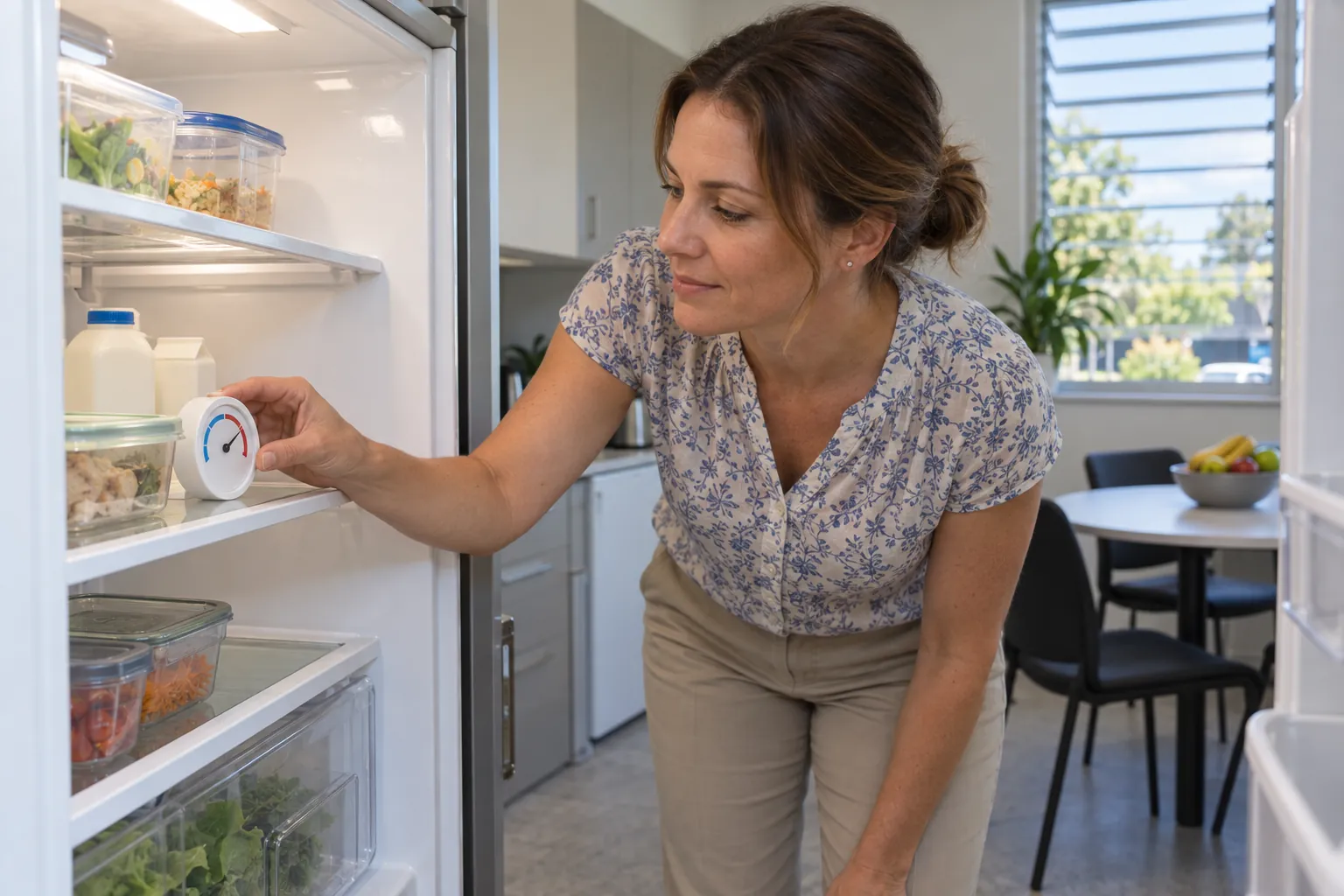
- Fridge: the outside and handle daily; shelves, drawers and door seals on a set day; expired food and unlabelled items removed under an agreed rule (see below).
- Dishwasher: loaded, run and emptied during the day, and the filter cleared on a schedule so that it keeps cleaning properly. Who does each of these is a common argument in offices.
- Boiling water unit or kettle, coffee machine and water dispenser: outside surfaces and drip trays cleaned; descaling, filter changes and servicing done by whoever maintains the appliance, to the maker's instructions.
- Tables, chairs and floor: tables wiped, chairs checked, floor swept and mopped, spills dealt with immediately.
- Bins: general waste, recycling and organics where the building collects them, emptied at least daily, liners replaced, bins washed periodically.
- Consumables: dishwashing detergent, dishwasher tablets, hand soap and paper towel topped up; clean tea towels and cloths put out and used ones taken away.
- Faults: a dripping tap, a fridge that is not cold, a blocked sink or a boiling water unit that leaks, noticed and reported rather than cleaned around.
Tea towels, dishcloths and sponges deserve a line of their own, because a dirty cloth undoes the rest of the kitchen's hygiene. Safe Food Queensland's article Food safety in the office kitchen warns that they "can become bacteria breeding grounds" and should be washed and replaced regularly. Cloths changed at every clean, or disposable ones, are the simple answer, and they prevent what was in the sink being carried onto the bench.
03
Who is responsible for which part
Many office kitchen problems are problems of ownership: a shared, communal room belongs to everyone, and so to no one in particular. Four groups have a part in it.
- The PCBU or employer holds the duty: it must provide adequate facilities and maintain them clean, safe and in good working order. It can pay a contractor to do the cleaning, but not hand over the duty. It must also consult workers and any health and safety representatives; the code of practice says consultation covers "access, cleaning and maintenance of the facilities".
- The cleaning contractor, whether a professional cleaning company or the building's own team, does what the specification says, often once a day out of hours. If it says "clean kitchen" and nothing more, expect the bench and the floor and little else. Name each element, the frequency and what the cleaner does when the sink is full of dishes.
- The office manager or facilities coordinator sets the house rules and helps maintain them: the fridge clear-out, the dishwasher roster, the consumables order, and the note on the wall that says who to tell when something breaks.
- Staff wash or stack their own dishes, label and remove their own food, and wipe up their own spills. The code's housekeeping section says it may be reasonable to expect workers to leave their immediate work area clean and tidy at the end of the day, with general cleaning done another way, such as engaging cleaners; the same sense applies to their own dishes and spills.
In a multi-tenant office tower, add the building manager. The kitchen inside a tenancy is normally the tenant's to clean under its own contract, while the base building team looks after common areas, plumbing risers, pest control and the building's own services. Where the landlord owns the boiling water unit, the dishwasher or the plumbing behind them, the lease says who repairs it. Settle that before the first leak.
The Victorian compliance code adds a point for shared buildings: an employer that finds its facilities inadequate but does not control the building needs to try to influence whoever does to fix the problem. A dated, written fault report shows that attempt.
04
How often to clean, and when
Both codes tie frequency to use: how busy the room is, the shifts worked and the type of work, with bins emptied at least daily. A sensible regular cleaning schedule to start from in an ordinary office, adjusted for headcount and hours:
- Every clean, at least daily: benches and splashbacks, sink and taps, touch points, the outside of the fridge and microwave, tables, the floor, bins emptied and relined, consumables topped up, cloths changed.
- During the day, where the kitchen is busy at lunch: a quick check after the lunch peak by a day cleaner or a rostered staff member, to clear the sink, wipe the benches, run or empty the dishwasher and deal with spills.
- Weekly: fridge clear-out on a set day and time, microwave interior and turntable, cupboard fronts and handles, dishwasher filter, coffee machine drip tray and grounds bin if it is not done daily.
- Monthly or periodically, a deep clean: fridge shelves, drawers and door seals washed; behind and under movable appliances, where crumbs and grease build up; bins washed; grout, skirting and high splashback areas; a look at the condition of chairs, cupboards and appliances.
- To the maker's schedule: descaling and filter changes on the boiling water unit, water dispenser and coffee machine, arranged by whoever maintains them and recorded as done.
Times matter as much as frequencies. A kitchen cleaned at 6 am and then used by 60 people over lunch needs the midday check to stay hygienic. Where people work shifts, the code asks for cleaning that takes account of shiftwork, so a night shift should not arrive to the day shift's dishes.
05
Cleaning products, checks and what a good record shows
Many kitchen cleaning products are hazardous chemicals, including some sold in supermarkets. Under section 344 of the Work Health and Safety Regulation 2011 (Qld), a PCBU need not obtain a safety data sheet for a consumer product used only in quantities and in a way consistent with household use, and incidental to the work, but must still make "sufficient information about the safe use, handling and storage" of it readily accessible to workers. The cleaning contractor's commercial concentrates need their current safety data sheet, and belong in the cleaner's store or trolley, not under the staff sink.
In practice:
- Products kept in their original labelled containers, never decanted into an unmarked spray bottle or a drink bottle.
- Cleaning products stored away from food and crockery, with dishwasher tablets and drain cleaners in a closed cupboard.
- Food-contact surfaces rinsed or wiped with clean water after any product whose label asks for it.
- Spills cleaned up at once. The code of practice notes that some cleaning agents can make floors more slippery, so a mopped kitchen floor needs to be dry before the lunch rush.
A check of the kitchen is a short walk-through, not an audit: look at each element, fix what you can and report what you cannot. A record of that check is worth keeping when it shows:
- Where: which kitchen, on which floor. A single sheet for the whole tenancy hides the kitchenette on level 4 that nobody visits.
- When: the actual time the check was made, not a tick filled in for the week.
- Who: the named person who did it, whether cleaner, day cleaner or staff member on the roster.
- What was found: fridge at 9°C, dishwasher not draining, soap dispenser empty, bin lid broken, and a photo where it helps someone else understand the problem.
- What happened next: fixed on the spot, or reported to whom, and when the fault was closed.
Reviewed monthly with the cleaning contractor, that record turns "the kitchen is always a mess" into something both sides can act on: which kitchen, at which time of day, and which job keeps being missed. See the office cleaning checklist for the rest of the tenancy and the cleaning log sheet for how to lay out a record by location.
06
Where the kitchen record fails, and what SiteClara does about it
Kitchen records tend to fail in familiar ways. The sheet taped inside the cupboard door is initialled for the whole week on Monday, or not at all. The midday check that was agreed in the contract review quietly stops after a month, and nothing shows that it stopped. And the fridge that is not cold, the leaking boiling water unit or the broken bin lid is mentioned to whoever was passing, and reported again a week later by someone else.
SiteClara helps with the routine checks and the reports between them. A printed QR poster, with an optional NFC tag behind it, sits at each location where checks are scheduled, such as each kitchen and kitchenette, the amenities on each floor or the loading dock. Staff scan or tap on their own phone, with no app to install, see the checks due there, and mark each one done or explain what stopped them. They can also report a problem at that location, with a photo when one helps. The report carries the location, the time and the named person, and goes onto the team's list of open jobs until someone closes it.
The supervisor sees what is due, done and missed, and the open jobs grouped by building and floor. Each day they add a note and approve a report that goes to nominated management or client contacts the next morning, showing what was checked, what was reported, what was completed and what is still open.
07
Where to read more, and a list to take away
The official sources for office kitchens and eating facilities in Australia are these:
- Code of Practice: Managing the work environment and facilities: section 3.5 and the Appendix B checklist.
- Work Health and Safety Regulation 2011 (Qld), section 41; check your own state or territory's regulation.
- WorkSafe Victoria, Compliance code: Workplace facilities and the working environment (Edition 1, December 2023), for Victorian workplaces under the Occupational Health and Safety Act 2004.
- Food Standards Australia New Zealand, food safety basics.
- Safe Food Queensland, Food safety in the office kitchen.
And a list to take away:
- Write each kitchen element, and how often it is cleaned, into the cleaning specification rather than "clean kitchen".
- Clean the kitchen at least daily, empty the bins at least daily, and add a check after the lunch peak where the room is busy.
- Clean touch points every time, and change cloths at every clean or use disposable ones.
- Agree, announce and keep a fridge clear-out rule, and check the fridge runs at 5°C or colder.
- Keep cleaning products in their labelled containers, away from food and crockery, with the information workers need to use them safely.
- Settle who repairs the fridge, dishwasher and boiling water unit before anything breaks.
- Record each check by kitchen, time and name, with what was found, and follow every reported fault until it is closed.
Sources
Every document this guide quotes or links to, in the order it first cites them.
- Work Health and Safety Regulation 2011 (Qld), section 41 legislation.qld.gov.au
- Code of Practice: Managing the work environment and facilities safework.nsw.gov.au
- Occupational Health and Safety Act 2004 (Vic) legislation.vic.gov.au
- Compliance code: Workplace facilities and the working environment worksafe.vic.gov.au
- Food Standards Code Standard 3.1.1 (Interpretation and Application) legislation.gov.au
- Food safety in the office kitchen safefood.qld.gov.au
- Food safety basics foodstandards.gov.au
Related guides
 CleaningOffice cleaning checklist: what to clean, how often, and how to show it was doneAn office cleaning checklist for Australian workplaces: what WHS law expects, room-by-room tasks, how often, who does what, and how to show the list is kept.
 Premises and facilities managementWorkplace amenities: what the law asks for, and how to keep them clean and workingWorkplace amenities under Australian WHS and OHS law: what must be provided, the numbers the codes give, who cleans and maintains them, and what a good record shows.
 CleaningCleaning log sheet: what to record, who signs it, and what a signature provesWhat a cleaning log sheet should record in Australian workplaces and food businesses, the WHS and food safety rules behind it, and what a signature proves.
 Premises and facilities managementWorkplace housekeeping: what WHS law asks, and a routine that holds between inspectionsWorkplace housekeeping under Australian WHS law: regulation 40, what the codes of practice ask, who keeps which areas tidy, how often, and what a good record shows.