Cleaning
Office cleaning checklist: what to clean, how often, and how to show it was done
An office cleaning checklist is a list of every cleaning task in an office, grouped by area – reception, work areas, meeting rooms, kitchen, toilets and waste – with how often each one is done, from daily tasks such as emptying bins to periodic ones such as carpet extraction.
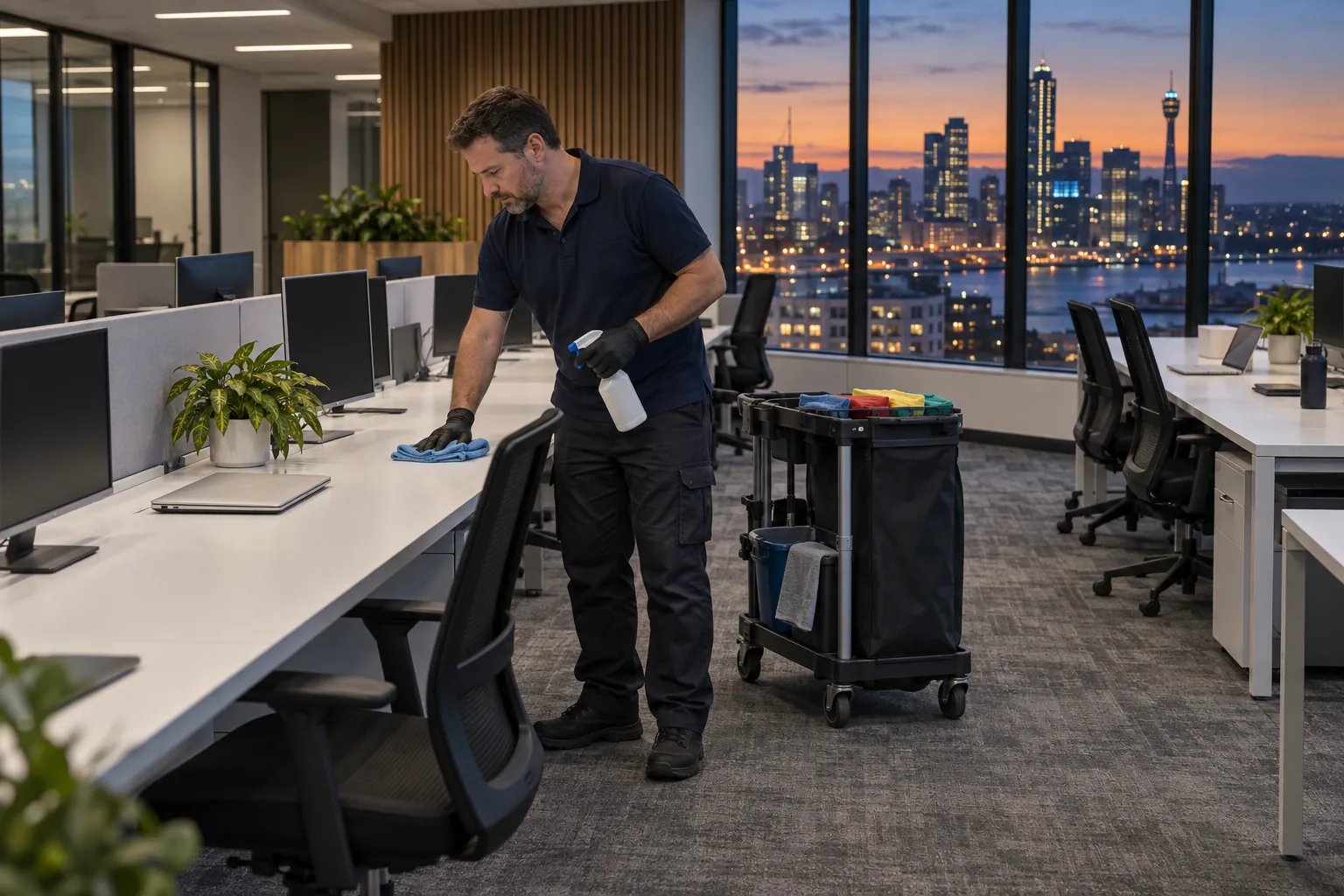
It turns "keep the office clean" into tasks a cleaner can tick off and a supervisor can check. This guide sets out what Australian work health and safety law expects of an office, what belongs on the checklist room by room, which tasks are daily and which can wait, who is responsible in a leased or multi-tenant building, and how to keep a record that shows the checklist is actually being followed.
01
What Australian law expects of a clean office
No Australian law requires an office to have a written cleaning checklist. The law sets the outcome, and a checklist is how most businesses, building managers and cleaning contractors show they are meeting it. Under the harmonised work health and safety laws, the duty sits with the person conducting a business or undertaking (PCBU). Regulation 41 of the Work Health and Safety Regulations 2011 (Cth), which follow the model regulations, requires a PCBU to ensure, so far as is reasonably practicable, "the provision of adequate facilities for workers, including toilets, drinking water, washing facilities and eating facilities", and that those facilities are maintained so as to be "in good working order" and "clean, safe and accessible". Regulation 40 adds that floors and other surfaces are maintained so that work can be carried out without risk to health and safety. The Commonwealth regulations cover Commonwealth workplaces; New South Wales, Queensland, South Australia, Western Australia, Tasmania and the territories each have their own WHS regulations based on the same model, so check your own jurisdiction's version for the regulation numbers.
The practical detail is in the code of practice. The Managing the work environment and facilities code of practice (SafeWork NSW edition, August 2019, based on Safe Work Australia's model code) says: "The work environment must be maintained so that it remains in a clean and safe condition." It goes on: "Workplaces and facilities should be cleaned regularly taking into account the type of work performed, the likelihood of contamination, the number of workers using them, including during shiftwork, and the type of facility, such as eating areas, toilets, handbasins and showers." Consumables, "including soap and toilet paper, should be replenished regularly". Codes of practice are admissible in court proceedings, and an inspector may refer to one when issuing a notice.
Victoria is different. It has not adopted the harmonised laws, and the duty comes from the Occupational Health and Safety Act 2004 (Vic), where section 21(2)(d) requires employers to provide, so far as is reasonably practicable, adequate facilities for the welfare of employees. WorkSafe Victoria's Compliance code: Workplace facilities and the working environment (Edition 1, December 2023) says facilities "need to be kept in hygienic, safe, secure and working order", and that "Workplaces and facilities need to be cleaned regularly. Cleaning may be needed at each shift change or daily, but can be needed more often depending on the type or nature of the work." It also says the cleaning schedule "needs to account for the hygienic maintenance of facilities in high-use areas, like dining areas, toilets, urinals, hand washing facilities and showers."
Both point the same way: clean regularly, clean high-use facilities more often, keep consumables stocked. The office cleaning checklist is where those words become tasks, and under a contract it becomes the list the service is judged against.
02
What an office cleaning checklist covers, room by room
A useful office cleaning checklist is organised by area, because that is how cleaners work and how problems are found. Every office needs the same areas covered, whatever its size, from a ten-desk suite in a suburban business park to several floors of a CBD tower:
- Entry and reception: entry matting vacuumed, hard floors mopped, glass doors spot-cleaned, the reception counter and seating wiped. This is where grit and rain are carried into the tenancy.
- Open-plan work areas: bins and recycling emptied and relined, clear desks wiped, chairs checked, carpet vacuumed, and shared touch points such as hot-desk keyboards, phones and door handles wiped.
- Offices and meeting rooms: tables and chairs wiped, whiteboards cleaned, screens, remotes and conference phones wiped with a suitable product, glass partitions spot-cleaned, rubbish removed.
- Kitchen, tea room or kitchenette: benchtops, sink and taps, the fridge handle and front, microwave, dishwasher, boiling water unit and coffee machine; the floor; bins emptied. Both codes say the eating area's bins should be emptied at least daily.
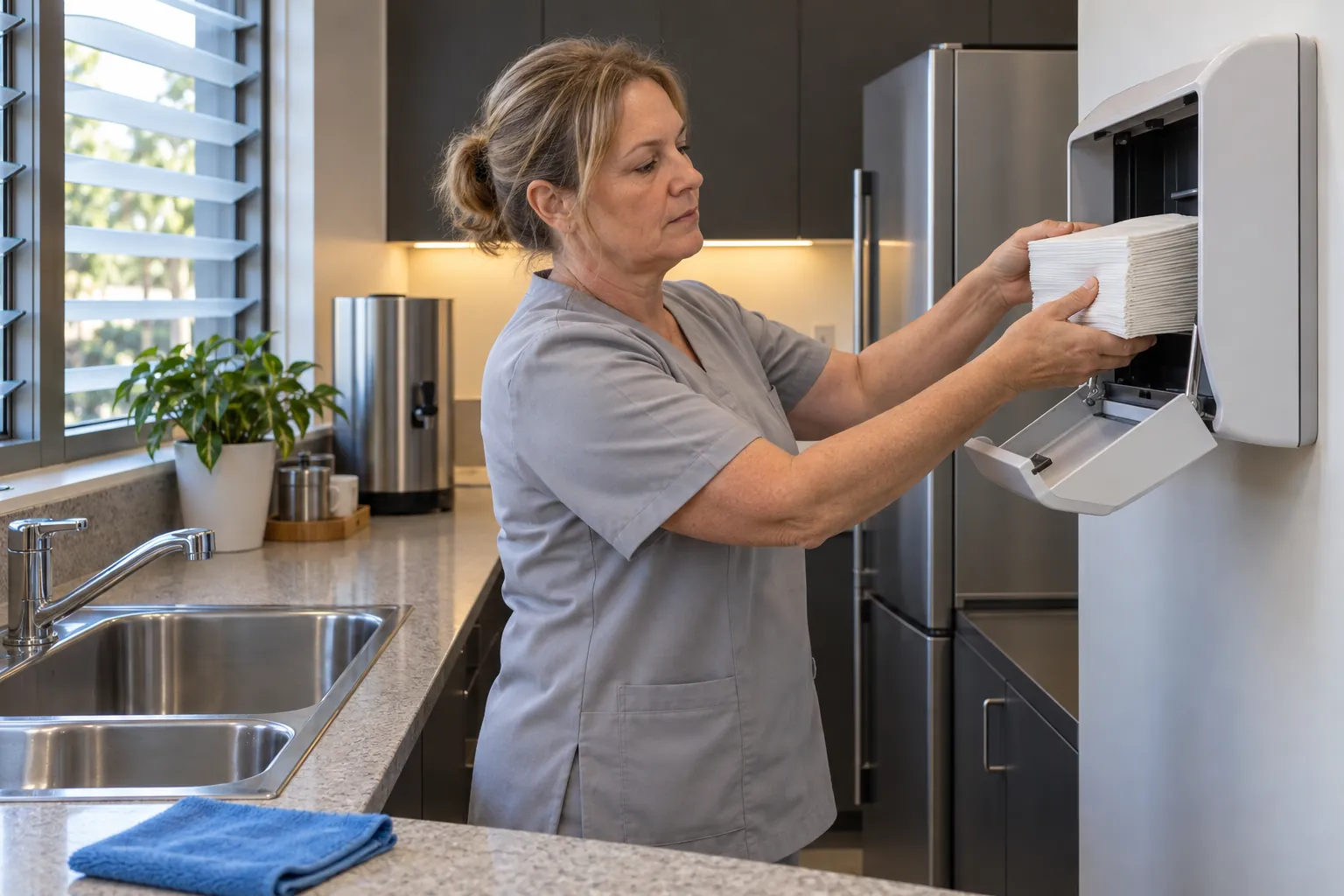
- Toilets and amenities, the bathrooms in everyday speech: toilets, urinals, basins, taps, mirrors, partitions, sanitary units and floors cleaned; toilet paper, soap and hand towels restocked; hand dryers checked.
- End of trip facilities, where the building has them: showers, change rooms, lockers and the bike store, on their own checklist if they serve the whole building.
- Lift lobbies, corridors and fire stairs: floors, handrails, lift call buttons and door push plates; fire stairs kept clear, with nothing stored in them.
- Waste and recycling: general waste, commingled recycling and paper separated and taken to the building's bin room, with secure document bins left for the destruction service.
- Low-use areas: storerooms, comms rooms, archive rooms and quiet rooms, on a slower cycle.
Write each of the cleaning tasks as something a person can do and someone else can check: "wipe and disinfect the kitchen benchtop and sink" rather than "kitchen", and "restock toilet paper, soap and hand towels in each cubicle" rather than "amenities". A checklist written in general terms is easy to tick and impossible to audit.
03
Daily, weekly, monthly and periodic tasks
Both codes tie cleaning to how many people use an area and the type of facility, so frequencies should follow foot traffic and hygiene risk, not habit. A busy office of three hundred and a small practice of eight need the same list of areas and very different frequencies. As a starting point for a typical Australian office:
- Daily tasks: empty bins and recycling; clean and restock toilets and amenities; clean kitchen benchtops, sinks and appliance fronts and empty kitchen bins; wipe high-touch points such as door handles, push plates, light switches, lift buttons, handrails and shared phones; vacuum or mop entry and reception floors; spot-clean glass doors; clear and wipe meeting room tables.
- Checks during the day: toilets and kitchens fail first, so in a busy office they usually need a check and a restock after the morning clean, often after lunch. In a tenancy cleaned only at night, someone in the business needs to know whom to call when the soap runs out at 11am.
- Weekly tasks: vacuum all carpet if it is not done daily; mop hard floors throughout; dust clear desks, sills, partitions and furniture; clean inside the microwave and wipe down the fridge; wipe printers and shared equipment; clean internal glass.
- Monthly tasks: high-level dusting of air-conditioning vents and grilles, light diffusers and cupboard tops; skirting boards and door frames; descale taps and the boiling water unit outlet; clean under desks and chair bases; empty, clean and sort out the kitchen fridge, with notice to staff first.
- Periodic tasks: carpet hot water extraction, which the Carpet Institute of Australia's Carpets Cleaning Maintenance fact sheet suggests about every 12 months in general office areas and every 6 months in corridors and foyers; hard floor strip and seal; window cleaning, with high-rise external glass left to a specialist contractor; upholstery; a deep clean of the amenities. These belong on a calendar with dates, because they are never urgent on any given day.
Desks cause the most arguments. Many contracts clean only cleared desks, so a checklist line that says "wipe desks" should say whether that means every desk or only clear ones. Do the same for personal items, kitchen cupboards and the fridge: decide who is responsible, write it on the checklist, and tell staff.
04
Who does what, including in a leased building
An office cleaning checklist only works if every item has an owner. In most offices there are five:
- The cleaners, employed directly or through a professional cleaning contractor (the cleaning service provider), carry out the checklist, usually early in the morning or in the evening when the office is quiet.
- The cleaning supervisor plans the runs, checks the work, covers absences, deals with gaps and reports to the client.
- The office manager or facility manager owns the checklist on the tenant's side, agrees changes with the contractor, and takes complaints and requests.
- The building manager or property manager looks after base building areas: the ground floor lobby, lifts, fire stairs, shared amenities on some floors, end of trip facilities and the bin room, often under a separate contract.
- Staff keep their desks clear enough to be cleaned, clean up after themselves in the kitchen, and report spills and faults.
Leased buildings split the work, and the checklist should follow the split. The tenancy is usually cleaned by the tenant's contractor; common areas and base building amenities by the landlord's, recovered as outgoings. Toilets on a floor shared by two tenants are the classic gap. WorkSafe Victoria's compliance code expects an employer that finds inadequate facilities it does not control to "attempt to influence the person who does manage or control that workplace to fix the issue", and the NSW code reminds duty holders who share a workplace that they must consult, cooperate and coordinate. A written split, with each area on one checklist only, is the simplest way to do that. Outsourcing the cleaning does not move the WHS duty; it moves the work.
Cleaning chemicals belong on the checklist too. Say who supplies consumables, which products may be used, and where the safety data sheets are kept. Under regulation 344 of the WHS Regulations a PCBU must obtain the current safety data sheet for a hazardous chemical used at the workplace, and regulation 346 requires a register of hazardous chemicals, including the current data sheet for each. Consumer products used only in household quantities and ways are exempted from both, though information on their safe use must still be readily accessible. Colour-coded cloths and mops, with separate colours for toilets and kitchens, stop cleaning carrying germs from one area to another.
05
How to check the checklist is being kept
A checklist is a promise. Whether it is being kept is a separate question, and it needs its own answer. The NSW code says "PCBUs must monitor the conditions of the work environment, including facilities", and in Victoria section 22 of the OHS Act imposes the equivalent monitoring duty, which WorkSafe Victoria's compliance code restates: "Employers must monitor conditions of their workplace, which may include facilities, and the health of their employees." In an office, monitoring cleaning usually means some mix of:
- Inspections: the supervisor or office manager inspects a sample of areas against the checklist, at different times of day and without warning, and writes down what they found.
- Joint audits: client and contractor walk the office together each month or quarter and score it against the same checklist, which settles disagreements before they become disputes over the invoice.
- Records of work done: sheets, logs or scans showing each area was cleaned or checked, by whom and when.
- Complaints and requests: logged with the time they were raised and the time they were put right, so the same problem reported three times in a month is visible as a pattern.
- The code's own checklist: Appendix B of the NSW code is a yes-or-no list that includes "Are facilities cleaned regularly?", "Are toilets cleaned regularly and maintained in good working order?" and "Are consumable items, such as soap and toilet paper, replaced regularly?". It is a useful annual cross-check on the office cleaning checklist itself.
Review the checklist whenever the office changes: a new floor, hybrid working that empties the building on Fridays, a kitchen refit, a new team on a different shift, or a complaint that keeps coming back. A checklist written for a full office five days a week wastes money on quiet days and falls short on busy ones. Cleaning should match how the office is used now, not how it was used when the contract was signed.
Commercial cleaning contractors usually work out the hours from a site inspection, measuring each area and applying a time to each task, and it is worth asking to see the calculation. A checklist that cannot be done in the hours paid for will not be done.
06
Where the checklist record fails, and what SiteClara does about it
Most offices can produce a cleaning checklist. Far fewer can show it was followed. The work happens out of hours, and the record is usually a sheet on the back of the cleaners' cupboard door, ticked for the week in one sitting. A missed kitchen clean comes to light when someone complains about the fridge, and the empty soap dispenser mentioned to whoever was passing is never written down at all.
SiteClara records checks and reports at the location. A printed QR poster, with an optional NFC tag behind it, goes at each place on the checklist, such as the kitchen, each amenities block and reception. The cleaner scans the code or taps the tag on their own phone, with no app to install, and sees the scheduled checks due there. They mark each one done, or say what stopped them, and can add a photo when one is asked for. If something needs fixing, such as a dripping tap or a broken hand towel dispenser, they report it on the spot, and it goes onto the team's list of open jobs until someone closes it.
The supervisor sees what is due, done and missed, and can record the reason a check was missed from the company's own list. At the end of the day they review the totals and photos, add a note and approve the report, which goes to the office manager or client the next morning, showing what was completed, what is still open and how the scheduled checks went, for example 12 of 12 completed. An unapproved report is held, not sent.
07
Questions people ask
What should I include on my office cleaning list?
Include every area and facility people use, with a frequency for each. The Managing the work environment and facilities code of practice (SafeWork NSW edition) says facilities "must be clean, safe, accessible and in good working order", that consumables "including soap and toilet paper, should be replenished regularly", and that the eating area's rubbish bins "should be emptied at least daily". Its Appendix B checklist asks whether facilities and toilets are cleaned regularly, which makes a good test of your own list.
What does office cleaning usually include?
General cleaning of the whole workplace, with extra attention to the high-use areas. WorkSafe Victoria's Compliance code: Workplace facilities and the working environment says employers should arrange general cleaning, "for example hire cleaners", taking into account "the need for hygienic upkeep of facilities in high-use areas like dining areas, toilets, urinals, hand basins and showers". It adds that waste containers in kitchens and toilets should be emptied regularly, and that soap, toilet paper and paper towels "should be replaced or refilled regularly".
08
Further reading, and a list to take away
Read regulations 40, 41, 344 and 346 of your jurisdiction's WHS regulations and the Managing the work environment and facilities code of practice as approved there; the SafeWork NSW edition includes the Appendix B checklist. In Victoria, read the Occupational Health and Safety Act 2004 and WorkSafe Victoria's Compliance code: Workplace facilities and the working environment.
Before you agree the next version of your office cleaning checklist, check that:
- every area is listed, including kitchens, amenities, fire stairs and low-use rooms;
- each item is specific enough for a supervisor to check;
- each item has a frequency: daily, during the day, weekly, monthly or periodic;
- kitchen bins are emptied at least daily;
- periodic tasks such as carpet extraction and window cleaning have dates on a calendar;
- high-touch points are named, not left to judgement;
- the checklist says who cleans desks, the fridge and personal areas;
- the split between tenancy and base building areas is written down, with each area on one checklist only;
- consumables, cleaning products, safety data sheets and colour coding are covered;
- you know how completed work will be recorded and who will see the record;
- there is a date to review the checklist against how the office is actually used.
Sources
Every document this guide quotes or links to, in the order it first cites them.
- Work Health and Safety Regulations 2011 legislation.gov.au
- Managing the work environment and facilities code of practice safework.nsw.gov.au
- Occupational Health and Safety Act 2004 legislation.vic.gov.au
- Compliance code: Workplace facilities and the working environment content-v2.api.worksafe.vic.gov.au
- Carpets Cleaning Maintenance fact sheet carpetinstitute.com.au
Related guides
 CleaningCommercial cleaning checklist: area by area, and how to know it is followedA commercial cleaning checklist for Australian offices and shared buildings, area by area, with the WHS duties behind it and how a supervisor checks it is followed.
 CleaningOffice kitchen cleaning: what the law asks, who does what, and a routine that survives the lunch rushOffice kitchen cleaning in Australia: what WHS law and the codes ask of eating areas, who cleans what, how often, the fridge rule, and what a good record shows.
 CleaningToilet cleaning checklist: what to check, how often, and how to make the record believableWhat a toilet cleaning checklist should cover in Australian workplaces, how often to check, the WHS and OHS duties behind it, and how to make the record believable.
 CleaningCleaning log sheet: what to record, who signs it, and what a signature provesWhat a cleaning log sheet should record in Australian workplaces and food businesses, the WHS and food safety rules behind it, and what a signature proves.