Fire and water checks
Sprinkler system inspection: what the standard asks, what the law asks, and what the site team can see
A sprinkler system inspection is the scheduled inspection, testing and preventive maintenance of an automatic fire sprinkler system to AS 1851, carried out by a licensed or accredited fire protection contractor at monthly, six-monthly, yearly and longer intervals.
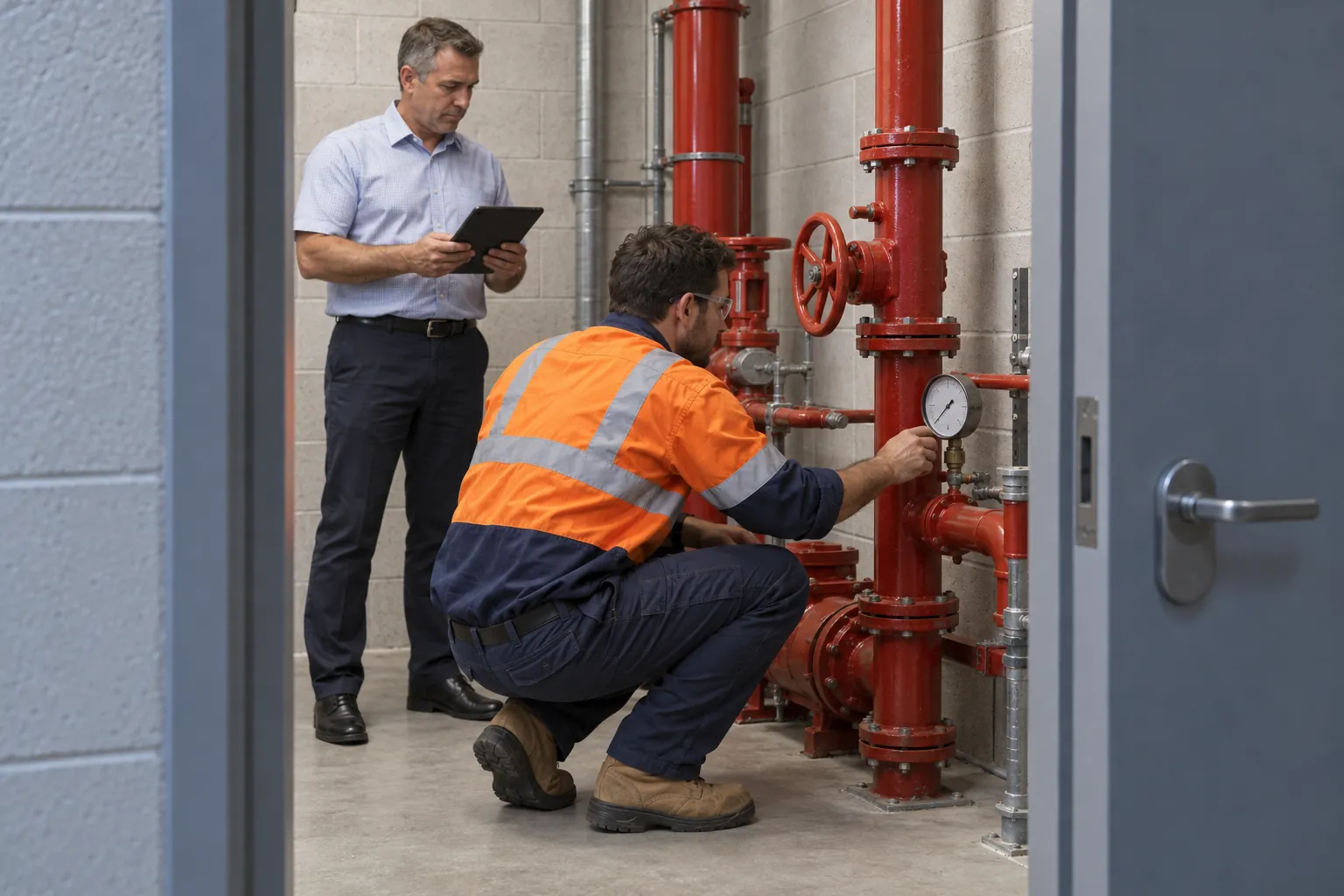
The system sits unnoticed in the ceiling for years, and has to work the first time it is asked. In Australia it is designed and installed to AS 2118, serviced to AS 1851, and kept in working order under state and territory law that puts the duty on the owner or occupier of the property. This guide explains what a sprinkler system inspection covers, how often the work falls due, who may do it, what the records must show in Victoria, New South Wales and Queensland, and what the building team can usefully check between the fire contractor's visits.
01
Which standards and codes govern a sprinkler system
Two Australian Standards do most of the work. AS 2118.1:2017 Automatic fire sprinkler systems, Part 1: General systems, published by Standards Australia on 14 September 2017 and listed as current, "specifies general requirements for the design, installation and commissioning of automatic fire sprinkler systems in buildings". Once the system is handed over, its inspection, testing and preventive maintenance fall under AS 1851-2012 Routine service of fire protection systems and equipment, which "sets out requirements for inspection, testing, preventive maintenance and survey of fire protection systems and equipment". Section 2 of AS 1851 deals with automatic fire sprinkler systems and Section 3 with fire pumpsets. The Standards Australia store lists AS 1851-2012 as pending revision, with Amendment 1:2016 as the latest version, so check the edition your contract names.
Whether a building needs sprinklers at all is set by the National Construction Code 2025, Volume One, Part E1 Fire fighting equipment. Its performance requirement E1P4 says an automatic fire suppression system "must be installed to the degree necessary to control the development and spread of fire", having regard to the size of the fire compartment, the function of the building, the fire hazard and the building's height. The deemed-to-satisfy clauses E1D5 to E1D13 then name the buildings that need one, among them:
- any building with an effective height of more than 25 metres, with narrow exceptions such as open-deck car parks (E1D5);
- Class 2 and 3 buildings, such as apartment buildings and hotels, with a rise in storeys of four or more (E1D6);
- Class 6 shops and shopping centres above 3,500 square metres of floor area or 21,000 cubic metres of volume (E1D8);
- Class 7a car parks for more than 40 vehicles or with car stackers (E1D9);
- residential care buildings, multi-storey health-care buildings, Class 9c aged care buildings and most early childhood centres (E1D7, E1D10 and E1D11).
Where a sprinkler system is required, NCC 2025 Specification 17 Fire sprinkler systems says it must comply with AS 2118.1, or in particular cases Specification 18 (Class 2 and 3 buildings no more than 25 metres in effective height with a rise in storeys of four or more), AS 2118.6 (a combined sprinkler and fire hydrant system) or AS 2118.4 (residential care buildings and Class 2, 3 and 9c buildings), with alarm valves in a secure room or enclosure with direct egress to a road or open space. None of this makes anyone service the system: that duty comes from state and territory law.
02
What a sprinkler system inspection covers
A sprinkler system inspection in the everyday sense is the fire services contractor's scheduled visit under AS 1851: looking, testing, recording readings and doing preventive maintenance, then reporting what was found. It is not a design review or a repair.
AS 1851 sorts sprinkler systems into four kinds, each with its own schedules, and the first question for any building is which kinds it has:
- Wet pipe systems, with water always in the pipework: the usual kind wherever the pipes will not freeze.
- Dry pipe systems, holding air under pressure until a head opens, where water in the pipes could freeze.
- Deluge and water spray systems, with open heads that discharge together, around particular hazards.
- Pre-action systems, which need a detection signal before water enters the pipes, where an accidental discharge would do serious damage.
Across those kinds, a routine service reaches every component of the fire sprinkler system, not only the heads people see in the ceiling:
- The valve set: the main stop valve, the alarm valve and its gauges, usually in a sprinkler valve room at ground level.
- Water supplies: the town main, any tanks, and the fire pumpsets, which AS 1851 treats in a section of their own.
- The fire brigade booster connection, where the brigade pumps water into the system.
- Alarm and signalling: flow and pressure switches, the fire indicator panel, and any link to the fire brigade.
- Heads and pipework: condition, type and spacing, pipe supports, and anything changed around them.
- Interfaces with other systems, checked in AS 1851's systems interface test.
Section 2 of AS 1851 also covers survey, baseline data, service records and reports for sprinkler systems. The survey matters: a system is designed around the building as it was, and a fit-out that adds partitions, a mezzanine or high racking can leave part of a floor unprotected without anyone touching the pipework.
03
How often it falls due, and who may do the work
AS 1851 sets service schedules by interval. For wet pipe systems the standard's table of contents shows monthly, six-monthly and yearly schedules, then five-yearly, ten-yearly, twenty-five-yearly and thirty-yearly ones. Dry pipe, deluge and water spray, and pre-action systems each have monthly, six-monthly, yearly and five-yearly schedules, and fire pumpsets have their own monthly to five-yearly schedules. The general section sets tolerances around each interval and says how a scheduled date may be changed. The long intervals are the ones most easily lost when a building changes owner or contractor, so keep the calendar with the building. Which schedules apply, and whether the building follows AS 1851 or an older requirement, depends on the state.
Victoria. Schedule 8 of the Building Regulations 2018 (Vic) lists the "Sprinkler system" among the fire fighting services and equipment that are essential safety measures. Under regulation 217, where a maintenance determination requires maintenance to AS 1851-2005 or an equivalent earlier standard, complying with AS 1851-2012 counts as compliance, and an owner who switches to AS 1851-2012 must keep to it. Under regulation 226 the owner must ensure each essential safety measure "is maintained in a state which enables the essential safety measure to fulfil its purpose" (version 031, in force from 1 September 2026).
New South Wales. The Environmental Planning and Assessment (Development Certification and Fire Safety) Regulation 2021 makes the owner responsible, under section 81, for maintaining each fire safety measure. The Department of Planning and Environment's Fire safety statements: frequently asked questions (October 2022) names fire sprinklers as a fire safety measure and adds that "an agent cannot be made responsible for this requirement". Each year the owner issues an annual fire safety statement declaring that an accredited practitioner (fire safety) has assessed, inspected and verified each essential fire safety measure; critical fire safety measures need assessment at intervals shorter than 12 months.
Queensland. Under section 54 of the Building Fire Safety Regulation 2008 (Qld) the occupier must ensure that maintenance of each prescribed fire safety installation "is carried out by an appropriately qualified person", and that each installation is inspected and tested at intervals in compliance with the Queensland Development Code, part MP6.1. For a water-based installation such as a sprinkler system, an appropriately qualified person holds a licence of a class listed in the Plumbing and Drainage Regulation 2019 or the Queensland Building and Construction Commission Regulation 2018 whose scope includes that maintenance.
In South Australia, the Metropolitan Fire Service says on its page on maintenance of fire safety systems that owners must give their local council a "Form 3 – ESP Maintenance Verification notice" at the start of each calendar year, that maintenance must be conducted in accordance with Ministerial Building Standard 002, and that ongoing compliance means maintaining the systems in line with AS 1851. Elsewhere, start from the state's legislation and the building's own documents. Whatever the state, servicing is licensed or accredited trade work: a building manager who reads the valve room gauge has made a useful observation, not a routine service.
04
Records, defects and what good evidence looks like
AS 1851's general section has clauses on routine service records, covering logbooks, tags and labels, summary records and records retention, and on reports of "defects, non-conformances and out of tolerance activities" and yearly condition reports. The sprinkler section adds its own clauses on service records and reports. The legal detail then varies by state.
Queensland spells out the record most fully. Section 55 of the Building Fire Safety Regulation 2008 requires the occupier to keep a record of maintenance for each prescribed fire safety installation, stating:
- a description of the installation maintained;
- the name and licence number of the appropriately qualified person who did the work, or under whose personal supervision it was done;
- the date and a brief description of the maintenance;
- that it was carried out in compliance with QDC, part MP6.1;
- the results, including whether the installation was in proper working order and any repair needed or made;
- a signed statement certifying the record, and any critical defect notice.
A critical defect, under section 49, is one likely to make the installation inoperable and reasonably likely to have a significant adverse impact on the safety of occupants if a fire or hazardous materials emergency happens. Section 53 requires the person maintaining the installation to give the occupier a critical defect notice, in the approved form, within 24 hours after carrying out the maintenance. Under section 54, where the record shows a repair or corrective action is needed, the occupier must see it done within one month of the maintenance, unless they have a reasonable excuse. Section 55A requires an occupier statement at the intervals MP6.1 sets, kept with the record of maintenance for two years, with a copy to the commissioner within 10 business days.
In Victoria, regulation 225 requires the owner to make available at the building, within 24 hours of a request by the municipal building surveyor or the chief officer, the annual essential safety measures reports from the last 10 years, the maintenance schedules and determinations, and "the records of all inspections, testing and maintenance (including repairs)" of any essential safety measure. The CFA's page on essential safety measures for businesses says evidence of servicing is stored on site in a red box, which it calls both an 'Essential Service' and an 'Essential Safety Measures' box, located in a front entry or a commonly accessible space.
Whatever the state, good sprinkler records show the schedule each visit belonged to and whether it was within tolerance, who did the work, the readings against the baseline data, anything not done and why, and each defect from report to closure. That last part is where most files are weakest: a contractor can report the same defect for months while the approval sits in someone's inbox. Give every defect an owner and a closure date, and keep the closure with the record.

05
What the building team can check between visits
The building manager, cleaners and security officers are in the building every day, and they notice when something changes. None of what follows is routine service under AS 1851, and none of it should be written up as if it were:
- Heads: painted, bent, taped, bagged or capped after a fit-out, or with things hung from them or the pipework.
- Storage: stock or archive boxes stacked close to the ceiling or around heads, in storerooms, loading docks and car park cages.
- Changes to the space: new partitions, mezzanines, high racking or a tenant's fit-out, which may need the contractor to survey coverage.
- The valve room: the door secured as the building requires, access kept clear, nothing stored inside, no water on the floor, and gauges readable.
- The booster connection: visible from the street, not blocked by parked vehicles, bins, landscaping or a delivery, and not damaged.
- Leaks and corrosion: drips, staining on ceiling tiles, rust at joints or a wet patch under pipework.
- Faults on the panel: a sprinkler valve or flow switch fault showing on the fire indicator panel, reported the same day rather than accepted as normal.
Some of these belong on a scheduled walk-around, weekly or monthly depending on the building, between the contractor's inspections; security officers on night patrols can take the valve room and the booster. Others, such as a new fit-out, should trigger a call to the contractor before the work finishes.
Impairments need their own routine. While a system is isolated for maintenance or building work, the building is less protected. AS 1851 includes precautions in its general section, and the contractor will have a procedure; the building should know who authorised the isolation, which areas are affected, who has been told, and who confirms the system is back in service. A valve left closed after a fit-out is one of the plainest ways to lose protection without anyone noticing.
06
Where the record fails, and what SiteClara does about it
The contractor's service reports are usually the most complete part of a sprinkler file. The gaps are in the building's own part: the walk-around ticked at the end of the month, the bagged head a cleaner mentioned to whoever was passing, the panel fault seen at 2am and never followed up. When an owner signs an annual statement, nothing shows whether anyone actually looked, or what happened to what they found.
SiteClara records those checks at the place they happen. A printed QR poster, with an optional NFC tag behind it, goes at each location with a scheduled check, such as the valve room or the booster connection. Staff scan or tap with their own phone, with no app to install, and mark each check done or say what stopped them. The time and the named person are recorded, with a photo when one is asked for, and a problem reported there stays on the team's list of open jobs until someone closes it.
The supervisor sees what is due, done and missed, and gives the reason a check was missed. Each day they review the checks and approve a report that goes to nominated contacts, such as the owner's facility manager, at 8am the next morning.
07
Questions people ask
How often does a sprinkler system need to be inspected?
At the intervals in the AS 1851 service schedules, and state law decides which apply to the building. The table of contents of AS 1851-2012 Routine service of fire protection systems and equipment, shown on its Standards Australia store page, lists monthly, six-monthly, yearly and five-yearly service schedules for wet pipe, dry pipe, deluge and water spray, and pre-action systems, with ten-yearly, twenty-five-yearly and thirty-yearly schedules as well for wet pipe systems. In Queensland, section 54 of the Building Fire Safety Regulation 2008 (Qld) requires the occupier to ensure each prescribed fire safety installation "is inspected and tested at intervals in compliance with QDC, part MP6.1".
What are the Australian standards for sprinkler systems?
AS 2118 for design and installation, and AS 1851 for routine service. Clause S17C2 of NCC 2025 Specification 17 Fire sprinkler systems says an automatic fire sprinkler system must comply with AS 2118.1 "for all building classifications", or with Specification 18 for a Class 2 or 3 building no more than 25 metres in effective height with a rise in storeys of four or more, AS 2118.6 for a combined sprinkler and fire hydrant system, and AS 2118.4 as applicable for a residential care building or a Class 2, 3 or 9c building. Once the system is in, its inspection, testing and preventive maintenance follow AS 1851.
Is AS 1851 mandatory in Queensland?
Not by name in the regulation. The Building Fire Safety Regulation 2008 (Qld) does not mention AS 1851: section 54 requires the occupier to ensure maintenance of each prescribed fire safety installation "is carried out by an appropriately qualified person", at intervals in compliance with QDC, part MP6.1. The Fire Safety Management Tool for Building Occupiers, Owners, Lessees and Bodies Corporate with Advisory Notes (effective September 2025) says "The requirements for maintenance are now contained in the Queensland Development Code MP 6.1", so read MP6.1 for the intervals and any standard it calls up, and check which edition your service contract names.
08
Further reading, and a list to take away
Standards Australia sells AS 1851-2012 Routine service of fire protection systems and equipment and AS 2118.1:2017 Automatic fire sprinkler systems, Part 1: General systems; each store page shows the edition's status. The NCC 2025 Part E1 and Specification 17 are free to read on the ABCB's site. For the duties, read Part 15 and Schedule 8 of the Building Regulations 2018 (Vic), the NSW Government's page on fire safety certification, and Part 5 of the Building Fire Safety Regulation 2008 (Qld).
Before the next sprinkler service, check that:
- you know which kinds of sprinkler system the building has: wet, dry, deluge or pre-action;
- the contract names the edition of AS 1851 and matches the building's list of fire safety measures;
- the building holds a calendar of every interval, including the five-yearly and longer ones;
- each technician's licence or accreditation is shown before work starts;
- every defect has an owner and a closure date;
- fit-outs and storage changes trigger a call to the contractor about coverage;
- every isolation has a named person who confirms the system is back in service;
- the valve room and booster are on a regular walk-around, with one person to report to;
- the records could be produced at the building within a day.
Sources
Every document this guide quotes or links to, in the order it first cites them.
- AS 2118.1:2017 Automatic fire sprinkler systems, Part 1: General systems store.standards.org.au
- AS 1851-2012 Routine service of fire protection systems and equipment store.standards.org.au
- National Construction Code 2025, Volume One, Part E1 Fire fighting equipment ncc.abcb.gov.au
- NCC 2025 Specification 17 Fire sprinkler systems ncc.abcb.gov.au
- Building Regulations 2018 (Vic) legislation.vic.gov.au
- Fire safety statements: frequently asked questions planning.nsw.gov.au
- Building Fire Safety Regulation 2008 (Qld) legislation.qld.gov.au
- Maintenance of fire safety systems mfs.sa.gov.au
- Essential safety measures for businesses cfa.vic.gov.au
- Fire Safety Management Tool for Building Occupiers, Owners, Lessees and Bodies Corporate with Advisory Notes fire.qld.gov.au
- Fire safety certification planning.nsw.gov.au
Related guides
 Fire and water checksAS 1851 routine service: what it asks of owners, fire contractors and building teamsWhat AS 1851-2012 routine service covers, how intervals and competent persons work, what the records must show, and how Victoria's regulations call it up.
 Fire and water checksFire hose reel inspection: the six-monthly service, the records and the checks in betweenHow fire hose reels are inspected in Australia: AS 2441 and the NCC, the six-monthly and yearly AS 1851 service, state records rules, and the checks between visits.
 Fire and water checksEssential safety measures in Victoria: the duties, the annual report and the recordsWhat essential safety measures are under Victoria's Building Regulations 2018, who maintains them, the annual ESM report, the records to keep and the checks between.
 Fire and water checksFire safety logbook: what to record, who keeps it and for how longWhat a fire safety logbook should hold in Australia: AS 1851 service records, Victoria's ESM records, the NSW fire safety statement and Queensland's rules.