Cleaning
Strata cleaning: keeping the common areas clean, and showing the committee it was done
Strata cleaning is the regular cleaning of a strata scheme's common property, such as the foyer, lifts, corridors, fire stairs, bin room and car park, and it is paid for and arranged by the owners corporation (the body corporate in Queensland) as part of its legal duty to maintain that common property.
Also written for United Kingdom · United States
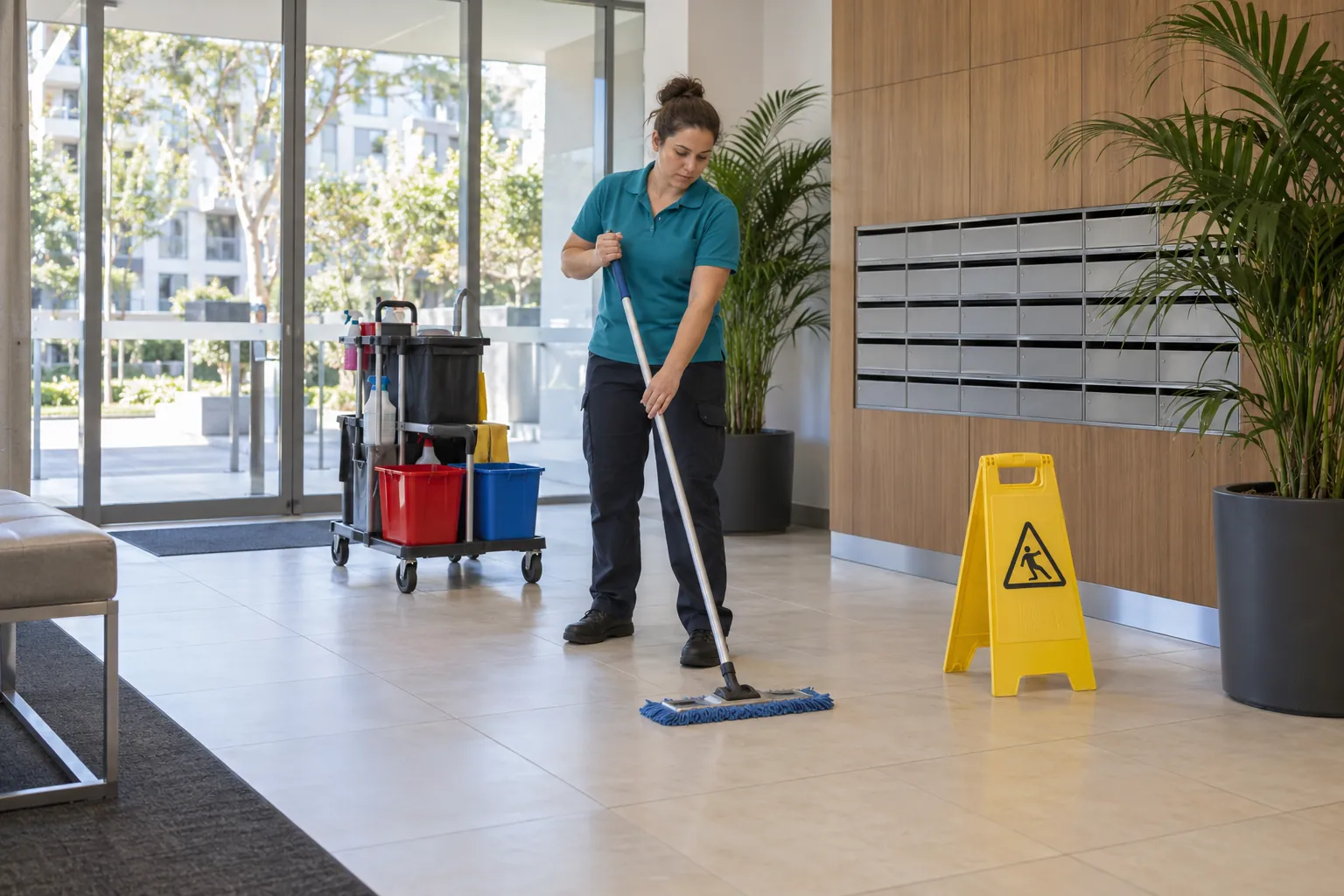
A scheme buys strata cleaning services from a contract cleaner or has the work done by a caretaker or building manager, and the shared spaces are what every owner and resident walks through each day. This guide covers the duty in New South Wales, Victoria and Queensland, what a strata cleaning service covers, how often, who does what, the safety law that applies, and how a strata committee can tell the work was actually done.
01
What strata cleaning is, and whose duty it is
A strata scheme divides apartment buildings, townhouse complexes and commercial or mixed-use buildings into lots, owned individually, and common property, which the owners share and the owners corporation manages. Strata cleaning is the cleaning of that common property. Strata is state and territory law, so the words change at each border, but everywhere the owners corporation must keep the common property maintained, and cleaning is the most visible, most frequent part of that work.
New South Wales. For a scheme in Sydney or anywhere else in the state, NSW Fair Trading's Common Property Repairs and Maintenance Compliance and Enforcement Policy (version 1.0, October 2025) says section 106 of the Strata Schemes Management Act 2015 "places a statutory duty on owners corporations and community scheme associations to properly maintain and repair common property". The duty can be set aside by special resolution only where the decision "will not affect the safety of any building, structure or common property in the scheme or detract from the appearance of any property in the scheme", and an owner who suffers loss from a breach can be awarded damages by the NSW Civil and Administrative Tribunal under section 106(5). The NSW Government's guide to strata repairs and maintenance puts it simply: "The owners corporation is responsible for maintenance and repair of common property."
Victoria. Section 4 of the Owners Corporations Act 2006 (Vic) (version 024, in force from 9 September 2026) gives an owners corporation the functions "to manage and administer the common property" and to repair and maintain it, and section 46 makes the second a duty: "An owners corporation must repair and maintain– (a) the common property; and (b) the chattels, fixtures, fittings and services related to the common property or its enjoyment."
Queensland. Under the Body Corporate and Community Management Act 1997 and the regulation module named in the scheme's community management statement, the Queensland Government's page on maintenance responsibilities in a body corporate says: "A body corporate must maintain the common property in a good and structurally sound condition."
None of these duties sets a cleaning frequency or a standard of clean. What is cleaned, how often and by whom is settled through the contract, the by-laws and the budget, which is why the contract and the record are the only place the standard is written down.
02
What a strata cleaning service covers
Where common property ends and a lot begins depends on the registered strata plan, so check it before agreeing a scope. Strata properties vary, but on a typical apartment or mixed-use building, a strata cleaning service covers:
- Entrances and foyers: hard floors swept and mopped, entrance mats vacuumed, entry glass cleaned, letterbox banks and the intercom panel wiped, cobwebs removed.
- Lifts: floor, walls, mirrors and stainless steel, buttons and handrails, and the door tracks, where grit and rubbish collect.
- Corridors, hallways and lift lobbies: carpets vacuumed or hard floors mopped, skirting boards, light switches, door furniture and the faces of fire doors.
- Fire stairs and stairwells: each flight swept or mopped, handrails wiped, rubbish and stored items reported rather than moved into another corner.
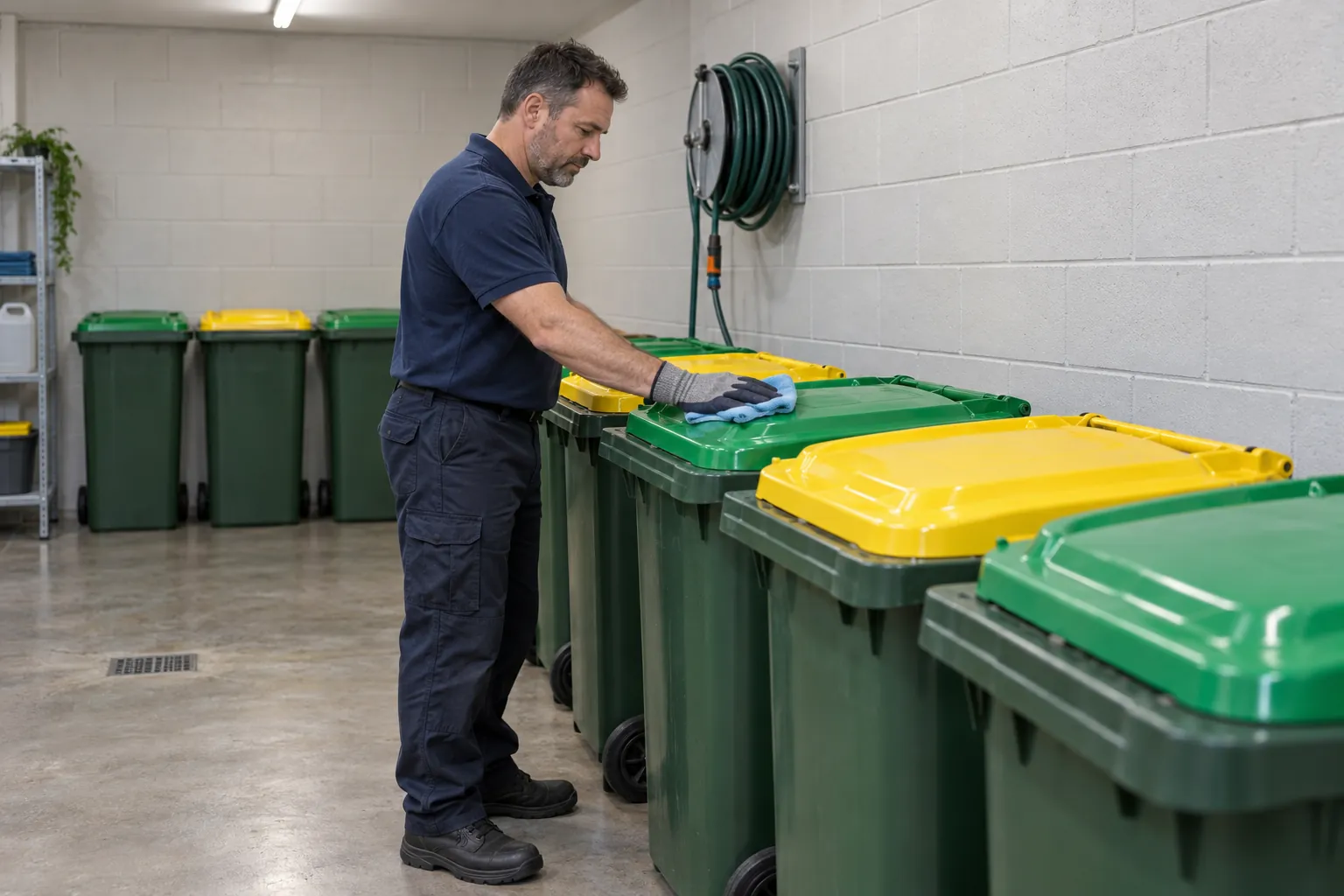
- Bin rooms and garbage chutes: floors swept and washed, spills cleared, bins tidied and presented on the council's collection day where the contract includes it, and dumped items reported. See bin room cleaning.
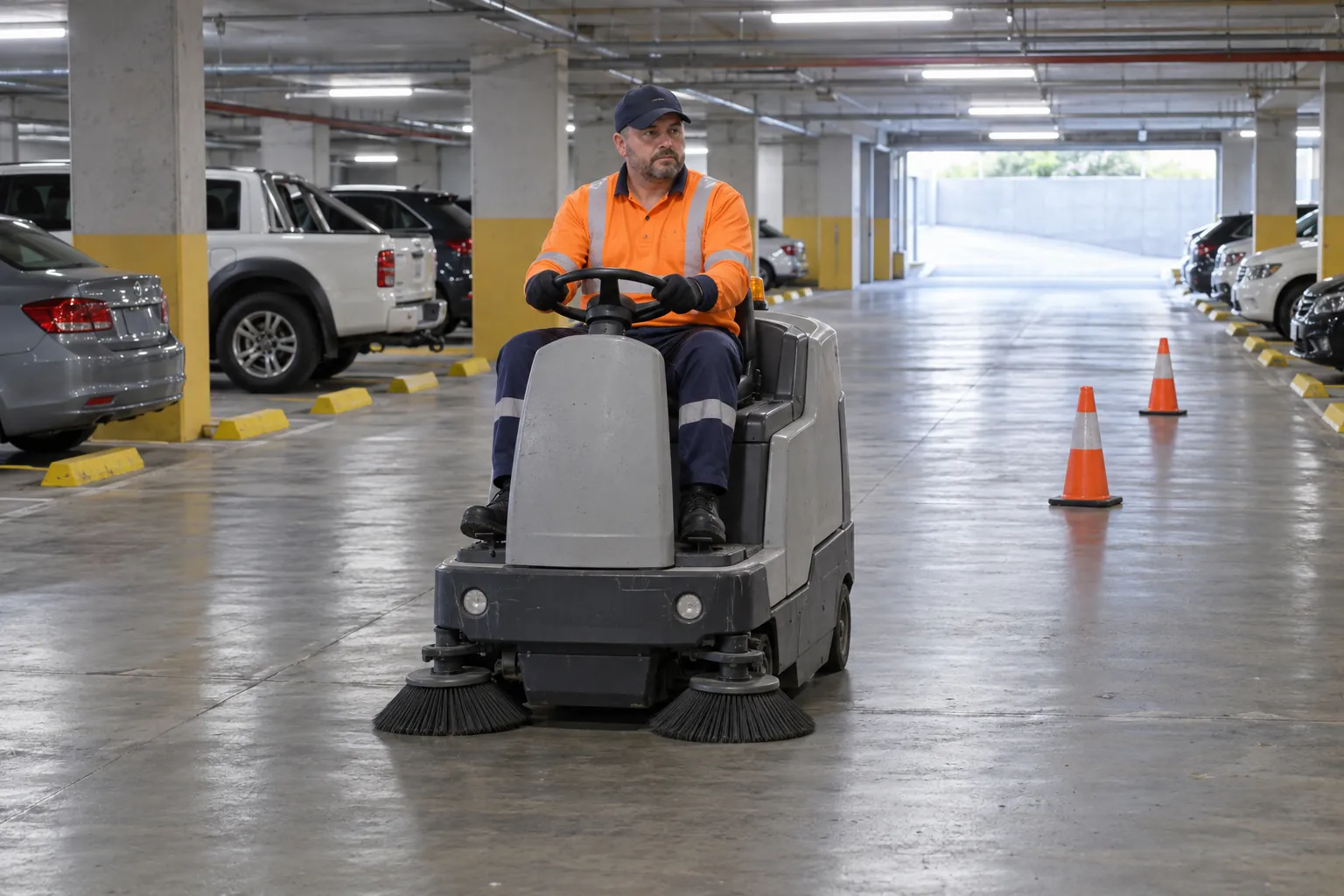
- Car parks: sweeping of driveways, bays and ramps, litter picking, oil spills treated, and periodic pressure cleaning or scrubbing. See car park cleaning.
- Shared facilities: the pool surrounds, barbecue area, gym, rooftop terrace, bicycle store and any common toilets, often on their own frequency.
- External areas: paths, entry forecourts and courtyards swept, leaves cleared from drains and grates.
Windows need a written split. The NSW Government's guide to strata repairs and maintenance lists window cleaning as an owner's responsibility, "unless you can't access it (for example, if it is too high)", but does not say who cleans the glass an owner cannot reach. In practice the external glass of a high-rise building is often a periodic contract arranged by the owners corporation, carried out by specialists working at height, while owners clean what they can reach. Common area glass, such as the foyer and the lift lobbies, sits with the routine strata clean.
A mixed-use building, with shops or offices on the lower floors, is often split into separate parts, one or more of them a strata scheme, run together under a building or strata management statement by a building management committee made up of representatives of the owners of each part. The cleaning scope should say plainly which common areas each contract covers.
03
How often strata common areas should be cleaned
No strata Act sets a frequency. The right one follows the number of lots, the foot traffic and what happens when an area is left: a bin room in summer cannot wait a week, while the upper corridors of a small block can. Bin rooms, common toilets and gym equipment matter for hygiene as well as appearance, so they usually need more frequent cleaning than a corridor that only looks tired. Typical patterns are:
- A small walk-up block of six to twenty units: one or two visits a week, with the bin room and entrance done each time.
- A mid-rise apartment building with lifts and a basement car park: several visits a week, the foyer, lifts and bin rooms more often than the upper floors.
- A large or high-rise complex with a building manager and shared facilities: a daily presence, often with a day cleaner for the foyer, lifts, gym and pool area and an early or late shift for bins and the car park.
- Periodic work on a calendar: carpet cleaning, hard floor scrubbing and sealing, car park pressure cleaning, external glass, high dusting of light fittings and vents, and garbage chute cleaning.
Write the frequency into the scope of works for each area, not as a total number of hours. "Two visits a week, 2.5 hours" says nothing about whether the fire stairs are done each week or once a month. A good scope lists the area, the task, the frequency and the standard an owner could check against.
Employment law sets a floor on visit length. Under clause 13.5 of the Cleaning Services Award 2020, which covers the contract cleaning services industry, a part-time or casual cleaner must be rostered for at least 2 consecutive hours at a location of up to 2,000 square metres of cleaning area, 3 hours from 2,000 to 5,000 square metres and 4 hours above that, and paid for the minimum even when they finish early. A one-hour minimum is allowed only at a small stand-alone location of 300 square metres or less, in the circumstances the clause sets out. A quote for a 45-minute weekly visit to a mid-sized block deserves a question about how it pays the award; see the cleaning contract guide.
04
Who does what, and the safety law that applies
The owners corporation holds the duty, but it acts through committees, managers and contractors, and strata cleaning complaints often land in the gaps between them. The NSW Government's guide Who's who in strata sets out the usual cast:
- The strata committee handles spending "for the day-to-day running of the scheme (e.g. hiring repairers, arranging insurance)", within what the owners corporation lets it decide. In most schemes it chooses and reviews the cleaning contractor.
- The strata manager (strata managing agent) is "often the primary contact for owners", gets quotes, holds the contract and passes on complaints. See strata manager responsibilities.
- The building manager, where there is one, "is generally the primary contact for contractors working on-site", and must disclose any benefit it receives, such as a referral fee from a cleaning company it nominates.
- The caretaker in Queensland is usually a caretaking service contractor: a service contractor who is also the scheme's authorised letting agent, or an associate of one. The Queensland Government's page on the role of a service contractor and letting agent says a service contractor is engaged "to supply services (other than administrative services) for at least a year", gives "cleaning the pool", "lawn mowing" and "gardening" as examples, and notes that a caretaking service contractor must comply with a code of conduct, while "The Act does not include a code of conduct for a service contractor." See body corporate caretaker.
- The cleaning contractor employs and supervises the cleaners, supplies the equipment and chemicals, and answers for the standard under its contract.
Work health and safety. Every state and territory except Victoria has a Work Health and Safety Act based on the national model law. Under section 19 of the Work Health and Safety Act 2011 (Qld), which follows the model, a person conducting a business or undertaking (PCBU) "must ensure, so far as is reasonably practicable, the health and safety of" its workers, and must ensure that "the health and safety of other persons is not put at risk" from its work. A cleaning contractor is a PCBU, so its duty covers its cleaners' chemicals, manual handling and lone work, and residents walking past a wet floor. Section 46 adds that where more than one person has a duty in relation to the same matter, each must "consult, cooperate and coordinate activities" with the others. In Victoria the equivalent duties are in the Occupational Health and Safety Act 2004 (Vic).
The owners corporation's own position depends on the building. SafeWork NSW's page on strata title and body corporate obligations says that where a body corporate "is only responsible for common areas used only for residential purposes", it generally "is not a person conducting a business or undertaking in relation to the common areas". That changes if the scheme is mixed residential and commercial, where WHS laws will usually apply, and "As soon as a strata title body employs someone to carry out a job, they become an employer." The page notes that "contractors are not employees". Either way, the contractor should know the building's hazards, such as car park traffic and the pool chemicals store.
05
How the committee knows the cleaning was done
Strata cleaning is hard to oversee: the client is a committee of owners who are rarely there when the cleaner is, and who often find out about the standard of cleanliness through complaints, after the problem. A better arrangement gives the committee, the strata manager and the contractor the same evidence:
- A scope of works by area, with the task, the frequency and the standard, attached to the contract.
- A record of each visit: which areas were done, by whom, and when, kept in a form the strata manager can read without going to the building.
- A way to report what the cleaner finds: a failed light, a fire door propped open, furniture dumped in the car park, a leak in the bin room. The cleaner sees the common property more often than anyone else.
- Photographs of an area after the clean, or of a problem when found.
- A periodic joint walk by the contractor's supervisor and the strata manager or a committee member, against the scope, with the findings written down and followed up.
- A short regular report to the committee: visits made, periodic work done, issues raised and still open.
Evidence matters when an owner escalates. Under NSW Fair Trading's enforcement policy, concerns about common property maintenance "should be reported in writing to the strata committee or strata managing agent" first, then by a motion at a general meeting, then through mediation, and only then by complaint. Where Fair Trading finds a breach it asks the owners corporation for an action plan, and "The owners corporation will be expected to provide evidence of progress or completion by agreed timeframes." A scheme with a dated record of cleaning visits and reported faults can answer that; one with a signing sheet in the cleaner's cupboard usually cannot.
Keep the records properly. The NSW Government's page on strata record keeping requirements says "The owners corporation must keep records for 7 years", and "From 11 June 2024, records which strata schemes are required to keep must be kept electronically." That applies to records the scheme is required to keep, created from that date; a cleaning visit record is useful evidence whether or not it is one of them.
06
Where the record fails, and what SiteClara does about it
The usual strata cleaning record is a sheet taped inside the cleaner's cupboard or the bin room door, initialled for the week, read by nobody and thrown out when it is full. When an owner emails the strata manager to say the fire stairs have not been touched for a fortnight, nobody can show whether they are right. Faults the cleaner noticed were mentioned to whoever was in the foyer, or not at all.
SiteClara puts a printed QR poster at each location in the building, such as the foyer, each lift lobby, the fire stairs, the bin room, each car park level and the pool gate, with an optional NFC tag behind it. The cleaner scans the code or taps the tag on their own phone, with no app to install, sees the checks due there and marks them done, or explains what stopped them, with a photo when one is asked for. A failed light, a propped fire door or dumped rubbish can be reported there and then; it goes onto the team's list of open jobs, grouped by building and floor, until someone closes it, and a supervisor can escalate a job to the building manager, who can answer it.
Each day the contractor's supervisor reviews the totals and photos, adds a note and approves a report of what was reported, completed and still open, and how the scheduled checks went, which goes to the nominated contacts, such as the strata manager or the building manager, the next morning. Where a cleaning contractor and a security or gardening contractor work in the same building, each runs its own staff, forms and approval.
07
Questions people ask
Is window cleaning the owner's job or the owners corporation's in NSW?
Usually the owner's, for the windows they can reach. The NSW Government's guide to strata repairs and maintenance lists window cleaning as an owner's responsibility "unless you can't access it (for example, if it is too high)". The page does not say who cleans the glass an owner cannot reach. In practice the owners corporation often arranges it, so settle it in the by-laws or the cleaning contract.
Is a strata cleaner a building manager?
No, not in New South Wales, if they only clean. The NSW Government's guide Who's who in strata says a person such as "a gardener, cleaner or roof repairer" who is engaged solely to do repair or maintenance services for the common property, and does not manage or control it, is not a building manager, so the building manager rules do not apply to them.
Does a residential owners corporation have WHS duties to the cleaners?
Generally not as a PCBU, unless it employs someone or the scheme is mixed use. SafeWork NSW's page on strata title and body corporate obligations says a body corporate responsible only for residential common areas generally is not a person conducting a business or undertaking in relation to them, but it becomes an employer as soon as it employs someone, and WHS laws will usually apply to mixed residential and commercial common areas. The cleaning contractor has its own duties as a PCBU in every case.
08
Where to read more, and a list to take away
The official sources are short and worth reading for the state where the building is:
- New South Wales: the NSW Government's strata repairs and maintenance guide, Who's who in strata, the record keeping requirements, safety rules for strata common property and NSW Fair Trading's Common Property Repairs and Maintenance Compliance and Enforcement Policy.
- Victoria: the Owners Corporations Act 2006, sections 4, 46 and 47.
- Queensland: the Queensland Government's pages on maintenance responsibilities and the role of a service contractor and letting agent.
- Safety and employment: SafeWork NSW on strata title and body corporate obligations, your state's Work Health and Safety Act (Victoria's Occupational Health and Safety Act 2004), and the Cleaning Services Award 2020 on the Fair Work Ombudsman's site.
Before you agree or renew a strata cleaning contract, check that:
- the scope lists every common area from the strata plan, inside and out, including bin rooms, fire stairs, car park levels and shared facilities;
- each area has tasks, a frequency and a standard an owner could check;
- periodic work, such as carpets, car park pressure cleaning and external glass, has dates;
- the price can pay the Cleaning Services Award, including its minimum shifts;
- the contractor's safety arrangements keep cleaners and residents safe around chemicals, wet floors, lone work and the building's own hazards;
- cleaners know to report failed lights, propped fire doors, blocked exits, dumped rubbish and damage, and to whom;
- each visit is recorded in a way the strata manager and committee can read without going to the building;
- the records the scheme must keep are kept electronically, for seven years in NSW.
Sources
Every document this guide quotes or links to, in the order it first cites them.
- Common Property Repairs and Maintenance Compliance and Enforcement Policy nsw.gov.au
- Strata repairs and maintenance nsw.gov.au
- Owners Corporations Act 2006 (Vic) legislation.vic.gov.au
- Maintenance responsibilities in a body corporate qld.gov.au
- Cleaning Services Award 2020 awards.fairwork.gov.au
- Who's who in strata nsw.gov.au
- Role of a service contractor and letting agent qld.gov.au
- Work Health and Safety Act 2011 (Qld) legislation.qld.gov.au
- Occupational Health and Safety Act 2004 (Vic) legislation.vic.gov.au
- Strata title and body corporate safework.nsw.gov.au
- Record keeping requirements nsw.gov.au
- Safety rules for strata common property nsw.gov.au
Related guides
 Premises and facilities managementStrata maintenance: keeping common property in repair, and showing that you haveStrata maintenance in Australia: the duty to repair common property in NSW, Victoria and Queensland, the plans a scheme needs, who does what and the records to keep.
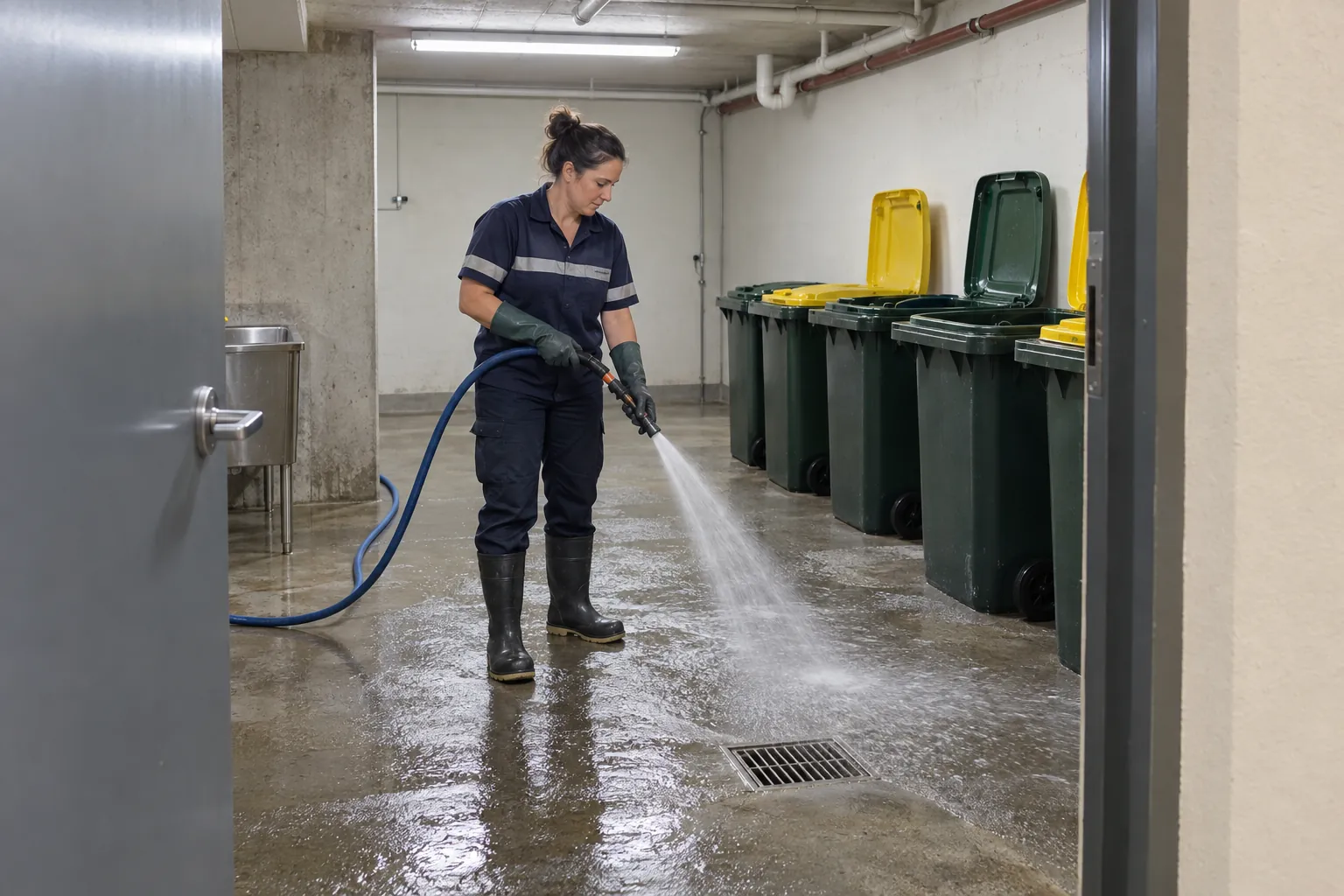 CleaningBin room cleaning: who is responsible, what to do, and how to show it was doneGarbage room cleaning in Australia: who is responsible in strata and commercial buildings, what to clean and how often, working safely, and a record to trust.
 CleaningCar park cleaning: what to clean, how often, and how to show it was doneCar park cleaning in Australia: the WHS and OHS duties, what to clean and how often, working safely among traffic, wash water, and a record worth trusting.
 CleaningCleaning contracts in Australia: what to put in them, and how to know they are workingWhat an Australian commercial cleaning contract should cover, how the Cleaning Services Award and Fair Work Act shape it, and how to show the work was done.