Premises and facilities management
Boiler log: what the law requires, and what a useful one records
A boiler log, also called a boiler log sheet or boiler room log book, is the dated record of a boiler's operation and maintenance: who was on shift, what was tested, what was blown down, what went wrong and what was done about it.

In an Ontario registered plant, the log is a legal document with rules on who may write in it, in what ink and for how long it is kept. In a small commercial building with a hot water heating boiler, no statute may ask for a log at all, yet the certificate of inspection, the insurer's inspector and the next service call all go better with one. This guide covers what Ontario law requires, what other buildings should record, how often, and who signs.
01
What the law requires: two regulations, two kinds of record
In Ontario, boilers are regulated under the Technical Standards and Safety Act, 2000, administered by the Technical Standards and Safety Authority (TSSA). Two regulations under it matter for a boiler log, and they do different jobs.
The first is O. Reg. 220/01 (Boilers and Pressure Vessels). It is about the equipment. It requires every owner and operator to ensure a boiler "is maintained in safe working condition and operated safely" (section 3 (3)), forbids operating one without a current certificate of inspection (section 5 (1)), and requires periodic inspection by the insurer or by a TSSA inspector (section 10). It does not prescribe a daily log.
The second is O. Reg. 219/01 (Operating Engineers). It is about the people who run a plant and how the plant is attended, and it applies to "the operation of all registered plants". Section 37 is the boiler log rule in Ontario law. It opens: "Every user of a plant shall keep in the plant a log in the form of a book or electronic log."
Outside Ontario, each province has its own boiler and pressure vessel law and its own authority, and the rules on logs differ. British Columbia's Power Engineers, Boiler, Pressure Vessel and Refrigeration Safety Regulation (B.C. Reg. 104/2004), for example, requires the owner of a plant to keep records required under the regulation or by a provincial safety manager "for a period of at least 7 years". Read your own province's regulation before relying on the Ontario rules in this guide. Federal law applies only where the work is federally regulated.
02
What an Ontario registered plant log must record
Section 37 (8) of O. Reg. 219/01 lists what shift entries in the log shall include. In summary:
- the date, the shift and its start and end times, and everyone on duty with their periods of duty;
- any instructions for the shift, with the name of the person who gave them;
- any change from normal operating procedure, and any abnormal condition observed, with the time;
- the starting and stopping times of primary equipment not recorded in other logs;
- repairs and maintenance, including tests of fail-safe devices: when, whether completed and who attended;
- any malfunction, when it occurred and what was done to correct it;
- work by plant staff outside the plant, and the entry of any unauthorized person, with times;
- the times of the primary shift functions, which include at least boiler blowdown, water column blowdown, controls tests, safety valve tests, sootblower operation, and water sampling and chemical treatment.
Two other sections feed the log. Section 39 (9) requires the user of a guarded plant to ensure fail-safe protective devices are "regularly tested under operating conditions and calibrated as required, and that the results of the tests are logged". Section 41 requires a registered boiler to have water conditioning services that meet the manufacturer's recommendations, "based on a scheduled procedure that is logged".
Section 46 adds a companion document: the owner must keep on the premises an up-to-date operating procedures manual, designed by or acceptable to the chief operating engineer, covering training, the operation of all equipment and systems, and emergency procedures. Standing orders that are routinely followed must be "clearly documented" where the people they apply to can find them, and "supplementary logs shall be registered in the log" (section 37 (7)). A separate water treatment or chemical log is fine, as long as the main log says it exists.
03
Who writes in it, how, and for how long
O. Reg. 219/01 is specific about the log as a physical record, because it is evidence:
- A bound book. The logbook "shall be bound and constructed so that the pages are numbered and cannot be removed" (section 37 (2)).
- A signature page. The names and sample signatures of the chief operating engineer or chief operator, relief chiefs, shift engineers and shift operators are entered on it (section 37 (5)).
- Only certified staff write in it. "No person except the chief operating engineer, chief operator, a shift engineer or a shift operator may make an entry in or sign the logbook" (section 37 (6)).
- Ink, and no erasing. Entries are in ink, and corrections "shall not be erased but crossed out, corrected and initialled" (section 37 (9)).
- Read daily by the chief. The chief operating engineer or chief operator "shall read and sign the log at least once each business day" (section 37 (11)).
- Kept three years, in the plant. The user keeps the logbook accessible in the plant for at least three years after the last entry, and produces it when an inspector asks (section 37 (12)). Nobody may deface or destroy it, or remove it from the plant without the owner's or user's permission (section 37 (10)).
An electronic log is allowed. Under section 37 (3), a dated paper print-out must be made at the end of each shift, entered into the logbook and signed by the chief the next business day, and section 37 (4) sets requirements for the system, including entry by authorized pass code only. TSSA's alternate rules for O. Reg. 219/01, in effect since 2 October 2020, allow a plant user instead to follow procedures established by the chief officer "to ensure the authenticity, integrity and reliability of electronic log entries", and allow the person responsible for an unattended plant to make entries once their name and sample signature are on the signature page.
Separately, the user of a registered plant must notify TSSA's chief officer by telephone or other direct means of any accident, injury or death as soon as practicable and no more than eight hours after it, and send a written report within 48 hours where someone is seriously injured or killed or an accident involves property damage (section 47). The log is often where the first facts come from.
04
Inspections, certificates and relief valve tests: the dates the log should hold
Under section 10, every owner of a boiler in operation must have it inspected by its insurer, if it is insured, or by a TSSA inspector if it is not, at the intervals in the code adoption document. As TSSA's Boilers and Pressure Vessels Certificate of Inspection page puts it: "If you own a BPV device, it must be inspected regularly, and you must hold a valid Certificate of Inspection from TSSA." After the inspection, a record of inspection is issued, and the owner or operator must apply for the certificate no later than 30 days after receiving it (section 10.1 (3)). The certificate is posted "in a conspicuous place near the boiler" (section 10.1 (6)), and the inspection report is kept for six years (section 10 (7)).
The intervals are in TSSA's Boilers and Pressure Vessels Code Adoption Document Amendment BPV-25-01 R1 (revision of 15 May 2026, effective 15 June 2026), which adopts CSA B51-24, Boiler, pressure vessel and pressure piping code, with Ontario amendments. Its Table 1 sets maximum inspection intervals, including:
- high pressure boiler: 1 year;
- low pressure boiler: 2 years;
- pressure vessel: 3 years;
- deaerator: 1 year.
The same document sets maximum test and service intervals for pressure relief devices. For a heating boiler in hot water service at no more than 1100 kPa (160 psig) and 121°C (250°F), it is a manual lift test or system test every 2 years and service every 6 years; for a heating boiler in steam service at no more than 103 kPa (15 psig), a manual lift test annually and service every 5 years. Power boilers in steam service above 15 psig need a system or lift test annually. Evidence of relief valve servicing "will be verified at the time of periodic inspections", so keep a dated record of each test: when, by whom, with what result.
Anyone responsible for a boiler who learns of "any defect that might render it unsafe" must notify the director and the insurer forthwith (O. Reg. 220/01, section 10.2 (6)), and at an inspection must point out any defect they know of (section 10 (3)). Faults written down at the time make both easier to do honestly.
05
What to log when no regulation asks for a log
A commercial building whose boilers only heat water below 100°C may have no operating engineer and no statutory log. The owner's duty to keep the boiler "in safe working condition and operated safely" still applies, and so does the need to show it was looked after. A simple boiler room log, kept by the building superintendent, the building operator or the service contractor, is the usual answer. A one-page boiler log sheet on a clipboard, or a template your contractor provides, is enough if it is filled in honestly and kept.
A useful routine for a building like this, to be adjusted to the manufacturer's instructions and your service contractor's advice, might be:
- Daily in the heating season: no alarms or lockouts; temperatures and system pressure in their normal range; no leaks, smells, unusual noise or scorching; the boiler room clear of storage and its door closed and locked as your procedures require.
- Weekly or monthly: the checks your manufacturer or contractor sets for the low water cut-off, a steam boiler's gauge glass, make-up water and water treatment readings.
- At each service or inspection: who came, what was found and done, the certificate's expiry and the next relief valve test due.
- Whenever something is wrong: what was seen, when, who was told, and when it was put right.
Keep entries short and factual: "Boiler 2 in lockout at 06:10, reset by contractor 08:45, flame sensor cleaned" is worth more than a page of ticks. Write readings as numbers, not "OK", and record checks where nothing was wrong, because an empty page looks like a missed visit.
Record the fall start-up and spring shut-down too. If your building has a preventive maintenance program, the boiler tasks sit in it; the log records the doing.
06
Where boiler logs fail, and what SiteClara does about it
Boiler logs fail in familiar ways. The sheet on the boiler room door is ticked to the end of the month, in one pen, on one day. A lockout is reset and nobody writes it down, so the fourth in a month looks like the first. The certificate of inspection expires in a drawer. And the leak noticed on Friday afternoon is mentioned to whoever was passing.
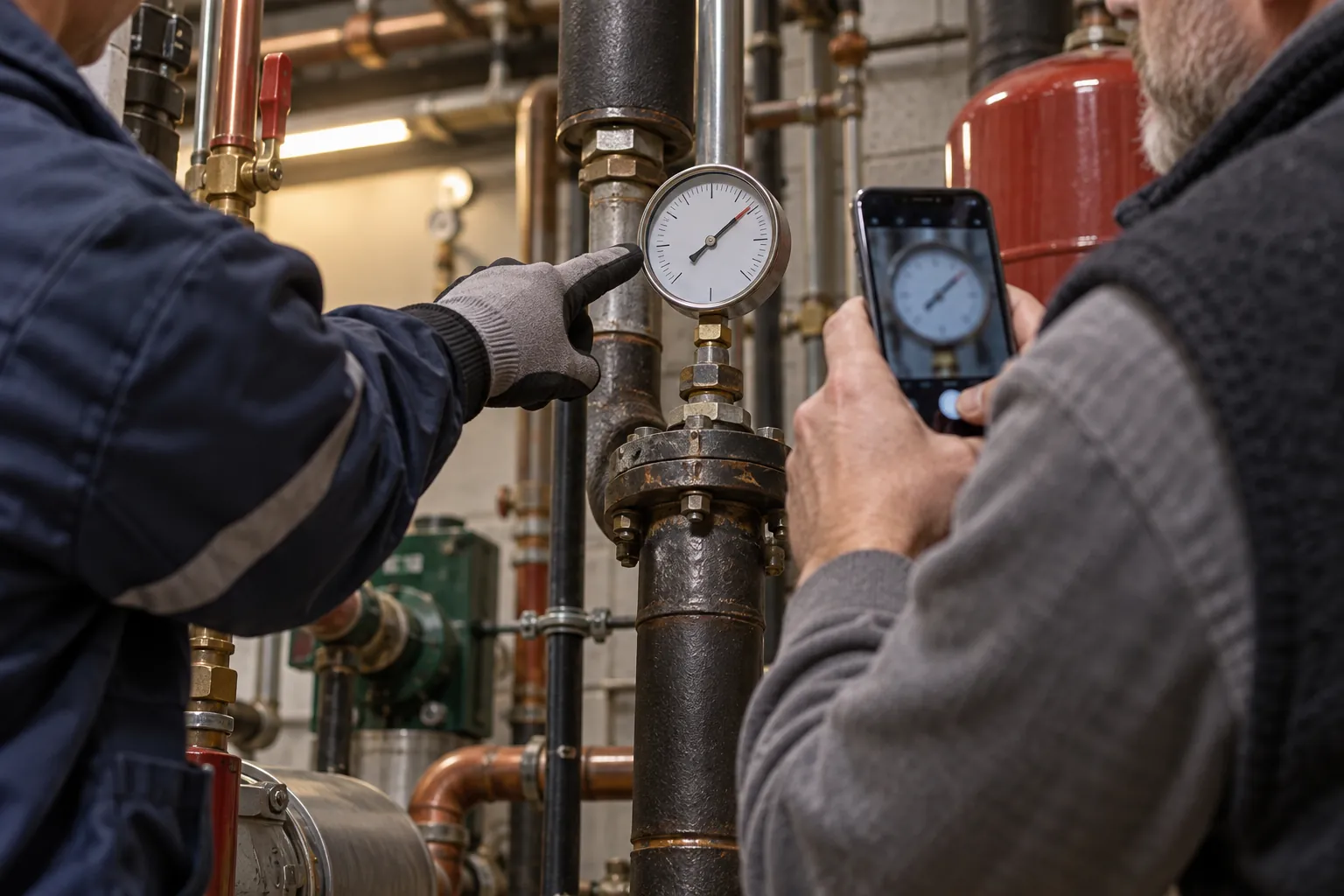
SiteClara records work at the location. A printed QR poster, with an optional NFC tag behind it, sits at each place where a check is scheduled, such as the boiler room door or a mechanical room. Staff scan or tap on their own phone, with no app to install, and mark the check done at that place, with a photo when one is asked for, for example of the pressure gauge. The time, the place and the named person are recorded automatically, so the entry is made on the spot rather than written up later. If something stopped the check, such as a locked room with no key on site, they say so, and the reason is recorded against that check.
Anyone on the team can report a problem at a location, such as water under the boiler or a smell of gas, with a photo, and it stays on the team's list of jobs until someone closes it. Checks can be scheduled, such as a daily walk of the boiler room in the heating season, and a missed one shows as missed. The supervisor adds a note and approves a daily report that goes to nominated management or client contacts the next morning, showing what was checked, what was reported and what is still open.
07
Questions people ask
What is a boiler maintenance log book?
It is the book in which a boiler's shifts, tests, repairs and faults are written down as they happen. In an Ontario registered plant it is a legal requirement: section 37 of O. Reg. 219/01 (Operating Engineers) says "Every user of a plant shall keep in the plant a log in the form of a book or electronic log", bound so that the pages are numbered and cannot be removed, and kept in the plant for at least three years after the last entry.
What goes in a steam boiler log?
In an Ontario registered plant, the shift entries required by section 37 (8) of O. Reg. 219/01 (Operating Engineers) include the times of "boiler blow down", "water column blow down", "controls tests", "safety valve tests", "sootblower operation" and "water sampling and chemical treatment", as well as who was on shift, any abnormal condition and any malfunction with what was done to correct it.
Do hot water boilers need log sheets?
Not always by law. Section 3 of O. Reg. 219/01 (Operating Engineers) says it does not apply to "a boiler or an installation comprised of more than one boiler, where the boiler contains hot water at a temperature of less than 212°F (100°C)", so a heating boiler of that kind needs no section 37 log. The boiler still needs inspection and a certificate under O. Reg. 220/01 (Boilers and Pressure Vessels) unless that regulation excludes it too, and a simple log sheet is the easiest way to show it was looked after.
What are the parts of a boiler?
O. Reg. 220/01 (Boilers and Pressure Vessels) defines a boiler as "a fired vessel in which gas or vapour may be generated or a gas, vapour or liquid may be put under pressure by heating", and calls what is attached to it fittings, which include "valves, gauges and controlling devices and other pressure-retaining components". Those fittings, such as the safety valve, the pressure gauge and the low water cut-off, are what most boiler log checks are about.
08
Where to read more, and a list to take away
In Ontario, read sections 3, 37, 39, 41, 46 and 47 of O. Reg. 219/01 (Operating Engineers) for registered plants and their logs, and sections 2, 3, 5, 8, 10, 10.1 and 10.2 of O. Reg. 220/01 (Boilers and Pressure Vessels) for scope, the owner's duties, certificates, inspection and reporting. TSSA's Code Adoption Document Amendment BPV-25-01 R1 sets the inspection and relief valve intervals, and its alternate rules page covers electronic logs. CSA B51 itself is a paid standard from CSA Group. Outside Ontario, start with your province's boiler and pressure vessel regulation, such as British Columbia's B.C. Reg. 104/2004, and ask your boiler insurer what it expects to see.
Before the heating season, check that:
- you know whether each boiler is part of a registered plant, and so whether a section 37 log and certified staff are required;
- the certificate of inspection is current and posted near the boiler, and you know when the next periodic inspection is due;
- the relief valve test and service dates are recorded, with the next ones scheduled;
- the log, or a registered supplementary log, covers water treatment and the tests of safety controls;
- each check says who may do it, and which items are look-and-report only;
- lockouts, leaks and faults are recorded when they happen, with who was told and when they were put right;
- in a registered plant, the chief reads and signs the log each business day;
- the logs and inspection reports are kept for as long as the law and your insurer require: three years for a section 37 log, six years for an inspection report in Ontario.
Sources
Every document this guide quotes or links to, in the order it first cites them.
- Technical Standards and Safety Act, 2000 ontario.ca
- O. Reg. 220/01 (Boilers and Pressure Vessels) ontario.ca
- O. Reg. 219/01 (Operating Engineers) ontario.ca
- Power Engineers, Boiler, Pressure Vessel and Refrigeration Safety Regulation (B.C. Reg. 104/2004) bclaws.gov.bc.ca
- Alternate rules for O. Reg. 219/01 tssa.org
- Boilers and Pressure Vessels Certificate of Inspection tssa.org
- Boilers and Pressure Vessels Code Adoption Document Amendment BPV-25-01 R1 tssa.org
Related guides
 Premises and facilities managementPreventive maintenance checklist: what to include, how often, and how to show it was doneA preventive maintenance checklist for Canadian buildings: what the fire code and provincial law require, what to include, how often, and the records to keep.
 Premises and facilities managementGenerator testing: what CSA C282 and the fire code require, and how to show it was doneEmergency generator testing in Canadian buildings: what the fire code and CSA C282 require, the weekly and monthly checks, shutdowns, fuel and the records to keep.
 Premises and facilities managementBuilding superintendent duties: what the super does, and how to show it was doneWhat a building superintendent does in Canada: the landlord's duties a super carries out, heat and vital services, fire safety, working alone and the daily record.
 Premises and facilities managementHVAC filter change log: what the rules ask for, and what a useful one recordsWhat an HVAC filter change log should record, what federal and BC workplace rules require, how often to change filters, and what makes the log believable.