Premises and facilities management
HVAC filter change log: what the rules ask for, and what a useful one records
A filter change log is the running record of every air filter changed in a building's heating, ventilation and air conditioning (HVAC) system: which unit and filter, who changed it and when, and what condition the old one was in.
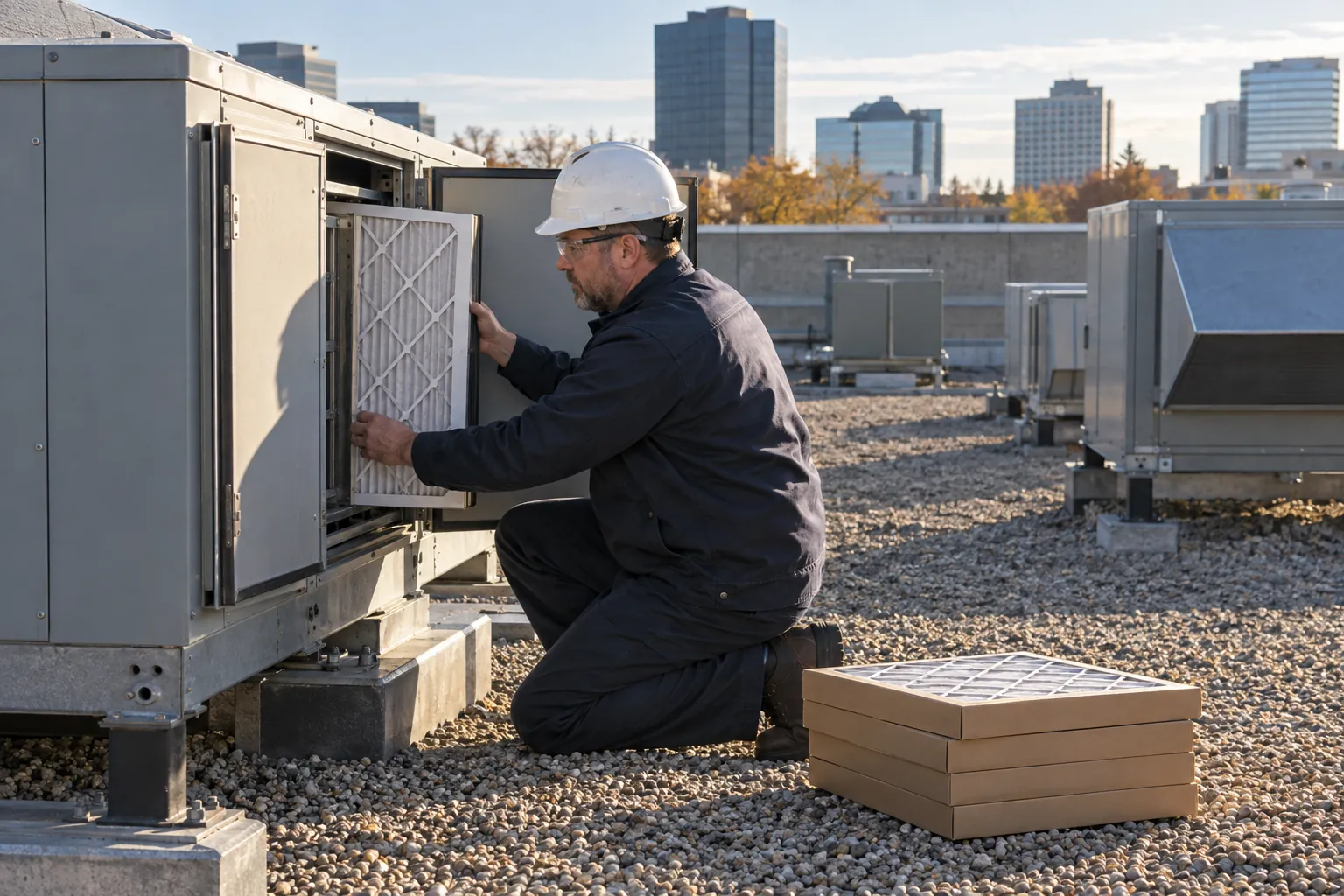
Filters are the cheapest part of the system and the easiest to forget. In a federally regulated workplace, a written report of each maintenance operation on the HVAC system is a legal requirement, kept for at least five years. In British Columbia, replacing filters is named in the preventive maintenance program the regulation requires. Everywhere else, the log is how a building operator shows the program is real when an occupant complains about the air. This guide covers what the rules say, what to record, how often, who does it, and how the log is checked.
01
What the rules require: federal, provincial and the general duty
No Canadian law is called the filter change log rule. The duty comes from workplace health and safety law on ventilation and indoor air quality, and it differs by jurisdiction. Most workplaces are regulated by their province or territory; federal law applies only to federally regulated work, such as banks, airports, telecommunications and interprovincial transport.
Federally regulated workplaces. Part II, Division III of the Canada Occupational Health and Safety Regulations (SOR/86-304) deals with HVAC systems. Its section 2.20 applies sections 2.21 to 2.24 to "every work place that is equipped with an HVAC system and that is under the employer's control". An HVAC system is defined as "a heating, ventilating and air conditioning system that is installed in a building, and includes all of its equipment and components", so the filters are part of it. Section 2.24 sets out two duties that together amount to a filter change log:
- Written instructions. The employer "shall appoint a qualified person to set out, in writing, instructions for the operation, inspection, testing, cleaning and maintenance of an HVAC system". The instructions must "specify the nature and frequency of inspections, testing, cleaning and maintenance", be readily available, and be reviewed at least every five years, and sooner when the system is modified under section 2.22 for a change in occupancy or use, when the ASHRAE standard it must meet is amended, or when an air quality investigation finds a hazard.
- A written report of each operation. The employer "shall appoint a qualified person or persons to implement the instructions and make a report, in writing, of each inspection, testing, cleaning and maintenance operation" (section 2.24 (4)). The report is kept readily available "for a period of at least five years" and must "specify the date and type of work performed, and the identity of the person who performed it", identify the components involved, and "record test results, any deficiencies observed and the actions taken to correct them" (section 2.24 (5)).
A filter change is a maintenance operation on a component of the system, so each one needs a written report with those details. Section 2.25 adds that the people doing the work must be instructed and trained in the procedures, and section 2.27 requires a procedure for investigating air quality concerns that includes "a review of the maintenance schedule for the HVAC system".
British Columbia. Part 4 of the WorkSafeBC Occupational Health and Safety Regulation covers indoor air quality in sections 4.70 to 4.80. Section 4.78 requires the employer, "or if the employer is not responsible for maintenance of the ventilation system, the owner of the ventilation system", to "establish an effective preventive maintenance program for the ventilation system". The program must include regular inspections of critical components "such as dampers, fans, belts, baffles, ductwork, diffusers and control systems", correction of deficiencies found, and "repair or replacement of malfunctioning and consumable components, such as filters and belts". The regulation does not prescribe a log format, but a program you cannot show on paper or screen is hard to call effective.
Everywhere else. The Canadian Centre for Occupational Health and Safety (CCOHS) puts it plainly in CCOHS OSH Answers: Indoor Air Quality – General: "Many Canadian jurisdictions do not have specific legislation that deals with indoor air quality issues in non-industrial workplaces. In the absence of such legislation, the 'general duty clause' applies." The same page advises that the ventilation system be inspected to make sure "filtration systems are working".
02
What a filter change log records
The federal list in section 2.24 (5) is a good template for any building, federal or not: date, type of work, who did it, which component, results, deficiencies and what was done about them. For filters, that becomes one line per filter bank per change:
- The unit. The equipment tag of the air handling unit, rooftop unit, fan coil or make-up air unit, and where it is: roof, penthouse mechanical room, ceiling space above a named room.
- The filter position. Pre-filter, final filter, return air grille or outdoor air intake, so a two-stage unit is not recorded as done when only the pre-filters were changed.
- What went in. Size, type and rating, and the quantity. If the specification changes, the log shows when.
- Date and time, and the name of the person who did it, not the company alone.
- The condition of what came out. Light, normal or heavy loading; wet, torn, collapsed, bypassing at the frame; any growth or odour.
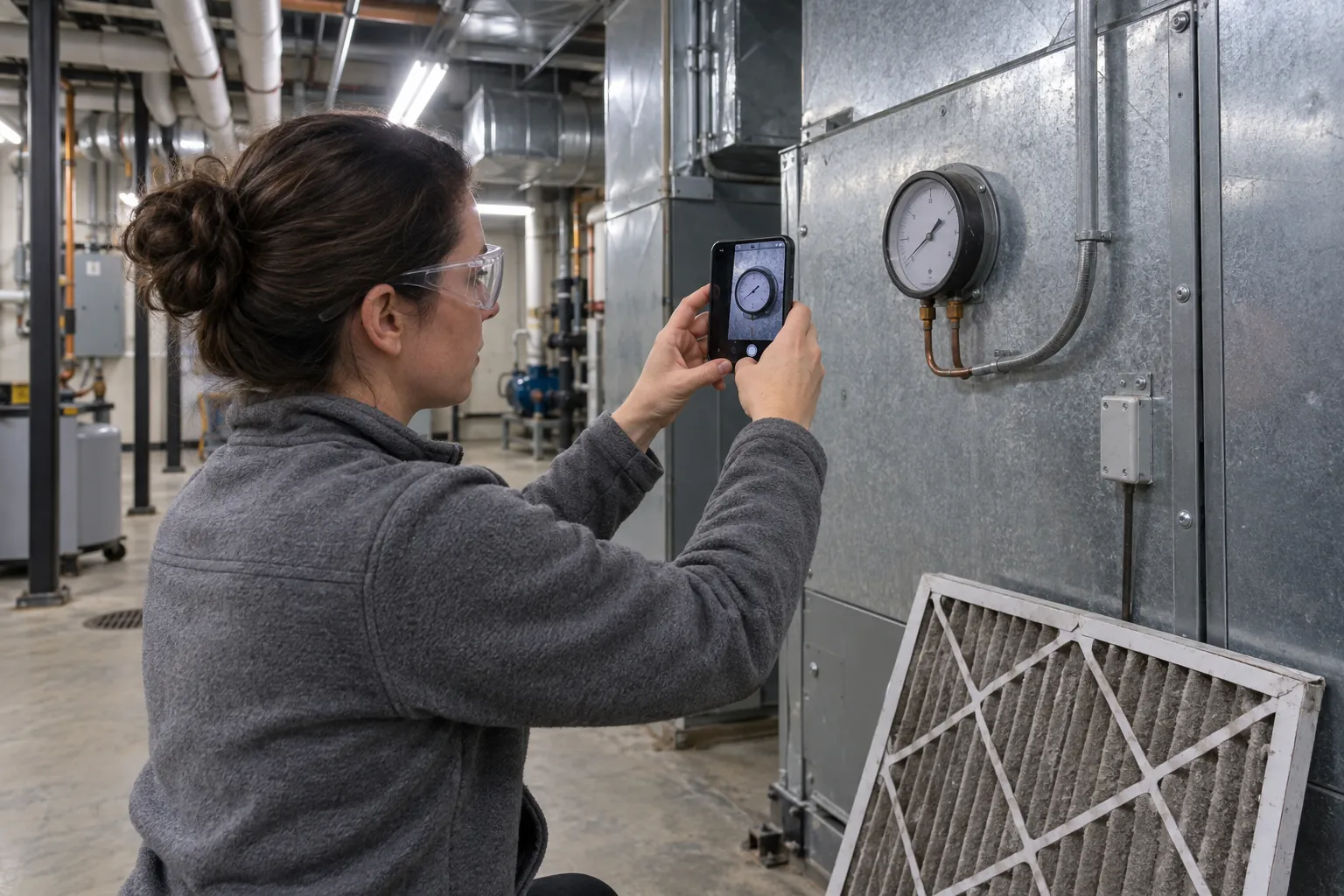
- The differential pressure reading, before and after, where the unit has a gauge across the filter bank. It is the one number that shows the change was needed and done.
- Anything else found. A loose belt, a blocked condensate drain, a missing access panel screw, water in the drain pan, a damper stuck shut. Each is a deficiency with an action and a name.
- The next change due, by date or by pressure reading.
Record the whole bank, not a tick for the building. A building with forty rooftop units and a note reading "filters changed, March" has told nobody which units were done, and when a tenant on the third floor complains about stuffy air, the first question is when the unit serving that floor was last changed.
03
How often to change filters
There is no single right interval, and no Canadian regulation sets one for ordinary buildings. The federal regulation leaves the frequency to the qualified person's written instructions, and the BC regulation asks for replacement of consumable components as part of an effective program. In practice the interval comes from four things:
- The equipment manufacturer's instructions, which usually give a change interval or a final pressure drop at which the filter is replaced.
- The differential pressure across the bank. Where a gauge is fitted, the filter is changed when the reading reaches the change-out point in the instructions, whatever the calendar says. Condition-based changes avoid throwing away clean filters and running dirty ones.
- The building and the season. A downtown office next to construction, a school gym, a unit drawing outdoor air beside a loading dock, or a spring of heavy pollen will load filters faster than the average. After a wildfire smoke event, check the gauges and the filters rather than waiting for the next scheduled date.
- The contract or standard. If the maintenance contract calls up ASHRAE Standard 180 or a client's specification, it sets the minimum.
Write the interval for each unit into the instructions and the log, so the schedule and the record agree. Many buildings mix fixed intervals for small units without gauges, pressure-based changes for larger air handlers, and a monthly look at every gauge in between, with extra checks before the cooling and heating seasons.
When you change the filter specification, for example to a higher rating to improve particle removal, ask the qualified person whether the fan can handle the extra resistance. ASHRAE Standard 52.2-2025, Method of Testing General Ventilation Air-Cleaning Devices for Removal Efficiency by Particle Size, is the test method behind the ratings printed on many filters. Record the change and the reason in the log, and have the qualified person update the written instructions so the filter specification they give matches what is fitted. Section 2.24 (2) of the federal regulation requires the instructions to be reviewed at least every five years and when the system is modified under section 2.22 for a change in occupancy or use.
04
Who changes the filters, and who signs
The law names roles rather than job titles. Federally, the employer appoints a "qualified person", defined as someone who "because of his knowledge, training and experience, is qualified to perform that duty safely and properly", both to write the instructions and to implement them. In British Columbia, the duty falls on the employer or, where the employer is not responsible for maintaining the ventilation system, its owner. In a multi-tenant office tower, that usually means the landlord's property manager and building operators, not the tenant.
In most commercial buildings the work is shared out like this:
- The property manager or facility manager owns the program: the instructions, the schedule, the contract with the mechanical contractor and the log. They answer when a tenant or a health and safety representative asks about the air.
- The building operator or superintendent reads the gauges, changes simple filters where the instructions allow, and records what was found.
- The mechanical contractor changes filters on larger or harder-to-reach equipment, often on a preventive maintenance visit, and leaves a service report.
- The janitorial or custodial team should not open air handlers. They can, and often do, notice a return grille furred with dust, a musty smell from a diffuser or water dripping from a ceiling unit, and should have a clear way to report it.
Filter work has its own hazards: ladders and fall protection on roofs and in ceiling spaces, fans isolated and locked out before a panel is opened, and dust shed by loaded filters. The written procedure should cover them, and training should come before the first change, as section 2.25 of the federal regulation requires.
05
What a believable log looks like, and how it is checked
A log is believable when each entry was obviously made at the unit, at the time, by the person who did the work. The signs are simple:
- entries at different times on different days, not a month of lines in one hand and one pen;
- the unit tag written as it appears on the equipment, not "AHU" for a building with six;
- pressure readings that move: high before, low after, rising over the weeks between;
- condition notes that vary, because filters do;
- deficiencies with an action and a closing date, not a note that says "see contractor";
- the date written on the frame of the new filter, matching the log, so the next person opening the unit can check both;
- a photograph of the gauge or the filter bank where the program asks for one, taken at the unit.
The checks that catch a weak log take an afternoon. Pick three units at random and open them. Does the date on the frame match the log, and the gauge roughly match the last reading? Are the filters the specified size and rating, sitting tight with no gaps for air to bypass? Does a contractor's visit invoiced for forty units match forty entries?
In British Columbia, an air quality investigation under section 4.79 must include "inspection of the ventilation system as required in section 4.78(2)" and "a record of the complaint, the findings of the investigation, and any actions taken". The filter log is the first thing that investigation will want to see.
06
Where filter logs fail, and what SiteClara does about it
Filter logs fail in familiar ways. The sheet inside the mechanical room door is filled in for the whole quarter on the day the contractor's invoice arrives. The log says every rooftop unit was done in April, but nobody went up to the three over the new wing. The musty smell a custodian noticed was mentioned to whoever was passing.
SiteClara records work at the location. A printed QR poster, with an optional NFC tag behind it, sits at each place where a check is scheduled, such as the door of a mechanical room, the roof hatch or the access panel of an air handler. The building operator or contractor scans or taps with their own phone, with no app to install, and marks the check done at that place, with a photo when one is asked for, such as of the pressure gauge after the change. The time, the place and the named person are recorded automatically, so the entry is made at the unit rather than written up later. If something stopped the check, such as a roof closed by ice or a locked penthouse, they say so, and the reason is recorded against that check.
Anyone on the team, including the custodians, can report a problem at a location, such as a dusty return grille or water dripping from a ceiling unit, with a photo, and it stays on the team's list of jobs until someone closes it. Checks can be scheduled, such as a monthly look at every unit's gauge, and a missed one shows as missed. The supervisor adds a note and approves a daily report that goes to nominated management or client contacts the next morning, showing what was checked, what was reported and what is still open.
07
Where to read more, and a list to take away
For federally regulated workplaces, read sections 2.20 to 2.27 of the Canada Occupational Health and Safety Regulations. In British Columbia, read sections 4.70 to 4.80 of the Occupational Health and Safety Regulation, Part 4. Elsewhere, start with your province's occupational health and safety act and regulations and CCOHS OSH Answers: Indoor Air Quality – General. For the practice itself, ASHRAE's read-only standards page lists Standard 180-2018 for inspection and maintenance, Standard 52.2-2025 for filter testing and Standard 62.1-2025, Ventilation and Acceptable Indoor Air Quality.
Before the next season turns, check that:
- you know which law applies to the building: federal, your province, or the general duty alone;
- a qualified person has written the instructions, with the filter type, size, rating and change interval or pressure for each unit;
- every air handling unit, rooftop unit and fan coil is on the list, with its tag and its location;
- each change is recorded with the date, the person, the unit, the condition of the old filter and, where fitted, the pressure before and after;
- deficiencies found while the unit is open are recorded with an action and a closing date;
- custodians and tenants have a clear way to report a smell, dust or a drip, and those reports reach the operator;
- the new filter frames are dated, and a spot check of three units matches the log;
- the records are kept for as long as the law and your contract require: at least five years for a federal report.
Sources
Every document this guide quotes or links to, in the order it first cites them.
- Canada Occupational Health and Safety Regulations (SOR/86-304) laws-lois.justice.gc.ca
- Section 2.20 laws-lois.justice.gc.ca
- WorkSafeBC Occupational Health and Safety Regulation worksafebc.com
- CCOHS OSH Answers: Indoor Air Quality – General ccohs.ca
- ASHRAE's list of read-only standards ashrae.org
Related guides
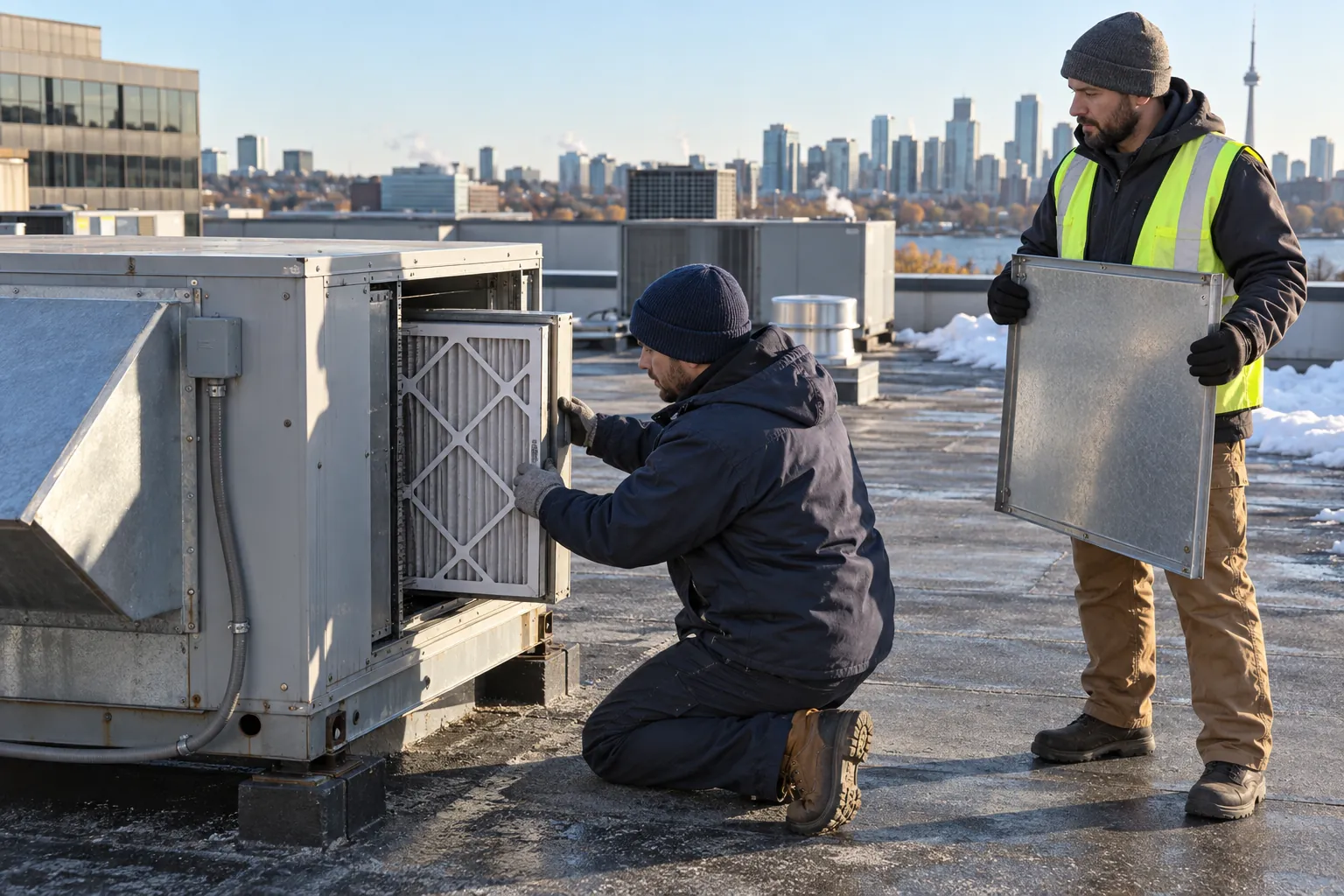 Premises and facilities managementPreventive maintenance checklist: what to include, how often, and how to show it was doneA preventive maintenance checklist for Canadian buildings: what the fire code and provincial law require, what to include, how often, and the records to keep.
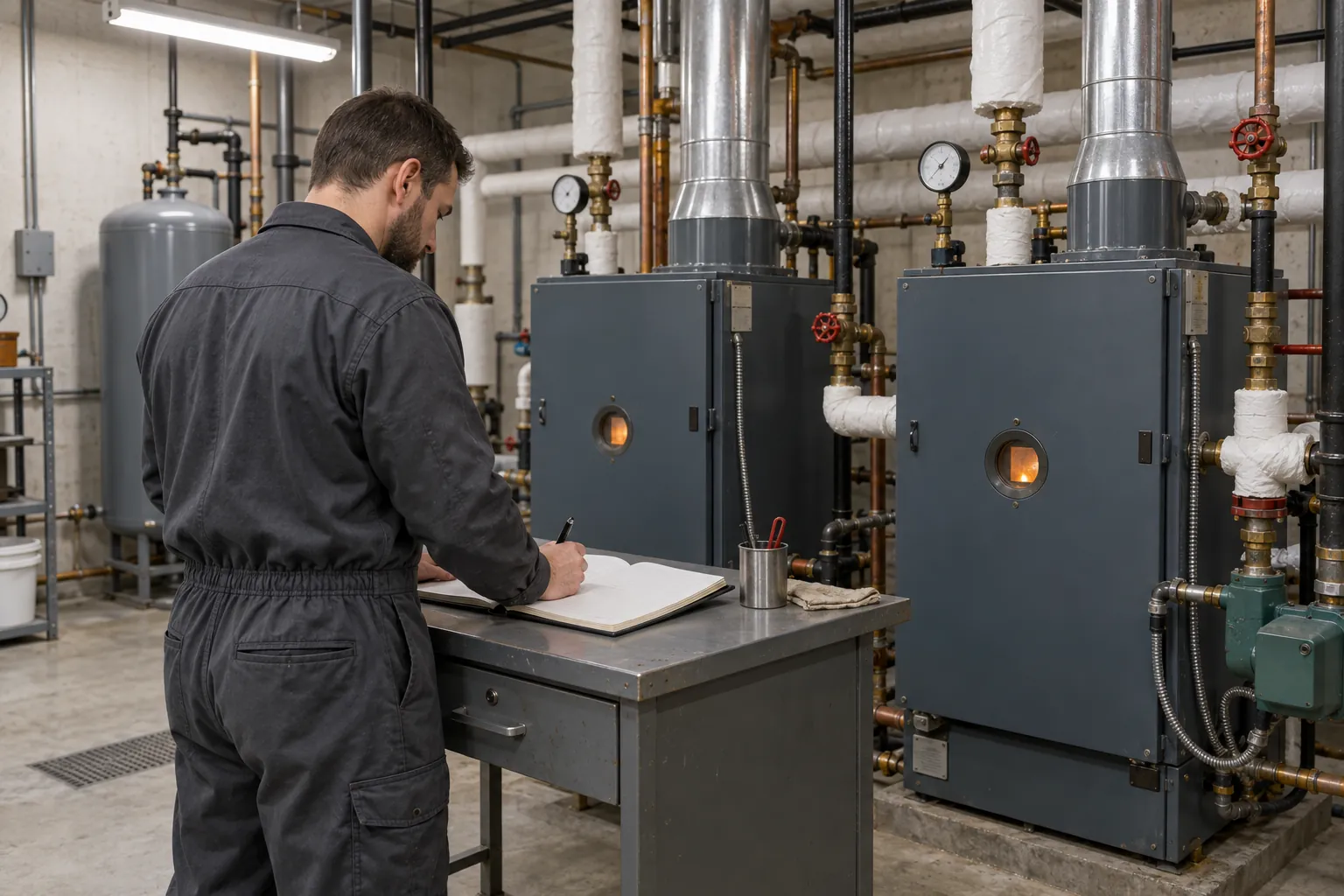 Premises and facilities managementBoiler log: what the law requires, and what a useful one recordsWhat a boiler log must record in an Ontario registered plant, what to log when no statute requires one, how inspections and relief valve tests fit in, and who signs.
 Premises and facilities managementBuilding maintenance checklist: what to check, how often, and who does itA building maintenance checklist for Canadian buildings: daily to annual tasks, the property standards bylaws and fire code behind them, and who does each.
 Fire and water checksCooling tower requirements in Canada: maintenance, Legionella testing and the registerCooling tower maintenance in Canada: Quebec's RBQ rules, the Vancouver and Hamilton by-laws, Legionella sampling, what each result demands and the records to keep.