Premises and facilities management
Building superintendent duties: what the super does, and how to show it was done
A building superintendent, or super, keeps a residential building running day to day for its owner: the heat and water, cleaning the common areas, garbage and recycling, minor repairs and tenants' requests, fire safety rounds, snow and ice, and security.
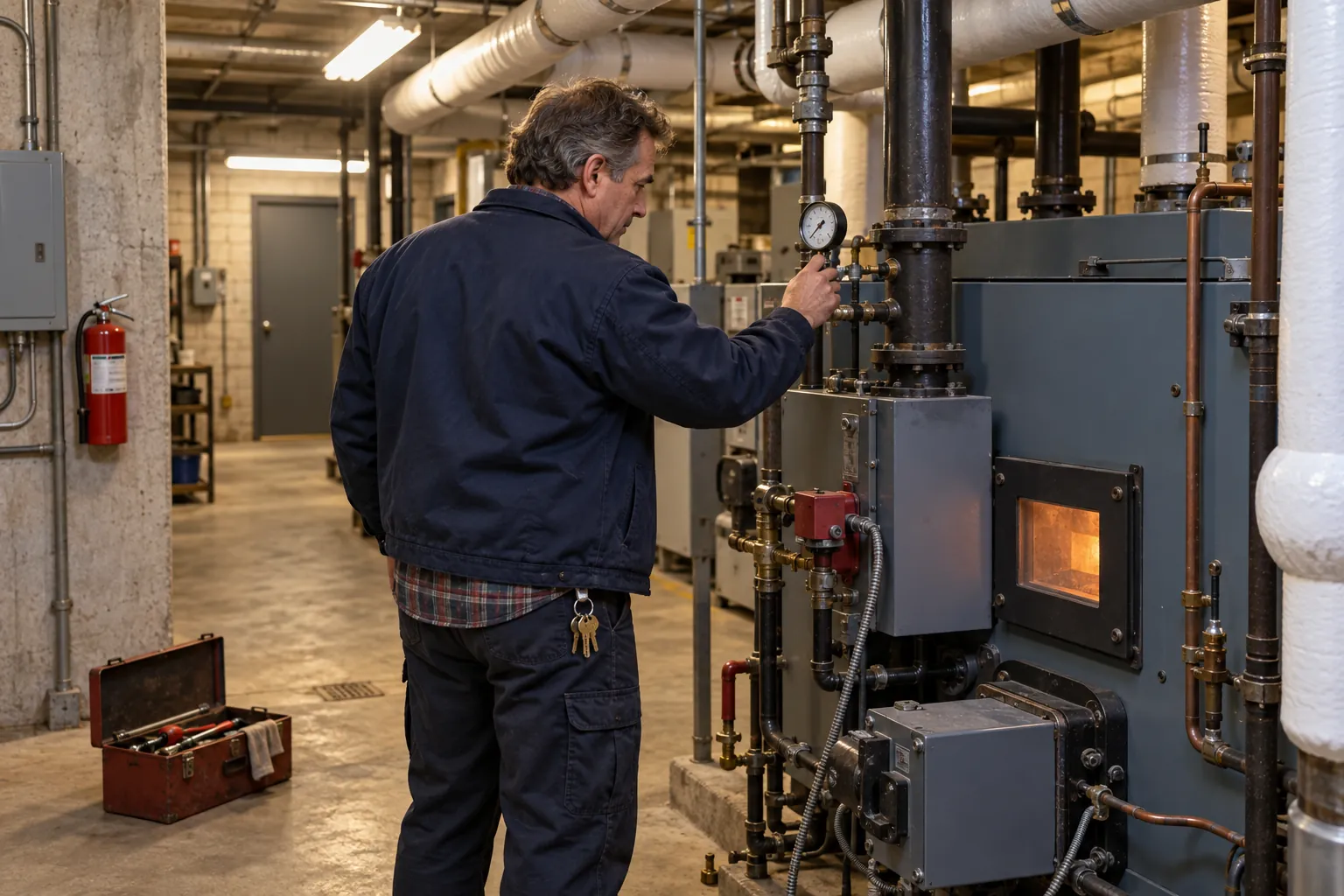
The super is the person tenants call when the heat goes off, the garbage room overflows or a door will not lock. Most of the super's work carries out duties the law places on the landlord or owner, and in Canada those duties are provincial and sometimes municipal. This guide covers what the role is, the Ontario rules that shape it (with British Columbia for comparison), the daily, weekly and seasonal routine, entry to units and working alone, and what a good record of the work looks like.
01
What a building superintendent is, and whose duties the job carries out
A building superintendent looks after a residential building day to day on behalf of its owner. The title varies: superintendent or super in Ontario, resident manager, building operator, custodian, and caretaker in British Columbia and in some school boards. Many supers live in the building in a unit that comes with the job; others work for a property management company and cover several buildings (see property manager duties). In a condominium the same work is done for the condominium corporation, usually under a condominium manager.
The national occupational classification places the job in NOC 2021 unit group 73201, General building maintenance workers and building superintendents. In a large establishment the superintendent is responsible for the operation of the building and may supervise other workers. Secondary school education is usually required, previous maintenance experience may be, and a building superintendent may need a certificate in one or more of the trades or a building operator certificate.
Ontario's Residential Tenancies Act, 2006 recognizes the role directly. It defines a superintendent's premises as "a rental unit used by a person employed as a janitor, manager, security guard or superintendent and located in the residential complex with respect to which the person is so employed". Under section 93, unless otherwise agreed, the tenancy of those premises ends on the day the employment ends, and the former super must vacate within one week, with no rent charged for that week.
Most of the legal duties a super performs belong to someone else. In Ontario they are chiefly:
- the landlord's duties under the Residential Tenancies Act, 2006: to keep the residential complex "in a good state of repair and fit for habitation" (section 20), not to withhold vital services (section 21), and to enter units only as sections 26 and 27 allow;
- the maintenance standards in O. Reg. 517/06 (Maintenance Standards), or the municipality's own property standards bylaw where one applies;
- the owner's duties under the Ontario Fire Code (O. Reg. 213/07), which says in Division A that "the owner is responsible for carrying out the provisions of this Code" (Article 1.2.1.1.), unless the Code says otherwise;
- the employer's duties to the super as a worker under the Occupational Health and Safety Act.
The Act also names the super personally: a tenant can apply to the Landlord and Tenant Board for an order that "the landlord, superintendent or agent of the landlord" withheld a vital service, harassed the tenant or entered the unit illegally, among other things (section 29).
02
Building superintendent duties and responsibilities, listed
Job descriptions differ, but the core duties are consistent:
- Heat, water and the other vital services: watching the boiler or heating plant, responding to no-heat and no-water calls, and knowing where the shut-offs are and whom to call when a system fails.
- Cleaning the common areas: lobbies, vestibules, corridors, stairwells, laundry rooms, the parking garage and the garbage room, on a set schedule, with spills and messes dealt with as they happen.
- Garbage and recycling: keeping the garbage room, chutes and bins clean (see garbage room cleaning), moving containers out for collection on the right day and back again, and dealing with bulky items left behind.
- Repairs and maintenance requests: taking tenants' requests, fixing what they are trained and allowed to fix, such as a dripping faucet, a sticking door or a burned-out light, and booking contractors for the rest.
- Fire safety: keeping exits and corridors clear, making sure doors in fire separations close and latch, watching exit signs and emergency lighting, and doing whatever the fire safety plan assigns to supervisory staff.
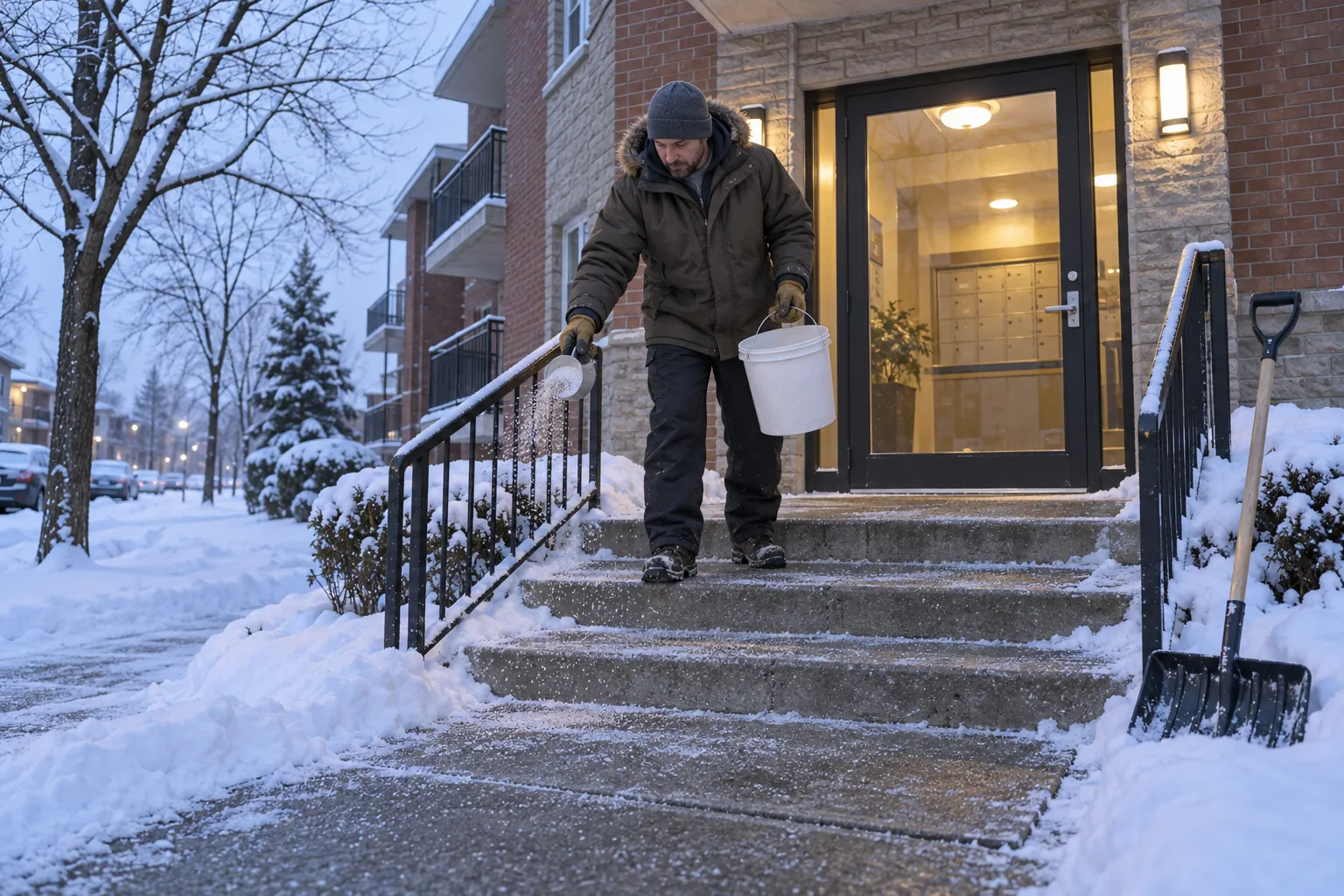
- Snow, ice and grounds: clearing and salting walkways, entrances, steps and ramps, keeping mailboxes and fire hydrants clear, and keeping a snow removal log; grass, litter and graffiti in summer.
- Security and access: checking entry doors, intercoms and the garage door, and managing keys and fobs.
- Move-ins and move-outs: booking and padding the elevator, preparing vacant units, and testing smoke alarms at each change of tenancy.
- Contractors: letting contractors in, and checking the work was completed safely and as ordered before signing for it.
What a super should not do matters as much. Gas work, electrical work beyond changing a bulb, work on the fire alarm or sprinkler system, and elevator repairs belong to licensed or certified contractors, and a good job description says so.
03
The standards that shape the routine
Much of a super's week follows from a handful of written standards. Ontario's provincial maintenance standards apply where there is no municipal property standards bylaw covering the building (section 224 of the Residential Tenancies Act); most larger cities have their own bylaw, so check which applies to yours. The provincial standards in O. Reg. 517/06 show what is expected:
- Heat: heat must be maintained so that the room temperature "is at least 20 degrees Celsius" in habitable space and areas tenants normally use, measured 1.5 metres above the floor and one metre from exterior walls (section 15). The general regulation, O. Reg. 516/06, makes heat a vital service from September 1 to June 15.
- Common areas: "All interior common areas and exterior common areas shall be kept clean and free of hazards" (section 44), and interior common areas include "laundry rooms, garbage rooms, corridors, lobbies, vestibules, boiler rooms, parking garages, storage areas and recreation rooms".
- Garbage: containers or compactors must be maintained "in a clean and sanitary condition", be accessible to tenants and not obstruct an emergency route, driveway or walkway (section 45).
- Pests: the complex must be kept "reasonably free of rodents, vermin and insects", and openings sealed or screened (section 46).
- Outside: unsafe accumulations of ice and snow must be removed from exterior common areas (section 26), driveways, ramps, walkways and outside stairs kept to "a safe surface for normal use" (section 28), and mailboxes and their approaches kept free of snow (section 33).
- Elevators: "properly maintained and kept in operation" apart from reasonable repair time (section 43).
Toronto adds its own layer. RentSafeTO: Apartment Building Standards covers apartment buildings "with three or more storeys and ten or more units". The city's RentSafeTO: Building Owners Requirements include a cleaning plan listing the common areas and how often each is cleaned, a pest management record and a vital service disruption plan. Its page on Service Requests Response Times sets a response to urgent requests within 24 hours and non-urgent ones within seven days, with records of requests and responses kept for 24 months. The super is usually the person who makes those plans and records true.
British Columbia is similar in outline. Section 32 of the Residential Tenancy Act requires residential property to comply with health, safety and housing standards, and section 33 requires the landlord to post in a conspicuous place, or give tenants in writing, the name and telephone number of the person to contact for emergency repairs. Often that person is the resident caretaker.
04
Fire safety, entering units, and working alone
In Ontario a fire safety plan is required in buildings containing a residential occupancy where the occupant load exceeds 10 (Fire Code, Division B, Article 2.8.1.1.). The plan must "provide for the appointment and organization of supervisory staff to carry out fire safety duties" and for their training (Article 2.8.2.1.). The Code defines supervisory staff as "those occupants of a building who have some delegated responsibility for the fire safety of other occupants under the fire safety plan", and in an apartment building the super is usually one of them. Supervisory staff must be instructed in the fire emergency procedures before taking on any responsibility, and be available on notification of a fire emergency (Article 2.8.1.2.).
The Fire Code's everyday rules are the super's rounds: a door in a fire separation "shall be kept closed when not in use" (Article 2.2.3.4.), exit signs must be "clearly visible and maintained in a clean and legible condition" (Article 2.7.3.1.), and in rental suites "the landlord shall test smoke alarms annually and after every change in tenancy", and after a battery is replaced (Article 6.3.3.8.). Where the Code requires tests or operational procedures, records must note "what was done and the date and time it was done" (Article 1.1.2.1.), and be kept at the building for at least two years (Article 1.1.2.2.). The fire alarm system itself is inspected and tested by a qualified technician under CAN/ULC-S536; see fire alarm testing.
Entering a unit. Under the Residential Tenancies Act, 2006, the landlord, and so the super, may enter without written notice in an emergency or with the tenant's consent at the time (section 26). For a repair, an inspection or another reason listed in section 27, the tenant must get written notice at least 24 hours ahead that specifies "the reason for entry, the day of entry and a time of entry between the hours of 8 a.m. and 8 p.m." A written note of each entry answers a later complaint.
Working alone. Supers are often the only staff member in the building, early, late and on weekends. Ontario's Occupational Health and Safety Act requires the employer to "take every precaution reasonable in the circumstances for the protection of a worker" (section 25), and requires the worker to report defective equipment and known hazards to the employer or supervisor (section 28). The Canadian Centre for Occupational Health and Safety's guidance on working alone recommends defining when the lone worker checks in and how often, naming a contact and a backup, and an emergency plan "if the lone worker does not check in when they are supposed to". Some provinces have specific working alone rules.
In an industrial establishment, which the Act defines to include an office building or shop, such as the commercial floors of a mixed-use building, Regulation 851 (Industrial Establishments) adds rules such as a sound, firmly footed portable ladder (section 73) and cleaning or repairing a machine only when it is stopped (section 75).
05
Hours, pay rules and what a good record shows
Living in the building changes the employment rules. In Ontario, O. Reg. 285/01 under the Employment Standards Act, 2000 exempts "a person who is employed as the superintendent, janitor or caretaker of a residential building and resides in the building" from the hours of work limits in sections 17 to 19 of the Act, the three-hour rule, minimum wage, overtime pay and public holidays (sections 4, 4.1, 7, 8 and 9 of the regulation). None of this changes what the building needs; it makes a clear agreement on hours, call-outs and days off more important, not less.
British Columbia's Employment Standards Regulation defines a resident caretaker as a person who lives in an apartment building with more than 8 residential suites and is employed as its "caretaker, custodian, janitor or manager". It sets a separate monthly minimum wage, rising with the number of suites up to 60 and a flat monthly amount from 61 (section 17), and requires the employer to display in the building a schedule of the caretaker's hours of work and days off, and give the caretaker a copy (section 35). Other provinces have their own rules.
Whatever the province, when something goes wrong a super's work is judged by a tribunal, a fire inspector or a property standards officer. A good record shows:
- that the routine work was done: common areas cleaned, garbage handled, rounds of exits and fire doors walked, walkways cleared, with the date, time and person;
- what was found on each round, and what was done about it;
- each tenant request: when it came in, where, what it was, whether it was urgent, and when and how it was closed;
- each entry to a unit, with the notice given or the emergency that justified it;
- each vital service disruption: when it started, who was told, and when it was restored.
With that record, the super can show a tenant or an inspector that the building was looked after, rather than relying on memory.
06
Where the record fails, and what SiteClara does about it
Supers are usually reliable and badly recorded. The cleaning schedule is taped inside the janitor's closet and signed at the end of the week. A tenant mentions a leak to the super in the elevator, and it lives in the super's head until it becomes a ceiling stain two floors down. When a tenant tells the Board the heat complaint was ignored, there is little to show either way.
SiteClara puts a printed QR poster at each location, such as the lobby, the garbage room, the laundry room, a stairwell, the boiler room or the garage ramp, with an optional NFC tag behind it. The super, or a contractor's staff, scans the code or taps the tag on their own phone, with no app to install, sees the checks due there, and marks each one done or explains what stopped them, with a photo when one is asked for. A problem found or reported at the poster goes onto the team's list of jobs until someone closes it.
A supervisor, such as the property manager or the super responsible for several buildings, sees what is due, done and missed, grouped by building and floor, and can escalate a job to the building manager, who can answer it. Each day the supervisor approves a short report, which goes to nominated contacts such as the owner or the property manager the next morning, showing what was reported, what was completed, what is still open and how the scheduled checks went, with the reason where one was missed.
07
Questions people ask
What are the typical responsibilities of a building superintendent?
The federal NOC 2021 profile for unit group 73201, General building maintenance workers and building superintendents, lists duties that people in the group do some or all of: adjustments and minor repairs to heating, cooling, ventilating, plumbing and electrical systems, with tradespersons called in for major repairs; routine maintenance such as painting and drywall repair; responding to residents' requests for minor repairs; daily inspections of the building systems; coordinating the preparation of units before new residents arrive; and making sure security and safety measures are in place. They may also advertise vacancies, show apartments to prospective tenants, collect rent, process lease or rental applications and supervise other workers.
What are the requirements to become a building superintendent?
The NOC 2021 profile for unit group 73201 says secondary school education is usually required and previous maintenance experience may be. A journeyperson's certificate in one or more of the trades, or a building operator certificate, may be required for building superintendents. Employers add their own requirements, and a super who lives in the building should know that, unless otherwise agreed, the tenancy of the unit ends with the job under section 93 of Ontario's Residential Tenancies Act, 2006.
What is the average salary for a building superintendent in Toronto?
Job Bank's wage report for building superintendents in Ontario gives a median of $24.00 an hour in the Toronto region, with a low of $17.60 and a high of $40.00, from Statistics Canada's Labour Force Survey for 2023–2024. The Ontario median is also $24.00. A super who lives in the building is exempt from the minimum wage and overtime rules under O. Reg. 285/01, so the employment agreement matters more than the averages.
08
Where to read more, and a list to take away
In Ontario, start with the Residential Tenancies Act, 2006, O. Reg. 517/06 (Maintenance Standards) and O. Reg. 516/06, the Ontario Fire Code, the Occupational Health and Safety Act, and O. Reg. 285/01 for the employment standards exemptions. In Toronto, read RentSafeTO: Apartment Building Standards, and elsewhere your municipality's property standards bylaw. In British Columbia, read the Residential Tenancy Act and the Employment Standards Regulation. CCOHS's working alone guidance applies everywhere.
If you are hiring a super, or starting as one, check that you know:
- who your employer is, and whether you are the landlord's employee or a management company's;
- whether you live in the building, and what that means for your hours and pay;
- the cleaning plan for each common area you look after;
- what the fire safety plan asks of you as supervisory staff, and where the keys and fire alarm instructions are kept;
- how tenants make a maintenance request, how urgent ones reach you out of hours, and how each is closed;
- the notice rules for entering a unit, and how you record each entry;
- which repairs you may do yourself, and which go to a licensed contractor;
- your working alone arrangements, and who expects to hear from you.
Sources
Every document this guide quotes or links to, in the order it first cites them.
- NOC 2021 unit group 73201, General building maintenance workers and building superintendents noc.esdc.gc.ca
- Residential Tenancies Act, 2006 ontario.ca
- O. Reg. 517/06 (Maintenance Standards) ontario.ca
- Ontario Fire Code (O. Reg. 213/07) ontario.ca
- Occupational Health and Safety Act ontario.ca
- O. Reg. 516/06 ontario.ca
- RentSafeTO: Apartment Building Standards toronto.ca
- RentSafeTO: Building Owners Requirements toronto.ca
- Service Requests Response Times toronto.ca
- Residential Tenancy Act bclaws.gov.bc.ca
- Working alone ccohs.ca
- Regulation 851 (Industrial Establishments) ontario.ca
- O. Reg. 285/01 ontario.ca
- Employment Standards Regulation bclaws.gov.bc.ca
- Job Bank's wage report for building superintendents in Ontario jobbank.gc.ca
Related guides
 Premises and facilities managementProperty manager duties in Canada: licensing, legal duties and the daily recordWhat a property manager does in Canada: provincial licensing, the owner's duties under occupiers', tenancy and fire law, the daily work and the records.
 Premises and facilities managementCondo manager duties: the licence, the code and the recordWhat a condo manager does in Canada: licensing in Ontario, BC and Alberta, the code of ethics, the management contract, site oversight and the records to keep.
 Premises and facilities managementBuilding maintenance checklist: what to check, how often, and who does itA building maintenance checklist for Canadian buildings: daily to annual tasks, the property standards bylaws and fire code behind them, and who does each.
 Premises and facilities managementMaintenance request forms: what to capture, how fast to answer, and what to keepWhat a maintenance request form should capture, how requests are prioritized and closed, and what Ontario, Toronto and BC rules say about repairs and records.