Premises and facilities management
Generator testing: what CSA C282 and the fire code require, and how to show it was done
Generator testing is the regular inspection and test run under load that shows a building's emergency backup generator will start, take the load and keep the fire pump, the elevators and the exit lights running when the power fails.
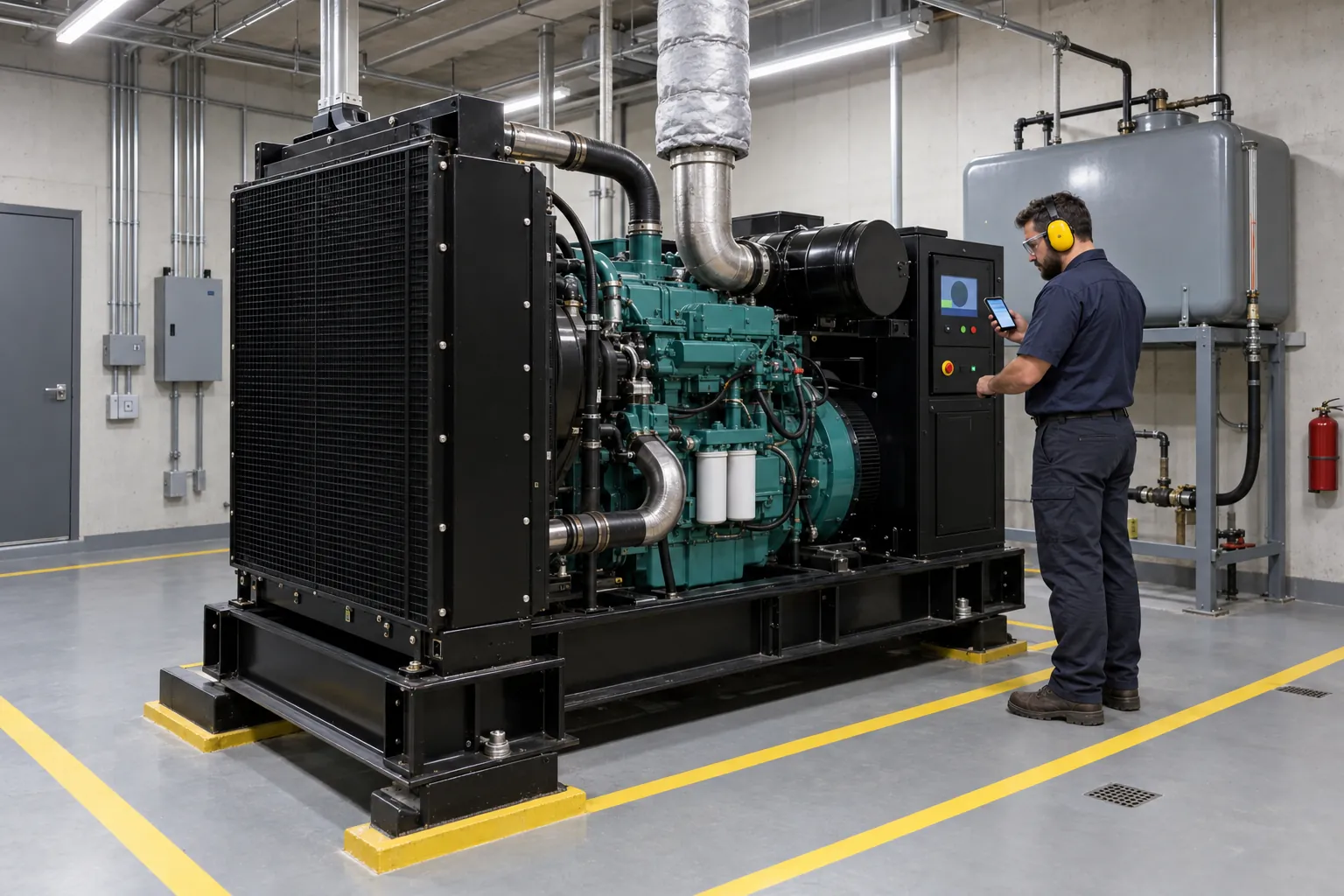
It is the one piece of plant nobody thinks about until that moment. This guide explains what the National Fire Code of Canada, the Ontario Fire Code and CSA C282 require of a building's emergency generator, what is checked weekly, monthly and yearly, what to do when the set is shut down, and what a good generator record looks like.
01
The duty: the fire code and CSA C282
Where the building code requires a building to have an emergency power supply, it is usually provided by a diesel or natural gas generator set with an automatic transfer switch (ATS). Once the building is occupied, the duty to keep it working sits in the fire code, which hands the detail to a Canadian standard: CSA C282, Emergency electrical power supply for buildings.
Each province and territory adopts its own fire code, most of them based on the National Fire Code of Canada 2025, a model code developed by the Canadian Board for Harmonized Construction Codes. The National Research Council's own advice is to contact the appropriate provincial or territorial official to learn which codes apply where you are. Alberta, for example, enforces the National Fire Code – 2023 Alberta Edition.
Ontario's rule is typical. The Ontario Fire Code, O. Reg. 213/07, Division B, Sentence 6.7.1.1.(1), says that, with stated exceptions, "emergency power systems shall be inspected, tested and maintained in conformance with CSA-C282, Emergency Electrical Power Supply for Buildings." Sentence (2) sets a different standard for hospitals: an emergency power supply for emergency equipment there "shall be inspected, tested and maintained in conformance with CSA-Z32, Electrical Safety and Essential Electrical Systems in Health Care Facilities." The code's table of referenced documents names the 2015 edition of C282, so an Ontario building is inspected to C282-15 unless and until the code is amended.
CSA C282 itself is now in its eighth edition, CSA C282:24. CSA Group's published scope says it "applies to the design, installation, operation, maintenance, and testing of generator sets and associated equipment for providing an emergency electrical power supply" to electrical loads in buildings "when the normal power supply fails, and an emergency electrical power supply is required by the National Building Code of Canada". It does not cover emergency power from storage batteries or other sources of uninterrupted power supply (UPS), or the design and construction of unit equipment for emergency lighting.
02
What generator testing covers
Generator testing is not just starting the engine. A life safety generator is a system, and any part of it can stop the building getting power. A program for a typical Canadian office tower, apartment building, school or long-term care home looks at:
- The engine: oil, coolant, belts, hoses, air intake, and the block heater that keeps the engine warm enough to start on a January night.
- Starting batteries and the charger: a common reason a set fails to start.
- The fuel system: the day tank and main tank, fuel level, leaks, and the condition of stored diesel, which ages and picks up water.
- The automatic transfer switch: the switch that senses the loss of normal power, starts the set and moves the emergency loads across, and moves them back afterwards.
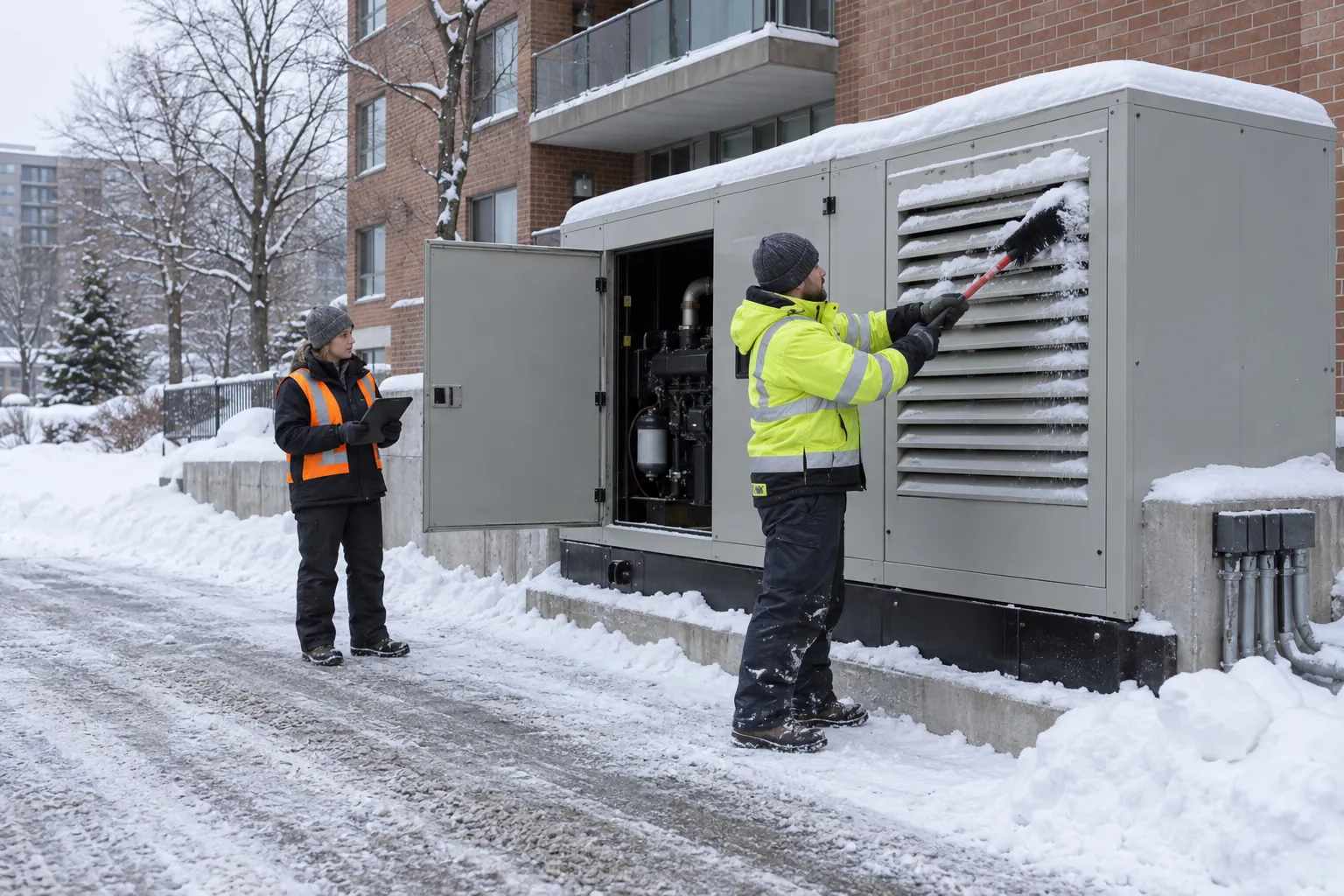
- Cooling, exhaust and ventilation: the radiator, the exhaust system and its supports, and the louvres or dampers that let the generator room breathe, which must open even when snow and ice are against them.
- Controls and alarms: the control panel, the selector left in the automatic position, and the remote annunciator in the fire alarm or security room.
- The room or enclosure: clear of storage, dry, lit, with its posted instructions in place.
- The loads it serves: the fire pump, elevators, emergency lighting and exit signs, the fire alarm system and smoke control, which is why a generator test is often done together with the fire and life safety contractor.
The Ontario Fire Code also requires that, where an emergency power system is installed, "instructions shall be provided for switching on essential loads and for starting the generator when this is not done automatically" (Article 6.7.1.2.). Those instructions belong in the generator room, where the person who has to follow them in the dark will find them.
In newer buildings the generator is also part of integrated testing. Section 6.10 of the Ontario Fire Code applies to integrated fire protection and life safety systems installed on or after 1 January 2020 that the Building Code requires to be verified under CAN/ULC-S1001, Standard for Integrated Systems Testing of Fire Protection and Life Safety Systems, and waives the one-year integrated test for a system installed before 1 January 2026.
03
How often: weekly, monthly and yearly
The frequencies and the items are set by the edition of C282 your fire code names, so the standard, not a generic checklist, is the authority. CSA Group's companion CSA C282 Logbook:19 shows the shape of the program: it "consists of tables for weekly, monthly, semi-annual and annual inspections, as well as tables for inspection scheduled every five years and for unscheduled maintenance." A building's program usually follows that pattern:
- Weekly: a walk-round inspection of the set, its room and its fuel: typically levels, leaks, the battery charger, the block heater, the control panel and alarms, and a check that the set is left ready to start automatically.
- Monthly: a test run under load, typically simulating a failure of normal power so that the transfer switch operates and the set carries the building's emergency loads. CSA's summary of the 2024 edition notes that the "minimum load required for monthly testing" was "corrected back to 30%" (Table 3), so a run with no load on the set is not the monthly test the standard describes.
- Semi-annual and annual: the deeper service and inspection, generally by the generator contractor. For the 2024 edition, CSA notes that "diesel fuel treatment and testing requirements for annual maintenance" were clarified (Table 5).
- Every five years: the longer-interval inspections the logbook provides for.
- Unscheduled: every fault, repair and real power failure, with what happened and what was done.
Two fuel rules sit in the Ontario Fire Code itself. "The amount of fuel stored and connected to the emergency power system shall be sufficient to operate the engine for at least 2 h" (Article 6.7.1.4.). And liquid fuel tanks "shall be drained and refilled with fresh fuel at intervals not greater than 12 months", a requirement that "may be achieved by replenishment as the result of the normal test program" (Article 6.7.1.5.).
04
Who does what, and what happens when the set is shut down
The owner is responsible for meeting the fire code, and in practice the work is shared. Often the weekly walk-round and the monthly run are done by the building's own people: the building operator, chief engineer or superintendent, trained on that set. The periodic service, load bank testing and repairs are done by a generator service contractor. Who may do which item is set by the standard and your authority having jurisdiction, so agree it in writing.
A generator taken out of service for repair is a gap in the building's fire protection, and the code treats it as one. Under Ontario Fire Code Sentence 6.7.1.1.(3), if an emergency power system or any part of it is shut down, the fire department and building occupants must be notified as the code requires, and "the supervisory staff shall be notified." The building's approved fire safety plan must already say what happens next: Sentence 2.8.2.1.(2) requires it to "provide for alternative measures to be provided for the safety of occupants during a shutdown of any or all fire protection equipment or systems", to "include documents and diagrams showing the type, location and operation of the building fire emergency systems", and to "provide for the maintenance of building facilities provided for the safety of occupants".
A workable division of duties looks like this:
- Owner or property manager: puts the service contract in place, makes sure the program follows the right edition of C282, keeps the records and the fire safety plan current, and authorizes shutdowns.
- Building operator or superintendent: does the weekly inspection and the monthly run, records what was found, reports defects the same day, and knows how to start the set and switch on essential loads by hand.
- Generator contractor: does the periodic service, fuel testing, load bank work and repairs, and leaves a written report with the deficiencies listed.
- Fire alarm and life safety contractors: confirm that the emergency loads transfer and that the annunciator shows the generator's state.
- Supervisory staff under the fire safety plan: are told about any shutdown and carry out the alternative measures until the set is back.
05
What a good generator record shows
For generators, the Ontario Fire Code points to the standard for the records. Article 6.7.1.3. says that "despite the requirements of Subsection 1.1.2., written records shall be maintained as required in CSA-C282". For other fire code records, Subsection 1.1.2. asks for what was done and the date and time, kept at the building for at least two years, and accepts electronic records readily available to the Chief Fire Official. Keeping generator records to at least that standard is sensible, but their content comes from the edition of C282 in force.
Whatever form the logbook takes, a record a fire inspector, an insurer or a new property manager can rely on shows:
- Who and when: the name of the person who did the check or test, the date and the time, not initials added later.
- What was checked: each item on the weekly or monthly table, answered, not a single tick for the whole page.
- The readings: engine hours before and after, fuel level, battery charger output, and for the monthly run the load carried, the voltage and frequency, how many minutes it ran and how the transfer went.
- What was wrong: every defect found, in plain words, with who it was reported to.
- The follow-up: the repair raised, the contractor's visit and the date the set was returned to automatic, so no defect sits open in the log for months.
- Shutdowns: when the set was out of service, who was notified and what alternative measures were in place.
- The contractor's reports: the semi-annual, annual and fuel test reports, filed with the log they relate to.
The weak point in most generator logs is not the contractor's annual report. It is the weekly and monthly entries between visits, which are easy to fill in from memory and hard to check afterwards.
06
Where the generator record fails, and where SiteClara fits
The generator room is usually in the basement, on the roof or in an outbuilding, far from the office where the logbook lives. So the weekly check is done at one end of the building and written up at the other, sometimes days later, and a fault is mentioned to whoever happens to be in the office.
SiteClara records those routine checks where they happen. A printed QR poster on the generator room door, with an NFC tag behind it if you want staff to tap, lets the building operator scan or tap on their own phone, with no app to install, see the checks scheduled there, such as the weekly inspection and the monthly run, and mark each one done or say what stopped them, such as a locked room or the set out of service. The named person and the time are recorded as it happens, with a photo when the check asks for one, such as the panel showing the engine hours. A fault, such as a battery charger alarm or a fuel leak, is reported there with a photo and goes onto the team's list of jobs until someone closes it.
The supervisor sees what was due, done and missed across the building, and records the reason a check was missed; a job that needs the building manager can be escalated to them to answer. Each day the supervisor reviews and approves a report that goes to nominated management or client contacts at 8 a.m. the next morning, showing what was reported, completed and still open, and how the scheduled checks went.
07
Questions people ask
How often does a generator need to be tested?
For an emergency generator in a Canadian building, the frequencies come from the edition of CSA C282 that your fire code names, not from a rule of thumb. CSA Group describes its CSA C282 Logbook:19 as consisting of "tables for weekly, monthly, semi-annual and annual inspections, as well as tables for inspection scheduled every five years and for unscheduled maintenance." In practice that means a weekly inspection, a monthly test run under load, and the deeper semi-annual and annual service by the generator contractor.
How can you test a generator?
A life safety generator is tested under load, not just started: the monthly test typically simulates a failure of normal power so that the automatic transfer switch operates and the set carries the emergency loads, and the load, run time, readings and transfer are recorded. CSA Group's summary of CSA C282:24, Emergency electrical power supply for buildings, says the "minimum load required for monthly testing" was "corrected back to 30%" (Table 3) and that "diesel fuel treatment and testing requirements for annual maintenance" were clarified (Table 5). The detailed procedure, and any load bank work, is for a qualified generator technician working to the edition your fire code names.
08
Further reading, and a list to take away
Start with the fire code in force where the building is: Section 6.7 and Subsection 1.1.2. of the Ontario Fire Code, or the National Fire Code of Canada 2025 and your province's own edition, such as the National Fire Code – 2023 Alberta Edition. The standard itself, CSA C282:24, and the CSA C282 Logbook:19 are published by CSA Group. Your contractor should work to the edition your fire code names. For the whole maintenance program around the generator, see our guide to the preventive maintenance checklist.
Before the next power failure, check that:
- you know whether the generator is a life safety set required by the building code, and which edition of C282 your fire code names;
- the weekly inspection is done and recorded every week, by a named person, including holidays;
- the monthly test runs under load, with the transfer switch operating, and the load, run time and readings are recorded;
- the fuel lasts at least two hours at load and is replaced or tested within 12 months;
- the semi-annual and annual contractor reports are on file, and every deficiency has a repair and a date it was closed;
- the starting and switching instructions are posted in the generator room;
- the fire safety plan says what alternative measures apply during a shutdown, and supervisory staff know it;
- the block heater, battery charger and louvres are checked before the first cold snap.
Sources
Every document this guide quotes or links to, in the order it first cites them.
- National Fire Code of Canada 2025 nrc.canada.ca
- National Fire Code – 2023 Alberta Edition alberta.ca
- Ontario Fire Code, O. Reg. 213/07 ontario.ca
- CSA C282:24 csagroup.org
- Occupational Health and Safety Act ontario.ca
- CSA C282 Logbook:19 csagroup.org
Related guides
 Premises and facilities managementPreventive maintenance checklist: what to include, how often, and how to show it was doneA preventive maintenance checklist for Canadian buildings: what the fire code and provincial law require, what to include, how often, and the records to keep.
 Premises and facilities managementBoiler log: what the law requires, and what a useful one recordsWhat a boiler log must record in an Ontario registered plant, what to log when no statute requires one, how inspections and relief valve tests fit in, and who signs.
 Fire and water checksEmergency lighting inspection in Canada: the monthly test, the annual test, and the recordEmergency lighting inspection in Canada: the monthly check and test, the annual duration test, what the fire code says about records, and how to keep them honest.
 Fire and water checksFire safety plan: what it must contain, who approves it, and how to keep it trueWhat a fire safety plan must contain under the National Fire Code of Canada and the Ontario Fire Code, who approves it, how often it is reviewed, and the records.