Fire and water checks
Cooling tower requirements in Canada: maintenance, Legionella testing and the register
Cooling tower maintenance is the regular inspection, cleaning, water treatment and Legionella sampling that keeps a tower's water clean, its components sound and bacterial growth in check, carried out under a written program and recorded in a register.
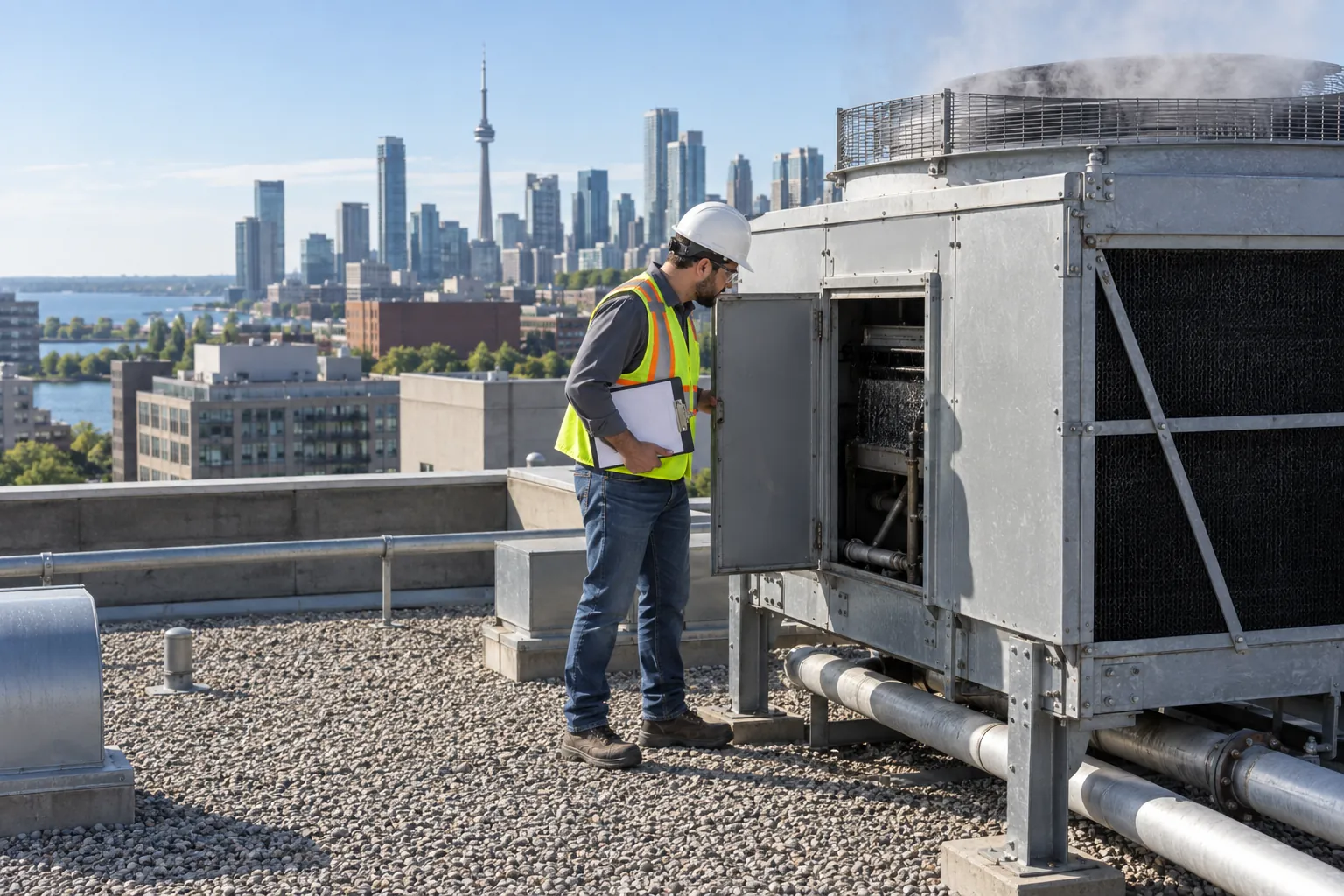
A cooling tower on the roof of an office, hospital, school or industrial plant sends a fine mist of warm water into the air all summer. Kept clean and treated, it is harmless; neglected, it can spread Legionella across a neighbourhood. Canada has no national cooling tower rule. Quebec has the most detailed one, in the Safety Code enforced by the Régie du bâtiment du Québec, and cities such as Vancouver and Hamilton have their own by-laws. This guide explains where the requirements come from, what a maintenance program covers, how often towers are inspected and sampled, what to do when a Legionella result comes back high, and what the register has to show.
01
Where cooling tower requirements come from
A water cooling tower rejects heat from a building's air conditioning or process cooling by letting warm water fall through a stream of air, so that some of it evaporates. The CCOHS OSH Answers fact sheet on Legionnaires' disease explains that cooling towers "may contain Legionella and other microorganisms brought in by circulating air or water", and that people are infected by breathing in contaminated water droplets, not from one another.
There is no single Canadian law for cooling towers. Building and public health rules are provincial and municipal, and the requirements you face depend on where the tower stands:
- Quebec. The Building chapter of the Safety Code (Code de sécurité, chapitre Bâtiment), enforced by the Régie du bâtiment du Québec (RBQ), has had a Division VII on the maintenance of water cooling tower installations since 12 July 2014. The RBQ's page on the Règlement sur l'entretien d'une installation de tour de refroidissement à l'eau says the aim is to improve public safety by minimizing bacterial growth and the risk of contamination by Legionella pneumophila. It applies to all water cooling tower installations, including those of industries, businesses and institutions.
- Vancouver. The Vancouver Building By-law 2019, Book II (Plumbing Systems), Division B, Part 2, as consolidated to 1 July 2024, requires an operating permit for every cooling tower, new or existing, under Article 2.2.11.6., with monthly Legionella testing, notification to the Chief Building Official and a maintenance log.
- Hamilton. The City of Hamilton's Cooling Tower Registry By-law No. 11-078 requires owners to register their cooling towers with Public Health Services before 1 May each year, and the owner or whoever is in control of each tower to keep a risk management plan and a log book for it.
- Federal buildings. Public Works and Government Services Canada's (now Public Services and Procurement Canada) standard MD 15161-2013, Control of Legionella in Mechanical Systems (issued March 2016) sets minimum requirements for buildings managed by the department or its service providers, though not leased ones. It is also a thorough Canadian reference for a tower's routine anywhere.
MD 15161 records why the rules tightened: an outbreak of Legionnaires' disease in Quebec City in 2012, which caused several deaths, was traced to a cooling tower in a downtown building.
Elsewhere, most provinces have no regulation written for cooling towers, but the owner still has a duty: provincial occupational health and safety law protects the workers who inspect and clean the tower, and local public health units investigate when cases of legionellosis appear. Ask your municipality and public health unit whether a registry or by-law applies. Whichever rule applies, the duty starts with the owner (Hamilton also holds whoever is in control of the tower to it); a property manager, facility manager, building operator or water treatment company can do the work, but the owner's duty does not move.
02
What a cooling tower maintenance program covers
Every regime starts with a written program for each installation: Quebec's programme d'entretien, Hamilton's risk management plan, MD 15161's Legionella Bacteria Control Management Program. The names differ; the content is much the same.
In Quebec, the RBQ's page on the programme d'entretien says the program must be prepared and signed by one or more members of a professional order, such as the Ordre des ingénieurs du Québec, the Ordre des chimistes du Québec or the Ordre des technologues professionnels du Québec, within their field of practice. It must contain:
- the winterization and restart procedure, where the tower is shut down for the winter;
- the procedures for shutdowns and restarts during the season;
- the cleaning procedure;
- the procedure for maintaining water quality so as to minimize bacterial growth and keep Legionella pneumophila permanently below 10,000 colony-forming units per litre (CFU/L);
- the decontamination procedure;
- the measures to reduce corrosion, scaling and the build-up of organic matter;
- a schematic plan of the water network;
- the list of chemical products used;
- the measures for checking the mechanical components.
The RBQ's interpretation note on Tours de refroidissement à l'eau – Programme d'entretien adds that the program is revised every five years, and sooner after a change to the installation that affects it, a change to the water quality procedure or any use of the decontamination procedure, and its guidance on good practice in a maintenance program expects follow-up documents for maintenance and monitoring, and a drift eliminator that is present and maintained so that it works.
MD 15161's list for federal buildings adds an inventory of every system where Legionella could grow, a single-line schematic with the sampling points, a risk and hazard assessment, and a "Maintenance log and all other maintenance records" available for inspection on site at any time.
The same measures protect the tower's performance: MD 15161 defines fouling as organic growth or other deposits on heat-transfer surfaces that cause a loss of heat-transfer efficiency, and scale, corrosion and debris on the fill and in the basin restrict the flow of water and wear out components, so the regular routine that helps prevent Legionella also keeps the entire system cooling as designed.
A good program also names the people: the owner's representative, the building operator, the water treatment company, the laboratory and the professional who signed it.
03
How often towers are inspected, cleaned and sampled
The program sets the frequencies for your tower and may ask for more. The rules and standards set these floors:
- Weekly, under MD 15161: a visual inspection under normal operation for microbial growth, algae, leaks, splashing, blockages and restrictions at the air inlets, and a check that the water treatment equipment works and has enough chemicals in stock.
- Monthly, under MD 15161: everything in the weekly inspection, plus the water flow through the tower, the drift eliminators inside and out for damage or excessive drift, the internal structure with the power off (fill, drift eliminators, basin and distribution system), and a test for free chlorine or other biocide levels.
- Legionella sampling at least every 30 days while the tower is in service in Quebec, according to the RBQ, and also on restart after winterization and after any decontamination. In Vancouver, Article 2.2.11.6. requires a Legionella pneumophila culture test each calendar month of operation, with not more than 33 days between samples, and a test 48 hours to 5 days after start-up and disinfection.
- Yearly, under MD 15161: a more detailed inspection of every component and an assessment by a water treatment specialist for corrosion, biofilm and deposits. CCOHS says towers and evaporative condensers should be inspected and thoroughly cleaned at least once a year, with corroded parts such as drift eliminators replaced.
- Offline cleaning and disinfection at least once every calendar year and at every start-up in Vancouver, and when a result requires it. MD 15161 also calls for cleaning and disinfection at start-up.
Shutdowns need their own care, because stagnant warm water is where Legionella does best. Vancouver's by-law says a tower shut down for more than 3 days must be drained within 5 days or, for a short shutdown where that is not practical, treated with a biocide before start-up. A tower taken out of use for good is drained, sanitized and has its make-up water line disconnected and capped.
Many Canadian towers are drained and winterized in the fall and restarted in the spring. The restart is the riskiest week of the year: the tower is cleaned, disinfected, refilled and sampled before it is trusted again, and each step belongs in the register.
04
Legionella results, and who does what
Quebec and Vancouver use almost the same two thresholds, written in different units. Quebec counts colony-forming units per litre; Vancouver counts per millilitre, and 10 CFU/mL is the same as 10,000 CFU/L. Quebec's upper band starts at 1,000,000 CFU/L, while Vancouver's starts above 1,000 CFU/mL, so a result of exactly 1,000 CFU/mL is still in Vancouver's middle band.
- Below 10,000 CFU/L (10 CFU/mL): the program is working. Keep sampling on schedule.
- 10,000 CFU/L or more, but below 1,000,000 CFU/L (up to and including 1,000 CFU/mL in Vancouver): in Quebec, the owner applies the corrective measures in the program to bring the count back below 10,000 CFU/L. The next sample shows whether they worked. In Vancouver, Table 2.2.11.6. requires notice to the Chief Building Official within 24 hours and either an immediate shutdown with offline cleaning and disinfection, or running disinfection followed within 7 days by a shutdown, cleaning and disinfection, then a new test 48 hours to 5 days later.
- 1,000,000 CFU/L or more (more than 1,000 CFU/mL in Vancouver): Quebec requires measures that eliminate the dispersal of water as aerosol. Vancouver requires immediate notice to the Chief Building Official, the medical health officer and the owner, by the owner and by the laboratory; immediate measures to stop aerosol dispersal from the tower; offline cleaning and disinfection before the tower returns to service; and a new test 48 hours to 5 days afterwards.
Quebec also requires the owner to make sure the accredited laboratory sends every result to the RBQ, and to send the RBQ its information form for each installation within 30 days of first service and before 1 March every year. Vancouver requires notice to the Chief Building Official within 5 days of any start-up, shutdown or test result. Hamilton requires registration changes to be reported within 10 business days.
The work is usually shared out like this:
- The owner holds the duty, keeps the register and makes the notifications, often through the property manager.
- The professional who signs the program designs the routine and the response to a bad result, and revises it.
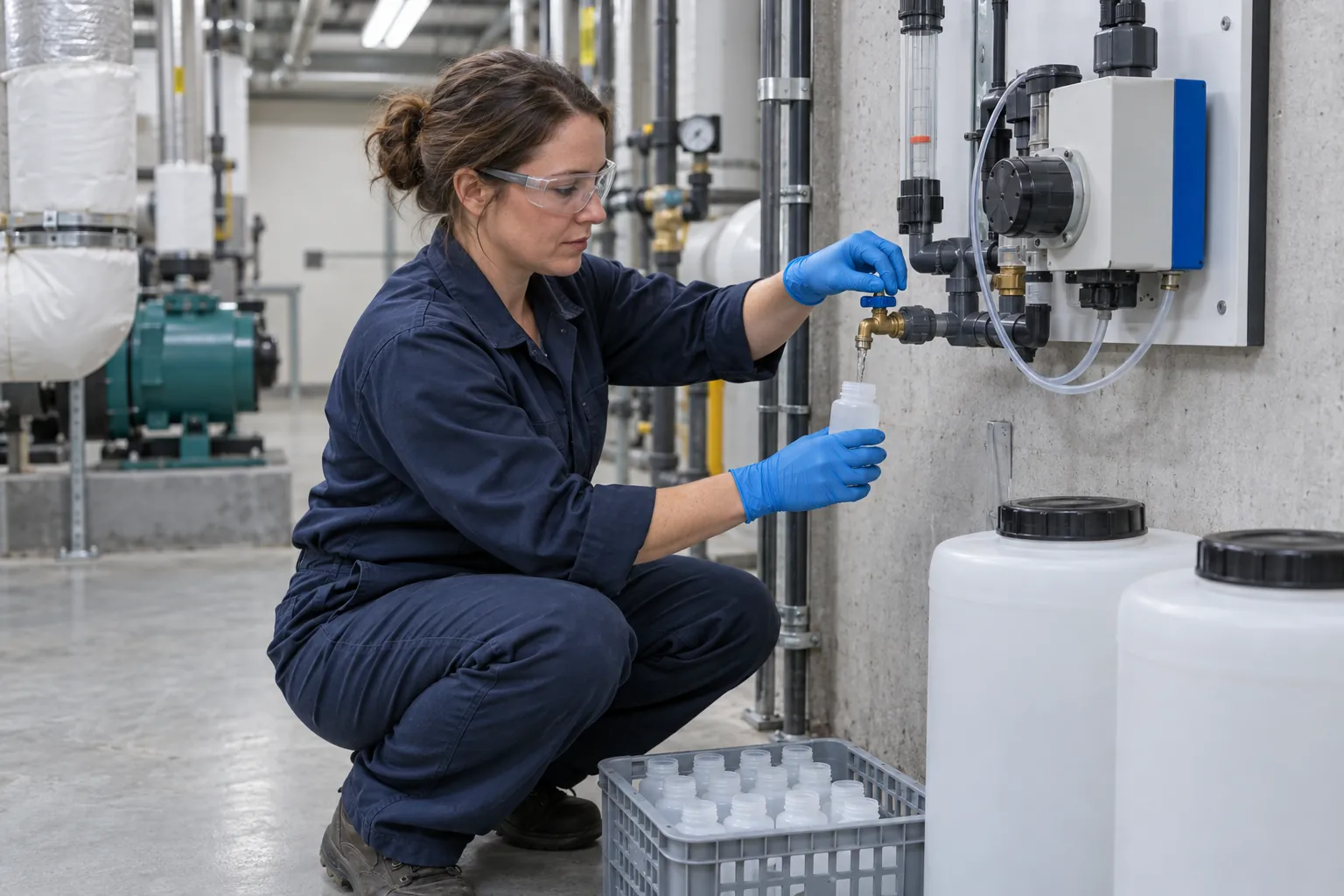
- The water treatment company sets the chemical program, tests on its visits and often takes the Legionella samples. Vancouver requires a one-year service contract with a qualified service provider for an operating permit.
- The building operator or stationary engineer does the weekly and monthly inspections, keeps the chemical tanks filled and is the first to see a leak or a damaged drift eliminator.
- The accredited laboratory analyzes the samples; in Quebec it sends every result to the RBQ, and in Vancouver it gives immediate notice to the authorities when a result is above 1,000 CFU/mL.
Anyone opening a tower needs training for the job. CCOHS reminds workers never to enter a confined space without proper instruction or training.
05
What the cooling tower register must show
Every regime asks for a record of cooling tower maintenance for each tower, usually kept on site, and they agree on most of what goes in it. The RBQ's page on the obligations of an owner lists the contents of the Quebec register:
- the name and contact details of the owner of the installation;
- a copy of the as-built design plans;
- the manufacturer's operating and maintenance manual;
- the names and telephone numbers of the person responsible and the staff assigned to maintenance;
- the maintenance program prepared by one or more members of a professional order;
- the results of water analyses for the last 2 years;
- the history and description of maintenance, repairs, replacements and modifications.
Vancouver's maintenance log, under Article 2.2.1.8., also holds the operating permit number, emergency contacts, where the safety data sheets and operating manual are kept, a current schematic with the sampling points, and the last 24 months of inspections and maintenance, disruptions and corrective actions, chemical treatments and dosages, and water quality results, with who took each Legionella sample and which laboratory tested it. A failed result adds the deviation, the corrective action, any notification and the outcome, with dates and times. The log may be paper or electronic, is kept on site and is shown to the Chief Building Official on request.
Beyond what the rules name, each routine check in a register that stands up to questions shows:
- The tower and the check, named as in the program.
- The date, time and person, written at the time.
- The reading or finding: a biocide residual as a number, "scale on the east cell", not a tick.
- What was done about anything wrong, who was told and when it was closed.
- The gaps: a check that could not be done, and why.
The laboratory and water treatment reports usually arrive complete. The weak part is the in-house routine between them, and that is what an investigator asks about after a high result.
06
Where cooling tower records fail, and what SiteClara does about it
Cooling tower records rarely fail on the laboratory side. They fail on the roof. The weekly inspection sheet is filled in for the month on the day the water treatment technician visits. The biocide column says "OK" instead of a number. A torn drift eliminator is mentioned to whoever is passing and never reaches the contractor. A tower is shut down for a week in July and nobody records whether it was drained. And a property manager with a dozen buildings cannot tell which towers had their weekly check without phoning each one.
SiteClara records checks at the location. A printed QR poster, with an optional NFC tag behind it, goes where the check is due: at the roof access door, beside the tower, at the chemical feed station. The person doing the check scans the code or taps the tag on their own phone, with no app to install, sees what is due there, such as this week's visual inspection, and marks it done or says what stopped them. The time and the named person are recorded as it happens, with a photo when one is asked for, such as the basin or the controller display. A problem found on the round is reported there and goes onto the team's list of open jobs until someone closes it, and a supervisor can escalate it to the building manager.
The supervisor sees what is due, done and missed across the building or portfolio, and records why a check was missed. Each day they approve a short report that goes to the nominated managers or client contacts the next morning.
07
Questions people ask
How often should cooling towers be serviced?
Every week while the tower runs, with more each month and a full inspection and cleaning every year. MD 15161-2013, Control of Legionella in Mechanical Systems sets a weekly visual inspection and a check of the water treatment equipment, a monthly inspection that adds the water flow, the drift eliminators and the internal structure with the power off, and a yearly, more detailed inspection of every component with an assessment by a water treatment specialist for corrosion, biofilm and deposits. The CCOHS OSH Answers fact sheet on Legionnaires' disease says towers and evaporative condensers should be inspected and thoroughly cleaned at least once a year.
What are the maintenance requirements for a cooling tower?
Constant water treatment, regular inspection, cleaning and disinfection, and Legionella testing. The CCOHS OSH Answers fact sheet on Legionnaires' disease says cooling water should be treated constantly, ideally by an automatic system, and that corroded parts such as drift eliminators should be replaced and algae and scale removed. MD 15161-2013, Control of Legionella in Mechanical Systems adds a weekly dipslide test for total bacteria and a monthly Legionella culture test while the tower is in normal operation, and requires a tower shut down for more than three days to be drained or, where that is not practical, pre-treated with a biocide before start-up. Your province or city may require more; see the sections above.
How do I clean my cooling tower?
Clean it at start-up and every year, then disinfect it. Under MD 15161-2013, Control of Legionella in Mechanical Systems, section 3.4.5, you add cleaning agents and circulate the water for at least one hour, switch off and drain to waste as the local water authority allows, clean the internal shell, fill and sump and flush away all debris, refill, dose with free chlorine or another biocide and circulate for one hour, clean the filters, strainers, nozzles and fittings, then refill and treat again. For shock chlorination, section 3.4.8 turns the fan off, keeps the pH below 7 and holds a free chlorine residual of at least 5 ppm for 6 hours, or 15 ppm for 2 hours. Anyone entering the tower needs confined space training.
08
Further reading, and a list to take away
In Quebec, read the RBQ's pages on the obligations of an owner and its questions and answers on water cooling towers, which explain when a glycol system is covered. In Vancouver, read Article 2.2.11.6. of the Vancouver Building By-law, Book II and confirm the current edition with the City. Hamilton's Cooling Towers page, under Requirements for Cooling Tower Operators, has the by-law, the forms and a risk management plan template. Everywhere, MD 15161-2013 is a thorough reference for the routine. The guide to a preventive maintenance checklist covers the rest of the plant.
Before the cooling season starts, check that:
- you know which regulation, by-law or registry applies to each tower, and it is registered or permitted where it must be;
- the maintenance program is current, signed where it must be, and names the people responsible;
- the spring restart is cleaned, disinfected, refilled and sampled before the tower is trusted;
- weekly and monthly inspections have an owner, a name and a time, and readings are numbers;
- Legionella samples are booked at least every 30 days in service;
- everyone knows what happens at 10,000 CFU/L and at 1,000,000 CFU/L, and who makes the call;
- every shutdown is recorded, with the drain or biocide treatment before restart;
- the register holds at least two years of results and the full history of repairs and changes.
Sources
Every document this guide quotes or links to, in the order it first cites them.
- CCOHS OSH Answers fact sheet on Legionnaires' disease ccohs.ca
- Règlement sur l'entretien d'une installation de tour de refroidissement à l'eau rbq.gouv.qc.ca
- Vancouver Building By-law 2019, Book II (Plumbing Systems), Division B, Part 2 free.bcpublications.ca
- Cooling Tower Registry By-law No. 11-078 hamilton.ca
- MD 15161-2013, Control of Legionella in Mechanical Systems tpsgc-pwgsc.gc.ca
- Programme d'entretien rbq.gouv.qc.ca
- Tours de refroidissement à l'eau – Programme d'entretien rbq.gouv.qc.ca
- Good practice in a maintenance program rbq.gouv.qc.ca
- The obligations of an owner rbq.gouv.qc.ca
- Questions and answers on water cooling towers rbq.gouv.qc.ca
- Cooling Towers hamilton.ca
Related guides
 Premises and facilities managementPreventive maintenance checklist: what to include, how often, and how to show it was doneA preventive maintenance checklist for Canadian buildings: what the fire code and provincial law require, what to include, how often, and the records to keep.
 Premises and facilities managementBoiler log: what the law requires, and what a useful one recordsWhat a boiler log must record in an Ontario registered plant, what to log when no statute requires one, how inspections and relief valve tests fit in, and who signs.
 Fire and water checksSprinkler system inspection in Canada: what is checked, how often, and what the record must showSprinkler system inspection in Canada: what the fire codes and NFPA 25 ask, the weekly and monthly checks, the annual test, shutdowns and the records to keep.
 Premises and facilities managementHVAC filter change log: what the rules ask for, and what a useful one recordsWhat an HVAC filter change log should record, what federal and BC workplace rules require, how often to change filters, and what makes the log believable.