Fire and water checks
Sprinkler system inspection in Canada: what is checked, how often, and what the record must show
A sprinkler system inspection is the routine check of a building's fire sprinkler system – its control valves, gauges, alarms, pipes and sprinkler heads – that Canadian fire codes require the property owner to have carried out weekly, monthly and yearly, in most provinces to the American standard NFPA 25.
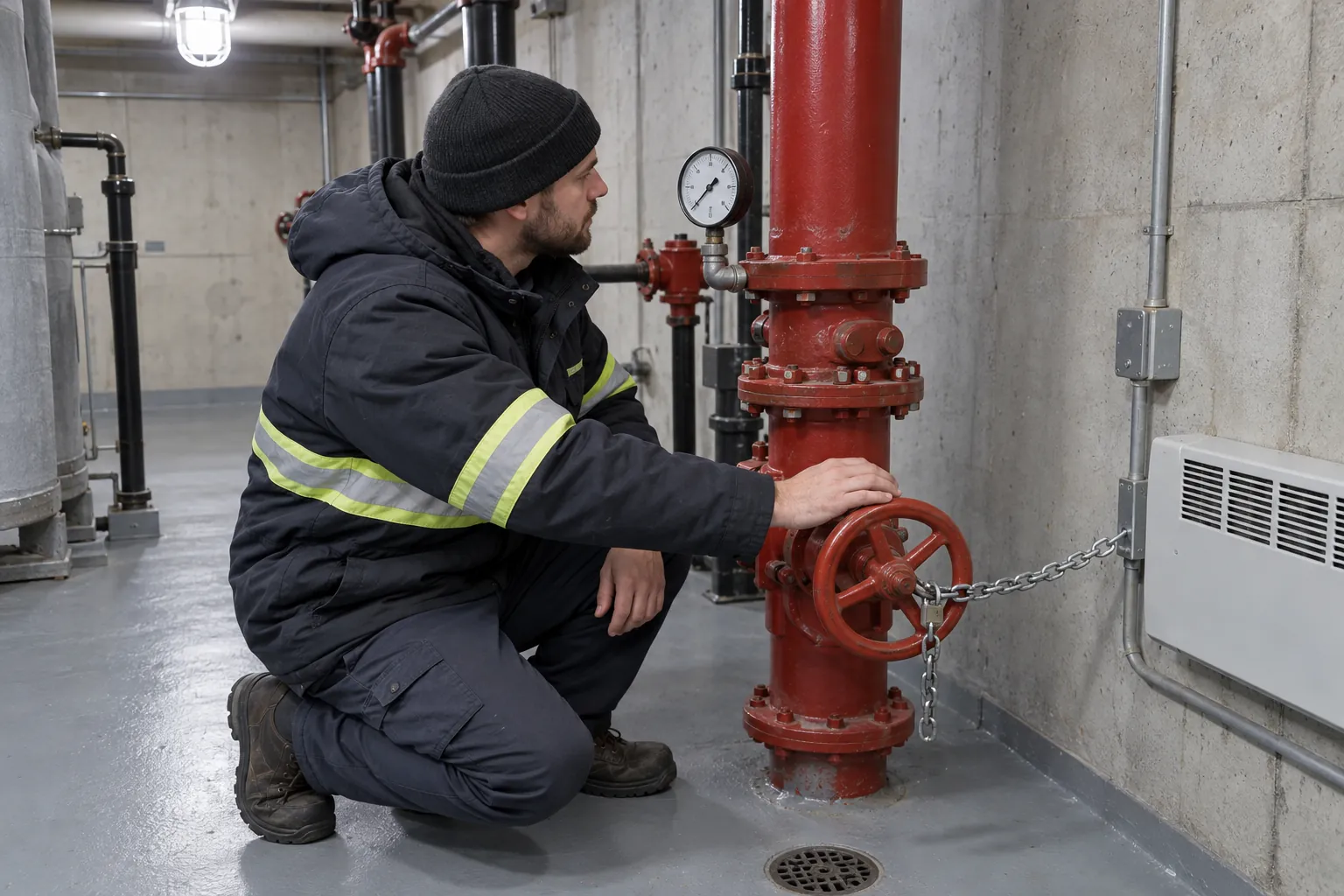
The system sits unused for years and has to work the first time, and in Ontario the fire code also sets out its own list of checks. Some of that work is a weekly look at valves and gauges by building staff; the rest is testing and repairs by a qualified sprinkler contractor. This guide explains where the requirement comes from, what is checked and how often, who does which part, what to do when the system is shut down, and what the record has to show when the fire prevention officer asks for it.
01
Where the sprinkler inspection requirement comes from
There is no single Canadian sprinkler law. Fire safety in buildings is provincial and territorial, and most provinces adopt the National Fire Code of Canada 2020, published free by the National Research Council, either as it stands or with their own amendments. Article 6.4.1.1 of that code is short: water-based fire protection systems "shall be inspected, tested and maintained in conformance with NFPA 25", the Standard for the Inspection, Testing, and Maintenance of Water-Based Fire Protection Systems. Its explanatory note says these include sprinkler systems, standpipes, private hydrants and fire pumps. As first published, the 2020 code referenced the 2017 edition of NFPA 25; the revisions issued in March 2025 moved it to the 2020 edition, and each province or territory decides whether those revisions apply.
The provinces then adopt it in their own way. British Columbia applies the BC Fire Code 2024, which is the National Fire Code used together with the province's amending Ministerial Order No. FSA 2023 1. Alberta applies the National Fire Code – 2023 Alberta Edition, known as NFC(AE), which the Calgary Fire Department's Fire Safety Maintenance Requirements summarizes as inspection, testing and maintenance "as per NFPA 25-2017". Always check which edition is in force where the building is: your municipal or provincial fire official can tell you.
Ontario is different. The Ontario Fire Code, O. Reg. 213/07, as consolidated from 1 January 2026, has its own Section 6.5 on sprinkler systems, with named frequencies for checking, inspecting and testing. Sentence 6.5.1.1.(2) then says that complying with the inspection, testing and maintenance provisions of NFPA 25 "is deemed to satisfy" Subsections 6.5.4 to 6.5.6, and Ontario's table of referenced documents names NFPA 25-2017. Note what that sentence leaves out: Subsection 6.5.3, the checking of gauges, pipe hangers and sprinkler heads, still applies as written, and so do the general rules, records and shutdown procedures in Subsections 6.5.1 and 6.5.2.
Whichever code applies, the duty sits with the owner. Division C of the national code says that unless otherwise specified "the owner or the owner's authorized agent shall be responsible for carrying out the provisions of this Code", and Ontario's Article 6.5.1.2 says simply that "Sprinkler systems shall be maintained in operating condition." A property manager, building operator or contractor can do the work; the duty does not move.
02
What a sprinkler system inspection covers
A sprinkler inspection is not one visit. It is a set of checks, inspections and tests on different components of the system, each at its own interval. In a typical wet or dry pipe system in an office, school, condominium, warehouse or other commercial building, the parts that need regular attention are these:
- Control valves: every valve controlling the water supply or the alarms, open and sealed, locked or electrically supervised.
- Gauges: water supply pressure and system air or water pressure, read against the system's normal range.
- Alarm devices: the water flow alarm, and the supervisory signals that report a closed valve, low air or low temperature.
- Dry pipe and preaction valves: the valve room's heat in winter, the priming water level, air pressure and the trip test.
- Fire department connection: the outside inlet, with its caps or plugs on and free of debris.
- Sprinkler heads: free of damage, corrosion, grease, dust and paint, with storage clear of the deflectors.
- Pipe and hangers: exposed piping supported, not leaking and not used to hang anything.
- Spare heads: the cabinet of spare sprinklers and the wrench to fit them.
- Water supply: the main drain test, and any fire pump or tank serving the system.
Storage is where occupants affect the system most. Ontario's Sentence 3.2.2.3.(1) says the clearance between sprinkler head deflectors and the top of any indoor general storage "shall not be less than 457 mm", and Article 6.5.1.5 says "No obstructions shall be placed so as to interfere with the effectiveness of water discharge from sprinklers." Boxes stacked to a storeroom ceiling, or a banner hung from a sprinkler pipe, are findings on a fire inspection.
03
How often each part is checked, inspected and tested
The Ontario Fire Code sets out its frequencies in Subsections 6.5.3 to 6.5.5. They are a useful map of the work for any building, because they are written plainly:
- Weekly: water supply pressure and system air or water pressure "checked weekly by using gauges" (Article 6.5.3.2); valves controlling sprinkler water supplies or alarms sealed in the open position and inspected weekly (Sentence 6.5.4.5.(1)).
- Monthly: valves that are locked open or electrically supervised inspected monthly instead (Sentence 6.5.4.5.(2)); the alarm tested monthly "by flowing water through the test connection located at the sprinkler valve", unless the system is electrically supervised and tested under Article 6.5.5.7 (Article 6.5.5.2).
- Every two months, where electrical supervision is provided: transmitters and water-flow-actuated devices tested (Sentence 6.5.5.7.(2)).
- Every three months: the priming water for dry pipe systems inspected "to ensure that the proper level above the dry-pipe valve is maintained" (Article 6.5.4.3).
- Every six months, where electrical supervision is provided: valve supervisory switches, tank water level and temperature devices and other supervisory devices tested (Sentence 6.5.5.7.(3)).
- Yearly: exposed pipe hangers and sprinkler heads checked (Articles 6.5.3.1 and 6.5.3.4); fire department connection caps removed and the inlet inspected (Sentence 6.5.4.4.(2)); a water flow alarm test at the most hydraulically remote test connection on wet systems (Article 6.5.5.3); dry pipe valves trip tested (Sentence 6.5.5.4.(2)); and the water supply tested with the main drain valve fully open (Article 6.5.5.5).
- Every three years: dry pipe valves trip tested with the control valve fully open (Sentence 6.5.5.4.(4)).
- Every 15 years: dry pipe systems inspected for obstructions in the piping, and flushed if necessary (Article 6.5.4.2).
Two Ontario requirements have no fixed interval. The main drain test is repeated "after any sprinkler system control valve has been operated" (Article 6.5.5.6). And dry pipe valve rooms in unheated buildings are checked "as often as necessary" when the outside temperature falls below 0 °C (Article 6.5.3.3), which in a Canadian winter can mean daily.
NFPA 25 arranges the same ground by component, and in places it differs. The Calgary Fire Department's summary of NFPA 25-2017 lists, among other things: weekly inspection of sealed control valves and gauges; monthly inspection of locked or supervised valves and of gauges on dry and preaction systems; quarterly inspection of the fire department connection, supervisory and waterflow alarm devices and wet system gauges; a semi-annual test of vane and pressure switch waterflow alarms; the annual inspection and test to the standard's Table 5.1.1.2; a five-yearly internal assessment of the piping; and replacement or sample testing of older sprinklers by age. Your contractor will build an inspection schedule for your system; your job is to know which items are yours and see that none drops off the calendar.
04
Who does which part, and what happens when the system is shut down
The routine checks suit trained building staff: a superintendent, building operator, custodian or security guard who has been shown the valves and the normal gauge readings. Walking the valve rooms, confirming each valve is open and sealed, noting the gauge readings, checking the heat in a dry valve room and looking for storage piled under the heads all fall here. It helps to give the weekly round to one named person, with a deputy.
The tests and the annual inspection are work for a qualified person. The Calgary guidance says people who inspect, test and maintain life safety systems "must be qualified for the specific system", typically including a "journeyperson sprinkler system installer", and that "owners are responsible for ensuring that the persons they hire are qualified." Other provinces set their own rules; ask your local fire department. Ontario's Article 6.5.5.1 adds that notice of water flow and other tests "shall be given to parties who could be affected by an alarm", usually the monitoring company and the occupants.
Deficiencies are where it most often goes wrong. The annual report lists what failed: a painted head, a corroded hanger, a gauge reading zero. Ontario's Sentence 1.1.1.2.(3) says a device that does not operate as intended "shall be repaired or replaced" where its failure would affect fire or life safety, and Calgary's guidance tells owners to keep the letters or updated reports showing each deficiency was resolved with the original report, as proof.

05
What the sprinkler inspection record must show, and for how long
Every fire code in Canada asks for records, and the fire prevention officer will ask to see them. Ontario's Article 6.5.1.8 says "An approved record shall be kept of inspections of each system", available for examination by the Chief Fire Official, and the general rule in Article 1.1.2.1 is that where the code requires tests, corrective measures or operational procedures, "records shall be made noting what was done and the date and time it was done." Division C of the national code says the same in its own words: records are made and the original or a copy is "retained at the premises for examination by the authority having jurisdiction."
A useful sprinkler record, whatever form it takes, shows:
- which system, riser, valve, gauge or device was checked, so three risers are three lines, not one tick;
- the date and time, and the name of the person who did it;
- the reading, where there is one: gauge pressures, valve positions, the dry valve room temperature;
- the result, including a normal one;
- anything found, who it was reported to, and when it was put right;
- shutdowns: when, why, who was notified, the alternative measures, and when the system was restored;
- the contractor's reports, with the deficiencies and the proof each was resolved.
How long to keep it depends on the province. Ontario's Article 1.1.2.2 requires records to be kept at the building for at least two years, and so that the most recent and the immediately preceding record of each test or inspection are kept; initial verification or test reports for systems installed after 21 November 2007 are kept for the life of the system. The national code follows the same pattern. Alberta's edition is longer: the Calgary guidance says the current and previous five years must be available, and wants a printed copy on site in a binder labelled "Life Safety Records".
Ontario allows electronic records: Sentence 1.1.2.1.(4) deems records "that can be made readily available to the Chief Fire Official upon request" to comply. Keep them where your fire department expects to find them, often with the fire safety log book, and ask if in doubt.
06
Where sprinkler records fail, and what SiteClara does about it
Sprinkler records rarely fail at the annual inspection; the contractor's report goes in the binder. They fail in the weeks between. The weekly valve and gauge round is a sheet in the riser room, and in the week the superintendent is away it is blank or filled in later in one pen. The gauge column says "OK" instead of a number, so a falling pressure goes unseen. A broken seal is mentioned to whoever walks past and never reaches the contractor. And a property manager with a portfolio cannot tell which buildings had their valves checked this week without calling each one.
SiteClara records checks at the location. A printed QR poster, with an optional NFC tag behind it, is put where the check is due: in the sprinkler valve room, beside a riser, at the dry pipe valve enclosure, next to the fire department connection. The person doing the check scans the code or taps the tag on their own phone, with no app to install, sees what is due there, such as this week's valve and gauge check, and marks it done or says what stopped them. The time and the named person are recorded as it happens, with a photo when one is asked for, such as the gauge face or the sealed valve. A problem, such as a missing seal, a low reading or a leaking fitting, is reported there and goes onto the team's list of open jobs until someone closes it.
The supervisor sees what is due, done and missed across the building or the portfolio, and records the reason a check was missed. Each day they review and approve a short report that goes to the nominated managers or client contacts the next morning, showing what was reported, completed and still open, and how the scheduled checks went.
07
Questions people ask
How often should a sprinkler system be checked?
In Ontario, the Ontario Fire Code, O. Reg. 213/07 says water supply pressure and system air or water pressure "shall be checked weekly by using gauges" (Article 6.5.3.2), valves controlling sprinkler water supplies or alarms are sealed open and "inspected weekly", or monthly where they are locked open or electrically supervised (Article 6.5.4.5), and sprinkler heads "shall be checked at least once per year" (Article 6.5.3.4). Under NFPA 25-2017, the Calgary Fire Department's Fire Safety Maintenance Requirements list weekly inspection of sealed control valves and gauges, monthly inspection of locked or supervised control valves, quarterly inspection of wet system gauges and alarm devices, and an annual inspection, test and maintenance of the sprinkler system to the standard's Table 5.1.1.2.
What does a 5 year sprinkler inspection consist of?
Under NFPA 25-2017, the five-yearly items in the Calgary Fire Department's Fire Safety Maintenance Requirements are an assessment of the internal piping condition with an obstruction investigation (Chapter 14), a hydrostatic test of the piping from the fire department connection to the check valve, the inspection, testing and maintenance of common components and valves to Table 13.1.1.2, and a test of gauges, extra high temperature solder-type sprinklers and sprinklers in harsh environments. Older sprinklers are also replaced or sample tested by age, and sprinklers more than 75 years old are tested again every five years.
What is the 18-inch rule for sprinklers?
It is the clear space kept between stored goods and the sprinkler heads above them: 18 inches is 457 mm. Sentence 3.2.2.3.(1) of the Ontario Fire Code, O. Reg. 213/07 says "The clearance between sprinkler head deflectors and the top of any storage shall not be less than 457 mm", and where storage rises above the lower chords of the floor or roof framing, Sentence 3.2.2.3.(2) adds a horizontal clear space of at least 300 mm between the storage and the structural members. Article 6.5.1.5 also says "No obstructions shall be placed so as to interfere with the effectiveness of water discharge from sprinklers."
08
Further reading, and a list to take away
Start with your own province's fire code: the Ontario Fire Code on e-Laws, where Section 6.5 covers sprinklers; the BC Fire Code 2024; or the adoption in force where you are, alongside the National Fire Code of Canada 2020. NFPA 25 is published by the National Fire Protection Association; your contractor will have the edition your code references. The Calgary Fire Department's Fire Safety Maintenance Requirements has a table of NFPA 25 frequencies by component, and the City of Ottawa's Ontario Fire Code Pre-Inspection Guide lists what an Ontario inspector looks at. The guide to Ontario Fire Code inspections covers the rest of the owner's routine.
Before the fire prevention officer's next visit, check that:
- you know which fire code and edition of NFPA 25 apply, and your contractor works to them;
- every control valve is checked open and sealed, locked or supervised, week by week, with a name and a time;
- gauge readings are recorded as numbers against a known normal range;
- dry valve rooms are checked for heat whenever it is below freezing;
- the annual inspection and the longer-interval tests are booked and tracked;
- every deficiency on the last report has an owner, a date and proof it was fixed;
- storage stays at least 457 mm below the deflectors and the spare heads cabinet is stocked;
- shutdowns follow a written procedure: notify, tag closed valves, protect, restore, drain test;
- records are kept as long as your code requires: at least two years in Ontario, and the current and previous five years under the Calgary Fire Department's reading of the Alberta edition.
Sources
Every document this guide quotes or links to, in the order it first cites them.
- National Fire Code of Canada 2020 nrc.canada.ca
- BC Fire Code 2024 www2.gov.bc.ca
- Calgary Fire Department's Fire Safety Maintenance Requirements calgary.ca
- Ontario Fire Code, O. Reg. 213/07 ontario.ca
- NFPA 25 nfpa.org
- City of Ottawa's Ontario Fire Code Pre-Inspection Guide ottawa.ca
Related guides
 Fire and water checksFire log book: what to record, who keeps it and how long, under Canadian fire codesWhat a fire log book should hold under the Ontario Fire Code and the National Fire Code of Canada: the tests, who records them, how long to keep them, and the form.
 Fire and water checksOntario Fire Code monthly inspections: what is due, who does it, and the recordEvery monthly fire protection and egress inspection the Ontario Fire Code sets, article by article, the checks around them, and what a fire inspector can ask to see.
 Fire and water checksFire alarm testing in Canada: what the owner checks, what the technician tests, and what to recordFire alarm testing in Canada: what the fire codes and CAN/ULC-S536 ask of owners daily and monthly, the annual test by a technician, and what the record must show.
 Fire and water checksFire watch: when the code requires one, and how to run it properlyWhen a fire watch is required under the National Fire Code of Canada and the Ontario Fire Code, how often to patrol, who can do it, and what the log should show.