Cleaning
Blood spill cleanup: a workplace procedure for Canada
To clean up a blood spill at work, put on disposable gloves, soak up the blood with disposable towels working in from the edges, disinfect the whole area with a disinfectant that has a DIN or a fresh 1:100 household bleach solution for its full contact time, then bag the waste and wash your hands.
A nosebleed in a washroom, a cut hand in a stairwell, blood on a lobby floor after a fall: every building gets blood spills, and every custodian, guard or front-desk worker who might meet one needs to know what to do. This guide sets out what Canadian guidelines and provincial law say, what a spill kit should hold, a step-by-step cleanup procedure with bleach strengths, what to do about needles and exposures, and what record to keep.
01
What Canadian guidance and law say about blood spills
The starting point is a principle, not a regulation. The Canadian Centre for Occupational Health and Safety's page on Routine Practices rests on the assumption that "all blood, body fluids, secretions, excretions, mucous membranes, non-intact skin or soiled items are potentially infectious."
The most detailed Canadian method is written for health care. The Provincial Infectious Diseases Advisory Committee's Best Practices for Environmental Cleaning for Prevention and Control of Infections in All Health Care Settings (PIDAC, 3rd edition, first revision November 2025) says that "spills of blood and other body substances, such as urine, faeces and emesis, must be contained, cleaned and the area disinfected immediately", and that "a mycobactericidal disinfectant or a hypochlorite solution (diluted to 500-5000 ppm, equivalent to a 1:10-1:100 dilution of 5.25% sodium hypochlorite) should be used for blood spills."
For cleaners outside health care, CCOHS's fact sheet Sanitation and Infection Control for Cleaning Staff is the plain-language version: wear gloves, use disposable towels or tools "that will stop direct contact between you and the blood or body fluids", and "decontaminate the area with an approved disinfecting agent or a 1:100 solution of household bleach."
The law is provincial or territorial. Most workplaces fall under their province's or territory's occupational health and safety law; only federally regulated work, such as banks, airports and interprovincial transport, falls under Part II of the Canada Labour Code. Provincial and territorial law does not generally set a time limit for cleaning up blood in an ordinary workplace; the duty is the general one. In Ontario, the Guide to the Occupational Health and Safety Act, Part III summarizes section 25: the employer must ensure protective devices are provided and "maintained in good condition", must "instruct, inform and supervise workers to protect their health and safety", and must "take every precaution reasonable in the circumstances for the protection of a worker." A custodian sent to a blood spill with no gloves and no disinfectant is a gap in that duty.
British Columbia goes further. Section 6.34 of WorkSafeBC's Occupational Health and Safety Regulation, Part 6 says that if a worker "has or may have occupational exposure" to a designated biological agent, the employer "must develop and implement an exposure control plan": a risk assessment, the work activities involved, controls, precautions, protective equipment, training, "a record of all training and education provided to workers" and "a record of all workers who have been exposed."
Bleach and disinfectants bring WHMIS with them: CCOHS's WHMIS – General lists its components as "hazard identification and product classification, labelling, safety data sheets, and worker education and training."
02
What a blood spill kit should hold, and who responds
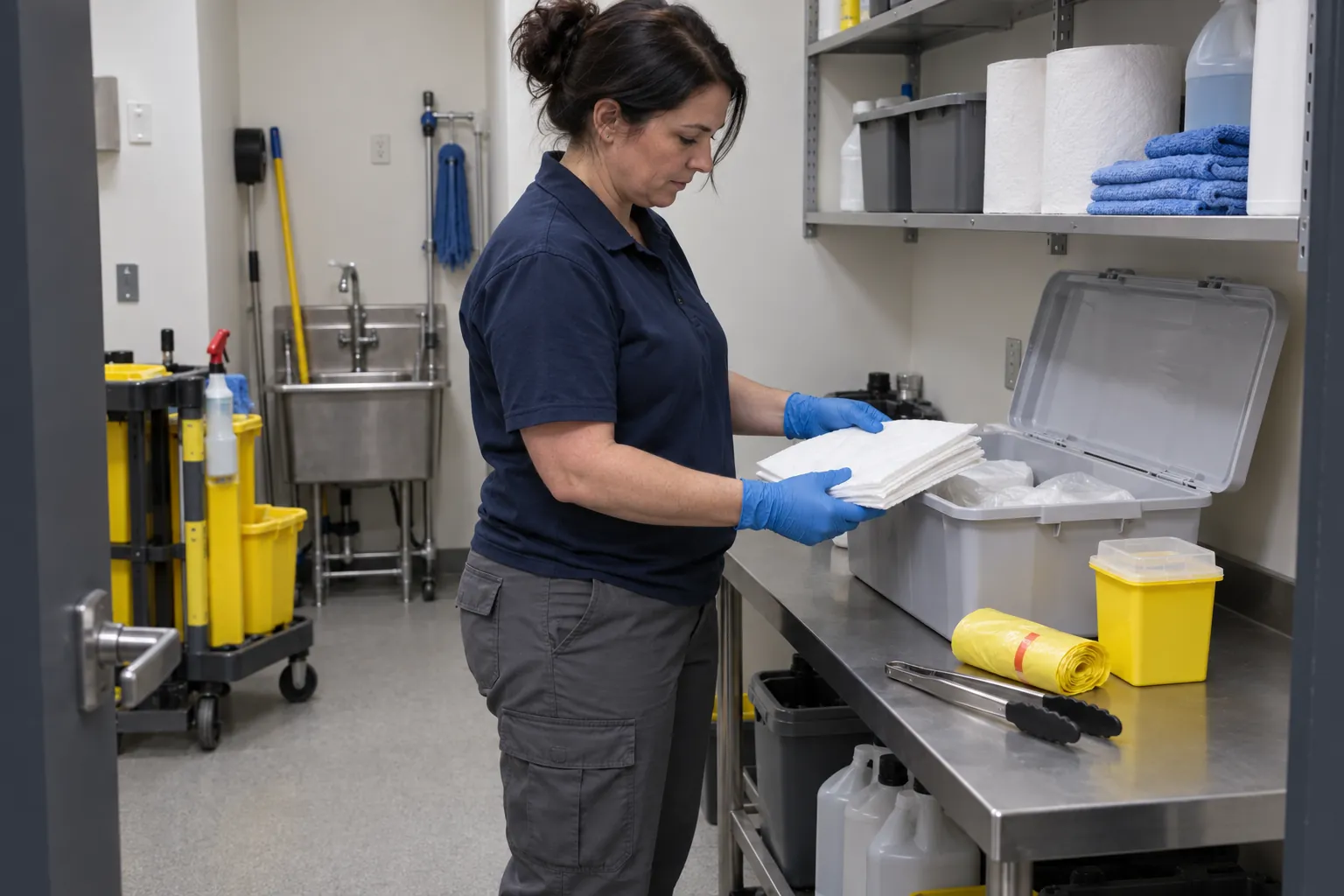
PIDAC's sample procedure begins: "Assemble materials required for dealing with the spill prior to putting on personal protective equipment." That works only if a kit is already stocked in a known place: the janitor's closet on each floor, the security desk, the first aid room. A practical kit holds:
- Disposable gloves, enough for two changes, and puncture-resistant gloves.
- Tongs or a dustpan and a small rigid sharps container, for needles or broken glass.
- A disposable gown or apron and facial protection, which PIDAC calls for "if there is a possibility of splashing".
- Absorbent material: disposable towels or a solidifying granule, and a disposable scoop.
- Leak-proof plastic bags and ties.
- A disinfectant with a drug identification number (DIN) that suits blood, or bleach and a measuring cup.
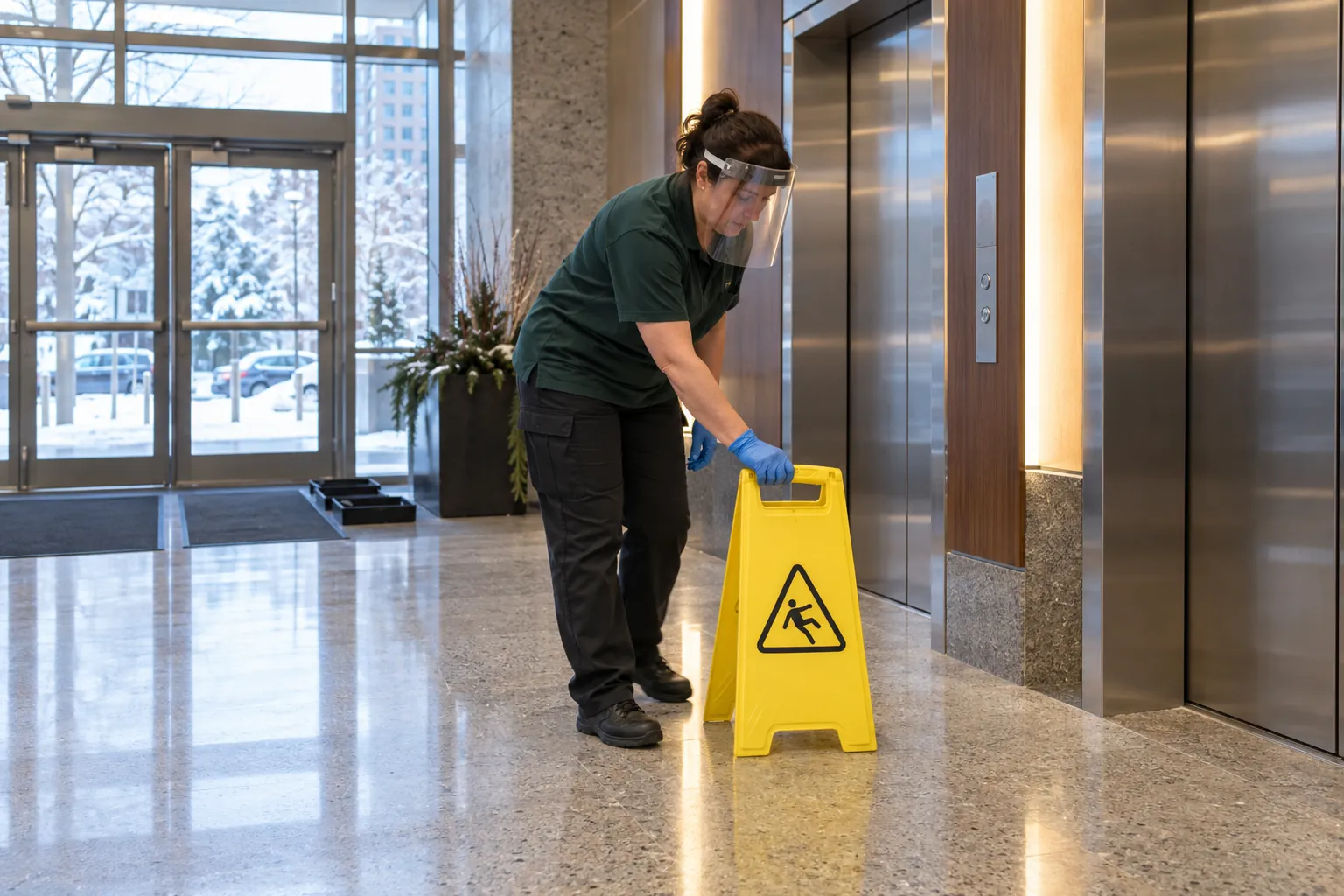
- Wet floor signs or cones.
- A one-page copy of the procedure, with who to call and what to do after a needlestick or splash.
Check the kits on a schedule, so each one is ready when it is needed. A kit whose gloves were used last month and never replaced is a common reason cleanups go wrong.
Who responds matters as much. PIDAC says a health care setting's written spill procedure must include "clearly defined assignment of responsibility for cleaning the spill in each area of the health care setting during all hours when a spill might occur", provision for timely response, containment of the spill, training, access to protective equipment and supplies, proper disposal of waste, a procedure for staff exposure, and "documentation of the spill incident." The same headings suit any building. The weak point is usually time of day: the day custodian knows the procedure, but the evening crew, a weekend gym rental or the overnight concierge in a condominium lobby may not.
Security guards and front-desk staff are often first on the scene. Their job is to keep people away, look after anyone injured and call the person trained to clean. Say so in the site's post orders, and put the cleanup itself in the janitorial scope of work.
03
A step-by-step blood spill cleanup procedure
These steps follow PIDAC's Appendix 23, Sample Procedure for Cleaning a Biological Spill, and the CCOHS fact sheet. First aid for anyone hurt always comes first.
- Keep people away. PIDAC says to "restrict the activity around the spill until the area has been cleaned and disinfected and is completely dry."
- Put on gloves, and a gown and facial protection if anything could splash.
- Look for sharp objects before touching anything; see the next section.
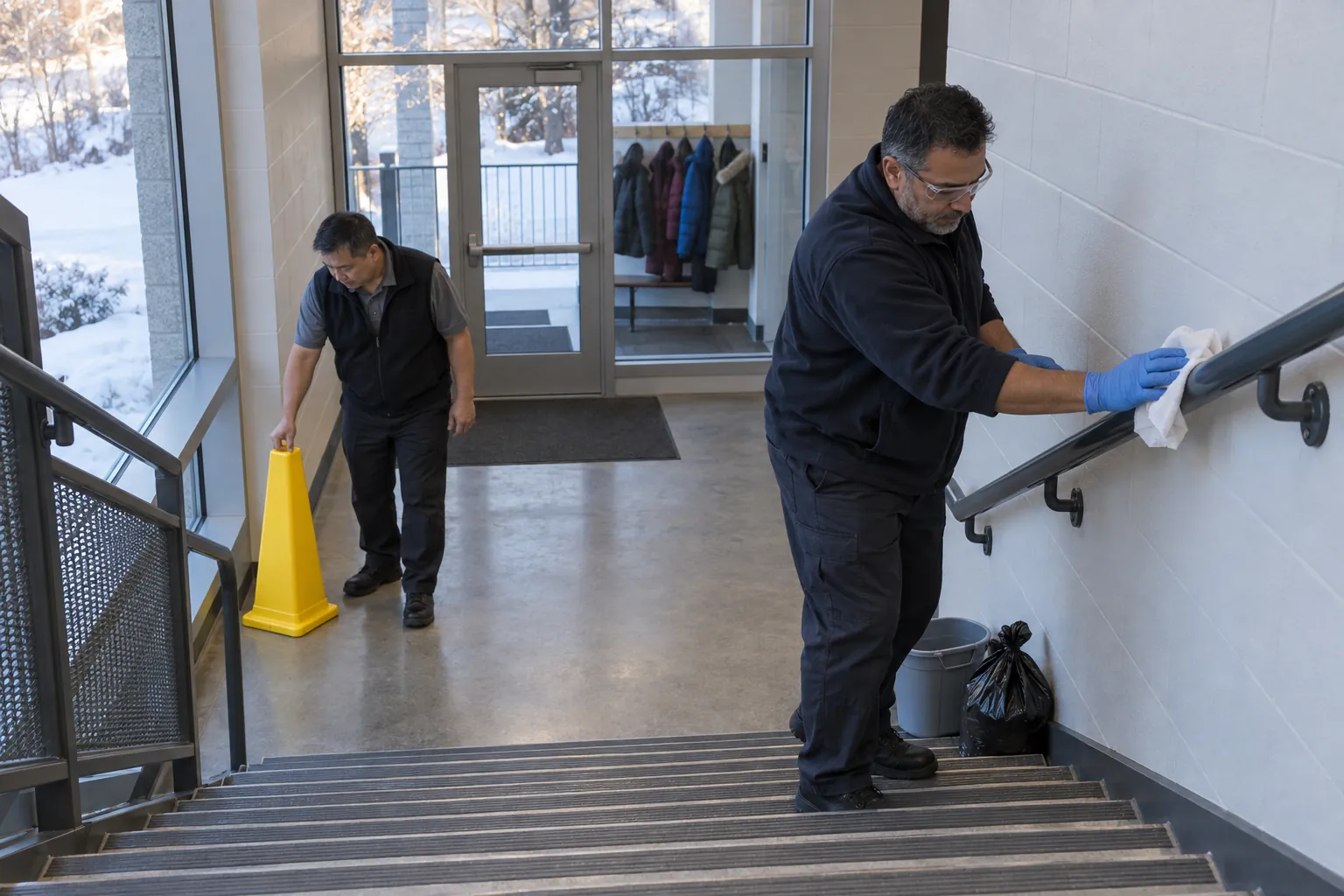
- Look wider than the pool. PIDAC says to "inspect the area around the spill thoroughly for splatters or splashes": door edges, push plates, railings, elevator buttons.
- Contain and wipe it up with disposable towels or a solidifier, working inward from the edges. "Care must be taken to avoid splashing or generating aerosols": no mops, no squeezing towels by hand.
- Clean off what remains, because disinfectant works poorly through soil.
- Disinfect the whole area, splashes included, and leave the product on "for the amount of time recommended by the manufacturer."
- Wipe up again, and bag everything in a leak-proof bag. CCOHS adds that "all tools or equipment used should be washed and disinfected", so reusable tongs and dustpans go back in the kit only once they have been.
- Remove gloves and wash your hands "thoroughly with warm water and soap".
- Leave the signs until the surface is dry, reopen the area and record the response.
Choosing the disinfectant. In Canada, disinfectants are regulated as drugs. PIDAC explains that a manufacturer "must obtain a drug identification number (DIN) from Health Canada prior to marketing". Look any product up by its DIN in Health Canada's Drug Product Database, and follow the label's dilution and contact time. The guide to disinfectant DINs explains how to read one.
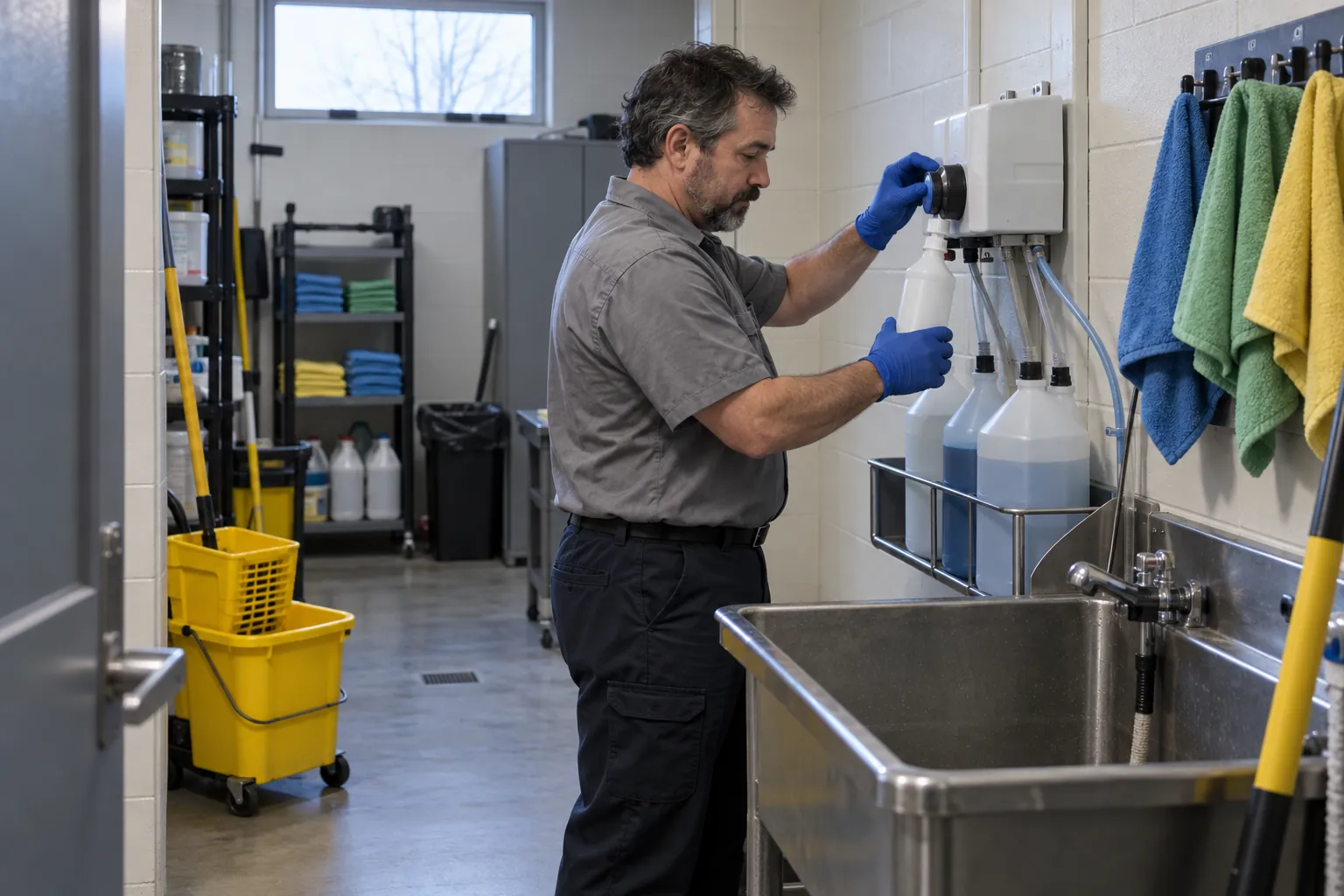
Using bleach. PIDAC gives two strengths: for a minor blood spill, 500 ppm, "1 part of bleach (5.25%) to 99 parts of water", the same 1:100 CCOHS recommends; for a major one, 5,000 ppm, "1 part of bleach (5.25%) to 9 parts of water". Those ratios assume 5.25% bleach, so check the label and use Public Health Ontario's Chlorine Dilution Calculator. Its safety notes belong inside the janitor's closet door: "Always add the bleach solution to the water"; do not premix, "as it loses potency over time"; and never mix bleach with other cleaning products, "especially glass cleaners, and products containing ammonia or acids such as vinegar", which can produce toxic gases.
Carpet. PIDAC's Appendix 24 says to mop up as much as possible with disposable towels, disinfect for the contact time, and then have the carpet removed or "cleaned with an industrial carpet cleaner as soon as possible." Use a product whose label allows carpet.
Waste. PIDAC puts spill materials in the regular waste "unless the soiled materials are so wet that blood can be squeezed out of them", when a health care setting uses its biomedical waste stream. Ontario's C-4: The management of biomedical waste in Ontario covers "items saturated with liquid or semi-liquid human blood or blood products" but is written for hospitals, clinics, laboratories and similar generators. If an ordinary building produces waste like that, ask your hauler or local public health unit. CCOHS's rule for cleaners: "Do not mix infectious waste with regular garbage or trash."
04
Needles, broken glass and exposures
Blood in a washroom sometimes comes with a needle, in a sanitary bin, behind a toilet or in a garbage bag. CCOHS's Needlestick and Sharps Injuries names HIV, hepatitis B and hepatitis C among the diseases passed on this way, and notes that "needles can hide in linen or garbage and injure other workers who encounter them unexpectedly."
Picking up a needle. PIDAC's Appendix 26, Safe Disposal of Sharps, fits on a kit lid: put on gloves; take a sharps container to the needle; "NEVER re-cap a needle and syringe even if a cap is available"; pick it up with tongs or puncture-resistant gloves; place it in the container; report it to your supervisor. CCOHS adds: "Try not to touch a sharp object such as a needle. Use a dustpan or shovel to move it", and "Do not reach your hand into any waste container" that may hold hazardous waste.
After a needlestick, cut or splash. CCOHS's first steps are "thoroughly rinsing the injury site with running water, and gently cleaning with soap and water if possible", and "flushing the eyes, nose, or mouth with running water if they have been exposed." Then "report the incident and exposure immediately to your employer" and follow medical advice. In British Columbia, section 6.40 of the OHS Regulation says that where a worker may have been exposed to HIV, hepatitis B or another designated agent, "the employer must advise the worker to seek immediate medical evaluation."
Hepatitis B vaccine. PIDAC lists it among the immunizations appropriate for environmental service workers in health care, "due to risk of sharps injury", and says contracts with supplying agencies should include them for contracted staff. In British Columbia, section 6.39 requires employers to offer the vaccine to workers at risk of occupational exposure to the virus. Elsewhere, a contractor whose staff handle washroom waste should take occupational health advice.
Every exposure is an incident. It goes through the employer's incident process and any reporting the province requires, separately from the spill record, following the written procedure PIDAC expects "if there is a staff exposure to blood or body fluid material".
05
What a good blood spill record shows
PIDAC lists "documentation of the spill incident" as part of a spill procedure. Outside health care no regulation prescribes the form, but a record lets a property manager answer a complaint, a supervisor check the contract's response time, and an employer show the procedure was followed. A useful entry shows:
- Where: building, floor and exact spot, such as "second-floor washroom, second stall".
- When it was reported, and when someone arrived: the gap is the response time.
- Who cleaned it, by name.
- What was used, and that the label's contact time was followed.
- Any sharps or broken glass, and how they were disposed of.
- When the area reopened, and anything taken out of use.
- Anything that went wrong, such as an empty kit, and that the kit was restocked.
Washrooms in Ontario. The province's guidance, Maintaining clean washroom facilities for workers, explains that under O. Reg. 480/24 cleaning records must be kept and "the date and time of the two most recent cleanings of the washroom facility" posted in or near it, or made available electronically with directions for workers, and that an inspector may consider "the actual condition of the washroom facility, such as visible soiling." A spill cleanup is a cleaning, so bring the posted record up to date; the spill record sits beside it, not in place of it. In British Columbia, the exposure control plan's training and exposure records are the employer's statutory records.
06
Where the spill record fails, and what SiteClara does about it
Most blood spill cleanups leave no trace. A guard radios the custodian, the custodian cleans up, and by morning nobody can say when it was reported, how long it took, what was used or whether the splashes on the door were done. The paper log in the janitor's closet, where there is one, is filled in at the end of the shift from memory, or not at all.
SiteClara puts a tag at each location: a printed QR code, with an NFC tag behind it if staff would rather tap than scan. Anyone who finds a spill can scan the tag in the washroom, stairwell or lobby and report it, with a photo if it helps, and it goes onto the cleaning team's list of open jobs with the time it was reported. The custodian who cleans it scans the same tag on their own phone, with no app to install, and closes the job; the time and the person are recorded as it happens, so the gap between report and response is plain to see. A supervisor can see what is still open across every building they look after.
Routine checks work the same way. If the site checks its spill kits weekly, or its washrooms every two hours, staff see what is due at each location and mark it done, or say what stopped them. At the end of the day the supervisor reviews the day, adds a note, and the approved report goes to the client or facility manager at 8 a.m. the next morning.
07
Questions people ask
What is the best way to clean up a blood spill?
CCOHS's fact sheet Sanitation and Infection Control for Cleaning Staff gives the method for cleaners: "Wear gloves and use disposable towels or other means of cleaning" that keep you from touching the blood, decontaminate the area "with an approved disinfecting agent or a 1:100 solution of household bleach", put all soiled materials "in a leak-proof plastic bag", and wash your hands "thoroughly with warm water and soap, after removing gloves."
What is the best disinfectant for blood spills?
PIDAC's Best Practices for Environmental Cleaning for Prevention and Control of Infections in All Health Care Settings says "a mycobactericidal disinfectant or a hypochlorite solution (diluted to 500-5000 ppm, equivalent to a 1:10-1:100 dilution of 5.25% sodium hypochlorite) should be used for blood spills." In practice that means a disinfectant with a DIN whose label claims it is mycobactericidal (tuberculocidal), used for its stated contact time, or bleach mixed fresh at 1:100 for a minor spill and 1:10 for a major one.
How do hospitals clean up blood spills?
In Ontario, PIDAC's Best Practices for Environmental Cleaning says health care settings "shall have written policies and procedures dealing with spills of blood and other body fluids", with responsibility for cleaning clearly assigned for all hours, training, protective equipment and documentation of each spill. Its Appendix 23 sets out the steps: restrict the area, put on gloves (and a gown and facial protection if anything could splash), wipe up with disposable towels, disinfect "with a hospital disinfectant" for the manufacturer's contact time, wipe again, and put materials wet enough to squeeze blood out of into "the biomedical waste container (i.e., yellow bag)."
Is spilled blood a biohazard?
Treat it as one. CCOHS's page on Routine Practices starts from the assumption that "all blood, body fluids, secretions, excretions, mucous membranes, non-intact skin or soiled items are potentially infectious." For waste, Ontario's C-4: The management of biomedical waste in Ontario counts "items saturated with liquid or semi-liquid human blood or blood products" as human blood waste, while PIDAC lets towels go in the regular waste unless they are wet enough to squeeze blood out of; either way, bag them in a leak-proof bag.
08
Further reading, and a checklist to take away
Start with CCOHS's Sanitation and Infection Control for Cleaning Staff, short enough to hand to every custodian, and its Needlestick and Sharps Injuries fact sheet. For the fuller method, read section 12 and Appendices 23, 24 and 26 of PIDAC's Best Practices for Environmental Cleaning. For products, CCOHS's Cleaning Products – Working Safely covers labels, safety data sheets and dilution. For your legal duties, read your own province's occupational health and safety law, and in British Columbia the Biological Agents sections of Part 6.
Before the next spill, check that you have:
- a written spill procedure with a named responder for every hour the building is open;
- stocked kits in known places, with puncture-resistant gloves, tongs and a sharps container, checked on a schedule;
- a disinfectant with a DIN that suits blood, or bleach diluted fresh and never mixed with ammonia, acids or glass cleaner;
- custodians, guards and front-desk staff trained, with the training recorded;
- a rule for needles: never recapped, never picked up by hand, always reported;
- first aid and reporting steps for a needlestick or splash that every worker knows;
- every spill recorded with location, times, who cleaned it and what was used.
Sources
Every document this guide quotes or links to, in the order it first cites them.
- Routine Practices ccohs.ca
- Best Practices for Environmental Cleaning for Prevention and Control of Infections in All Health Care Settings publichealthontario.ca
- Sanitation and Infection Control for Cleaning Staff ccohs.ca
- Canada Labour Code laws-lois.justice.gc.ca
- Guide to the Occupational Health and Safety Act, Part III ontario.ca
- WorkSafeBC's Occupational Health and Safety Regulation, Part 6 worksafebc.com
- WHMIS – General ccohs.ca
- Drug Product Database health-products.canada.ca
- Chlorine Dilution Calculator publichealthontario.ca
- C-4: The management of biomedical waste in Ontario ontario.ca
- Needlestick and Sharps Injuries ccohs.ca
- Maintaining clean washroom facilities for workers ontario.ca
- Cleaning Products – Working Safely ccohs.ca
Related guides
 CleaningVomit cleanup and norovirus cleaning: a workplace procedureHow to clean up vomit safely at work in Canada: the spill kit, step-by-step procedure, disinfectant choice for norovirus, outbreak cleaning and the record to keep.
 CleaningHealth Canada approved disinfectants: what the DIN tells you, and how to use itHow to tell a Health Canada approved disinfectant: the DIN, what the label must show, how to check it, and what the Biocides Regulations changed.
 CleaningHospital environmental cleaning: the standards, the frequencies and the auditsHospital environmental cleaning in Canada: PIDAC best practices, CSA Z317.12, risk-based frequencies, who cleans what, and how cleaning is audited.
 CleaningWashroom cleaning checklist: what to check, how often, and Ontario's new cleaning recordsWhat a workplace washroom cleaning checklist should cover, how often to clean, and Ontario's posted cleaning records required since January 1, 2026.