Cleaning
Vomit cleanup and norovirus cleaning: a workplace procedure
Norovirus cleaning means containing and removing vomit or diarrhea at once, cleaning the area, then disinfecting it with chlorine bleach or a disinfectant with a virucidal claim, because the virus spreads through contaminated surfaces and can live on them for up to 12 days.
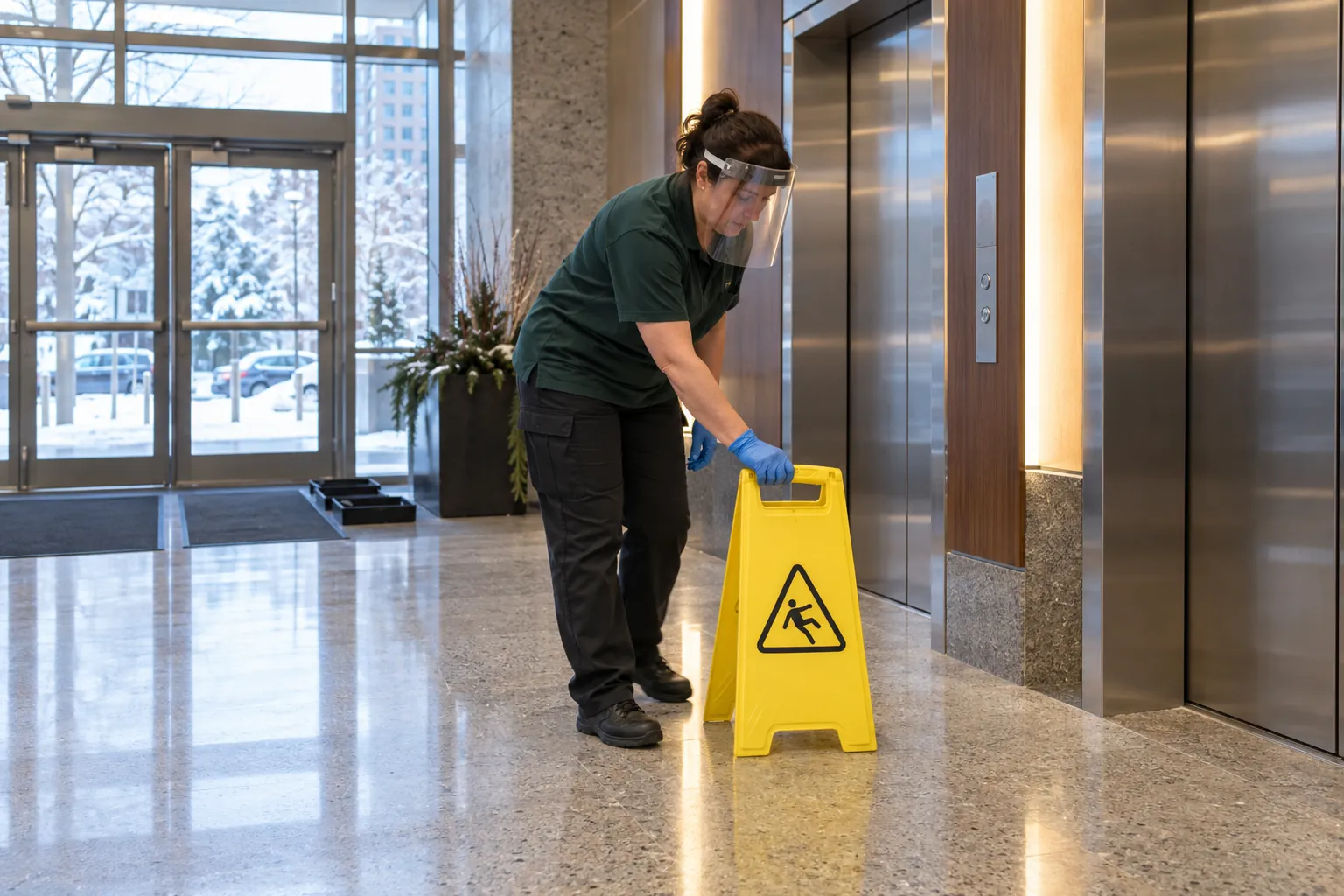
Vomit in a lobby, a classroom or a washroom is the one spill nobody wants and everybody needs handled well. If it was caused by norovirus, a careless cleanup spreads the illness further through the building. This guide sets out what Canadian public health guidance says, what a spill kit should hold, a step-by-step cleanup procedure, how to clean during a suspected outbreak, and what record to keep.
01
What the guidance says about vomit and norovirus
Norovirus is the reason vomit cleanup deserves a written procedure. Public Health Ontario's Significant Organisms in Environmental Cleaning: Frequently Asked Questions (first revision, October 2024) describes it as a virus that causes acute gastroenteritis, with symptoms such as nausea, vomiting, diarrhea and abdominal pain, and says it "is highly contagious". It adds that norovirus "can live on surfaces in the environment for up to 12 days", that contaminated surfaces and equipment "play a significant role" in its spread, and that "immediate cleaning is required when there are spills or heavy/gross contamination of room surfaces by body fluids such as vomit or diarrhea."
Health Canada's page on noroviruses explains why a building cannot relax once the person has gone home. People are contagious "from the moment they start feeling ill, to at least three days after they have recovered", and some for as long as two weeks. It says people become infected through direct contact with an infected person, by touching contaminated surfaces or objects, or by eating food or drinking water that has been contaminated. The same page advises: "Thoroughly clean contaminated surfaces, and disinfect using chlorine bleach, especially after an episode of illness."
The most detailed Canadian procedure is written for health care. The Provincial Infectious Diseases Advisory Committee's Best Practices for Environmental Cleaning for Prevention and Control of Infections in All Health Care Settings (PIDAC, 3rd edition, first revision November 2025) states that "spills of blood and other body substances, such as urine, faeces and emesis, must be contained, cleaned and the area disinfected immediately." It uses "vomitus in elevator" as its example of a spill that must be dealt with straight away, whatever the area's usual cleaning frequency. Other buildings are not bound by PIDAC, but its method is the best model a janitorial company can adopt.
No Canadian statute sets a time limit for cleaning up vomit. The legal duty is the general one. In Ontario, the Guide to the Occupational Health and Safety Act, Part III: duties of employers and other persons summarizes section 25: the employer must ensure that equipment, materials and protective devices are provided and "maintained in good condition", must "instruct, inform and supervise workers to protect their health and safety", and must "take every precaution reasonable in the circumstances for the protection of a worker." Other provinces set similar general duties, and federally regulated workplaces fall under Part II of the Canada Labour Code. A custodian asked to clean up vomit with bare hands and a household spray bottle is a gap in that duty, not a matter of taste.
The chemicals bring their own rules. A disinfectant with a DIN is regulated as a drug and household bleach bought at retail is a consumer product; CCOHS's WHMIS – General lists both among the products excluded from WHMIS, so they may not come with a supplier label or safety data sheet. It adds that employers "must still provide education and training on health effects, safe use, and storage." Where a cleaning product is covered by WHMIS, staff also need training to read its label and safety data sheet.
02
What a vomit spill kit should hold, and who responds
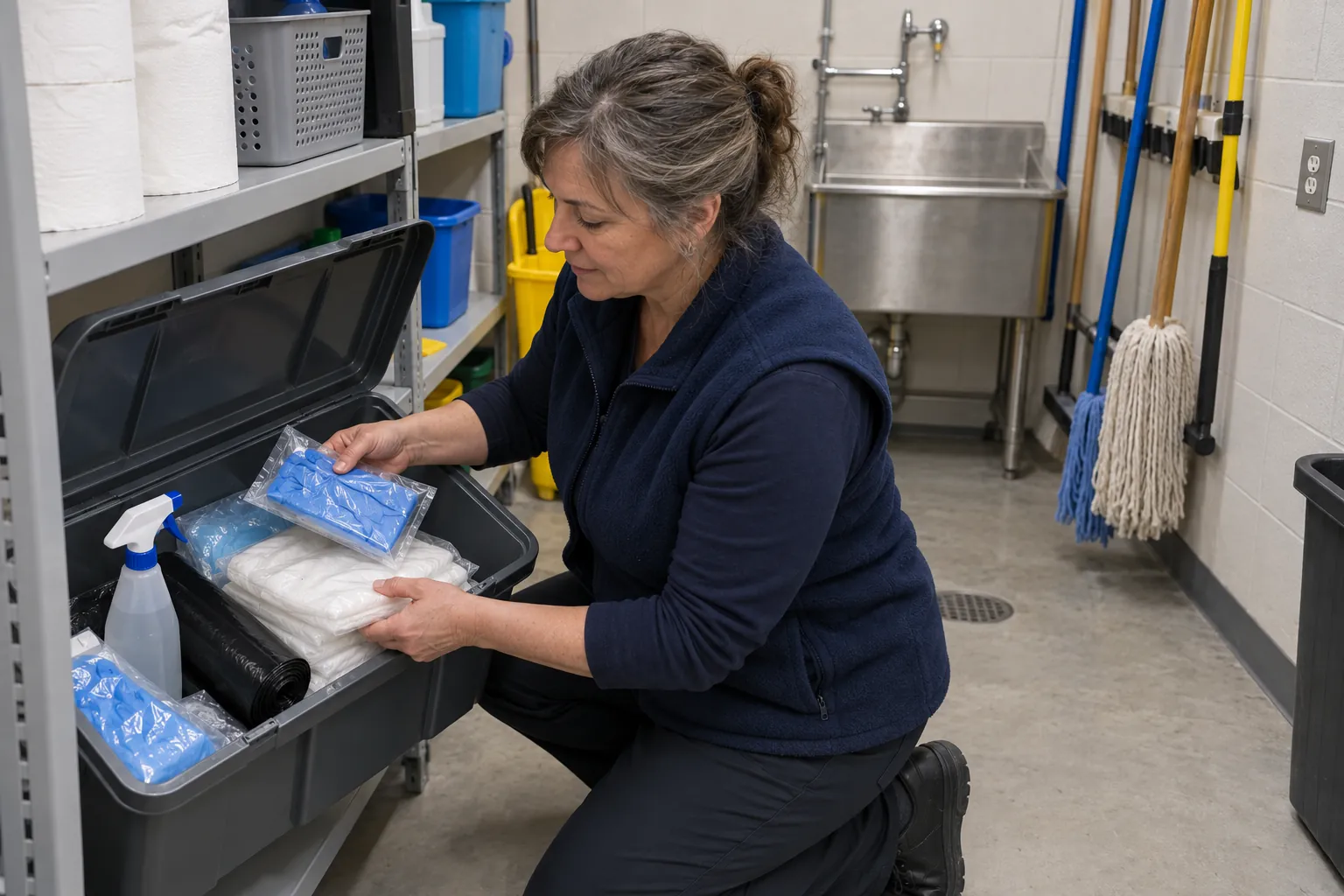
PIDAC's first step is to "assemble materials required for dealing with the spill prior to putting on personal protective equipment." That only works if a kit already sits in a known place on every floor. A practical kit holds:
- Disposable gloves, enough for two changes.
- A disposable gown or apron and facial protection: a mask with eye protection, or a face shield. PIDAC calls for them "if there is a possibility of splashing", which with vomit there usually is.
- Absorbent material: disposable towels or a solidifying product, and a disposable scoop.
- Heavy waste bags and ties.
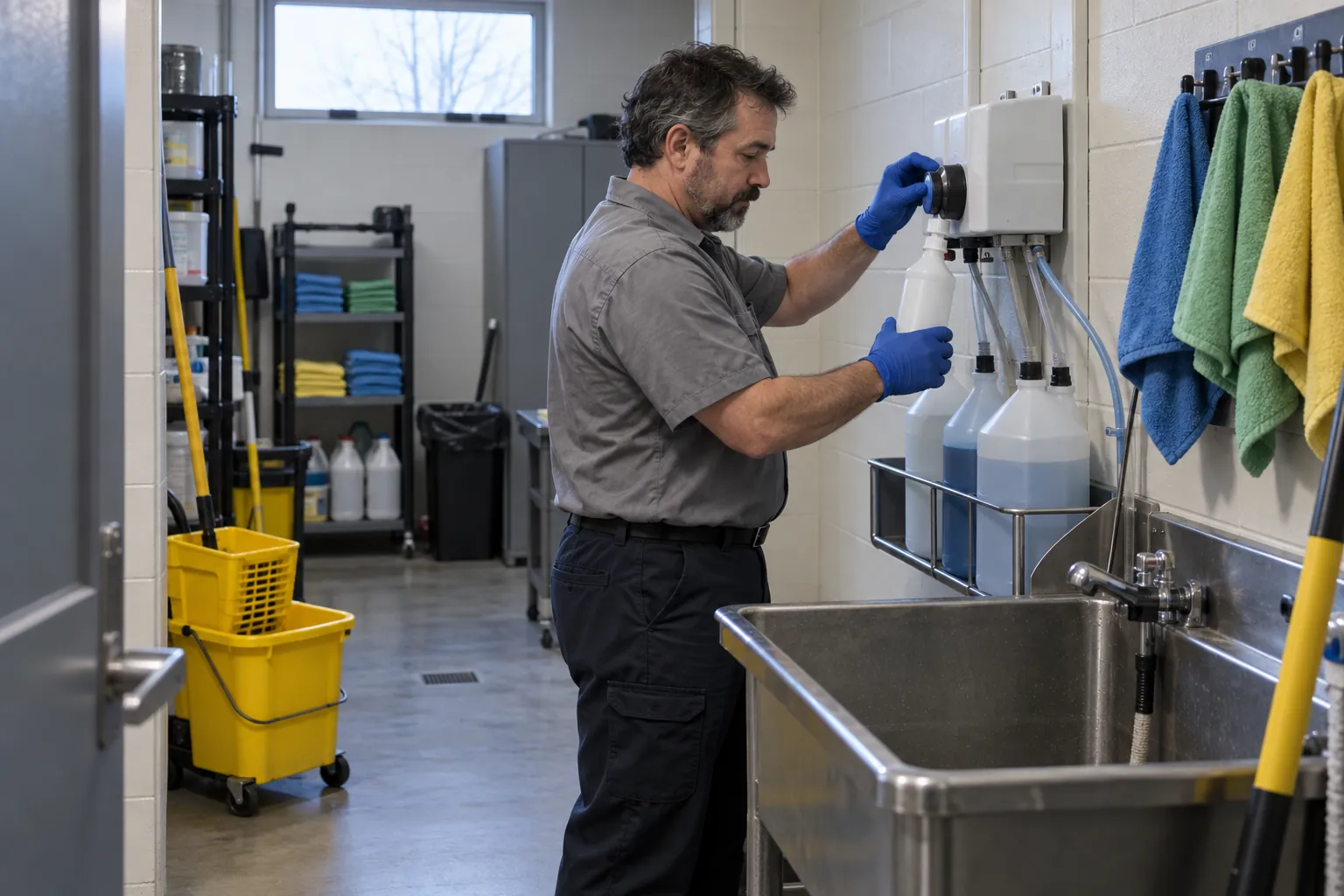
- A disinfectant with a drug identification number (DIN) and a virucidal claim on its label, or bleach with a measured way to dilute it.
- Wet floor signs or cones.
- A spare mop head, or disposable ones, so equipment does not go on to the next room.
- A one-page copy of the procedure, and the number of whoever must be told.
Who responds matters as much as what is in the kit. PIDAC says a health care setting's written spill procedure must include "clearly defined assignment of responsibility for cleaning the spill in each area" during all hours when a spill might occur, provision for timely response, training, access to PPE and supplies, proper disposal of waste, a procedure for staff exposure, and "documentation of the spill incident." The same headings suit any building. The gap is usually time of day: who responds at 7 p.m. during an evening gym rental, or at 2 a.m. in a condominium lobby?
Front-desk staff, concierges and security guards are often first on the scene. Their job is to keep people away and call the person trained to clean. Say so in the site's post orders.
03
A step-by-step vomit cleanup procedure
The steps below follow PIDAC's sample procedure for cleaning a biological spill (Appendix 23), adapted for vomit in an ordinary workplace.
- Keep people away. Put out signs or cones and move people out of the immediate area. PIDAC says to restrict activity around the spill "until the area has been cleaned and disinfected and is completely dry."
- Bring the kit to the spill, then put on gloves, and a gown and facial protection if there is any chance of splashing.
- Look wider than the puddle. PIDAC says to "inspect the area around the spill thoroughly for splatters or splashes": nearby walls, furniture legs, door handles and elevator buttons.
- Contain and lift it. Cover the spill with absorbent or paper towels, working from the outside in, and scoop it into a bag, avoiding splashes and aerosols.
- Clean the area of what remains with a detergent or cleaner; disinfectant works poorly through soil.
- Disinfect the whole area, splashes included, and leave the product "to stand for the amount of time recommended by the manufacturer", as PIDAC puts it.
- Wipe up again with paper towels or other disposable towels and bag them.
- Remove PPE carefully, in the order on Public Health Ontario's How to Remove Personal Protective Equipment poster: gloves first, then the gown, then clean your hands, then eye protection and mask. Put it all in the bag and close it.
- Wash your hands. The Public Health Agency of Canada's Norovirus: Prevention and risks advises washing hands with soap and water after using the washroom and before preparing or eating food; after a vomit cleanup, do the same.
- Leave the signs until the floor is dry, then reopen the area and record what was done.
Choosing the disinfectant. Public Health Ontario's FAQ says disinfectants used during norovirus outbreaks "should have a virucidal claim", and that "most quaternary ammonium compounds do not have significant activity against norovirus and should not be used." So check the active ingredient and the virucidal claim on the label rather than assume that the site's everyday disinfectant will do. In Canada, disinfectants are regulated as drugs, and PIDAC explains that the DIN from Health Canada shows that labelling and supporting data were reviewed. Health Canada's page on surface disinfectants for emerging viral pathogens tells users to locate the DIN on the label and stresses that products must be used "following the directions for use on the product label."
Using bleach. For blood spills, PIDAC gives sodium hypochlorite at 500 to 5,000 ppm, equivalent to a 1:100 to 1:10 dilution of 5.25% household bleach. For norovirus it notes: "In some jurisdictions, sodium hypochlorite at 1000 to 5000 ppm is recommended." For a norovirus cleanup, use the concentration your local public health unit or your disinfectant policy specifies, and work out the bleach solution with Public Health Ontario's Chlorine Dilution Calculator. Its safety notes are worth printing: always add bleach to the water, not the other way around; do not premix a bleach solution, because it "loses potency over time"; and never mix bleach with other cleaning products, especially glass cleaners and anything containing ammonia or acids such as vinegar, because the mixture can release toxic gases.
Carpet. PIDAC's carpet procedure (Appendix 24) is to mop up as much as possible with disposable towels, disinfect for the manufacturer's contact time, and then remove the carpet or clean it "with an industrial carpet cleaner as soon as possible."
04
After the spill: surfaces, washrooms and a possible outbreak
One episode of vomiting is a spill. Several people ill in the same building within a day or two may be an outbreak, and the cleaning changes to slow the spread of norovirus through the building.
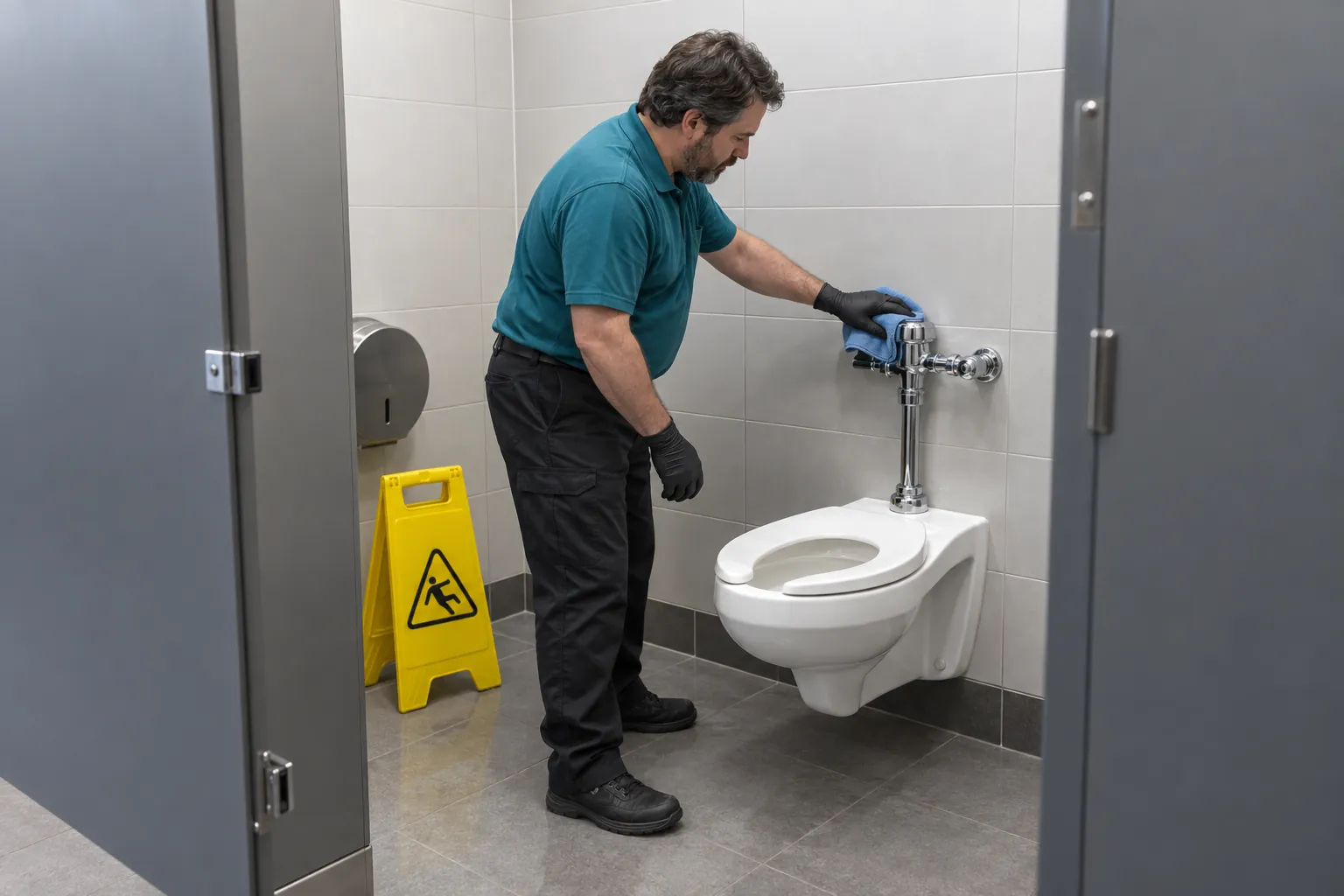
- Widen the cleaning to touched surfaces: door handles, washroom faucets and flush handles, railings, elevator buttons and light switches. See the guide to high-touch surfaces.
- Increase washroom cleaning. Public Health Ontario's FAQ suggests health care settings "may also consider increasing the frequency of cleaning and disinfecting the bathrooms and toilets" on affected units; the same logic applies to the washrooms nearest where people fell ill.
- Stop dry methods for a while. The same FAQ advises that vacuuming carpets and buffing floors "are not recommended during an outbreak, because they have the potential to re-circulate norovirus." Postpone the floor care program's burnishing night.
- Keep equipment to one area. Use a fresh mop head and cloths for each affected room.
- Launder promptly. The Public Health Agency of Canada advises that clothing and linens soiled with vomit or diarrhea be washed immediately.
Ill staff stay away. Health Canada's advice is to avoid contact with others until well, and to avoid preparing food "while you have symptoms and for the first three days after you recover." Cleaning staff who work while sick can carry the virus from one building to the next, so the contractor's absence policy is part of the cleaning plan.
When it is an outbreak. In Ontario, the Ministry of Health's Infectious Disease Protocol, Appendix 1: Gastroenteritis Outbreaks in Institutions and Public Hospitals (effective May 2022) defines a confirmed outbreak in those settings as "two or more cases meeting the case definition with a common epidemiological link (e.g., specific unit or floor, same caregiver) with initial onset within a 48-hour period", and says that if an outbreak is suspected, the local board of health should be notified. In an office, school, daycare or residential building, call the local public health unit and follow its instructions rather than improvise.
05
What a good spill record shows
PIDAC lists "documentation of the spill incident" among the things a written spill procedure must cover. Outside health care nobody prescribes the form, but a record lets a property manager answer a complaint and a supervisor check the contract's response time. A useful entry shows:
- Where: the building, floor and exact spot, such as "elevator 2", not just "lobby".
- When it was reported, and when someone arrived: the gap is the response time.
- Who cleaned it, by name.
- What was used, and that the label's contact time was followed.
- When the area reopened, and anything taken out of use.
- Anything that went wrong: an empty kit, a staff member splashed. An exposure also goes through the employer's incident process.
Where the spill was in a washroom provided for workers in Ontario, remember the separate washroom rule. The province's guidance, Maintaining clean washroom facilities for workers, explains that O. Reg. 480/24 requires the date and time of the two most recent cleanings of a washroom facility to be recorded, posted in a conspicuous place in or near it or available electronically with directions for workers. It also notes that an inspector may consider the washroom's actual condition, "such as visible soiling." Keep that posted record current as the rule requires; a spill log is in addition to it, not a substitute.
A janitorial scope of work should say who responds to body fluid spills, how fast at each time of day, who restocks the kits, and how each response is recorded.
06
Where the spill record fails, and what SiteClara does about it
Most vomit cleanups leave no trace. The guard radios the custodian, the custodian cleans it, and by morning nobody can say when it was reported, how long it took or whether the splashes were done. Where there is a log, it is often filled in at the end of the shift from memory. When public health asks what was cleaned and when, the answer is an assurance rather than a record.
SiteClara puts a tag at each location: a printed QR code, with an NFC tag behind it if staff would rather tap than scan. Anyone who finds a spill can scan the tag in the lobby or washroom and report it, with a photo if it helps, and it goes onto the cleaning team's list of open jobs with the time it was reported. The custodian who cleans it scans the same tag on their own phone, with no app to install, and closes the job; the time and the person are recorded as it happens, so the gap between report and response is plain to see. A supervisor can see what is still open across every building they look after.
Routine checks work the same way. If the site adds more frequent washroom or touch-point cleaning during a suspected outbreak, staff see what is due at each location and mark it done, or say what stopped them. At the end of the day the supervisor reviews the day, adds a note, and the approved report goes to the client or facility manager at 8 a.m. the next morning, showing what was done and what is still open.
07
Questions people ask
How do you disinfect a building after norovirus?
Clean first, then disinfect. Health Canada's Noroviruses page advises: "Thoroughly clean contaminated surfaces, and disinfect using chlorine bleach, especially after an episode of illness." Public Health Ontario's Significant Organisms in Environmental Cleaning: Frequently Asked Questions adds that disinfectants used during norovirus outbreaks "should have a virucidal claim", and that vacuuming carpets and buffing floors are not recommended during an outbreak, "because they have the potential to re-circulate norovirus." Whatever the product, follow the contact time on its label.
Is an everyday disinfectant spray enough to kill norovirus?
Not necessarily. Public Health Ontario's Significant Organisms in Environmental Cleaning: Frequently Asked Questions says that "most quaternary ammonium compounds do not have significant activity against norovirus and should not be used." Before relying on a spray as effective against norovirus, check its active ingredient and look for a DIN and a virucidal claim on the label.
How long does norovirus live on surfaces?
Public Health Ontario's Significant Organisms in Environmental Cleaning: Frequently Asked Questions says norovirus "can live on surfaces in the environment for up to 12 days", and that contaminated surfaces and equipment "play a significant role" in its spread. That is why the splashes and nearby touch points need disinfecting, not only the spill itself.
How should clothing soiled with vomit be washed?
Health Canada's Noroviruses page advises: "After an episode of illness, immediately remove and wash clothing or linens that may be contaminated with the virus (use hot water and soap)." For a cleaning team, the same care suits uniforms and reusable cloths and mop heads used on a spill: bag them at the scene and handle them with gloves until they are washed.
08
Further reading, and a checklist to take away
Start with Public Health Ontario's Significant Organisms in Environmental Cleaning FAQ, then the spill sections and Appendices 23 and 24 of PIDAC's Best Practices for Environmental Cleaning. The federal norovirus pages are short enough to share with staff. For chemicals, CCOHS's Cleaning Products – Working Safely covers WHMIS labels, safety data sheets and dilution, and warns that "products containing bleach and ammonia must never be mixed." For legal duties, read your own province's occupational health and safety law. If you suspect an outbreak, call your local public health unit.
Before the next norovirus season, check that you have:
- a written spill procedure, with a named responder for every hour the building is open;
- stocked spill kits in known places, checked on a schedule;
- a disinfectant with a DIN and a virucidal claim, and staff who know its contact time;
- bleach, if used, diluted fresh and never mixed with ammonia, acids or glass cleaner;
- trained custodians, guards and front-desk staff, with the training recorded;
- outbreak steps agreed in advance: more washroom and touch-point cleaning, no vacuuming or buffing;
- ill staff, contractors included, expected to stay away;
- every spill recorded with location, times, who cleaned it and what was used.
Sources
Every document this guide quotes or links to, in the order it first cites them.
- Significant Organisms in Environmental Cleaning: Frequently Asked Questions publichealthontario.ca
- Noroviruses canada.ca
- Best Practices for Environmental Cleaning for Prevention and Control of Infections in All Health Care Settings publichealthontario.ca
- Guide to the Occupational Health and Safety Act, Part III: duties of employers and other persons ontario.ca
- WHMIS – General ccohs.ca
- How to Remove Personal Protective Equipment publichealthontario.ca
- Norovirus: Prevention and risks canada.ca
- Surface disinfectants for emerging viral pathogens canada.ca
- Chlorine Dilution Calculator publichealthontario.ca
- Infectious Disease Protocol, Appendix 1: Gastroenteritis Outbreaks in Institutions and Public Hospitals files.ontario.ca
- Maintaining clean washroom facilities for workers ontario.ca
- Cleaning Products – Working Safely ccohs.ca
Related guides
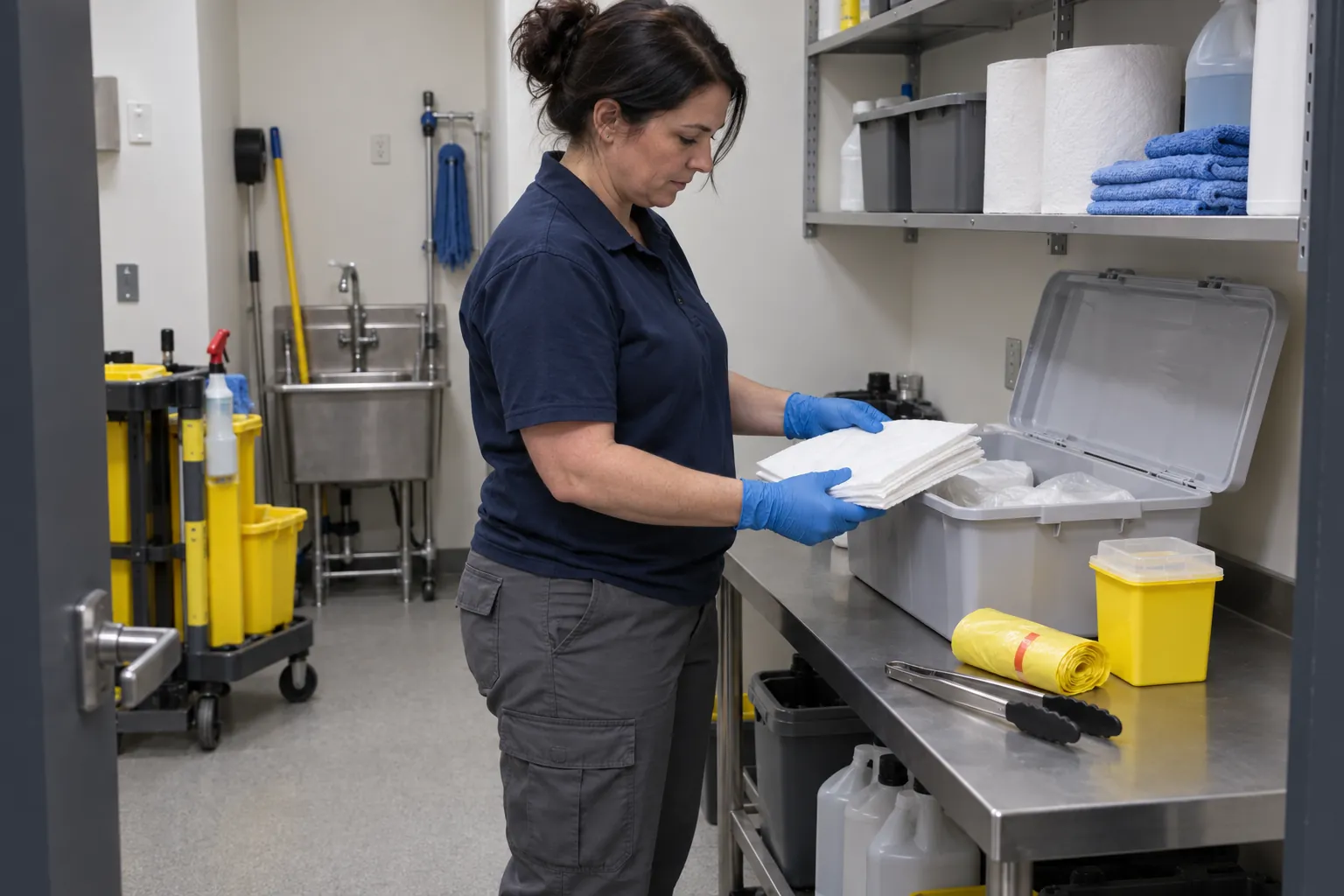 CleaningBlood spill cleanup: a workplace procedure for CanadaHow to clean up a blood spill at work in Canada: the kit, a step-by-step procedure, bleach strengths, needles in the spill, exposures and the record to keep.
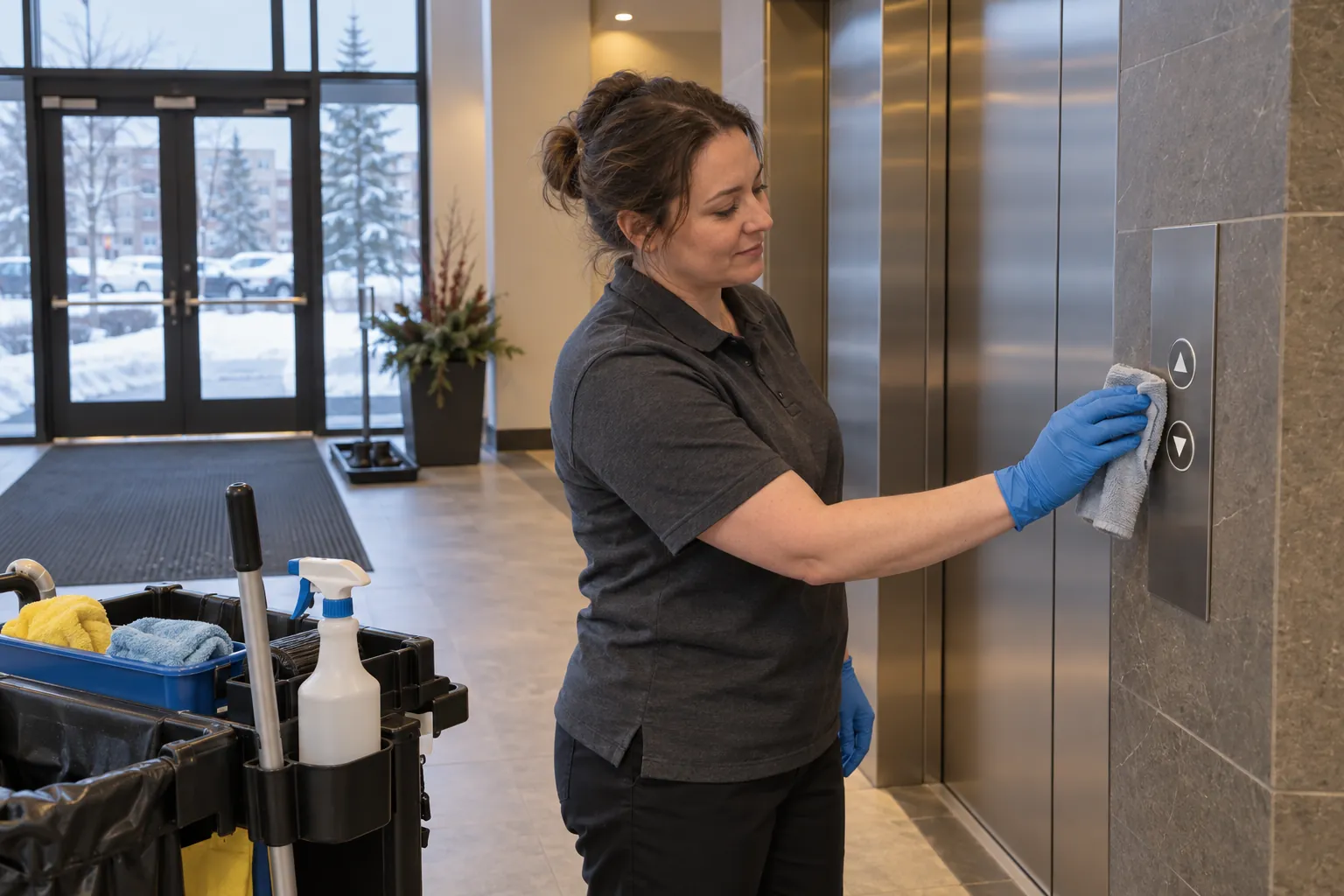 CleaningHigh-touch surfaces: what counts, how often to clean them, and how to prove itHigh-touch surfaces in Canadian workplaces: what counts, how often to clean and disinfect them, how to do it properly, and how to check it was really done.
 CleaningHealth Canada approved disinfectants: what the DIN tells you, and how to use itHow to tell a Health Canada approved disinfectant: the DIN, what the label must show, how to check it, and what the Biocides Regulations changed.
 CleaningWashroom cleaning checklist: what to check, how often, and Ontario's new cleaning recordsWhat a workplace washroom cleaning checklist should cover, how often to clean, and Ontario's posted cleaning records required since January 1, 2026.