Premises and facilities management
AED inspection: the monthly check, the record, and what the law asks
An AED inspection is a routine check, monthly under Manitoba's law, that an automated external defibrillator (AED) is in its place, shows it is ready, and has a working battery and in-date pads, so it can deliver a shock the moment someone goes into sudden cardiac arrest.
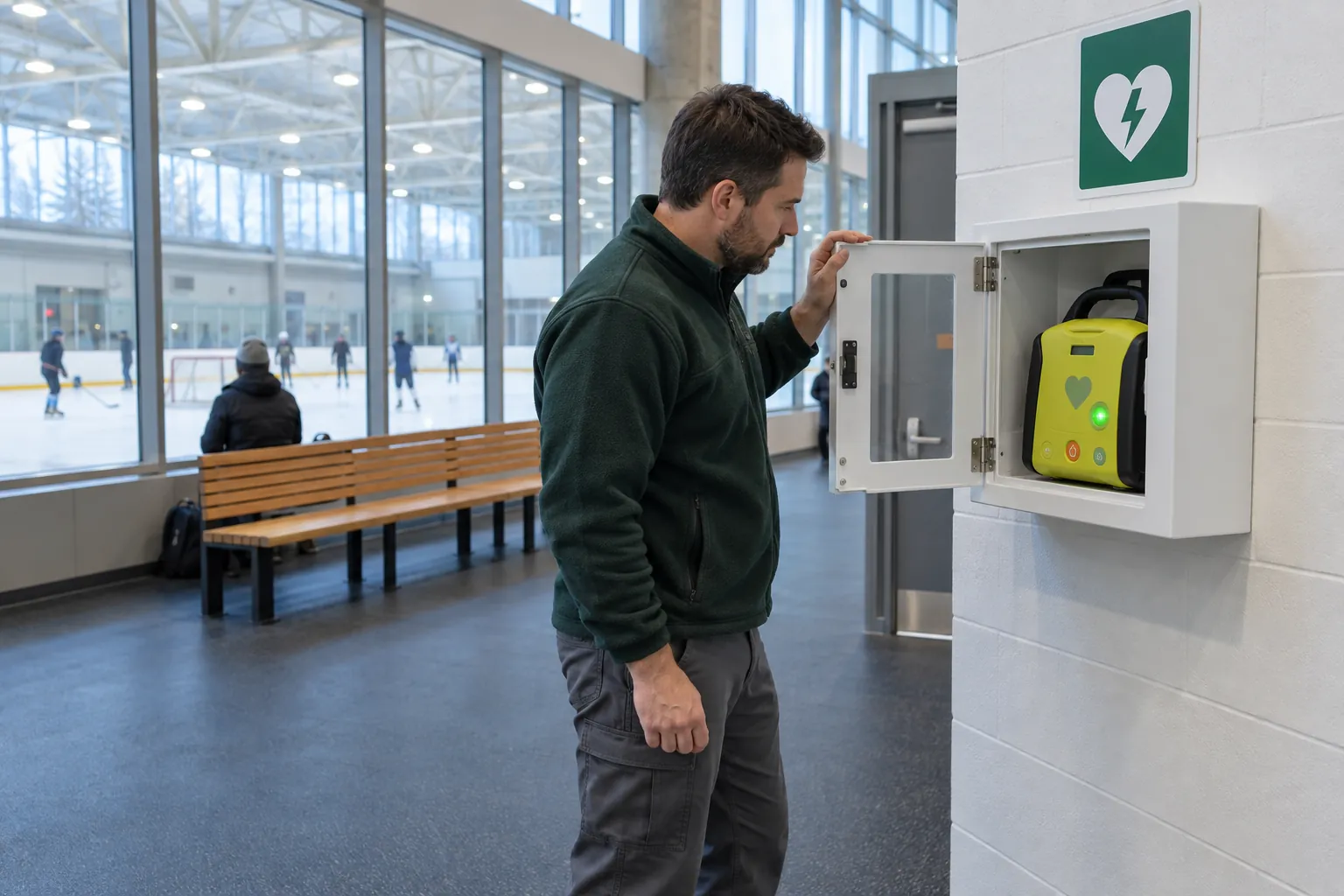
An AED on the wall only helps if it works on the day someone collapses. Most AEDs test themselves, but a self-test cannot see a blocked cabinet, an expired set of pads or a device someone moved to a storeroom. This guide covers what a routine AED inspection checks, how often, who does it, what Manitoba's legislation requires, where Ontario stands, and what a record should show so a property manager can rely on it.
01
Is AED inspection required in Canada?
It depends on the province and on the building. The Canadian Centre for Occupational Health and Safety puts the starting point plainly in CCOHS OSH Answers: First Aid – Automated External Defibrillators: "In Canada, currently, there is no occupational health and safety (OHS) legislation that specifically requires employers to have AEDs installed in the workplace." Where the duty exists, it comes from public access legislation aimed at owners of designated public places, not from the workplace health and safety acts.
Manitoba is the clearest example. The Defibrillator Public Access Act, C.C.S.M. c. D22 requires the owner of a designated premises to install one or more defibrillators, make them available to the public, keep signs displayed and register each one within 30 days. Section 8 is the inspection duty: the owner must ensure the defibrillator "is maintained and tested in accordance with the manufacturer's guidelines", and must make and maintain records of that maintenance and testing in accordance with the regulations.
The detail is in the Defibrillator Public Access Regulation, M.R. 150/2012. It lists the designated premises (schools, university and college campuses with an indoor athletic facility, indoor public pools, indoor ice arenas, curling clubs, fitness clubs with 150 or more members or at least 20 hours of indoor group programs in most weeks, community recreation facilities with the same 20 hours of programs, homeless shelters, airport, train and bus terminals, casinos, golf course clubhouses and a list of named venues), and adds a monthly inspection to the manufacturer's schedule. Section 15 says the owner must ensure the defibrillator is "inspected on a monthly basis" against the items in Schedule D; section 16 requires an inspection tag on the device; section 17 requires a monthly inspection record kept for 12 months.
Ontario passed Bill 141, the Defibrillator Registration and Public Access Act, 2020 (S.O. 2020, c. 8), which received Royal Assent on June 18, 2020. It would require owners of designated premises to install, maintain, test and register defibrillators, but it comes into force only on a day to be named by proclamation, and CCOHS describes it as not yet in force. Check the Act's status on e-Laws before treating it as binding on an Ontario building.
Everywhere else, an AED that has been installed is still safety equipment people will rely on. The manufacturer's guidelines set its maintenance schedule, and Health Canada says AEDs should be checked regularly. A voluntary AED program deserves the same monthly inspection as a mandatory one.
It matters because the device is only useful in the first minutes. The Heart and Stroke Foundation's page on AEDs says that performing CPR and using an AED on a person in cardiac arrest can double their chance of survival, and that nine in 10 cardiac arrests outside hospital will result in death without immediate intervention.
02
What an AED inspection covers
Schedule D of the Manitoba regulation is a good checklist for any Canadian building, whether or not the law applies to it. At a minimum, each monthly inspection confirms that:
- The AED can be seen and reached: it is in its place, visible and unobstructed, with no furniture, carts, stored materials or locked door in the way.
- No maintenance indicator is showing: the status light is green or the display shows ready, with no blinking warning, chirping or error message.
- The battery is properly installed and in good working condition, with clean electrodes.
- There is no visible physical damage to the case, the connector or the pad cable.
- The device is clean, with no unusual dirt or contamination.
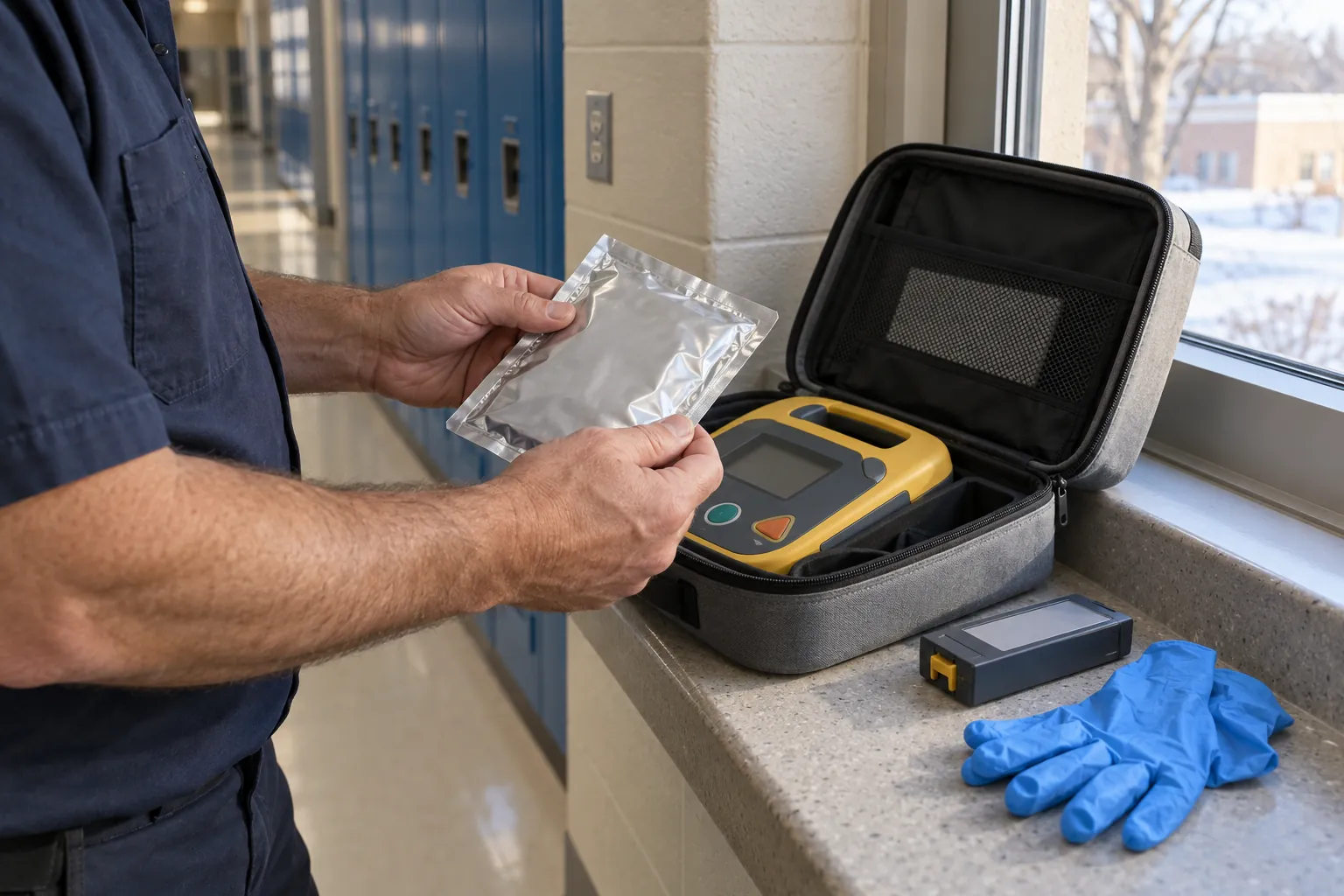
- The supplies are present, sealed and in date: two sets of defibrillator pads, a set of pediatric pads if the model needs them to be used on a child, a pocket mask with a one-way valve, medical examination gloves, absorbent gauze or hand towels, scissors to cut clothing, and a razor to remove chest hair.
A good inspection also looks at what surrounds the device:
- The signs at the main entrance and beside the device are still up and readable.
- The cabinet opens as it should, and its alarm sounds if it has one.
- The registered location still matches where the device actually is.
The inspection is a visual and functional check of the unit's readiness by a trained person following the manufacturer's instructions. It is not a service. Anything beyond the manual's user checks, such as a failed self-test that does not clear, damage to the case or a software update, goes to the manufacturer or its authorized service provider.
03
How often, and who does it
Monthly is the floor in Manitoba and a sensible default elsewhere. Most programs build a few layers around it:
- A quick look at the status indicator, daily or weekly, often folded into an existing round: the building operator's walk-through, a security guard's patrol, the custodian's opening check. It takes seconds and catches a warning light weeks before the monthly check would.
- The monthly inspection against the full checklist, with the tag and the record completed.
- After every use: pads and razor replaced, the device checked against the manual, the data handed over if the manufacturer or paramedics ask for it, and the device back in service or a loaner in its place.
- Whenever the device alerts: section 14 of the Manitoba regulation says that when a defibrillator indicates by a blinking light, chirping sound or other indicator that immediate maintenance is necessary, the owner must "forthwith inspect the defibrillator" and do whatever maintenance or testing is needed.
- On a recall or safety notice: Health Canada publishes advisories for AEDs on its recalls and safety alerts site. The Health Canada recall notice for the Powerheart AED G5 (started February 27, 2025) concerned devices that could fail their self-test after prolonged exposure to extreme temperature or humidity, and told users to monitor the self-test status. A program needs someone who reads these.
- Ahead of expiry dates: pads and batteries are ordered before they expire, not on the day the inspection finds them out of date.
On who can inspect, Manitoba's Questions and Answers about Defibrillators in Public Places says owners can make their own arrangements: it could be the owners themselves or an authorized employee or agent. In practice the duty sits with the owner, and the property manager or facility manager organizes it. The monthly check is often done by the building operator, the superintendent, a security supervisor or the first aid attendant; some owners contract it to the AED supplier.
What matters is that the job is named. A device that belongs to everybody in a multi-tenant office, a condo lobby or a school gym is checked by nobody. Write down who inspects monthly, who covers holidays, who orders pads and batteries, who reads recall notices, and who hears about a warning light. Where there is a joint health and safety committee, add the AED to its workplace inspection route too.
Training is a separate question. The Manitoba FAQ notes that anyone can use an AED by following its voice prompts, while CCOHS says an employer should have a training program by an approved training agency. The inspector needs to know the checks the manual sets out.
04
Placement, signs and registration
An AED inspection checks placement against a standard, and Manitoba's is the most specific in Canada. Section 4 of the regulation requires enough defibrillators that a member of the public witnessing a cardiac arrest anywhere on the premises can reach one and return to the victim "in less than three minutes". Section 7 says each one must be readily visible, on or near common paths of travel, free from blockage by equipment or stored materials, and protected as far as reasonably possible from environmental damage. Sections 8 and 9 require signs at the main entrances and next to each device, using the heart and lightning bolt symbol with the words Automated External Defibrillator or AED, in contrasting colours.
The same test works anywhere. Walk from the farthest corner of the floor, the gym or the parking garage to the AED and back, and time it. A door locked after hours, a device behind a reception desk that closes at 5 p.m., or one moved during a renovation belongs in the inspection record.
Registration tells 911 dispatchers where the device is, so a caller can be sent to fetch it:
- Manitoba: registration within 30 days of installation is required for designated premises, with Shared Health acting as registrar, and the FAQ says the registry is shared with 911 dispatchers. Section 11 of the regulation requires the registrar to be told within 15 days when a defibrillator is moved or removed.
- British Columbia: BC Emergency Health Services encourages organizations and public venues to register their AEDs through the PulsePoint AED registry, described on its PulsePoint CPR app page.
- Quebec (Montréal and Laval): Urgences-santé, the ambulance service for Montréal and Laval, asks buildings with an AED to register with its health communication centre, which receives 9-1-1 calls, as explained on its page Programme d'accès à la défibrillation. Elsewhere in Quebec, check with the regional emergency medical service.
- Ontario: Bill 141 would require registration within 30 days of installation once it is in force; until then, check with your local paramedic service.
A registration that is out of date can be worse than none, because it sends someone to an empty wall. The monthly inspection is the natural moment to confirm the registered location still matches the device.
05
What a good AED inspection record shows
Manitoba sets out what the record contains. Under section 17(2) of the regulation, the monthly inspection record shows the location of the defibrillator, its serial number, its registration number, the date of the inspection, the name of the person who did it, confirmation that every Schedule D item was inspected and any corrective action taken, and the name and contact details of the distributor. Section 16 puts a shorter version on a tag attached to the device, which stays on it for at least 12 months. That is a good template for any province, and CCOHS recommends keeping documented records of maintenance checks, repairs and replacements.
A record someone can rely on also has these qualities:
- It is made at the device, at the time. A tag initialled in advance, or a monthly sheet filled in at the desk, says the check was planned, not that it was done.
- It is specific. Ready indicator seen; pads expire March 2027; battery installed September 2025; cabinet alarm tested. A tick against AED OK tells a reader very little.
- It records the exception and what happened next. Pads out of date, ordered on the 4th, replaced on the 9th. A missed month is recorded as missed, with the reason.
- It shows the dates ahead: when the pads and battery expire, so they can be ordered in time.
- It covers every device. A building with five AEDs has five records, one per location, not one line for the building.
- It sits with the other life-safety records, alongside the first aid kit and eyewash station checks, so a property manager, an insurer or an inspector can see the whole picture in one place.
A photograph of the status indicator and the pad expiry date is quick to take and shows what the inspector saw, which is more than a signature does.
06
Where the AED record fails, and what SiteClara does about it
AED programs rarely fail at the purchase. They fail in year two or three. The inspection tag has twelve boxes initialled in the same pen. The person who did the checks left, and nobody took the job over. The pads expired in the spring and the reorder waited for a purchase order. A security guard heard the device chirping on a night patrol and mentioned it to whoever was at the desk, and the message never reached the property manager. None of this shows on a spreadsheet until someone opens the cabinet in an emergency.
SiteClara records the checks where they happen. A printed QR poster, with an optional NFC tag behind it, sits beside each AED cabinet. The person doing the monthly inspection, or the operator or guard glancing at the status light on a round, scans or taps with their own phone, with no app to install, sees the checks due at that location and marks each one done, or explains what stopped them. The time and the named person are recorded as it happens, with a photo when one is asked for, such as the ready indicator or the pad expiry date. A problem found at the cabinet, such as a warning light, missing supplies or a blocked route, goes onto the team's list of jobs until someone closes it.
The supervisor sees what was due, what was done and what was missed at each location, and records the reason for anything missed. Each day they review the record, add a note and approve a report that goes to nominated managers the next morning, so the property manager or the owner can see that each device was checked, month by month and location by location, rather than taking it on trust.
07
Questions people ask
How often should an AED be inspected?
Monthly, as well as whatever the manufacturer recommends. Section 15 of Manitoba's Defibrillator Public Access Regulation, M.R. 150/2012 requires a monthly inspection against Schedule D on top of maintenance and testing according to the manufacturer's guidelines, and section 14 requires an inspection at once whenever the device shows a blinking light, chirping sound or other maintenance indicator. Health Canada's page on automated external defibrillators says to follow the manual's recommended maintenance and testing schedule.
What are the requirements for AEDs in Ontario?
Ontario has no AED requirements in force yet. Bill 141, the Defibrillator Registration and Public Access Act, 2020 received Royal Assent on June 18, 2020, but it comes into force only on a day to be named by proclamation. Once in force, it would require owners of designated premises to install, maintain, test and register defibrillators.
What is the 3-minute rule for AED?
It is the placement test in section 4 of Manitoba's Defibrillator Public Access Regulation, M.R. 150/2012: a designated premises needs enough defibrillators that someone witnessing a cardiac arrest anywhere on the premises can reach one and return to the victim in less than three minutes.
What does AED stand for?
Automated external defibrillator. The Heart and Stroke Foundation's page on AEDs describes it as a safe, easy-to-use, portable device that can deliver a shock to a person in cardiac arrest, and says it will only shock a heart that needs it.
Which is first, CPR or AED?
CPR, until the AED arrives. The Heart and Stroke Foundation's page on AEDs sets out three steps: call 9-1-1 and shout for an AED, start CPR right away, and use an AED as soon as one is available.
08
Where to read more, and a checklist to take away
The primary sources, all from the owners' own sites:
- The Defibrillator Public Access Act, C.C.S.M. c. D22 and the Defibrillator Public Access Regulation, M.R. 150/2012 (Manitoba).
- Questions and Answers about Defibrillators in Public Places (Manitoba Health).
- Bill 141, Defibrillator Registration and Public Access Act, 2020 (Legislative Assembly of Ontario).
- CCOHS OSH Answers: First Aid – Automated External Defibrillators.
- Health Canada: Automated external defibrillators (AEDs).
- The manufacturer's manual for each model you own, which sets the maintenance and testing schedule.
A monthly AED inspection, in short:
- Name the owner of the AED program, the monthly inspector and a deputy.
- Keep a list of every AED: location, serial number, registration number, distributor.
- Check the status indicator often, as part of rounds that already happen.
- Once a month, check placement, access, indicator, battery, damage, cleanliness, pads and the accessory kit.
- Record the inspection at the device, at the time, with the name, date and anything wrong.
- Act on every warning light or chirp immediately, not at the next monthly check.
- Order pads and batteries before they expire, and keep a spare battery.
- Replace single-use items after every use, and follow the manual before returning the device to service.
- Watch Health Canada's recalls and safety alerts for the models you own.
- Keep the registration current when a device is added, moved or removed, and keep records for at least 12 months, or longer if your program or insurer asks.
Sources
Every document this guide quotes or links to, in the order it first cites them.
- CCOHS OSH Answers: First Aid – Automated External Defibrillators ccohs.ca
- The Defibrillator Public Access Act, C.C.S.M. c. D22 web2.gov.mb.ca
- Defibrillator Public Access Regulation, M.R. 150/2012 web2.gov.mb.ca
- Bill 141, the Defibrillator Registration and Public Access Act, 2020 ola.org
- Heart and Stroke Foundation's page on AEDs heartandstroke.ca
- Health Canada recall notice for the Powerheart AED G5 recalls-rappels.canada.ca
- Questions and Answers about Defibrillators in Public Places gov.mb.ca
- PulsePoint CPR app page bcehs.ca
- Programme d'accès à la défibrillation urgences-sante.qc.ca
- Health Canada's page on automated external defibrillators canada.ca
Related guides
 Premises and facilities managementFirst aid kit requirements: what the law asks, province by provinceWorkplace first aid kit requirements in Canada: Ontario's Regulation 1101, CSA Z1220-17 kits in Alberta and B.C., federal rules, and how often to inspect.
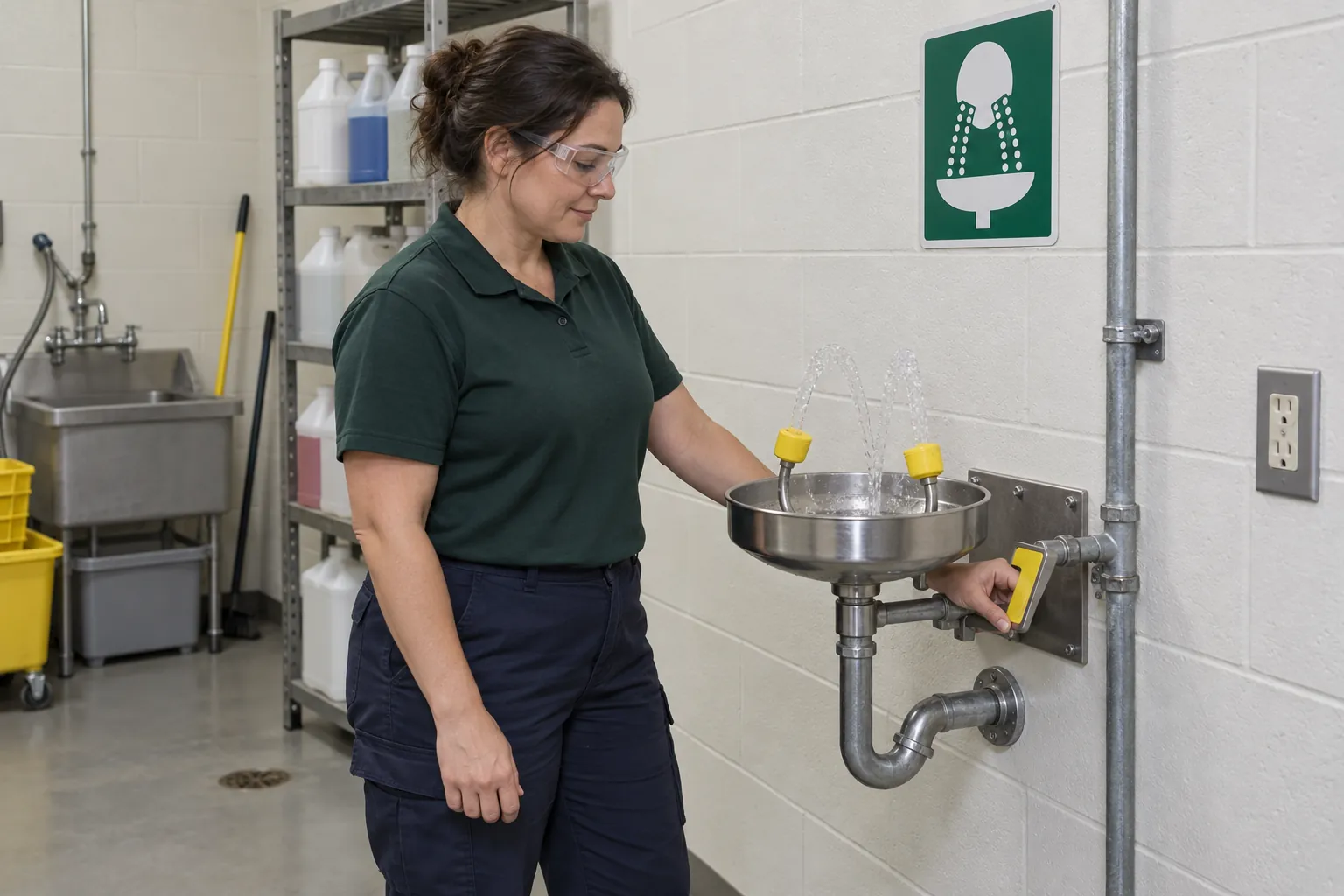 Premises and facilities managementEyewash station requirements: what the law asks, and how to keep them workingEyewash station requirements in Canada: Ontario, Alberta, B.C. and federal rules, the ANSI Z358.1 benchmark, weekly and monthly flushing, and what to record.
 Premises and facilities managementWorkplace inspection checklist: how a JHSC inspection should workA workplace inspection checklist for Canadian JHSCs and representatives: Ontario, BC, Alberta and federal rules, what to walk, how often and what to record.
 Premises and facilities managementPreventive maintenance checklist: what to include, how often, and how to show it was doneA preventive maintenance checklist for Canadian buildings: what the fire code and provincial law require, what to include, how often, and the records to keep.