Fire and water checks
Fire safety plan: what it must contain, who approves it, and how to keep it true
A fire safety plan is a written, building-specific document setting out the emergency procedures to follow when the fire alarm sounds, who is responsible for what, and how the building's fire protection is kept working the rest of the year.
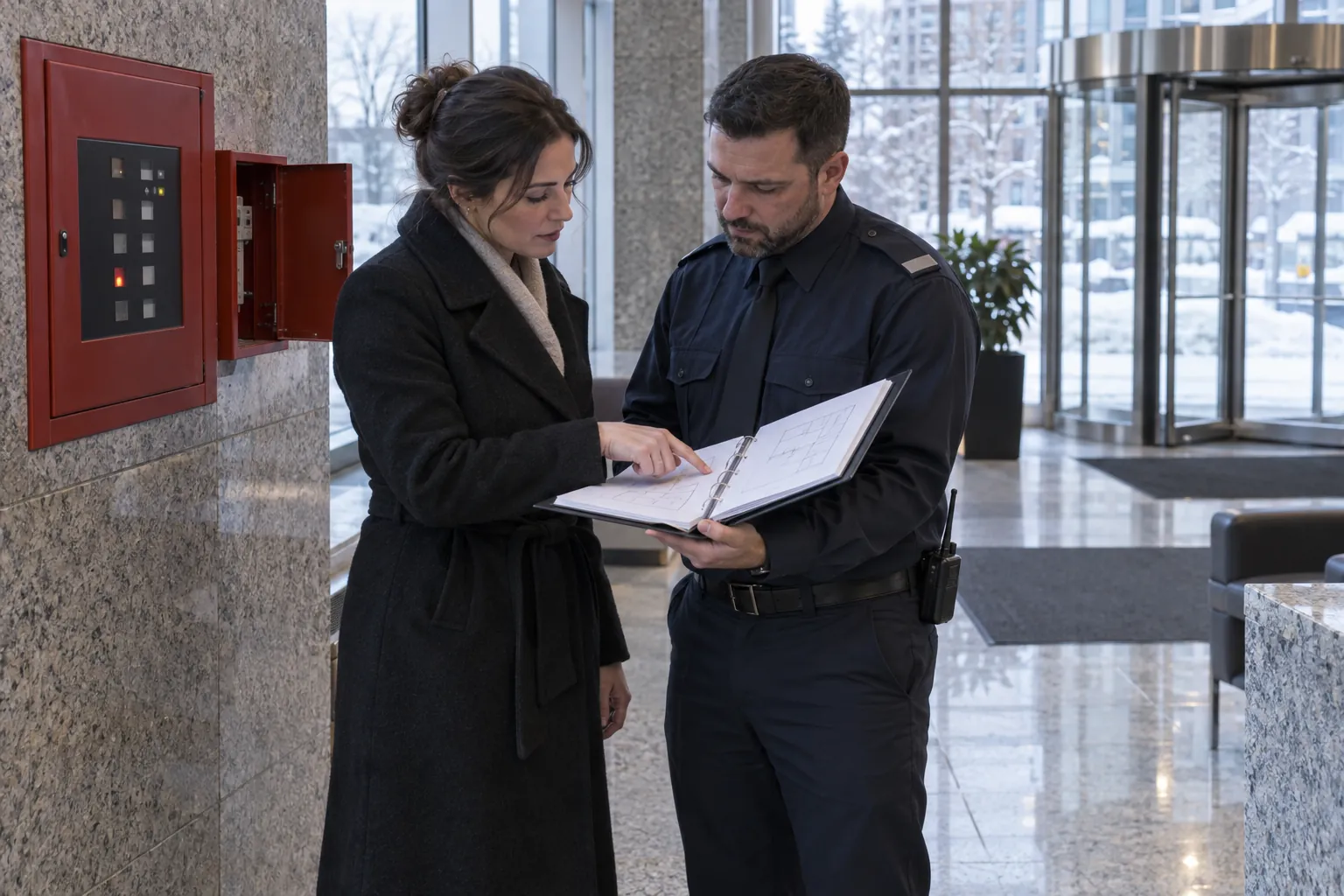
Most larger and higher-risk buildings in Canada must have one under their province's fire code. This guide covers which code applies, what Section 2.8 requires the plan to contain, who approves it and how often it is reviewed, and the checks and records that show the plan is being followed rather than sitting in a binder.
01
Which fire code requires a fire safety plan
Fire safety in existing buildings is provincial and territorial law in Canada. The starting point is the National Fire Code of Canada 2025, developed by the Canadian Board for Harmonized Construction Codes and published free by the National Research Council (NRC). It is a model code: as the NRC's Codes Canada frequently asked questions put it, Codes Canada publications "are model documents only and must be adopted by an authority having jurisdiction in order to come into effect". Several provinces and territories adopt the national code by reference, while Alberta, British Columbia, Ontario and Quebec publish codes of their own based on it. The edition in force where you are may not be the newest one.
In every version, the fire safety plan lives in Division B, Section 2.8, Emergency Planning. The main provincial versions are:
- Ontario: the Ontario Fire Code, O. Reg. 213/07, a regulation under the Fire Protection and Prevention Act, 1997. As the province's page on fire safety legislation and Ontario's Fire Code says, "The owner of the building is responsible for complying with the Fire Code, except where otherwise specified. Municipal fire departments enforce the Fire Code."
- British Columbia: the BC Fire Code 2024, in effect since 8 March 2024, which the province describes as an adopted National Fire Code with a few amendments made by ministerial order.
- Alberta: the National Fire Code – 2023 Alberta Edition.
- Quebec: the Chapitre Bâtiment du Code de sécurité du Québec incluant le CNPI 2020, administered by the Régie du bâtiment du Québec, in force since 17 April 2025 with the earlier provisions usable until 16 October 2026; the RBQ lists the conformity and implementation of fire safety plans among its changes.
Ontario's rules are quoted most in this guide, with the national code noted where it differs. Whatever the province, the duty falls on the owner: the Ontario Fire Code (Division A, Article 1.2.1.1) says that "unless otherwise specified, the owner is responsible for carrying out the provisions of this Code". The national code (Division C, Article 2.2.1.1) places it on "the owner or the owner's authorized agent", often the property manager.
02
What a fire safety plan must contain
The Ontario Fire Code (Division B, Sentence 2.8.2.1.(1)) says that "a fire safety plan shall be prepared, approved and implemented" in every building to which Section 2.8 applies. Approved is a defined term: approved by the Chief Fire Official, who is the municipal fire chief, a member of the fire department the chief appoints, or a person the Fire Marshal appoints. Sentence 2.8.2.1.(2) then sets out what the plan must do. It shall:
- Provide for the emergency procedures in case of fire, including sounding the fire alarm, notifying the fire department, instructing occupants on what to do when the alarm sounds, evacuating occupants "including special provisions for persons requiring assistance", procedures for use of elevators, and confining, controlling and extinguishing the fire.
- Provide for the appointment and organization of supervisory staff to carry out fire safety duties.
- Provide for the training of supervisory staff and the instruction of other occupants in their responsibilities for fire safety.
- Include documents and diagrams showing the type, location and operation of the building fire emergency systems.
- Provide for the holding of fire drills and set out fire drill procedures.
- Provide for the control of fire hazards in the building.
- Provide for the maintenance of building facilities provided for the safety of occupants.
- Provide for alternative measures for the safety of occupants during a shutdown of any or all fire protection equipment or systems.
The national code's list (Sentence 2.8.2.1.(3)) is close to Ontario's, with clause (g) worded as "the inspection and maintenance of building facilities provided for the safety of occupants". It has no clause on alternative measures during a shutdown, and it asks for elevator procedures only in high buildings (Article 2.8.2.2). It also says the plan shall be "prepared in cooperation with the fire department and other applicable regulatory authorities".
Some buildings need more. A high building adds the voice communication system, the actions supervisory staff take to start smoke control until the fire department arrives, and fire department access (Ontario Article 2.8.2.3); buildings storing dangerous goods add after-hours contacts and storage details (Articles 2.8.2.5 and 2.8.2.6).
Two parts of the plan leave the binder and go on the wall or into people's hands:
- Posted procedures. "At least one copy of the fire emergency procedures shall be prominently posted and maintained on each floor area" (Ontario Sentence 2.8.2.8.(1)). A hotel also posts the approved plan in its main reception area and the emergency procedures, exits and fire safety rules inside each guest suite door.
- Copies for supervisory staff. A copy of the fire emergency procedures and other duties for supervisory staff, as laid down in the plan, "shall be given to all supervisory staff" (Article 2.8.2.4).
The plan itself "shall be kept in the building or premises in an approved location" (Sentence 2.8.2.1.(3)); in a high building the national code puts it at the central alarm and control facility (Article 2.8.2.12).
03
Who does what: owners, supervisory staff and everyone else
A fire safety plan is only as good as the people named in it. The Ontario Fire Code defines supervisory staff as "those occupants of a building who have some delegated responsibility for the fire safety of other occupants under the fire safety plan". In an office tower that is usually the building's property management and operations team, security at the lobby desk, and the floor or fire wardens each tenant appoints. In a school it typically includes the principal, custodial staff and teachers. In a condominium it may be the property manager, the superintendent and concierge.
The code sets a few firm rules about them:
- Trained first. "Supervisory staff shall be instructed in the fire emergency procedures as described in the fire safety plan before they are given any responsibility for fire safety" (Ontario Sentence 2.8.1.2.(1)).
- Available when needed. They "shall be available on notification of a fire emergency to fulfil their obligation", but they "are not required to be in the building on a continual basis", subject to Article 2.8.2.2, which sets staffing rules for care, care and treatment, and detention occupancies, retirement homes and hotels (Sentences 2.8.1.2.(2) and (3)).
- Keys to hand. Any keys or special devices needed to operate the fire alarm system or reach fire protection equipment "shall be readily available to on-duty supervisory staff" (Article 2.8.1.4).
The rest of the building's team matters too. The janitorial crew is often the only group in the building after hours, building operators keep the alarm panels and generators running, and tenants' staff need to know the procedures posted on their floor. A plan written for the owner's own staff alone misses most of the people who will be there when the alarm goes.
Contractors are a common gap. Before demolition or construction, "including hot surface applications", begins, the Ontario plan must be revised to add temporary alternative measures for occupants and temporary procedures to control the work's fire hazards, and the revised plan implemented (Sentences 2.8.2.1.(5) and (6)).
04
Keeping the plan current: reviews, drills and shutdowns
A fire safety plan is not a document you write once. In Ontario it "shall be reviewed as often as necessary, but at least every 12 months, and shall be revised as necessary so that it takes into account changes in the use or other characteristics of the building or premises" (Sentence 2.8.2.1.(4)); the national code sets the same 12-month ceiling. A new tenant, a renovation, a new property manager or security contractor, or a lesson from a drill should prompt a review sooner.
Fire drills are the plan's rehearsal. The drill procedure is part of the plan and, in Ontario, is prepared in consultation with the Chief Fire Official (Sentence 2.8.3.1.(2)). The Ontario frequencies (Article 2.8.3.2) include:
- at least once in each 12-month period for supervisory staff, as the general rule;
- at least monthly for supervisory staff in care occupancies, care and treatment occupancies, detention occupancies, retirement homes and most child care premises;
- total evacuation drills at least three times in each of the fall and spring terms in schools;
- at least every three months in high buildings within Subsection 3.2.6. of the Building Code, and in laboratories.
The national code's intervals differ in places, for example not more than two months in high buildings, so use your own province's code. In Ontario, "a record shall be prepared of every fire drill" and kept for at least 12 months (Article 2.8.3.4), and in care occupancies, care and treatment occupancies and retirement homes, supervisory staff training must also be recorded and kept in the building for at least two years (Sentences 2.8.2.1.(7) and (8)).
Shutdowns are where plans are most often forgotten. When a sprinkler zone is drained for repairs, a fire alarm panel is replaced or detectors are covered for dusty work, clause 2.8.2.1.(2)(h) requires the plan to provide "alternative measures" for occupants' safety. Those measures, such as extra patrols, a fire watch, notifying the fire department and the monitoring company, and telling occupants, should be written down in advance, so that the building operator does not have to invent them on the morning of the work.
05
The routine checks behind the plan, and the records to keep
Clause (g), the maintenance of building facilities provided for the safety of occupants, links the plan to the everyday checks the rest of the fire code requires. The plan usually sets out who does each check and how often. A few examples show the range:
- portable extinguishers "shall be inspected monthly" (Article 6.2.7.2);
- the central alarm and control facility "shall be checked daily for indication of trouble in the system" (Article 6.3.2.3);
- the checks the plan itself sets, such as exits and stairwells kept clear, fire doors closing and latching, and the posted fire emergency procedures still in place on each floor.
The national code makes the link explicit for fire separations: doors in fire separations "shall be operated at intervals not greater than one month", as specified in the fire safety plan (Division B, Sentence 2.2.2.4.(3)). The heavier inspections and tests, such as those of the fire alarm and sprinkler systems, are usually carried out by specialist contractors; the plan names who arranges them, and the daily, weekly and monthly checks in between are done by the building's own people.
Then there is the record. The Ontario Fire Code (Division C, Article 1.1.2.1) says that where the code "requires tests and corrective measures or operational procedures to be carried out, records shall be made noting what was done and the date and time it was done", kept at the building for the Chief Fire Official; "electronic records that can be made readily available to the Chief Fire Official upon request, are deemed to comply". Records are kept for at least two years, with at least the most recent and the preceding record of each test (Article 1.1.2.2). The national code (Division C, Article 2.2.1.2) is similar.
Good evidence that the plan is working looks like this:
- each check recorded when it was done, with the date, time and person, not filled in at the end of the month;
- a missed check recorded as missed, with the reason;
- defects such as a blocked exit or a door wedged open reported, fixed and closed with a date;
- drill records that say what happened and what needs to change;
- a current list of supervisory staff with training dates, and a dated note of each annual review.
06
Where the record fails, and what SiteClara does about it
The plan is usually fine on the day it is approved. What goes wrong is everything after. The supervisory staff list names people who left years ago, the diagrams predate the renovation, monthly checks are initialled in a batch before the inspector's visit, and a door wedged open is mentioned to whoever happens to be passing. When the Chief Fire Official asks what was done and when, the answer is assembled from memory.
SiteClara records the routine checks at the place they happen. A printed QR poster, with an optional NFC tag behind it, sits at each location a check is scheduled, such as an extinguisher point, a stairwell door or the fire alarm annunciator. Staff scan the code or tap the tag on their own phone, with no app to install, see the checks due there, and mark each one done or say what stopped them, such as a locked room. The time and the named person are recorded as it happens, with a photo when the check asks for one. A problem, such as an obstructed exit or a missing extinguisher, is reported there with a photo and goes onto the team's list of jobs until someone closes it.
The supervisor sees what is due, done and missed, and records the reason a check was missed; a job that needs the building manager can be escalated to them to answer. Each day the supervisor reviews and approves a report that goes to nominated management or client contacts at 8 a.m. the next morning, showing what was reported, what was completed, what is still open, and how the scheduled checks went, for example 12 of 12 completed. The owner sees each day whether the checks the plan relies on are being done.
07
Questions people ask
Who needs a fire safety plan in Ontario?
Article 2.8.1.1 of the Ontario Fire Code, O. Reg. 213/07 sets the list. It covers buildings containing an assembly, care, care and treatment or detention occupancy; a residential occupancy where the occupant load exceeds 10; a retirement home; a business and personal services or mercantile occupancy where the occupant load exceeds 300; and industrial occupancies above set occupant loads (25 for high-hazard, 100 for medium-hazard and 300 for low-hazard). It also covers any building "containing 4 storeys or more, counting storeys below grade", convalescent homes and children's custodial homes providing sleeping accommodation for more than three people, recreational camps, and premises to which certain other parts of the code apply.
Do you have to submit a fire safety plan to the fire department?
In Ontario the plan must be approved by the fire department. Sentence 2.8.2.1.(1) of the Ontario Fire Code, O. Reg. 213/07 says a fire safety plan "shall be prepared, approved and implemented", and the code defines approved as "approved by the Chief Fire Official", who is the municipal fire chief, a member of the fire department the chief appoints, or a person the Fire Marshal appoints. Your local fire department sets how plans are submitted. In Alberta, the City of Calgary's Fire safety plan page says that if you need your plan "accepted in writing, wish to have it reviewed, or it requires further input or corrections", you submit it through the city's 311 process, and that "submitting a fire safety plan for review is subject to a fee".
Where can I find a template for a fire safety plan in Ontario?
The Ontario Fire Code sets what the plan must contain but does not include a template. The Office of the Fire Marshal's technical guidelines on fire safety planning, such as Fire Safety Planning for Industrial Occupancies (TG-01-2016) and Fire Safety Planning for Institutional Facilities (TG-02-1999), are listed on Ontario's page on fire safety legislation and Ontario's Fire Code, which says they "are available upon request and in PDF format" from AskOFM@ontario.ca. Because your local fire department approves the plan, ask its fire prevention office what format it expects before you start.
Is there a fire safety plan template for Alberta?
In Calgary, the City of Calgary's Fire safety plan page offers building owners a vital building information form, which it describes as "a quick reference sheet for initial responders", along with approved fire safety plan symbols and sample base building and fire alarm zone drawings. The same page lists the buildings and businesses that need a plan under the National Fire Code (Alberta Edition), including "buildings containing an assembly, care, treatment, or detention occupancy" and "buildings that require a fire alarm system according to the Alberta building Code". It also names four types of plan (building and high building, construction and demolition site, hot works and hot surface, and special event) and says there may be additional requirements depending on which type you need.
08
Where to read the code, and a list to take away
The National Fire Code of Canada 2025 is free to read through the NRC Publications Archive, as is the National Fire Code of Canada 2020, the edition Quebec's current chapter incorporates. In Ontario, read Division B, Section 2.8 of the Ontario Fire Code, O. Reg. 213/07, and ask your municipal fire department's fire prevention office how it wants plans submitted and revised. The Canadian Centre for Occupational Health and Safety explains how the plan fits into wider workplace emergency planning.
Before your next review, check that:
- you know which fire code, and which edition, applies to the building;
- the plan covers every item in Section 2.8, including alternative measures during shutdowns, and has been approved as your code requires;
- the supervisory staff it names are current, trained and hold their copy of the procedures;
- the procedures posted on every floor match the plan, and the diagrams match the building;
- drills are held at your code's frequency and recorded;
- routine checks are recorded with the date, time and person, and missed checks are visible;
- the plan is reviewed at least every 12 months, and before construction or demolition.
Sources
Every document this guide quotes or links to, in the order it first cites them.
- National Fire Code of Canada 2025 nrc.canada.ca
- Codes Canada frequently asked questions nrc.canada.ca
- Ontario Fire Code, O. Reg. 213/07 ontario.ca
- Fire safety legislation and Ontario's Fire Code ontario.ca
- BC Fire Code 2024 www2.gov.bc.ca
- National Fire Code – 2023 Alberta Edition alberta.ca
- Chapitre Bâtiment du Code de sécurité du Québec incluant le CNPI 2020 rbq.gouv.qc.ca
- Fire safety plan page calgary.ca
- National Fire Code of Canada 2020 nrc.canada.ca
- Emergency planning ccohs.ca
Related guides
 Fire and water checksFire drill requirements in Canada: how often, who takes part, and what to recordHow often fire drills must be held in Canada under the National Fire Code and Ontario Fire Code, who takes part, and what a fire drill record should show.
 Fire and water checksFire warden duties: the routine checks, the evacuation, and the law behind the roleWhat a fire warden does in a Canadian building: the fire code's supervisory staff, federal emergency wardens, the routine checks, the evacuation and the records.
 Fire and water checksFire log book: what to record, who keeps it and how long, under Canadian fire codesWhat a fire log book should hold under the Ontario Fire Code and the National Fire Code of Canada: the tests, who records them, how long to keep them, and the form.
 Fire and water checksOntario Fire Code monthly inspections: what is due, who does it, and the recordEvery monthly fire protection and egress inspection the Ontario Fire Code sets, article by article, the checks around them, and what a fire inspector can ask to see.